Feeds:
Posts
Comments

Archive for the ‘Hitters’ Category

(Updated Jan. 30, 2024)

Ted Simmons was elected to the National Baseball Hall of Fame on Dec. 8, 2019.

Here are 10 reasons the former Cardinals catcher deserved to be elected:

1. Among players whose primary position was catcher, Simmons ranks second all-time in each of three significant hitting categories: hits (2,472), RBI (1,389) and doubles (483). He trails only Yogi Berra (1,430) in RBI. Ivan Rodriguez leads in hits (2,844) and doubles (572).

Hall of Famer Paul Molitor, a teammate of Simmons with the Brewers, told “Memories and Dreams” magazine, “I played with Teddy and knew how he influenced the team, and his leadership, but it wasn’t until I took a good look at his career numbers and how they compared to other players that I realized what a great career he had.”

2.  Simmons was named to the all-star team eight times, six as a Cardinal.

3. Simmons had 90 or more RBI in a season eight times, six as a Cardinal. He led the Cardinals in RBI in seven consecutive seasons (1972-78). From 1971 through 1980, Simmons had more RBI than all but one player, Johnny Bench, in the National League, according to Cardinals Gameday Magazine.

In a 2020 interview with Stan McNeal of Cardinals Gameday Magazine, Simmons said of Bench, “We were different. Let’s say you were down three runs in the eighth and two men were on, then you might want Bench hitting. If you’re trailing by one with a man on second and two outs in the eighth, you might not want him. You might want me.”

4. A durable, tough athlete who toiled most of his summers in St. Louis’ searing heat, Simmons played in 150 or more games seven seasons (1972-78) in a row. He caught in 130 or more games in seven of his St. Louis seasons.

According to Cardinals Gameday Magazine, Simmons led the major leagues in games caught during the 1970s.

“The fact I caught as many games for as many years as I did in the St. Louis climate was my most memorable accomplishment as a player,” Simmons told Cardinals Gameday Magazine.

5. Simmons had a slugging percentage of .500 or better three seasons in a row (1977-80). That is remarkably consistent high-level production. Neither Bench nor Berra nor Carlton Fisk, for example, achieved .500 or better slugging percentages three straight years.

Al Hrabosky, a Cardinals reliever in the 1970s, told Cardinals Gameday Magazine, “Teddy was as pure a hitter as there was in the 1970s.”

6. He ranks third in career total bases (3,793) by a player whose primary position was catcher. Only Rodriguez (4,451) and Fisk (3,999) have more.

In the book “Late Innings,” Simmons talked hitting with author Roger Angell and explained that there is more than one kind of slider.

“If a pitcher holds the ball with his forefinger and middle finger between the wide part of the seams, out at that horseshoe-shaped part of the ball, you see a big, wide white spot when it’s pitched, sort of a flickering,” Simmons said to Angell. “The white one tends to hang. You can read the white one when it’s about three feet out of the pitcher’s hand.

“The better slider comes when he grabs the ball where the seams are close together. Then the red laces on the ball make a little red spot out there. That’s because the ball is spiraling so hard that it’s like the tip of a football that’s just been passed. The red dot sliders are the hard ones to hit _ like J.R. Richard’s. The red dot I can pick up about five feet from his hand.”

7. In 1975, Simmons established the National League single-season record at the time for most hits by a catcher. He hit .332 that year and 188 of his 193 hits came while in the lineup as a catcher.

8. In a franchise rich with success (11 World Series titles) and notable catchers (Roger Bresnahan, Walker Cooper, Tim McCarver, Darrell Porter, Tony Pena and Yadier Molina), Simmons is the best hitter of the bunch.

“What a hitter,” McCarver told Cardinals Gameday Magazine. “In 1973, he hit more line drives than anybody I have ever seen. He must have hit 400 balls on the button that year.”

9. While he wasn’t a great defensive catcher, he was much better than generally recognized. He twice (1972 and 1978) led NL catchers in assists, and twice (1976 and 1978) led NL catchers in number of runners caught attempting to steal.

Don Hood, who pitched 10 seasons in the major leagues, including with the 1980 Cardinals, told Larry Harnly of The State Journal-Register of Springfield, Ill.: “I respected Ted Simmons a lot. I believe in him. He worked well with me and mixed up the pitches well.”

In 2020, Hrabosky told the Baseball Hall of Fame Yearbook, “He could motivate me better than anybody I’ve ever been around. You wanted him catching you because he was going to win the game with his bat. Offensively, he was going to carry the load for us. He was as tough an out in the National League as there was in the 1970s.”

Pitcher Pete Vuckovich, a teammate of Simmons with the Cardinals and Brewers, told “Memories and Dreams” magazine, “If you were pitching to him, you didn’t have to think. Just bang the glove. He wasn’t given enough credit for that.”

10. In his book, “Tales from the Cardinals Dugout,” pitcher Bob Forsch touted Simmons for the Hall of Fame. Forsch said Simmons hit productively even though “he didn’t get leg hits, and we had nobody in the lineup to protect him.” (Simmons twice led the NL in intentional walks). As for Simmons’ defense, Forsch said, “He didn’t have a strong arm, but he got rid of the ball quick … and Teddy called a good game.”

Simmons caught Forsch’s 1978 no-hitter against the Phillies and he also caught Bob Gibson’s 1971 no-hitter versus the Pirates.

“Catching two no-hitters still ranks as a career highlight,” Simmons told Cardinals Gameday Magazine. “Somebody has to be back there, and I’m glad it was me. When pitchers are on like they were, the catcher just needs to make sure he doesn’t screw up.”
Read Full Post »

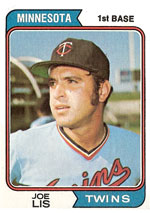
In his fifth big-league game, Phillies left fielder Joe Lis belted a home run against the Cardinals’ Steve Carlton.

Afterward, manager Frank Lucchesi called Lis to his office and handed him the home run ball. “This is the first of many for you, Joe,” Lucchesi said.

The prediction didn’t turn out to be quite accurate. Lis hit 32 homers in eight years (1970-77) in the majors.

But, with the way he hit against the Cardinals after his call-up to the Phillies from Class AAA in September 1970, Lucchesi wasn’t alone in forseeing big days ahead for Lis.

After his home run against Carlton on Sept. 8, 1970, at Connie Mack Stadium in Philadelphia, Boxscore Lis followed that with another big game against the Cardinals at St. Louis.

Playing left field and batting fifth, Lis went 3-for-5 with two doubles and three RBI in the Phillies’ 10-6 win on Sept. 19. His RBI-double off Frank Bertaina in the second gave Philadelphia a 1-0 lead. In the seventh, Lis smacked a two-run double off Frank Linzy. Boxscore

Lis hit .313 (5-for-16) with four RBI in five games against St. Louis that month.

He kept it up the next year, too, going 3-for-5 with a home run and two runs scored in an 8-6 Phillies win at St. Louis on April 23, 1971.

With St. Louis ahead 3-2 in the fourth, Lis doubled and scored on Don Money’s inside-the-park homer. In the eighth, Lis broke a 6-6 tie with a homer off reliever George Brunet. Boxscore

Injuries and a reputation as a below-average fielder kept Lis from becoming an everyday player. He lost the left field job to Greg Luzinski, then was sent to the Twins, where he was given a chance to replace Harmon Killebrew at first base. When that didn’t work out, Lis went to the Indians, then the Mariners.

Lis finished his career as a .233 hitter with a .332 on-base percentage. But against the Cardinals, he hit .255 with three homers, 11 walks and a .390 on-base percentage.

Read Full Post »

One reason the Cardinals never reached the postseason during the 1970s is the trouble they had against manager Sparky Anderson’s Reds.

The Cardinals were 42-66 against the Reds in the nine seasons (1970-78) Anderson managed them. Only once in that stretch did St. Louis have a winning record against Cincinnati (7-5 in 1977).

Anderson led the Reds to two World Series titles and four National League pennants after a three-year stint as a manager in the Cardinals’ system.

Here are five of the most memorable games between the Reds and Cardinals when Anderson managed Cincinnati:

_ July 4, 1972: The Cardinals’ Scipio Spinks entered the game with a 2.33 ERA and ranked third in the NL in strikeouts, behind Steve Carlton and Tom Seaver.

On a rainy Independence Day in Cincinnati, Spinks was on first with one out when Luis Melendez doubled. Spinks, ignoring the stop sign from third-base coach Vern Benson, scored but tore ligaments in his right knee when he collided with catcher Johnny Bench. Boxscore

Spinks needed knee surgery and missed the rest of the season.

The Cardinals, 38-33 at the time, went into a tailspin. losing 10 of 13 from July 22 to Aug. 5, and finished 75-81. The Reds won the pennant.

Spinks returned in 1973, went 1-5 with a 4.89 ERA in eight starts, hurt his shoulder, and never pitched in the big leagues again.

_ July 7, 1974: The first game of a doubleheader at Cincinnati featured starting pitchers making their big-league debuts, Bob Forsch for the Cardinals and Tom Carroll for the Reds.

Forsch was good (6.2 innings, four hits, two runs); Carroll was better (seven innings, two hits, one run). The Reds won, 2-1.  Boxscore

Cesar Geronimo’s RBI-double in the second and solo home run in the seventh accounted for the Reds’ runs. Forsch said his pre-game instructions were to make sure not to walk Geronimo. He didn’t.

_ July 17, 1974: Bob Gibson struck out Geronimo to end the second inning and joined Walter Johnson as the only pitchers with 3,000 strikeouts.

Gibson was lifted after seven innings with the score 4-4. George Foster’s two-run double against Orlando Pena in the 12th gave the Reds a 6-4 victory at St. Louis. Boxscore

_ May 9, 1977: With the score 5-5 in the ninth at St. Louis, the Cardinals brought in closer Al Hrabosky. The Reds loaded the bases with no outs on a Ken Griffey single, a walk to Joe Morgan and Dan Driessen’s bunt single. Hrabosky, milking his “Mad Hungarian” act for all it was worth, then struck out George Foster, Johnny Bench and Bob Bailey.

In the 10th, the Reds threatened with two outs. Ray Knight singled and Griffey followed with a double to right. The relay throw to catcher Ted Simmons nailed Knight at the plate.

Simmons led off the bottom of the inning with a home run versus Dale Murray, giving St. Louis a 6-5 win. Boxscore

_ June 16, 1978: Tom Seaver pitched the only no-hitter of his career, beating the Cardinals, 4-0, at Cincinnati.

Seaver walked Keith Hernandez and Ken Reitz in the second. The Cardinals didn’t have another baserunner until pinch-hitter Jerry Mumphrey led off with a walk in the ninth.

Seaver, who pitched five one-hitters in his career (all with the Mets), then retired the side in order. Boxscore

Read Full Post »

(Updated April 6, 2026)

Joe Garagiola of the Cardinals was the first rookie to produce four hits and three RBI in a World Series game.

Garagiola was 4-for-5 with three RBI in the Cardinals’ 12-3 Game 4 win against the Red Sox in the 1946 World Series.

According to the Elias Sports Bureau, before Garagiola, the only other rookie with four hits and at least two RBI in a World Series game was third baseman Freddie Lindstrom of the Giants. Lindstrom was 4-for-5 with two RBI in Game 5 of the 1924 World Series against Walter Johnson of the Senators. Boxscore
Garagiola, best known as a broadcaster and humorist, was a 20-year-old rookie catcher for the Cardinals in 1946. He joined the Cardinals in May after completing service with the Army in the Philippines. He hit .237 in 74 regular-season games for a St. Louis team that won the National League pennant.

In Game 4 of the World Series at Boston, Garagiola had three singles and a double. Boxscore

His RBI-single to center in the third scored Stan Musial. He singled again in the fifth. In the seventh, Garagiola drove a double to left, scoring Enos Slaughter. In the ninth, Slaughter scored again on a Garagiola single to right.

The 1946 World Series, won by the Cardinals in seven games, was Garagiola’s only World Series appearance. He hit .316 (6-for-19) in five games, and did almost all of his damage at Fenway Park. Garagiola hit .417 at Boston in that Series (5-for-12) and .143 (1-for-7) at St. Louis.

In its recap of the 1946 World Series, The Sporting News wrote that St. Louis native Garagiola “was extremely popular with fellow players who frequently were his guests at spaghetti dinners cooked by Mom.”

The report concluded that “Joe is destined to become one of the game’s catching greats, in the opinion of (manager Eddie) Dyer and others.”

Read Full Post »

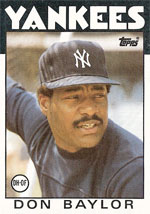
Don Baylor filled a void by becoming the Cardinals’ hitting coach in 1992.

In 1991, the Cardinals went without a hitting coach. The duties were shared by manager Joe Torre and bench coach Red Schoendienst.

After the 1991 season, Torre and Baylor were participating in infielder Jose Oquendo’s golf tournament in Puerto Rico. Baylor had spent the 1990 and 1991 seasons as a coach on Brewers manager Tom Trebelhorn’s staff. When the Brewers fired Trebelhorn, Baylor applied to become manager and appeared to be a leading candidate, but the job went to Phil Garner.
Torre quietly approached Baylor at Oquendo’s golf tournament and invited him to become the Cardinals’ hitting coach. Baylor hit 338 home runs and had 1,276 RBI in a 19-year American League playing career (1970-88).

According to a report by Rick Hummel in The Sporting News, Baylor had interviewed for the Cardinals managerial job in 1990 before it went to Torre. Baylor was impressed Torre wouldn’t feel his job security was threatened by having him on the staff.

Baylor’s impact was substantial. Outfielders Ray Lankford and Bernard Gilkey, in particular, blossomed under Baylor’s instruction. Lankford, who hit .251 with nine home runs and 69 RBI in 1991, improved to .293, 20 homers and 86 RBI under Baylor in 1992. He led the Cardinals in 13 offensive categories that season. Gilkey’s batting average jumped from .216 in 1991 to .302 in 1992.

The 1992 Cardinals led the National League in batting average (.262) and hits (1,464) and ranked third in on-base percentage (.323).

After the season, the expansion Rockies hired Baylor to be their first manager. “We will miss his leadership and expertise,” Cardinals general manager Dal Maxvill said. “His importance to the Cardinals was demonstrated by the development of our young hitters last season, especially Lankford.”

The Cardinals replaced Baylor with Chris Chambliss.

Read Full Post »

(Updated Jan. 9, 2019)

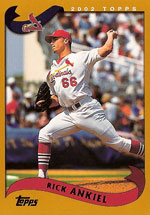
In October 2010, Rick Ankiel joined Babe Ruth and Smoky Joe Wood as the only big-league players since 1900 to appear in postseason games as starting pitchers and as starters at another position.

Ankiel started in center field for the Braves on Oct. 7, 2010, in Game 1 of the National League Division Series at San Francisco.

It was the first time Ankiel had started a postseason game at a position other than pitcher. Ankiel appeared in two games as a pinch-hitter for the Cardinals in the 2009 NL Division Series against the Dodgers, but didn’t start a game.
Ankiel’s first postseason starts were as a pitcher for the Cardinals in the 2000 NL Division Series against the Braves and in the 2000 NL Championship Series against the Mets.

Those performances were the start of Ankiel’s stunning slide from pitching phenom to flop.

After posting an 11-7 record and striking out 194 in 175 innings during the regular season, Ankiel got the start in Game 1 of the 2000 Division Series at St. Louis. The Cardinals struck for six runs in the first and kept a 6-0 lead heading to the third before Ankiel unraveled.

The rookie left-hander gave up four runs, four walks and five wild pitches in the inning before being lifted with two outs. Boxscore

St. Louis held on for a 7-5 win and eventually swept the series, advancing to face New York for the pennant.

In Game 2 of the NL Championship Series at St. Louis, Ankiel got the start, lasted two-thirds of an inning and yielded two runs, three walks, a hit and two wild pitches. The Mets won, 6-5, and went on to clinch the series in five games. Boxscore

Though Ankiel made a relief appearance in Game 5 of the series, his career as a pitcher was in tatters. He pitched in 11 more big-league games before successfully converting into a power-hitting outfielder.

The Society for American Baseball Research confirmed Ruth and Wood, like Ankiel, made postseason starts as pitchers and as outfielders.

Ruth started Game 2 of the 1916 World Series for the Red Sox against Brooklyn. He pitched 14 innings and earned the win, outdueling Sherry Smith in Boston’s 2-1 victory. Boxscore

Ruth also was the starting pitcher for Boston in two games of the 1918 World Series against the Cubs before he went on to star as baseball’s iconic slugging outfielder in seven World Series for the Yankees.

Wood started three games as a pitcher for the Red Sox against the Giants in the 1912 World Series. Eight years later, his pitching career cut short by a severe shoulder injury, he was the starting right fielder for the Indians in Game 1 of the 1920 World Series against Brooklyn. Boxscore

Ninety years later, Ankiel equaled the feat.

When Ankiel hit a home run for the Braves in Game 2 of the 2010 NL Division Series against the Giants Boxscore, he and Ruth became the only big-league players to both start a postseason game as a pitcher and hit a home run in the postseason as a position player.

Ankiel hit his postseason home run in the 11th inning on a fastball from Ramon Ramirez, snapping a 4-4 tie and carrying the Braves to a victory.

In his 2017 book “The Phenom,” Ankiel said, “The contact was so pure I could barely feel the ball off the bat … I don’t recall being happier on a baseball field than I was that October night in San Francisco.”

Read Full Post »

« Newer Posts - Older Posts »