Feeds:
Posts
Comments

Archive for the ‘Hitters’ Category

(Updated Dec. 12, 2020)

At baseball’s winter meetings in December 1980, Whitey Herzog stole the show with a breathtaking series of daring deals that remade the Cardinals into the manager’s kind of team.
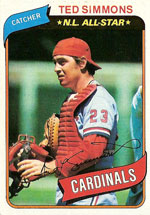
Herzog, who doubled as the Cardinals’ general manager, traded 13 players and received nine in return in deals with the Padres, Cubs and Brewers. The biggest stunner was the last one on Dec. 12, 1980: popular catcher Ted Simmons, the soul of the team, was traded with pitchers Rollie Fingers and Pete Vuckovich to the Brewers for pitchers Lary Sorensen and Dave LaPoint and outfielders Sixto Lezcano and David Green.

Herzog also landed free-agent catcher Darrell Porter during the meetings.

“I’ve done my job as general manager,” Herzog told the St. Louis Post-Dispatch. “Now if the manager doesn’t screw it up…”

The acquisitions turned out well for the Cardinals. Porter, LaPoint, Green, closer Bruce Sutter and catcher Gene Tenace helped the Cardinals win the World Series championship in 1982, but the trade of Simmons was unpopular.

In his book, “White Rat: A Life in Baseball,” Herzog said, “I liked Teddy. He is bright and intelligent and he played hard for me in 1980. If the National League had the designated hitter rule, he would have died a Cardinal.”

The deal was put in motion after Herzog signed Porter, whom he managed in Kansas City, to a five-year, $3.25 million Cardinals contract. Herzog planned to move Simmons to first base and Keith Hernandez from first base to left field for the 1981 season.

Herzog said, “Teddy couldn’t catch, at least not on my club … He gave up a lot of passed balls and he couldn’t throw worth a damn.”

As a Cardinal, Simmons hit .298, drove in more than 90 runs six times and had an on-base percentage of .366. He produced 1,704 hits in 1,564 games.

In his book, “You’re Missin’ a Great Game,” Herzog said, “Ted hit the ball like a son of a gun, was a fine person who played hard and cared about winning, but he had one major weakness as a ballplayer: poor arm strength.”

Vuckovich, among others, was miffed about the Cardinals’ plan to have Simmons shift positions. “They say he (Simmons) can’t catch,” Vuckovich said. “That makes me laugh.”

Simmons initially said playing first base was “just fine” with him, but he reconsidered and asked to be traded. “You’re taking a Gold Glove (Hernandez) and putting him at a position other than where he might win it,” Simmons said.

Herzog said Simmons “really pissed me off” by changing his mind about playing first base, but he regrouped and looked for a trade partner.

Herzog said he approached Brewers general manager Harry Dalton and asked, “How’d you like to win the pennant next year?”

The Brewers were eager to make a deal for Simmons, but he had a no-trade clause in his contract and wanted to be compensated for relinquishing it. Herzog said Simmons asked for $750,000. The Brewers wanted the Cardinals to split the cost. When the Cardinals refused, the Brewers threatened to walk away from the deal, but after Herzog indicated he would trade Simmons to another American League team, the Brewers made the swap.

In a November 2019 interview with broadcaster Dan McLaughlin, Simmons said he and Herzog had several discussions about the trade before it was made and Herzog explained to him the objectives. When Simmons learned Fingers and Vuckovich would go to the Brewers with him, he said he knew it would make them a championship contender.

“I was then in a position to say OK,” Simmons said.

Regarding his opinion of Herzog, Simmons said, “Whitey was a great, great manager. People ask me, ‘Who was the best manager you ever had?’ I was only with him the one year (1980), but clearly he was the best strategist. No one could out-design him. He literally took a ballclub and said, ‘OK, we are going to speed and defense you to death’ and he did.”

Herzog told the Post-Dispatch the trade “might be the best thing for Simmons.”

“Teddy had gotten down on the whole situation here, never winning, and he took responsibility on himself for the whole organization,” Herzog said. “He’s an analyzer, and he let a lot of things worry him that he had no control over.”

Year later, in an interview with “Memories and Dreams” magazine, Hall of Famer Paul Molitor, a Brewers teammate of Simmons, said, “You realized when you talked with Teddy just how smart he was. He had a unique way of thinking. A lot of it was above most of us, to be honest. He influenced the game in a lot of ways.”

Read Full Post »

(Updated Nov. 1, 2023)

The Cardinals shopped third baseman Mike Shannon in trade talks with the Phillies, Angels and Mets after the 1969 season.

When outfielder Curt Flood balked at joining the Phillies after being dealt with catcher Tim McCarver, reliever Joe Hoerner and outfielder Byron Browne in October 1969, the Cardinals almost sent Shannon as a replacement.

According to columnist Dick Young in the March 14, 1970, edition of The Sporting News, “The Phils and Cards had a settlement deal all cooked up when Curt Flood first expressed his disaffection for playing in Philly. Bob Carpenter (Phillies owner) was prepared to settle for somebody like Mike Shannon, just to end the succession of headaches. Then Curt Flood filed his (antitrust) lawsuit, and the whole thing blew up.”

In December 1969, published reports surfaced that the Mets were talking about a deal for Shannon to replace third baseman Ed Charles, who was released. The Mets instead acquired third baseman Joe Foy from the Royals for outfielder Amos Otis and pitcher Bob Johnson.

In October 1969, Dick Young revealed in his syndicated column for the New York Daily News that Cardinals general manager Bing Devine “tried to send Mike Shannon and (shortstop) Dal Maxvill to the Angels for (shortstop) Jim Fregosi.”

According to Young, Angels general manager Dick Walsh told the Cardinals, “Not enough. We want a genuine homer hitter for Fregosi. I don’t consider Shannon a home run hitter.”

In the Dec. 27, 1969, edition of The Sporting News, it was reported that Angels third baseman Aurelio Rodriguez, “the young man with the flashy glove but the sporadic bat, would be exchanged for an older strongman, someone like Ken McMullen (of the Senators) or Mike Shannon.”

In March 1970 a medical exam revealed Shannon was suffering from a kidney disease and would miss at least the first part of the season.

With that, McMullen became the Angels’ target. On April 27, 1970, the Angels traded Rodriguez and outfielder Rick Reichardt to the Senators for McMullen.

Shannon returned to the lineup on May 14 and played in 55 games for the 1970 Cardinals. After the season, he retired and the Cardinals gave him the job in the front office.

Read Full Post »

In spring training 2010, ESPN reported the possibility of an Albert Pujols-for-Ryan Howard trade. It wasn’t the first time a spectacular trade report was linked to a Cardinals franchise player.

In August 1959, The Sporting News pubished a trademarked Page 1 story by publisher J.G. Taylor Spink reporting the Cardinals would trade Stan Musial to the Yankees for catcher and St. Louis native Yogi Berra.

Given the reputation of The Sporting News as “the Bible of baseball” and of Spink, who is in the writers’ wing of the Baseball Hall of Fame, the report had credibility.

Under the headline “Musial to Yanks — Berra a Redbird,” Spink wrote in the Aug. 26, 1959, edition that “Musial will go from the Cardinals for Yogi Berra … Both clubs may deny that the deal is in process or that there is any thought of it. But The Sporting News’ authority states convincingly that the trade already is in the works.”

A Cardinals spokesman confirmed Eddie Stanky, player development director and special assistant to general manager Bing Devine, was in New York, scouting the Yankees, in August 1959.

The trade never happened, but it makes one wonder about the possibilities. The Yankees would have had an all-star outfield of Musial in left, Mickey Mantle in center and Roger Maris in right. Musial played four more seasons (1960-63) for the Cardinals. The Yankees won pennants in all four of those seasons, primarily with Hector Lopez in left field.

Devine said The Sporting News story was “ridiculous” and Musial laughed about it, the St. Louis Post-Dispatch reported.

The Sporting News said Musial, 38, didn’t fit into the 1960 plans of Cardinals manager Solly Hemus, but Hemus told the Associated Press, “Stan definitely fits into our plans and I feel sure he will do us some good.”

In a brief followup on Page 8 of the Sept. 2, 1959, edition, The Sporting News said Cardinals owner Gussie Busch issued a “special statement” declaring Musial never would be traded.

“When Stan retires from baseball, it will be in a Cardinal uniform,” Busch said. “… Stan Musial is and always will be a Cardinal.”

Read Full Post »

(Updated Jan. 6, 2025)

Johnny Mize played six seasons for the Cardinals (1936-41) and never for a championship team in St. Louis, but he left a legacy as a slugger supreme.

Mize was the first to hit three home runs in a game four times as a Cardinal.

Mize achieved the feat in two seasons: doing it twice in 1938 and twice in 1940.
Here’s a look at how he did it:

_ July 13, 1938: Entering the game with just five home runs for the season and only one since June 5, Mize hit three consecutive homers against Jim Turner of the Braves, but Boston won, 10-5, at St. Louis. Mize hit a two-run shot in the fourth, a solo homer in the fifth and a two-run homer in the eighth. Boxscore

_ July 20, 1938: In Game 2 of a doubleheader at St. Louis, Mize hit two home runs off starter Slick Castleman (in the first and third innings) and another off Bill Lohrman (in the eighth) in a 7-1 Cardinals victory before a home crowd that included Missouri governor Lloyd Stark and St. Louis mayor Bernard Dickmann.

“Mize sent the crowd into ecstacies of joy by hitting three home runs in one game for the second time in eight days,” the St. Louis Globe-Democrat reported. Boxscore

_ May 13, 1940: Played on a Monday afternoon at Crosley Field in Cincinnati, this was one of the most unusual games in Cardinals history. Boxscore

The game was called because of darkness with the score 8-8 after 14 innings. All statistics counted, but the tie didn’t count in the standings and the game was replayed as part of an Aug. 11 doubleheader.

Although there were lights at Crosley Field, a National League rule prohibited lights from being turned on to finish a day game.

Mize hit homers off Reds ace Johnny Vander Meer in the second and third innings. His 13th-inning homer off Milt Shoffner gave the Cardinals an 8-7 lead. Cincinnati scored in the bottom of the 13th.

“Mize is a grand hitter in anybody’s ballpark,” the Dayton Herald declared, “but he has a great fondness for staging field days at the Crosley lot.” (Mize hit 22 career homers at Crosley Field.)

_ Sept. 8, 1940: In Game 1 of a doubleheader at St. Louis, Mize slugged home runs in three consecutive at-bats, but the Pirates won, 16-14.

According to the St. Louis Star-Times, “Those three straight mighty Mize blasts onto the pavilion roof afforded the crowd a good excuse for straw-hat throwing and loud vocal demonstration.” Boxscore

Mize had two other three-homer games: for the Giants in 1947 and for the Yankees in 1950.

Read Full Post »

« Newer Posts