Feeds:
Posts
Comments

Archive for the ‘Hitters’ Category

Not even a dugout full of four-leaf clovers would have been enough to help Patsy Donovan turn the 1903 Cardinals into winners.

What Donovan needed more than the luck of the Irish was a dugout full of run producers and premium pitchers.

As player-manager of the 1903 Cardinals, Donovan (pictured here) did all he could. He was a crafty hitter and a smart manager _ and he also had a rookie pitcher who would become a Hall of Famer _ but that was not enough to compete in the National League.

The 1903 Cardinals finished in last place in the eight-team league at 43-94. Their .314 winning percentage is the lowest in Cardinals franchise history, and the 43 wins are the fewest by a Cardinals club in a season not shortened by labor strife or pandemic.

Popular lad

Born in County Cork, Ireland, Patsy Donovan immigrated to the United States with his family when he was a boy and settled in Massachusetts.

An outfielder and left-handed batter, Donovan reached the big leagues in 1890 and replaced Connie Mack as player-manager of the Pirates in 1896. “As a field general, Patsy ranks with the best in the business,” The Pittsburgh Press noted.

After the 1899 season, the Pirates had an ownership change and Donovan’s contract was sold to the Cardinals. Playing right field for them in 1900, Donovan hit .316 with 45 stolen bases, but the team finished 65-75.

Donovan became Cardinals player-manager in 1901 and led them to a 76-64 record. He hit .303 with 73 RBI and 28 steals. The St. Louis Post-Dispatch declared that “Donovan comes very near to being the best-versed man in the inside workings of the game.”

Many eyes, Irish or otherwise, were smiling on Donovan, whose “classic features (unlike those of some roughhouse ballplayers) don’t look as if they had been chiseled out with a crowbar,” the Post-Dispatch observed.

As the newspaper noted, “The ladies turned out in full force to see the old favorite of the fair fans, Patsy Donovan.”

Shuffling the Cards

Any hopes the Cardinals had of continuing a rise in the National League standings in 1902 were dashed when the fledgling American League made a raid on their roster. Five of their eight starting position players (first baseman Dan McGann, second baseman Dick Padden, shortstop Bobby Wallace, left fielder Jesse Burkett and center fielder Emmet Heidrick) and three top starting pitchers (Jack Harper, Jack Powell and Willie Sudhoff) were enticed to jump to the American League. Most went to the St. Louis Browns.

Donovan hit .315 with 34 steals in 1902, but with so much of his supporting cast departed, the Cardinals fell to 56-78.

Discouraged, Donovan resigned and planned to quit baseball. “He had no money (from the Cardinals) with which to build up a team,” the Post-Dispatch reported in November 1902. “With the prospect of going through another season like the one closed, Donovan concluded he wanted to change.”

Cardinals owners Frank and Stanley Robison convinced Donovan to change his mind and come back for the 1903 season. To help appease him, they acquired a third baseman, Jimmy Burke, from the Pirates and purchased the contract of a minor-league pitcher, Mordecai Brown.

Helping hands

A son of Irish immigrant parents, Jimmy Burke was born and raised in Old North St. Louis. Playing for the Shamrocks, an amateur sandlot team, Burke developed a reputation as a scrappy competitor. As The Sporting News noted, “He made up in hustle and fight what he may have lacked in exceptional ability.”

Mordecai Brown hailed from Nyesville, Ind., 30 miles northeast of Terre Haute. He was a youth when he mangled his right hand in a corn chopper accident, the Chicago Tribune reported. Soon after, he fell while chasing an animal on the family farm and did more damage to the hand.

As a teen, Brown worked in a coal mine and played baseball. Because of the unusual way he was forced to grip the ball in his deformed hand, Brown’s pitches had an unorthodox spin that often baffled batters, the Chicago Tribune noted.

Brown was 24 when he entered professional baseball with a minor-league team in Terre Haute in 1901. After posting 27 wins for Omaha in 1902, he was signed by the Cardinals, and by then he had a nickname _ Mordecai “Three Finger” Brown.

On the skids

Donovan began to feel optimistic about his 1903 team. In February, he told The Pittsburgh Press, “The Cardinals will be much stronger than they were last year.”

The good vibes continued when the Cardinals won their season opener, beating the Cubs, 2-1, on a five-hitter by Clarence Currie. Boxscore

“Three Finger” Brown made his big-league debut against the Cubs and pitched a one-hit shutout for the win in a game shortened to five innings because of rain. Boxscore

Before Brown’s next start, against Pittsburgh, “Patsy Donovan warned the Pirates that they would be surprised when they saw his find in the person of a pitcher with only three (usable) digits on his throwing hand,” The Pittsburgh Press reported. “The (Pirates) laughed, but their laughs turned to weeping when the battle was on.”

Brown gave up five runs in the fourth inning, held the Pirates scoreless for the other eight innings, and got the win. Boxscore

The good times faded fast. After a 6-7 record in April, the Cardinals were 4-23 in May. They collapsed over the last two months, losing 38 of 48 games. Their 43-94 mark for the season put them 46.5 games behind the National League champion Pirates (91-49).

The Cardinals gave up the most runs (787) in the league and scored the fewest (505). Their top home run slugger, Homer Smoot, hit four.

Patsy Donovan, 38, was the club’s leading hitter (.327) and also had 25 stolen bases. Jimmy Burke hit .285 with 28 steals.

“Three Finger” Brown led the pitching staff in ERA (2.60) and strikeouts (83), and tied Chappie McFarland for the team high in wins (nine).

On the move

After the season, the Cardinals made matters worse, trading “Three Finger” Brown and catcher Jack O’Neill to the Cubs for pitcher Jack Taylor and catcher Larry McLean. Patsy Donovan left to manage the Washington Senators.

Brown went on to help the Cubs win four National League pennants and two World Series titles. He was elected to the Baseball Hall of Fame.

Donovan finished with 2,256 hits and a .301 batting average. He managed the Senators, Dodgers and Red Sox after leaving the Cardinals.

In 1914, when he was a Red Sox scout, Donovan was sent to Baltimore to check out a pitching prospect, Dave Danforth. The player who got his attention was Babe Ruth. Donovan told the Red Sox to sign Ruth immediately and, acting on his recommendation, they did, The Sporting News reported.

According to the Associated Press, Donovan’s acquaintance with one of the Xavierian brothers who coached Ruth at a Baltimore orphanage helped get The Babe to sign with the Red Sox.

Described by The Sporting News as “a great developer of young players,” Donovan was hired to manage the minor-league Buffalo Bisons in 1915. He encouraged one of their infielders, Joe McCarthy, “to study the strategy of the game,” The Sporting News reported.

McCarthy followed Donovan’s advice and embarked on a managing career with the Cubs, Yankees and Red Sox that led to his election to the Baseball Hall of Fame.

Read Full Post »

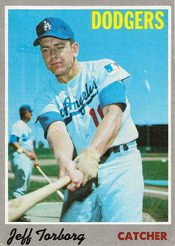
Hobie Landrith was an undersized catcher with big desire.

At 5-foot-8, according to the Associated Press and his Topps baseball card, Landrith stood “about as tall as the bat boy,” the Baltimore Sun noted, but he played in the majors for 14 seasons, including two with the Cardinals.

A left-handed batter, he had many good games at St. Louis, both for and against the Cardinals. Landrith had more career hits (78) in St. Louis than he did in any other big-league city.

Though best known for being the first player the Mets took in the National League expansion draft, Landrith didn’t last a full season with them.

Catching up

Hobart Landrith was born in Decatur, Ill., and moved with his family to metropolitan Detroit when he was 7. At 15, he served as a bating practice catcher for the Tigers.

In 1948, according to the Detroit Free Press, Landrith was one of two top high school catchers in Detroit. The other was Harry Chiti. Both became big-leaguers. (Landrith and Chiti were teammates on the 1956 Cubs and 1962 Mets).

After attending Michigan State for a year, Landrith signed with the Reds in 1949. Sent to their Tulsa farm club in 1950, Landrith broke a leg sliding into home plate in the season opener at the Cotton Bowl in Dallas, the Tulsa World reported.

When he recovered, the Reds, needing a bullpen catcher, brought Landrith, 20, to Cincinnati. He impressed manager Luke Sewell, who put him on the roster. Landrith started four games for the Reds that summer.

After spending most of 1951 and 1952 in the minors, Landrith stuck with the Reds through 1955 as backup to Andy Seminick and then Smoky Burgess.

Flair for dramatic

For a player who hit .198 in 1954, Landrith had his share of standout performances. In May, his three-run home run against the Cardinals’ Gerry Staley sparked the Reds to victory. Boxscore Two months later, Landrith hit a walkoff home run in a 1-0 triumph over the Giants. Boxscore

Reds broadcaster and former pitcher Waite Hoyt referred to Landrith “with unabashed affection as Little Hobie because he’s been the sort of guy it’s always easy to root for,” the Dayton Journal Herald reported.

On Sept. 1, 1954, Landrith impressed with his glove _ and his courage _ when he took part in a promotional stunt and caught a baseball dropped 575 feet from a helicopter at Crosley Field. “It knocked me to the ground, ” Landrith told the Cincinnati Enquirer, “but I held on.”

Landrith received $500 for catching the ball.

(The record was set in 1938 when Indians catchers Hank Helf and Frank Pytlak each caught a ball dropped from atop the 708-foot Terminal Tower in Cleveland, the Associated Press reported.)

Second string in St. Louis

In November 1955, Landrith was traded to the Cubs and he made 90 starts for them in 1956. After the season, the Cubs dealt Landrith, pitchers Sam Jones and Jim Davis, and utilityman Eddie Miksis to the Cardinals for pitchers Tom Poholsky and Jackie Collum, catcher Ray Katt, and an infield prospect, Wally Lammers.

Cardinals general manager Frank Lane then tried to flip Landrith to the Reds for Smoky Burgess, but was turned down, the Associated Press reported.

Used primarily as a backup to Hal Smith, Landrith made 56 starts for the 1957 Cardinals. He hit .243 and nailed 14 of 30 runners attempting to steal.

Seeking a catcher with more pop, Bing Devine, Lane’s successor as Cardinals general manager, tried to swap Landrith to the Reds for Burgess after the 1957 season, but he was turned down, too, according to the Associated Press.

Landrith was the Cardinals’ Opening Day catcher in 1958, but most of the playing time that season went to Hal Smith (61 starts) and Gene Green (48). Landrith, who started 34 games, batted .215.

A highlight came on July 13, 1958, when Landrith had four hits and two RBI against the Pirates at St. Louis. (A lifetime .233 hitter in the majors, Landrith batted .313 versus the Pirates in his career.) Boxscore

A month later, Landrith walloped a game-winning home run in the eighth inning against the Phillies’ Turk Farrell at St. Louis. Boxscore

On Oct. 7, 1958, Landrith, pitcher Billy Muffett and third baseman Benny Valenzuela were traded to the Giants for pitchers Ernie Broglio and Marv Grissom.

Tall among Giants

Landrith twice had four-hit games for the Giants at St. Louis. The first was July 4, 1959. Boxscore The other came on Aug. 16, 1960, when Landrith had three doubles and a single against Bob Gibson and caught the four-hitter of rookie Juan Marichal, who was facing the Cardinals for the first time. Boxscore (Landrith also was the catcher when Marichal pitched a one-hit shutout versus the Phillies in his Giants debut. Boxscore)

“Hobie has helped me a lot, especially on gripping the ball so the batters can’t see if it’s going to be a fastball or a curve,” Marchial told the St. Louis Post-Dispatch.

On Aug. 17, 1961, a spectacular catch by Cardinals center fielder Curt Flood robbed Landrith of an extra-base hit at Candlestick Park in San Francisco.

With the Cardinals ahead, 2-0, in the eighth, the Giants had a runner on second when Landrith batted against Larry Jackson. “At least three Cardinals (in the dugout) grabbed towels and signaled Flood to shade farther to the right,” the San Francisco Examiner reported. “He took five steps and needed every one.”

Landrith drove a pitch to right-center. “I hit that ball as hard as I’ve ever hit any,” he said to the Post-Dispatch.

Flood told the newspaper, “I thought for sure the ball was going out.”

“Flood took off with his back to the infield all the way,” the Post-Dispatch reported. “About one step from the fence he timed his high leap perfectly and speared the ball.” Boxscore

An original

After being drafted by the expansion Mets, Landrith went to spring training with them in 1962. Crouched behind the plate in a game, he was struck on top of the head by the backlash of a batter’s big swing. After a few days on the sideline, Landrith returned and was knocked on the noggin by another batter’s backlash. “I’m three inches shorter than when I reported to camp,” he told Dick Young of the New York Daily News.

In the Mets’ first regular-season game, against the Cardinals, Landrith started, went hitless and made an errant throw to second on Julian Javier’s stolen base. Boxscore

Landrith’s Mets highlight came on May 12, 1962, when he hit a two-run walkoff home run at the Polo Grounds against the Braves’ Warren Spahn. The high fly down the line in right “just did make the railing of the upper deck as it fell almost straight down,” the New York Daily News reported. Boxscore

A month later, Landrith was traded to the Orioles as the player to be named in a deal for first baseman Marv Throneberry

In his second week with the Orioles, Landrith slugged a two-run walkoff home run against Dick Radatz of the Red Sox at Baltimore, earning a win for starter Robin Roberts. Landrith, Radatz and Roberts all attended Michigan State.

“Roberts leaped out of the Orioles dugout, jumped up and down, and gave Landrith a big bear hug as Hobie battled his way through congratulating teammates.” the Baltimore Sun reported. Boxscore

Read Full Post »

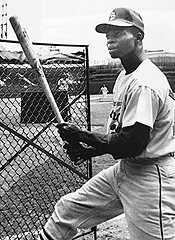
Bob Uecker’s speed, whatever there was of it, was no match for the arm of Jesus Alou.

A perfect throw by Alou in a game against the Cardinals nailed Uecker at the plate, aiding a win for the Giants that moved them into sole possession of first place in the 1964 National League pennant race.

Alou, youngest of three brothers to play in the majors, was an outfielder and contact hitter who excelled against premier pitchers. St. Louis University students formed a fan club in his honor.

Oh, brother

Jesus Alou was a right-handed pitcher when he joined the Giants’ Class D farm team at Hastings, Neb., in 1959. Alou, 17, “developed a sore arm and was sure he was about to be released,” the Fort Lauderdale Sun-Sentinel reported. Instead, he became an outfielder, the same position played by his brothers Felipe and Matty.

“I always thought that maybe they just kept me because Felipe and Matty were moving up and they didn’t want them to feel bad,” Alou told the newspaper.

All three Alou brothers were born and raised in the Dominican Republic. In his autobiography, “Alou: My Baseball Journey,” Felipe said, “Our home was the size of an average bedroom in the United States _ 15 by 15 feet _ some of it with an uneven cement floor, and the rest, particularly our kitchen floor, was dirt.”

Felipe recalled Jesus would take meat “right out of the pot when it was still cooking over an open fire. He loved meat and always seemed to have a ravenous appetite … Jesus was the one who grew the tallest and filled out the most.”

Felipe entered the Giants’ system in 1956 and Matty joined him a year later. Felipe reached the majors with the Giants in 1958 and Matty got there in 1960.

Jesus Alou hit .324 or better in four consecutive seasons in the minors before he was brought up to the Giants in September 1963.

In Jesus Alou’s debut against the Mets, he, Matty and Felipe batted consecutively in the eighth inning (Jesus and Matty as pinch-hitters) and became the first trio of brothers to appear in the same big-league game. Boxscore

Five days later, Felipe (in center), Matty (in left) and Jesus (in right) were the Giants outfielders for two innings in a game against the Pirates. Boxscore

In his book, Felipe said, “People have asked me what I felt. Pride, to some degree, but mostly what I felt was an overwhelming sense of responsibility to look out for my younger brothers. I was more concerned for them than anything.”

After seeing Jesus Alou play, Giants manager Al Dark told the San Francisco Examiner, “He’ll be something special one of these days, perhaps next year.”

The three Alou brothers appeared in a game together eight times, but never started a game together.

After the season, Felipe was traded to the Braves and Dark said Jesus would get first crack at Felipe’s right field job. “In Dark’s expert opinion, (Jesus) is destined to become a better all-around ballplayer than Felipe, a development which would qualify him to rub shoulders with the best in the business,” the Examiner noted.

Forgive me, Father

A son of a carpenter _ naturally _ Alou was the first player in the majors to be named Jesus. Some of the less enlightened had a devil of a time accepting this.

“In the Dominican Republic, as well as elsewhere in Latin America, the name Jesus is a common one, but in this country … the name is sacred to the Savior and a jarring note is struck when the name is not so honored,” Examiner columnist Prescott Sullivan wrote in March 1964.

“It’s a grand name, a wonderful name, and Jesus Alou wears it proudly,” Sullivan wrote, but “we’ve been thinking that what Jesus Alou needs is a nickname.”

Sullivan suggested Alou should be called “Jay or Jess or even Chi Chi.”

(Sullivan provided playwright Neil Simon with the inspiration for the Oscar Madison character in “The Odd Couple,” according to the Associated Press.)

Sullivan contacted several San Francisco holy men, who told him that, by God, they agreed with the notion that Alou should not be called by his given name.

Monsignor Eugene Gallagher, director of the Catholic Youth Organization, confessed, “A nickname for Alou would eliminate the danger of disrespect for a name sacred to our Savior.” A spokesman for Episcopal Bishop James Pike of Grace Cathedral said, “It would be simpler all around to call him by a name other than the one given to our Lord.” Rabbi Alvin Fine of Temple Emanuel offered, “For baseball purposes, I’d rather call him Butch.”

The advice was taken as gospel. Some broadcasters and reporters referred to the player as Jay Alou instead of Jesus.

Good impressions

On May 28, 1964, Alou was the left fielder for the Giants at St. Louis. In the seventh inning, the Cardinals led, 1-0, and had Bob Uecker on second when Carl Warwick lined a single to left. “With two out, we had to try for the run and send Uecker in,” Cardinals manager Johnny Keane told the St. Louis Post-Dispatch. “We had to hope for a wide throw, or a bounce that got past the catcher.”

Instead, Alou charged the ball, scooped it on one hop and fired a strike on the fly to catcher Del Crandall, who was waiting when Uecker slid into the tag. “That ball passed Uecker like a roadrunner,” coach Vern Benson said to the Post-Dispatch.

In the next inning, Willie Mays hit a Curt Simmons pitch off a girder in right-center for a two-run home run. The Giants won, 2-1, and moved into first place. Boxscore

(Mays “used to play cards with us all the time,” Jesus Alou told the Fort Launderdale Sun-Sentinel. “Every time he won, he gave us our money back.”)

Two months later, Alou had six hits (five singles and a home run) in a game against the Cubs at Wrigley Field. Boxscore

The Giants stayed in contention but finished three games behind the champion Cardinals.

The next year, Alou had 22 hits, including five doubles and two home runs, in 18 games against the 1965 Cardinals.

When the Giants played at St. Louis on June 28, 1966, a fan club of 48 graduate students from St. Louis University came to Busch Memorial Stadium and supported Alou with banners and cheers, the Post-Dispatch reported.

Alou had three hits in the game, scored twice and stole a base, then posed for pictures with the students. He hit .333 versus the Cardinals in 1966. Boxscore

Close call

After the 1968 season, Alou was chosen in the National League expansion draft by the Expos, who flipped him to the Astros for Rusty Staub.

In a June 1969 game against the Pirates, Alou fractured his jaw in a collision with shortstop Hector Torres while chasing a pop fly. On the ground, Alou “looked like he was dead,” Astros player Denis Menke told the Associated Press.

Alou swallowed his tongue and struggled to breathe before Pirates trainer Tony Bartirome “pulled Alou’s tongue up, inserted an inflationary tube in his throat and blew into it to open the passage,” Astros trainer Jim Ewell told the wire service.

Alou recovered and in 1970 he hit .306 for the Astros and .460 (17-for-37) against the Cardinals. In a May 1 game at St. Louis, he had three hits, three RBI and two runs scored. Boxscore

In 1971, the Cardinals acquired Matty Alou from the Pirates. In a game at Houston that year, Matty had two hits for the Cardinals and Jesus had three for the Astros. Boxscore

Bruce Bochy, who went on to manage the Giants to three World Series championships, began his professional playing career in the Astros’ system. In Felipe Alou’s book, Bochy said, “When I was a player, Jesus Alou was a guy who took me under his wing _ something I will never forget. I would sit next to Jesus in the dugout whenever I had the chance, soaking in his sage wisdom.”

In his book “I’m Glad You Didn’t Take It Personally,” Jim Bouton said Astros teammate Jesus Alou “is one of the most delicate, sensitive, nicest men I have ever met. He’d walk a mile out of his way to drop a coin in some beggar’s cup.”

Playing to win

In 1973 and 1974, Jesus Alou got to play in two World Series for the champion Athletics. The manager of the 1974 team was Al Dark. Jesus was joined on the A’s by an Angel, fellow reserve outfielder Angel Mangual.

Jesus Alou played 15 seasons in the majors and had 1,216 hits. He was at his best against some future Hall of Famers, batting .436 (24-for-55) against Steve Carlton, .370 (17-for-46) against Don Sutton, .353 (12-for-34) against Sandy Koufax and .333 (14-for-42) against Tom Seaver.

After his playing days, Jesus Alou was a scout for the Expos, and then director of Dominican Republic operations for the Marlins and later the Red Sox.

Read Full Post »

(Updated July 6, 2024)

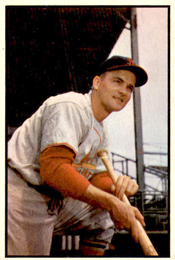
For a guy who hit .154 in the 1964 World Series, Yankees first baseman Joe Pepitone was at the center of several significant plays against the Cardinals.

Pepitone got hit by a Bob Gibson pitch at a key moment in Game 2, lined a ball that struck Gibson in Game 5, and belted a grand slam in Game 6.

The Cardinals prevailed in seven games, but Pepitone wasn’t done with them. After he joined the Cubs in 1970, Pepitone thrived against the Cardinals. A career .258 hitter in the majors, Pepitone batted .331 in 36 regular-season games versus the Cardinals.

Pepitone also played for, and had conflicts with, former Cardinals managers Johnny Keane and Harry Walker.

A power hitter and Gold Glove fielder who had a well-earned reputation as a carouser, Pepitone played for the Yankees, Astros, Cubs and Braves.

Survival skills

In spring 1958, Pepitone, 17, was approached at his Brooklyn high school by an acquaintance who displayed a .38 Colt revolver and simulated a hold-up. The gun discharged and a slug ripped through Pepitone and came out his back. A priest administered last rites before Pepitone was rushed into surgery.

In his book, “Joe, You Coulda Made Us Proud,” Pepitone said, “I was in surgery for nine hours. The bullet had struck a rib and caromed out my lower back, missing three vital organs by inches.”

He spent 12 days in the hospital. Soon after, Pepitone’s father, Willie, 39, died from complications following a heart attack.

In August 1958, the Yankees signed Pepitone for $25,000. He said in his book he splurged on a Thunderbird, a speedboat and several silk suits.

Four years later, in April 1962, Pepitone reached the majors. His first hit, a single, came against a future Hall of Famer, Jim Bunning. After the season, the Yankees traded first baseman Bill Skowron, opening the door for Pepitone to replace him in 1963. On Opening Day, he smacked two home runs. Boxscore

Pepitone, 22, had 27 home runs for the 1963 Yankees and led the club in RBI (89) and total bases (260). He followed that with 28 home runs and 100 RBI for the 1964 Yankees.

The Yankees won their fifth consecutive American League pennant in 1964 and faced the Cardinals in the World Series.

Bad actor

The Cardinals won Game 1 and part of the reason was Pepitone’s inability to deliver on scoring chances. In the fifth and seven innings, he batted with two runners on base and made the final outs both times. Boxscore

In Game 2, with the score tied at 1-1 and Mickey Mantle on first, Bob Gibson threw a pitch inside to Pepitone. “I was going to swing at the ball, but then it started coming in on me and I checked my swing,” Pepitone told the St. Louis Post-Dispatch.

Plate umpire Bill McKinley said the ball struck Pepitone in the right thigh and awarded him first base, with Mantle moving to second. The Cardinals argued the ball hit Pepitone’s bat first. “That play was the turning point of this game,” Cardinals manager Johnny Keane told the Associated Press.

The next batter, Tom Tresh, singled, scoring Mantle and giving the Yankees the lead. They went on to win. Boxscore and Video at 12:22 mark

During batting practice before Game 3 at Yankee Stadium, Pepitone spotted Cardinals first baseman Bill White. Pepitone had a photo he wanted White to sign. “So Pepitone, emerging from the first base dugout, limped pitiably” toward White, the New York Times reported. “The Cardinals whooped and sneered. Pepitone limped harder. The Cardinals couldn’t avoid laughing.”

“If that ball hit you,” Cardinals catcher Tim McCarver yelled out, “you’ve got a wooden leg.”

White autographed the photo and Pepitone headed back to the dugout, but forgot to limp. When the Cardinals called him on it, Pepitone began “limping worse than ever,” the Times noted.

Then, according to the New York Daily News, White hollered, “Hey, you’re limping on the wrong leg,”

“Oops,” said Pepitone, who switched his limp.

On his first trip to the plate in Game 3, Pepitone was decked by Curt Simmons’ first pitch. He also had to spin away from two other Simmons pitches. Throughout the game, “Cardinals bench jockeys gave Pepitone a solid riding every time he came to bat,” The Sporting News reported.

Crucial out

The Cardinals, with Gibson pitching, led, 2-0, in the ninth inning of Game 5. With Mantle on first and one out, Pepitone hit a hard liner that struck Gibson in the right hip. As the ball darted toward the third base line, Gibson “was off the mound in a flash, grabbed the ball and fired off balance” to White at first base, The Sporting News reported. Umpire Al Smith called Pepitone out.

The next batter, Tom Tresh, hit a home run, tying the score. If not for Gibson’s play, Pepitone would have joined Mantle on the bases and Tresh’s homer would have won the game for the Yankees. Instead, the Cardinals prevailed on Tim McCarver’s home run in the 10th. Boxscore and Video

Rare feat

In Game 6 at St. Louis, the Yankees led, 4-1, when Pepitone faced Gordon Richardson with the bases loaded in the eighth. Twice, with the count 2-and-2, Pepitone fouled off balls “that just skipped off McCarver’s glove,” according to the Post-Dispatch. Then he hit a grand slam onto the roof in right. Boxscore and Video at 2:45 mark

Pepitone became the 10th player to hit a World Series grand slam, The Sporting News noted. Ken Boyer did it for the Cardinals in Game 4. The 1964 World Series was the second to have two grand slams. In 1956, Bill Skowron and Yogi Berra did it for the Yankees versus the Dodgers.

Authority issues

After the Cardinals clinched the championship in Game 7, Johnny Keane resigned and became Yankees manager. In his autobiography, Pepitone said, “Keane and I didn’t hit it off from the beginning.”

Pepitone said Keane fined him multiple times and benched him indefinitely for missing batting practice, the Associated Press reported.

“There was a moment in 1965 when I came close to punching Johnny Keane,” Pepitone said in his book.

Pepitone was deep in debt in 1965, he said in his book, and trying to hide from bill collectors. Near the end of the season, he said, Yankees general manager Ralph Houk convinced him to enter a hospital for psychiatric evaluation.

“For me, the 1965 baseball season was one long agonizing scream,” Pepitone said in his book. “I tried to muffle it with endless partying and rebelling against authority. Before the season was over, I was feeling my mind snap, crack, pop at any minute.”

Keane was fired in May 1966. Pepitone led the Yankees that season in home runs (31), RBI (83), runs scored (85) and total bases (271).

Pepitone also got attention for what was considered a bold step in a macho culture _ using a hairdryer in the clubhouse.

After hitting 27 home runs in 1969, Pepitone was traded to the Astros for Curt Blefary. The trade reunited Pepitone with former Yankees teammate Jim Bouton. In his book, “Ball Four,” Bouton wrote about how Pepitone wore two hairpieces, one for ballgames and another for going out on the town. Pepitone opened a men’s hair styling boutique in New York and was looking to franchise the business, the New York Daily News reported.

The Astros’ manager, Harry Walker, had been a Cardinals manager (1955) and coach on Keane’s staff (1961-62). Walker and Pepitone didn’t get along either.

Pepitone hit 14 home runs in 279 at-bats for the 1970 Astros, but in July he was told by Walker he no longer could room alone on road trips. Fed up with what he considered petty rules, Pepitone walked out on the team and asked to be put on the voluntary retirement list. In his book, Pepitone said, “I couldn’t stand Harry Walker and all his rules and regulations.”

Placed on waivers, Pepitone was claimed by the Cubs.

Moving on

Cubs manager Leo Durocher put Pepitone in center field and he did well. He produced 12 home runs and 44 RBI in 213 at-bats for the 1970 Cubs and made one error in 459 innings in center.

The next year, primarily playing first base, Pepitone hit .307 for the 1971 Cubs and .411 against the Cardinals. His success versus the Cardinals extended to 1972, when he hit .438 against them. During that season, Durocher left the Cubs and replaced Harry Walker as Astros manager.

One of Pepitone’s last big games came against the Cardinals on April 15, 1973, when he had five RBI and scored three runs. “Pepitone can play well,” Cubs manager Whitey Lockman told the Post-Dispatch. “It depends whether he wants to.” Boxscore

A month later, Pepitone, 33, was dealt to the Braves. He played in three games for them, the last against the Cardinals, and quit. “I’d had it with major league baseball,” Pepitone said in his book. “I just didn’t have any feeling for the game.”

The next year, he went to Japan, didn’t like it, hurt his ankle and played in 14 games before seeking his release.

In his book “The Mick,” Mickey Mantle said of Pepitone, “If he had just cared about anything, he could have been on top, among the very best. He had all the tools. A natural home run hitter who played center field better than I did and he was a great first baseman. He never took the game seriously.”

Read Full Post »

Getting dealt by a World Series champion put Dave Duncan and George Hendrick on a course toward helping the Cardinals win three World Series titles.

On March 24, 1973, the Athletics traded Duncan and Hendrick to the Indians for Ray Fosse and Jack Heidemann.

Duncan, a catcher, and Hendrick, an outfielder, played in the 1972 World Series for the Athletics, who prevailed in seven games against the Reds. Each wanted to be traded, but for a different reason. Duncan felt unappreciated and feuded with Athletics owner Charlie Finley. Hendrick wanted a chance to play every day.

The trade to Cleveland gave Duncan and Hendrick the opportunities they sought and positioned them for success with World Series champions in St. Louis _ Duncan as a coach for the 2006 and 2011 Cardinals and Hendrick as a player for the 1982 club.

Fed up

Duncan was the Athletics’ Opening Day catcher in 1972, slugging a home run against Bert Blyleven, but Gene Tenace replaced him in the last five weeks of the season. Though Duncan hit for power (19 home runs) and ranked second among American League catchers in fielding percentage (.993) in 1972, he batted .218.

Tenace was the starting catcher in the first six games of the 1972 World Series and hit four home runs, but manager Dick Williams shifted him to first base for Game 7 and put his best catcher, Duncan, behind the plate. Duncan threw out Joe Morgan attempting to steal second, Tenace drove in two runs, and the Athletics won, 3-2. Boxscore

Duncan, who was paid $30,000 in 1972, wanted $50,000 in 1973, $10,000 more than what Finley offered, The Sporting News reported. When Duncan remained unsigned during 1973 spring training, the Athletics looked to trade him, an action Duncan welcomed.

“I didn’t have a very good relationship with Finley,” Duncan said to The Sporting News. “We didn’t share the same philosophy. One of the things I’ve learned from Finley is how I don’t want to live my life. I consider myself a human being with an identity of my own, and I think he tries to strip this away from everyone surrounding him.

“Part of our bad relationship is that he never took the time to listen to me like a human being, and that’s all I ever wanted him to do _ listen to me.”

Unlimited potential

Hendrick made his big-league debut with the Athletics in June 1971 and primarily was a backup to Reggie Jackson. When Jackson was injured during the decisive Game 5 of the 1972 American League Championship Series, Hendrick replaced him and scored the winning run in the pennant-clinching victory versus the Tigers. Boxscore

With Jackson sidelined, Hendrick started in center in each of the first five games of the 1972 World Series. The Athletics won three of those.

“He’s on the threshold of being a star in this game,” Athletics manager Dick Williams told the Associated Press. “He can run, throw and hit with power to all fields. I’m not afraid to put him anywhere in my outfield. Whenever anyone talks trade with us, they mention Hendrick. We won’t even talk about him.”

Let’s make a deal

The Athletics changed their minds about not trading Hendrick when the Indians expressed a willingness to deal catcher Ray Fosse, a two-time Gold Glove Award winner. Though there were some who thought Fosse’s left shoulder never fully recovered from a 1970 All-Star Game collision with Pete Rose, the Athletics liked the idea of having him behind the plate and moving Tenace to first base.

“I’ve long had an eye on Fosse,” Finley told the San Francisco Examiner. “I consider him second only to Johnny Bench as an all-around outstanding catcher.”

To obtain Fosse, the Indians insisted on Hendrick being part of the deal. “They wouldn’t have gone for the trade, not one bit, if we offered Duncan even up,” Finley said to the Examiner. “Putting Hendrick in the pot was what did it.”

Comparing Hendrick to a young Hank Aaron, Indians manager Ken Aspromonte told The Sporting News, “There is nothing, absolutely nothing, George can’t do if he puts his mind to it.”

Hendrick said he wanted to be traded after Finley told him he’d open the 1973 season in the minors, The Sporting News reported. Duncan told the Examiner, “The A’s soured on Hendrick because they believed him to be lazy, but I don’t feel he is. What’s more, he has marvelous all-around talent.”

Five days after the trade, in a spring training game at Mesa, Ariz., in which orange baseballs were used as an experiment, Hendrick hit three home runs versus the Athletics. Two of the homers came against Catfish Hunter. Fosse also hit a home run in the game against his friend, Gaylord Perry.

Opportunity knocks

With Fosse as their catcher, the Athletics won two more World Series championships in 1973 and 1974. The trade helped Duncan and Hendrick, too. Duncan got to be a leader on the field, and Hendrick got to prove he could be a productive player.

“Being traded was the only answer to my problems,” Duncan told The Sporting News. “I had lost my taste for the game, but now I expect it to be fun again.”

Displaying leadership qualities that would make him a successful coach, Duncan earned the respect of his Indians teammates and manager Ken Aspromonte.

“He knows what he’s doing,” Aspromonte told the Sacramento Bee. “So I let him run things for me on the field. He moves the players around on defense and he always lets me know how the pitchers are doing _ whether to lift them or keep them in. I listen to him because I trust his judgment very much. I admire the fact that he tells the truth. He knows this game, and he doesn’t hesitate to tell me what he sees.”

Hendrick told The Sporting News, “We’re especially better because of Duncan.”

Hendrick was a big contributor, too. On April 17, 1973, he lined a pitch from the Brewers’ Billy Champion that carried 455 feet into the center field bleachers at Cleveland Stadium. Indians pitching coach Warren Spahn told The Sporting News, “We retrieved the ball and, so help me, it was flat where George hit it.” Boxscore

Two months later, Hendrick hit home runs in three consecutive at-bats against the Tigers’ Woodie Fryman, then drove in the winning run in the ninth with a single. Boxscore

Unfortunately, both Duncan and Hendrick fractured their right wrists when hit by pitches. Duncan, struck by Don Newhauser of the Red Sox, was sidelined from June 29 through Aug. 17. Hendrick missed the rest of the 1973 season after being struck by the Royals’ Steve Busby on Aug. 14.

Winning touch

Duncan played two seasons with the Indians, then was traded to the Orioles for Boog Powell in February 1975. (Eleven months later, the Indians reacquired Fosse from the Athletics.)

Hendrick spent four seasons with the Indians, topping 20 home runs in three of those, before being dealt to the Padres.

The Cardinals acquired Hendrick in 1978 and four years later he helped them win a World Series title. Hendrick hit .321 in the 1982 World Series against the Brewers and drove in the winning run in Game 7. Boxscore (Gene Tenace also was a member of that Cardinals championship team.)

Duncan became a prominent pitching coach on teams managed by Tony La Russa. With Duncan as their pitching coach, the Athletics won three American League pennants (1988-90) and a World Series title (1989).

In 1996, La Russa’s first season as Cardinals manager, Duncan was pitching coach and Hendrick was hitting coach. The Cardinals won a division title that year for the first time since 1987.

Hendrick joined the Angels’ coaching staff in 1998. He went on to coach for 14 seasons in the majors, primarily with the Rays.

With Duncan as their pitching coach, the Cardinals won three National League pennants (2004, 2006, 2011) and two World Series championships (2006 and 2011). He spent 34 years in the majors as a coach.

Read Full Post »

Born and raised in St. Louis, Dave Nicholson was one of baseball’s all-time best power-hitting prospects, but the Cardinals were unwilling to pay the price it took to sign the hometown slugger.

In January 1958, Nicholson was 18 when he signed with the Orioles for more than $100,000, a shocking sum for an amateur at that time.

A right-handed batter, he was “probably the hottest prospect in the country,” the Cleveland Plain Dealer reported.

Though he went on to hit some mighty home runs in the majors, the records Nicholson set were for striking out. As Frank Hyland of the Atlanta Constitution noted, Nicholson “turned around the can’t-miss label. He could miss, and did almost every opportunity.”

An outfielder, Nicholson played seven seasons in the majors with the Orioles, White Sox, Astros and Braves.

Special talent

At 6-foot-3, 215 pounds, strong and swift, Nicholson attracted pro scouts to St. Louis to see him play in amateur leagues and for Southwest High School. “He has power, physique, the arm and speed,” White Sox farm director Glen Miller told the Chicago Tribune. “His hands are as big as hams.”

The Cardinals scouted Nicholson for two years, The Sporting News reported.

In the summer of 1957. when Nicholson was playing in the amateur Ban Johnson League after his junior season in high school, Orioles scout and former Cardinals catcher Del Wilber tracked him. “Best prospect I’ve ever seen,” Wilber told the St. Louis Globe-Democrat.

The Orioles sent seven scouts at various times to St. Louis to verify Wilber’s glowing reports on Nicholson. All liked what they saw. Paul Richards, who had the dual role of general manager and manager of the Orioles, and his pitching coach Harry Brecheen, the former Cardinal, showed up, too. They put Nicholson through a special workout, with Brecheen pitching to him. Nicholson passed the test, according to the Globe-Democrat. 

By the end of the summer, scouts from every big-league team had come to see the teen who crushed baseballs with the power of a hulk.

Your bid

In the fall of 1957, Nicholson, a senior, dropped out of high school and took a job with a St. Louis printer for $60 a week, the Baltimore Sun reported. According to the Chicago Tribune, Nicholson withdrew from school because of a disagreement with a coach who wanted him to play football. The Sporting News reported he left because of “weakness in the classroom.”

The pro scouts didn’t care. Every big-league team, except the Tigers, made Nicholson an offer, the Associated Press reported. It put the teen and his parents in a strong negotiating position. They let the clubs drive up the bidding in visits to the family’s Arthur Avenue home.

The Cardinals dropped out when the price reached $60,000, the Globe-Democrat reported. The Yankees didn’t stick around long either. Their scout, Lou Maguolo, who signed the likes of Tony Kubek, Norm Siebern and Lee Thomas, told The Sporting News, “Nicholson struck out seven times in 10 trips when I saw him, and I can’t recommend anybody like that.”

When the bidding reached six figures, three teams were left in the running: Cubs, Orioles, White Sox. According to The Sporting News, the Cubs and White Sox made the highest offers, but Nicholson said he chose the Orioles because, “I like Paul Richards, and I honestly think the quickest road to the majors is through the Orioles’ farm system.”

In addition to the bonus of more than $100,000 (published estimates of the amount ranged from $107,000 to $150,000), the deal included two new Pontiacs _ one for Dave and one for his father, Larry, The Sporting News reported. Larry Nicholson also was given a part-time scouting job with the Orioles.

According to the Globe-Democrat, the only other baseball amateurs to get signing bonuses of $100,000 or more were Paul Pettit (Pirates, 1950), St. Louisan Frank Baumann (Red Sox, 1952) and Hawk Taylor (Braves, 1957). Nicholson “is worth every penny,” White Sox scout Pat Monahan told the Globe-Democrat.

Learning curve

A month after signing, Nicholson was at the Orioles’ spring training camp in Scottsdale, Ariz. Watching him in batting practice, Richards told The Sporting News, “He has as much bat speed as I have seen in a youngster.”

The quick bat didn’t result too often in contact, especially against breaking pitches. Nicholson struck out in seven of his first eight at-bats in spring training games, The Sporting News reported. His only hit in 11 at-bats in exhibition games was a home run against the Giants’ Curt Barclay.

“The kid’s stance is too wide,” Cubs hitting coach Rogers Hornsby told The Sporting News. “He has to do it all with his arms, and the breaking stuff will give him a fit.”

Richards planned to have Nicholson start his pro career at the Class D level of the minors, but changed his mind and sent him to Class A Knoxville. After 25 games, he was dropped to Class B Wilson, N.C. He struggled there, too, and was demoted to Class D Dublin, Ga. 

The Dublin club was managed by a St. Louisan who spent six years playing in the Cardinals’ farm system, Earl Weaver. His task was to restore Nicholson’s sagging confidence. “He has the tools to make the majors,” Weaver told The Sporting News. “He just has to get the experience to catch up with the other boys.”

Nicholson’s combined numbers for the 1958 season were 98 hits (15 for home runs) and 158 strikeouts.

The Orioles assigned Nicholson, 19, to Class AA Amarillo in 1959, and again it was a mistake. Overmatched, he was dispatched to the Class C Aberdeen (S.D.) Pheasants and put under the care of their manager, Earl Weaver.

Weaver got Nicholson to relax and play loose. Nicholson responded, producing 35 home runs and 119 RBI for Aberdeen. When injuries depleted the Pheasants’ pitching staff, Weaver had Nicholson take some turns on the mound. In nine pitching appearances, including two starts, Nicholson was 3-1 with a 2.91 ERA. He struck out 43 batters in 34 innings.

Swishing sound

Nicholson, 20, began the 1960 season with Class AAA Miami, then was called up to the Orioles in May. He batted .186 and struck out 48 percent of the time (55 whiffs in 113 at-bats) in his first big-league season.

After another year in the minors in 1961, Nicholson was with the Orioles in 1962. He batted .173 and struck out 44 percent of the time (76 whiffs in 173 at-bats).

The Orioles dealt Nicholson, Ron Hansen, Pete Ward and Hoyt Wilhelm to the White Sox for Luis Aparicio and Al Smith in January 1963. The White Sox made Nicholson their left fielder. He hit 22 home runs for them in 1963, but struck out 175 times, a major-league record.

Just six years earlier, the batter who fanned the most times in the American League in 1957 was the Senators’ Jim Lemon, with 94. As The Sporting News noted, “It wasn’t too long ago when the total of 100 strikeouts in any one season was considered staggering … but those days are gone, perhaps never to return.”

(Today, the major-league record for striking out the most times in a season is held by Mark Reynolds, 223 whiffs with the 2009 Diamondbacks. At least Reynolds hit 44 home runs that year. In 2011, Drew Stubbs of the Reds struck out 205 times and hit 15 homers. According to baseball-reference.com, the career big-league salaries paid to those players: $30 million to Reynolds and $15 million to Stubbs.)

Playing hardball

On May 6, 1964, in the first game of a doubleheader at Comiskey Park in Chicago, Athletics starter Moe Drabowsky threw a slider to Nicholson on a 2-and-1 count. Nicholson launched a towering shot that disappeared over the roof covering the upper deck in left and landed in nearby Armour Square Park. White Sox officials estimated the ball carried 573 feet, the Chicago Tribune reported.

The ball was retrieved by 10-year-old Michael Murillo Jr., who was listening to the game on his radio while his father was at softball practice in the park, the Tribune reported. In exchange for the home run ball, Nicholson gave Michael an autographed baseball and one of his bats.

Some witnesses in the upper deck said the ball cleared the roof on a fly; others said it hit atop the roof, then skidded out of the ballpark. Regardless, Nicholson joined Jimmie Foxx, Mickey Mantle and Eddie Robinson as the only players to propel a home run out of Comiskey Park, the Tribune reported.

Nicholson’s prodigious homer was the first of three he hit that day. He had another against Drabowsky an inning later, and hit one in the second game against Aurelio Monteagudo. Boxscore and Boxscore

Two months later at Kansas City, in his first plate appearance against Drabowsky since hitting the home runs against him, Nicholson was struck in the forehead, just above the left eye, by a fastball. He fell to the ground, bleeding. Teammates carried him off the field on a stretcher. Nicholson was taken to a hospital and needed stitches to close the wound.

“The beaning was clearly an accident,” the Kansas City Times reported. “It appeared Nicholson was hit by a fastball that took off. Drabowsky was not warned by the plate umpire, Joe Paparella, and there was nothing said to him by the White Sox players.”

Paparella told The Sporting News, “It was an inside pitch that sailed.” Boxscore

Hit or miss

As Nicholson’s strikeout rate increased, his playing time decreased with the White Sox in 1964 and again in 1965. His totals in three seasons with them: 176 hits (37 for home runs) and 341 whiffs.

One person who didn’t lose faith in Nicholson was Paul Richards, who had become general manager of the Astros. He traded for Nicholson in December 1965.

Going to a National League team meant Nicholson would get to play in his hometown for the first time as a big-leaguer. On May 30, 1966, in his first at-bat in his first game in St. Louis, Nicholson singled against Bob Gibson. Boxscore 

On July 5, 1966, Nicholson hit two home runs against the Braves’ Denny Lemaster. One of the shots reached the purple seats in the fourth level of the Astrodome, 512 feet from home plate. Boxscore A month later, Nicholson belted a home run against Sandy Koufax. Boxscore

The long balls were thrilling; the strikeouts, not so much. Nicholson had the most strikeouts among Astros batters in 1966. After the season, he went to the Florida Instructional League, tried converting into a pitcher and “showed some promise,” The Sporting News reported.

Then, Paul Richards came back into his life. Richards, who left the Astros to become general manager of the Braves, acquired Nicholson in the trade that sent Eddie Mathews to Houston in December 1966.

Richards had hopes Nicholson, 27, still could be a consistent hitter, but he wanted him to begin the 1967 season in the minors at Class AAA Richmond, where he could play every day. The Braves sent hitting instructor Dixie Walker to Richmond to work with Nicholson, but the plan unraveled.

Nicholson struck out 100 times in 254 at-bats and was demoted in July 1967 to Class AA Austin (managed by Hub Kittle).

In September, Richards did Nicholson a favor and brought him to the Braves. He played his last 10 games in the majors that month. His last hit, a single, came against Bob Gibson in Atlanta. Boxscore

Nicholson’s last big-league game was Oct. 1, 1967, against the Cardinals. Naturally, his last at-bat, against Nelson Briles, resulted in a strikeout. Boxscore

Read Full Post »

« Newer Posts - Older Posts »