Feeds:
Posts
Comments

Archive for the ‘Hitters’ Category

Nimble footwork in the field and on the bases helped make shortstop Charlie Gelbert a prominent part of Cardinals championship clubs, yet it was a stumble that nearly cost him his foot and his playing career.
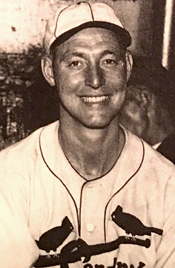
On Nov. 16, 1932, during a hunting trip in Pennsylvania, Gelbert accidently shot himself just above his left ankle when he tripped over a vine in the underbrush.

Gelbert underwent multiple operations and was unable to play baseball the next two years. Undaunted, he defied the odds and returned to the Cardinals in 1935.

Three years later, in 1938, White Sox pitcher Monty Stratton accidently shot himself, resulting in the amputation of his right leg above the knee. Stratton’s determined effort to pitch professionally again inspired a Hollywood movie with Jimmy Stewart in the lead role.

No film was made about Charlie Gelbert, but his comeback was just as amazing.

Name game

When Charlie Gelbert was born in Scranton, Pa., he was christened Magnus Ott Gelbert. “Magnus and Ott were the family names of my father’s grandparents in Germany,” Gelbert later told The Sporting News.

The father, Charles, a veterinarian, had been an all-America football player at the University of Pennsylvania in the 1890s. An offensive guard and defensive lineman who was 5 feet 9 and 170 pounds, Charles “was called The Miracle Man because he did so much with so little,” according to the National Football Foundation.

From as early as he could remember, Magnus Ott Gelbert disliked his name. “The boys hung all sorts of nicknames on me,” he recalled to The Sporting News. “Maggie, of course, was one of them. So I had the name changed.”

When he was 8, Magnus Ott Gelbert became Charles Magnus Gelbert, but everyone called him Charlie.

On the rise

Like his father, Charlie Gelbert became a standout athlete, but his best sport was baseball. While excelling at Lebanon Valley College in Annville, Pa., Gelbert was signed by Cardinals scout Pop Kelchner.

After three years in the minors, Gelbert got to the Cardinals in 1929 and became their shortstop. He helped them to consecutive National League pennants in 1930 and 1931 and a World Series championship.

A right-handed batter, Gelbert hit .304 during the 1930 regular season and .353 in the World Series. He followed with a .289 batting average in 1931. His squeeze bunt in Game 2 of the 1931 World Series scored Pepper Martin from third base with an insurance run. Boxscore

In 13 World Series games for the Cardinals, Gelbert played 113 innings at shortstop without making an error.

“I consider Gelbert one of the most brilliant shortstops in the game,” Cardinals owner Sam Breadon told the St. Louis Star-Times.

St. Louis columnist Sid Keener wrote, “He could hit, field, run and throw. He handled difficult grounders with ease. His throws from deep field were straight to the mark. He was an artist in playing a slow hopper in back of the pitcher.”

As a hitter, Keener noted, “He’d stretch singles into doubles and doubles into triples by daring running.”

Shotgun blast

About a week before Thanksgiving Day in 1932, Gelbert and four companions went hunting in the mountains near McConnellsburg, Pa., about 25 miles from the Maryland state line.

When Gelbert tripped on a vine, he lost his balance and fell backward, sending his feet into the air. As he crashed down heavily, the butt of his shotgun struck the ground and the weapon discharged. The load of pellets struck him in the left leg, about two inches above the ankle, and “left a ragged wound,” according to the Chambersburg (Pa.) Public Opinion newspaper.

“I thought my foot had been severed,” Gelbert told the St. Louis Star-Times. “Blood was streaming from my foot.”

According to the St. Louis Post-Dispatch, “At its deepest point, the wound severed muscles, nerves and blood vessels.” Part of his fibula bone also was shattered.

Responding to Gelbert’s shrieks, his hunting companions rushed to his aid and applied a tourniquet. Gelbert “was carried about a half mile before he could be placed” in a car of one of the hunters, the Chambersburg newspaper reported.

Gelbert was driven about 25 miles to the Chambersburg hospital. After five days there, he was transferred to a hospital in Philadelphia.

At some point, gangrene set in and doctors advised amputating Gelbert’s left foot. “I knew what that meant,” Gelbert, 26, told the Star-Times. “I’d be through as a ballplayer. I pleaded with my doctors to give me the last chance” to save the foot.

Gradually, the infection started to clear and amputation wasn’t necessary, the Star-Times reported, but he faced a long recovery.

“I never thought he’d play ball again,” Cardinals second baseman Frankie Frisch told the New York Times.

Moving forward

Teammate Sparky Adams, whose winter residence was about two hours from Philadelphia, visited Gelbert in the hospital several times, and most of the Cardinals sent him cards and letters, the Post-Dispatch reported.

A couple of days before Christmas, five Philadelphia Athletics (coach Eddie Collins, and players Jimmie Foxx, Jimmy Dykes, Lew Krausse Sr and Jim Peterson) came to his hospital room and brought presents. Gelbert and the Cardinals had opposed the Athletics in both the 1930 and 1931 World Series.

To replace Gelbert, the Cardinals made a trade for Dodgers shortstop Gordon Slade. The Cardinals’ Rogers Hornsby described Slade to columnist Sid Keener as “a brilliant player _ defensively, I mean. The team is strong enough in batting to carry a light-hitting shortstop.”

Slade started at shortstop on Opening Day for the 1933 Cardinals, but soon after was sent to the minors. In May, the Cardinals got a capable replacement, acquiring Leo Durocher from the Reds.

Durocher led National League shortstops in fielding percentage in 1933, and helped the 1934 Gashouse Gang Cardinals become World Series champions.

Gelbert received no salary from the Cardinals while sidelined in 1933 and 1934, the Star-Times reported. Cardinals players voted him a World Series share of $1,000 in 1934 _ a goodwill gesture Gelbert was grateful for in the Great Depression era. “It was Frisch who guided the players to make the generous action,” the Post-Dispatch reported. “He told the players, ‘Be big and the baseball world will accept you as big. Be cheap and the world will jeer and get you down.’ “

Remarkable return

In 1935, doctors gave Gelbert the green light to return to baseball, and he headed to the Cardinals’ training camp in Bradenton, Fla., hoping to earn a spot on the Opening Day roster of the reigning World Series champions.

“His presence in training camp was believed to be just a sympathetic gesture by the Cardinals’ officials,” the Post-Dispatch reported. “That he would ever again be deemed fit to become a cog for a pennant outfit was not dreamed of.”

As the St. Louis Globe-Democrat noted, “For two years he scarcely put the weight of his body on the shattered left leg.”

Gelbert, 29, had a shaky start to his comeback, then began making slow, steady progress. Frisch, the Cardinals’ player-manager, was patient and allowed Gelbert to ease back in. He gave Gelbert a spot on the Opening Day roster as a backup to Durocher at short and to Pepper Martin at third base.

One week into the season, Gelbert appeared in a game, running for catcher Bill DeLancey. Boxscore

A month later, on May 21, 1935, Gelbert got to bat. Boxscore

Gilbert’s first hit in his comeback year was a single against former teammate Tex Carleton of the Cubs on June 2. Boxscore

A week later, Frisch put Gelbert in the starting lineup for the slumping Durocher, who was batting .215.

On June 9, in a game versus the Cubs, Gelbert had four hits, including a home run against Charlie Root, drove in three runs and scored twice. Boxscore

Gelbert made 12 starts at shortstop for the Cardinals in June, hit .340 for the month and continued to play after he was spiked in the left foot during a game against the Cubs.

The sight of Gelbert producing and playing through pain seemed to snap Durocher from his slump. Reinstated at shortstop, Durocher batted .290 with 22 RBI in July and hit well the rest of the season.

Position switch

Early in August, after Pepper Martin was injured, Frisch started Gelbert at third base and he made the most of the opportunity.

“He has been fielding confidently and hitting in a timely fashion,” The Sporting News reported.

Sid Keener noted in the Star-Times, “He has fielded phenomenally at the far corner, handling torrid cracks with the utmost ease, making perfect throws to first base, prancing to short left field for difficult pop twisters, and getting his share of hits in the pinch.”

Gelbert made 30 starts at third base for the 1935 Cardinals. For the season, he hit .292, including .309 with runners in scoring position. He did this even though, as Sid Keener wrote, “Whenever too much pressure is put on the left foot, Gelbert reeks with pain.”

The Cardinals opened the 1936 season with Gelbert, 30, as their third baseman, but he hit .167 in May and got benched. After batting .229 for the season, the Cardinals traded him to the Reds.

Gelbert was a utilityman with the Reds (1937), Tigers (1937), Senators (1939-40) and Red Sox (1940).

He served in the Navy for three years during World War II, mostly in the Pacific, and achieved the rank of lieutenant commander. Afterward, he became baseball coach at Lafayette College in Pennsylvania and amassed a record of 307-176.

Read Full Post »

(Updated July 31, 2023)


In his return to the Cardinals, Tim McCarver was hoping to be their first baseman, even though he’d never played the position in the big leagues.

On Nov. 6, 1972, the Cardinals traded outfielder Jorge Roque to the Expos for McCarver.

As the Cardinals’ catcher during their glory days in the 1960s, McCarver played on two World Series championship clubs and three National League pennant winners. He hit .311 in 21 World Series games for the Cardinals, In the 1964 classic against the Yankees, McCarver hit the game-winning home run in the pivotal Game 5 and had a steal of home in Game 7.

When the Cardinals reacquired him, it appeared his role would be as a reserve, but McCarver, 31, had other ideas.

Changing places

The Cardinals traded McCarver and Curt Flood to the Phillies for Dick Allen in October 1969. Flood refused to report, triggering the antitrust challenge that led to free agency for players. McCarver became the Phillies’ catcher. Limited to 44 games in 1970 because of a broken hand, he came back the next season, hit .278 and got into a fight with former Cardinals teammate Lou Brock.

In 1972, McCarver slumped, entering June with a .208 batting average, and fell into disfavor with manager Frank Lucchesi. “The Phillies had been trying since the end of the 1971 season to trade McCarver,” The Sporting News reported. “Lucchesi was not satisfied with McCarver’s receiving or throwing.”

McCarver sank deeper into Lucchesi’s doghouse when he argued with him in the lobby of a Pittsburgh hotel about the manager’s decision to ban beer on a charter flight from Montreal. In his book, “Oh, Baby, I Love It,” McCarver recalled, “I told him that the players deserved to be treated as adults.”

The Expos were interested in McCarver as a utility player. Though McCarver never had played a position other than catcher since entering the majors with the Cardinals at 17 in 1959, Expos manager Gene Mauch wanted him to play third base and left field as well as back up rookie catcher Terry Humphrey.

Mauch phoned McCarver to find out whether he’d be willing to try other positions. In his book, McCarver said Mauch told him, “If (former teammate) Mike Shannon can do it, you can.”

After McCarver agreed, the deal was made.

On June 14, 1972, Lucchesi informed McCarver he’d been traded to the Expos for catcher John Bateman. In his book, McCarver said he replied, “If you didn’t get any more for me than Bateman, you got fucked.”

In his Expos debut, McCarver started in left field. A week later, he started at third base against the Cardinals at St. Louis. “If fellows like Joe Torre and Yogi Berra could make the transition, there’s no reason McCarver can’t,” Mauch told The Sporting News. “Tim is a much better all-round athlete than those fellows.”

In August, McCarver replaced Humphrey, who was batting below .200, as the Expos’ catcher. “I know there are catchers who can throw better than I can,” McCarver said to The Sporting News, “but I can produce something that will help the team.”

(McCarver told writer Roger Angell, “Gene Mauch is one of the few managers who really understood and appreciated catching.”)

On Oct. 2, 1972, McCarver was catching when Bill Stoneman pitched a no-hitter against the Mets. Boxscore

McCarver hit .251 for the 1972 Expos. He made 13 starts in left field, five at third base and 42 as catcher.

Mix and match

The Cardinals, who finished 21.5 games behind the division champion Pirates in 1972, were looking to strengthen many areas, including the bench. One position that didn’t need improvement was catcher. Future Hall of Famer Ted Simmons was stationed there.

So, when they traded for McCarver, the conventional wisdom was he’d be a utility player and pinch-hitter. McCarver thought otherwise. “I’ve got plenty of baseball left in me and I don’t like people categorizing me as a reserve,” he told The Sporting News.

McCarver went to the Cardinals’ Florida Instructional League camp in St. Petersburg and got lessons from teacher George Kissell on how to play first base.

When the Cardinals gathered for spring training in 1973, McCarver arrived in top shape after a winter of workouts. Manager Red Schoendienst needed to determine whether it would be better to open the season with Joe Torre at first base and rookie Ken Reitz at third, or shift Torre to third and start McCarver at first.

Reitz impressed with his fielding, so Torre stayed at first.

For the first two weeks of the 1973 season, McCarver was used as a pinch-hitter, but on April 22, in the second game of a Sunday doubleheader at Philadelphia, it felt like old times when the Cardinals started Bob Gibson on the mound and McCarver behind the plate. In the eighth inning, with the Phillies ahead, 1-0, Gibson walked, stole second and scored on McCarver’s single versus Dick Ruthven. The Phillies won on Mike Schmidt’s walkoff home run against Gibson with two outs in the ninth, dropping the Cardinals’ record to 1-12. Boxscore

Desperate, Schoendienst went for offense over defense in the Cardinals’ next game against the Dodgers, starting Ted Simmons in right field for the first time as a big-leaguer and McCarver at catcher. The Cardinals scored only twice, but Rick Wise pitched a shutout for them. Boxscore

A week later, Schoendienst tried Simmons at first base, and McCarver got to catch Gibson in his win versus the Padres. Boxscore

At that point, McCarver still hadn’t played at first base, but change was coming.

On-the-job training

On May 17, 1973, Torre injured his left leg in a collision at the plate with Cubs catcher Randy Hundley. McCarver made his debut as a first baseman, replacing Torre in the second inning. Boxscore

While Torre was sidelined for two weeks, McCarver filled in, hitting .316 for the month of May and fielding like a catcher. In his book, McCarver said, “I was trained to block balls thrown in the dirt, not catch them. At first base, I blocked a hell of a lot of balls, but I didn’t actually catch too many.”

Nonetheless, when Torre returned, Schoendienst sometimes shifted him to third in order to get McCarver into the lineup at first base.

On June 2, 1973, McCarver, batting for Ken Reitz, hit his first home run of the season, a grand slam against the Astros’ Fred Gladding, lifting the Cardinals to a 6-2 victory. McCarver hit .500 (7-for-14) with the bases loaded for the 1973 Cardinals. Boxscore

The next day, McCarver, playing first base, scored the tying run in the ninth and drove in the winning run in the 10th versus the Astros. “The Cardinals have won 14 of their last 16 games and tough Timmy has been a sparkplug in the resurgence,” Dick Kaegel wrote in the St. Louis Post-Dispatch. Boxscore

On July 26, 1973, McCarver caught Gibson for the final time. He replaced Simmons in the seventh and caught the last three innings in a 13-1 rout of the Mets. According to baseball-reference.com, McCarver caught more of Gibson’s games (214) than any other catcher. Boxscore

Make or break

First base was the position McCarver played the most in 1973, though he never felt quite comfortable there.

Recalling a game against the Phillies, McCarver said in his book, “With a runner on second, two out, a ground ball was hit three steps to my right. I should have fielded it, but, of course, didn’t. Fully realizing there’d be no play at the plate, I thought it a good time to try to figure out how I missed the ball. Jose Cruz, the right fielder, had other ideas. Trained to hit the cutoff man _ me _ that’s exactly what he did, right in the back.

“Bobby Wine, the first base coach, fell to his knees laughing as I yelled out to Cruz, ‘That’s the first time you’ve hit the cutoff man all year.’ “

In September, when the Cardinals had a chance to finish first in a weak division, McCarver did his best to help. He made 17 September starts at first base and committed no errors. For the month, McCarver hit .333 with 14 RBI and had an on-base percentage of .405.

The Cardinals finished 81-81. McCarver hit .266 overall but .291 as a first baseman. (He batted .205 as a pinch-hitter and .171 as a catcher.) He made 68 starts at first base and 10 at catcher.

McCarver rarely played the next season. He hit .217 in 106 at-bats for the 1974 Cardinals and was sent to the Red Sox in September.

Read Full Post »

Rogers Hornsby slammed the door on the Cardinals but it didn’t shut.

On Oct. 25, 1932, the Cardinals signed Hornsby for a second stint with them.

The reunion seemed unimaginable six years earlier when Hornsby and Cardinals owner Sam Breadon quarreled during contract talks. Reaching a boiling point, Hornsby stormed out of Breadon’s office, slamming the door behind him and triggering his banishment from the club.

Hit and miss

In December 1926, Hornsby was at the height of his popularity in St. Louis. A second baseman and right-handed batter of exceptional skill, he hit better than .400 three times with the Cardinals and earned six of his seven National League batting titles with them. In May 1925, Hornsby became Cardinals player-manager, replacing Branch Rickey, who moved into the front office. Hornsby led them to their first World Series title the following year.

The relationship between Hornsby and Breadon became strained during the 1926 championship season. As the St. Louis Star-Times noted, Breadon grew uneasy with the amount of gambling Hornsby was doing on horse races. According to author Mike Mitchell in his book “Mr. Rickey’s Redbirds,” Hornsby often was visited at the ballpark by a bookmaker, Frank Moore.

For his part, Hornsby was miffed that Breadon scheduled exhibition games for the Cardinals during the pennant stretch. Hornsby also resented Rickey’s authority in player personnel decisions and clashed with him, upsetting Breadon.

Shortly before Christmas Day 1926, Hornsby and Breadon met to discuss a contract, but neither was feeling the holiday spirit.

According to the Star-Times, Breadon offered a one-year deal for $50,000. Hornsby demanded three years at $150,000. Wanting control of all player personnel decisions, Hornsby also insisted that Breadon fire Rickey.

The talks deteriorated further when Breadon introduced a contract clause banning Hornsby from attending a horse race or from betting on one, and prohibiting him from associating with bookmakers, author Mike Mitchell noted.

The meeting unraveled and so did Hornsby, who exited in a huff. Fed up, Breadon called the Giants and agreed to trade Hornsby to them for second baseman Frankie Frisch and pitcher Jimmy Ring.

Hornsby played in 1927 with the Giants (filling in as manager in September when John McGraw became ill) and in 1928 with the Braves (taking over as manager in May) before going to the Cubs. Near the end of the 1930 season, he became player-manager of the Cubs.

Cubs capers

Hornsby had the support and admiration of Cubs owner William Wrigley Jr., who, according to the Chicago Tribune, called Hornsby “the smartest manager and the smartest player I have ever seen.”

When William Wrigley Jr. died in January 1932, his son, Philip Wrigley, took over and relied on the experience of club president William Veeck Sr. Without William Wrigley Jr., to protect him, Hornsby and Veeck Sr. clashed. “The temperature between them had dropped to freezing,” The Sporting News reported.

In addition, Hornsby’s relations with some Cubs players became strained. He “snarled at the athletes and injured the tender feelings of quite a few,” The Sporting News noted.

In his autobiography, “My War With Baseball,” Hornsby said Veeck Sr. “tried to make some of my managing decisions from his office and it was obvious we didn’t see eye to eye.”

On the night of Aug. 2, 1932, with the Cubs in second place at 53-46, five behind the Pirates, Veeck Sr. fired Hornsby and replaced him with Charlie Grimm.

A subsequent investigation by baseball commissioner Kenesaw Mountain Landis disclosed that Hornsby had borrowed about $6,000 from four Cubs players to cover his horse racing bets, the Star-Times reported.

The Cubs went on to overtake the Pirates and win the National League pennant. When Cubs players met to determine how to divide their share of the World Series proceeds, they voted to give Hornsby nothing.

Forgive us our trespasses

After winning National League pennants in 1930 and 1931, the Cardinals finished 72-82 in 1932, 18 behind the champion Cubs. The Cardinals ranked sixth in the eight-team league in both hits and runs scored.

Seeking a hitter, Breadon and Rickey turned to Hornsby, who was at his St. Louis County farm. According to Red Smith of the Star-Times, Hornsby “had been an apparent outcast from baseball, passed up by every major-league club except the Cardinals, and his farm property is under federal attachment for unpaid income taxes and penalties.”

The Cardinals signed Hornsby to a one-year contract for $15,000. The deal included a provision “that at the close of the 1933 season he will be given his unconditional release and therefore will be free to sell his services to the highest bidder,” the Star-Times reported.

In essence, Hornsby had a contract that would grant him free agency. Ever the gambler, he was betting on himself that he would parlay a productive 1933 season into a more lucrative offer the following year.

Another unusual twist: With second basemen Frankie Frisch and Rogers Hornsby, the Cardinals had the players who were swapped for one another six years earlier.

Considering the genuine animosity expressed after Hornsby’s departure in 1926, the reconciliation was surprising to some. “I could hardly believe the setting before my eyes was a reality,” Sid Keener wrote in the Star-Times. “Hornsby and Breadon were chatting and making plans again. They had been pals, then enemies, and now they’re pals again.”

A contrite Hornsby told Red Smith, “If I had listened to Mr. Breadon and Mr. Rickey six years ago, I’d be a lot better off today financially and every other way. It’s like coming home. I had disagreements with the Cardinals, but I know Mr. Breadon and Mr. Rickey always treated me fairly.”

Hornsby said to Keener, “I’m willing to admit I made the one big mistake of my career when I slammed the door on Mr. Breadon’s face six years ago and refused to accept the contract that was offered.”

According to the St. Louis newspapers, the Cardinals projected Hornsby as their second baseman for 1933, with Frisch moving either to shortstop or third base.

“We believe Rog is still a great ballplayer,” Breadon said to the Star-Times. “We think he will help us win the pennant next year. That is why we are signing him.”

Rickey told the St. Louis Post-Dispatch, “I see no reason why Hornsby can’t have a great year for us.”

Cardinals manager Gabby Street was onboard with the move, too. “Rogers Hornsby is far from being through as a baseball player,” Street said to the Springfield (Mo.) Leader. “I think he’s got a lot left in him and that he’ll be of a real help to the Cardinals.”

Street added, “I don’t anticipate any trouble from him.”

Speculation swirled that Hornsby soon would be lobbying to have Street’s job, but Breadon told the Star-Times that Hornsby had been given “no consideration whatsoever” as a possible successor to Street.

Never a dull moment

Shortly before the 1933 Cardinals started spring training, Hornsby injured his right foot while instructing at a baseball school in Hot Springs, Ark. When the Cardinals opened the regular season against the Cubs at Chicago, Frisch was at second base and Hornsby was on the bench.

Hornsby didn’t appear in either of the Cardinals’ first two games at Chicago, nor did he play in the home-opening series versus the Cubs at St. Louis a week later, but he created controversy with comments accusing Cubs teammates Charlie Grimm and Gabby Hartnett of plotting to get him fired the year before.

According to United Press, Grimm and Hartnett wanted to go into the Cardinals clubhouse at St. Louis and “horsewhip” Hornsby for making what they said were false statements about them, but William Veeck Sr. advised against fighting “a washed up ballplayer.”

In response, Hornsby told the news service, “Whenever Charlie Grimm or Gabby Hartnett want to fight, all they have to do is to roll up their sleeves and come on. I’m ready for them.”

The mood was both tense and electric when the Cardinals returned to Chicago to play a Sunday doubleheader at Wrigley Field on April 30, 1933. 

Facing the Cubs for the first time since his firing and for the first time since the war of words with Grimm and Hartnett, Hornsby, 37, started at second base in both games. He had two hits and a RBI and scored a run in the opener, then drove in the winning runs with a two-run home run against Pat Malone in the second game. Game 1 and Game 2.

Hornsby was jeered in every at-bat, but there were no incidents with Cubs players. In the clubhouse after the games, Hornsby displayed “a little extra gleam of satisfaction in his eyes,” the Post-Dispatch noted.

In June, Hornsby had hits in five consecutive plate appearances as a pinch-hitter, including a two-run double that broke a 5-5 tie in a 7-5 victory over the Dodgers. Boxscore

A month later, both the Cardinals and the American League St. Louis Browns made major changes.

On July 19, when their manager, Bill Killefer, resigned, the Browns approached the Cardinals about a replacement. According to the Star-Times, Branch Rickey came to Hornsby and asked, “How would you like to manage the Browns?”

Hornsby replied enthusiastically and accepted Rickey’s offer to negotiate for him.

On July 24, the Cardinals fired Gabby Street and elevated Frankie Frisch to the role of player-manager. Two days later, the Browns hired Hornsby to be their player-manager.

“Mr. Rickey was my guiding adviser throughout the negotiations with the Browns,” Hornsby told the Star-Times. “It may seem peculiar to the fans in St. Louis, but I am indebted to Mr. Rickey for obtaining the position with the Browns. We’ve had many bitter battles in the past, but they’ve been forgotten long ago.”

In 83 at-bats for the 1933 Cardinals, Hornsby had 27 hits and 21 RBI. He batted .325 overall and .333 as a pinch-hitter. His on-base percentage was .423.

“I’ve learned to like him,” Frankie Frisch told the Star-Times, “and I regretted to see him go.”

Read Full Post »

The Cardinals acquired the player who might have helped them win a division title in 1973, but gave him away before he played a game for them.

On Oct. 26, 1972, the Cardinals got outfielder Larry Hisle from the Dodgers for pitchers Rudy Arroyo and Greg Milliken.

Hisle might have been a fit to join a Cardinals outfield with Lou Brock and either Jose Cruz or Bake McBride.

Instead, on Nov. 29, 1972, a month after acquiring him, the Cardinals traded Hisle to the Twins for reliever Wayne Granger.

Hisle fulfilled his potential with the Twins and later with the Brewers. Granger, in his second stint with St. Louis, was a disappointment.

The 1973 Cardinals, who ranked last in the National League in home runs, finished 1.5 games behind the division champion Mets. Hisle’s 15 home runs for the 1973 Twins would have made him the team leader on the 1973 Cardinals.

Prized prospect

Born in Portsmouth, Ohio, Larry Hisle was named by his mother, a baseball fan, in honor of Larry Doby, who became the first black player in the American League, according to the Society for American Baseball Research (SABR). Hisle’s parents died when he was a youth and he was adopted by Orville and Kathleen Ferguson, “two of the finest people in the world,” Hisle told United Press International.

Hisle played youth baseball with two other future big-leaguers, Al Oliver and Gene Tenace, according to SABR, but he also was a standout prep basketball player. When Oscar Robertson, recruiting for the University of Cincinnati, called, “I almost dropped the phone,” Hisle told The Sporting News.

After agreeing to play basketball at Ohio State, Hisle was picked by the Phillies in the second round of the 1965 baseball draft and signed with them. A right-handed batter, he played two seasons at the Class A level in the minors, then reported in 1968 to Phillies spring training camp, where he roomed with Bill White.

In choosing Hisle, 20, to be the Phillies’ 1968 Opening Day center fielder, manager Gene Mauch told The Sporting News, “Hisle is the best center fielder I’ve ever had.”

The experiment didn’t last long. Though he hit .364 in 11 at-bats for the 1968 Phillies, Hisle was sent to the minors before the end of April.

Rookie season

The Phillies named Hisle their center fielder for 1969, but he had a shaky start. He hit .159 in April and removed himself from a game because of what the team physician described to The Sporting News as “acute anxiety.”

“We’re all aware he’s a very intense, high-strung young man who is going to take a little longer to adjust up here,” Phillies manager Bob Skinner said to The Sporting News.

Hisle did better in May, producing four hits, two RBI, two runs and two stolen bases in a game against the Cardinals. Boxscore

Before a game in Philadelphia, the Giants’ Willie Mays chatted with Hisle and told him, “Open your stance, take it easy and concentrate on just meeting the ball,” The Sporting News reported. Hisle responded with four hits and two RBI that day. Boxscore

Phillies teammate Dick Allen aided Hisle, too, and became a mentor. “I’ll never forget how much he helped me,” Hisle told the Philadelphia Inquirer.

Hisle hit .266 with 20 home runs and 18 stolen bases for the 1969 Phillies.

Too far, too fast

Dick Allen was traded to the Cardinals after the 1969 season in a deal involving center fielder Curt Flood, who refused to report.

With neither Allen nor Flood, the Phillies needed Hisle to step up, but he didn’t, hitting .205 in 1970 and .197 in 1971.

“I put too much pressure on myself,” Hisle said to the Chicago Sun-Times. “I doubted my ability.”

In October 1971, the Phillies dealt Hisle to the Dodgers for Tommy Hutton.

Hisle “was built up as the potential superstar who would lead the Phillies out of the wilderness, and he wasn’t ready to handle the role,” Philadelphia Inquirer columnist Frank Dolson wrote. “The enormous pressures beat him down, sent his batting average plummeting, and turned the fans who had cheered him as a rookie into a booing mob that virtually chased him out of town.”

Mind games

At spring training in 1972, Hisle was the last player cut by the Dodgers, according to the Albuquerque Journal. Rather than go to the minors, Hisle said he considered quitting baseball. He was attending Ohio University in the off-seasons, studying math and physical education, “and has thought of teaching and social work,” the Los Angeles Times reported.

A voracious reader of authors as diverse as B.F. Skinner and James Joyce, Hisle “dabbles in analytic geometry, and worries about what happened to his hitting,” the Los Angeles Times noted. “He may be, he says, too much of a thinker for his own good.”

The Dodgers assigned Hisle to Albuquerque, hoping the manager there, Tommy Lasorda, would help him overcome self-doubts.

Playing for Lasorda, “I learned that the most important thing a person can say about himself is, ‘I believe in myself,’ ” Hisle told the Philadelphia Inquirer.

Hisle hit .325 with 23 home runs and 91 RBI for Albuquerque in 1972.

The Twins tried to acquire him after the season, but the Dodgers wanted pitcher Steve Luebber in return. Luebber was rated the best pitching prospect in the Twins’ system and they didn’t want to trade him, so the Dodgers dealt Hisle, 25, to the Cardinals.

Coming and going

“Hisle could play a big part in the youth movement of the Cardinals,” the St. Louis Post-Dispatch declared. 

The Cardinals brought Hisle to St. Louis and told him “they were hoping I could help the outfield defense,” Hisle told the Minneapolis Star Tribune. “From what I heard, it needed help. I was really happy to join the Cardinals.”

General manager Bing Devine also was seeking help for the bullpen, and approached the Twins about Wayne Granger, a former Cardinal. Granger’s 19 saves for the 1972 Twins were six more than Cardinals pitchers totaled that year.

“We had talked with the Twins about Granger shortly after the season ended, but they wanted a hitter in return and we didn’t have anyone available,” Devine told The Sporting News. “After we got Hisle, they expressed a strong interest in him.”

The Twins hardly could believe their good luck. Granger “had not endeared himself to the front office with charges that the Twins weren’t a first-class organization,” The Sporting News reported, and they were eager to trade him.

“It was fortunate for us that Bing Devine was interested in Wayne Granger,” Twins owner Calvin Griffith told columnist Sid Hartman. “We talked to Devine about Hisle. He was reluctant to give him up, but he wanted Granger.”

Devine said to The Sporting News, “We really had figured on Hisle as an extra man on the club because he can do so many things.”

Nothing personal

Hisle was at home when the Cardinals called, informing him of the trade to the Twins. “I was disappointed and hurt,” he told the Minneapolis Star Tribune.

According to the newspaper, “Hisle later received a handwritten note from Bing Devine. Devine apologized for the quick trade to Minnesota, explaining it was not intentional nor a snub at Hisle, but merely something which Devine felt could help the Cardinals. Hisle appreciated the letter, and still has it.”

The Twins made Hisle feel at home, naming him their center fielder. “I’m getting a chance to play regular here,” he told the Minneapolis newspaper. “I don’t know if I would have played every day for the Cardinals.”

Hisle scored 88 runs and drove in 64 for the 1973 Twins. His 230 total bases ranked third on the team, behind only Rod Carew and Tony Oliva.

Granger was 2-4 with five saves and a 4.24 ERA for the 1973 Cardinals before he was traded to the Yankees in August.

Hisle had big seasons for the Twins in 1976 (96 RBI, 31 stolen bases) and 1977 (28 home runs, 119 RBI). Granted free agency, he signed with the Brewers and had 34 home runs, 115 RBI and 96 runs scored for them in 1978.

A two-time all-star, Hisle played 14 seasons in the majors. He was the hitting coach for the World Series champion Blue Jays in 1992 and 1993.

Read Full Post »

Two years before they acquired Lou Brock, the Cardinals made a blockbuster trade with the Cubs for an outfielder they hoped would ignite their offense.

On Oct. 17, 1962, the Cardinals acquired outfielder George Altman, pitcher Don Cardwell and catcher Moe Thacker from the Cubs for pitchers Larry Jackson and Lindy McDaniel and catcher Jimmie Schaffer.
Altman was the key to the deal for the Cardinals. A left-handed batter, he was a National League all-star who hit for power and average.

The Cardinals thought they were getting a run generator who would propel them to their first championship since 1946. Instead, Altman lasted one season with the Cardinals, who contended but fell short in their bid for a title. It wasn’t until June 1964, when they made another big trade with the Cubs to get Brock, that the Cardinals got the catalyst they needed to become World Series champions.

From hoops to hardball

Born and raised in Goldsboro, N.C., Altman was a standout high school athlete in multiple sports, including baseball. Tennessee State University recruited him to play basketball.

A 6-foot-4 forward, Altman had hopes of pursuing a professional basketball career, but a knee ailment his junior season made him reconsider. When Tennessee State started a baseball program his junior year, Altman made the team. Though he continued to play college basketball, he began thinking his future was in baseball.

After graduating in 1955, Altman got a tryout with the Kansas City Monarchs of the Negro American League and impressed manager Buck O’Neil, who signed him and became his mentor.

(Altman’s Monarchs teammate was pitcher Satchel Paige, 49. In his autobiography, “George Altman: My Baseball Journey From the Negro Leagues to the Majors and Beyond,” Altman recalled, “I’m not 100 percent sure that Satchel knew all of our names. He definitely called me ‘Young Blood.’ We didn’t talk to him that much because he didn’t travel with us most of the time. He had his own Cadillac and he followed the bus.”)

After the season, O’Neil joined the Cubs as a scout and recommended Altman. The Cubs signed him, and in 1959, Altman, 26, made his big-league debut as their Opening Day center fielder. In his first at-bat, Don Drysdale hit him in the thigh with a pitch. “I don’t know if he hit me on purpose,” Altman said in his autobiography, “but I would say he was trying to intimidate me.”

Unfazed, Altman singled twice in the game against the future Hall of Famer. Boxscore

Let’s make a deal

In 1961, the Cubs had four future Hall of Famers in their lineup (Richie Ashburn, Ernie Banks, Ron Santo, Billy Williams) but Altman was their batting leader (.303). He produced a league-leading 12 triples, 27 home runs and 96 RBI.

The Cubs also had four future Hall of Famers in their 1962 lineup (Banks, rookie Lou Brock, Santo, Williams) but Altman again was their top hitter (.318). He clubbed 22 homers, had 19 stolen bases, ranked fourth in the league in on-base percentage (.393) and was named an all-star for the second year in a row.

To improve on their 1962 record (59-103), the Cubs determined they needed pitching and a corner outfield spot for Brock.

Brock was the Cubs’ center fielder in 1962 but was better suited for left or right. With Billy Williams entrenched in left, the Cubs opted to shop Altman for pitching and to open a spot in right for Brock.

The Cardinals, who, as St. Louis Globe-Democrat columnist Bob Burnes noted, “spent much of the summer in a state of frustrated anguish because they couldn’t come up with the big hit when they needed it,” sought a run-producing right fielder after Charlie James totaled eight home runs in 1962. When they suggested swapping their 1962 leaders in wins (Larry Jackson with 16) and saves (Lindy McDaniel with 14) for Altman, “the Cubs had to jump at the offer,” Burnes wrote.

High hopes

With Altman, the Cardinals had three of the top six finishers in the 1962 National League batting race: Stan Musial (third at .330), Bill White (fourth at .324) and Altman (sixth at .318).

General manager Bing Devine told the Globe-Democrat the Cardinals’ starting outfield in 1963 would be Musial in left, Curt Flood in center and Altman in right.

Altman “figures to be of particular value in Busch Stadium, where the close right field pavilion is an inviting home run target for left-handed swingers,” the Chicago Tribune observed.

According to the Post-Dispatch, the shortest distance from home plate to the right field wall at Busch Stadium was a mere 310 feet.

“With the short right field fence in St. Louis, I have to like the park,” Altman told the Post-Dispatch. “I’d like to top all my season highs. I’ll settle for 100 runs batted in, but I’d like to go for 150. I want to hit more than 27 home runs and bat higher than .318.”

Vision problems

In the winter months after the trade, Altman stayed in Chicago and studied to earn a stockbroker license. Altman said he believed the studying he did in the dim lighting of his basement hurt his eyesight.

Driving from Chicago to the Cardinals’ spring training site in Florida, “I had trouble seeing the road signs and the lane lines” at night, Altman said in his autobiography. “I stopped in Nashville to have my eyes examined. The doctor said, ‘Son, you need glasses and should get them as soon as possible.’ “

At spring training, Altman’s vision improved sufficiently enough that he opted not to wear eyeglasses.

He began the 1963 regular season with great promise _ eight hits in his first 16 at-bats _ but went into an 0-for-27 slump in May. Altman, 30, didn’t hit his first home run until May 10, a two-out shot in the ninth inning off the Pirates’ Bob Friend that carried the Cardinals to a 1-0 victory. Boxscore

In June, Altman produced a 17-game hitting streak, but wasn’t hitting many home runs. Cardinals consultant Branch Rickey wanted Altman to pull with power to right field and convinced Bing Devine to deliver that message to Altman.

Altman, who preferred hitting for contact to all fields, tried pulling the ball regularly, but struggled, hitting .226 in July. “I tried to pull entirely too much,” he said to The Sporting News. “It fouled me up.”

Desperate, he wore eyeglasses for a game against the Reds and went 0-for-4, bringing a quick end to the experiment. “They weren’t worth the discomfort,” Altman said to The Sporting News. Boxscore

In his autobiography, Altman said the eyeglasses “steamed up in the humid summer air. I did better without them.”

Altman gave up trying to pull the ball and did better the last two months, hitting .291 in August and .273 in September. For the season, he batted .274 with nine home runs and 47 RBI. The Cardinals, who finished six games behind the champion Dodgers, “felt that if he had performed this year as expected, the team would have won the pennant,’ syndicated columnist Red Smith wrote.

Altman said in his autobiography the causes for his drop in production were tension “with me wanting to make good and make a good first impression with the Cardinals” and his eyesight. “There were times my vision was weak enough that when I looked out everything was fuzzy,” Altman said.

In November 1963, Altman and pitcher Bill Wakefield were traded to the Mets for pitcher Roger Craig.

After an injury-plagued season with the Mets, Altman was dealt back to the Cubs. The trade was made by Bing Devine, who joined the Mets after being fired by the Cardinals. Thus, Devine was involved in three Altman trades, acquiring him for the Cardinals from the Cubs, swapping him from the Cardinals to the Mets, and then trading him from the Mets to the Cubs.

Altman went to Japan in 1968 and revived his career there. In eight seasons in Japan, Altman hit 205 home runs, including 34 in 1968 and 39 in 1971.

Read Full Post »

A candy commercial turned sour instead of sweet for Cardinals speedster Lou Brock.

In September 1972, the Federal Trade Commission banned a Milk Duds television commercial featuring Brock because it deemed the advertisement as deceptive.

In the commercial, Brock suggested he got the speed to steal bases by eating Milk Duds.

Candy man can

Milk Duds, chewy chocolate-covered caramels, were introduced in the 1920s in Chicago. (The Chicago Tribune reported the start date as 1926. Hershey, the current owner of Milk Duds, lists the date as 1928.)

Milton J. Holloway, a Chicago native whose father immigrated to the United States from England, was the creator of Milk Duds and other candy such as Black Cow suckers, the Tribune reported.

According to Hershey, Milk Duds got named because the maker couldn’t get the caramels to form perfectly round shapes, and thus dubbed them duds. In another version, a candy executive told the Tribune, “It was supposed to be duds _ as in fancy duds.”

Regardless, the name and the candy were popular in the United States and became a successful business for Milton Holloway. According to the Tribune, Holloway said he ate Milk Duds every day to measure the candy’s quality.

In 1960, Holloway sold Milk Duds to Beatrice Foods Co. of Chicago for $1.25 million, the Tribune reported. Holloway was 76 when he died in 1972.

Follow the money

After Marvin Miller became executive director of the Major League Baseball Players Association in 1966, he “negotiated numerous lucrative licensing and marketing deals that added millions of dollars to the Players Association coffers,” Bill Madden of the New York Daily News reported.

In one of those deals, Beatrice Foods agreed to pay the players’ union for the rights to market Milk Duds as the official candy of the Major League Baseball Players Association.

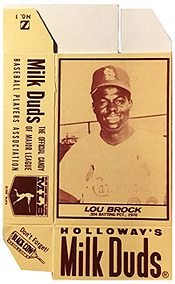
Also, the agreement enabled Beatrice Foods to produce baseball cards on the backs of 5-cent boxes of Milk Duds in 1971. The cards included several future Hall of Famers, including Brock, Bob Gibson, Hank Aaron, Johnny Bench, Roberto Clemente, Willie Mays, Brooks Robinson, Frank Robinson and Tom Seaver.

Beatrice signed Brock to do television commercials for Milk Duds. In a 1970 commercial, Brock is shown giving base stealing tips to youngsters. “When the pitcher goes into his motion,” Brock says, “I take off like I was running for a box of Milk Duds.” A narrator’s voice intones: “Milk Duds are great little energy builders.” Video

Say what?

Things got as sticky as a melted Milk Dud for Beatrice Foods with a follow-up commercial featuring Brock.

Here’s a transcript of the controversial commercial as reported by the Hackensack (N.J.) Record:

Narrator: “Lou Brock, St. Louis Cardinals outfielder. Hitter with blazing speed on the bases. What’s your secret for stealing second, Lou?”

Brock: “I study every pitcher in the league and his moves. I take about a four- to five-step lead off the bag, and stay real loose.”

Narrator: “Milk Duds with energy for speed. Is that where you get your speed, Lou?”

Brock: “Sure. I sure do like Milk Duds.”

Narrator: “Milk Duds are little bits of energy. Rich chocolate-covered caramel. Milk Duds with energy for speed on the bases. That’s why Milk Duds are the official candy of the Major League Baseball Players Association. You’ll see the official seal on every box. Enjoy them often.”

Ain’t that America

That commercial got the attention of the Federal Trade Commission (FTC) in Washington, D.C. Created by President Woodrow Wilson in September 1914, the FTC describes its mission as “protecting the public from deceptive or unfair business practices and from unfair methods of competition.”

The FTC determined the Milk Duds commercial was deceptive because Brock told viewers he got his base stealing speed by eating the candy. “The FTC believed a false impression was being conveyed,” the Hackensack Record reported.

In this case, the false impression was “that eating candies, such as Holloway Milk Duds, was necessary to instill, improve and maintain athletic ability and performance,” the Associated Press explained.

In issuing its consent order, the FTC prohibited Beatrice Foods from using deceptive endorsements by athletes and athletic organizations. Or, as the Washington Star-News put it, “For the first time, a jock huckster was told to get off the air if he wasn’t going to tell the truth.”

According to the FTC, the endorsements were based on a monetary relationship between Beatrice Foods and its endorsers and not on nutritional superiority, The Sporting News noted.

Under the headline, “FTC Watchdog On Prowl Vs. Athletes’ Oversell,” the Boston Globe described the ruling as “a landmark finding.”

“For the first time, the Federal Trade Commission is formalizing guidelines for endorsements,” the Globe reported.

(The next year, the FTC cracked down on Domino Sugar for hyping its product as the official sugar of Major League Baseball and the NFL. The FTC ordered Domino Sugar to use part of its advertising budget to say its product is not a special or unique source of strength, energy and stamina.)

According to the Hackensack Record, “The probable audience of an advertisement would influence FTC action. One aimed at children may be measured against more rigorous standards than one for adults.”

In a September 1972 editorial, the St. Louis Post-Dispatch supported the FTC action.

“The Cardinals have had little to cheer about all summer,” the editorial stated. “One bright spot, as usual, has been the play of Lou Brock, and how he does it we don’t know except we are fairly certain the Federal Trade Commission is right in saying it isn’t by eating a brand of candy called Milk Duds. The FTC has taken a much needed step toward correcting the abuses of athlete testimonials, which are directed at a largely young and impressionable audience.”

Read Full Post »

« Newer Posts - Older Posts »