Feeds:
Posts
Comments

Archive for the ‘Hitters’ Category

In a reversal of roles, Marv Throneberry played the hero and the Cardinals performed like the 1962 Mets.

On July 7, 1962, Throneberry hit the first walkoff home run of his big-league career, lifting the Mets to victory against the Cardinals at the Polo Grounds in New York. Throneberry’s winning hit came an inning after Dal Maxvill made a base running blunder that cost the Cardinals a run.

A first baseman whose gaffes on the field came to symbolize the ineptness of the expansion 1962 Mets, losers of 120 games, Throneberry hit like an all-star against the Cardinals that season.

Family affair

Marv and his older brother Faye, who also reached the big leagues, grew up on a family farm in Fisherville, Tenn., about 30 miles east of Memphis.

Faye Throneberry signed with the Red Sox in 1950 and hit .236 during eight years in the majors as an outfielder for the Red Sox, Senators and Angels.

Marv Throneberry signed with the Yankees in 1952. A left-handed batter, he became a prolific slugger for their Denver farm club, hitting 36 home runs in 1955, 42 in 1956 and 40 in 1957.

When Marv made his big-league debut with the Yankees in a game at Boston on Sept. 25, 1955, Faye was in the outfield for the Red Sox. Marv went 2-for-2 with three RBI and a run scored. Boxscore

That would be Marv’s only big-league experience until he stuck with the Yankees as a backup to first baseman Moose Skowron in 1958.

After the 1959 season, Throneberry was traded to the Athletics in a multi-player deal that brought Roger Maris to the Yankees.

“Marv Throneberry swings and misses with outlandish regularity,” Sports Illustrated noted in April 1960, “but manages to connect just often enough to maintain his reputation as a slugger of great promise.”

The Athletics shipped him to the Orioles in June 1961. Throneberry was a teammate of Whitey Herzog in Denver and with the Athletics and the Orioles.

No shortage of shortcomings

The 1962 Mets opened their inaugural season with Gil Hodges, 38, as their first baseman, but a variety of ailments limited his playing time. On May 9, the Mets acquired Throneberry, 28, from the Orioles for a player to be named (former Cardinals catcher Hobie Landrith) and cash.

When Mets general manager George Weiss said Throneberry probably would be the club’s first baseman for the next four years, manager Casey Stengel “almost fell off his seat,” columnist Joe King reported. Weiss and Stengel were with the Yankees when Throneberry was there, and Stengel wasn’t impressed. “I know he can maybe move around at first base, but whether he can hit, I don’t know,” Stengel told The Sporting News.

With his options limited, Stengel played Throneberry against right-handers. Making mistakes in the field and on the base paths, and whiffing a lot at the plate, Throneberry was viewed as “a symbol of the futility of one of the most tragicomic teams in baseball,” the New York Times noted.

On June 17, in the first inning of a game against the Cubs at the Polo Grounds, Throneberry, batting with two on and one out, drilled a deep drive to right. Both runners scored and Throneberry reached third with a triple.

“He was dusting off his uniform at third base, apparently feeling that the tide in his fortunes had turned,” the Associated Press reported, when the Cubs appealed to first-base umpire Dusty Boggess, saying Throneberry had failed to touch the base on the way around.

The umpire agreed, and Throneberry was ruled out. He was credited with two RBI but no hit on the play.

“Stengel charged from the dugout in protest,” columnist Arthur Daley wrote in the New York Times. “The umpire shut him up fast. Throneberry didn’t touch second either.”

When the next batter, Charlie Neal, followed with a home run, Stengel emerged and pointed out each of the four bases to Neal as he made his home run trot, the New York Times reported. Boxscore

Hooray for Marv

The Mets were 22-57 entering the July 7 Saturday doubleheader versus the Cardinals at the Polo Grounds.

With the score tied at 3-3 in the eighth inning of the opener, the Cardinals had two on and two outs when Red Schoendienst hit a smash off Hodges’ glove at first base and into right field for a single.

Dal Maxvill, running at second for Stan Musial, rounded third and reached the plate easily with the apparent go-ahead run. The Mets appealed, saying Maxvill didn’t touch third base, and umpire Augie Donatelli agreed, calling him out and nullifying the run. Donatelli said Maxvill missed the bag by almost a foot, the St. Louis Post-Dispatch reported.

In the ninth, Curt Flood led off with a home run, putting the Cardinals ahead, 4-3.

Facing left-hander Curt Simmons in the bottom half of the inning, Joe Christopher hit a tapper along the first-base line. Simmons fielded the ball, tried to tag Christopher, but missed, enabling him to reach first with a single.

After right-hander Ernie Broglio relieved and got Hodges to fly out, Stengel countered by sending Throneberry to bat for shortstop Elio Chacon. Rather than have a left-hander pitch to Throneberry, Cardinals manager Johnny Keane stayed with Broglio.

Facing the Cardinals for the first time in a regular-season game, Throneberry worked the count to 1-and-1 before lining a pitch into the lower seats in right for a two-run home run, giving the Mets a 5-4 triumph. Boxscore

“Chances are that if you had 20 guesses as to which Met batsman had a pinch-hit homer in the ninth, you’d probably mention Marv Throneberry last, if at all,” the New York Times concluded. “His derelictions afield and at bat in recent exercises had made him the comic symbol of all that is wrong with the forlorn Mets.”

Throneberry started at first base in Game 2 of the doubleheader and almost was the hero again. In the seventh inning, his home run against Ray Washburn tied the score at 2-2. After Stan Musial put the Cardinals ahead, 3-2, with a home run in the eighth, Throneberry hit a triple against Washburn with two outs in the ninth, but Lindy McDaniel relieved and retired Gene Woodling to end the game. Boxscore

Man of the people

Throneberry hit one more walkoff home run for the Mets. On Aug. 21, 1962, he was coaching first base when Stengel told him to bat for Jim Hickman in the bottom of the ninth. Throneberry hit a three-run home run against Pirates closer Roy Face, eliminating a two-run deficit and giving the Mets a 5-4 victory. Boxscore

For the season, Throneberry led the National League in one category: most errors by a first baseman (17 in 97 games).

He hit 16 home runs for the 1962 Mets and batted .244, with almost as many strikeouts (83) as hits (87).

Against the 1962 Cardinals, though, Throneberry batted .326 (with 15 hits) and had an on-base percentage of .396.

“Marvin Eugene Throneberry became the symbol of the New York Mets,” Arthur Daley wrote in the New York Times. “Even his initials spelled out Met. Like the rest of his team, he was lovably inept but with a flair for heroics. He’d lose games by his bungling, or win them with dramatic home runs.”

According to Daley, “more than half the fan mail that came to the 1962 Mets was directed to Marvelous Marv. Ninety-nine percent of it pledged undying devotion. One percent call him a bum.”

After the season, the Mets acquired Tim Harkness, 25, from the Dodgers and made him their first baseman in 1963. Throneberry got into 14 games, hit .143 and was sent to the minors in May. 

In seven years in the majors, he had 295 strikeouts and 281 hits.

He resurfaced in popular TV commercials for Miller Lite beer during the 1970s. Video

Read Full Post »

For a player labeled a utility man, Dick Schofield left a prominent mark.

He helped the Pirates, Dodgers and Cardinals win National League pennants. He played 19 seasons in the majors. He was the second of four generations in his family to play pro baseball.

An infielder who reached the majors with the Cardinals at 18, Schofield had three stints with them in three different decades.

All in the family

Dick Schofield’s father, John Schofield, played in the minor leagues for 10 seasons and was nicknamed Ducky. At home in Springfield, Ill., John taught baseball to his son. “We’d go out and he’d hit nine million ground balls to me,” Dick told author Danny Peary for the book “We Played the Game.”

When Dick was 8, his father showed him how to bat from both sides of the plate and Dick, a natural right-hander, remained a switch-hitter in the pros.

John Schofield also took Dick on trips to St. Louis to see the Red Sox play the Browns because Ted Williams was Dick’s favorite player. Dick became a Red Sox fan, he told the St. Louis Post-Dispatch.

During his senior baseball season in high school, Dick Schofield drew the interest of most big-league teams. A shortstop, he hoped to sign with the Red Sox, but the highest offers came from the Cardinals and White Sox.

Big bonus

On June 3, 1953, Schofield signed with the Cardinals, even though, as he told Danny Peary, they were a team “I had always rooted against.”

The $40,000 he received was then the largest bonus paid by the Cardinals. “He’s got a great arm,” Cardinals manager Eddie Stanky told the Post-Dispatch after seeing Schofield work out with the team. “His hands are extremely quick.”

Under the rules then, an amateur player signing for more than $6,000 was required to spend his first two seasons with the big-league team.

Schofield, 18 and looking younger, joined the Cardinals in New York. “I was scared to death,” he recalled to Peary. “The team was playing Brooklyn and I checked into the Commodore Hotel in Manhattan. Then I rode to the ballpark with Stan Musial and Red Schoendienst. They asked me to come along. Imagine that!”

Schofield was assigned to room on the road with the Cardinals’ backup catcher, Ferrell Anderson, 35. “He was like my dad and took good care of me,” Schofield told Peary. “He made it easier for me.”

Learning curve

Schofield was called Ducky by Cardinals players after they were introduced to his father and learned it had been his nickname.

He didn’t get into a game during his first month with the Cardinals, and spent his days being mentored by Stanky and shortstop Solly Hemus.

Stanky “knew baseball better than anybody I ever met,” Schofield told Peary. “Stanky and Hemus helped me learn to play shortstop in the majors, especially turning the double play.”

On June 25, in a game at St. Louis, Stanky complained that Giants pitcher Jim Hearn wasn’t coming to a stop in his delivery. After losing his argument with umpire Augie Donatelli, Stanky threw a towel from the dugout and got a warning from the ump, the Post-Dispatch reported.

Not wanting to back down, but not wanting to get ejected, Stanky turned to Schofield. Knowing the rookie wouldn’t get into the game, Stanky told him to toss a towel, according to the Society for American Baseball Research. Schofield obeyed, and Donatelli ejected him from a game before he’d ever played in one. Boxscore

Hello and goodbye

When Schofield made his big-league debut, on July 3, 1953, against the Cubs at Chicago, it was as a pinch-runner. Boxscore

His first hit came two weeks later, a single versus Johnny Podres at Brooklyn. Boxscore 

Used primarily as a pinch-runner, Schofield hit .179 for the Cardinals in 1953 and .143 in 1954.

With the two mandatory seasons on the big-league club completed, Schofield spent most of the 1955 and 1956 seasons playing for manager Johnny Keane at minor-league Omaha.

(Schofield married his wife Donna in Omaha in 1956. Tyrone Power and Kim Novak, in town to promote their movie, “The Eddy Duchin Story,” sent them a cake, the Post-Dispatch reported, and that’s why the Schofields’ first child, a daughter, was named Kim.)

A backup to Cardinals shortstop Al Dark in 1957, Schofield was a reserve again in 1958 when he was traded to the Pirates in June for infielders Gene Freese and Johnny O’Brien.

“I was totally surprised,” Schofield said to Peary. “I thought the world had come to an end. Nobody wanted to play on the Pirates then. They were a last-place team and Forbes Field was a tough park.”

(According to Schofield, Freese’s reaction to the deal was: “They traded two hamburgers for a hot dog.”)

Key contribution

Schofield, strictly a shortstop with the Cardinals, also was used at second and third by Pirates manager Danny Murtaugh. With Bill Mazeroski at second and Dick Groat at short, Schofield got few starts, but grew to like the Pirates.

On Sept. 6, 1960, with the Pirates contending for a National League pennant, Groat suffered a broken left wrist when hit by a pitch from the Braves’ Lew Burdette. Schofield, hitless since May, was Murtaugh’s choice to replace Groat.

Steady on defense, Schofield surprised with the bat. He hit .375 in September and his on-base percentage for the month was .459.

“He was as fine a utility infielder that ever played this game,” Groat said to Peary. “He could give you two or three weeks of great play at any one of those positions.”

The Pirates won the pennant, but Groat was reinserted at shortstop for the World Series against the Yankees. In Game 2, a Yankees rout, Schofield entered in the sixth and got a single and a walk versus Bob Turley. Boxscore

Helping hand

Groat was traded to the Cardinals after the 1962 season and Schofield, at last, became a starting shortstop. He was the Pirates’ starter in 1963 and 1964. When rookie Gene Alley was deemed ready to take over in 1965, Schofield was dealt to the Giants in May and started for them that season.

Another rookie, Tito Fuentes, became the Giants shortstop in 1966 and Schofield was shipped to the Yankees in May.

On Sept. 10, 1966, the Dodgers acquired Schofield to help them in their pennant drive. He took over for Jim Gilliam and John Kennedy at third base, and stabilized the position, helping the Dodgers win the pennant.

According to The Pittsburgh Press, Dodgers pitcher Don Drysdale said, “He’s been making the big play for us ever since we got him. If it isn’t his glove, it’s his bat. If it isn’t his bat, it’s his base running.”

Because Schofield joined the Dodgers after Sept. 1, he wasn’t eligible to play in the World Series. He watched on TV as the Dodgers got swept by the Orioles.

“The Dodgers couldn’t have won the league flag without him, and they collapsed in the World Series because he wasn’t eligible,” Los Angeles Times columnist Sid Ziff wrote.

Long, winding road

Released by the Dodgers after the 1967 season, Schofield, 33, was signed by the reigning World Series champion Cardinals to be a backup to Dal Maxvill at shortstop and Julian Javier at second base.

Fifteen years after he accompanied Schofield on his ride to the ballpark on the rookie’s first day in the big leagues, Red Schoendienst, manager of the 1968 Cardinals, told the Post-Dispatch, “Schofield is the finest all-round utility infielder we’ve got on the club.”

Schofield made 17 starts at second base and 13 starts at shortstop for the 1968 Cardinals, who repeated as National League champions. On May 4, he contributed four hits and three RBI against the Giants. Boxscore

Schofield got into two games of the 1968 World Series against the Tigers but didn’t have a plate appearance.

Two months later, the Cardinals traded Schofield to the team he rooted for as a boy, the Red Sox. Schofield spent two seasons with the Red Sox and was dealt back to the Cardinals in October 1970.

In July 1971, the Cardinals traded Schofield, 36, for the third and last time, packaging him with Jose Cardenal and Bob Reynolds to the Brewers for Ted Kubiak and a prospect.

A son, also Dick Schofield, played 14 seasons as an infielder in the majors, and a grandson, Jayson Werth (Kim’s son), was a big-league outfielder for 15 seasons.

Read Full Post »

Scott Rolen worried about the Phillies’ commitment to winning. He didn’t have the same concerns about the Cardinals.

On July 29, 2002, the Cardinals traded for Rolen, acquiring the third baseman, along with pitcher Doug Nickle, from the Phillies for infielder Placido Polanco and pitchers Bud Smith and Mike Timlin.

Having struck out in their efforts to get Rolen to sign a contract extension before he could become eligible to enter free agency after the 2002 season, the Phillies sought to trade him.

The Cardinals were the beneficiaries, adding Rolen to an imposing lineup with Jim Edmonds, Albert Pujols and Edgar Renteria.

The Phillies had losing records in six of Rolen’s seven seasons (1996-2002) with them and never qualified for the playoffs. With the Cardinals, Rolen played in two World Series, helping them to a championship in 2006.

Hoosier hot shot

Rolen was born in Evansville, Ind., and raised in Jasper, Ind. When he was a youth in the 1980s, his parents would make the 200-mile drive with him from Jasper to St. Louis to attend Cardinals games at Busch Memorial Stadium. “It’s the place I always dreamed of playing,” Rolen told ESPN.com years later.

At Jasper High School, Rolen won the state’s Mr. Baseball honor given to the best prep player. He also received basketball scholarship offers from schools such as Georgia and Oklahoma State. Georgia recruiters promised he’d start in the backcourt as a freshman, according to the Philadelphia Daily News.

Rolen was 18 when the Phillies picked him in the second round of the June 1993 amateur draft. After he signed with them that summer, Phillies scouting director Mike Arbuckle brought Rolen to St. Louis and had him take grounders at third base during infield practice before a game against the Cardinals.

“Dave Hollins, then the Phillies’ third baseman, took one look at the eager Indiana schoolboy standing at his position and said, ‘Get lost,’ ” according to Philadelphia Inquirer columnist Jim Salisbury.

Described by the Inquirer as “a spectacular fielder with gap power,” Rolen, 21, made his big-league debut for the Phillies against the Cardinals at Philadelphia on Aug. 1, 1996. To open a spot for him at third base, the Phillies shifted the positions of a pair of former Cardinals, moving Todd Zeile from third to first and Gregg Jefferies from first to left.

With his parents and high school coach in attendance, Rolen got his first hit, a double against Donovan Osborne. Boxscore 

Hurt feelings

In 1997, his first full season in the majors, Rolen earned the National League Rookie of the Year Award. The next season, he had 31 home runs, 110 RBI and won a Gold Glove Award, the first of eight he would receive in his career. Video

During the 2001 season, Rolen’s relationship with Phillies management soured. In June, after Rolen went hitless with three strikeouts in the Phillies’ one-run loss to the Red Sox, manager Larry Bowa told the Philadelphia Daily News that Rolen was “killing us” in the middle of the lineup.

(Rolen hit .350 with runners in scoring position for the 2001 Phillies. Overall, for the season, he had 25 home runs and 107 RBI.)

“Rolen believes that his manager should be like a family member, there to protect, encourage and nurture,” Jim Salisbury noted in the Philadelphia Inquirer. “He felt betrayed by Bowa, felt like the man who should have been building his confidence was tearing it down.”

Two months later, Phillies adviser Dallas Green, who had managed the club to a World Series title in 1980, said in a radio interview that Rolen “can be greater but his personality won’t let him.”

“Scotty is satisfied with being a so-so-player” Green said.

Stung by the criticism, Rolen told the Philadelphia Inquirer, “I don’t feel as welcome here in this organization as I have in the past.”

Phillies general manager Ed Wade wanted to sign Rolen to a long-term contract extension and keep him from opting for free agency after the 2002 season. In November 2001, Wade told the Philadelphia Daily News he offered Rolen $90 million guaranteed over seven years, plus three option years that could bring the total contract value to $140 million, but Rolen rejected it because he questioned whether the team was committed to winning.

Almost an Oriole

With Rolen showing no intention of signing a contract extension, the Phillies tried to trade him at the December 2001 baseball winter meetings. The Cardinals were interested until the Phillies asked for Rookie of the Year Award winner Albert Pujols to be included in a package of players, the St. Louis Post-Dispatch reported.

The Phillies and Orioles “came agonizingly close” to a nine-player deal involving Rolen, the Philadelphia Inquirer reported. According to the Baltimore Sun, the Orioles agreed to send pitchers Sidney Ponson, Buddy Groom, Erik Bedard and Sean Douglass plus utility player Jeff Conine to the Phillies for Rolen, pitcher Chris Brock, infielder Kevin Jordan and a prospect.

When Orioles general manager Syd Thrift called club owner Peter Angelos to tell him about the trade, Angelos asked what it would take to sign Rolen to a contract extension. “Thrift suggested at least a 10-year, $150 million bid,” the Baltimore Sun reported.

Angelos nixed the trade.

Done deal

When the 2002 season began, Rolen still was with the Phillies. He played well, but the Phillies didn’t, and they shopped him.

The Cardinals made a proposal on July 25, but it nearly fell apart on July 28, according to the Philadelphia Daily News.

The Cardinals initially insisted Rolen had to agree on terms of a contract extension with them before a trade could be made, the Post-Dispatch reported. They also wanted the Phillies to pay the remaining portion of Rolen’s 2002 salary.

On July 29, the Phillies came close to trading Rolen to the Reds, according to the Philadelphia Daily News. Reds general manager Jim Bowden told WLW radio he had a trade in place for Rolen but couldn’t make it work financially, The Cincinnati Post reported.

The Phillies went back to the Cardinals, who relented on their demands after the Phillies agreed to take Mike Timlin along with Placido Polanco and Bud Smith in the trade. Unloading Timlin opened room on the payroll for the Cardinals to pay the remainder of Rolen’s 2002 salary.

Happy days

Rolen, 27, went from a last-place team to a first-place team. “I feel as if I’ve died and gone to heaven,” he told ESPN.com.

According to the Philadelphia Daily News, Bowa said he called Rolen after the trade and left a message. “I told him, ‘It’s been a pleasure managing you. If everybody played the game like you do, there would be no problems. Careers are short. Try to be happy wherever you end up.’ “

In his Cardinals debut, on July 30, 2002, at Miami, Rolen was 2-for-4 with a run and a RBI. Boxscore

“I’ve been given an opportunity right now and I’m going to run through a wall to try to take advantage of it,” Rolen said to the Philadelphia Daily News.

On Aug. 16, 2002, Rolen played in Philadelphia for the first time since being traded. Enduring what the Philadelphia Inquirer described as “an evening of boos and insults,” Rolen had two hits against Randy Wolf. Boxscore

A month later, Rolen agreed to a $90 million eight-year contract extension with the Cardinals. “It wasn’t a chase for the last dollar,” Rolen told the Post-Dispatch. “It was a chase for happiness.”

Bad vibes return

In 2004, the Cardinals won the National League championship and Rolen had his best season: .314 batting average, .409 on-base percentage, 34 home runs, 124 RBI and 109 runs scored.

The happiness began to fade the next year when an injury to his left shoulder limited Rolen to 56 games. Rolen believed the Cardinals misled him about the severity of the injury, the Post-Dispatch reported, and it caused a strain in his relationship with manager Tony La Russa.

In 2006, La Russa benched a slumping Rolen during the National League Division Series. In the World Series, Rolen hit .421 and helped the Cardinals prevail against the Tigers.

After the 2007 season, La Russa sent Rolen a letter, expressing his opinions of the player, and Rolen didn’t like it. When La Russa signed in October 2007 to remain Cardinals manager, Rolen requested a trade. He was dealt to the Blue Jays for Troy Glaus in January 2008.

In six seasons with St. Louis, Rolen had a .286 batting average and .370 on-base percentage. In 17 years in the majors with the Phillies, Cardinals, Blue Jays and Reds, he produced 2,077 hits, 316 home runs and 1,287 RBI.

Read Full Post »

Being a Little League phenom is no guarantee of success at the professional level. The Cardinals made that costly discovery with Art Deras.

An exceptional Little League, Pony League and high school player, Deras was signed by the Cardinals, who outbid multiple teams with the intention of grooming him to replace Ken Boyer at third base.

A right-hander who threw hard and hit with power, Deras played five seasons in the Cardinals’ system, but never reached the majors.

Super powers

When Deras grew up in Hamtramck, Mich., near Detroit in the 1940s and 1950s, the town was a Polish-American enclave. His Polish grandmother nicknamed him Pinky. “I never did learn how she picked the name Pinky, but it stuck,” Deras said to the National Polish-American Sports Hall of Fame.

In 1959, when he turned 13, Deras led Hamtramck into the Little League World Series in Williamsport, Pa.

Against San Juan, Puerto Rico, in Game 1, Deras pitched a one-hitter and struck out 17 in a 5-0 victory. In Game 2, Deras played shortstop and hit a grand slam in Hamtramck’s 8-1 triumph versus Kailua, Hawaii.

For the Game 3 championship final, Deras pitched a three-hitter, struck out 14 and hit a three-run home run in Hamtramck’s 12-0 rout of Auburn, Calif. Among those in attendance were Baseball Hall of Famers Frank “Home Run” Baker and Frankie Frisch.

In the two six-inning games Deras pitched in the Little League World Series, 31 of the 36 outs he recorded were strikeouts. He allowed four total hits and no runs.

The Sporting News described him as “this super boy from Hamtramck.”

For the season, Deras pitched 10 no-hitters, including five in a row, struck out 296 in 108 innings, and had 18 wins, including 16 shutouts, The Sporting News reported. Video

Soon after the Little League World Series, Chrysler Corporation arranged for the team to be flown to California for an appearance on The Lawrence Welk Show. Michigan-based Chrysler was a sponsor of the television program.

“They introduced us, and at the end of the show I danced with the champagne lady,” Deras recalled to the Detroit Free Press. “Can you imagine that? Twelve years old and dancing with the champagne lady. Where do you go from there?”

The beat goes on

Deras advanced to Pony League and in 1961 he led Hamtramck to a national title. One of his teammates was Tom Paciorek, who went on to hit .282 during 18 seasons (1970-87) in the majors.

In an interview with the Free Press, Paciorek described Deras as “very, very talented. A tremendously gifted athlete. At his age level, from 12 to 14, I doubt if there is any question that he was the finest athlete in the country.”

Deras continued having success in high school sports. In addition to his pitching and hitting in baseball, he was a standout running back in football. In April 1964, he signed a letter of intent to play football at Michigan State.

Big-league baseball scouts had other plans for him.

Highest bidder

“Claimed by many to be the greatest natural hitter ever to come off the Detroit sandlots,” Deras received interest from at least 10 big-league teams, the Free Press reported.

Cardinals scout Mo Mozzali recommended the club go all-out to sign Deras. Knowing it would take a substantial offer to outbid others, the Cardinals sent their 82-year-old consultant, major-league legend Branch Rickey, to Hamtramck to see the 17-year-old amateur legend and determine whether he was worth the cash.

Rickey arrived at the Hamtramck high school ballfield in a black limousine and was escorted to a roped-off area behind home plate, according to the Free Press. Rickey was impressed with what he saw, and endorsed the Cardinals’ effort to pursue Deras.

On June 1, 1964, the Cardinals came to Detroit to play the Tigers in an exhibition game to benefit amateur baseball. Wearing a Cardinals uniform, Deras worked out with the team before the game at Tiger Stadium, the Free Press reported.

Two weeks later, on June 10, Deras graduated from high school. Attending the family graduation party that night at the home of Deras’ parents were the Cardinals’ scout, Mo Mozzali, and scouts for the Red Sox and Yankees. The hometown Tigers dropped out of the chase when Deras asked for $50,000.

According to the Free Press, Deras’ father was a security guard at General Motors. Deras’ mother worked in an auto supply factory. Deras saw a big-league signing bonus as a chance to help his parents, and decided to go with the team that made the highest offer.

On June 15, 1964, the same day the Cardinals traded for Lou Brock, Deras signed with them for $80,000, $20,000 more than the other finalist, the Red Sox, offered, the Free Press and St. Louis Post-Dispatch reported.

Attending the signing ceremony were Mozzali and Cardinals director of scouting George Silvey. Deras “has the talent to reach the majors in two years,” Mozzali told the Post-Dispatch.

Cavorting with champions

Though he primarily was a pitcher in high school, the Cardinals wanted Deras to play every day because of his bat. He hit .478 his senior season.

“The Cardinals have high hopes for him at third base” as the eventual replacement for all-star Ken Boyer, the Free Press reported.

The Sporting News designated Deras and Ed Spiezio as “the best bets as eventual successor to Ken Boyer.”

Assigned to Class A Rock Hill, Deras hit .208 in 51 games in 1964. He did better at the fall Florida Instructional League, attacking pitches the way the Cardinals hoped he would, and was invited to join the big-league club at spring training in February 1965.

Placed on the 40-man winter roster, Deras, 18, joined the reigning World Series champions at their St. Petersburg, Fla., training camp. He posed for pictures with club executive Stan Musial, took batting practice from Bob Gibson, and played cards with Mike Cuellar. “He used to cheat,” Deras told the Free Press. “Whenever you’d call him on it, he’d pretend he didn’t speak English.”

Deras returned to Class A in 1965 and hit .260 with 18 stolen bases, but the Cardinals decided to move him to the outfield. “We would have preferred to keep him at third base,” farm director Sheldon Bender told The Sporting News, “but the throwing from there to first base was bothering him.”

Peaked too soon

After two seasons at Class AA Arkansas, Deras was demoted to Class A Modesto in 1968. While Deras, 21, was on the way down, his Modesto teammate, Ted Simmons, 18, another Michigan high school standout who was signed by Mo Mozzali, was on the way up.

Deras hit .269 for Modesto, then walked away from the Cardinals. “I didn’t tell them I was retiring, and they didn’t ask why,” Deras told the Free Press. “I guess they knew.”

In five seasons in the Cardinals system, Deras hit .243 with 32 home runs.

Deras had invested part of his signing bonus in a Hamtramck sporting good store, but the business collapsed, according to the Free Press. In 1974, he joined the Warren, Mich., police force. He retired as a detective in 2001.

Looking back at Deras’ time in the Cardinals’ organization, the Free Press concluded, “It was never a question of ability. It was a question of desire _ and it was gone.”

Deras said, “By the time I was 21, I had already had a full career _ playing every day, two amateur championships, a room full of trophies. I should have been reaching my prime, and I was exhausted. Looking back on it, I guess it was just a problem of getting too much too soon.”

Read Full Post »

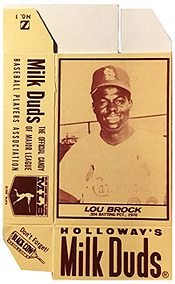
Leave it to Lou Brock to find a hole in a five-man infield.

On June 27, 1972, the Expos put five players on the infield in an attempt to escape a jam against the Cardinals.

Brock did what the Expos hoped he would _ hit a ground ball _ but it eluded the infielders and bounded into the outfield for a game-winning hit.

Stacking the infield

After a loss to Sam McDowell and the Giants dropped their record to 24-32, the Cardinals won six in a row heading into a Tuesday night doubleheader versus the Expos at Busch Memorial Stadium in St. Louis.

The Expos’ starting lineup in Game 1 featured a pair of former Cardinals (Tim McCarver, making his second career start at third base, and center fielder Boots Day), two future Cardinals (right fielder Ron Fairly and first baseman Mike Jorgensen) and a St. Louis native (second baseman Ron Hunt).

After the Cardinals came back from a 3-0 deficit and tied the score, the game went to extra innings.

In the 11th, with the bases loaded and one out, Brock came to bat against closer Mike Marshall, who was working his fourth inning. Marshall’s signature pitch was a screwball, which batters tended to hit on the ground.

Hoping for a ground ball to create either a force at the plate or a double play, if Marshall couldn’t get Brock to strike out or hit a pop-up, Expos manager Gene Mauch removed left fielder Jim Fairey and sent utility player Hector Torres to the infield.

Because Brock batted left-handed, the Expos put three infielders on the right side _ first baseman Mike Jorgensen, shortstop Tim Foli (positioned to the right of second base) and second baseman Ron Hunt (stationed between Jorgensen and Foli), according to the St. Louis Post-Dispatch.

On the left side were third baseman Bobby Wine (who had replaced McCarver in the sixth inning) and Torres (positioned to the left of second base).

The two outfielders, Ron Woods in center and Ken Singleton in right, played shallow in case of a pop fly.

Getting it done

Jorgensen at first base moved in a bit from his normal fielding spot so that if Brock did ground the ball to him he could attempt a short throw to the plate. Jorgensen also didn’t want to be too far from the bag in case he needed to beat Brock there to field a relay throw on a double play.

Brock, a spray hitter, did the unexpected, slashing a grounder down the first-base line. The ball zipped past Jorgensen for a single, scoring Scipio Spinks from third with the winning run. Boxscore

“He hit it to the (Expos’) strong point, the right side, and still hit it past them,” Cardinals manager Red Schoendienst said to the Post-Dispatch.

Stunned that Brock, who hit .233 for his career against Marshall, drove the ball where he did, Mauch said, “If I’d have had seven infielders, I wouldn’t have put one right there.”

Brock seemed surprised, too. “It must have been 1967 since I last hit a ball to that spot,” he told The Sporting News.

Read Full Post »

At the Polo Grounds, site of baseball magic for the hometown Giants, the Cardinals got to experience something extraordinary, too.

On June 15, 1952, the Cardinals erased an 11-0 deficit and defeated the Giants, 14-12, at the Polo Grounds, the ballpark located between Coogan’s Bluff and the Harlem River in upper Manhattan.

Eight months earlier, in “The Miracle of Coogan’s Bluff,” Bobby Thomson hit a walkoff three-run home run in the ninth for a pennant-clinching Giants triumph versus the Dodgers.

Thomson was in the lineup the following year when the Cardinals made their improbable comeback.

Sure thing

A crowd of 41,899, the largest of the season in the National League, gathered at the Polo Grounds on a hot, sunny Sunday for a doubleheader between the Cardinals and the Giants.

The first game, which began at 3:22 p.m., featured starting pitchers Sal Maglie of the Giants versus Joe Presko of the Cardinals. Maglie had the best record (9-2) in the league and a 1.94 ERA.

In the second inning, the Giants struck for five runs against Presko, snapping his streak of 18 consecutive scoreless innings.

After the Giants added six more runs in the third against Jack Crimian for an 11-0 lead, confident manager Leo Durocher began substituting, taking out left fielder Bob Elliott and catcher Wes Westrum.

The Giants’ lead “was as safe as money in the bank,” Bob Broeg wrote in the St. Louis Post-Dispatch.

Cardinals first-year manager Eddie Stanky, the former Giant, also considered lifting some starters, but “something inside told me not to make the changes,” Stanky told the Post-Dispatch.

Letting up

The Cardinals, shut out by Maglie for four innings, began their comeback in the fifth, totaling seven runs against him to make the score 11-7. The big hits were a three-run home run by Enos Slaughter, a solo shot by Tommy Glaviano and Stan Musial’s two-run single.

(Musial had a career .474 on-base percentage versus Maglie. In 171 games played at the Polo Grounds against the Giants and Mets, Musial batted .343 with 216 hits.)

“With the big lead, I relaxed,” Maglie told the New York Daily News. “Then they started hitting and, when I tried to bear down again, I just didn’t have it.”

Rookie knuckleball specialist Hoyt Wilhelm relieved, and in the seventh the Cardinals scored three times against him, cutting the deficit to one at 11-10.

Preparing to face George Spencer leading off the eighth, Solly Hemus asked Stanky whether he wanted him to try to draw a walk. Stanky instructed him to swing away. Hemus took a rip at Spencer’s first offering, driving it against the front of the upper deck in right for a home run, tying the score at 11-11.

Max Lanier, the former Cardinal who was traded to the Giants for Stanky, relieved. He retired Red Schoendienst and Musial, but Dick Sisler singled, Peanuts Lowrey drew a walk and Slaughter followed with a single, scoring Sisler and putting the Cardinals ahead 12-11.

Hemus hit another homer, a two-run blow in the ninth against Monty Kennedy, extending the lead to 14-11, and the Cardinals went on to a 14-12 triumph. 

Cardinals relievers Bill Werle, Eddie Yuhas and Willard Schmidt combined to limit the Giants to one run over the last seven innings. Boxscore

Things change

“Greatest rally I’ve ever seen,” Stanky told The Sporting News.

Cardinals coach Buzzy Wares, 66, said, “I’ve been in baseball since 1905 and I’ve never seen anything like that.”

According to the New York Daily News, no Giants team “ever suffered a more humiliating defeat.”

“How the Giants ever contrived to blow that horrendous opener is something that doubtless will remain to plague Durocher for all his days,” the New York Times declared.

When the second game began at 5:52 p.m., less than half of the crowd remained. Those who departed missed the performance of Giants starter Dave Koslo, who pitched a shutout in a game called after seven innings because of darkness. The win was his 11th in a row versus the Cardinals. Boxscore

(A left-hander, Koslo stretched his streak against them to 13 consecutive wins before the Cardinals beat him on Sept. 14, 1952. His career record against the Cardinals was 24-21.)

The day after the doubleheader, the Cardinals took a 7-4 lead into the bottom of the ninth, but Bobby Thomson again did something special, hitting a walkoff grand slam for an 8-7 Giants victory.

Read Full Post »

« Newer Posts - Older Posts »