Feeds:
Posts
Comments

Archive for the ‘Hitters’ Category

(Updated May 8, 2021)

As managers, Red Schoendienst and Dallas Green led teams to World Series championships. As players, they faced one another with the outcome of a game on the line.

On April 28, 1961, Schoendienst, a pinch-hitter, stroked a two-run double against Green in the 11th inning, lifting the Cardinals to a 10-9 walkoff victory versus the Phillies at St. Louis.

Schoendienst, 38, was in his first season back with the Cardinals after being traded by them in June 1956. Green, 26, was in his second season in the majors and trying to overcome persistent shoulder and arm ailments.

After their playing careers, Schoendienst managed the Cardinals to a World Series title in 1967 and Green did the same for the Phillies in 1980.

Heading home

A second baseman of Hall of Fame caliber with the Cardinals, Giants and Braves, Schoendienst was at a career crossroads in 1961. He sat out most of the 1959 season while recovering from tuberculosis and was released by the Braves in October 1960.

Angels general manager Fred Haney, who managed the Braves to a World Series championship in 1957 when Schoendienst was the second baseman, offered him a contract to play for the American League expansion team in 1961. Schoendienst almost accepted, but opted instead for an invitation to spring training with the Cardinals.

Schoendienst was issued uniform No. 16 because the No. 2 he wore for most of his first stint with the Cardinals belonged to catcher Hal Smith. Smith voluntarily gave No. 2 back to Schoendienst.

“When Red was with the Cardinals the first time, he wore No. 2 and had two children,” Smith told the St. Louis Post-Dispatch. “When he was with the Braves, he wore No. 4 and had four children. When he came back to the Cardinals, he was given No. 16, so ….”

Schoendienst made the Opening Day roster, accepting a role as pinch-hitter and backup to second baseman Julian Javier.

“Don’t write me off,” Schoendienst said to The Sporting News. “This is too much fun. I’m not ready to throw in the towel.”

Clutch hit

A switch-hitter, Schoendienst had a sizzling start to the 1961 season, hitting .348 in April.

Dallas Green also did well early for the Phillies. A right-hander, he earned a spot in the starting rotation and pitched a shutout against the Giants in his first appearance of the season.

“For the first time in several years, I can throw without pain,” Green told The Sporting News. “You just can’t imagine what a feeling it is to be able to let go again.”

When the Phillies and Cardinals played on April 28, a raw, chilly Friday night at Busch Stadium, the starting pitchers were Robin Roberts and Ernie Broglio. The Cardinals led 6-1 after four innings, but the Phillies rallied. The game went to extra innings and the Phillies went ahead, 9-8, in the 11th.

Green, the Phillies’ seventh pitcher of the game, was working his third inning when the Cardinals loaded the bases with one out in the 11th.

Sent to bat for pitcher Al Cicotte, Schoendienst lined a double into the right-field corner, scoring Carl Sawatski and Alex Grammas.

“A good pitch, a slider, I think,” Schoendienst said to the Post-Dispatch. Boxscore

Getting it done

Three months later, on July 6, when the Cardinals fired manager Solly Hemus and replaced him with coach Johnny Keane, Schoendienst was added to the staff as player-coach.

Schoendienst led by example, becoming “one of the best pinch-hitters in the business,” the Post-Dispatch noted.

For the season, Schoendienst hit .347 as a pinch-hitter and .300 overall. In 54 plate appearances as a pinch-hitter, his on-base percentage was .407.

In 133 plate appearances overall in 1961, Schoendienst had six strikeouts, or one out of 22 times. No other Cardinal whiffed so infrequently in 1961, The Sporting News reported. Only once did he hit into a double play during the season. 

Schoendienst continued as a player-coach for Keane in 1962, hitting .306 as a pinch-hitter and .301 overall.

He began the 1963 season in the same role, but after going hitless in six plate appearances, the Cardinals opted to remove Schoendienst from the player roster. According to Cardinals Gameday Magazine, general manager Bing Devine informed Schoendienst he could remain with the Cardinals as a coach or make his own deal to sign with another club as a player.

“I’ve talked to five clubs,” Devine told Schoendienst. “They all said they want you.”

Schoendienst chose to stay as a coach, ending his playing days. 

For his big-league career, Schoendienst had better numbers as a pinch-hitter (.305 batting average and .371 on-base percentage) than he did overall (.289 batting average and .337 on-base percentage).

Read Full Post »

Redbirds ventured into the place where the Birdman of Alcatraz once was cooped.

In 1960 and 1961, Cardinals players and coaches visited inmates in the federal penitentiary at Alcatraz.

The first group to make the goodwill tour on June 3, 1960, consisted of Cardinals players Ken Boyer, Alex Grammas, Curt Simmons and Hal Smith.

A year later, on April 21, 1961, the visitors were Cardinals players Stan Musial and Red Schoendienst, and coaches Johnny Keane, Howie Pollet and Harry Walker.

The groups went there while the Cardinals were in San Francisco to play the Giants.

Known as The Rock, Alcatraz was where some of the most notorious criminals served their sentences, though when the Cardinals visited, convicted murderer Robert Stroud, known as the Birdman of Alcatraz, no longer was there. He was moved to the Medical Center for Federal Prisoners in Springfield, Mo., in 1959.


Lawless legend

Alcatraz got its name when Spanish explorer Juan Manuel de Ayala sailed into San Francisco Bay in 1775 and called the rocky island “La Isla de los Alcatraces,” the island of seabirds.

The U.S. Army built a fort on Alcatraz Island in the 1850s and the facility later was made into a military prison.

From 1934-63, the island was the site of a federal penitentiary. Prisoners included gangsters Al Capone and George “Machine Gun” Kelly.

Robert Stroud was at Alcatraz for 17 years (1942-59) but didn’t have birds there. He became a bird expert during his 30 years of incarceration (1912-42) at the Leavenworth federal penitentiary in Kansas.

Burt Lancaster got an Academy Award nomination for best actor for his portrayal of Stroud in the 1962 movie “Birdman of Alcatraz.” Also nominated for Oscars from the film were Thelma Ritter for best supporting actress and Telly Savalas for best supporting actor. Film clip

According to the FBI, 36 convicts tried to escape from Alcatraz in the 29 years it was a federal prison. Nearly all were caught or died trying. A handful were declared missing and never found, most notably Frank Morris and brothers John Anglin and Clarence Anglin. In June 1962, the trio escaped through loosened air vents in their cells and left the island on a rubber raft. They never were found and the FBI, which closed the case in December 1979, concluded the three men probably died in the frigid water and dangerous currents of the bay.

Play ball!

Among the activities available to Alcatraz inmates were handball, table games and softball.

According to the National Park Service, inmates were allowed two hours of yard time each Saturday and Sunday. Softball was played on a patch of lawn, and balls, bats and gloves were provided.

Balls hit over the wall were considered outs, not home runs.

The softball games were well-organized. Individual and team statistics were kept and two leagues were formed. The leagues were based on talent level. The most talented players belonged to a league with four teams: Cardinals, Cubs, Giants and Tigers. The other league had four teams named for minor-league baseball clubs: Bees, Oaks, Oilers and Seals.

In 1938, one of the best softball players at Alcatraz was Lorenzo Murrieth, who was serving 40 years for assault and theft. He batted .402 for the 1938 Alcatraz Cardinals. Murrieth and another top player, William Lucas, led the Alcatraz Cardinals to a .778 winning percentage, best in the league in 1938, according to the National Park Service.

Unlike professional baseball at that time, the Alcatraz softball teams were integrated.

Many Alcatraz prisoners were avid baseball fans. According to the National Park Service, radio jacks were installed in cells on Oct. 4, 1955, and inmates listened on headphones to the broadcast of Game 7 of the World Series between the Dodgers and Yankees.

“Baseball allowed inmates to mentally escape their confinement and experience a brief moment of freedom,” the National Park Service noted.

Fan club

On Thursday, June 2, 1960, Ken Boyer hit a home run, helping the Cardinals to a 4-3 victory over the Giants at San Francisco. The next day, Boyer joined teammates Alex Grammas, Curt Simmons and Hal Smith on the visit to Alcatraz.

The players were familiar names to the Alcatraz audience. Twenty-eight inmates were subscribers to The Sporting News, the magazine reported.

“Most of the prisoners are either violently for the Giants or violently against them,” Simmons said.

One inmate complained to Boyer that Giants owner Horace Stoneham “must have had rocks in his head” when he traded Daryl Spencer and Leon Wagner to the Cardinals for Don Blasingame.

Some prisoners told Smith they lost their allotments of three packs of cigarettes a week by betting on the Cardinals, The Sporting News reported.

When an inmate spoke to Grammas in Greek and Grammas responded in kind, a guard ordered them to talk in English and wanted to know what they had said to one another in the foreign language.

The players told the St. Louis Post-Dispatch that the question they were asked most often by the prisoners was, “Where’s Stan the Man?”

Stepping up

A year later, Musial gave the inmates their wish, joining Red Schoendienst, Johnny Keane, Howie Pollet and Harry Walker for the April 1961 visit the day after the Cardinals arrived in San Francisco for a weekend series.

“One of the inmates comes from East St. Louis and he told me he ate in my restaurant once,” Musial said to the Post-Dispatch.

Keane said, “A lot of them like the Cardinals and they know all about the players, too. They get to hear the Dodgers’ games as well as the Giants through earphones in their cells. No television of any kind.”

In an editorial, The Sporting News saluted the Cardinals for meeting with the prisoners: “This was a simple act of charity and the men involved are to be congratulated for taking the time.”

Read Full Post »

(Updated Dec. 8, 2024)

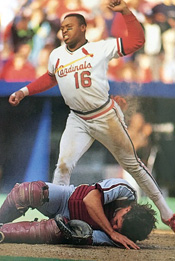
Like a pinball careening across a slick surface, Ray Lankford dived, slid and sped his way into and around the bases, culminating his hyperactive journey with a colossal crash.

On April 21, 1991, Lankford scored the winning run for the Cardinals against the Phillies when he raced from second base to the plate on an infield out, barreling into Darren Daulton and jarring the ball loose from the mitt of the dazed catcher.

The play, reminiscent of the Gashouse Gang Cardinals of the 1930s, became the signature of Lankford’s career.

Hit and run

Lankford brought a football player’s attitude to the Cardinals, who chose him in the third round of the 1987 amateur draft. In addition to playing baseball, he was a starting running back in high school and at Modesto Junior College in California.

An outfielder and left-handed batter, Lankford was in his fourth season in the minors when he got called up to the Cardinals in August 1990. He became their center fielder the following season.

For the Phillies vs. Cardinals game on Sunday afternoon, April 21, at Busch Memorial Stadium in St. Louis, Lankford batted third and had a single and a double in two of his first three plate appearances.

In the seventh, with the Phillies ahead, 6-1, Lankford ignited a comeback with a run-scoring triple against ex-Cardinals reliever Joe Boever. The Cardinals scored four times in the seventh and once in the ninth, tying the score at 6-6.

Game of inches

With one out and none on in the 10th, Lankford faced Phillies closer Mitch Williams, a left-hander. When the count got to 2-and-2, Williams threw a slider he thought was strike three, but umpire Randy Marsh disagreed. Lankford drew a walk on the next pitch.

Felix Jose was next, but Williams focused on Lankford. He made a throw to first that “appeared to have Lankford picked off,” the Philadelphia Inquirer reported.

“We seemed to have him cold,” Phillies manager Nick Leyva said.

Lankford, though, eluded the tag of first baseman John Kruk and got back to the bag safely. “He just slid around me,” Kruk told the Philadelphia Daily News.

Given a reprieve, Lankford stole second. Williams gave an intentional walk to Jose, setting up a forceout or double play possibility with Gerald Perry at the plate.

Going for broke

Perry rapped a hard grounder between first and second. Kruk snared the ball and threw to shortstop Dickie Thon, covering second, for the forceout of Jose.

Thon looked to first, prepared to make a throw to complete an inning-ending double play, but no one was there. Williams, whose pitching motion took him to the third-base side of the mound, failed to cover the bag at first.

As Thon held the ball, Lankford rounded third and headed for the plate, never looking to see whether coach Bucky Dent was giving the stop sign. “From the start, I just decided I was going,” Lankford said to the St. Louis Post-Dispatch.

Hung out to dry

Phillies second baseman Randy Ready told the Philadelphia Inquirer, “Lankford was hustling … I started screaming at Dickie to throw home.”

Thon’s throw to Daulton arrived ahead of Lankford, who lowered his shoulder and slammed into the catcher “with the force of an 18-wheeler hitting a brick wall,” the Philadelphia Inquirer reported.

Daulton toppled and the ball fell from his glove, enabling Lankford to score the winning run for a 7-6 victory. Boxscore

Lankford separated Daulton “from both the baseball and his senses,” wrote Paul Hagen of the Philadelphia Daily News. Video

“He got me pretty good,” Daulton said. “It was bang-bang.”

Feeling woozy, Daulton said, “I saw him out of the corner of my eye and then I don’t remember.”

Lankford told the Post-Dispatch it was his first plate collision. “I’ll do anything to win a game,” Lankford said. “It’s not that I want to hurt anybody or anything, but I’ll do whatever I have to do to score.”

Recalling the play for an interview with the 2016 Cardinals Yearbook, Lankford said, “It was really a base-running mistake, but it ended up paying off for us.”

Read Full Post »

In a game of role reversals, Gene Stechschulte was up to the challenge.

On April 17, 2001, Stechschulte, a Cardinals relief pitcher, made his first plate appearance in the majors. Pinch-hitting against Diamondbacks starter Armando Reynoso, Stechschulte hit a two-run home run at Busch Memorial Stadium.

A reliever pinch-hitting in his first plate appearance wasn’t the only unusual occurrence in the game. Bobby Bonilla, a Cardinals first baseman and outfielder, made his first pitching appearance since high school, working the last inning in the 17-4 rout by the Diamondbacks.

College clouter

Stechschulte was a hitter before he became a pitcher. As a shortstop for Ashland University in Ohio, he set school records for total bases, home runs and RBI, leading the club to a NCAA Division II World Series appearance in 1995.

After Stechschulte graduated first in his class from Ashland’s school of business and economics with summa cum laude honors, he signed with the Cardinals in June 1996 and became a relief pitcher in their farm system.

A 6-foot-5 right-hander, Stechschulte had 33 saves for Peoria in 1998 and 26 for Memphis in 2000.

He only got to bat one time in the minors and when he did he cracked a double for Memphis.

Surprise swat

Stechschulte made his Cardinals debut in 2000 and was 1-0 in 20 relief appearances, shuttling back and forth between St. Louis and Memphis.

In 2001, he opened the season with the Cardinals and allowed only one run in his first five relief appearances.

On April 17, a Tuesday night at St. Louis, the Diamondbacks scored eight runs in three innings against Cardinals starter Dustin Hermanson and seven more versus reliever Chad Hutchinson.

In the sixth inning, with the Diamondbacks ahead, 15-1, the Cardinals had Albert Pujols on first, two outs, and reliever Mike James due to bat.

Cardinals manager Tony La Russa, who had substituted liberally after the Diamondbacks built their lead, wanted a pinch-hitter, but his options were limited. He chose Stechschulte, even though he’d never batted in the big leagues.

Stechschulte swung at the first pitch and hit it over the wall in left-center for a two-run home run.

“One pitch, and whack!” broadcaster Jack Buck said on the air. “What a surprise that was.” Video

Stechschulte said it was his first home run since he was Ashland’s cleanup hitter in 1996.

“Most of the guys back home still think of me as a hitter and not a pitcher,” Stechschulte told the St. Louis Post-Dispatch. “They’re probably more surprised that I’m pitching.”

In the ninth, La Russa had Bonilla pitch in a big-league game for the first time and he gave up two runs, including a home run to the first batter he faced. Boxscore

Special fraternity

Stechschulte was the fifth Cardinals player to hit a home run in his first big-league plate appearance. Since then, others have done it. The complete list:

_ Eddie Morgan, pinch-hitter, April 14, 1936, vs. Cubs.

_ Wally Moon, center fielder, April 13, 1954, vs. Cubs.

_ Keith McDonald, pinch-hitter, July 4, 2000, vs. Reds.

_ Chris Richard, left fielder, July 17, 2000, vs. Twins.

_ Gene Stechschulte, pinch-hitter, April 17, 2001, vs. Diamondbacks.

_ Hector Luna, second baseman, April 8, 2004, vs. Brewers.

_ Adam Wainwright, pitcher, May 24, 2006, vs. Giants.

_ Mark Worrell, pitcher, June 5, 2008, vs. Nationals.

_ Paul DeJong, pinch-hitter, May 28, 2017, vs. Rockies.

_ Lane Thomas, pinch-hitter, April 19, 2019, vs. Mets.

Stechschulte became the 16th major-league player to hit a home run on the first pitch in his first plate appearance. He also was the 13th big-league player to hit a pinch-hit home run in his first plate appearance.

Paid to pitch

A week later, on April 25, 2001, Stechschulte got his first big-league save, with 2.1 innings of scoreless relief against the Expos at St. Louis. Boxscore

“Getting this save was definitely more exciting than the home run because we won this game,” Stechschulte told the Post-Dispatch. “It feels better to contribute to a victory. Pitching like that is my role on this team. My role is not to hit.”

The next day, though, La Russa again sent Stechschulte to pinch-hit for Mike James. Stechschulte coaxed a walk from Expos pitcher Masato Yoshii. Boxscore

On May 10, Stechschulte pitched two scoreless innings of relief against the Pirates and produced a RBI-single versus Scott Sauerbeck. Boxscore

For the season, Stechschulte was 1-5 with six saves. He had two hits and a walk in four plate appearances.

The next year, 2002, was Stechschulte’s last in the majors. He had a 6-2 record for the Cardinals and was hitless in two at-bats.

Stechschulte became head baseball coach at Ohio Northern University in 2012. His teams set a school record with 79 victories from 2014-2016.

Read Full Post »

In September 1972, the Cardinals gave Ken Reitz a look in the majors for the first time and liked what they saw.

Playing with confidence and aggressiveness, Reitz, 21, fielded smoothly and hit for average, convincing the Cardinals he was ready to be their third baseman.
In two stints with the Cardinals, Reitz led National League third basemen in fielding percentage five times (1973, 1974, 1977, 1978 and 1980) and won a Gold Glove Award (1975).

His surehanded glovework earned Reitz the nickname “Zamboni” because, like the machine, he cleaned everything in his path on the artificial turf at Busch Memorial Stadium in St. Louis.

A right-handed batter, Reitz played in the majors for 11 seasons, including eight with the Cardinals.

Giants fan

A son of a beer distributor, Reitz grew up in Daly City near Candlestick Park in San Francisco. “When I was a kid, I used to sneak into Candlestick over the fence,” Reitz told the San Francisco Examiner. “That’s before they enclosed the park.”

His favorite player was Giants slugger Willie McCovey.

The Cardinals chose Reitz in the 31st round of the 1969 amateur draft. Signed as a shortstop for $3,000, Reitz, 18, played first, second and third for Cardinals farm clubs in 1969. At the Florida Instructional League in the fall, he played 10 games at catcher and also was tried in the outfield.

Reitz settled in at third base in 1970 and began a steady rise through the Cardinals’ farm system. With Class AAA Tulsa in 1972, he led the club in doubles (26) and RBI (66) and dazzled with his defense, even though he twice dislocated his left shoulder.

“Ken is an aggressive hitter,” Tulsa manager Jack Krol told The Sporting News. “He’s not going to be cheated. You might say he’s a lot like Joe Medwick. If the ball is quite a bit outside, he’ll still swing.”

Regarding Reitz’s fielding, Krol said, “Ken makes the play coming in as well as any third baseman I’ve seen.”

Born for baseball

In late August 1972, the Cardinals sent first baseman Matty Alou to the Athletics, clearing the way for Joe Torre to move from third to first and for Reitz to get a chance at third.

Reitz was a refreshing addition to a Cardinals club that was out of contention. Bob Broeg of the St. Louis Post-Dispatch described Reitz as a “throwback to an era when ballplayers came to play nothing but baseball.”

When asked on a National League questionnaire about his ambition outside of baseball, Reitz answered, “Baseball is my life. I have always wanted to be a professional baseball player. I was born with a baseball glove in one hand and a bat in the other.”

Asked about his hobbies, Reitz replied, “Hitting line drives.”

Wearing uniform No. 47, Reitz made his Cardinals debut against the Expos at St. Louis on Sept. 5, 1972, and had two hits, two runs and a RBI. Boxscore

In a doubleheader versus the Mets on Sept. 8 at New York, Reitz had four hits in the first game and three in the second. Boxscore and Boxscore

After five games in the majors, Reitz was batting .571 (12-for-21). On Sept. 19, he drove in the winning run against the Phillies in the 10th inning at St. Louis. Boxscore

In 21 games for the 1972 Cardinals, Reitz hit .359 and had 10 RBI.

The Cardinals liked his hitting and fielding, but not his lack of speed. They hired UCLA track coach Jim Bush to put Reitz on a running and conditioning program during the off-season in California. Bush had success with several athletes, including Lakers guard Jerry West, Rams receiver Lance Rentzel and UCLA quarterback Mark Harmon, the future actor.

“Harmon’s dad, Tom, asked me to work with him,” Bush told The Sporting News. “Mark’s legs were as good when the football season ended as they were at the start. My running program really paid off for him.”

Defense matters

The Cardinals opened the 1973 season with rookies on the left side of the infield, Reitz at third and Ray Busse at shortstop. Reitz switched from No. 47 to No. 44, the same worn by his boyhood hero, Willie McCovey.

April was a tough month for the club. The Cardinals lost 15 of 18 games. For the month, Reitz hit .177 and Busse hit .114, drawing boos from home fans.

Busse never recovered and was traded to the Astros. Reitz rebounded and hit .256 with 12 RBI in May. He also established himself with his glove.

On May 4, 1973, at Dodger Stadium in Los Angeles, the Dodgers had runners on first and third, one out, in the ninth inning when Joe Ferguson drilled a grounder down the third-base line. Reitz dived, made a backhanded grab, spun and threw a strike to catcher Tim McCarver, who tagged out Bill Buckner.

“The greatest play I’ve ever seen any third baseman make,” Cardinals manager Red Schoendienst said to the Post-Dispatch.

According to the newspaper, Reitz “had to make an arching throw to keep from possibly hitting the runner. He was falling away when he made the throw.”

First baseman Joe Torre said, “I think he threw the ball without looking.” Boxscore

Bob Broeg noted, “It’s nice to have the kind of brilliant plays Ken Reitz has been making at third base, but it’s even nicer to see the routine plays made, the kind that the center fielder and a medley relay of shortstops have been unable to execute.”

Storybook stuff

Another highlight occurred on May 9, 1973, when Reitz hit his first major-league home run. It came against the Giants’ Ron Bryant at Candlestick Park. Reitz’s parents were in the stands, along with some of the boyhood buddies who used to sneak into games with him at Candlestick Park. Boxscore

A month later, Cardinals broadcaster Mike Shannon, the third baseman for the pennant-winning 1967 and 1968 teams, told The Sporting News that Reitz “probably will become the best defensive third baseman the Cardinals ever had.”

“The plays Reitz makes are unbelievable,” Shannon said in June 1973. “For a guy slow afoot, he has the best lateral movement I’ve ever seen. He has great range, a sure and true arm, great confidence, and can come in well on a ball. I think he can become better than, or as good as, Ron Santo, and he’s the best I’ve seen.”

Read Full Post »

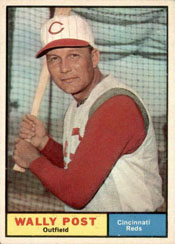
Batting for the Reds against the Cardinals, Wally Post boldly launched a baseball where none had gone before at the original Busch Stadium in St. Louis.

On April 14, 1961, Post hit a home run that struck an Anheuser-Busch sign high atop the scoreboard in left.

If not for the barrier, the ball would’ve carried almost 600 feet, according to estimates. The St. Louis Post-Dispatch called it the “most impressive, most powerful home run hit in Busch Stadium.”

Big bopper

A right-handed batter, Wally Post reached the majors with the Reds in September 1949 when he was 20.

At 6 feet 1 and 190 pounds, he wasn’t exceptionally large but he was exceptionally powerful. Post hit 40 home runs for the Reds in 1955 and 36 in 1956. In 21 games against the 1956 Cardinals, managed by Fred Hutchinson, Post produced nine home runs and 17 RBI.

In 1959, Post beat Hank Aaron in TV’s Home Run Derby. Video

“He was a fun guy who could hit the ball a ton and a good fielder with a strong, accurate arm,” catcher Andy Seminick recalled in the book “We Played the Game.”

For 20 years, the folks at Siebler Clothing Store in Cincinnati offered a free suit to any player whose home run hit their advertising sign behind the left field wall at Crosley Field. The store gave away 176 suits. Post won the most, with 11.

The Reds traded Post to the Phillies for pitcher Harvey Haddix in December 1957 but reacquired him in June 1960 when Hutchinson was the Reds’ manager.

Having gotten thick around the middle, Post dropped weight and showed up at spring training in 1961 focused on beating out Gus Bell for a starting outfield spot. Getting trim enabled Post to swing the bat more freely and the results were impressive. He hit seven home runs in spring training games.

“It just shows what a fellow can do when he gets himself in shape and comes down here determined to win a job,” Hutchinson told The Sporting News. “Post’s power has been tremendous.”

We have liftoff

In the Reds’ season opener at home against the Cubs, Post started in right field and hit a three-run home run.

Three days later, the Reds were in St. Louis to play in the Cardinals’ Friday night home opener at Busch Stadium. Batting in the cleanup spot, Post had a triple and a walk in his first two plate appearances against starter Curt Simmons.

In the sixth, the Cardinals led, 3-0, when Post came up with one on and two outs. The first pitch from Simmons was to Post’s liking. As soon as he swung, the players knew it was something special.

Left fielder Stan Musial turned his head and watched the ball soar. “It was like a man in orbit,” Musial said to the Cincinnati Enquirer.

Simmons told The Sporting News, “Usually I don’t watch homers, but this one I had to see.”

Applied science

The ball cleared the wall and rocketed over the bleachers. Behind the bleachers was the massive scoreboard. Attached to the top of the scoreboard was a rectangular Budweiser sign. Atop the Budweiser sign was a square sign showing a neon Anheuser-Busch eagle. The animated eagle flapped its wings when a Cardinal hit a home run.

Post’s projectile pounded high off the Anheuser-Busch sign near the eagle’s beak. “The ball almost made the eagle scream,” the Post-Dispatch noted.

In his book “Pennant Race,” Reds reliever Jim Brosnan wrote, “That’s about as high and hard as a ball can be batted by a human being.”

The Anheuser-Busch sign was about 90 feet from the ground. “That ball still had juice left in it when it hit the sign,” Hutchinson said.

Reds pitcher Jay Hook, pursuing a master’s degree in mechanical engineering at Northwestern University, estimated the ball would have carried 569 feet if its path hadn’t been impeded.

“The ball carried about 150 feet a second,” Hook told the Post-Dispatch.

Cardinals outfielder Charlie James, who had an electrical engineering degree from the University of Missouri, agreed the ball would have gone nearly 600 feet.

Nothing like it

Musial, who two innings earlier hit a pitch from Hook over the pavilion roof in right and onto Grand Boulevard, told the Post-Dispatch, “Post’s shot made mine look like a bunt.”

In comments to The Sporting News, Musial said Post’s home run was “the most powerful I’ve ever seen.”

“I’ve seen some balls go halfway up on that scoreboard but never up there,” Musial told the Dayton Daily News.

Hutchinson said, “That’s the longest homer I ever saw.”

Cardinals manager Solly Hemus and broadcaster Harry Caray echoed Hutchinson’s comment. Cardinals general manager Bing Devine said, “Post’s ball has got to be the longest here” at Busch Stadium, formerly known as Sportsman’s Park.

Bill DeWitt Sr., who worked in the front offices of the Cardinals and Browns before becoming Reds general manager, said there was no doubt Post’s home run was a record for the ballpark.

“Paul Easterling of the Tigers hit one out of here at the top of the pavilion roof in center,” DeWitt told the Post-Dispatch. “Babe Ruth hit some long ones here, but they were into the center field seats.”

Scoreboard engineer Lou Adamie recalled Luke Easter of the Indians hitting a ball over the pavilion extremity in center, but agreed Post’s was the mightiest.

Cardinals outfielder Bob Nieman said Post’s home run would have gone at least as far as Mickey Mantle’s epic shot against Chuck Stobbs of the Senators at Washington’s Griffith Stadium in 1953. Mantle’s homer cleared the left field bleachers and was estimated to go more than 500 feet.

Cardinals crusher

Post, 31, told the Dayton Daily News that “everything was perfect” with his swing on the tape-measure home run.

“I only wish a sequence camera had recorded the swing so I could study what I did right,” Post said to the Cincinnati Enquirer. Boxscore

Post hit 20 home runs in 99 games for the 1961 Reds, who won the National League pennant. In 13 games versus the 1961 Cardinals, Post hit five home runs and batted .342. Ten of his 13 hits against the Cardinals were for extra bases.

In the World Series against the Yankees, Post hit a home run and batted .333.

Four years later, Jim Wynn of the Astros hit a home run that struck the Budweiser sign on the Busch Stadium scoreboard, a mammoth shot, but still short of where Post’s ball landed.

Read Full Post »

« Newer Posts - Older Posts »