Feeds:
Posts
Comments

Archive for the ‘Hitters’ Category

Gene Tenace brought to the Cardinals a winning pedigree, leadership and a consistent ability to get on base. Willing to accept a reserve role as a catcher and first baseman, Tenace was a good fit for a franchise looking to change its culture and transform from underachievers to champions.
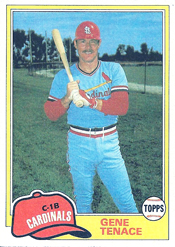
On Dec. 8, 1980, the Cardinals got Tenace, pitchers Rollie Fingers and Bob Shirley, and a player to be named, catcher Bob Geren, from the Padres for catchers Terry Kennedy and Steve Swisher, infielder Mike Phillips and pitchers John Littlefield, John Urrea, Kim Seaman and Al Olmsted.

Fingers, a closer and future Hall of Famer, was the player who got the attention for the Cardinals when the deal was made, but Tenace was the one who contributed the most.

Four days after acquiring Fingers, Whitey Herzog, who had the dual roles of Cardinals manager and general manager, dealt him and another future Hall of Famer, catcher Ted Simmons, to the Brewers. Tenace remained with the Cardinals for two years, fulfilled the role Herzog envisioned for him, and helped them become World Series champions in 1982.

Finding his way

Tenace was born Fiore Gino Tennaci in Russelton, Pa. He grew up in Lucasville, Ohio, and his name was changed to Fury Gene Tenace because the family wanted it to be more American than Italian.

He was 18 and a shortstop when the Athletics selected him in the 20th round of baseball’s first amateur draft in 1965. Tenace was an outfielder and third baseman in the Athletics’ farm system before he was converted to catcher in 1968.

A right-handed batter, Tenace generated tremendous bat speed. “I play to hit,” Tenace told The Sporting News. “I love to hit.”

A turning point in Tenace’s career came in 1969 when he was assigned to Birmingham, a Class AA club managed by Gus Niarhos. A former big-league catcher who started for the 1948 Yankees before being replaced by future Hall of Famer Yogi Berra, Niarhos taught Tenace how to play the position.

Tenace, 22, was called up to the Athletics in May 1969. After he went 0-for-4 in his debut against Denny McLain, Tenace got a single the next day versus Luis Tiant for his first hit in the majors.

Though the Athletics liked Tenace’s hitting, the catcher they liked best was Dave Duncan, the future Cardinals pitching coach. Duncan was the Athletics’ starting catcher in 1971, when they won the first of five consecutive division titles.

Duncan was the starter again in 1972 before he went into a hitting slump. “He wasn’t doing it with the bat and it was beginning to affect his catching,” Athletics manager Dick Williams said.

Tenace replaced Duncan for the last two months of the 1972 season, and he was the starter when the Athletics went into the World Series against the Reds.

Valuable player

Tenace took center stage in the 1972 World Series. In Game 1, he became the first player to hit home runs in his first two World Series at-bats. The homers versus Gary Nolan produced all the runs for the Athletics in a 3-2 victory. Boxscore

Tenace hit .348 with four home runs and nine RBI against the Reds and was named most valuable player of the 1972 World Series. Video

Moved to first base in 1973, he had 24 home runs and a .387 on-base percentage. In the World Series against the Mets, Tenace had 11 walks and three hits.

In 1974, when the Athletics won a third consecutive World Series title, Tenace again played first base and hit 26 home runs. He returned to catcher in 1975 and had 29 home runs and an on-base percentage of .395.

Regarding his ability to get on base often, Tenace told the St. Louis Post-Dispatch, “I’ve always used discipline at the plate. I know my limitations. I’ve been in the game long enough to know I can handle only certain pitches.”

Herr almost dealt

Tenace became a free agent after the 1976 season and signed with the Padres. He was tough versus the Cardinals. In 1978, he had 11 RBI in 12 games against them and his on-base percentage was .467.

In 1980, Tenace and Fingers clashed with manager Jerry Coleman and asked to be traded. According to The Sporting News, the Padres tried to trade Tenace to the Cubs in July 1980, but it didn’t work out.

Herzog was interested in both Fingers and Tenace. The Padres wanted a young catcher, and the Cardinals’ Terry Kennedy and the Pirates’ Tony Pena were the two who appealed to them most.

In his book, “White Rat: A Life in Baseball,” Herzog said Kennedy approached him near the end of the 1980 season and asked to be traded to a team needing a starting catcher.

Herzog and Padres general manager Jack McKeon met during the 1980 World Series and agreed to a trade of Kennedy, second baseman Tommy Herr and others for Fingers, Tenace and Bob Shirley. “I can make that deal now,” Herzog told the Post-Dispatch.

Herr said, “I don’t know if I’d like it or not. I want to play with a contender.”

The trade “was close” to being made, The Sporting News reported, but it got held up because of a snag over Fingers’ contract.

Herzog and McKeon resumed their talks at the baseball winter meetings in December. In his book, Herzog said he almost traded Kennedy to the Reds for reliever Tom Hume, but when the Padres agreed to take other players instead of Herr, Herzog closed the deal with them.

Good as advertised

Herzog said Fingers was “the great relief pitcher I needed, but not the one I really wanted. The guy I was really after was Bruce Sutter.”

Fingers was insurance in case Herzog couldn’t make a deal for Sutter.

On Dec. 9, 1980, the day after the trade with the Padres, the Cardinals acquired Sutter from the Cubs. With catcher Darrell Porter joining the Cardinals earlier in the week as a free agent and Sutter filling the closer role, Herzog decided to package Fingers and Ted Simmons in a trade to the Brewers.

Tenace was projected to back up Porter at catcher and Keith Hernandez at first base. Unfazed about a reserve role, Tenace said, “I’ve been adjusting all my life.”

Tenace delivered what was expected of him. He had on-base percentages for the Cardinals of .416 in 1981 and .436 in 1982.

A leader in the clubhouse, he made sure the reserves were as ready as he was to play. Outfielder Tito Landrum said, “If I start having a letdown, he comes over and kicks my rear end. Literally. He pulls no punches. He lets you know.”

After the Cardinals won Game 7 of the 1982 World Series versus the Brewers, Porter, like Tenace in 1972, was named the Series’ most valuable player, meaning the Cardinals had two catchers on the same team who had received the honor.

Tenace became a free agent after the 1982 World Series. Herzog said the Cardinals wanted to keep him, but on a one-year contract. When the Pirates gave Tenace a three-year deal, he accepted.

After one season with the Pirates, Tenace was through playing. He went on to coach, manage and instruct, including a stint with the Cardinals as minor league hitting coordinator from 2002-07.

Read Full Post »

Kerry Robinson encountered multiple roadblocks and detours before he got a chance to play for his hometown Cardinals, completing a family quest his father began several decades earlier.

Robinson, 27, signed a minor-league contract with the Cardinals on Dec. 7, 2000, after becoming a free agent.
An outfielder with speed who hit for contact from the left side, Robinson was a St. Louis native who followed the Cardinals as a youth. His father, Rogers Robinson, spent 11 seasons as an outfielder and first baseman in the Cardinals’ farm system but never played in the majors.

Kerry Robinson was drafted and signed by the Cardinals in 1995 and played in their farm system before he was acquired by the Rays in 1997. Three years later, when he rejoined the Cardinals, Robinson was ticketed for the minor leagues, but he set his sights higher.

All in the family

Robinson was born in St. Louis in October 1973. His mother, Lois, was a special education teacher and his father, Rogers, was a pharmaceutical salesman, according to the St. Louis Post-Dispatch.

Before Kerry came along, Rogers Robinson was a professional baseball player. A St. Louis native and left-handed batter, Rogers Robinson had two stints in the Cardinals’ farm system: 1957-61 and 1964-69. He had a career batting average of .298, with 1,348 hits in 1,256 games, according to baseball-reference.com.

Rogers Robinson twice reached the Class AAA level (1961 and 1964) and hit .300 or better in six seasons. He twice had seasons of more than 80 RBI and he hit 15 or more home runs five times.

Kerry Robinson attended several Cardinals games at Busch Memorial Stadium as a youth. He also developed into a standout baseball, hockey and football player at Hazelwood East High School in St. Louis. As a senior, he scored 29 goals for the hockey team and hit .557 for the baseball team.

“I’m a big hockey fan,” Robinson told the Post-Dispatch. “That’s probably my favorite sport, with football next and then baseball.”

Baseball was the sport Robinson excelled in when he went to college at Southeast Missouri State. He had a 35-game hitting streak, an Ohio Valley Conference record, his senior season.

While working toward a degree in sports management, Robinson spent time as a public relations intern for the NFL Rams, but his future was in baseball. The Cardinals chose him in the 34th round of the June 1995 amateur baseball draft.

Winding road

Robinson adapted quickly to professional baseball. In 1995, his first season, he hit .296, with 74 hits in 60 games, for Johnson City.

At spring training the next year, Robinson caught the attention of Cardinals manager Tony La Russa. “Tony said, ‘If you keep hitting like you are now, you’ll be playing here.’ ” Robinson told the Post-Dispatch.

Assigned to Peoria in 1996, Robinson hit .359 and had an on-base percentage of .422. He also had 50 stolen bases. He got promoted to Class AA Arkansas in 1997 and did well again, hitting .321, swiping 40 bases and producing an on-base percentage of .386.

At 24, his career was on the rise, but it took a turn when the Rays selected him in the American League expansion draft in November 1997.

Called up to the Rays in September 1998, Robinson went hitless in three at-bats, got waived and was claimed by the Mariners, who sent him back to the minors. Traded to the Reds in July 1999, Robinson was called up in September, used as a pinch-runner and was hitless in one at-bat.

Released by the Reds in March 2000, Robinson considered quitting, but instead signed with the Yankees, his fifth organization. He went to their Columbus farm club, hit .318 and had 37 stolen bases.

Granted free agency after the 2000 season, Robinson returned to the Cardinals, who assigned him to Class AAA Memphis.

Opportunity knocks

Though he was a non-roster player, Robinson was determined to make an impression at Cardinals spring training camp in 2001.

“My dream is to play in Busch Stadium this season, even if it’s only one game, or one at-bat,” Robinson told columnist Bernie Miklasz. “I grew up watching baseball at Busch Stadium and I want to be on that field.”

Robinson hit so well throughout spring training that after he was reassigned to the minor-league complex the Cardinals brought him back to play in big-league exhibition games.

Robinson opened the 2001 season with Memphis, batted leadoff and hit .325 in 10 games. When Mark McGwire went on the disabled list on April 18, 2001, the Cardinals called up Robinson to fill a reserve outfield spot while Craig Paquette and Bobby Bonilla moved to first base to substitute for McGwire.

Asked about getting to the big leagues with the Cardinals after his father had tried so long to do the same, Robinson told the Post-Dispatch, “I’m sort of living out his dream. I’m so proud I can do that.”

Welcome to the club

On April 24, 2001, Robinson got his first major-league hit, an infield single for the Cardinals against the Expos’ Masato Yoshii. Boxscore

A month later, Robinson got his first major-league start in the outfield and got a two-run single for his first RBI, giving the Cardinals the lead in a victory against the Brewers. Boxscore

After getting two hits in a start in center versus the Reds on June 4, 2001, Robinson was hitting .368 for the season.

“He’s got a nice calmness about him,” La Russa said. “It’s like he hasn’t been intimidated at all. He’s really had some good at-bats in clutch situations. When he puts it in play, he runs like hell.”

Bernie Miklasz noted, “Robinson is a polished hitter. He knows how to work pitchers, he can draw walks, he makes contact.”

Going deep

On June 17, 2001, Robinson entered a game against the White Sox after McGwire was ejected for arguing a called third strike. Batting in the cleanup spot, Robinson hit his first major-league home run. Boxscore

Robinson hit .285 and had 11 stolen bases for the 2001 Cardinals. In the decisive Game 5 of the National League Division Series against the Diamondbacks, he batted for McGwire in the ninth inning and executed a sacrifice bunt. Boxscore

Robinson hit .260 for the Cardinals in 2002 and .250 in 2003.

Though optioned twice to the minors during the 2003 season, Robinson came back and hit .356 for the Cardinals in August. A highlight was a walkoff home run to beat the Cubs on Aug. 28, 2003. Boxscore and Video

Bernie Miklasz wrote, “Robinson’s hunger and energy are good for the team.”

“He’s an igniter for us,” said La Russa. “He’s got a good idea about being aggressive with a ball in the strike zone, not taking those pitches.”

In March 2004, the Cardinals traded Robinson to the Padres for outfielder Brian Hunter, who was released two months later and never played a game for them.

Read Full Post »

In 1980, catcher Darrell Porter received treatment for drug and alcohol addiction, slumped in the second half of the season and had a terrible World Series for the Royals. The Cardinals signed him anyway.

On Dec. 7, 1980, Porter agreed to a five-year, $3.5 million offer to be the Cardinals’ catcher, supplanting one of the franchise’s best players, future Hall of Famer Ted Simmons. According to the Associated Press, the deal made Porter baseball’s highest-paid catcher.
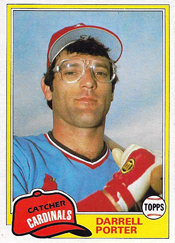
A free agent who had spent his career in the American League with the Brewers and Royals, Porter, 28, had a bond with Whitey Herzog, who had the dual role of Cardinals manager and general manager. Herzog was Porter’s manager with the Royals from 1977-79 and was credited with reviving Porter’s career.

With Porter again at a crossroads, Herzog gave him another chance.

Helped by Herzog

Born in Joplin, Mo., and raised in Oklahoma City, Porter was 18 when he was selected by the Brewers in the first round of the June 1970 amateur baseball draft. He made his debut in the majors a year later in September 1971.

In six seasons with the Brewers, Porter, a left-handed batter, hit .229. He reached a low point in 1976 when he hit .208. Porter was “beset with personal problems, principally a divorce,” during the 1976 season, the Associated Press reported.

On Dec. 6, 1976, the Brewers traded Porter to the Royals, and Herzog went to work on getting him to fulfill his potential.

“I’ve played for quite a few managers, but I’ve never respected one more than Whitey,” Porter told The Sporting News. “He gave me back a lot of confidence.

“Whenever I would get discouraged and feel like I didn’t belong in the major leagues, Whitey would tell me, ‘You’re my catcher. You’ll come back and feel OK tomorrow.’ Just the way he said it made me believe in myself.”

Porter helped the Royals win division titles in 1977 and 1978. His breakout season came in 1979 when he hit .291 and had an on-base percentage of .421. He led the league in walks (121), scored 101 runs and drove in 112. According to The Sporting News, Porter joined Mickey Cochrane of the 1932 Athletics as the only American League catchers with 100 runs, 100 walks and 100 RBI in a season.

Though Porter excelled, the Royals failed to win a division title for the first time in four years, and Herzog was fired. According to columnist Dick Young, when Porter heard the news, he called Herzog and cried.

Destructive demons

At spring training the next year, Porter left camp and was admitted to The Meadows, a facility in Wickenburg, Ariz., to get help for his addictions.

Dick Young suggested, “Porter would not have retrogressed had Herzog still been there for him to turn to.”

Porter admitted he was “a drug addict and an alcoholic” who “almost destroyed myself.”

“From this day forward, I will be facing the greatest challenge of my life,” Porter said.

Porter returned to the Royals’ lineup in May 1980. He spent a month as the designated hitter, batting .314 with 26 RBI in 22 games in May. When he went back to catching, his hitting declined. He hit .224 in August and .109 in September. For the season, Porter hit .249 with 51 RBI.

The 1980 Royals won the franchise’s first American League pennant and advanced to the World Series against the Phillies.

The Royals lost four of six games to the Phillies and Porter was part of the reason. In Games 1 and 5, both one-run losses for the Royals, Porter was thrown out at home attempting to score. He hit .143 for the Series.

Afterward, Porter, who became a free agent, told The Sporting News, “I can’t picture myself ever leaving Kansas City.”

Asked whether the Royals would attempt to keep Porter, club owner Ewing Kauffman said, “Depends on how silly other clubs are in offering him money. The Darrell Porter of the last four months is not the same as the Darrell Porter of a year ago.”

Royals flushed

The bidding for Porter came down to the Royals and Cardinals.

In his book, “White Rat: A Life in Baseball,” Herzog said, “I wanted Porter a lot. The big question mark was drugs, but knowing Darrell as I did, I was sure that if he said he was OK, he was OK.”

On Dec. 5, 1980, two days before the start of the baseball winter meetings, Herzog told Porter’s financial advisor, Frank Knisley, he’d withdraw the Cardinals’ offer if he didn’t receive an immediate answer.

“I wasn’t going to leave my offer out there while they shopped,” Herzog told the Kansas City Times. “I wanted an answer before the meetings or I’d pull out, take our offer off the board.”

Knisley called Royals general manager Joe Burke “and asked him if he could give me what the Cardinals were offering, or if he could come close,” Porter told the Associated Press. “Joe said no. He said what he had in mind was a three-year contract. It was for so much less that there really was no decision.”

Porter added, “It would have cost me over a million dollars to stay with the Royals. I stopped being a fool when I left The Meadows.”

Burke told the Kansas City Star, “We’d love to have Darrell Porter, but when you stop and analyze it, Darrell had a bad year and we were still able to win.”

Stepping on Simmons

While Porter was on a honeymoon cruise in the Caribbean, he and the Cardinals reached an agreement on Dec. 6 and it was announced at the start of the baseball winter meetings on Dec. 7.

With Porter as catcher, Herzog said he planned to move Ted Simmons to first base and shift Keith Hernandez from first base to left field.

Herzog spoke with Simmons on Dec. 5 about moving to first base, the St. Louis Post-Dispatch reported.

“I like Ted Simmons,” Herzog said. “I think he’s a winner … but Darrell Porter is my catcher.”

Porter said, “I don’t want to cause any problems, that’s for dang sure. Ted could help me a whole lot.”

Initially, Simmons told the Post-Dispatch, “I would think I’ll be playing a lot of first base and it’ll be just fine with me, but I don’t know if it will be just fine for Keith. You’re taking a Gold Glove and putting him somewhere where he might not win another one.”

Regarding Porter replacing him, Simmons said, “There’s going to come a time when you’re not going to be able to catch forever. It certainly isn’t bad judgment to find someone who is qualified and capable, and I presume he is.”

Simmons later said to the Post-Dispatch his understanding of Herzog’s decision was he would play first base only once in a while. Simmons said he didn’t want to play first base every day, in part because he couldn’t compare with Hernandez, and would prefer to be traded.

Herzog responded, “I think we can win with Ted Simmons at first base, but if he wants to be traded, we’ll trade him.”

Series standout

On Dec. 12, 1980, Simmons was dealt to the Brewers, creating an uproar among the Cardinals’ fan base and a backlash against Porter.

Porter told The Sporting News, “I just hope the fans don’t resent me all year.”

He also was starting to feel homesick. “When I get to thinking about leaving Kansas City, I get real depressed,” he told the Associated Press.

Two years later, Simmons and the Brewers were matched against Porter and the Cardinals in the 1982 World Series. Porter helped the Cardinals get there. In the National League Championship Series versus the Braves, Porter had five hits and five walks in 14 plate appearances and was named most valuable player. He followed up with eight hits, a walk and five RBI in the World Series and again was selected most valuable player when the Cardinals prevailed.

In his book, “You’re Missin’ a Great Game,” Herzog said, “Porter’s style was the kind that turns chumps into champions.”

In five seasons with St. Louis, Porter hit .237, but Herzog saw attributes beyond batting average. In the book “Whitey’s Boys,” Herzog said, “He was the kind of guy who could hit .220 and help a team just about as much as a guy who hit .300 and didn’t pull the ball. When he got a hit, everybody advanced two bases, and when he made an out, they advanced one base. He could do more a lot of times making an out than a guy who hit a clunker to left field.”

As for Porter’s catching, Herzog said, “He had a knack of knowing how his pitchers got people out. He didn’t catch as much against the hitter as he caught to the strength of the pitcher.”

After the 1985 World Series, when Porter allowed a critical passed ball in Game 6 Video, he became a free agent, signed with the Rangers and played his last two seasons with them.

Read Full Post »

(Updated Dec. 9, 2020)

Lance Berkman wanted to return to the National League, and the Cardinals were willing to give him the chance.

On Dec. 4, 2010, the Cardinals and Berkman agreed to terms on a one-year contract for $8 million. The Cardinals projected Berkman to be their right fielder in 2011 and join Albert Pujols and Matt Holliday in the heart of the batting order.
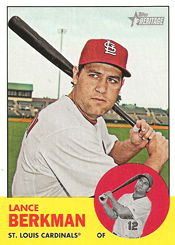
A switch-hitter who became a free agent after the 2010 season, Berkman, 34, hadn’t played the outfield regularly since 2004. He split the 2010 season with the Astros and Yankees, playing first base and designated hitter, and disappointed at the plate, hitting .248 with 14 home runs and 58 RBI in 122 games combined for the two teams.

The Cardinals, though, were confident Berkman in 2011 would be more like the player they’d been accustomed to seeing in his prime with the Astros.

“Lance’s talent, his character and what he brings to the club makes us a better team and changes the makeup of the clubhouse,” Cardinals general manager John Mozeliak told the St. Louis Post-Dispatch. “It’s a big add.”

Houston hitter

While with the Astros from 1999 to 2010, Berkman hit .296 and had an on-base percentage of .410. He produced more than 100 RBI in a season six times, slugged 30 or more home runs five times and also scored more than 100 runs five times with Houston. In addition, Berkman twice led the National League in doubles, 55 in 2001 and 46 in 2008, and was No. 1 in RBI in 2002 (128).

Berkman was tough on the Cardinals. He hit .313 against them for his career, with an on-base percentage of .415. In 13 postseason games versus the Cardinals, Berkman had 12 RBI.

He played the outfield from 1999 to 2004 before moving to first base.

Before the 2010 season, Berkman had arthroscopic knee surgery. He missed the first two weeks of the season before joining the Astros on April 20. Scouts said Berkman wasn’t fully recovered when he returned to the lineup and “the lack of leg strength hurt his swing,” the New York Daily News reported.

Berkman hit .245 with 13 home runs for the 2010 Astros, who dropped out of contention early. His batting average against left-handers was .188.

Berkman’s contract gave the Astros the option to bring him back for 2011 at a salary of $15 million, or pay him a $2 million buyout and let him become a free agent. A more appealing option was to trade him for prospects.

The Yankees, who had Mark Teixeira at first base, were interested in Berkman as a designated hitter. Berkman agreed to waive the no-trade clause in his contract if the Yankees would pay him the $2 million buyout after the season and allow him to become a free agent.

On July 31, 2010, the Astros dealt Berkman to the Yankees for Mark Melancon and Jimmy Paredes.

Trying on pinstripes

The Yankees were contending with the Rays for the American League East title and hoped Berkman would give them an edge.

“Berkman long has been considered a tough out, a smart, patient hitter who always has a high on-base percentage,” wrote New York Daily News columnist John Harper.

It was an adjustment for him trying to play for a contender in the American League after spending his whole career in the National League.

“When you’re a veteran _ I’m 34, which isn’t necessarily ancient but definitely getting toward more yesterdays than tomorrows in the game _ you start to see the window for an opportunity to win, and feel the rush of the playoffs, close,” Berkman said.

“I really feel like I had to do something with my career. I felt like I needed to either retire, or get into a situation where you’re scared again, where if you fail, then you’re a bum. I want that situation. I want to see what I’ve got.”

Berkman wasn’t much of an upgrade for the Yankees. He hit .255 for them, with one home run. His batting average versus left-handers was .111.

The Yankees got to the American League Championship Series before being eliminated by the Rangers.

Right stuff

Berkman became a free agent and got offers from two American League clubs, the Athletics and White Sox, to be a first baseman and designated hitter. The Athletics offered a two-year contract, according to the Post-Dispatch.

The Cubs also wanted Berkman as a first baseman.

The Cardinals countered with an invitation to play the outfield.

In his book, “If These Walls Could Talk,” author Stan McNeal said the Cubs “came close” to landing Berkman, “but after the Cardinals offered $4 million, Berkman told St. Louis if the team upped it to $8 million with no incentives, he wouldn’t bother with the Cubs.”

“I didn’t want to limit myself to first base or designated hitter,” Berkman told the Post-Dispatch. “I know I can run around in the outfield. I don’t foresee that as an issue.

“It worked out how I wanted. I love the National League.”

The Cardinals, who had Albert Pujols at first base, planned to feature a 2011 starting outfield of Matt Holliday in left, Colby Rasmus in center and Berkman in right. The club viewed Berkman as a player who would “reshape its lineup and its personality,” the Post-Dispatch reported.

It turned out to be an ideal fit.

In his book, author Stan McNeal said, “In the off-season after signing with St. Louis, Berkman retained a personal trainer for the first time and strengthened his knees and lost 20 pounds.”

Berkman hit .301 for the 2011 Cardinals and led the club in walks (92) and on-base percentage (.412). He hit 31 home runs, drove in 94 runs and scored 90. He also was a leader in the clubhouse.

Berkman’s return to prominence earned him the 2011 National League Comeback Player of the Year Award.

The Cardinals (90-72) qualified for the postseason as a wild-card entry, beat the Phillies and Brewers, and won the National League pennant.

Berkman excelled in the World Series against the Rangers. He had a team-high 11 hits, including a run-scoring, two-out single in the 10th inning of Game 6 to tie the score and set the stage for David Freese’s walkoff home run in the 11th. Boxscore and Video

Among Cardinals regulars, Berkman was the leader in batting average (.423) and on-base percentage (.516) in the seven-game World Series.

Limited to 22 games in 2012 because of knee injuries, Berkman became a free agent after the season and completed his playing career with the 2013 Rangers.

Read Full Post »

The Cardinals had the right idea, but the wrong position in mind, when they acquired strong-hitting Cecil Cooper from the Red Sox.

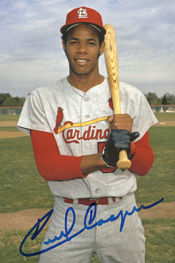
On Nov. 30, 1970, the Cardinals chose Cooper in the Rule 5 draft. Cooper, 20, was the Midwest League batting champion in 1970, but the Red Sox didn’t put him on their 40-man major-league winter roster, leaving him eligible to be drafted by another organization.

The Cardinals took advantage of the opportunity to obtain a left-handed hitter who was tailored for the AstroTurf and spacious dimensions of Busch Memorial Stadium in St. Louis.

Cooper ran well and consistently hit line drives to all fields, but his best position was first base. The Cardinals wanted him for the outfield.

Cards call

A standout high school player in Texas, Cooper was 18 when he was selected by the Red Sox in the sixth round of the June 1968 amateur draft. Assigned to a Class A farm club in Jamestown, N.Y., Cooper impressed, batting .452 with 38 hits in 26 games.

Though he continued to hit well, Cooper stayed in Class A the next two seasons. He hit .297 as the first baseman for Greenville, S.C., in 1969 and .336 for Danville, Ill., in 1970. Cooper primarily played first base for Danville but he also appeared in the outfield in 47 games.

The Cardinals were looking for backup outfielders for the 1971 season. When Cooper was left unprotected, the Cardinals paid the required $25,000 fee to draft him and put him on their 40-man major-league winter roster as an outfielder.

Either the Cardinals thought Cooper had a good chance to make the leap from Class A to the major leagues, or they figured the Red Sox wouldn’t want him back. Under the rules of baseball, if a player claimed in the Rule 5 draft is not kept on the major-league roster throughout the following regular season, he must be offered back to the team that lost him for $12,500.

Plenty of competition

The Cardinals went into 1971 spring training with a starting outfield of Lou Brock in left, Matty Alou in center and Jose Cardenal in right. Seven other players listed as outfielders on the big-league roster were competing for backup spots. In addition to Cooper, others in the mix were Jim Beauchamp, Bob Burda, Jose Cruz, Leron Lee, Luis Melendez and Jorge Roque.

Of the backup outfielder candidates, Burda, Cooper, Cruz and Lee batted from the left side. Another left-handed batter, Joe Hague, was the starting first baseman. Beauchamp, Burda and Cooper could back up Hague as well as play the outfield, but only Cooper lacked big-league experience.

“The Cardinals tried to make an outfielder out of me,” Cooper told The Sporting News.

When the Cardinals began playing intra-squad games, Cooper swung “a pretty stout bat,” according to the St. Louis Post-Dispatch.

In a game with eight position players in the field and batters taking their cuts against a pitching machine, Cooper hit a three-run triple. In an intra-squad game versus pitchers, he had a triple against Santiago Guzman and a double off George Lauzerique. He also substituted for Alou in center field.

“I’m very happy to get this shot with St. Louis and I hope to make the most of it,” Cooper told the Post-Dispatch. “I’ve got to work on my fielding and my throwing.”

Cooper didn’t fare so well in Grapefruit League exhibition games. He had one hit in 11 at-bats. He also walked and scored a run against the Reds. Meanwhile, his competition hit much better: Beauchamp, .408, and Burda, .438.

The Cardinals opened the 1971 season with Beauchamp, Burda, Lee and Melendez in reserve roles. Cruz and Roque were sent to the minors. Cooper was offered back to the Red Sox.

If the Red Sox had said no thanks, the Cardinals could have kept Cooper and assigned him to the minors, but the Red Sox paid the $12,500 to get him back.

Hot hitting

To his dismay, Cooper was assigned by the Red Sox to Winston-Salem, a Class A team, though he already had proven he could play at that level.

“That got me mad, depressed and frustrated,” Cooper said. “I told them, ‘I’m going home,’ and stayed away for five days. I wasn’t going to quit, but I wanted to get away and think. They told me I was lazy, that I didn’t want to play.”

Cooper took out his frustrations on opposing pitchers. He hit .379 in 42 games for Winston-Salem and got promoted to Class AA Pawtucket. In his first six games for Pawtucket, Cooper had 14 hits in 23 at-bats. He went on to hit .343 for Pawtucket, and in September, five months after the Cardinals rejected him, the Red Sox brought him to the major leagues.

“They aren’t likely to let him get away again,” The Sporting News declared. “Cooper is a hitter of promise.”

Cooper’s first hit in the big leagues was noteworthy, It came on Sept. 11, 1971, against Joe Coleman of the Tigers. Coleman held the Red Sox hitless until Cooper singled to lead off the eighth. Swinging at the first forkball he’d ever seen, Cooper tapped the ball toward third. Aurelio Rodrigeuz tried to make a backhand scoop, but the ball rolled under his glove and was ruled a hit. “I thought it would be an error the way I hit it,” Cooper told the Boston Globe. Boxscore

Cooper hit .310 for the Red Sox in 1971 and figured to be their first baseman in 1972, but they traded for Danny Cater and gave him the job. In 1973, Carl Yastrzemski moved from the outfield to first base and he remained the Red Sox’s first baseman through 1976, relegating Cooper to the role of backup and designated hitter.

“Boston never gave me a chance to show what I could do,” Cooper told The Sporting News. “I feel the Red Sox did me an injustice.”

Everyday excellence

In December 1976, the Red Sox traded Cooper to the Brewers for George Scott and Bernie Carbo. Given the chance to play every day, Cooper thrived as the first baseman. He was named to the American League all-star team five times and twice won a Gold Glove Award for fielding. In 1980, he led the league in total bases (335) and RBI (122). He was the RBI leader again in 1983 (126), and twice topped the league in doubles: 44 in 1979 and 35 in 1981.

The Brewers got to the World Series for the only time in 1982 and faced the Cardinals. Though the Cardinals won the championship in seven games, Cooper hit .286 with six RBI.

In Game 5, with the Brewers clinging to a 3-2 lead, the Cardinals had runners on first and second, two outs, in the seventh when Darrell Porter hit a ball sharply to the right side of the infield. Cooper dived, snared the ball and threw to pitcher Mike Caldwell covering first to retire Porter. The Brewers went on to a win, their third of the Series. Boxscore

“That play changed the whole game,” Cardinals second baseman Tommy Herr told the Post-Dispatch. “Cooper has played great first base the whole Series.”

Cooper batted .298 with 2,192 hits and 1,125 RBI in 17 seasons in the majors.

He became Astros manager late in the 2007 season, and managed them in 2008 (86-75) and 2009 (70-79).

Read Full Post »

Concerned the Cardinals had become complacent, manager Tony La Russa wanted to add infielder Ryan Theriot to the team as much for his attitude as his skills.

On Nov. 30, 2010, the Cardinals traded pitcher Blake Hawksworth to the Dodgers for Theriot.

The Cardinals projected Theriot to be their 2011 shortstop, replacing Brendan Ryan, and bat leadoff.

“One of the things we wanted to do was find someone who fit in very well with the club, someone who played hard, and I think Theriot represents those characteristics,” Cardinals general manager John Mozeliak told the St. Louis Post-Dispatch.

Though Theriot eventually got shifted from shortstop to second base by the Cardinals, he and another key acquisition, outfielder Lance Berkman, helped change the club vibe in a 2011 season that concluded with a World Series title.

Cardinals rival

Theriot played for 2000 College World Series champion Louisiana State and was chosen by the Cubs in the third round of the 2001 June amateur baseball draft. 

A right-handed batter who hit for average, Theriot made his debut in the majors in September 2005 with the Cubs. Two years later, he became their starting shortstop, replacing Cesar Izturis.

Playing for manager Lou Piniella, Theriot helped the Cubs reach the postseason in 2007 and 2008. He had 30 doubles in 2007, and he hit .307 in 2008.

Theriot remained the Cubs’ shortstop when they opened the 2010 season, but in May he was shifted to second base and rookie Starlin Castro took over at short. On July 31, 2010, the Cubs traded Theriot to the Dodgers and he finished the season as their second baseman.

Culture change

Theriot preferred to play shortstop and the Cardinals were in the market for one. The Cardinals, who failed to qualify for the postseason in 2010, wanted a shortstop to replace Brendan Ryan, “whose defensive wizardry failed to compensate for what manager Tony La Russa and the Cardinals’ front office saw as maddening inconsistency,” the Post-Dispatch reported.

Ryan hit .223 in 2010.

When the Dodgers signed free-agent infielder Juan Uribe in November 2010, Theriot became expendable.

According to the Post-Dispatch, the Cardinals had been in talks with the Rays about acquiring their shortstop, Jason Bartlett, but the Rays wanted a package of prospects and Mozeliak was more agreeable to dealing a player, such as Hawksworth, from the big-league roster.

Mozeliak described Theriot as “a winning-type player, someone who understands the game, who can be used in a variety of roles and who has the ability in a lot of different places in the lineup.”

Post-Dispatch columnist Bernie Miklasz noted La Russa “coveted” Theriot’s “fierce competitiveness to sharpen the team’s edge.”

“La Russa wanted Theriot’s hard-wired personality, and the Cardinals believed they’d receive enough offense from Theriot to make up for his shaky defense,” Miklasz wrote.

A week after acquiring Theriot, the Cardinals signed Berkman, a free agent, to bolster a club that had missed the postseason in three of the past four years.

Mozeliak said, “Last season, if we were down, 4-2, in the seventh inning, the game was over. We thought Berkman and Theriot could help us change the culture.”

Cardinals first baseman Albert Pujols called Theriot a “smart player” and someone “who knows how the game should be played.”

That’s a winner

Theriot, 32, signed for $3.3 million to play shortstop for the 2011 Cardinals. “For me, shortstop is the most comfortable,” Theriot said. “It’s what I grew up playing.”

Theriot hit .322 for the Cardinals in April, but he made errors in his first two games. When he made a couple of more errors early in May, giving him eight after one month of play and dropping his fielding percentage to .927, skeptics wondered whether Theriot was right for the job.

Responding to the criticism, La Russa told the Post-Dispatch, “I look at the whole player. He plays his butt off every day. Overall he’s been a significant plus for us. So, he’s made some errors … I’ve equated him a lot to David Eckstein in the way he never takes a day off, never takes an inning off, never takes an at-bat off. Those kinds of guys over six months will do a lot of extra things for you.”

Theriot went on a 20-game hitting streak from May 15 to June 7, raising his batting average for the season to .298.

A month later, he went into a slump, with one hit in 27 at-bats, and his batting average dropped to .263 on July 28. Theriot’s on-base percentage also plummeted to .311, poor for a leadoff batter.

On July 31, the Cardinals acquired Rafael Furcal from the Dodgers and made him the shortstop and leadoff batter. Theriot was shifted to second base, platooning with left-handed batter Skip Schumaker.

Furcal was a catalyst in the Cardinals’ late run to qualify for a postseason berth as a wild-card entry.

Theriot finished the regular season with 26 doubles and a .271 batting mark. He hit .310 against left-handers and .281 from the leadoff spot. He made 87 starts at shortstop and 17 at second base.

In the 2011 National League Division Series, Theriot had six hits in 10 at-bats versus the Phillies. He batted .077 in the World Series against the Rangers, but he did drive in a run in the 10th inning of the Cardinals’ comeback classic in Game 6. Boxscore

After the season, Theriot became a free agent and signed with the Giants. He was the Opening Day second baseman for the 2012 Giants, but eventually was supplanted by Marco Scutaro, who hit .500 (14-for-28) against the Cardinals in the National League Championship Series.

The 2012 Giants went on to become World Series winners. Theriot, who started 81 games at second base for the Giants and hit .270 for the season, got World Series championship rings in each of his last two seasons in the majors.

Read Full Post »

« Newer Posts - Older Posts »