Feeds:
Posts
Comments

Archive for the ‘Hitters’ Category

During his year in the Cardinals’ farm system, Jim Hicks was the best hitter in the Pacific Coast League.
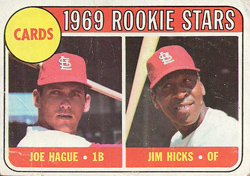
Though he hit for power and average in the minors, Hicks primarily was a reserve player in brief stints in the majors with the White Sox, Cardinals and Angels. A right-handed slugger, he began the 1969 season as a backup outfielder for the Cardinals.

His best season was 1968 when he played for the Cardinals’ Tulsa farm team and earned the Most Valuable Player Award in the Pacific Coast League. Hicks led the league in hitting (.366) and helped Tulsa win the championship. In 117 games played, Hicks had 149 hits, including 32 doubles and 23 home runs, scored 100 runs and drove in 85.

Thanks, coach

According to the Chicago Tribune, Hicks grew up in a section of East Chicago, Indiana, “where you either eat or get eaten up.”

His father was a steel mill foreman, according to The Sporting News.

When he went East Chicago Roosevelt High School, “I guess you could say I was on the road to becoming a hoodlum at the time,” Hicks told The Sporting News.

Hicks excelled in baseball, basketball and football, and credited a coach, Pete Rucinski, with changing his life. “He’s the greatest man I’ve known because he took me out of the streets and made me an athlete,” Hicks said.

Rucinski told the Chicago Tribune, “Jim wasn’t a bad kid, but he was unsettled.”

In 1958, Hicks got an athletic scholarship to the University of Illinois, but during his freshman year he signed a baseball contract with the White Sox when they offered him $15,000.

Seeking a break

Hicks spent nine seasons (1959-67) in the White Sox farm system. He hit home runs with an upper-cut swing, but also struck out a lot. He got called up to the White Sox for stints as a reserve in 1964, 1965 and 1966.

Limited to 19 at-bats with the White Sox in 1965 and 26 at-bats with them in 1966, Hicks told The Sporting News, “You can’t play one day and sit out two weeks and expect to do any good. You have to play regularly.”

In 1967, when White Sox manager Eddie Stanky assigned Hicks to the minors during spring training and told him to work on becoming a first baseman, Hicks said, “I was discouraged.”

Hicks, married with children, had gotten a degree in business at the Gary branch of Indiana University, and considered quitting baseball when he failed to make the White Sox’s Opening Day roster in 1967.

After thinking it over and determining he’d give the sport another try, Hicks reported to the White Sox’s farm club at Indianapolis, became the first baseman and produced 20 doubles, 12 triples and 21 home runs.

The Cardinals took notice. In October 1967, right after the Cardinals won the World Series championship, general manager Stan Musial made a trade, swapping first baseman George Kernek for Hicks.

Hicks, 27, was ticketed to play outfield for the Cardinals’ Tulsa affiliate in 1968.

“Even though I’d been up and down with the Sox and really had not had a chance to play regularly, I didn’t look forward to joining a St. Louis farm club,” Hicks told The Sporting News.

Hicks explained the Cardinals were stocked with “good, young outfielders like Curt Flood, Lou Brock and Bob Tolan” and he didn’t see much chance of getting to play regularly if he got to St. Louis.

Happy days

At spring training in 1968, Hicks bonded with Tulsa manager Warren Spahn and quickly adapted to being part of the Cardinals’ organization. When the regular season began, he was a terror against Pacific Coast League pitching.

“This is the best thing that ever happened to me,” he told The Sporting News. “I found this is a friendly organization in which there was none of the secret cloak and dagger stuff I encountered with the White Sox. I was relaxed from the outset and had more confidence. I give Warren Spahn considerable credit. He told me to take it easy, not to press.”

Spahn said Hicks “has good power to all fields and he has poise and balance at the plate.”

The Cardinals might have called up Hicks in June 1968 when they were seeking a backup outfielder, but he instead got called to serve a two-week stint for military reserve training. With Hicks unavailable, the Cardinals made a trade with the Astros for outfielder Ron Davis.

When he returned to Tulsa, Hicks continued to compile hits, but the Cardinals, on their way to winning a second consecutive National League pennant, didn’t ask him to join them.

Short stay

After Hicks’ successful 1968 season for Tulsa, Cardinals general manager Bing Devine said he “had quite a few inquiries about Hicks” from potential trade partners, but the Cardinals opted to keep him.

Hicks “figures to get a good shot at an outfield reserve job in addition to drawing a big part of the pinch-hitting assignments” with the 1969 Cardinals, The Sporting News reported.

Cardinals manager Red Schoendienst said, “Anybody who hits .366, even in a cow pasture league, is worth giving a good look.”

The Cardinals went into the 1969 regular season with Hicks and Joe Hague as backup outfielders to Brock, Flood and Vada Pinson.

On May 6, 1969, Hicks got the start in right field against the Giants at St. Louis and was credited with two assists in one inning.

It happened in the fifth. The Giants’ Hal Lanier was on first with one out when Bobby Bonds singled to right. Hicks quickly threw to second. When Lanier overran the bag and got caught in a rundown, Bonds broke for second and was tagged out. Ron Hunt followed with a single to right and Hicks’ one-hop throw to the plate nailed Lanier for the third out. Boxscore

Two weeks later, Hicks had five hits, including a home run versus Gaylord Perry, in two games against the Giants at San Francisco. Boxscore 1 and Boxscore 2

“He swings the bat with authority,” Giants coach Wes Westrum told the St. Louis Post-Dispatch. “He has a quick swing and he’s learned to lay off the high, inside pitch.”

Though Hicks had two triples and a home run for the 1969 Cardinals, he also had more strikeouts (14) than hits (eight) in 44 at-bats.

On May 30, 1969, the Cardinals traded Hicks to the Angels for outfielder Vic Davalillo.

Hicks had four hits, three for home runs, in 48 at-bats for the 1969 Angels. He got four more at-bats for the Angels in 1970 and spent the rest of his playing career in Hawaii and Japan.

Read Full Post »

Curt Flood needed money. Bob Short needed customers.

On Nov. 3, 1970, in an attempt to fulfill their needs, Flood signed a contract to return to baseball as center fielder for the Washington Senators, who were owned by Short.

Flood hadn’t played in a game since Oct. 2, 1969, with the Cardinals. Five days later, the Cardinals traded Flood to the Phillies, but he refused to report. He filed an antitrust lawsuit against baseball, challenging its reserve clause, which bound a player to a team.

After sitting out the 1970 season while his case went to court, Flood reached an unnerving conclusion: Baseball was his legal adversary, but it also was his best benefactor.

Bob Short saw an opportunity to capitalize.

Cash poor

After rejecting the Phillies’ offer of a $100,000 contract, Flood moved from the United States to Denmark in 1970 and pursued business interests. He was a portrait artist and, according to the Associated Press, he also got involved in a restaurant venture in Copenhagen.

Flood discovered he couldn’t earn nearly as much as an artist as he did playing baseball, and he lost money in the restaurant investment.

“I’m paying alimony and I’ve got five kids to support,” Flood told the Philadelphia Inquirer. “That’s enough to drive any man back into the game.”

While Flood was seeking a financial backer, Short was seeking ways to boost fan interest in the Senators, who finished 70-92 in 1970 and averaged about 10,000 fans per home game.

If the Senators couldn’t attract customers with their play, Short figured they might do it with personalities. He already had manager Ted Williams and slugger Frank Howard. Looking for more, Short, in October 1970, acquired pitcher Denny McLain. Next, he wanted Flood.

“If you sat at as many ballgames as I did this year looking at guys who can’t hit, and you knew somewhere there was somebody not playing who can hit, you’d go after him, too,” Short said.

Pay now

The Phillies retained the rights to Flood, even though he never played for them. Short sought and received permission from the Phillies to negotiate with Flood.

According to The Sporting News, Short offered Flood a one-year contract for $110,000, $20,000 more than he got from the 1969 Cardinals, and agreed to let Flood collect salary as soon as he signed, not when the baseball season started. It also was agreed Flood would continue with his legal challenge against baseball. A federal district judge ruled against Flood, but he appealed.

Flood’s contract included the reserve clause, binding him to the Senators.

All that remained to seal the deal was for Short to get the Phillies to agree to compensation.

Phillies negotiate

Short offered the Phillies a choice of either Mike Epstein, Rick Reichardt or Ed Stroud, the Washington Post reported. All were big-league players. General manager John Quinn said no.

“Epstein can’t hit left-handers,” Quinn said. “He can’t do anything but swing a bat. The only place he can play is first base and we’re up to our ears in first basemen. Reichardt? Our fellows think he’s overrated all the way. Stroud isn’t as good as our John Briggs or Ron Stone.”

The Phillies wanted the rights to the Senators’ No. 1 pick in the 1971 amateur draft, but trading a draft position wasn’t permissible in baseball.

The Phillies settled on a package of Greg Goossen, Gene Martin and Jeff Terpko, a group the Philadelphia Daily News described as “three uniforms filled with air.”

None of the three would ever play for the Phillies.

Still suing

When Flood signed with the Senators, he said, “I’ve had some business reverses and I need the money. I still think the reserve clause stinks.”

Players’ union executive director Marvin Miller said Flood’s return wouldn’t damage the legal challenge to the reserve clause.

“This case involves an issue, not just one man,” Miller said.

Shaky spring

Flood agreed to go to the Senators’ Florida Instructional League team, managed by former Cardinals catcher Del Wilber, and sharpen his skills. “I don’t believe it’s going to be any problem getting in stride again,” Flood said.

Four months later, at spring training, Flood, 33, hit .200 in exhibition games and didn’t play at the level he had with the Cardinals.

“I find my mind wandering all over the place,” Flood said.

Los Angeles Times columnist Jim Murray observed, “Curt is playing for the sheer money of it. He is as apprehensive as a guy going down a dark cellar to investigate a growl.”

Back in business

The Senators opened the regular season at home on April 5, 1971, against the Athletics. Ted Williams started Flood in center and batted him second. It was Flood’s first regular-season game in 18 months.

“I was jumpy,” Flood said. “I couldn’t sit down. I paced like a caged lion, but after the first time at bat I felt like I’d never been away.”

Flood produced a bunt single and walked twice, but he told United Press International, “I’m not out of the woods yet. I need to feel a little more comfortable at the plate and get acclimated in the outfield.” Boxscore.

Flood totaled three singles in his first 20 at-bats, and Williams benched him against right-handers.

“I told Curt we needed runs and we’re not scoring them with him in there,” Williams said. “He has a great attitude. He understands. He’ll be back.”

Flood’s road roommate, Elliott Maddox, added, “As for his benching, he told me that’s all right as long as we’re winning.”

Flood made his last start on April 20, and followed with a couple of appearances as a pinch-hitter. He hit .200 in 13 games.

Before an April 25 game against the Brewers, Flood was shagging fly balls when he told teammate Mike Epstein, “Things are closing in on me.”

That’s enough

Two days later, on April 27, Flood checked out of his room at the Anthony House hotel in Washington and took a flight to New York. When he didn’t show for the Senators’ home game that night, club officials checked his room and discovered he was gone.

“He never mentioned quitting to me or to anyone else,” Williams said.

When Flood got to New York’s Kennedy Airport, he sent a telegram to Short. It read: “I tried. A year and a half is too much. Very severe personal problems are mounting every day. Thanks for your confidence and understanding.” It was signed: Flood.

The Senators contacted the commissioner’s office in New York, and publicity director Joe Reichler was dispatched to the airport to try to persuade Flood to change his mind. Reichler found Flood at an airport bar.

“I told him he shouldn’t be discouraged, that fans didn’t expect him to come back and hit .400,” Reichler said. “For a while, I thought I had convinced him. He told me, ‘I know I owe Bob Short a great deal. He stuck his neck out for me.’ Then, suddenly, he said, ‘No, no. I’m not going to do it. I’ve reached the end. I’ll go crazy if I don’t get out.’ “

Flood boarded a Pan-Am flight to Spain and never played again.

His friend, St. Louis police lieutenant Fred Grimes, told the St. Louis Post-Dispatch that, in addition to the alimony and child support payments, Flood was distressed because his father had terminal cancer and a younger brother was in jail.

“He’s running away from himself, so don’t be hard on him,” Grimes said. “This man’s personal life is as unpleasantly involved as a soap opera.”

Senators executive Joe Burke said Flood received about half of his $110,000 salary. Payments started Nov. 1, 1970, and he was paid through April 15, 1971.

Read Full Post »

A day at the beach turned deadly for Cardinals outfielder Herman Hill.

On Dec. 14, 1970, Hill, 25, drowned while swimming in the sea in Venezuela.

Fourteen years earlier, on Nov. 27, 1956, another Cardinals outfielder, Charlie Peete, also was the victim of a fatal accident in Venezuela. Peete, 27, his wife and three children were passengers in an airplane that crashed into a mountain top in Venezuela. All 25 people onboard perished.

Both Hill and Peete batted left-handed and intrigued the Cardinals with their talents.

Peete made his major-league debut with the Cardinals in July 1956, four months before his death. Hill made his debut in the majors with the Twins in 1969, but never got to play for the Cardinals, who acquired him in a trade two months before his death.

Special speed

Hill was born in Tuskegee, Ala., and raised in Farmingdale, N.J. A standout athlete in high school in Freehold, N.J., he attended Yankees games and followed his favorite player, Mickey Mantle, the Minneapolis Star-Tribune reported.

Jack McKeon, a scout for the Twins before he became a big-league manager, signed Hill in 1966.

In the Twins’ farm system, Hill’s speed distinguished him. He hit .292 with 58 stolen bases for Orlando in 1967 and had a 26-game hitting streak.

At spring training with the Twins in 1968, Hill was noticed “for his creativity and originality in baserunning,” the Star-Tribune reported, and he earned the nickname “Beep-Beep” because of “his roadrunner speed and posture.”

On March 15, 1968, in an exhibition game versus the Cardinals, Hill drove in a run with a single against Jim Cosman.

Though the Twins sent him back to the minors for the 1968 season, Hill said his experience at spring training convinced him he’d have success as a base-stealing threat in the majors.

“I’ve seen these pitchers and catchers now,” Hill said. “I could steal on them if they let me get a little jump. I could steal quite a few.”

In the majors

Hill had his best season in 1969 when he hit .300 with 31 stolen bases for Denver. He was called up to the Twins in September and made his big-league debut as a pinch-runner for Harmon Killebrew in a game versus the Indians. Boxscore

Hill got into 16 games, 13 as a pinch-runner, for the 1969 Twins.

In 1970, Hill began the season with the Twins’ farm club in Evansville. He’d been timed running 100 yards in 9.5 seconds, and he went from home to first in 3.4 seconds, The Sporting News reported. Hill said he set a goal of hitting .340 with 70 stolen bases for the season.

Hill was hitting .276 for Evansville when he got called up by the Twins in June 1970, replacing Charlie Manuel on the roster.

On June 29, 1970, Hill got his first major-league hit, a single versus the Royals’ Dick Drago. Boxscore

According to the Star-Tribune, the Twins talked to the Red Sox about a trade of Dave Boswell, Dick Woodson, Brant Alyea and Hill for Reggie Smith and Sparky Lyle, but the proposal was rejected.

In July 1970, Hill was returned to Evansville. The Twins brought him back in September and he was used mostly as a pinch-runner and defensive replacement.

Terror and tragedy

The Cardinals had installed AstroTurf at Busch Memorial Stadium in 1970 and were looking to build a lineup featuring speed and defense. Hill was a prospect who appealed to them.

“Our scouts, Fred McAlister and Mo Mozzali, liked him a lot and figured he’d be able to take advantage of the AstroTurf with his speed,” Cardinals director of player procurement George Silvey told the St. Louis Post-Dispatch. “He had to learn things like hitting more to the opposite field and making contact more consistently.”

Twins owner Calvin Griffith tried to get the Cardinals to deal pitcher Steve Carlton, but was turned down, the Star-Tribune reported. On Oct. 20, 1970, the Twins settled for a swap of Hill and minor-league outfielder Bob Wissler to the Cardinals for pitcher Sal Campisi and infielder Jim Kennedy.

Hill was placed on the Cardinals’ major-league roster and they were eager to see him in spring training after he fulfilled a commitment to play winter ball in Venezuela for the Magallanes Navigators, a team based in Valencia.

On Dec. 14, 1970, a Monday, the Navigators had a day off. Hill and three Navigators teammates, Indians catcher Ray Fosse, Brewers pitcher John Morris and Dale Spier, a minor-league pitcher in the Yankees’ system, decided to go to the beach in Puerto Cabello on Venezuela’s north coast.

Hill was swimming in the Caribbean Sea when a large wave swept him away from shore, The Sporting News reported.

While Hill struggled to stay afloat, his teammates tried to rescue him. According to The Sporting News, Morris grabbed hold of Hill, who flailed to keep from sinking. Morris had three teeth knocked out in the desperate thrashing. Fosse saved Morris from going under, The Sporting News reported.

Three days later, on Dec. 17, Hill’s body was recovered, according to United Press International.

Read Full Post »

J.W. Porter began his major-league career with the St. Louis Browns and ended it with the St. Louis Cardinals.

He was a highly regarded prospect who experienced personal tragedy soon after he got to the majors.
Primarily a catcher, Porter spent six seasons in the big leagues and played for the Browns (1952), Tigers (1955-57), Indians (1958), Senators (1959) and Cardinals (1959).

Prime prospect

When Porter was born in Shawnee, Okla., in 1933, his father wanted to name him James William and his mother preferred initials, so they settled on J.W., according to the Society for American Baseball Research.

The family moved to California when Porter was 10 and he became a standout youth baseball player in Oakland. One of his American Legion teammates was Frank Robinson, who was two years younger than Porter. “Frank always could hit hard,” Porter told the St. Louis Post-Dispatch. “We all knew he would become a great ballplayer.”

Pro scouts expected the same from Porter. He was a strong-armed catcher and a right-handed batter who hit for power. With red hair, freckles and green eyes, Porter resembled Red Schoendienst or Huckleberry Finn, the Post-Dispatch noted.

White Sox scout Hollis Thurston told the Saturday Evening Post, “I’m so sold on him that I’m willing to say without reservation that if he doesn’t make stardom then I see no point in the whole scouting system. Porter is just one of those naturals.”

Before the 1951 baseball season, Porter signed with the White Sox for $65,000, but he never would play a game for them in the majors.

Brought to Browns

In 1952, Porter was with the White Sox’s farm club in Colorado Springs and learning to play outfield. The manager was Don Gutteridge, former infielder for the Cardinals and Browns. Gutteridge told the Post-Dispatch, “I have one outfielder who can’t miss. He’s certain to be playing big-league ball. His name is J.W. Porter.”

On July 28, 1952, Porter, batting .340 for Colorado Springs, was traded by the White Sox to the Browns with Ray Coleman for Jim Rivera and Darrell Johnson.

Two days later, on July 30, 1952, at St. Louis, Porter made his big-league debut. Pinch-hitting against the Senators’ Bob Porterfield, Porter was called out on strikes. Boxscore

After the game, Porter, 19, spoke by phone with his wife of seven months, Patricia, 18, who had stayed in Colorado Springs after Porter got traded. Patricia’s father, Walter Singleton, had joined her, and together they planned to drive home to Oakland while Porter played out the season. According to the Post-Dispatch, Patricia was pregnant.

Devastating deaths

The next day, July 31, 1952, Patricia and her father were beginning their journey to Oakland when they were killed in a head-on car crash near Gunnison, Colo. Porter learned of the deaths from Browns owner Bill Veeck.

Devastated, Porter, accompanied by Browns assistant trainer Bob Spackman, returned home to Oakland, The Sporting News reported.

“I hope the boy will be able to shake off the terrible shock,” Veeck said to the Post-Dispatch. “He’s at liberty to take all the time he wants to take care of his affairs at home.”

After the funerals, Porter rejoined the Browns. He was a pinch-hitter against the Indians on Aug. 9, and started in left field versus the White Sox on Aug. 12.

“Porter may make it, but he’s too young to be counted right now as anything but a good prospect,” Browns manager Marty Marion told the Post-Dispatch.

“I’ve hit Porter a lot of fungoes during the brief spell he’s been with the club and I can’t say he’s a good outfielder, but he has the physical requirements,” Marion said. “He can run well, he has a strong arm and practice should develop his defensive play. As a hitter, he looks great. He has a fine, natural swing, good power and apparently sharp eyes.”

Porter made 24 starts in center field for the 1952 Browns and hit .250 for them. He had a four-hit game against the Senators on Aug. 19. Boxscore

After the season, it was learned Porter would be drafted into the Army. Soon after, on Dec. 4, 1952, the Browns traded Porter, Bob Nieman and Owen Friend to the Tigers for Virgil Trucks, Johnny Groth and Hal White.

“I hate to lose title to Porter, who is a fine prospect,” Veeck told the Post-Dispatch, “but he’s 19 years old and headed for two years in the armed services and the Browns can’t wait for him to be available again.”

Reserve role

Porter was inducted into the Army in February 1953 and he remarried in 1954. After a two-year Army hitch, Porter reported to Tigers spring training in 1955. When Ferris Fain got hurt, Porter became the Opening Day first baseman for the 1955 Tigers. Boxscore

Mostly, though, Porter filled a utility role for the rest of his career.

His first major-league home run was hit in June 1957 against the Yankees’ Don Larsen. Boxscore

In May 1958, when he was with the Indians, Porter batted for Roger Maris and hit a home run versus the Orioles. Boxscore.

Cards come calling

Porter began the 1959 season as the backup catcher for the Senators. On July 25, 1959, the Cardinals acquired him on waivers to be the backup to starting catcher Hal Smith.

Porter, 26, played in 23 games for the 1959 Cardinals and hit .212. He made nine starts at catcher. In two of those starts, rookie Bob Gibson was the Cardinals’ starting pitcher.

On Aug. 8, 1959, with Gibson pitching and Porter catching, Porter hit a home run against the Phillies’ Taylor Phillips. The ball landed “far up in the left-center field bleachers” at Busch Stadium, the Post-Dispatch reported. Boxscore

Two months after acquiring Porter, the Cardinals called up a catching prospect, 17-year-old Tim McCarver. The Cardinals ticketed Porter for the minors in 1960. The Braves acquired him and he played in their farm system from 1960-66.

In 1969 and 1970, Porter managed Expos farm teams in West Palm Beach and settled in the area. When the Cardinals opened a spring training facility in nearby Jupiter, Fla., in 1998, Porter became a stadium usher at their exhibition games.

Read Full Post »

A kind gesture by Reds manager Sparky Anderson turned a disappointing ending into an uplifting moment.

On Oct. 15, 1970, the Reds were one out away from being eliminated in the decisive game of the World Series against the Orioles. At a time when some managers might be feeling despair, Anderson was feeling compassion.

The Reds’ Pat Corrales, a loyal, seldom-used backup catcher who had experienced personal tragedy, never had played in a World Series game. Realizing Corrales might never get another chance, and knowing how meaningful it would be to him, Anderson sent him to bat for one of the Reds’ hottest hitters, Hal McRae.

In his brief plate appearance, Corrales made the last out of the 1970 World Series, but the result didn’t matter. Unlike Hall of Famers such as George Sisler and Ernie Banks, Corrales had gotten to play in a World Series, and Anderson, in his first season as a big-league manager, had enhanced his growing reputation by being a considerate leader.

Three years earlier, Anderson and Corrales were in the Cardinals’ system _ Anderson as a manager looking to move up in rank, and Corrales as a catcher looking to show he could hit.

Cardinals connections

Anderson joined the Cardinals as a minor-league manager in March 1965. Corrales was acquired by the Cardinals in a trade with the Phillies in October 1965. Cardinals general manager Bob Howsam dealt Bill White, Dick Groat and Bob Uecker to the Phillies for Alex JohnsonArt Mahaffey and Corrales.

After managing St. Petersburg to a 91-45 record in 1966, Anderson was looking to manage the Cardinals’ top farm club, Tulsa, in 1967, but Stan Musial, who’d replaced Howsam as general manager, gave the job to Warren Spahn. Anderson was assigned to manage Modesto. After the 1967 season, Howsam, who had become general manager of the Reds, hired Anderson to manage in the Cincinnati farm system. Two years later, he became manager of the Reds.

Corrales, 25, spent the 1966 season as backup to Cardinals catcher Tim McCarver, but got into a mere 28 games and hit .181. “I’m probably the only guy in the league who has thrown out more runners than he has hits,” Corrales told The Sporting News.

Actually, it was a tie. Corrales finished the 1966 season with 13 hits and threw out 13 runners attempting to steal.

Afterward, Corrales reported to the Cardinals’ Florida Instructional League team to work on his hitting. The manager was George Kissell and Sparky Anderson was his assistant. When Corrales injured a knee, the Cardinals acquired Johnny Romano from the White Sox to be McCarver’s backup. Corrales played the 1967 season at Tulsa for Spahn, and hit .274 in 130 games.

Howsam and the Reds knew their top prospect, Johnny Bench, would be the starting catcher in 1968, replacing Johnny Edwards, and viewed Corrales as a potential backup. On Feb. 8, 1968, Howsam acquired Corrales for the second time, trading Edwards to the Cardinals for him and Jimy Williams. 

Devastating death

Corrales began the 1968 season with the Reds’ farm team at Indianapolis, managed by Don Zimmer, and hit .273 in 77 games. He got called up to the Reds in July to provide relief for Bench, who started 81 games in a row. On July 29, 1968, Corrales was the catcher when the Reds’ George Culver pitched a no-hitter against the Phillies.

Corrales impressed Reds management and was popular with teammates. Asked about Corrales, Pete Rose told The Sporting News, “There’s a man who can do it all. He knows what’s going on out there every minute. Corrales makes a pitcher think on the mound.”

Corrales stuck with the Reds in 1969.

On July 22, 1969, Corrales’ wife, Sharon, 27, gave birth to a son at 5:02 a.m. at Cincinnati’s Christ Hospital. It was the couple’s fourth child. They had three daughters, the oldest, 5, and twins, 3.

Ten hours later, Sharon died in the hospital. The cause was pulmonary embolism, a blood clot in the lungs, the Dayton Daily News reported.

Corrales returned to the Reds a week after Sharon’s funeral. Several teams raised money for an education fund for Corrales’ children, Newsday reported. Among the fund-raisers were the Orioles. According to The Sporting News, Orioles players donated money from fines collected by their clubhouse kangaroo court. Orioles wives raised funds with a bake sale and paper flower sale.

After the 1969 season, the Reds changed managers, replacing Dave Bristol with Sparky Anderson. At spring training in 1970, Anderson said, “In Corrales, I’ve got the best backup catcher in baseball.”

People skills

Corrales hit .236 in 43 games for the 1970 Reds, who finished first in the West Division. Against the Cardinals, he hit .417 (5-for-12).

In the National League Championship Series, the Reds swept the Pirates, and Corrales didn’t play. In the World Series, the Orioles won three of the first four games, and again Corrales didn’t play.

In Game 5 at Baltimore, the Orioles led, 9-3, entering the ninth. Sparky Anderson called to the bullpen, where Corrales had been catching throws from Reds relievers, and told him to come to the dugout.

According to the Dayton Daily News, Anderson approached Hal McRae, who hit .455 in the World Series, and told him, “Unless somebody gets on base before you, I’m going to have Pat hit for you. It’s not a reflection on you. I want him to have a chance to get his name in a World Series box score.”

McRae told Anderson he understood.

After starter Mike Cuellar retired the first two batters, Bench and Lee May, Anderson sent Corrales to the plate. Anderson, who played one season in the majors and 10 in the minors, appreciated a role player such as Corrales, who lived in Bench’s shadow.

“Anyone who plays his heart out for you all year deserves a chance to play in a World Series,” Anderson told the Cincinnati Enquirer. “Corrales has done that for us and I wasn’t going to let this chance get away.”

To the Dayton Daily News, Anderson said, “I wasn’t being sentimental. I was being honest. I’d have let him down by not letting him bat.”

Corrales hit Cuellar’s first pitch to third. Brooks Robinson fielded it and threw to first for the final out, clinching the championship for the Orioles. Boxscore

Explaining why he swung away, Corrales told the Cincinnati Enquirer, “I wasn’t going to take nothing when I went up there. I wanted to hit.”

Regarding the move by Anderson, Corrales told Newsday, “I appreciate he thought of giving me the chance.”

Ritter Collett of the Dayton Journal Herald called Anderson’s action “a considerate gesture, like a coach getting his seniors into the final game.”

Wells Twombly wrote in The Sporting News, “It was a charming gesture, full of good, rich schmaltz. The lovely thing about Sparky is he dares to be corny in a violently cynical age.”

Said Anderson, “The World Series still is the biggest sporting event in America. That’s why I wanted to make sure Pat had a chance to get his name in a box score. It means a lot to a guy.”

Corrales never played in another World Series. He did coach in five World Series (1991, 1992, 1995, 1996 and 1999) for the Braves on the staff of manager Bobby Cox.

Read Full Post »

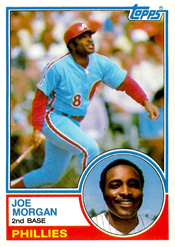
In his last hurrah as a National League player, Joe Morgan helped the Phillies dethrone the Cardinals.

A second baseman who began his big-league career with the Houston Colt .45s, Morgan spent his prime years as an integral member of championship Reds teams in the 1970s.

A two-time recipient of the National League Most Valuable Player Award as well as a member of the Baseball Hall of Fame, Morgan was 5 feet 7 but hit like a giant. He produced 2,517 hits and 1,133 RBI in 22 seasons in the majors. He also won five Gold Glove awards for fielding.

Morgan, a left-handed batter who flapped his left elbow as a distinctive timing mechanism before unleashing his swing, consistently clobbered the Cardinals.

A career .271 hitter, he batted .293 versus the Cardinals. His on-base percentage against them was .408. In 203 games versus the Cardinals, Morgan had 216 hits and 147 walks. He hit .313 against Bob Gibson and struck out a mere three times in 83 career at-bats versus the Cardinals’ ace.

In 1976, when Morgan was at his peak, he hit .452 versus the Cardinals, and his on-base percentage against them was an astounding .578. In 45 plate appearances against the 1976 Cardinals, Morgan had 14 hits and 12 walks.

Seven years later, with the 1983 Phillies, Morgan’s numbers against the Cardinals weren’t as great, but his performance remained devastating.

Power surge

In December 1982, after two seasons with the Giants, Morgan, 39, was traded to the Phillies, and was reunited with a prominent pair of former Big Red Machine teammates, Pete Rose and Tony Perez.

Playing in the same National League East Division as the Cardinals, who won the World Series championship in 1982, the 1983 Phillies were assembling a group of baseball royalty in the hope of overtaking the Cardinals. In addition to Morgan, Rose and Perez, the Phillies had Mike Schmidt and Steve Carlton.

Early on, the Phillies fizzled. They were 9-13 in May and lost their first four games in June.

On June 9, 1983, the Phillies went into their home game against the Cardinals with a record of 22-25. Morgan was batting .193.

Before the game, Morgan worked with coaches Deron Johnson and Bobby Wine to correct a flaw in his swing. Johnson noticed Morgan was committing too soon to pitches, and suggested Morgan rely more on his hands for timing. “As soon as I did, I felt good,” Morgan told the Philadelphia Inquirer.

In the bottom of the first inning, Morgan led off with a home run against Joaquin Andujar. The Cardinals came back and led, 5-1, heading to the bottom of the eighth, but Andujar unraveled. A double and two singles produced a run, making the score 5-2, and brought Morgan to the plate with two on and none out.

With the count 1-and-0, Andujar threw a fastball and Morgan walloped it over the wall in right for his second home run of the game, tying the score at 5-5.

“I wanted to go up and get a pitch I could pull and maybe hit out of the ballpark,” Morgan said. “I knew the situation, and I knew what I’m here for. I’m here to add some power. I could go up there and try to slap a ball to right, but they brought me here to do a job.”

It was the first time Morgan hit two home runs in a game since 1977. When Andujar gave up the second home run, he threw his hands up in disgust. “I feel like I want to kill myself,” Andujar told the St. Louis Post-Dispatch.

The Phillies got a run against Cardinals relievers in the 11th and won, 6-5. Boxscore

Repeat performance

Morgan said he thought the comeback victory would propel the Phillies into a winning streak, but it didn’t happen. Instead, the Phillies experienced a dismal July. Manager Pat Corrales was fired and replaced by Paul Owens. Morgan suffered a hamstring pull and batted .060 for July.

On Aug. 5, 1983, the Phillies were in St. Louis to play the Cardinals, and both Morgan and the club remained in a funk. The Phillies were 53-50 and trailed the first-place Pirates. Morgan was batting .192 for the season.

In the second inning, with the Phillies ahead, 2-0, Morgan faced John Stuper with two on and two outs. With the count 3-and-0, Morgan got a fat pitch and hit it over the wall in right for a three-run home run. In the seventh, Morgan hit a solo home run versus Dave Von Ohlen, giving him his second two-homer game of the season against the Cardinals. The Phillies won, 10-7. Boxscore

“I’m really glad for Joe,” Owens said. “It’s good to see him finally relax a little.”

Experience counts

Entering September, four teams were in contention for the National League East title. The Pirates (68-63) led, but the Phillies (67-64), Expos (66-64) and Cardinals (65-65) were close behind.

The Phillies took control, and Morgan played a prominent part. 

The Phillies were 22-7 in September, including 6-0 against the Cardinals, and finished atop the division at 90-72. The Cardinals were 12-18 in September and finished at 79-83.

Morgan hit .337 in September and had 18 RBI in 24 games. He had unusual numbers against the Cardinals for the season: a .181 batting average, but five doubles, four home runs and 13 RBI in 17 games.

The Phillies prevailed in the National League Championship Series versus the Dodgers and advanced to the World Series against the Orioles. Though the Orioles won four of five games, Morgan hit two home runs.

Released by the Phillies after the World Series, Morgan signed with the Athletics, who wanted him as their second baseman. After 21 seasons in the National League, Morgan, 40, completed his playing career in the American League with the 1984 Athletics.

Read Full Post »

« Newer Posts - Older Posts »