Feeds:
Posts
Comments

Archive for the ‘Hitters’ Category

As third baseman for the 1957 Cardinals, rookie Eddie Kasko helped them transform from underachievers to contenders.
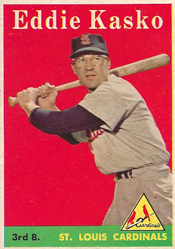
During his career in the major leagues, Kasko was a player, manager and scout. As a shortstop, he was a National League all-star and played in the World Series.

A fielder with sure hands and a strong arm, Kasko’s ability to play third base and hit productively for the Cardinals in 1957 enabled them to move Ken Boyer to center field and strengthen the lineup.

Feeling at home

Kasko was raised in Linden, N.J., a town with a large Polish-American population. His family name was Kosko, but his birth certificate mistakenly listed him as Kasko and he never changed it, The Sporting News reported.

A baseball talent at the high school and sandlot levels, Kasko attended Cardinals tryout camps in New Jersey when he was 18, but scout Benny Borgmann suggested he come back in a year, according to The Sporting News. Instead, Kasko launched his career in the minor leagues. After three seasons (1949-51) in the minors, Kasko went into the Army for two years (1952-53) and was stationed at Fort Leonard Wood in Missouri.

After his discharge, Kasko resumed his career in the minors at Richmond, Va., in 1954. Richmond became an important place for Kasko. He met a William & Mary College student, Catherine, who became his wife, and they made Richmond their home. The Richmond team was managed by Hall of Fame shortstop Luke Appling, who became a mentor to Kasko and taught him to play the position.

Kasko played two seasons (1954-55) for Appling at Richmond and developed a reputation as the best fielder in the International League.

One of the teams in the league was Rochester, a Cardinals farm club. During the 1955 season, Rochester general manager George Sisler Jr. and manager Dixie Walker suggested the Cardinals try to acquire Kasko, The Sporting News reported. The Cardinals sent scout Walter Shannon to Richmond to evaluate Kasko. Based on Shannon’s report, the Cardinals purchased Kasko’s contract in October 1955.

“I owe a lot to Richmond,” Kasko said. “That’s where the Cardinals found me and that’s where I found Catherine.”

Prime prospect

The Cardinals assigned Kasko to Rochester in 1956, and manager Dixie Walker worked with Kasko, a right-handed batter, to be more aggressive at the plate.

“At Richmond, I’d been taking a lot of pitches because Luke Appling had been that kind of hitter, a clever two-strike hitter,” Kasko told the St. Louis Post-Dispatch, “but Walker told me I wasn’t any Appling and couldn’t afford to give the pitcher an edge. He told me to come off the bench swinging.”

Kasko followed Walker’s advice and batted .303 with 179 hits in 147 games for Rochester. He also continued to dazzle with his fielding and throwing.

Good impression

After the 1956 season, Kasko played winter ball in Cuba. Cardinals general manager Frank Lane, manager Fred Hutchinson and scout Al Hollingsworth went to Havana and became convinced Kasko could play in the majors.

Hollingsworth referred to Kasko as “Mr. Automatic” because of his flawless fielding and said he was the best player he saw in the Caribbean. “There’s no doubt that defensively he is ready right now,” Hollingsworth told The Sporting News.

Lane said, “He can run, throw, go into the hole and make the plays … He showed he could handle a bat somewhat like Alvin Dark, hitting behind the runner.”

Kasko, 25, played well at Cardinals spring training in 1957 and made the Opening Day roster as the backup to Dark at shortstop. Lane had been talking to the Cubs about a deal of Dark for pitcher Bob Rush, but the Cubs wanted Kasko, according to the St. Louis Globe-Democrat.

Getting a chance

The 1957 Cardinals struggled early. With the club record at 13-16, Cardinals owner Gussie Busch held a meeting on May 21, 1957, with Lane, his assistant, Bing Devine, executive Dick Meyer and Walter Shannon, who had become farm director. They decided Hutchinson needed to shake up the lineup.

Lane relayed the directive to Hutchinson, who made multiple changes, including moving Ken Boyer from third base to center field to replace the slumping Bobby Gene Smith. Kasko replaced Boyer at third base.

“The position didn’t frighten me,” Kasko said. “Just getting to play was what I had been wanting.”

Bespectacled, balding and quiet, Kasko wasn’t an intimidating presence, but his performance delivered the desired results.

From May 23, when the lineup changes were implemented, until Aug. 5, the 1957 Cardinals were 50-25. The surge gave them an overall record of 63-41 and put them into contention for the National League pennant.

The Cardinals finished in second place at 87-67. Kasko made 117 starts at third base and appeared in 134 games. He batted .273 overall, including .341 versus left-handers. The Sporting News named him third baseman on its all-rookie team.

Change in plans

Instead of playing winter ball after the 1957 season, Kasko stayed in Richmond and worked as a men’s clothing salesman at a department store.

At spring training in 1958, Hutchinson said he intended to open the regular season with Boyer in center, Dark at third and Kasko at shortstop. Kasko had more range than Dark, Hutchinson said.

The plan changed when Kasko batted .141 in spring training. When the 1958 season opened, Dark was at shortstop, Boyer was back at third, Bobby Gene Smith returned to center and Kasko was on the bench.

On May 20, 1958, the Cardinals traded Dark to the Cubs for pitcher Jim Brosnan. Dick Schofield became the Cardinals’ shortstop but struggled to hit and Kasko became the starter at the end of May.

Kasko also slumped at the plate and in July he was replaced by Ruben Amaro.

Kasko hit .220 in 104 games for the 1958 Cardinals. He made 64 starts at shortstop. After the season, Kasko, Del Ennis and Bob Mabe were traded by the Cardinals to the Reds for George Crowe, Alex Grammas and Alex Kellner.

Hutchinson, fired by the Cardinals near the end of the 1958 season, became Reds manager in July 1959 and made Kasko the Reds’ shortstop. “If a guy can’t play for him,” Kasko said, “he just can’t play.”

In 1961, the Reds won the pennant and Kasko was named to the National League all-star team. In the World Series versus the Yankees, Kasko led the Reds in hits (seven) and batted .318.

In five seasons (1959-63) with the Reds, Kasko hit .277. He finished his playing career with the Astros and Red Sox.

After managing in their farm system for three seasons (1967-69), Kasko became Red Sox manager. He led them to winning records in each of his four seasons (1970-73) and was 345-295.

“I learned more from Eddie Kasko in nine minutes than I did in all my years under all the other managers who have handled this club,” outfielder Carl Yastrzemski told the Boston Globe.

Red Sox catcher Jerry Moses said Kasko “has the greatest mind in baseball.”

After managing, Kasko became a Red Sox scout before being promoted to their front office as director of scouting and then vice president of player personnel.

Read Full Post »

Disheartened when the Cardinals benched him indefinitely, Stan Musial was willing to accept a trade to the Pirates.

In 1960, Cardinals manager Solly Hemus took Musial out of the starting lineup and relegated him to a pinch-hitting role. Hemus made the move, with the approval of the front office, because Musial wasn’t hitting for average and Hemus perceived Musial’s fielding as more a liability than an asset.
A seven-time National League batting champion, Musial, 39, was stunned and saddened by the Cardinals’ determination he was washed up.

If the Cardinals couldn’t use him, the first-place Pirates were willing to take him and play him at first base. Asked whether he’d agree to a trade to the Pirates and a chance to finish his playing career near his hometown of Donora, Pa., Musial replied, “Yes.”

In his autobiography, “Stan Musial: The Man’s Own Story,” Musial said, “Few realize how close I came to finishing my career with Pittsburgh.”

Fading star

After batting .255 in 1959, the first season he didn’t top .300, Musial faithfully followed a physical fitness and diet program during the winter and reported to 1960 spring training camp in shape.

The Cardinals opened the 1960 season with Musial at first and with an outfield of Leon Wagner in left, Bill White in center and Joe Cunningham in right.

Musial hit .300 in 13 games in April, but slumped in May. As Musial’s batting average dipped, Hemus utilized him sporadically and erratically. “I know he had lost confidence in me,” Musial said in his autobiography.

The 1960 Cardinals lost 16 of their first 26 games and were a half-game out of last place after play on May 15. Hemus experimented with various lineups in an effort to jolt the Cardinals. “If ever a manager panicked, I’m afraid Hemus did,” Musial said in his book.

On May 22, 1960, Bob Broeg of the St. Louis Post-Dispatch and Bob Burnes of the St. Louis Globe-Democrat came out with columns criticizing the Cardinals for unfair treatment of Musial.

Broeg wrote, “If they’re trying to embarrass a man who never embarrassed them, either by word or deed, the Cardinals are succeeding.”

Burnes wrote, “What concerns us is the way an extraordinary performer and complete team man is being pushed around. Certainly his years of service to the Cardinals entitle him to more than that. What we are wondering is whether the Cardinals are trying to embarrass Musial into retiring.”

Reserve role

A few days later, Musial’s batting average for the season was at .250 when he was called to a meeting at the home of Cardinals owner Gussie Busch. Joining them were club executive Dick Meyer, general manager Bing Devine and Hemus. They informed Musial he was being benched because Hemus wanted a younger lineup.

Musial told them he would do what the club wanted. In his book, Musial said he was “hurt and disappointed” by the decision.

On May 27, 1960, Hemus started Curt Flood in center field in place of Bill White and moved White to first base in place of Musial.

Musial “has been benched indefinitely,” the Post-Dispatch reported.

“Solly and I agreed that Solly ought to play his best lineup,” Devine said. “We talked it over with Musial and he went along with the plan.”

Musial, who hit .204 in May, told the Associated Press, “We haven’t been winning and they want to try that new lineup for a while. Anything they want to do is OK with me. We’ll see what happens. I think I’ll be back in the lineup soon.”

Hemus had other ideas.

Pirates treasure

Musial was out of the starting lineup from May 27 through June 23. He appeared as a pinch-hitter nine times in that stretch and had one hit, a double versus Warren Spahn, and his batting average sank to .238.

In his autobiography, Musial said he was planning to quit during the all-star break in July if he wasn’t back in the starting lineup by then.

When the Pirates came to St. Louis for a series in June, their manager, Danny Murtaugh, asked Broeg what was wrong with Musial. Broeg told him all Musial needed was a chance to play and to “go out with a winner.” Murtaugh asked whether Musial would accept a trade to the Pirates. Broeg approached Musial, who responded, “Yes.” Broeg relayed the answer to Murtaugh, who said he would urge general manager Joe Brown to make a deal.

“Musial could mean the difference for us in the race,’ Murtaugh told Broeg.

In a June 14, 1960, column in the Post-Dispatch, Broeg wrote Musial had been “surprised and even a bit stunned” by the Cardinals’ decision to bench him and suggested Musial would be a good fit for the Pirates.

“Although he has been uncomplaining, it’s apparent he was hurt,” Broeg told readers. “Hurt enough, you ask, to go to Pittsburgh if he had a chance to play rather than sit on the bench, a chance perhaps to achieve the thrill of one more World Series? Yes.”

The Pirates wanted Musial, but couldn’t afford to offer much, Brown said to Broeg. Another option would be for Musial to ask the Cardinals for his release, leaving him free to sign with the Pirates. Either way, Brown said, it would put Bing Devine in a bind, and he didn’t want to do that to his colleague.

“As much as we’d like to have Musial,” Brown told Broeg, “I just can’t do it to Bing Devine. Sure, if Musial were released, we would grab him in a minute … and to offer too little would be taking advantage of the public sentiment, which is sure to be strongly behind Musial, not the ball club. Devine would be on a spot where i don’t care to put him.”

Still The Man

When Bob Nieman got injured and newly acquired Walt Moryn struggled to hit, Hemus put Musial back into the lineup as the left fielder on June 24, 1960.

Musial was 1-for-8 in his first two games back and his batting average fell to .229, but then he went on a tear. Musial produced 11 hits in 19 at-bats over his next five games, raising his batting mark to .281. He continued his blistering pace and got his batting average to .300 at the all-star break.

“He’s been amazing,” Cardinals third baseman Ken Boyer told the Globe-Democrat. “He’s delivering the big hits.”

Said Hemus: “Stan is popping the ball again.”

National League all-star manager Walter Alston of the Dodgers chose Musial as an all-star reserve.

On the field at Kansas City before the All-Star Game, Musial was approached by Red Sox counterpart Ted Williams, 41, who was in his last season as a player and batting .341. According to Bob Burnes, the conversation went like this:

Williams roared: “Hey, man, get on the train.”

Musial: “What train is it?”

Williams: “The one back to the minors. Us old guys are through. We’ve had it.”

The two laughed and Williams said, “What in the world got into you?”

Musial: “Just pecking away, just pecking away. I lucked a few, thumbed a few and then I got a couple of good ones.”

Williams: “Oh, hell, I wasn’t talking about your hitting. I wasn’t worried about that. What I’m talking about is that base you stole the other day.”

Musial: “Say, that was something, wasn’t it?”

The stolen base on July 8 was Musial’s first since 1957.

Musial hit .352 with 21 RBI in 21 games for the Cardinals in July. He hit .253 in August and .226 in September, finishing the season at .275 with 17 home runs and 63 RBI. He hit .338 with runners in scoring position and was 5-for-8 with the bases loaded.

“I look back on 1960 as a season of frustration and vindication, of sadness and success,” Musial said in his book. “It was the most emotional season I ever experienced.”

The Pirates went on to win the National League pennant, their first since 1927, and prevailed against the Yankees in the World Series. The Cardinals challenged the Pirates for a while and placed third at 86-69.

“I missed a chance to play in another World Series,” Musial said, “but I’m glad now I didn’t ask for my release.”

Read Full Post »

(Updated Feb. 2, 2023)

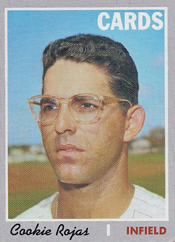
Cookie Rojas was supposed to be a 1970s version of Jose Oquendo for the Cardinals, but it didn’t work out.

On June 13, 1970, the Cardinals traded Rojas to the Royals for outfielder Fred Rico. The deal brought an unsatisfactory end to an unexpectedly short stint with the Cardinals for Rojas.
After acquiring Rojas from the Phillies in the October 1969 trade involving Dick Allen, Curt Flood and Tim McCarver, the Cardinals envisioned him as a valuable role player in 1970.

Like Oquendo did with the Cardinals in the 1980s and 1990s, Rojas played all nine positions for the Phillies in the 1960s. Unlike Oquendo, Rojas said he used the same glove to play each position. He donated it to the Baseball Hall of Fame. “I believe that glove represents what I was as a ballplayer and what kind of fielder I was,” Rojas told Bill Francis of the Hall of Fame. “I even used the glove when I caught.” (Rojas caught in seven games for the Phillies.)

Phillies manager Gene Mauch called Rojas the National League’s most versatile athlete since the Cardinals’ Red Schoendienst _ “and I never heard of Schoendienst catching,” Mauch said to the Wilmington (Delaware) News Journal.

The Cardinals projected Rojas to back up second baseman Julian Javier and shortstop Dal Maxvill, and to help out at third base after Mike Shannon was sidelined because of a kidney ailment.

Instead of being a Secret Weapon, as Oquendo was nicknamed, Rojas was more like a lost secret, who didn’t play much for the Cardinals and who rarely reached base when he did.

Cuban cutie

Octavio Victor Rojas was born in Havana, Cuba. His father was a pharmacist at the University of Havana hospital, according to the St. Louis Post-Dispatch.

When Octavio was a boy, his mother called him Cuqui, a common Cuban term of endearment loosely translated to mean cute, and the nickname morphed into Cookie when he came to the United States at 17 to begin his baseball career with a Reds farm club, the West Palm Beach Sun Chiefs.

After six years (1956-61) in the minors, Rojas debuted in the majors with the Reds in 1962 as the backup to second baseman Don Blasingame, the former Cardinal. Rojas’ first big-league hit was a single against Sandy Koufax and his first RBI came against the Cardinals’ Curt Simmons. Boxscore

To make room for their rookie second baseman, Pete Rose, in 1963, the Reds traded Rojas to the Phillies.

Rojas spent seven seasons (1963-69) with the Phillies. His first two years were as a utility player before he became their second baseman in 1965.

“Cookie Rojas is a remarkable individual, indefatigable, willing and able to play any position on the field,” syndicated columnist Red Smith wrote.

Rojas told the Philadelphia Inquirer, “I’m not a great ballplayer. I don’t have the ability some players have, but I can help my team win ballgames. Give me a chance, I’ll do it.”

Multiple skills

On June 30, 1967, Rojas pitched an inning against the Giants. With two on and two outs, Willie Mays came to the plate. “The only thing I could think of was I didn’t care how far Willie hit the ball as long as it didn’t come back through the middle,” Rojas said to the Philadelphia Daily News.

After Mays was retired on a soft fly to right, Rojas said, “I think Willie was more afraid of me than I was of Willie. He was probably worried I’d throw one wild and bean him.”

Said Mays: “He pitches good for a second baseman.”

Rojas was a good second baseman. He was a National League all-star in 1965, when he led the Phillies in hitting (.303), and he was tops among the league’s second basemen in fielding percentage, putouts and double plays turned in 1968. When the Phillies had a keystone combination of Rojas at second and Bobby Wine at shortstop, the plays of Wine and Rojas became a fan favorite.

Mauch told the Wilmington (Delaware) News Journal, “There are only three second basemen in the league who compare with Cookie as a glove man _ Tony Taylor, Bill Mazeroski, Julian Javier.”

Tough times

With rookie Denny Doyle projected to take over at second base in 1970, the Phillies deemed Rojas expendable. The Padres, managed by Rojas’ friend and winter-league manager, Preston Gomez, made offers for Rojas, The Sporting News reported, but the Phillies sent him to the Cardinals.

Though Rojas preferred to be a starter, he welcomed the trade to the Cardinals. “This club can win and, even more than playing regularly, I want to play on a championship team,” Rojas told the Post-Dispatch.

The union got off to an awkward start. On Feb. 23, Rojas phoned manager Red Schoendienst at the club’s spring training site in St. Petersburg, Fla., and said, “I think I’ve got chicken pox. What should I do?” Schoendienst replied, “Stay home until you’re sure you’re not contagious.”

Rojas didn’t report to camp until the day before the first exhibition game.

When the regular season began, Rojas, wearing the uniform No. 11 that Oquendo later wore with the Cardinals, struggled to hit. One of his few Cardinals highlights came on April 14, 1970, when he drove in the winning run with a scratch hit against the Expos. Batting for pitcher Sal Campisi in the bottom of the 10th with the bases loaded, one out and the score tied at 5-5. Rojas hit a squibber off the end of his bat down the third-base line.

“The ball was foul, but hit something and bounced over third baseman Angel Hermoso’s glove and over the bag,” the Post-Dispatch reported.

Said Cardinals third-base coach George Kissell: “It looked like the ball hit a cleat mark.”

Julian Javier scored from third on the single for a 6-5 Cardinals victory. Boxscore

Rojas played in 23 games for the Cardinals and hit .106. He made eight starts at second base and three in left field.

Reflecting on his short St. Louis stay, Rojas told the Philadelphia Inquirer, “I sat and I sat. I gained 10 pounds. Everybody said, ‘Rojas is done. Rojas is too slow.’ ”

Revival with Royals

When the Cardinals informed Rojas he was traded to the Royals, an American League team in its second season of existence, “I was going to quit,” Rojas said. “I thought, ‘I’m 31. What does an expansion ball club want with me?’ ”

Before declaring his intentions, Rojas consulted with Preston Gomez, whose Padres, like the Royals, were in their second season as a big-league franchise. Gomez told Rojas, “I think you’re wrong,” and urged him to play for the Royals.

When Rojas reported to the Royals, manager Bob Lemon put him in the starting lineup at second base, replacing Luis Alcaraz.

Out of shape from his limited playing time with the Cardinals, Rojas said, “I couldn’t run. My range was terrible. I got by on experience.”

Rojas played in 98 games for the 1970 Royals and hit .260. He had two four-hit games and a pair of four-RBI games, and stabilized the Royals’ infield. “I knew Rojas would help us defensively,” Lemon told the Kansas City Star. “He makes the right moves all the time.”

In 1971, with the help of hitting instructor Charlie Lau, Rojas batted .300. He went on to play eight seasons (1970-77) with the Royals and was named to the American League all-star team four times. In the 1972 All-Star Game in Atlanta, Rojas batted for Rod Carew and hit a two-run home run versus Bill Stoneman. Boxscore

In 16 big-league seasons, Rojas produced 1,660 hits.

Rojas went on to manage the Angels in 1988, replacing Mauch, who abruptly retired and recommended Rojas for the job. Rojas also was a coach for the Cubs (1978-81), Marlins (1993-96), Mets (1997-2000) and Blue Jays (2001-2002) before becoming a broadcaster on Marlins Spanish radio (2003-12).

Read Full Post »

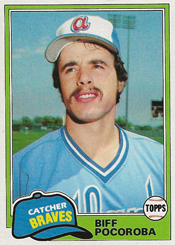
With two swings in one game, Biff Pocoroba created quite a bit of damage against the Cardinals.

A switch-hitting catcher, Pocoroba played 10 years in the major leagues, all with the Braves.
Born in Burbank, Calif., “Biff” was Pocoroba’s given name, not a nickname.

Selected by the Braves in the 17th round of the 1971 amateur baseball draft, Pocoroba reached the majors in 1975. He became the Braves’ starting catcher in 1977 and hit .290 with 24 doubles and an on-base percentage of .394. The Braves rewarded him with a six-year, $1 million contract.

In 1978, Ted Simmons of the Cardinals was voted starting catcher for the National League all-star team and his backups were the Reds’ Johnny Bench and the Phillies’ Bob Boone. When an injury made Bench unavailable for the All-Star-Game in San Diego, Pocoroba was chosen to replace him and caught an inning. Boxscore

A month later, Pocoroba injured his right shoulder and was out for the rest of the season. During rotator cuff surgery in September 1978, Dr. Frank Jobe transferred muscle from Pocoroba’s lower bicep to his shoulder, the St. Louis Post-Dispatch reported.

When Pocoroba returned to the Braves in June 1979, Bruce Benedict had taken over as the starting catcher.

Danger zone

On May 14, 1982, Pocoroba was in the lineup against the Cardinals in Atlanta. The Cardinals were in first place in the East Division and the Braves led the West. The pitching matchup was Joaquin Andujar for the Cardinals and Phil Niekro for the Braves. During Niekro’s Hall of Fame career, Benedict and Pocoroba caught more of his games than any other catchers.

While batting in the second inning, Pocoroba’s foul tip broke the right index finger of Cardinals catcher Darrell Porter. After the inning, Porter was replaced by Orlando Sanchez. The injury sidelined Porter for three weeks.

Pocoroba helped Niekro hold the Cardinals scoreless for eight innings. He threw out two base runners, Keith Hernandez and Mike Ramsey, attempting to steal.

Trailing 1-0, the Cardinals rallied for a run in the top of ninth versus Braves closer Gene Garber. Lonnie Smith singled, swiped second, moved to third on Ozzie Smith’s bunt hit and scored on Hernandez’s sacrifice fly.

Biff bops

In the bottom half of the ninth, Cardinals reliever Doug Bair retired the first two batters before Pocoroba came to the plate.

“I was looking for a fastball because Bair had been getting ahead of batters with the pitch,” Pocoroba told the Atlanta Constitution.

Bair told the Post-Dispatch, “I tried to throw the ball low and away. He’s a first-ball, fastball hitter. I threw it right in his wheelhouse.”

Pocoroba hit Bair’s first pitch over the fence in right for a walkoff home run and a 2-1 Braves victory. Boxscore

It was Pocoroba’s first home run since August 1980 versus the Cardinals’ Bob Forsch. It also was the first home run Bair allowed in 22 innings in 1982.

The Cardinals and Braves went on to win division titles and met in the 1982 National League Championship Series. The Cardinals won the pennant, sweeping the Braves in three games. Pocoroba had one at-bat in the postseason. Porter was named most valuable player in both the NL Championship Series and in the World Series versus the Brewers.

Read Full Post »

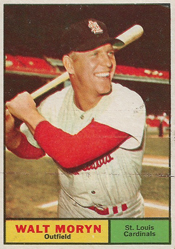
Walt Moryn was a big blonde slugger who hailed from Paul Bunyan country and was nicknamed Moose.

On June 15, 1960, the Cardinals acquired Moryn from the Cubs for utility player Jim McKnight and $25,000.
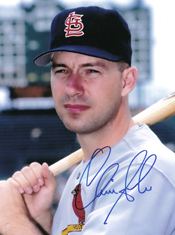
An outfielder and left-handed pull hitter, Moryn’s swing seemed tailored for the original Busch Stadium in St. Louis, where the shortest distance for a home run was to right.

Though no longer in his prime when he joined the Cardinals, Moryn, 34, had enough pop remaining in his bat to elicit calls of “M-o-o-o-s-e” from the fans in St. Louis when he got hold of a pitch.

Cubs clouter

Moryn was born and raised in St. Paul, Minn. His paternal grandparents immigrated to the U.S. from Russia and his maternal grandparents came from Poland. Moryn entered the Navy when he was 18 and served on an ammunition ship in the Pacific for two years during World War II.

When he returned home, Moryn played baseball in an industrial league. In August 1947, the Dodgers held a tryout camp in St. Paul. Moryn attended and was signed on the recommendation of scout Andy High, a former Cardinals infielder.

Moryn was 28 when he debuted in the majors with the Dodgers in June 1954. He also spent part of 1955 with them and was traded to the Cubs after the season.

For a stretch of three seasons, 1956-58, Moryn hit with consistent power and became a favorite of Cubs fans. He had 23 home runs in 1956, 33 doubles in 1957 and 26 home runs in 1958.

After his production declined to 14 home runs in 1959, Moryn was platooned in left field with Frank Thomas in 1960.

The signature play of Moryn’s career occurred on May 15, 1960, when he made a shoestring catch of a line drive by the Cardinals’ Joe Cunningham with two outs in the ninth to preserve a no-hitter by Don Cardwell. Video

Though Moryn was batting .294 and had an on-base percentage of .366 in 38 games for the 1960 Cubs, his home run total was a mere two when the Cubs shipped him to the Cardinals. Moryn told the Chicago Tribune he was on the outs with Cubs general manager John Holland. “He’s been trying to get rid of me for three years,” Moryn said.

Popular player

To make room for Moryn on their roster, the Cardinals sent Leon Wagner, their Opening Day left fielder, to the minors. The Cardinals were loaded with outfielders. Cunningham, Moryn and Stan Musial batted from the left side, and Curt Flood, Bob Nieman and John Glenn batted from the right. Moryn figured to platoon with Nieman in left.

“At Busch Stadium, I think Moryn still will be dangerous,” Cardinals coach Johnny Keane told the St. Louis Globe-Democrat.

Though listed at 6 feet 2 and 205 pounds, Moryn told the St. Louis Post-Dispatch he weighed 225. St. Louis writers had fun with his alliterative name and his size, referring to him as “Mighty Moose Moryn” and “a mass of muscle from Minnesota.”

Moryn was popular with teammates and helped rookies.

Second baseman Jerry Kindall, another St. Paul native who entered the majors with the Cubs in 1956, told the Chicago Tribune, “He gave the appearance of a very gruff guy, but if you were a teammate, you saw through that in a hurry. He was really a tender-hearted guy.”

In the book “We Played the Game,” Tim McCarver said when he was with the Cardinals as an 18-year-old in 1960, “Guys like Walt ‘Moose’ Moryn and Kenny Boyer couldn’t have been friendlier.”

Hot in August

In his Cardinals debut, on June 17, 1960, against the Braves, Moryn was 0-for-5 and struck out four times. Boxscore

Moryn hit .100 for the Cardinals in June and .194 in July, but sizzled in August, hitting .433 with 19 RBI in 23 games for the month.

“Cardinals crowds raise the “M-o-o-o-s-e’ call whenever the big blonde comes to the plate,” The Sporting News noted.

Moryn’s August performances at home included:

_ Aug. 6 vs. the Reds: 3-for-4, including a triple and a home run, and two RBI. Boxscore

_ Aug. 7 vs. the Reds: 2-for-2, including a home run and a walk, and two RBI. Boxscore

_ Aug. 17 vs. the Giants: 3-for-5, including a home run, and three RBI. Boxscore

_ Aug, 26 vs. the Pirates: 4-for-4, all singles, against Bob Friend. Boxscore

Moryn ended August with a .314 batting average since he joined the Cardinals.

Role player

Though he hit a three-run home run off Robin Roberts to carry the Cardinals to a 4-1 triumph at Philadelphia on Sept. 9, Moryn fell back into a slump and hit .154 for September.

In 75 games for the 1960 Cardinals, Moryn hit .245 with 11 home runs. He batted .301 at Busch Stadium and .196 on the road. Moryn also hit .266 versus right-handers and .111 against left-handers. He was a terror against the Reds, hitting .440 with five home runs and 11 RBI in 11 games for the 1960 Cardinals.

Moryn made 49 starts in the outfield _ 30 in right and 19 in left _ for the 1960 Cardinals.

At spring training in 1961, Moryn surprised the Cardinals by reporting at 198 pounds. “I’ve never been this light before,” he told the Globe-Democrat.

Regarding his playing weight in 1960, Moryn told the Post-Dispatch, “I realized I had let myself get too heavy.”

Cardinals trainer Bob Bauman predicted a slender Moose would slug more home runs at Busch Stadium. “I can see Moryn hitting a lot out on Grand Avenue this year,” Bauman said.

Used exclusively against right-handers and mostly as a pinch-hitter, Moryn, 35, never got untracked with the 1961 Cardinals. He hit .125 in 17 games and was traded to the defending World Series champion Pirates on June 15, 1961, for minor-league catcher Roberto Herrera and cash.

Three days later, on June 18, 1961, in his third game with the Pirates, Moryn, naturally, hit a three-run home run versus the Cardinals’ Larry Jackson. Boxscore

It was one of the last highlights for Moryn in the majors. He hit .200 in 40 games for the Pirates in 1961, his last season in the big leagues.

Read Full Post »

The Cardinals intended for Chris Sabo to replace Todd Zeile as their first baseman, but the plan fizzled when Sabo’s back gave out.

On June 8, 1995, the Cardinals signed Sabo after he was released by the White Sox. A third baseman, Sabo was sent to the Cardinals’ Louisville farm club to learn to play first base so he could be brought back to the majors and fill multiple roles.

About a week later, on June 16, 1995, Sabo was called up to the Cardinals amid a massive shakeup. On the day he arrived, manager Joe Torre was fired and Zeile was traded to the Cubs.

Interim manager Mike Jorgensen put Sabo into the lineup at first base, but his time with the Cardinals lasted only a few games.

Cincinnati kid

Sabo won the National League Rookie of the Year Award in 1988 when he produced 40 doubles and 46 stolen bases as third baseman for the Reds.

A son of a plumber from Detroit, Sabo became a Cincinnati favorite. Nicknamed “Spuds” for a resemblance to the dog Spuds McKenzie in beer commercials, Sabo wore goggles, a buzz cut and a K-mart wardrobe, and drove a well-used 1982 Ford Escort.

In 1990, Sabo had 38 doubles, 25 home runs and 25 steals for the champion Reds. In the Reds’ World Series sweep of manager Tony La Russa’s favored Athletics, Sabo hit .563 with two home runs and fielded flawlessly at third.

After the 1993 season, Sabo became a free agent, rejected an offer from the Mets and signed a one-year contract for $2 million with the Orioles because he viewed them as a contender.

The Orioles opened the 1994 season with a left side of the infield featuring Cal Ripken Jr. at shortstop and Sabo at third, but it didn’t last. Sabo hit .228 in April and went on the disabled list in May because of a bad back. His replacement, Leo Gomez, hit .325 in May and held the job.

Used primarily in the outfield and as designated hitter, Sabo played in 68 games for the Orioles, hit .256 and departed for free agency after the season.

New role

The Cardinals considered signing Sabo to be their third baseman, the St. Louis Post-Dispatch reported, but traded for Scott Cooper of the Red Sox instead. When no other teams showed interest, Sabo, 33, thought about returning to the University of Michigan to finish the work he started on a degree 14 years earlier, the Chicago Tribune reported.

Sabo’s plans changed on April 10, 1995, when the White Sox gave him a one-year contract at $550,000 to be their designated hitter. John Kruk was the first choice of White Sox general manager Ron Schueler to be designated hitter, the Tribune reported, but when Kruk, a free agent, opted to retire, Schueler selected Sabo.

Sabo plays with “intensity and has fire in his eyes,” Schueler said.

Said Sabo: “I’ve never been very level-headed. I have quite a temper. It’s the only way I’ve been able to get where I have. I get fiery. I don’t have a world of talent. So I fire up to help myself.”

Sabo preferred to play third base, but the White Sox had a Gold Glove winner, Robin Ventura, there.

What a Kruk

The White Sox opened the 1995 season with Sabo batting in the cleanup spot between slugger Frank Thomas and Ventura. In May, Kruk changed his mind about retirement and signed with the White Sox, who intended to make him the designated hitter.

Miffed, Sabo told The Cincinnati Post he’d return to the Reds “for a song.”

“I plan on being with the Reds again before I’m done, one way or the other,” Sabo told The Post.

Kruk, 34, joined the White Sox on May 24, 1995. The Tribune’s Paul Sullivan described him as having “the physique of Babe Ruth, the batting eye of Tony Gwynn and the sarcastic wit of David Letterman. He chain-smoked cigarettes, didn’t watch his weight and proudly wore the same T-shirt day after day.”

The White Sox released Sabo on June 5. In 20 games for them, he hit .254 with one home run.

Team in turmoil

Three days later, on June 8, 1995, the Cardinals signed Sabo and indicated he would be used as a utility player for them after he went to Louisville and learned to play first base.

“We know he can play third and the outfield,” said Cardinals manager Joe Torre. “If he can play first, it will add to his versatility. If he’s healthy, he’s a threat with the bat. He can hit the homer and he pulls the ball. He plays well defensively.”

Sabo hit .393 in nine games as Louisville’s first baseman.

Promoted to the Cardinals, he never got to play for Torre. With the Cardinals’ record at 20-27, general manager Walt Jocketty fired Torre on the morning of June 16 before trading Zeile. Though Zeile hit .291 with 22 RBI in 34 games, he was dealt after accusing management of reneging on a contract agreement.

With Zeile gone, Sabo became the first baseman and was assigned uniform No. 18, the same previously worn by Mike Shannon and Andy Van Slyke. In his Cardinals debut on June 16 against the Giants at St. Louis, Sabo batted fifth in the order between Ray Lankford and Scott Cooper. He made a fielding error in the second inning, leading to a run, but had a run-scoring single in the fifth. Boxscore

Sabo played in four more games for the Cardinals, making another start at first, one at third and two pinch-hit appearances. He had a two-run double versus Dodgers rookie Hideo Nomo on June 19. Boxscore

During batting practice one day, Sabo developed back spasms. He went on the disabled list on June 29, 1995, and remained sidelined for six weeks. “I don’t think there’s a lot of fuel left in the tank,” Cardinals coach Gaylen Pitts told Larry Harnly of The State Journal-Register of Springfield, Ill.

In August 1995, the Cardinals sent Sabo to their St. Petersburg farm club in the Florida State League to get in condition for a possible return to the majors in September. Instead, after Sabo hit .231 in 14 games for St. Petersburg, the Cardinals released him because “he didn’t dominate that league like you’d think he would,” Jocketty said.

In 13 at-bats for St. Louis, Sabo had two hits and three RBI.

As he predicted, Sabo returned to the Reds and played his final major-league season with them in 1996.

In 2018, Sabo was named head baseball coach at the University of Akron.

Read Full Post »

« Newer Posts - Older Posts »