Feeds:
Posts
Comments

Archive for the ‘Hitters’ Category

(Updated Sept. 1, 2024)

Bobby Del Greco was a graceful center fielder with a strong arm, but he was no Bill Virdon.

Del Greco was a principal figure in one of the Cardinals’ most lopsided trades.

On May 17, 1956, the Cardinals dealt center fielder Bill Virdon to the Pirates for Del Greco and pitcher Dick Littlefield.

Virdon, 24, was the winner of the 1955 National League Rookie of the Year Award. Del Greco, 23, was seeking a chance to play regularly in the major leagues.

The deal was a dud for the Cardinals. Virdon played 11 years with the Pirates, producing 1,431 hits, earning a Gold Glove Award and helping them win a World Series championship. Del Greco played part of one season for the Cardinals, couldn’t hit consistently and was sent to the Cubs.

Great glove

A Pittsburgh native, Del Greco was signed to a Pirates contract by Hall of Famer Pie Traynor. In 1952, Del Greco was 19 when he made his major-league debut with the Pirates against the Cardinals and produced three hits and a walk in five plate appearances. Boxscore

After hitting .217 in 99 games for the 1952 Pirates, Del Greco spent the next three seasons in the minor leagues. He played for the Hollywood Stars of the Pacific Coast League in 1955 and hit .287 with 26 doubles and 21 stolen bases for manager Bobby Bragan. Del Greco also caught the attention of Fred Hutchinson, manager of the rival Seattle Rainiers.

In 1956, Bragan became manager of the Pirates and Hutchinson became manager of the Cardinals. Bragan chose Del Greco to be the Opening Day center fielder for the 1956 Pirates.

Del Greco has “a strong, accurate arm and the instinct of throwing to the right base,” The Sporting News noted. He “gets a tremendous jump on any fly ball and can outrun some of them.”

Seeing is believing

The Cardinals opened the 1956 season with Wally Moon as the first baseman and an outfield of Hank Sauer in left, Virdon in center and Stan Musial in right.

After batting .281 as a Cardinals rookie in 1955, Virdon got off to a slow start in 1956. Cardinals general manager Frank Lane suspected Virdon might have deteriorating vision. Also, Virdon, like Musial and Moon, batted left-handed and Lane wanted an outfielder who batted from the right side.

Hutchinson suggested Del Greco as a replacement for Virdon and Lane began trade talks with the Pirates after the Phillies declined to deal center fielder Richie Ashburn for Virdon.

On May 13, 1956, Del Greco hit two home runs in a game at Pittsburgh against the Phillies’ Harvey Haddix, a former Cardinal. Lane was at the game to scout Del Greco and was impressed. Boxscore

Del Greco’s two-homer game “was the biggest boost for the trade,” Pirates general manager Joe Brown told The Sporting News.

Pirates plunder

Though Virdon was batting .211 in 24 games for the 1956 Cardinals, the trade was viewed as a major risk for them. Moon told Cardinals Yearbook in 1999, “Bill was an exceptionally good defensive player. I was most unhappy when they traded him to Pittsburgh.”

Del Greco was batting .200 for the 1956 Pirates and they primarily were playing him against left-handers.

Hutchinson called Del Greco “a terrific outfielder” with “a real good arm and speed.” He told the St. Louis Post-Dispatch, “Yes, I’d have to say (he’s) better than Virdon.”

Lane said, “We liked Del Greco because he seemed to have more drive than Bill.”

Citing the eyesight issue, Lane said, “Maybe, as has been suggested, we decided it would be better to let Pittsburgh or another club worry about whether he still has major-league vision.”

Lane added, “It wasn’t only Virdon’s failure to get base hits. Bill wasn’t even hitting the ball hard.”

Brown said the Pirates “wanted Virdon badly,” and when Lane readily agreed to the deal, “I began to wonder if there might be something wrong with Virdon.”

Turns out, Virdon was fine. He batted .334 with 170 hits in 133 games for the Pirates in 1956 and played a splendid center field. Virdon “is certainly on a par even with the fabulous Willie Mays,” The Sporting News remarked. “Pittsburgh fans compare him with the gifted Vince DiMaggio and Lloyd Waner.”

Del Greco batted .215 in 102 games for the 1956 Cardinals. He hit .176 in home games and overall his batting average with runners in scoring position was .098 (5-for-51).

“What a terrible deal,” Sauer said in the book “We Played the Game.” Virdon “was a great fielder, much better than Del Greco.”

A defiant Lane told The Sporting News, “I make no pretensions of perfection in trading. I merely hope to make more good deals than bad ones.”

Moving on

After the 1956 season, Del Greco played winter ball in Havana. Cardinals scout Al Hollingsworth went to Cuba to see Del Greco and said, “One thing he’s got to learn is to forget the long ball.”

At spring training in 1957, rookie Bobby Gene Smith won the Cardinals’ center field job when Del Greco batted .101 in Grapefruit League exhibition games.

On April 20, 1957, the Cardinals traded Del Greco and pitcher Ed Mayer to the Cubs for outfielder Jim King.

Del Greco played for the Cubs (1957), Yankees (1957-58), Phillies (1960-61 and 1965) and Athletics (1961-63), and batted .229 in his career in the majors.
Read Full Post »

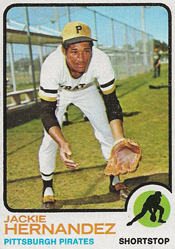
Jackie Hernandez experienced one of his most joyful moments in baseball after one of his most frustrating performances.

Born in Cuba, Hernandez was a shortstop in the major leagues for nine seasons with the Angels (1965-66), Twins (1967-68), Royals (1969-70) and Pirates (1971-73).
Hernandez had his most memorable season in 1971 when the Pirates won the World Series championship. He opened the season as the starting shortstop because incumbent Gene Alley was sidelined with a broken hand. Late in the season, Alley had a bad knee and Hernandez was the primary shortstop in the pennant stretch and in the postseason.

PIrates manager Danny Murtaugh “isn’t looking for base hits from Hernandez,” The Sporting News reported. “The manager wants steady shortstop play.”

On Sept. 22, 1971, at St. Louis, Hernandez struck out four times against Bob Gibson, but the Pirates beat the Cardinals, 5-1, and clinched the National League East Division title.

Hernandez contributed with his fielding, helping the Pirates turn three double plays.

As the Pirates celebrated inside the clubhouse at Busch Memorial Stadium, Hernandez smiled as he wiped champagne off his spikes. He never had been on a club that qualified for the postseason.

“For the first time in my life, I struck out four times and it didn’t bother me,” Hernandez said to the St. Louis Post-Dispatch. “I don’t care if I get a hit, or if I get on base. Just so we win the game. That’s all I cared about.” Boxscore

Hernandez started six of the seven games in the 1971 World Series against the Orioles and committed no errors in 53.2 innings at shortstop.

In the ninth inning of Game 7, with the Pirates clinging to a 2-1 lead at Baltimore, Hernandez cleanly handled the last two outs.

After Frank Robinson popped out to Hernandez for the second out in the ninth, Merv Rettenmund hit one on the ground. “The ball skipped up the middle and a foot or so to the right of second base,” The Sporting News reported. “Base hit? No chance. Hernandez was playing almost behind second. It wasn’t a routine play, but he was there in plenty of time to grab the ball and fire to first baseman Bob Robertson for the clinching out.” Boxscore

Hernandez hit .208 in his major-league career, including .205 versus the Cardinals.

One of his most productive games with the bat occurred against the Cardinals on May 17, 1972, at Three Rivers Stadium in Pittsburgh. Hernandez, batting eighth in the order, was 3-for-4 with three RBI in a 12-0 Pirates victory.

He entered the game with a season batting average of .167 and no RBI.

Hernandez broke the game open in the fourth inning. The Pirates led, 3-0, when Hernandez batted against Cardinals starter Reggie Cleveland with one out and the bases loaded. Hernandez hit a single to left, driving in two and giving the Pirates a 5-0 lead.

In the fifth, the Pirates scored three times against Joe Grzenda, extending their lead to 9-0. Hernandez scored Richie Hebner from third with a two-out single.

Hernandez also had a double to left in the seventh against Lance Clemons. Boxscore


Read Full Post »

(Updated Aug. 8, 2025)

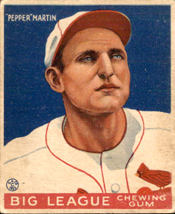
Pepper Martin interrupted a successful stint as a manager to return to the Cardinals as a player and help them get to another World Series.

In 1943, Martin managed in the Cardinals’ farm system for the third consecutive year. After the season, while in St. Louis to interview for a radio sports announcer job, Martin met with Cardinals owner Sam Breadon, who was looking for players to replace those called to serve in the military during World War II.
Accepting Breadon’s offer to come back to the Cardinals, Martin, 40, was a utility player for them in 1944 and contributed to a successful run to a third consecutive National League pennant.

With mission accomplished, Martin sought to resume his managing career and the Cardinals obliged by giving him his unconditional release in October 1944.

Spice to the lineup

When Martin was an infant in Temple, Oklahoma, he’d nap on a sack in the cotton fields while his family harvested the crop, according to Wilbur Adams of the Sacramento Bee. Martin was 6 when the family moved to Oklahoma City.

“Ever since I was old enough to handle a baseball, I loved the game,” Martin recalled in a column for the Philadelphia Inquirer.

When Martin was 9, he worked a newspaper route in Oklahoma City. “I’d get up at 3:30 every morning to get the Daily Oklahoman to the homes of my readers,” Martin said to the St. Louis Star and Times, “but before I delivered a single paper I used to sit down under a street corner lamp and study the box scores of the major leagues. In winter, I’d read the gossip of the hot stove league.”

Martin told the Inquirer, “The Red Sox were going great in those days and they were my favorite team. I had a pretty good memory as a kid and I knew by heart the averages of pretty nearly every big leaguer. I saved enough out of my earnings as a newsboy to buy my first glove and I had it stuck in my back pocket wherever I went and whatever I did. Not so many kids in my neighborhood had gloves, and owning that mitt gave me almost as much happiness as would a couple of home runs in a World Series game.”

While playing for a minor-league team in Texas when he was 21, Martin was signed by Cardinals scout Charley Barrett.

Martin debuted with the Cardinals in 1928. With his aggressive, fun-loving style of play, he was a prominent part of the Cardinals clubs of the 1930s. Martin and his pal, pitcher Dizzy Dean, symbolized the spirit of the group known as the Gashouse Gang. Dean “was just a big-hearted old country boy, from a cotton patch, like myself,” Martin said to The Sporting News. “So I guess that’s why I liked old Diz.”

An outfielder and third baseman nicknamed “Wild Horse of the Osage,” Martin led the National League in stolen bases three times and scored more than 120 runs in a season three times.

As a third baseman, Martin “introduced a style of play all his own,” the St. Louis Post-Dispatch reported. Martin described his approach to fielding groundballs as “stop it with your chest, then throw them out.”

In the 1931 World Series against the Athletics, Martin had an on-base percentage of .538, producing 12 hits and two walks in 26 plate appearances, and swiped five bases. He batted .355 and scored eight runs in the 1934 World Series versus the Tigers. “Pepper always was fighting to win, trying for that extra base or an impossible chance, no matter whether his team was miles ahead or furlongs behind,” The Sporting News noted in an editorial.

After the 1940 season, Martin became a player-manager in the Cardinals’ farm system. His Sacramento teams finished 102-75 in 1941 and 105-73 in 1942.

In 1943, Martin took over a Rochester team which finished 59-93 the year before and helped it improve to 74-78. One of his best Rochester players was shortstop Red Schoendienst.

Martin batted .280 for Rochester and “was the best outfielder on the club,” Sam Breadon said. “He could outrun any man on the club on the bases.”

Slow to age

Martin told the Associated Press he was offered a radio sports broadcasting job for 1944 but after talking with Breadon decided to play instead.

Breadon told the Post-Dispatch, “I asked him how he would like to play with the Cardinals and he shot back, ‘I sure would.’ ”

Though he was 40, Martin insisted his age was 10 because his birthday was Feb. 29, a date which appears on the calendar only once every four years.

“He still has his old-time sparkle and speed,” said Cardinals manager Billy Southworth. “I think he will help a lot.”

Said Martin:  “I’ll play any time and place they need me.”

Teaching by example

Martin played in 40 games, 29 as an outfielder, for the 1944 Cardinals, and had an on-base percentage of .386. He finished with a flourish, producing five hits, including a home run, in the last eight at-bats of his big-league career.

He also was a mentor who “sold the Cardinals’ rookies on his undying spirit,” the Post-Dispatch reported.

After the Cardinals won the 1944 Word Series championship against the Browns, Martin asked for his release so he could “negotiate for any coaching or managerial post he wants,” the St. Louis Globe-Democrat reported.

Breadon mailed him the release on Oct. 13, 1944, and Martin received it on Oct. 16. “We hate to let him go, but he wants it that way,” Breadon said.

San Diego, an unaffiliated minor-league team in the Pacific Coast League, needed a manager and identified two finalists, Martin and Casey Stengel. Martin got the job and Stengel went to manage the Yankees’ farm club at Kansas City.

Martin managed 14 seasons in the minors and had an overall record of 1,083-910.

Read Full Post »

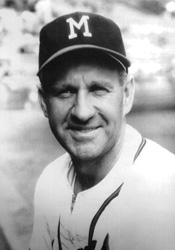
At 43, Enos Slaughter, the oldest active player in the big leagues in 1959, still had the skills to be considered a difference maker to a team in a pennant race.

Slaughter, who began his big-league career with the Cardinals in 1938 and became one of their all-time best, played his last game in the majors for the Braves in 1959.
The Braves acquired Slaughter from the Yankees on Sept. 11, 1959, because they thought he could provide an edge in their pursuit of a third consecutive National League championship.

Though the Braves barely missed out, tying for first place before losing to the Dodgers in a playoff, Slaughter helped them win a pivotal regular-season game.

On Oct. 13, 1959, the Braves released Slaughter, ending a prolific major-league career. Slaughter, who batted .300 with 2,383 hits, 1,304 RBI and a .382 on-base percentage, was elected to the National Baseball Hall of Fame.

That’s a winner

An outfielder who batted left-handed, Slaughter developed a reputation for his all-out hustle. His daring dash from first base to home plate on a hit by Harry Walker provided the winning run for the Cardinals in Game 7 of the 1946 World Series against the Red Sox.

Slaughter played for the Cardinals from 1938 to 1942, spent three years in military service during World War II and returned to play for the Cardinals from 1946-53. He batted .305 with 2,064 hits in his 13 seasons with St. Louis.

In 1954, the Cardinals wanted to open an outfield spot for rookie Wally Moon. In spring training, shortly before his 38th birthday, Slaughter was traded by the Cardinals to the Yankees. In two stints with the Yankees, before and after being sent to the Athletics, Slaughter became a valuable role player and trusted favorite of manager Casey Stengel.

“Slaughter is really one of the most remarkable ballplayers I’ve ever known,” Stengel said to The Sporting News.

After playing in two World Series (1942 and 1946) for the Cardinals, Slaughter played in three World Series (1956, 1957 and 1958) for the Yankees.

Pitchers, beware

Considering his age, some were surprised the Yankees brought back Slaughter in 1959, but Stengel said, “Enos was my best pinch-hitter last year. We’re not carrying him for charity. He earns his pay.”

On May 16, 1959, in a game against the White Sox, Slaughter had a stolen base, becoming one of the oldest players to achieve the feat. Boxscore

Six of his first 11 hits for the season were home runs. On July 4, 1959, Slaughter, after pinch-running for a gimpy Mickey Mantle, hit a three-run home run against Pedro Ramos of the Senators. Boxscore Two weeks later, on July 19, 1959, he hit a pair of two-run home runs, one against Barry Latman and the other off Ray Moore, versus the White Sox. Latman was not quite 2 years old when Slaughter debuted with the 1938 Cardinals. Boxscore.

The Yankees, who won nine of 10 American League pennants between 1949 and 1958, had an off year in 1959. Trailing the first-place White Sox by 16.5 games after play on Sept. 10, 1959, the Yankees were ready to shake up the roster. Slaughter, batting .172, was placed on waivers and claimed by the Braves.

Slaughter displayed “a black scowl” as he packed his gear before departing Yankee Stadium for Milwaukee, according to New York Herald Tribune columnist Red Smith.

“This is an unusual fellow, a professional and a tough one,” Smith wrote. “He eats tobacco and he spits and he wants pitchers dead.”

The Hustler

In joining the Braves, Slaughter was reunited with a former Cardinals teammate, second baseman Red Schoendienst.

“I feel that my eyes are as good as ever and my legs are good,” Slaughter said. “I’ll keep on playing as long as they’ll let me.”

In his Braves debut on Sept. 13, 1959, his first National League game since 1953 with the Cardinals, Slaughter batted for infielder Felix Mantilla and singled to center against the Reds’ Bob Purkey. Boxscore

Three days later, on Sept. 16, 1959, the Braves opened a key series against the Giants at San Francisco. The Giants were in first place, two games ahead of the Braves and Dodgers.

Braves manager Fred Haney gave Slaughter the start in left field and batted him fifth in a lineup featuring fellow future Hall of Famers Hank Aaron and Eddie Mathews.

The Braves won, 2-0, behind the pitching of Lew Burdette. Slaughter figured in both runs.

In the fourth, with one on and one out, Slaughter coaxed a walk from Sam Jones, advancing Joe Adcock to second base. After Bobby Avila struck out, Del Crandall singled, scoring Adcock. In the eighth, Slaughter’s two-out single scored Aaron from second. Boxscore

“We hoped he would win just one game for us and he did,” Braves executive Birdie Tebbetts said. “Unfortunately, one wasn’t quite enough.”

The Braves and Dodgers finished the regular-season schedule tied for first place with 86-68 records. In a subsequent best-of-three playoff, the Dodgers won the first two games and advanced to the World Series.

On Nov. 9, 1959, a month after the Braves released him, Slaughter was named player-manager of the Houston Buffs, a farm club of the Cubs.

Buffs president Marty Marion, Slaughter’s former Cardinals teammate, said, “The Chicago Cubs thought it was tremendous. They are happy to have their young players in Slaughter’s hands.”

The Associated Press referred to Slaughter as “baseball’s ageless country boy.”

“I’ll never be too old to learn,” Slaughter said. “I’ll listen to the rawest rookie about things that might help him or me.”

The top prospects on the Cubs’ Houston farm club were a pair of future Hall of Famers, third baseman Ron Santo and outfielder Billy Williams.

Slaughter managed Houston to an 83-71 record in 1960. He managed the Raleigh Capitals, a farm club of the fledgling Mets, in 1961.

In December 1961, a 20-year-old Reds prospect, Pete Rose, impressed observers with his aggressive approach in the Florida Instructional League. Asked how he developed his style of play, Rose, who would come to be known as “Charlie Hustle,” said, “I remember seeing Enos Slaughter play against the Reds on television. He ran to first after getting a walk. I’ve been doing it ever since.”

Read Full Post »

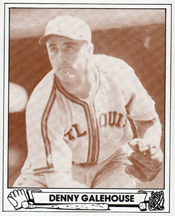
A pitcher with a losing record and a batter with a bad back provided a winning combination for the St. Louis Browns in their World Series debut.

On Oct. 4, 1944, Denny Galehouse outdueled Cardinals ace Mort Cooper and George McQuinn hit a two-run home run in the Browns’ 2-1 victory in Game 1 of the World Series at Sportsman’s Park in St. Louis.

The American League champion Browns, appearing in their only World Series, defied convention all season and did so again against the three-time defending National League champion Cardinals.

Browns manager Luke Sewell bypassed his ace, Nelson Potter, and started Galehouse (9-10) against Cooper (22-7). Galehouse was the first pitcher with a losing season record to start Game 1 of a World Series, The Sporting News reported.

McQuinn, the Browns’ first baseman, was another unexpected standout. He suffered from sciatica and needed to be rested for a stretch of games in early September when his chronic back pain became severe, according to United Press.

McQuinn “rarely gets a good night’s rest,” The Sporting News reported. “He has difficulty in sleeping because if he lies for several hours in one position the back becomes pinched and exceedingly painful.”

Given opportunities on baseball’s biggest stage, though, Galehouse and McQuinn delivered grand performances.

Duty calls

Galehouse, a right-hander, pitched for the Indians and Red Sox before being sent to the Browns in December 1940. Like his Browns teammate, outfielder Chet Laabs, Galehouse was too old for military service in World War II but the Army sent him to work in a plant in 1944 when he was 32.

According to the St. Louis Post-Dispatch, Galehouse was working fulltime at a rubber factory in the Akron-Youngstown region of northeast Ohio in 1944. In May, the Browns arranged for Galehouse to travel by train from Ohio for Sunday games.

Galehouse pitched in three Sunday games in May and three Sunday games in June, losing three decisions, before he got an indefinite leave of absence from the war plant. He became a fulltime member of the Browns’ starting rotation on July 24.

After the Browns clinched the pennant on the last day of the regular season, most expected Sewell to select Potter (19-7) to be the Game 1 World Series starter. Instead, Sewell opted for Galehouse, who in September had a 1.92 ERA in 56.1 innings pitched. Galehouse allowed one earned run in his last three regular-season starts, covering 23 innings.

Sewell hoped his hot starter would win Game 1 and Potter would follow suit in Game 2.

The strategy almost worked.

Great escape

Galehouse got out of an early jam in Game 1 with the help of a questionable decision by Cardinals manager Billy Southworth, who took the bat out of Stan Musial’s hands.

With the game scoreless, Johnny Hopp led off the bottom of the third inning with a single for the Cardinals. Ray Sanders followed with a sinking liner. Right fielder Gene Moore, trying to make a backhand grab, got his glove on the ball, but couldn’t hold it. Hopp, waiting to see whether Moore would catch the ball, advanced only to second on Sanders’ single.

Musial, who batted .347 with 94 RBI during the regular season, stepped to the plate with runners on first and second, none out. After fouling off a pitch from Galehouse, Musial was given the bunt sign. He sacrificed successfully, moving Hopp to third and Sanders to second, but Southworth deprived the Cardinals’ best hitter of a chance to deliver a big blow.

The next batter, Walker Cooper, was walked intentionally, loading the bases with one out for Whitey Kurowski.

After getting two strikes on Kurowski, Galehouse noticed the Cardinals’ batter “was protecting the far side of the plate,” the St. Louis Globe-Democrat reported. Galehouse threw a slider inside and Kurowski swung at it and missed for the second out. Next, Danny Litwhiler hit into a force play at third, enabling Galehouse and the Browns to escape the inning unscathed.

Grantland Rice, writing for the North American Newspaper Alliance, said Galehouse possessed a “stout right arm, cool head and scrappy heart.”

“Galehouse looked cooler than a slice of cucumber on ice,” wrote Rice.

Mighty McQuinn

With two outs in the fourth, Cooper gave up his first hit, a single by Moore.

Up next was McQuinn, a left-handed batter.

McQuinn, 34, hit 11 home runs during the season, but only one after Aug. 13.

With the count 1-and-0, Cooper threw him a fastball. “One of his low, fast ones _ almost too low for me,” McQuinn said to the St. Louis Star-Times.

McQuinn swung and “caught it just right,” he told United Press.

“The noise that followed sounded like the shot from a big gun,” Grantland Rice observed.

McQuinn’s rising line drive headed toward a right-field screen that extended from the wall to the pavilion roof.

“I was a bit worried at first (the ball) wasn’t quite high enough,” McQuinn said to the Globe-Democrat.

According to the Star-Times, “the ball cleared the pavilion roof by no more than a foot or so” for a home run and a 2-0 Browns lead.

St. Louis showdown

Cooper went seven innings, allowing only the two hits, and Blix Donnelly held the Browns hitless over the last two innings.

In the bottom of the ninth, Marty Marion led off with a drive to left-center for the Cardinals. Center fielder Mike Kreevich tried to make a shoestring catch, but barely missed, and Marion had a double.

Galehouse got Augie Bergamo to ground out to second, advancing Marion to third.

Ken O’Dea, batting for Donnelly, battled Galehouse, fouling off six pitches, before he flied out to deep center. Marion scored on the sacrifice fly, moving the Cardinals to within a run at 2-1, but the bases were empty with two outs.

The drama ended when Hopp flied out to right-center. Boxscore

“We were lucky,” Sewell said to the Post-Dispatch. “We had the breaks and I freely admit it. You have to be lucky to win when a pitcher holds you to two hits.”

Said Southworth: “We had everything that usually wins ballgames for you. You couldn’t have asked for better pitching than we got.”

The Browns’ mojo nearly held up in Game 2. Potter limited the Cardinals to two unearned runs, but Donnelly pitched four scoreless innings in relief of Max Lanier and the Cardinals won, 3-2, in 11 innings.

After the clubs split Games 3 and 4, Cooper got his revenge, striking out 12 and beating Galehouse with a 2-0 shutout in Game 5.

Needing one more win for the crown, the Cardinals got it, beating the Browns, 3-1, in Game 6.

Read Full Post »

Chet Laabs produced pipes to help win a war and home runs to help win a pennant.

On Oct. 1, 1944, Laabs hit a pair of two-run home runs, powering the St. Louis Browns to a 5-2 victory over the Yankees and clinching the club’s lone American League championship.

The Browns went on to play the Cardinals in the only all-St. Louis World Series.

Laabs was an unlikely hero, even for the Browns, who were described by the New York Daily News as “a ragbag ball team pieced together from remnants shed away by the rest of the circuit.”

A right-handed batter, Laabs, 32, had hit three home runs during the 1944 season before he slugged two in the pennant-clinching season finale.

His home run production was limited because when the season began he was working in a factory instead of in a ballpark.

Hard labor

Laabs began his major league career with the Tigers in 1937 and was traded to the Browns in 1939.

A 5-foot-8 outfielder, he hit 27 home runs for the Browns in 1942 and 17 the next season.

Laabs “derives tremendous power from muscular wrists and forearms,” the New York Daily News explained.

In February 1944, Laabs passed his Army induction physical, but his military service was deferred because he was older than 26. The Army put him to work in a fulltime defense job at a St. Louis plant, making pipes for construction of nuclear weapons used in World War II.

Because of the war work, Laabs missed spring training and wasn’t with the club when it won nine of its first 10 games to start the season.

In May, the Browns arranged for Laabs to play on weekends and in selected night games after his shift at the pipe plant, “but many times he was unable to even take part in batting practice” because the day job “kept him busy until a few moments before game time,” the St. Louis Star-Times reported.

Laabs appeared in his first game for the 1944 Browns on May 24. He returned fulltime to baseball in late June, but struggled. Laabs batted .133 in May, .154 in June, .239 in July and .172 in August. He hit a home run on May 30, didn’t hit another until July 18 and went two more months before hitting his third homer on Sept. 25.

The Star-Times called Laabs “the big bust of the Browns’ attack.”

Down to the wire

September was a good month for Laabs and the Browns. He batted .304 in September and the Browns went on a tear at the end of the month, winning 10 of their last 11 September games.

On the morning of Oct. 1, the last day of the 1944 regular season, the Browns and Tigers both had 88-65 records and were tied for first place. The Tigers were to finish at home against the Senators and the Browns had a game at home versus the Yankees.

At Detroit, the Senators’ knuckleball specialist, Dutch Leonard, was matched against the Tigers’ 27-game winner, Dizzy Trout.

At St. Louis, the largest home crowd in Browns history, 37,815, packed Sportsman’s Park for the Sunday afternoon game, looking for the hometown club to complete a four-game sweep of the defending champion Yankees.

The starting pitchers were the Yankees’ Mel Queen, a hard-throwing rookie, versus the Browns’ 35-year-old Sig Jakucki, a hard-drinking brawler.

In the minors, Jakucki beaned Cardinals prospect Johnny Keane, the future manager, and fractured his skull.

Jakucki made his big-league debut with the Browns in 1936 and didn’t return to the majors for eight years. The New York Daily News described him as “a tough solider who has rambled around the world, working his way by playing semipro baseball,” preferring “hoboing around the globe to playing in the big leagues.”

Jakucki was pitching for a shipyard team in Houston when the Browns rediscovered him and coaxed him back.

Going deep

Queen held the Browns hitless in the first three innings and the Yankees went ahead, 2-0. Browns batters treated Queen’s deliveries “as gently as if he were a lady,” the Star-Times noted.

Mike Kreevich got the Browns’ first hit, a line single to left, to lead off the fourth. Laabs came up next. According to the Star-Times, “There had even been a bit of booing when Laabs was announced as the starting left fielder.”

Undaunted, Laabs “cracked a fastball high into the left-field bleachers, the ball almost reaching the refreshment stand at the top,” the St. Louis Post-Dispatch reported.

Soon after Laabs’ longball tied the score at 2-2, the Sportsman’s Park scoreboard posted the final from Detroit, a 4-1 Senators victory. According to the Post-Dispatch, “the big crowd went wild, the cheering lasting for about five minutes.”

The Tigers’ loss meant the Browns would win the pennant if they beat the Yankees.

In the fifth, Kreevich singled with two outs and Laabs launched a slow curve from Queen 400 feet into the seats in left-center, giving the Browns a 4-2 lead.

Vern Stephens extended the lead to 5-2 with a solo home run against reliever Hank Borowy in the eighth.

Jakucki held the Yankees scoreless over the last six innings, completing the win. Boxscore

“His slider had plenty of sail and his curve was breaking fast and sharp,” Browns catcher Red Hayworth told United Press.

St. Louis showcase

In the victorious Browns clubhouse, “while his teammates sang, laughed, danced, kissed one another, Chet sat silently in front of his locker, wiping a towel across his brow,” the Star-Times observed. “He looked at the floor as if in a daze, as if he wondered if it were true.”

Asked about his home runs, Laabs said, “I think I hit the first one just a little bit harder. There was nothing to it.”

Billy Southworth, manager of the National League champion Cardinals, said he was “delighted” for the Browns and looked forward to the entire World Series being played in St. Louis.

“It’s going to be a nice family party,” Southworth said to the Post-Dispatch. “We won’t have to catch any trains or worry about hotel reservations or baggage. What’s more important, St. Louis can show the world that it can put on a World Series on its own.”

The Browns (89-65) were matched against a Cardinals club (105-49) which ran away with its third consecutive National League pennant, clinching the title on Sept. 21 and finishing 14.5 games ahead of the second-place Pirates.

The Browns won two of the first three World Series games before the Cardinals won the last three in a row. Jakucki started and lost Game 4, allowing four runs in three innings. Laabs had three hits in 15 World Series at-bats and no RBI.

Read Full Post »

« Newer Posts - Older Posts »