Feeds:
Posts
Comments

Archive for the ‘Hitters’ Category

Steve Huntz had impressive timing for a player with unimpressive numbers.
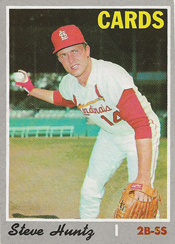
On Aug. 28, 1969, Huntz hit his first major-league home run, giving the Cardinals a 2-1 walkoff victory over the Astros at St. Louis.

Huntz was an unlikely candidate for such a feat. The rookie infielder entered the game with a season batting average of .186.

Prospect with pop

Huntz began his professional career when he signed with the Orioles as an amateur free agent after three successful varsity seasons at St. Ignatius High School in Cleveland.

In 1964, his first professional season, Huntz had 74 RBI for the Class A Midwest League Fox Cities Foxes. Of his 98 hits, 34 were for extra bases.

Cardinals scouts Jim Belz and Joe Mathes liked what they saw from Huntz. Based on their recommendations, the Cardinals paid $8,000 for the right to select Huntz in the November 1964 minor-league draft.

Huntz broke his leg in 1965 and sat out the season. He came back in 1966, played for Class AA Arkansas and committed 44 errors at shortstop.

After spending the 1967 season with Class AAA Tulsa, Huntz was called up to the big leagues when rosters expanded in September and appeared in three games for the Cardinals.

Huntz, a switch-hitter, was considered a prime candidate to earn a spot with the 1968 Cardinals as a utility player, but he batted .167 in spring training and “displayed limited range at the most critical position as backup man to Dal Maxvill at shortstop,” The Sporting News reported.

The Cardinals kept veteran Dick Schofield as their reserve shortstop and sent Huntz to Tulsa for the 1968 season.

Playing for manager Warren Spahn, Huntz hit .284 with 35 doubles and 74 RBI, helping Tulsa win the 1968 Pacific Coast League championship. Though Huntz committed 41 errors at shortstop, the Cardinals were intrigued by his power.

“He’s an infielder with sting at the plate and there aren’t many prospects like that around,” said Cardinals assistant farm director Fred McAlister.

As for fielding, McAlister said, “Huntz does a good job of moving to his right, bracing himself and gunning the ball. He can’t move to his left the way Dal Maxvill can, but how many men can a shortstop throw out when he fields the ball deep to his left? It’s making the routine plays that’s most important with a shortstop.”

Ups and downs

After the 1968 season, Schofield was traded to the Red Sox for pitcher Gary Waslewski, opening a path for Huntz to be a reserve infielder for the 1969 Cardinals. A headline in The Sporting News declared, “Cards Tap Huntz As New Super Sub.”

Huntz, 23, spent the entire 1969 season with the Cardinals, but struggled from the start. A breakthrough came on July 1, 1969, in a doubleheader against the Mets at St. Louis. Huntz, who had one RBI for the season, started at second base in the opener and drove in a run. Boxscore In the second game, he started at shortstop and drove in three runs with a bases-loaded double against Don Cardwell. Boxscore

Nearly two months later, Huntz got his first big-league home run. He entered the game against the Astros at Busch Stadium in the ninth inning as a replacement for Maxvill, who was lifted in the bottom half of the eighth for pinch-hitter Vic Davalillo.

The Astros led, 1-0, until the Cardinals tied the score in the bottom of the ninth against starter Don Wilson. Vada Pinson led off with a single. Joe Torre followed with a potential double-play grounder, but the ball took a bad hop, caromed off shortstop Denis Menke’s shoulder and went into center field for a single, advancing Pinson to third. A Dave Ricketts sacrifice fly scored Pinson.

Huntz led off the bottom of the 10th and hit a 2-and-1 pitch from Wilson over the right-field wall for the walkoff home run. Boxscore

Cardinals manager Red Schoendienst told the St. Louis Post-Dispatch, “When Steve went up to hit in the 10th, I said, ‘Hit one out of here so we can get going,’ and damned if he didn’t.”

Huntz had one more Cardinals highlight. On Sept. 26, Huntz became the only 1969 Cardinals batter to hit two home runs in a game. Facing the Expos at Jarry Park in Montreal, Huntz hit a two-run home run against Don Shaw and a solo home run versus ex-Cardinal Larry Jaster. Boxscore

“I haven’t exactly been mashing the ball, you know,” Huntz said. “I’ve tried to do the job, but I haven’t performed as well as I thought I would.”

Huntz completed the 1969 Cardinals season with a .194 batting average in 71 games. He had more strikeouts (34) than hits (27) and committed nine errors in 52 games at shortstop.

Moving on

At spring training in 1970, Huntz hit .345, but the Cardinals deemed him overweight and opted to send him to Tulsa. After Huntz told teammates he wouldn’t report to the minors, the Cardinals traded him to the Padres for pitcher Billy McCool on April 2, 1970.

The Padres assigned Huntz to their Class AAA farm club at Salt Lake City. He threatened to quit, but reconsidered after a talk with Padres manager Preston Gomez. “I told him to get in shape and he could be up with us before too long,” Gomez said.

Huntz hit .308 in seven games for Salt Lake City and got called up to the Padres.

On April 28, 1970, in his first Padres at-bat, Huntz hit a home run against the Expos at San Diego. It came against Waslewski, his former Cardinals teammate. Boxscore

Huntz hit 11 home runs for the 1970 Padres. Three of those homers came against future Hall of Famers _ Tom Seaver, Gaylord Perry and Phil Niekro.

Huntz also played for the White Sox in 1971 and again for the Padres in 1975.

Read Full Post »

Johnny Mize barely missed out on being part of the Cardinals’ championship run of the early 1940s, but his timing was right with the Yankees.

On Aug. 22, 1949, the Giants sold Mize’s contract to the Yankees for $40,000.
The slugging first baseman played for the Yankees for five seasons, 1949-53, and they were World Series champions in each of those years.

Mize, one of the National League’s most feared sluggers when he played for the Cardinals and Giants, became a valued role player with the Yankees, platooning at first base and excelling as a pinch-hitter.

Cardinals clouter

In 1936, two years after the Gashouse Gang Cardinals won a World Series title against the Tigers, Mize made his major-league debut and replaced Rip Collins as the first baseman.

A left-handed batter nicknamed “The Big Cat,” Mize hit with consistent power. He was the first Cardinals player to hit three home runs in a game four times.

Mize had 100 or more RBI in five of his six St. Louis seasons. He established the Cardinals’ single-season home run record with 43 in 1940. The mark held until Mark McGwire, using performance-enhancing drugs, hit 70 in 1998.

Mize batted .336 with 1,048 hits in 854 games as a Cardinal, but the club never won a pennant in any of his seasons with them.

On Dec. 11, 1941, the Cardinals traded Mize, 28, to the Giants for pitcher Bill Lohrman, first baseman Johnny McCarthy, catcher Ken O’Dea and $50,000.

The Cardinals went to the World Series in each of the next three years, winning championships in 1942 and 1944.

Differences with Durocher

After one season with the Giants, Mize joined the Navy and served for three years (1943-45) during World War II. He returned to the Giants in 1946 and twice led the league in home runs, hitting 51 in 1947 and 40 in 1948.

Leo Durocher became Giants manager in July 1948 and he was tough on his former Cardinals teammate. Mize’s “slowness afoot displeased Durocher,” the Associated Press reported, and, according to The Sporting News, Durocher tried to get Mize “to change his stance in order to pull outside pitches instead of poking them into left field.”

Mize “rebelled quietly at the harshness” of Durocher, the New York Daily News reported.

During spring training in 1949, the Dodgers inquired about Mize but lost interest when the Giants asked for $200,000 in return, the Associated Press reported.

The Tigers made a bid for Mize in July 1949, but it didn’t work out. According to the New York Daily News, the Tigers determined Mize, 36, was “too old and slow.”

Good move

In August 1949, the Giants placed Mize on waivers and none of the other seven National League teams put in a claim for him.

The Cardinals had first basemen Nippy Jones and Rocky Nelson, and club owner Fred Saigh said, “We’re in good shape at first base and didn’t need any more help.”

Said Phillies owner Bob Carpenter: “The fact all the clubs waived on him speaks for itself.”

Though past his prime, Mize still was an effective run producer, with 18 home runs and 62 RBI for the 1949 Giants.

By clearing waivers, Mize could be dealt to an American League team.

The first-place Yankees thought their closest pursuers, the Red Sox, “would take Mize if they didn’t,” the New York Daily News reported, and offered the most money for him. Acquiring Mize also enabled the Yankees to return Tommy Henrich, who was playing first base, to the outfield, his most natural position.

In five seasons with the Giants, Mize hit .299 with a .389 on-base percentage, but, like with the Cardinals, never played in a World Series for them.

Puffing on a cigar, Mize told United Press, “I wouldn’t say I’m glad to get away from the Giants. I got along all right with Leo Durocher, although I didn’t always agree with him.”

The Yankees were credited with making a shrewd move.

“Mize may turn out to be the longball-hitting first sacker the Yankees have been seeking ever since the immortal Lou Gehrig retired,” the Associated Press declared.

Sid Keener of the St. Louis Star-Times wrote, “The Yankees are playing table stakes with blue chips in their effort to bring the 1949 pennant to New York.”

Mize’s mother, Emma, immediately recognized the potential benefits for her son, telling United Press, “All my life I’ve wanted to see him in the World Series. Maybe he’ll make it at last.”

A lot left

In his second game for the Yankees, Mize hit a two-run home run against Bob Feller, sparking them to a victory. Boxscore

The 1949 Yankees went on to win the pennant and Mize got to play against the Dodgers in his first World Series.

In 1950, Mize produced 25 home runs and 72 RBI in just 90 regular-season games for the Yankees.

He was a standout of the 1952 World Series when he batted .400 and slugged three home runs against the Dodgers. He would have had a fourth home run, but Dodgers outfielder Carl Furillo “leaped high, leaned back and robbed” Mize, catching a drive headed for the bleacher seats, The Sporting News reported.

Mize appeared in 18 World Series games for the Yankees and hit .286 with nine RBI.

In 1953, his final season, Mize, 40, was at his best as a pinch-hitter, batting .311 (19-for-61) in the role.

When Mize completed his career in the majors, his 359 home runs ranked sixth all-time. He finished with 2,011 hits, 1,337 RBI and a career batting average of .312.

Mize hit 20 or more home runs nine times and never struck out more than 57 times in any of those seasons. When he hit his career-high 51 home runs for the 1947 Giants, he struck out only 42 times.

Read Full Post »

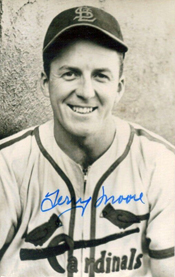
Taking advantage of clumsy defensive work by the Pirates, Terry Moore achieved an unusual feat for the Cardinals.

On Aug. 16, 1939, Moore hit two inside-the-park home runs in one game, driving in all four runs in a 4-3 Cardinals victory over the Pirates at Forbes Field in Pittsburgh.
Moore was the first player to hit two inside-the-park home runs in one game at Forbes Field, according to the Pittsburgh Press.

First homer

In the opener of the Wednesday afternoon doubleheader at Pittsburgh, Bob Klinger, a second-year right-hander, held the Cardinals scoreless for six innings and the Pirates led, 2-0.

In the seventh, Pepper Martin led off for the Cardinals and reached base when his grounder was fumbled by shortstop Arky Vaughan for an error.

Moore followed with a drive to the gap in left-center. Running hard and trying for a triple, Moore took advantage of what the St. Louis Globe-Democrat described as “a disconnected relay throw” by the Pirates and motored safely to the plate behind Martin with a two-run, inside-the-park home run, tying the score at 2-2.

The Pirates regained the lead, 3-2, in the bottom of the seventh with an unearned run against Cardinals starter Bob Weiland.

Second homer

In the top of the ninth, after Martin singled with one out, Moore drilled a pitch from Klinger to deep left. The ball struck the scoreboard, about halfway up.

Left fielder Johnny Rizzo, a former Cardinals prospect best known for his hitting, “went one way and the ball caromed another,” according to the St. Louis Star-Times.

As Rizzo looked around left-center for the baseball, it rolled toward the left-field foul line, the Globe-Democrat reported.

When he finally spotted the ball, Rizzo “frantically chased” it, the Pittsburgh Press reported. Moore tore around the bases and scored behind Martin with his second two-run, inside-the-park home run of the game, giving the Cardinals a 4-3 lead.

More drama

The Pirates threatened against reliever Bob Bowman in the bottom of the ninth. Pep Young led off with a double and advanced to third on Ray Mueller’s sacrifice bunt. Left-hander Clyde Shoun relieved Bowman and struck out Paul Waner, who was batting for Klinger.

Lloyd Waner, who had entered the game in the top half of the ninth as a defensive replacement in center for rookie Fern Bell, was due up next. Lloyd Waner, like his brother Paul, was destined for induction into the Baseball Hall of Fame and was batting .285 for the season. However, he batted left-handed, and Pirates manager Pie Traynor apparently wanted a right-handed batter to face Shoun with two outs and the potential tying run at third.

Traynor sent Jim Tobin, a pitcher, to bat for Lloyd Waner. Tobin, who was batting .265 for the season, grounded out to first, ending the game. Boxscore

Moore finished the 1939 season with 17 home runs, second on the club to Johnny Mize, who slugged 28.

In 11 seasons with the Cardinals, Moore hit 80 home runs. He hit three inside-the-park home runs, all at Forbes Field. The first occurred on Sept. 7, 1936, leading off the game against Waite Hoyt of the Pirates. Boxscore

Read Full Post »

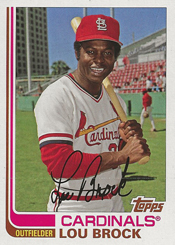
After getting lit up by Dennis Lamp, Lou Brock nearly turned out the lights on the Cubs pitcher.

On Aug. 13, 1979, Brock got his 3,000th career hit, a smash that struck Lamp’s right hand, turning three of his fingers purple.
Brock’s single came on the first pitch after Lamp brushed him back.

“I should thank Lamp for that fastball under the chin,” Brock said to the Chicago Tribune. “It brought me back to reality because it was a pretty close pitch. All the thoroughbred players I know bounce back from that, so I was ready for the next pitch. My concentration was back where it should have been.”

Setting the stage

After batting .221 in 1978, Brock said the 1979 season would be his last as a player. He needed 100 hits to reach 3,000. “I seriously doubted he’d make them,” Bob Broeg of the St. Louis Post-Dispatch wrote. “I hoped a grand guy wouldn’t wind up an embarrassment in the batting order.”

Brock, 40, made an adjustment in his batting stance, keeping his weight on his front foot, and began spraying hits consistently again. He went into the game against the Cubs with a .321 batting average and 2,998 hits.

The Monday night game at Busch Memorial Stadium matched Lamp against Cardinals starter Pete Vuckovich. Cardinals manager Ken Boyer put Brock in the No. 2 spot in the batting order between Garry Templeton and Keith Hernandez.

The Cubs were the ideal opponent for Brock’s attempt at the milestone. They were Brock’s first major-league team before they traded him to the Cardinals in 1964.

In the Cardinals’ clubhouse before the game, Brock’s mood was loose and relaxed, the Post-Dispatch reported. “He’s so even-keel you’d never know what was at stake,” Hernandez said.

Brock and Templeton shadow-boxed. Third baseman Ken Reitz reminded Brock of a bet they made in spring training regarding whether Brock would reach 3,000 hits before Reitz got to 1,000.

Playing before a crowd of 44,457, Templeton led off the Cardinals’ half of the first with a single. Boyer called for a hit-and-run and Brock lined a single to left for hit No. 2,999.

Big hit

Brock’s second at-bat of the game, and his first attempt at hit No. 3,000, came when he led off in the fourth.

“I pictured in my mind a hit up the middle,” Brock said.

The count was 1-and-2 when Lamp unleashed his brushback pitch. The high and tight fastball set up the next pitch, a curve Lamp hoped Brock would miss or hit weakly. “I thought it was a good pitch,” Lamp said.

Instead, Brock drilled the ball, “a line drive that would clean the sawdust off a 2-by-4,” according to Post-Dispatch columnist Tom Barnidge.

Brock told writer Roger Angell, “It was the hardest ball I hit all year.”

The ball pounded into the fingers of Lamp’s throwing hand _ “It felt like having your hand caught in a car door,” he said to The Sporting News _ and caromed across the third-base line. Third baseman Steve Ontiveros retrieved it but had no chance to throw out Brock, who streaked across first base. Video

Crowning achievement

As the crowd roared, club owner Gussie Busch and Stan Musial, the first Cardinal to achieve 3,000 hits, joined Brock and his teammates in a ceremony on the field.

“I’ve always wanted to leave baseball in a blaze of glory,” said Brock, who became the 14th major-league player to achieve 3,000 hits. “I’ve always wanted to orchestrate my own exodus.”

Lamp was removed from the game and replaced by a former Cardinal, Doug Capilla. “My middle and index fingers swelled up and turned purple,” Lamp said.

In the fifth inning, with Ken Oberkfell on second base and two outs, Boyer sent Tony Scott to bat for Brock.

Brock went into the Cubs’ clubhouse to check on Lamp, who was relieved X-rays showed no fractures to his fingers. “I told him not to be afraid to pull the ball next time,” Lamp said. “I guess what this means is that they’ll be sending my fingers to Cooperstown.”

That’s a winner

In the bottom of the ninth, with the score tied at 2-2, Reitz got his 1,000th career hit, a single against Willie Hernandez, but too late to win his bet with Brock. Tommy Herr, making his major-league debut, was sent in to run for Reitz.

After Hernandez hit Oberkfell with a pitch, moving Herr to second, Bruce Sutter relieved and yielded a single to Dane Iorg, loading the bases.

Templeton followed with a flyout to left fielder Dave Kingman. Herr tagged and headed toward the plate. The throw was wide and Herr scored the winning run. Boxscore

Great champion

Among the post-game reactions to Brock’s achievement:

_ Ted Sizemore, Cubs second baseman and former Cardinal: “Lou Brock is the most mentally prepared player I ever saw. He’s a guy who can identify with goals. When he sets his mind to it, he can get it. He’s one of the great champions in the game.”

_ Bob Forsch, Cardinals pitcher: “I think he wanted to do this against the Cubs. I mean, they’re the club that traded him away. There had to be a real sense of satisfaction.”

_Ted Simmons, Cardinals catcher: “You look at Lou’s career and you envy it. I do. I think most players do. I’ve enjoyed every ballgame I’ve ever played with him. What he’s done has been remarkable.”

The Sporting News called the 3,000 hits “a testimony to his ability, pride, determination and competitive spirit.”

In an editorial, the Post-Dispatch concluded, “What truly sets him apart is the self-discipline and fidelity to purpose that made possible the consistency and stamina demanded by such a sports milestone.”

Read Full Post »

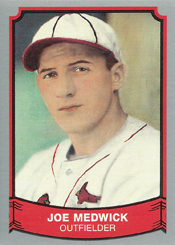
After slicing his pay, the Cardinals cut deeper into the pride of Joe Medwick with a move he viewed as a public insult.

On Aug. 1, 1939, the Cardinals were one strike away from completing a win at home against the Braves when manager Ray Blades removed Medwick from left field for a defensive replacement.
Blades said the move was made for strategic reasons. Medwick said it was done to humiliate him.

Salary squabble

Medwick, a right-handed hitter of Hall of Fame caliber, made his major-league debut with the Cardinals in September 1932 and became their left fielder in 1933.

In 1934, Medwick batted .379 in the World Series against the Tigers, helping the Cardinals win the championship.

Medwick achieved his best season in 1937 when he won the National League Most Valuable Player Award and earned the Triple Crown by leading the league in batting average (.374), home runs (31) and RBI (154).

Though he had another stellar season in 1938, batting .322 with 21 home runs and leading the league in doubles (47) and RBI (122), the Cardinals wanted to cut his pay for 1939 because he didn’t repeat his Triple Crown performance.

Medwick, 27, sought a 1939 salary of $22,000, a $2,000 increase from his 1938 pay of $20,000. The Cardinals offered $15,000, The Sporting News reported.

After a holdout during 1939 spring training, Medwick signed for $18,000, a $2,000 cut from what he made in 1938.

“Certainly Medwick is not happy with the Cardinals,” wrote J. Roy Stockton of the St. Louis Post-Dispatch. “He was unhappy when he signed his 1939 contract and made no attempt to conceal the fact. Joe felt he had been browbeaten into signing.”

The Dodgers, managed by Medwick’s friend and former Cardinals teammate, Leo Durocher, reportedly offered $200,000 for Medwick in the spring of 1939, but were rebuffed.

When the Dodgers came to St. Louis for a series against the Cardinals in late July 1939, Durocher hosted a dinner party and Medwick attended, causing some to suspect tampering.

Medwick dismissed the concerns, telling the St. Louis Star-Times, “I don’t want anyone to get the impression I ever ease up an inch when I’m playing against the Dodgers. No one is going to select my friends. If I want to attend a dinner at Durocher’s home, that’s my business.”

Mad as hell

After the Dodgers left town, the Cardinals opened a series versus the Braves on Tuesday afternoon, Aug. 1, at Sportsman’s Park.

In the ninth inning, with the Cardinals ahead, 4-3, the Braves had a runner on first, two outs, and Tony Cuccinello at the plate against Clyde Shoun.

With the count at 1-and-2 on Cuccinello, Cardinals coach Mike Gonzalez, acting on orders from Blades, came out of the dugout, asked the plate umpire for time and hollered out to Medwick to come off the field.

As Lynn King, a reserve outfielder, trotted out to take over in left, Medwick “staged a temperamental demonstration that showed his total disregard for his manager’s ideas of how to run a ballclub,” the Star-Times reported.

According to published reports, Medwick “threw his glove high in the air, dug up the turf with his spikes as he marched sullenly toward his glove, and kicked the glove around with disgust before he picked it up.”

Instead of going to the dugout, Medwick “stormed through the wagon gate on the third-base side of the grandstand,” the Star-Times reported.

As Medwick exited, Cuccinello swung and missed at strike three, ending the game. Boxscore

Playing the percentages

Asked why Medwick was removed, Blades told the Post-Dispatch, “I consider King a better defensive outfielder than the other fellow.”

Regarding the timing, Blades said, “I would have made the change earlier, but I was afraid (the Braves) might get another run to tie the score and I wanted to keep King in reserve as a pinch-hitter. With two outs, I decided the wisest thing was to strengthen our defense.”

Cardinals owner Sam Breadon defended his manager, telling the Post-Dispatch, “That’s Blades baseball. He plays for every bit of percentage … I didn’t think anybody had reason for feeling badly or being hurt.”

Others saw it differently:

_ The Sporting News: “The yanking of Joe in that game could hardly be construed as less than a humiliation.”

_ The Post-Dispatch: “If Blades has a weakness, it is the coldness which makes him forget and disregard the human element as he strives for victory.”

Dissatisfied with Cards

Medwick, who went into the clubhouse after he left the field, ducked into the trainer’s room to avoid reporters.

On the morning of Aug. 3, before the Braves and Cardinals played a doubleheader, Star-Times sports editor Sid Keener contacted Medwick at home and got him to talk about the incident.

Medwick said, “I think it was the rawest deal I’ve ever received in my baseball career … I’m dissatisfied playing with the Cardinals.

“If Blades thought I wasn’t spry enough to go after some drives in the ninth, why didn’t he take me out before the inning started?” Medwick said. “I don’t look like an old man out there, do I? I’ve made some pretty fancy catches this season, saved a lot of extra-base hits for our pitchers and I would have caught anything Cuccinello would have hit out to left field.”

Forget about it

When Medwick arrived at Sportsman’s Park for the Thursday afternoon doubleheader, he and Blades met and “apparently smoothed out their differences,” the Star-Times reported.

“I simply explained to Joe why I took him out of the game,” said Blades. “As for a feud or any personal differences between us, that’s foolish.”

Said Medwick: “Blades explained his move and I agree with him. Let’s forget the whole deal.”

Blades and Medwick posed in the dugout for photographers and shook hands.

Medwick got an ovation when he took his position in left field. When Medwick batted for the first time, leading off the second inning, he was cheered and responded by hitting a home run. Boxscore

Medwick batted .332 with 48 doubles and 117 RBI for the 1939 Cardinals.

In 1940, the Cardinals stumbled and, with their record at 14-24, Breadon fired Blades on June 7. Five days later, Medwick was traded to the Dodgers.

Read Full Post »

(Updated Dec. 23, 2019)

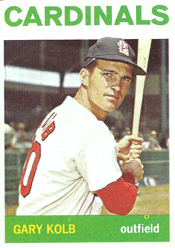
Gary Kolb impressed Branch Rickey, stepped in for Stan Musial and got traded for Bob Uecker.

Kolb played seven major-league seasons with the Cardinals (1960, 1962-63), Braves (1964-65), Mets (1965) and Pirates (1968-69).

A left-handed batter with speed, Kolb primarily was an outfielder who also experimented with catching and playing infield in the hope his versatility would enhance his value to the Cardinals.

Rickey, the former general manager who came back to the club as a consultant, liked Kolb, and so did Musial, who tabbed Kolb and Mike Shannon as potential outfield successors.

Top prospect

Kolb was a standout in baseball, basketball, football and track at Rock Falls High School in Illinois. He enrolled at the University of Illinois and played on the freshman football, basketball and baseball teams.

As a college sophomore, Kolb, 6 feet and 190 pounds, gave up basketball, but played varsity football and baseball. He signed a professional contract with the Cardinals in the spring of 1960 after completing his sophomore baseball season.

“I thought I’d better get out of football before I got hurt,” Kolb said to the St. Louis Post-Dispatch.

Kolb, 20, played for two Cardinals farm clubs in the summer of 1960, produced 15 triples and was called up to the big-league club in September. He made his Cardinals debut on Sept. 7, 1960, as a pinch-runner. Kolb appeared in nine games, eight as a pinch-runner, for the 1960 Cardinals.

Kolb spent the next two seasons in the minors before getting another September call-up to the Cardinals in 1962. He hit .357 for them in 14 at-bats.

A month later, in October 1962, the Cardinals hired Rickey, 80, as a consultant and one of his first assignments was to assess their players in the winter Florida Instructional League. Kolb was there, playing shortstop, and he caught the attention of Rickey.

Rickey “indicated he considered Kolb one of the best prospects in the camp,” the Post-Dispatch reported.

Batter up

In February 1963, shortly before the Cardinals opened spring training at St. Petersburg, Fla., they arranged for six prospects, including Kolb, to attend a special five-day hitting session. Joining Kolb were Jerry Buchek, Duke Carmel, Doug Clemens, Phil Gagliano and Dal Maxvill.

Rickey proposed the extra workouts after he observed the players at the Florida Instructional League.

“All are good athletes with good reflexes and baseball instinct,” the Post-Dispatch reported, “but all have been disappointing at swinging a bat against major-league pitching.”

Cardinals manager Johnny Keane, coach Vern Benson and Rickey were the instructors for the sessions.

Rickey “had a special batting cage built in the center field corner of the Redbirds’ spring training park,” the Post-Dispatch observed. “Behind the batting cage is a platform about five feet above the ground from which Rickey watches the batters hit against a pitching machine.”

Rickey told the assembled prospects, “You’ll hit until you are weary. You’ll get blisters on your hands before we’re through, unless you wear the golf gloves we have here for you, gloves for both hands. You’ll swing as hard as you can and you’ll bunt. You’ll bunt for the sacrifice and you’ll bunt for base hits.”

On the rise

The extra work apparently helped Kolb because he had a good spring training camp with the 1963 Cardinals. Eddie Stanky, the Cardinals’ director of player development, said Kolb is “a bulldog and a versatile athlete whose ability to play both infield and outfield will help him make the big-league club.”

Near the end of spring training, Kolb, at Rickey’s urging, “strapped on the pads” and worked out as a catcher “to lend value to his versatile efforts,” the Post-Dispatch reported.

When the Cardinals sold the contract of outfielder Minnie Minoso to the Senators, it opened a spot for Kolb on the Opening Day roster as a reserve outfielder.

The Cardinals returned Kolb to the minors in May 1963, but he hit .318 for Tulsa and was brought back to the big-league club in July.

Keane gave Kolb a start in right field against the Braves on July 12, 1963, and he produced two hits, including his first major-league home run, against Tony Cloninger. The two-run homer carried onto the pavilion roof at Busch Stadium. Boxscore

Kolb was back in the starting lineup again the next day, July 13, 1963, and went 3-for-4 with two singles and another home run against the Braves’ Hank Fischer. Boxscore

Kolb made 19 starts in right field, mostly in July, for the 1963 Cardinals. He batted .327 with 18 hits and 12 walks in 19 July games.

Kind words

In September 1963, with the Cardinals challenging the Dodgers for the pennant, Kolb was used primarily as a pinch-runner, most often for Musial, who was 42 and in his last season. Kolb appeared nine times as a pinch-runner for Musial in 1963.

On Sept. 29, 1963, Musial was in the Busch Stadium clubhouse, preparing to play his final game, when Kolb and Shannon walked by his locker.

“Wait a minute,” Musial said, putting an arm around each of them.

As photographers and reporters closed in, Musial said, “These are my proteges. They’re going to take over for me, aren’t you?”

Kolb and Shannon blushed, according to the Post-Dispatch.

After Musial stroked a RBI-single in the sixth, Keane sent in Kolb to run. Kolb told his hometown news organization, Saukvalley.com of Sterling, Ill., that as Musial departed first base for the final time to a thunderous ovation, he turned to him and said, “They love you, kid.” Boxscore

Moving on

Kolb batted .271 in 119 plate appearances for the 1963 Cardinals. He generated 26 hits, including five triples, and 22 walks for a .403 on-base percentage.

Kolb hit .328 for the Cardinals versus right-handers in 1963 and overall he batted .500 (9-for-18) against the Braves.

After trading George Altman to the Mets, Cardinals general manager Bing Devine said in November 1963 he viewed Kolb, Shannon, Clemens and Johnny Lewis as candidates to start in right field in 1964.

The scenario changed in February 1964 when the Cardinals acquired outfielder Carl Warwick from the Houston Colt .45s. Warwick and Lewis performed best in spring training and Kolb became expendable.

On April 9, 1964, the Cardinals traded Kolb and catcher Jimmie Coker to the Braves for Uecker, who was viewed as a defensive upgrade as a backup to starting catcher Tim McCarver.

Rickey opposed the deal made by Devine. According to the book, “October 1964,” when Uecker introduced himself to Rickey in the Cardinals’ clubhouse, Rickey replied, “I didn’t want you. I wouldn’t trade a hundred Bob Ueckers for one Gary Kolb.”

Kolb spent his final three seasons (1971-73) with the Pirates’ Class AAA farm club in Charleston, W.Va., and settled there after his playing career. His cousin, Dan Kolb, was a big-league relief pitcher from 1999-2007.

Read Full Post »

« Newer Posts - Older Posts »