Feeds:
Posts
Comments

Archive for the ‘Hitters’ Category

After making a pitch for Barry Larkin of the Reds, the Cardinals turned to a younger, less expensive shortstop, Edgar Renteria of the Marlins.

On Dec. 14, 1998, the Cardinals traded pitchers Braden Looper and Armando Almanza, plus infielder Pablo Ozuna, to the Marlins for Renteria.

The Cardinals went to the baseball winter meetings at Nashville determined to acquire a shortstop to replace Royce Clayton, whom they traded to the Rangers five months earlier.

Larkin and Renteria were atop the Cardinals’ shopping list and, if they couldn’t get either one, Pat Meares of the Twins was an alternative, according to the St. Louis Post-Dispatch.

Seeing red

Larkin was unhappy with the Reds and asked to be traded. The Reds had their second consecutive losing season in 1998 and Larkin, who had a Hall of Fame resume, wanted to be with a contender. Reds general manager Jim Bowden had vowed to rebuild the roster around Larkin and second baseman Bret Boone, so when Bowden traded Boone to the Braves in November 1998, Larkin felt betrayed.

“I’ve been lied to consistently,” Larkin said to the Dayton Daily News. “I’ve heard rebuild, rebuild, rebuild to get better. If that’s the case, I should see some light at the end of the tunnel. All I see is a tunnel filled with water.”

Because he had spent 10 years in the major leagues, including the last five with the same club, Larkin could veto any trade. He gave the Reds a list of five teams to which he would accept a trade: Cardinals, Cubs, Dodgers, Padres and Rangers.

“If they can move me, please do it now,” Larkin told the Dayton newspaper on the eve of the winter meetings.

“I feel as if I’m being held hostage by a team with no immediate plans to be competitive.”

Trade talk

Larkin batted .309 with 34 doubles for the 1998 Reds, earning his eighth of nine Silver Slugger awards. The three-time Gold Glove Award winner ranked second among National League shortstops in fielding percentage that year.

The Cardinals “keep inquiring about Larkin,” the Dayton newspaper reported.

Cardinals general manager Walt Jocketty offered the Reds a package of players, including pitcher Manny Aybar, who in 1998 was 10-0 for minor-league Memphis and 6-6 for the Cardinals.

Bowden’s response to Jocketty was: “You know who I want.”

According to the St. Louis and Dayton newspapers, the players Bowden wanted in exchange for Larkin were outfielder J.D. Drew and pitcher Rick Ankiel.

Bowden said the Cardinals and Mariners, who made a bid on behalf of Larkin’s friend, Ken Griffey Jr., were the clubs most interested in Larkin “but neither offered quality big-league players or top-notch prospects. We listened, but nothing was substantial. Teams felt they could steal him for nothing.”

Big catch

Unable to reach an agreement with the Reds, the Cardinals turned to the Marlins.

Renteria became a Marlins hero in 1997 when he delivered a RBI-single against Charles Nagy of the Indians in the 11th inning of World Series Game 7, clinching the title. Video

In 1998, Renteria batted .282 with 41 stolen bases for the Marlins and was named to the National League all-star team.

Renteria, 22, was younger than Larkin, 34, and Larkin was under contract to make $5.3 million in 1999 compared with $2 million for Renteria.

The Marlins were agreeable to trading Renteria because they had a highly regarded shortstop prospect, Alex Gonzalez, who was ready for the big leagues.

Initially, the Cardinals and Marlins discussed a deal of Renteria for Looper and another pitcher, Mike Busby, the Palm Beach Post reported, but Marlins general manager Dave Dombrowski, looking to get three players instead of two, opted for Almanza and Ozuna, along with Looper, rather than Busby.

“I want to play for the Cardinals,” Renteria said. “I want to show the fans I can play hard for a team that can win.”

Cardinals manager Tony La Russa said he planned to bat Renteria in the leadoff spot, with Drew second and Mark McGwire third.

Post-Dispatch columnist Bernie Miklasz rated the acquisition of Renteria a plus for the Cardinals. “He’s magic in the field and will take excellent care of Ozzie Smith’s cherished ground,” Miklasz concluded.

Good as expected

Renteria played six seasons (1999-2004) for the Cardinals and helped them to four postseason appearances. His best season for St. Louis was 2003 when he hit .330 with 47 doubles, 100 RBI and 34 stolen bases.

Overall with the Cardinals, Renteria won three Silver Slugger awards, two Gold Glove awards and posted a .290 batting average with 148 steals. He batted .333 for the Cardinals in the 2004 World Series against the Red Sox. Afterward, Renteria became a free agent and signed with the Red Sox.

In 2010, playing for the Giants against the Rangers, Renteria was the recipient of the World Series Most Valuable Player Award, hitting .412 with two home runs.

Read Full Post »

Wally Moon shined for the Cardinals for four years, but wore out his welcome in a single season when he slumped at the plate and displayed what some perceived as an indifferent attitude toward his outfield play.

On Dec. 4, 1958, the Cardinals traded Moon and reliever Phil Paine to the Dodgers for outfielder Gino Cimoli.
Four years earlier, Moon won the 1954 National League Rookie of the Year Award when he batted .304 and scored 106 runs for the Cardinals. He followed that by batting .295 with 19 home runs in 1955, .298 with a league-leading 11 triples in 1956 and .295 with 24 home runs in 1957.

Moon, a left-handed batter, posted consistently high on-base percentages, including a .390 mark in 1956. He combined with Stan Musial and Ken Boyer to give the Cardinals a formidable attack.

Though he went into a tailspin in 1958 and hit .238 with seven home runs, he didn’t start a game for a month after injuring his left elbow.

After the 1958 season, Moon joined the Cardinals on their goodwill tour of Japan, impressed new manager Solly Hemus and appeared to be back in the club’s plans, but the Dodgers, who’d shown interest in Moon all year, convinced general manager Bing Devine to trade him.

The deal revived Moon’s career and sparked the Dodgers to a World Series championship.

Season of struggles

During spring training in 1958, the Cardinals got trade offers for Moon from the Phillies and Reds, but Devine was reluctant to give up a power hitter, according to The Sporting News.

Moon never got untracked at training camp and Cardinals manager Fred Hutchinson was disappointed in his “light hitting and uninspiring defensive play,” The Sporting News reported.

In April, the Dodgers offered to deal outfielder Duke Snider to the Cardinals for Moon and Boyer, the Post-Dispatch reported, but Devine didn’t want to give up both players.

Moon’s funk carried through the first two months of the regular season. He was batting .246 with no home runs entering a May 31 game against the Giants at St. Louis. In the fifth inning, Moon, playing center field, and left fielder Joe Cunningham collided at the outfield wall while chasing a line drive by Orlando Cepeda. Moon suffered severe bruises to his left elbow and didn’t start another game until June 29. Boxscore

Moon hit .211 in July, rebounded in August with five home runs and 20 RBI and slumped again in September, batting .204.

Full Moon rising

The Cardinals finished 72-82 in 1958 and Hemus replaced Hutchinson after the season.

On Oct. 3, 1958, the Los Angeles Times reported Devine met with Dodgers general manager Buzzie Bavasi and discussed a deal of Moon for Cimoli. The Times described Cimoli as “a gifted athlete but something less than a favorite” of manager Walter Alston. Cimoli was in and out of the Dodgers lineup in 1958 “and made no attempt to veil his dissatisfaction with the situation,” the Times reported.

The Cubs wanted Cimoli, too, and Bavasi was in no rush to deal. “We’re being offered players for Cimoli that would help our farm clubs, but they wouldn’t strengthen the Dodgers,” Bavasi said.

As the Cardinals prepared to embark on their trip to Japan, trade talks with the Dodgers cooled, the Times reported, because “there are other St. Louis players Bavasi would prefer to Moon.”

Also, Hemus wanted to keep Moon and told The Sporting News, “You just can’t give up on a guy like that.”

Devine became less receptive to offers for Moon and noted, “A poor year sometimes is a challenge to a player and he comes back with a great season. We feel Moon can do it.”

After the goodwill tour, Hemus said Moon “looked good, improved … He looked like the Moon of old at times.”

Determined to deal

At the 1958 baseball winter meetings, the Braves made a bid to acquire Moon and the Cardinals were talking to the Cubs about left-handed power hitter Walt Moryn. The Cardinals also resumed negotiations with the Dodgers, and when Devine offered to include Paine, the Moon-for-Cimoli deal was made.

“The Cardinals made a mistake in letting me go because Cimoli isn’t the longball hitter they need,” Moon said.

Devine admitted the Cardinals sought a power threat in return for Moon, but opted for Cimoli because he “not only is better defensively, but also his ability to hit to right-center will be useful at Busch Stadium.”

According to Post-Dispatch sports editor Bob Broeg, Moon “disappointed consistently afield, both fly chasing and throwing. He seemed so satisfied with his inadequacies that his lean and hungry look appeared merely an unfortunate illusion.”

Alston acknowledged Moon “isn’t a great defensive outfielder,” but said he enhanced the Dodgers’ lineup because “he’s aggressive, he can run and what I like best about him is his power.”

The Dodgers projected Moon to be their left fielder and the Cardinals planned for Cimoli to start in center.

Cimoli said he looked forward to joining the Cardinals because “I can sit next to Stan Musial and pick up some hitting pointers.”

That’s a winner

Actually, Musial advised Moon, suggesting he develop an inside-out swing to take advantage of the short distance from home plate to the left-field screen at Los Angeles Memorial Coliseum.

Moon got off to hot start for the 1959 Dodgers, batting .352 in April. He also finished strong, hitting 11 home runs in the last two months of the season, including six in a six-game September stretch.

Moon concluded the season with a .302 batting mark, 19 home runs, 93 runs scored and an on-base percentage of .394. The Sporting News described him as “a dedicated hustler whose inspiration lifted the entire team.”

The Dodgers clinched the National League pennant and beat the White Sox in the World Series. Moon hit a two-run home run in the decisive Game 6. Boxscore

Cimoli batted .279 with 40 doubles for the 1959 Cardinals, who finished next-to-last at 71-83. After a torrid start, when he hit 30 doubles in three months, Cimoli tailed off in the second half and was traded to the Pirates in December.

Moon produced two more big seasons for the Dodgers, batting .299 with a .383 on-base percentage in 1960 and .328 with a .434 on-base percentage in 1961.

He was a role player from 1962-65 and concluded his playing career with another World Series championship with the 1965 Dodgers.

Read Full Post »

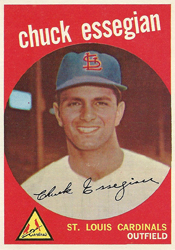
Chuck Essegian, a Renaissance man who played the violin, studied to be a doctor, became a lawyer and excelled in two sports, began the 1959 baseball season as a Cardinals reserve and ended it as a World Series hero for the Dodgers.

On Dec. 3, 1958, the Cardinals acquired Essegian from the Phillies for shortstop Ruben Amaro.
Essegian was an outfielder with a weak throwing arm, but the Cardinals were intrigued by his power.

After a short stint with them, Essegian was demoted by the Cardinals to the minor leagues in June 1959 and nearly quit baseball to pursue a medical career, but reconsidered after the club offered to relocate him to a West Coast franchise.

Four months later, Essegian achieved an unprecedented feat in the World Series.

Stanford standout

Essegian (pronounced Uh-see-jee-un) was born in Boston and moved with his family to Los Angeles when he was a boy. Essegian’s father was an Armenian immigrant who became a mail carrier.

Essegian was a standout baseball and football player at Fairfax High School in Los Angeles as well as a promising violinist. “If he could belt a tune the way he batters that baseball, the Philharmonic missed a hot bet,” the Los Angeles Times reported.

He enrolled at Stanford, played baseball and was a linebacker and fullback in football, appearing in the 1952 Rose Bowl game against Illinois. Essegian earned a degree in biology and considered pursuing a career as a doctor or dentist, but first tried professional baseball.

From 1953-55, Essegian played mostly for unaffiliated minor-league clubs. In 1956, he led the Northwest League in hitting at .366 for Salem (Ore.).

Essegian asked the National Association, overseeing minor-league baseball, to declare him a free agent because of irregularities in the handling of his 1956 contract. On Dec. 4, 1956, National Association president George Trautman ruled in favor of Essegian, granting him free agency and giving Salem 30 days to appeal, The Sporting News reported.

The next morning, Dec. 5, 1956, the minor-league draft was held and the Cardinals’ Rochester farm team, unaware Essegian was a free agent, selected him off Salem’s roster.

Rochester was allowed to cancel its selection and choose another player, but stuck with Essegian, hoping the free agency ruling was reversed on appeal.

While awaiting the results of the appeal, Essegian took graduate courses, “which may lead to a career in dentistry,” the Capital Journal in Salem reported.

On Feb. 15, 1957, an executive committee of the minor leagues rejected Salem’s appeal.

Free to make his own deal, Essegian signed with the Phillies.

Cards come calling

Essegian spent 1957 in the Phillies’ farm system and led the Eastern League in hitting at .355 for Schenectady.

In 1958, Essegian reached the major leagues, batted .246 for the Phillies and hit his first big-league home run against Sandy Koufax of the Dodgers. Essegian became a friend of Phillies second baseman Solly Hemus, who after the season was named Cardinals manager. Hemus suggested the club acquire Essegian.

Essegian, 27, displayed impressive power for the 1959 Cardinals in spring training. On March 15, he hit two home runs against Dick Donovan of the White Sox in an exhibition game at Tampa and the next day he hit another home run off the Yankees’ Don Larsen at St. Petersburg.

Essegian “doesn’t have a good throwing arm, a result of a football injury,” but “is eager to give baseball a good try before returning to medical school at his alma mater,” the St. Louis Post-Dispatch reported.

Essegian made the Opening Day roster and in his second regular-season game for the Cardinals he drove in three runs against the Dodgers. Boxscore

Highlights were few, however. Essegian hit .179 and on June 3, 1959, the Cardinals assigned him to Rochester.

Essegian balked at reporting and “talked of quitting baseball unless he could spend more time on the West Coast,” according to The Sporting News.

After the Cardinals assured him they’d try to accommodate him, Essegian went to Rochester and hit four home runs in 10 games. Good to their word, the Cardinals traded Essegian and pitcher Lloyd Merritt to the Dodgers on June 15, 1959, for infielder Dick Gray.

Series slugger

Essegian was sent to Spokane and hit nine home runs before being called up to the Dodgers on Aug. 4, 1959. Batting .304 over the last two months of the season, Essegian earned a World Series roster spot against the White Sox.

In Game 2 at Comiskey Park in Chicago, the White Sox led, 2-1, in the seventh when Essegian, batting for pitcher Johnny Podres, got a high slider from Bob Shaw and drove it deep into the upper deck in left for a home run, tying the score. “It had to be the best ball I ever hit,” Essegian said. The Dodgers won, 4-3, and Essegian was credited with sparking the comeback. Boxscore

The Dodgers led the decisive Game 6, 8-3, in the ninth at Chicago when manager Walter Alston, playing a hunch, had Essegian bat for Duke Snider. Essegian lined the first pitch from Ray Moore into the lower left-field stands, capping a championship-clinching triumph.

“He broke his bat on that homer, you know,” said Dodgers coach Pee Wee Reese. “How about that for power?” Boxscore

Essegian became the first player to hit two pinch-hit home runs in a World Series. Another former Cardinal, Bernie Carbo, matched the feat in 1975 for the Red Sox against the Reds.

Essegian also became the second athlete to play in a Rose Bowl and a World Series. The other, Jackie Jensen, appeared in the 1949 Rose Bowl for Cal and the 1950 World Series for the Yankees.

Law and order

Even with his World Series heroics, Essegian barely survived the last roster cut at spring training in 1960 and his name was omitted from the Opening Day program.

A crowd of 67,550 filled Los Angeles Memorial Coliseum to see the defending World Series champions open the 1960 season against the Cubs. With the score tied 2-2 in the 11th, Essegian batted for pitcher Don Drysdale and hit a slider from Don Elston high into the left-field seats for a walkoff home run. Boxscore

The 1960 season was Essegian’s last with the Dodgers. In 1961, he played for three American League teams _ Orioles, Athletics and Indians. He became an everyday player for the first time in the big leagues in 1962 and hit 21 home runs for the Indians. “Because of his medical school aspirations, (teammates) are calling him Dr. Essegian and Ben Casey,” The Sporting News reported. “He’s handsome and has the scowl. All he needs is the stethoscope.”

Traded back to the Athletics, Essegian played his last year in the big leagues in 1963. He spent 1964 with the Osaka Kintetsu Buffaloes of the Japan Pacific League and hit 15 home runs.

Essegian never did become a doctor or dentist. Instead, he earned a law degree and became a prosecutor in Pasadena before entering private practice.

Though often asked about the World Series home runs, Essegian downplayed the feat.

“I didn’t think that was so spectacular,” he told the Baltimore Sun. “I was just doing a job. Luck has a great deal to do with something like that. You have to have the right situation, the right pitch and be lucky enough to hit it.”

In a 2006 interview with the Los Angeles Times, Essegian said, “I’m not sure, but I think those home runs probably hurt my career. You kind of get labeled as a certain kind of player. If you’re a pinch-hitter, you’re a pinch-hitter because you’re not good enough to play everyday.”

In 161 regular-season plate appearances as a pinch-hitter in the major leagues, Essegian hit three home runs. In four World Series plate appearances as a pinch-hitter in the 1959 World Series, he hit two.

Read Full Post »

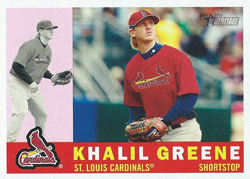
As a big-league shortstop, Khalil Greene had special physical skills, but a mental health condition rendered him unable to continue his playing career.

On Dec. 4, 2008, the Cardinals acquired Greene from the Padres for pitchers Mark Worrell and Luke Gregerson unaware Greene suffered from social anxiety disorder.
The Cardinals were seeking a replacement at shortstop for Cesar Izturis, who became a free agent, and Greene appealed because he hit for power and, according to the St. Louis Post-Dispatch, was “an above-average defender.”

Greene also was shy, or introverted, but those personality traits, the Cardinals found out, carried deeper meaning.

Early success

Khalil Thabit Greene was born in Butler, Pa., and went to high school in Key West, Fla. His father was a jeweler and his mother was a teacher.

Greene was brought up in the Baha’i Faith, whose followers “believe the crucial need facing humanity is to find a unifying vision of the future of society and of the nature and purpose of life,” the organization’s website explains.

According to the Post-Dispatch, Khalil translates to “friend of God” and Thabit means “steadfast.”

Greene enrolled at Clemson University and earned a degree in sociology. He also excelled at baseball, completing a four-year career as Clemson’s all-time leader in hits, doubles, RBI, extra-base hits and total bases.

The Padres chose Greene in the first round of the 2002 amateur draft and he made his big-league debut with them on Sept. 3, 2003.

From 2004 through 2007, Greene averaged 18 home runs and 72 RBI per year and had his best season in 2007 when he produced 27 home runs and 97 RBI.

Greene was limited to 105 games in 2008 because of a season-ending injury on July 30 when he fractured his left hand after punching a storage chest in frustration. “I would say that was very out of character,” Greene told Derrick Goold of the Post-Dispatch.

Though Greene batted .213 in 2008, Cardinals general manager John Mozeliak was unhesitant in dealing for him. “It’s our strong belief that last year (2008) was an aberration,” Mozeliak said.

Seventy percent of respondents to a stltoday.com poll gave the trade a thumbs up.

Under pressure

At spring training with the Cardinals in 2009, Greene, 29, impressed, hitting .408 with 17 RBI in exhibition games.

Regarding his quiet demeanor, Greene told the Post-Dispatch, “I internalize more and that leads people to assume different things about me.”

The Cardinals’ high expectations for Greene were evident in the season opener on April 6, 2009, when manager Tony La Russa batted him in the cleanup spot between Albert Pujols and Ryan Ludwick. Boxscore

Greene struggled, batting .219 in April and .171 in May. Teammates noticed Greene punishing himself during the season’s first road trip, the Post-Dispatch reported.

On May 29, 2009, the Cardinals placed Greene on the disabled list because of social anxiety disorder.

“We’re trying to take some things off him for a while,” La Russa said.

Greene’s condition “is brought on by fatigue caused by incessant stress,” Joe Strauss of the Post-Dispatch reported. “Any failure, such as a strikeout or an error, reinforces a sense of frustration that finds release only through verbal or physical outbursts, followed by embarrassment and regret.”

Said Greene: “It’s about trying to find balance, about not being too hard on myself and being able to let it go sometimes.”

Tough tests

The Cardinals reinstated Greene on June 18, 2009, and he hit home runs against the Royals in each of his first three games back. After that, he went into a slump, the anxiety resurfaced and the Cardinals returned him to the disabled list on June 29, 2009.

“When he had success in Kansas City, that wasn’t really the test,” La Russa said to the Associated Press. “The test is when you struggle and how you handle it.”

Greene went home to South Carolina to spend time with his wife and parents and receive treatment.

Brendan Ryan had taken over as Cardinals shortstop and was playing well, so when Greene returned to the club for the last two months of the season he primarily was used as a pinch-hitter and reserve infielder.

“I need to get a sense of gratification when things are going well while being able to see any shortcomings in a way that’s not such a debilitating thing,” Greene said.

On Aug. 28, 2009, Greene hit the first pinch-hit home run of his big-league career, tying the score at 2-2 in the eighth inning against the Nationals. The Busch Stadium crowd gave him a standing ovation and his teammates pushed him toward the top step of the dugout to make a curtain call and tip his cap, telling him, “Get out there. You earned it.” Boxscore

Greene finished the 2009 season with a .200 batting average, six home runs and 24 RBI in 77 games. He did hit .353 (12-for-34) with runners in scoring position.

In November 2009, Greene entered free agency and two months later signed a $750,000, one-year deal with the Rangers, who projected him for a utility role.

“This is a situation that will be good for me in a lot of ways,” Greene said. “It’s an exciting team to play for and it looks like a neat place to play.”

On Feb. 25, 2010, the Rangers voided the contract, saying a private matter would keep Greene from reporting to spring training. At age 30, he was finished as a professional ballplayer.

Read Full Post »

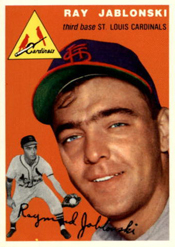
Ray Jablonski was an infielder who couldn’t field or throw well, but he excelled at stroking line drives for extra-base hits and generating large numbers of runs.

On Nov. 24, 1948, the Cardinals selected Jablonski from the Red Sox in the minor-league draft.
The minor move turned into a big deal for the Cardinals, who sought a right-handed batter with power to balance a lineup with left-handers Stan Musial and Enos Slaughter. Jablonski produced more than 100 RBI in each of his two seasons with St. Louis.

As a third baseman, though, Jablonski had the skills of a designated hitter. When prospect Ken Boyer proved ready to move from the minor leagues and play third base for the Cardinals, Jablonski became expendable.

Climbing the ladder

Ray Jablonski was born and raised in Chicago. As a youth, he was “an accomplished singer and piano player,” according to a biography by the Society for American Baseball Research.

A coach encouraged him to play high school baseball and he showed an ability to hit the ball hard and often. Jablonski enlisted in the Army in July 1945, spent most of his military service in France and was discharged in January 1947.

When he returned to Chicago, he attended a Red Sox tryout camp in Elgin, Ill., and was the only one of the 300 participants to get a contract offer, according to The Sporting News. The Red Sox assigned Jablonski to their Class D affiliate in Milford, Del., and he hit .326 in 1947 and .354 in 1948, primarily as a shortstop.

After the 1948 season, the Red Sox fired their farm director, former Cardinals shortstop Specs Toporcer, and in the reshuffling that followed the Red Sox left Jablonski exposed to the minor-league draft. He was selected by the Cardinals and assigned to their Class A Columbus (Ga.) club.

The leap from Class D Milford to Class A Columbus was a steep one and after Jablonski hit .275 for Columbus in 1949 he was sent down to Class B Lynchburg, Va., in 1950. Lynchburg was a turning point in Jablonski’s career because the manager there was Whitey Kurowski, the former third baseman who played in four World Series for the Cardinals. Kurowski put Jablonski at third base and mentored him.

After hitting .289 for Lynchburg, Jablonski played for Class B Winston-Salem in 1951 and led the Carolina League in batting at .363.

The Cardinals promoted Jablonski to Class AAA Rochester in 1952 and he played all four infield positions, committing 33 errors and batting .299 with 103 RBI.

Jablonski “has strong wrists and can get the bat through at the last split-second,” The Sporting News reported.

Competition at third

Billy Johnson was the incumbent at third base for the Cardinals. Johnson played in four World Series for the Yankees and was an American League all-star in 1947 before being traded to the Cardinals on May 14, 1951. A smooth fielder with a strong arm, Johnson gave the Cardinals “the best defensive play they’ve had at the hot corner in years,” according to writer Bob Broeg.

In 1952, Johnson hurt his elbow and the injury affected his throwing. Depriving Johnson “of his shotgun arm would be like taking a paint brush away from Rembrandt,” Broeg observed.

At spring training in 1953, the three contenders for the Cardinals’ third base job were Johnson, Jablonski, and Vern Benson, who’d spent parts of the 1951 and 1952 seasons with St. Louis.

Broeg concluded Jablonski’s “defensive play might be the drawback that could cost him the job.”

After observing Jablonski, former Cardinals infielder Frank “Creepy” Crespi said, “He’s got a lot to learn defensively and needs plenty of work, but he’s got a big thing in his favor and that’s willingness to listen and practice.”

In preseason exhibition games, Jablonski batted .302 with six home runs.

On April 14, when the Cardinals opened the 1953 regular season at Milwaukee in the Braves’ first game since relocating from Boston, Jablonski made his major-league debut as the starting third baseman.

He and two other newcomers to the starting lineup, first baseman Steve Bilko and center fielder Rip Repulski, became known as the Polish Falcons.

Jablonski finished his rookie season with 21 home runs and 112 RBI. He made 27 errors, the second-most among National League third basemen.

Too many errors

In 1954, Jablonski hit .296 with 104 RBI for the Cardinals and he was the starting third baseman for the National League all-star team, but his 34 errors were the most by any third baseman in the league.

Post-Dispatch sports editor J. Roy Stockton, citing Jablonski’s fielding problems, described him as “a defective player who broke the hearts of the pitchers.”

Cardinals pitcher Gerry Staley “was openly critical of the slow defensive reactions and uncertain throwing of Jablonski,” the Post-Dispatch reported.

In his two seasons with St. Louis, Jablonski had many of his best games against the Reds. He had five hits versus the Reds on July 8, 1953 (Boxscore), and he twice produced five RBI against them _ on May 28, 1953 (Boxscore) and on May 23, 1954 (Boxscore). Jablonski hit .315 with 20 RBI against the Reds in 1953 and .359 with 22 RBI versus them in 1954.

In December 1954, the Cardinals offered to trade Staley to the Reds for reliever Frank Smith. The Reds wanted second base prospect Don Blasingame as well but the Cardinals “flatly refused,” according to the Post-Dispatch.

The Cardinals, desperate to improve their relief pitching, countered by giving the Reds their choice of Jablonski or infielder Solly Hemus. On Dec. 8, 1954, the Cardinals dealt Jablonski and Staley to the Reds for Smith.

Cardinals general manager Dick Meyer admitted “we might have given too much,” but added, “We felt the need for relief pitching was that great.”

The Cardinals were influenced by the emergence of Boyer, a highly regarded prospect who was ready to take over at third base in 1955. Cardinals scout Joe Mathes predicted Boyer “could become the greatest third baseman in Cardinals history” and former Cardinals manager Eddie Dyer said Boyer “will hit the ball as far as any third baseman in the National League and he’ll outrun any third baseman I know of in the league.”

Boyer fulfilled those expectations and Jablonski, unable to overcome his fielding deficiencies, went on to have a journeyman career. After two seasons (1955-56) with the Reds and two seasons with the Giants (1957-58), Jablonski and Bill White were traded by San Francisco to the Cardinals on March 25, 1959, for pitchers Sam Jones and Don Choate.

Used in a reserve role, Jablonski hit .253 with the 1959 Cardinals and on Aug. 20 he was claimed on waivers by the Athletics. He ended his major-league career with the Athletics in 1960 and played another four years in the minors.

Jablonski was 58 when he died of kidney failure on Nov. 25, 1985.

Read Full Post »

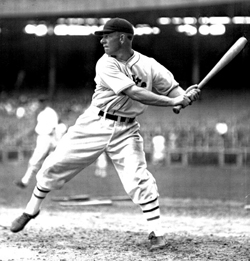
In a life tragically cut short, Mel Ott established the standard for power hitting in the National League and was an endearing role model to legions of baseball fans, including a young Stan Musial, for his humble, considerate manner.

On Nov. 21, 1958, Ott, 49, died in a New Orleans hospital from injuries suffered in a car accident a week earlier.

The sudden death of a popular baseball icon who represented vitality and decency stunned the nation.

Ott was the top slugger in the National League with the Giants from 1926-47. When his playing days ended, he was the National League career leader in home runs (511), RBI (1,860), extra-base hits (1,071), walks (1,708) and runs scored (1,859). Only Babe Ruth (714) and Jimmie Foxx (534) had hit more home runs. Ott had a career batting average of .304, with 2,876 hits, and was elected to the National Baseball Hall of Fame in 1951.

His journey to the major leagues began in storybook fashion.

Bayou to Broadway

In 1925, Ott was a catcher for a New Orleans semipro team owned by lumber tycoon Harry Williams, a friend of Giants manager John McGraw. Williams recommended Ott to McGraw, who agreed to take a look at the prospect. Ott, 16, traveled alone to New York, arrived at the Polo Grounds carrying a straw suitcase after getting lost in the subway system and met McGraw, who took a liking to the well-mannered teen. After watching Ott crush the ball in batting practice, McGraw knew he had a special talent.

Ott debuted with the Giants in April 1926 and became a regular after the Giants traded right fielder George Harper to the Cardinals in May 1928.

Primarily an outfielder, Ott had a strong arm and “learned to play rebounds from the right field wall at the Polo Grounds with the precision of a billiard player,” The Sporting News observed.

A left-handed batter, he had a peculiar approach to hitting. As described by the New York Daily News, Ott “lifted his right leg from the ground completely, accentuating a bend in the knee, and swung as the leg came down again.”

At 5 feet 9, 170 pounds, Ott was not large, but he was, according to The Sporting News, “as solid as a piece of Louisiana cypress.” Ott led the National League in home runs six times, produced 100 RBI or more in eight consecutive seasons (1929-36), was a 12-time all-star, and helped the Giants win three pennants and a World Series title.

“One of the things that made him a great hitter was hard practice,” said teammate Lefty O’Doul. “We used to spend hours, just the two of us, practicing hitting the ball down the right field foul line. We got so we could keep it fair by a few inches.”

Gentle giant

On Oct. 3, 1930, Ott married Mildred Rosina Wattigny. Both were 21 and friends since childhood.

Ott and his road roommate, pitching ace Carl Hubbell, were the most popular Giants players. Ott was admired as much for his demeanor as for his skill.

“Even Brooklyn (Dodgers) fans used to applaud Mel Ott,” Sports Illustrated noted.

In his book “Stan Musial: The Man’s Own Story,” the Cardinals standout recalled Ott as “one of my early idols” during his boyhood in Donora, Pa.

“I liked his mannerisms and his manners,” Musial said.

A Sporting News editorial cited Ott as “a quiet, modest hero” and declared his “gentleness, kindness and good sportsmanship always set a fine example.”

Ott could be hard-driving “but had something in his personality beyond all this that endeared him to people,” Sports Illustrated noted. “He was boyish, mannerly square. He looked like the beau ideal of American youth: the rugged kid who could win ballgames but who would stand up when a woman came into the room.”

Not nice

Ott was player-manager of the Giants from 1942-47 and remained the manager in 1948 when he no longer was playing. However, his teams never won a pennant and in July 1948 the Giants fired Ott and replaced him with Leo Durocher, longtime manager of the archrival Dodgers and a man whose brash, confrontational style was the opposite of Ott’s.

Giants fans “hated the sight of me, hated my guts,” Durocher said in his autobiography.

As Dodgers manager, Durocher was talking to columnist Frank Graham of the New York Sun in the dugout before a game against the Giants when he motioned toward Ott and said, “Look over there. Do you know a nicer guy than their manager, Mel Ott? Or any of the other Giants? Why, they’re the nicest guys in the world. And where are they? In last place.”

Over time, the sentences got melded into one, and the term “Nice guys finish last” came to define Durocher and highlighted what he viewed as the difference between antagonists like him and gentlemen such as Ott.

Ott remained with the Giants, assisting his friend Hubbell, who was the club’s farm director. Ott managed the minor-league Oakland Oaks in 1951 and 1952. In 1956, he became a Tigers broadcaster.

The Tigers consulted with Ott on player personnel matters. After the 1958 season, Ott returned to his home in Metairie, La., and was in contact with Tigers general manager John McHale, who sought his advice on trade proposals. “In Mel’s three years in Detroit as radio and television announcer, we always regarded him as an extra coach,” McHale said.

Fatal accident

On Nov. 14, 1958, Mel and Mildred Ott went to the coastal town of Bay St. Louis, Miss., to check on a cottage they had purchased. After dinner at a restaurant, Mel drove their station wagon onto a fog-shrouded highway. Their vehicle collided head-on with a car driven by Leslie S. Curry Sr., 50, a carpenter, who was killed instantly. Curry, a married father of seven, was alone in the car.

Mel suffered fractures of both legs, a broken arm, six broken ribs and injuries to his head and kidneys, according to United Press International. Mildred suffered a severe concussion and also broke both legs, an arm and ribs. The Otts were taken to a hospital in Gulfport, Miss.

On Nov. 20, Mel was transferred to a New Orleans hospital because of kidney failure and underwent surgery that night. He died the next day, “a tragic end to an around-the-clock attempt by doctors to save his life,” United Press International reported. Cause of death was uremia, a kidney poisoning resulting from a damaged kidney.

Mildred Ott recovered and lived until 1999 when she was 90, according to the Web site MyHeritage.

Althea Curry sued Mel Ott’s estate for the wrongful death of her husband Leslie. A district court judge dismissed the complaint when evidence showed the left wheels of Curry’s car were across the center line on Ott’s side of the road. An appeals court upheld the ruling, saying the plaintiff failed to prove negligence on the part of Ott.

Read Full Post »

« Newer Posts - Older Posts »