Feeds:
Posts
Comments

Archive for the ‘Hitters’ Category

(Updated July 15, 2020)

When the time came for Mike Shannon to choose a career path in either baseball or football, it put Bing Devine and Dan Devine at odds with one another.

On June 11, 1958, Shannon passed on a football future at the University of Missouri and signed a professional baseball contract with the Cardinals.

Missouri head coach Dan Devine was upset with the Cardinals and their general manager, Bing Devine, for taking a gifted quarterback away from college football.

“I’m bitterly disappointed and disillusioned by the mechanics of the signing for reasons I don’t want to discuss publicly,” Dan Devine said to the St. Louis Post-Dispatch.

The next day, Bing Devine called Dan Devine to discuss the matter and the conversation ended on “an amicable note,” the Post-Dispatch reported.

Cardinals courtship

Thomas Michael Shannon, called Mike, was born in St. Louis on July 15, 1939. His father, Tom, was a police officer who earned a law degree and became a prosecuting attorney for the city of St. Louis.

Mike Shannon was a multi-sport athlete at Christian Brothers College High School in St. Louis. He was the quarterback on the football team and his running back was Dick Musial, son of the Cardinals’ Stan Musial.

In 1957, Shannon accepted a football scholarship to the University of Missouri from head coach Frank Broyles. At that time, freshmen weren’t eligible to play for the varsity. After the 1957 season, Broyles left Missouri for Arkansas, and Dan Devine replaced him.

Shannon played quarterback in Missouri’s intrasquad spring game in April 1958 and threw a 23-yard touchdown pass. Dan Devine had big plans for Shannon in his sophomore season.

When Shannon returned home to St. Louis for the summer, he joined a baseball team in the Ban Johnson League for top amateurs. The hometown Cardinals were well aware of Shannon since his high school days and kept track of him.

On June 8, 1958, a part-time Cardinals scout, George Hasser, watched Shannon in a game at Heman Park in St. Louis and filed a glowing report to full-time Cardinals scout Joe Monahan.

The next night, Monahan, Hasser and Cardinals farm director Walter Shannon (no relation) went to see Mike Shannon play in a game at Scott Air Base. He worked out for the Cardinals at Busch Stadium on June 10. The next day, Shannon signed a $50,000 contract with them.

Years later, Shannon told the Post-Dispatch, “Back then, there wasn’t any money in football. If there would have been, I would have stayed with football. I enjoyed it at Mizzou and I would have played three years there. I think I had a lot more ability as a football player than a baseball player.”

Special talent

Before the deal was announced, Bing Devine called Missouri athletic director Don Faurot to inform him Shannon wouldn’t be returning to school. “I told Don that I know Missouri can’t score touchdowns with our expressions of regret, but baseball is our business,” Bing Devine told the Post-Dispatch.

Missouri athletic staff were stung by baseball’s ability to lure athletes away from the school before their eligibility expired. Shannon was the second football player to leave Missouri and sign with the baseball Cardinals in 1958. Running back Charlie James was the other. Also, soon after Shannon turned pro, Missouri basketball player Sonny Siebert signed a baseball contract with the Indians.

Dan Devine said Shannon had “the greatest potential of any back we had on our squad … He showed me more ability in the spring than any kid I ever worked with … Potentially one of the greatest.”

Dan Devine and Bing Devine were not related, but Dan caustically referred to “cousin Bing” when talking to Missouri booster groups about how the Cardinals wooed Shannon.

St. Louis broadcaster Jay Randolph said years later he asked Frank Broyles about Shannon and the coach replied, “If he had stayed in school, he may have won the Heisman Trophy” as college football’s best player, the Post-Dispatch reported.

Shannon, who turned 19 a month after signing with the Cardinals, was assigned to their Class D minor-league team in Albany, Ga., in June 1958 and batted .322 with 54 RBI in 62 games as an outfielder.

In February 1959, Shannon married Judith Ann Bufe and they began a family.

Shannon spent four more seasons (1959-62) in the minor leagues until getting promoted to the Cardinals in September 1962. He was an outfielder and third baseman for them until a kidney ailment caused him to quit playing in August 1970. In 21 games in three World Series with the Cardinals, Shannon produced 19 hits, including three home runs.

In 1972, Shannon began a successful second career as a Cardinals broadcaster.

Two of Shannon’s sons, Tim Shannon and Michael Shannon, followed in their father Mike’s football footsteps. Tim played for the University of Southern California and Michael played for Indiana State.
Read Full Post »

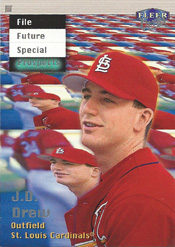
Confident in their ability to get a deal done, the Cardinals made a bold decision to pursue outfielder J.D. Drew.

On June 2, 1998, the Cardinals, with the fifth overall pick, chose Drew in the first round of baseball’s draft.
Drew was a top talent but his hardball contract demands made him a risky selection. The Phillies drafted him in 1997 with the second overall pick of the first round, but were unable to sign him.

The Cardinals, though, made him their prime draft target in 1998.

“He may be the best player to come out of the last two drafts,” Cardinals general manager Walt Jocketty said to the St. Louis Post-Dispatch. “He has a chance to be a franchise player.”

Phooey on Philly

While at Florida State in 1997, Drew won the Golden Spikes Award given to the nation’s best amateur baseball player. Drew became the third NCAA Division I player all-time to produce 100 hits, 100 RBI and 100 runs in a season.

After the Tigers chose pitcher Matt Anderson with the first pick of the 1997 June draft, the Phillies took Drew. Represented by agent Scott Boras, Drew wanted $10 million to sign. The Phillies offered $2.6 million. When the sides couldn’t reach a compromise, Drew signed with the St. Paul Saints, an independent team. Drew batted .341 in 44 games for St. Paul in 1997.

Drew’s rejection of the Phillies “made him about as popular locally as road construction on I-95,” wrote Paul Hagen of the Philadelphia Daily News.

In 1998, Drew returned to St. Paul. Because he hadn’t played for a team affiliated with organized baseball, Drew was able to re-enter the June draft. Giving no indication he’d concede on his contract demands, most teams determined using a high pick on Drew was a gamble.

The first four picks of the 1998 draft were outfielder Pat Burrell to the Phillies, pitcher Mark Mulder to the Athletics, outfielder Corey Patterson to the Cubs and pitcher Jeff Austin to the Royals.

Go for it

The Cardinals were delighted Drew was available when it became their turn to pick. Scouting director Ed Creech watched Drew play for St. Paul and recommended the Cardinals sign him.

“Drew was the No. 1 guy on our draft board,” Jocketty said. “We know he might be tough to sign, but we feel we’ve got a lot to sell here in St. Louis.”

Said manager Tony La Russa: “It’s an aggressive call.”

Unimpressed, Post-Dispatch columnist Bernie Miklasz wrote, “If the Cardinals don’t sign No. 1 draft choice J.D. Drew, that’s their problem, and their fault, and I’ll have no sympathy. The Cardinals know Drew’s holdout history. They know Drew’s financial demands. They know his agent, Scott Boras. Let the buyer beware.”

Boras was an infielder in the Cardinals’ minor-league system in the 1970s before becoming an agent for players. Among his clients was Rick Ankiel. In 1997, Ankiel was considered the best left-handed high school pitcher in the draft, but he wasn’t chosen in the first round because it was believed he wanted between $5 million and $10 million to sign. The Cardinals snatched him in the second round and negotiated with Boras on a deal Ankiel signed for $2.5 million.

The Cardinals and Boras had setbacks as well. In February 1998, Andy Benes, who wanted to stay in St. Louis, was declared a free agent and went to the Diamondbacks after Jocketty and Boras failed to reach a timely contract agreement for the pitcher.

Risk rewarded

On July 3, a month after he was drafted, Drew, 22, signed a four-year contract with the Cardinals for a guaranteed $7 million. The deal included incentive clauses that positioned Drew to net an additional $2 million.

“I believe this organization has unique insight on talent,” Boras said. “The decisions they make are not conventional, but you win in this game by being unconventional.”

Said Jocketty: “We take risks because we have a high regard for talent.”

In Philadelphia, Drew’s signing was mocked and criticized. “This signing is going to have a negative effect on the industry,” Phillies general manager Ed Wade said to the Philadelphia Inquirer.

Labeling Boras as the “sports world’s top-ranked terrorist,” Inquirer columnist Jayson Stark snarked, “So, the great J.D. Drew got his money. Yippee for him.”

Looking ahead to when the Cardinals and Phillies would play in Philadelphia, the Philadelphia Daily News declared, “Here’s an idea for the Phillies’ promotions department: Boo Drew Night.”

Said Drew: “I hope once everyone gets to know me as a person and as a player, they will accept me for what I am.”

Hot start

The Cardinals assigned Drew to their Class AA club in Arkansas. In his first game, he singled and doubled. In his second game, he hit two home runs.

After batting .328 in 19 games for Arkansas, Drew was promoted to Class AAA Memphis and hit .316 in 26 games.

In September 1998, the Cardinals called up Drew to the big leagues and he batted .417 (15-for-36) with five home runs.

The dazzling start heightened expectations to dizzying heights and Drew strained to deliver. Albert Pujols, not Drew, developed into the Cardinals’ franchise player.

In six seasons with St. Louis, Drew batted .282 and had an on-base percentage of .377. His best year for the Cardinals was 2001 when he hit .323 with 27 home runs in 109 games.

On Dec. 13, 2003, the Cardinals dealt Drew to the Braves for pitchers Adam Wainwright, Jason Marquis and Ray King.

Read Full Post »

(Updated May 24, 2025)

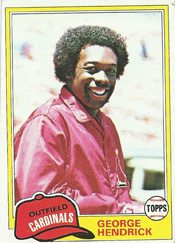
George Hendrick revived his career with the Cardinals and gave them the consistent run producer they were lacking in the outfield.

On May 26, 1978, the Cardinals acquired Hendrick from the Padres for pitcher Eric Rasmussen.
Platooned in right field by the Padres, Hendrick made it known he wanted to be traded to a team that would play him regularly. The Cardinals were happy to oblige.

Looking for lumber

The Cardinals opened the 1978 season with a starting outfield of Lou Brock in left, Tony Scott in center and Jerry Morales in right. None hit for power or average that season. Their totals: Brock (.221 batting average, no home runs), Scott (.228, one home run) and Morales (.239, four home runs).

The Cardinals needed another big bat to join catcher Ted Simmons and first baseman Keith Hernandez in the heart of the order.

Hendrick became available when he followed a strong 1977 season with a slow start in 1978 and fell out of favor with Padres manager Roger Craig.

The Padres opened the 1978 season with a starting outfield of Oscar Gamble in left, Hendrick in center and Dave Winfield in right. After batting .311 with 23 home runs and 81 RBI as the center fielder for the 1977 Padres, Hendrick hit .230 in April 1978.

Meanwhile, Craig determined catcher Gene Tenace and first baseman Gene Richards were playing out of position. In May, Craig moved Tenace to first base and Richards to left field, shifted Winfield from right to center and put Hendrick and Gamble into a platoon in right.

Hendrick and Gamble were unhappy with the arrangement and Gamble suggested he or Hendrick should be traded. When Padres general manager Bob Fontaine asked Hendrick whether he’d accept a trade, Hendrick said yes, The Sporting News reported.

Good deal

The Cardinals, Giants and Mets showed the most interest in Hendrick, Fontaine told the Associated Press. The Giants offered pitcher Jim Barr, but wanted to renegotiate the remainder of the three-year, $500,000 contract Hendrick signed in 1977, Padres owner Ray Kroc said to the Dayton Daily News.

After the Cardinals met with Hendrick’s agent, Ed Keating, an agreement was reached and the trade was made.

“He’s pleased to be coming here or he wouldn’t have approved of the deal,” Cardinals general manager Bing Devine said of Hendrick. “It was a good trade. There was no gun to our head. We wouldn’t have made it if there had been.”

Hendrick, 28, batted .243 with eight RBI in 36 games for the 1978 Padres. Rasmussen, 26, was 2-5 with a 4.18 ERA for the 1978 Cardinals after posting an 11-17 record the year before.

Cardinals manager Ken Boyer said Hendrick would be the center fielder and would bat third in the order, with Simmons fourth and Hernandez fifth.

“If Hendrick decides to give 100 percent, the deal could be Bing Devine’s best since he gave up Ernie Broglio for Lou Brock 14 years ago,” columnist Dick Young wrote in The Sporting News.

Joe Amalfitano, who was a coach with the 1977 Padres when Hendrick had his stellar season, told the St. Louis Post-Dispatch: “He’s a disciplined hitter. He’s a good base runner. He knows where he is at all times. He knows how to play this game. He never alibis. He never caused us any trouble.”

Special delivery

The Cardinals had lost 15 of their last 16 games and had a 15-31 record when Hendrick made his debut with them on May 29 in a doubleheader against the Mets in New York.

In a rare interview, Hendrick told Rick Hummel of the Post-Dispatch, “When I played against the Cardinals last year, my observation was that if they had somebody in the lineup who could protect Ted Simmons and hit 20 home runs and drive in 80 or 90 runs, I thought they could contend. I’m not saying I’m that guy, but I’m going to try to be.”

(In 2006, when Hendrick was a coach for the Rays, Hummel told the St. Petersburg Times, “He’s just a very delightful, charming, intelligent fellow and I relish every time I get to see him. People think because he doesn’t speak publicly that he’s this rude ogre, but he’s as gentle and kind a person as you’d ever want to meet.”)

Hendrick delivered for the 1978 Cardinals, batting .288 with 27 doubles, 17 home runs and 67 RBI in 102 games.

In seven seasons with St. Louis, Hendrick hit .294 and twice had more than 100 RBI in a season (109 in 1980 and 104 in 1982). He batted .321 in the 1982 World Series and drove in the go-ahead run in the sixth inning of the decisive Game 7 against the Brewers.

(Fun story about Hendrick and the 1982 World Series as told by club equipment manager Buddy Bates in an interview with Thoms R. Raber of 2004 Cardinals Yearbook: “It was real cold in Milwaukee. George was coming up to lead off the next inning. We had a heater at the end of the dugout. He laid his bat close to the heater. Well, it caught fire! Guys ran over there, stomping it out (but) his bat burned up.”)

Rasmussen, joining a rotation with Gaylord Perry and Randy Jones, was 12-10 for the 1978 Padres. He was 5-0 in July and 0-5 in September.

Rasmussen was reacquired by the Cardinals in December 1981 and pitched for them briefly in 1982 and 1983 before finishing his major-league career with the 1983 Royals.

Read Full Post »

(Updated Jan. 23, 2025)

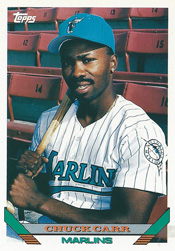
Chuck Carr, a switch-hitting speedster who appealed to the Cardinals but didn’t fit into their plans, found a home with the expansion Marlins.

On May 14, 1993, the Cardinals played the Marlins in a regular-season game for the first time. The first batter they faced was Carr, whom the Marlins selected from the Cardinals in the Nov. 17, 1992, National League expansion draft.

Carr developed into a productive player with the 1993 Marlins. He led the National League in stolen bases (58) that season, tied with Jeff Conine for the team lead in runs scored (75) and was second on the club in hits (147).

In a special edition magazine, “Marlins! Top of the First,” Dan Le Batard of the Miami Herald wrote, “If Marlins center fielder Chuck Carr hadn’t been born, Walt Disney would have created him. The cocky Carr, part cartoon and part character, added a flash of fluorescence to a game capable of being as black and white as its box scores.”

For instance, according to Le Batard, after winning a game for the Marlins with a bunt, Carr gave his interviews while staring into a mirror. He also wanted to name a son Sports _ as in, Sports Carr _ but his wife wouldn’t allow it. They settled on Sheldon instead.

The Cardinals would like to have kept Carr, but they had outfielders such as Ray Lankford, Bernard Gilkey and Brian Jordan who rated ahead of him.

Learning to hit

Carr entered pro baseball in 1986 when he was drafted and signed by Reds scout Ed Roebuck, a former big-league pitcher. After a year in the Reds’ system, Carr was released, joined the Mariners, spent two seasons in their organization and got traded to the Mets.

On Dec. 13, 1991, the Cardinals, acting on the advice of player development director Ted Simmons, got Carr from the Mets for minor-league pitcher Clyde Keller. Carr had a reputation for being a good fielder and weak hitter. “We signed him primarily as a defensive player,” Simmons told the St. Louis Post-Dispatch.

The Cardinals assigned Carr to Class AA Arkansas to open the 1992 season and sent minor-league hitting instructor Johnny Lewis to work with him.

“Chuck was just slapping at the ball … I took him aside and showed him ways he could hit the ball harder,” Lewis told the Louisville Courier-Journal.

Said Carr: “Johnny wants me to shorten my swing and put the ball in play more, just like Jose Oquendo and Ozzie Smith. It made sense to me.”

Carr hit .261 at Arkansas and was promoted to Class AAA Louisville on May 12. He batted .308 with 53 stolen bases in 96 games for Louisville.

“Carr is stirring memories of Vince Coleman,” wrote Courier-Journal columnist George Rorrer. “He’s fast enough to steal a base nearly any time he wants.”

Said Louisville manager Jack Krol: “Chuck has done more than we thought he could do … He can make it to the big leagues.”

Building block

Carr was called up to the Cardinals in September 1992 and they gave him a chance to play. He made 15 outfield starts. “His disruptive speed and defensive skills make Carr intriguing,” Dan O’Neill of the Post-Dispatch wrote.

Carr hit .360 in his first 25 at-bats and had five stolen bases. “Initially, he stirred excitement with the Cardinals,” wrote O’Neill. “Then he started hitting fly balls and his average deflated.”

In 22 games for the Cardinals, Carr hit .219 with 10 stolen bases.

After Carr was drafted by the Marlins, Cardinals manager Joe Torre said he “would have benefited us as a player coming off the bench” in 1993. “We were kind of hoping he might sneak through” the draft without being taken, Torre said.

The Marlins saw Carr as a possible cornerstone for building a lineup. “He can steal 50 bases in the major leagues,” said Marlins scout Cookie Rojas.

Run generator

Scott Pose was the Marlins’ starting center fielder and leadoff batter in their first Opening Day, April 5, 1993, but Carr took over the job on April 16 and kept it the remainder of the season.

A couple of more anecdotes from Dan Le Batard about Carr:

_ During 1993 spring training, Carr approached Lou Brock, then an Expos instructor, and asked for tips on how to be a better base stealer. “Listen, son,” Brock said to Carr, “what I’ve done can’t be taught in 15 minutes.” Carr got an autograph instead.

_ In a regular-season game against the Cubs, Carr was called out on a close play at first, taunted umpire Jeff Kellogg by pointing at his eyes and said to him, “If you are blinded by the speed, don’t make the call.”

When the Marlins came to St. Louis for the first time in a regular-season game, their lineup was Chuck Carr in center, Junior Felix in right, Dave Magadan at third, Orestes Destrade at first, Benito Santiago at catcher, Jeff Conine in left, Alex Arias at second, Walt Weiss at short and pitcher Chris Hammond.

The Cardinals’ lineup: left fielder Bernard Gilkey, shortstop Ozzie Smith, center fielder Ray Lankford, first baseman Gregg Jefferies, right fielder Mark Whiten, third baseman Todd Zeile, second baseman Geronimo Pena, catcher Erik Pappas and pitcher Bob Tewksbury.

The Cardinals won, 7-2. Carr contributed to both Marlins runs.

In the fourth, Carr got the Marlins’ first hit, lining a single to center. He swiped second _ “The throw was pretty good,” said Pappas. “He just beat it.” _ advanced to third on a groundout and scored on a single by Magadan.

In the seventh, with the bases loaded and two outs, Carr was grazed on the arm by a Tewskbury pitch, forcing in a run. “The ball was close to being a strike,” said Tewksbury. “He’s just diving into the pitch.” Boxscore

Carr batted .263 with six stolen bases against the Cardinals in 1993. The Cardinals won nine of 13 games against the expansion Marlins.

In eight major-league seasons with the Mets (1990-91), Cardinals (1992), Marlins (1993-95), Brewers (1996-97) and Astros (1997), Carr batted .254 with 144 stolen bases.


Read Full Post »

Sons of Polish fathers, Stan Musial and Moe Drabowsky reached the major leagues, played central roles in a baseball milestone and honored their heritages by helping others learn the game they loved.

On May 13, 1958, Musial got his 3,000th career hit, a double against Drabowsky at Wrigley Field in Chicago. The feat forever linked Drabowsky with Musial.

The relationship didn’t end there. In September 1987, Musial and Drabowsky went to Poland together to instruct men and women in their fathers’ homeland how to play baseball.

Land of opportunity

Miroslav Drabowski, later known as Moe Drabowsky, was born on July 21, 1935, in Ozanna, Poland. His father was Polish and his mother was American. In 1938, when Miroslav was 3, the family moved to the United States and settled in Connecticut.

In America, Miroslav took the name of Myron Walter Drabowski, though nearly everyone called him Moe. He was a natural as a baseball player. In school, his name often was misspelled as Drabowsky and he stuck with that, according to a biography by the Society for American Baseball Research.

After earning an economics degree from Trinity College in Connecticut, Drabowsky signed with the Cubs and made his big-league debut with them in 1956.

Musial, whose father immigrated to the United States from Poland in 1910, entered the 1958 season needing 43 hits to become the eighth player to reach 3,000. On May 12, against the Cubs at Wrigley Field, Musial got his 2,999th hit and indicated he’d prefer to achieve No. 3,000 before the fans in St. Louis.

Work day

Cardinals manager Fred Hutchinson told Musial to sit out the May 13 game at Chicago and prepare to return to the lineup May 14 against the Giants at St. Louis. Musial went to the bullpen along the right-field line at Wrigley Field and watched the game.

In the sixth inning, with the Cubs ahead, 3-1, Gene Green led off for the Cardinals and doubled. Hal Smith was up next, with pitcher Sam Jones on deck. As Smith batted, Hutchinson motioned for Musial. After Smith grounded out, Musial walked from the bullpen to the dugout, picked out a bat and went to the plate to hit for Jones. The Tuesday afternoon crowd of 5,692 cheered in approval.

Drabowsky, 22, was glad Cubs manager Bob Scheffing showed confidence in letting him pitch to Musial. Drabowsky won 13 for the Cubs in 1957 and was considered one of their best pitchers in 1958.

“I thought, ‘Here’s a guy who deserves No. 3,000.’ A nice guy,” Drabowsky told David Condon of the Chicago Tribune. “Then I remembered our 3-1 lead and that I was trying to preserve a victory. So I told myself, ‘Sure, he’s a nice guy, but he’ll have to earn No. 3,000.’ So I bore down.”

Hugs and kisses

Working methodically, Drabowsky alternated curves and fastballs. Musial fouled off three pitches to left and watched two others go wide of the strike zone.

With the count at 2-and-2, Drabowsky threw a curve. “Outside corner, higher than intended,” Drabowsky said.

In his book “Stan Musial: The Man’s Own Story,” Musial said, “I picked up the spin of the pitch, strode into the ball and drove it on a deep line into left field. I knew as soon as it left my bat that it would go between the left fielder, Walt Moryn, and the foul line.”

Musial’s No. 3,000 was a run-scoring double. “I don’t mind him getting 3,000 off me,” Drabowsky said, “but when I had two strikes, I thought I had him _ not for a strikeout, but I figured he’d hit it in the ground.” Video

As Hutchinson ran onto the field to congratulate Musial, he was followed by a pack of photographers. Umpire Frank Dascoli retrieved the ball and handed it to Musial, who was lifted for a runner, pitcher Frank Barnes.

Before leaving the field, Musial went to the box seats next to the Cardinals dugout and kissed his wife, Lillian. A photographer asked, “Say, Stan, did you know that blonde?” Musial laughed and replied, “I’d better. That’s my wife.”

Sparked by Musial’s hit, the Cardinals scored three more runs against Drabowsky in the inning and won, 5-3. Boxscore

Polish pride

Musial, who retired after the 1963 season, batted .405 with two home runs, four doubles and six walks against Drabowsky in his career.

Drabowsky pitched 17 seasons in the major leagues with eight teams: Cubs (1956-60), Braves (1961), Reds (1962), Athletics (1962-65), Orioles (1966-68 and 1970), Royals (1969-70), Cardinals (1971-72) and White Sox (1972). His best years were as an Orioles reliever. In Game 1 of the 1966 World Series, Drabowsky struck out 11 Dodgers, including six in a row, and earned the win with 6.2 innings of scoreless relief. Boxscore

In two seasons with the Cardinals, Drabowsky was 7-2 with 10 saves.

In 1987, Musial and Drabowsky reconnected, going to the town of Kutno in Poland to teach baseball to men and women in the Polish Baseball Union. It was Drabowsky’s first visit to Poland since he left when he was 3.

With equipment provided by baseball commissioner Peter Ueberroth, Musial and Drabowsky gave out enough bats, balls, gloves and catchers’ gear to supply 12 men’s teams and six women’s teams, according to the Chicago Tribune.

“We’re here to help get them going and maybe we can invite some of their coaches to the U.S. next year to see how we train so they can come home and teach the kids more,” said Musial.

The effort by Musial and Drabowsky led to Kutno, Poland, becoming home to the Little League Baseball European Leadership Training Center.

Read Full Post »

(Updated July 22, 2020)

Knowing Duke Snider wasn’t enamored with the new home of the Dodgers, the Cardinals made a bid to acquire him, but the price was deemed too high.

On April 25, 1958, the Cardinals played the Dodgers in Los Angeles for the first time in the regular season. The Dodgers left Brooklyn after 1957 and relocated to the Los Angeles Memorial Coliseum while waiting for Dodger Stadium to be built.

Snider, a left-handed pull hitter who thrived at Ebbets Field in Brooklyn, was frustrated by the dimensions of the Coliseum. The distance from home plate to the fence in right-center was 440 feet and it was 390 feet from home plate to straightaway right. Snider found drives hit to right that would have been home runs at Ebbets Field were outs at the Coliseum.

The Coliseum was much friendlier to right-handed pull hitters, with a distance of 251 feet down the line from home plate to the left field fence. Though a screen stretching 42 feet high and 140 feet long was erected along the left field wall, hitters reached the seats with routine fly balls.

Musial as mentor

Snider, the Dodgers’ highest-paid player at $42,000, was batting .231 with one home run when the Cardinals arrived in Los Angeles for the first time in 1958. A gimpy left knee was bothering him and he was being booed by hometown crowds who expected the outfielder to hit with the kind of power he displayed in Brooklyn.

When asked about his knee, Snider replied to the Los Angeles Times, “It hurts like the dickens.”

Asked about the booing, Snider said, “I’m used to it and I expect it when I’m not going good. I’d boo, too. I’m supposed to be a hitter, a long ball hitter. When I don’t hit, the fans certainly are entitled to boo.”

Before the opening game of the series with the Cardinals, Snider and his St. Louis counterpart, left-handed hitter Stan Musial, met at the batting cage, and Musial tried to console him. In his book “Stan Musial: The Man’s Own Story,” Musial recalled the conversation. “You can’t let this thing throw you,” Musial told Snider. “You can’t beat a park like this, so join it.”

In the game that night, Musial practiced what he preached. He produced a double and three singles in four at-bats against a left-hander, Fred Kipp, and raised his batting average for the season to .533 in nine games.

Snider was 0-for-4, but the Dodgers won, 5-3, Boxscore

In the St. Louis Post-Dispatch, Bob Broeg wrote, “If the Cardinals can’t win with Stan Musial hitting as though he had invented the game, what’s going to happen to the Redbirds when the man cools off to _ oh, say, a simple .400?”

High stakes

The game, however, was overshadowed by Broeg’s Post-Dispatch exclusive, reporting how the Cardinals discussed with the Dodgers a proposed trade involving Snider.

According to Broeg, Dodgers general manager Buzzie Bavasi offered Snider to the Cardinals for third baseman Ken Boyer and outfielder Wally Moon. Though Cardinals general manager Bing Devine wanted Snider, whose power stroke was suited for St. Louis’ ballpark, he thought Bavasi was asking too much in return.

Cardinals manager Fred Hutchinson said, “Sure, we’d like to have Snider. He’s not hitting in this heartbreak park (the Coliseum), but he’d rattle that fence at Busch Stadium. Still, he’s damaged goods _ with that operated-on left knee _ and we wouldn’t give Boyer for him, let alone both Boyer and Moon. Besides, (at 31) he’s nearly five years older than Kenny.”

Asked by the Los Angeles Times about the Post-Dispatch scoop on the proposed Snider deal, Bavasi said, “Somebody’s been smoking the wrong stuff.”

According to the Times, Bavasi said he and Devine were being facetious when they talked about a deal involving Snider, Boyer and Moon. The Times said Devine wanted Snider, “but realizes that the chances of getting him are as remote as northeastern Nepal.”

Devine continued to shop for a left-handed hitter and admitted discussing an offer with the Reds for either of their catchers, Ed Bailey or Smoky Burgess.

The Sporting News, meanwhile, acknowledged the Cardinals’ interest in Snider was sincere, telling its readers, “The Cardinals appeared unwilling to give up Boyer, Moon and others as requested by Los Angeles for Duke Snider.”

Snider snapped out of his slump and batted .312 for the 1958 Dodgers, but his 15 home runs were far below the 40 or more he hit in each of the previous five seasons. Musial, 37, hit .337 in 1958, placing third in the National League behind Richie Ashburn of the Phillies (.350) and Willie Mays of the Giants (.347).

After the 1958 season, the Cardinals traded Moon and pitcher Phil Paine to the Dodgers for outfielder Gino Cimoli.

Seven years later, in March 1965, Joe Becker, who joined the Cardinals’ coaching staff after serving as a Dodgers coach, said the Cardinals in 1958 tried to trade Ken Boyer and pitcher Larry Jackson to the Dodgers for Duke Snider and pitcher Roger Craig, but the deal fell through, the Dayton Daily News reported.

Read Full Post »

« Newer Posts - Older Posts »