Feeds:
Posts
Comments

Archive for the ‘Hitters’ Category

(Updated April 22, 2020)

Displaying mutual respect, Ty Cobb and Stan Musial met on the field before the first regular-season game between the Giants and Cardinals in San Francisco.
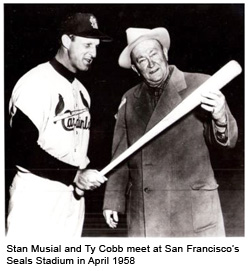
On April 22, 1958, the Cardinals played at Seals Stadium for the first time since the Giants moved from New York.

Cobb, 71, a resident of Atherton, Calif., went to the game to see Musial, 37, who was in the lineup for his first West Coast regular-season game.

Like Musial, Cobb batted left-handed. Cobb played for 24 years (1905-28) in the American League and retired as baseball’s career hits leader. Cobb and Musial rank first and second all-time in career hits among left-handed batters. The top four in career hits among all batters are switch-hitter Pete Rose (4,256), Cobb (4,189), right-handed Hank Aaron (3,771) and Musial (3,630).

Cobb, dressed in coat and hat and described by the St. Louis Post-Dispatch as “tall and sharp-eyed,” went onto the field during pre-game warmups and chatted with Musial. Their conversation continued in the dugout before Cobb took a seat in the stands to watch the game.

Musial, batting third and playing first base, produced a double and two singles in five at-bats, scored twice and drove in a run. Cobb admired how Musial scored from second on Gene Green’s line-drive single to left.

In comments published by The Sporting News, Cobb said of Musial, “He showed me that his legs are still good. That’s the life of a ballplayer _ his legs. I’ve always contended Joe DiMaggio could have lasted five years longer had he used his legs more in the winter.

“Musial’s speed impressed me,” Cobb said. “Too many long ball hitters today think they’re paid only to hit homers. Musial always hits his share of them, but he also fields and runs the bases. Stan is of the stripe who played in my time. There are too few of them today.”

Drawing a crowd

Musial and his road roommate, Del Ennis, sparked St. Louis to a 7-5 victory in the first Cardinals regular-season game at San Francisco. Ennis, a left fielder who batted cleanup, hit a two-run home run against Giants starter Johnny Antonelli in the first inning and a RBI-single off Al Worthington in the seventh.

The game drew a near sellout crowd of 22,786 to Seals Stadium (capacity 22,900) on a Tuesday night, and many were there to see Musial. “San Franciscans began to line up as early as noon for the 4,000 unreserved seats,” the Post-Dispatch reported. “Approximately 1,000 reportedly were turned away when the general admission and bleacher tickets were exhausted.”

Among retired Cardinals players who visited the clubhouse were Taylor Douthit and Tommy Glaviano. Musial and a former teammate, Hank Sauer of the Giants, posed together for photographers before the game. Both wore uniforms with the No. 6.

“Musial got by far the largest hand of the night when he batted,” the Post-Dispatch reported.

According to the San Francisco Examiner, the fans cheered for Musial “just as lustily as they applauded their own Willie Mays. The crowd enjoyed Musial and gave him repeated ovations, even during batting practice.”

Said Musial: “I never thought I’d play long enough to be in the majors when the big leagues went to the Coast, but it’s quite a thrill. Personally, I’ll miss New York _ wish we could go there, too.”

Opposite field swing

With the wind blowing in from right field to home plate, Musial decided not to try pulling pitches. His singles were hit to center and his double, which produced a run against Mike McCormick, was slashed along the left-field line.

In his book “Stan Musial: The Man’s Own Story,” Musial said of Seals Stadium, “I found that the trade winds made it tough (to bat) for a left-hander … and served as an anchor on drives smashed to right.”

Willie Mays and Orlando Cepeda each had three hits for San Francisco, but the Giants stranded 13 base runners. Boxscore

After winning the series opener, the Cardinals lost the next two games when the Giants came from behind in the ninth innings of both.

In two seasons at Seals Stadium before the Giants moved to Candlestick Park in 1960, Musial batted .294, with 20 hits and 11 walks in 20 games.

Read Full Post »

(Updated Nov. 25, 2019)

Rusty Staub, who did his best hitting versus right-handed pitchers, and Bob Gibson were matched against one another often. Though Staub didn’t hit Gibson as well as he did most right-handers, he had a couple of significant games while facing the Cardinals’ ace.

Staub had more plate appearances (162) and more at-bats (143) versus Gibson than he did against any other pitcher in his major-league career.
A left-handed batter, Staub played 23 seasons in the big leagues, starting in 1963, when he was 19, with the Houston Colt .45s before they were renamed the Astros. An outfielder and first baseman, Staub also played for the Expos, Mets, Tigers and Rangers.

Staub had career totals of 2,716 hits and 1,466 RBI, with a .279 batting average. Against right-handed pitching, he hit .291. Gibson was among the few right-handers who fared well against Staub, limiting him to a .224 batting average, but Staub was a respected adversary, compiling 32 hits, 16 walks and 15 RBI against him.

Cardinals nemesis

In 256 games against the Cardinals, Staub batted .273, with 226 hits, 109 walks and 102 RBI. He hit .300 or better versus the Cardinals every year from 1966 to 1973. Some of his performances against St. Louis were dominant: .484 batting average and 13 RBI in 1966; .328 and 15 RBI in 1967; and .343 and 15 RBI in 1975.

In a November 2019 interview with broadcaster Dan McLaughlin, longtime Cardinals catcher Ted Simmons said, “If Rusty decided he wasn’t going to strike out, you couldn’t strike him out. I mean, it wasn’t a matter of him trying to foul the ball off. He would put an at-bat on you. Every swing was critical.”

Staub was tough on Cardinals right-handers such as Nelson Briles (.384 batting average against) and Ray Washburn (.327), and one of the left-handers he solved was Steve Carlton (.308). Staub had more RBI (25) versus Carlton than he did against any other pitcher. All four of his career home runs off Carlton came while the pitcher was with the Cardinals.

Staub was 20 when he hit his first home run against a Cardinals pitcher, left-hander Curt Simmons, 35, in 1964.

Another longtime Cardinals left-hander, Ray Sadecki, struck out Staub more times (21) than any other major-league pitcher.

Perfect at plate

On May 1, 1968, Gibson pitched 12 innings, yielding seven hits and no earned runs, in a 3-1 Cardinals victory over the Astros at Houston. Staub gave him the most trouble, with four hits and a sacrifice bunt in five plate appearances.

“You can’t trick Staub,” Gibson said to the St. Louis Post-Dispatch.

Said Cardinals center fielder Curt Flood: “Staub has a good, short stride and he seems to know what kind of pitch is coming.”

Staub, batting in the cleanup spot, produced three singles and a double.

Explaining how Gibson relied on fastballs and sliders, Cardinals catcher Johnny Edwards said, “I think Gibby threw two curves all night and the only changeup was the one Rusty Staub hit up the middle (in the fourth) for a single.”

In the Astros’ half of the 11th, with the score tied at 1-1, Jim Wynn drew a leadoff walk. Staub was up next, and even though he was perfect at the plate against Gibson, Astros manager Grady Hatton instructed him to bunt. Staub executed, moving Wynn into scoring position at second base.

After Doug Rader struck out, Cardinals manager Red Schoendienst ordered Gibson to walk John Bateman to get to Denis Menke, a career .184 batter versus Gibson. Menke grounded into a forceout. Boxscore

Sweet swing

Seven years later, on April 23, 1975, Gibson was matched against Mets ace Tom Seaver in a game at New York. Staub was with the Mets then.

In the fifth, with the Cardinals ahead, 1-0, Jack Heidemann singled against Gibson and moved to second on Jerry Grote’s single. With Seaver at the plate, Gibson made a pickoff throw to second baseman Ted Sizemore. Sizemore applied a tag, but umpire Tom Gorman ruled Heidemann safe.

“He never got to the bag,” Sizemore complained.

After Seaver grounded out, Wayne Garrett walked, loading the bases, and Felix Millan hit a two-run double. After an intentional walk to Del Unser, reloading the bases, Staub came up, swung at Gibson’s first pitch, a fastball, and walloped it for a grand slam. The Mets won, 7-1.

“I’ve always said the key to hitting is to have men on base,” Staub said to The White Plains Journal News. “It doesn’t matter who bats behind you in the batting order. It matters only if men are on base in front of you and you can get a pitch to hit.”

Said Gibson: “I was having control problems and when you have control problems you don’t throw the same.” Boxscore

The grand slam was the sixth of nine Staub hit in the big leagues. Two other future Hall of Fame pitchers, Rollie Fingers and Dennis Eckersley, also yielded grand slams to Staub.

Read Full Post »

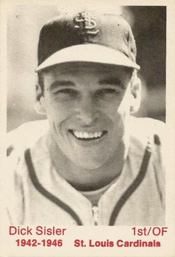
Dick Sisler, a standout as a St. Louis prep school athlete and son of a Hall of Fame baseball player, came to the Cardinals amid high expectations. He earned starts in two Opening Day lineups for the Cardinals but departed before he developed into a major-league all-star.

On April 7, 1948, the Cardinals traded Sisler to the Phillies for infielder Ralph LaPointe and $20,000.
Initially, the deal disappointed Sisler, who hoped to establish a big-league career with the hometown Cardinals. Sisler soon learned, however, that joining the Phillies was a good break for him.

Preps to pros

Dick Sisler excelled at baseball, basketball, football and track at John Burroughs School in the St. Louis suburb of Ladue. His father, George Sisler, a first baseman, was one of baseball’s best hitters, primarily for the St. Louis Browns of the American League, in a major-league career that spanned from 1915 to 1930.

As a high school senior, Dick Sisler accepted a college scholarship offer from Colgate, but when the Cardinals came calling with a professional contract in February 1939, Sisler, 18, went with them instead.

Sisler made his major-league debut with the Cardinals in 1946, starting at first base on Opening Day. When a hand injury sidelined Sisler in June, Cardinals manager Eddie Dyer moved Stan Musial from the outfield to first base. After Sisler recovered from his injury, Dyer kept Musial at first and put Sisler in left. Sisler hit .260 with 42 RBI in 83 games as a Cardinals rookie.

When the 1947 season opened, the Cardinals started Musial at first base and Sisler in left field. Sisler didn’t provide the power the Cardinals sought, and in May they acquired left fielder Ron Northey from the Phillies and moved Sisler to the bench. Sisler batted .203 in 46 games for the 1947 Cardinals.

When Sisler signed his Cardinals contract for the 1948 season, club owner Robert Hannegan informed him Musial would be moved back to the outfield. Sisler was told he would have the chance to compete for the starting first base job, but would be traded if someone else got the role, according to The Sporting News.

Spring cleaning

Sisler played well for the Cardinals at spring training in 1948. “Dick was meeting the ball better and seemed to be on his way to a bright season,” the St. Louis Post-Dispatch reported.

Sisler told the St. Louis Star-Times, “I was given to understand that I had a real chance to make the Cardinals’ ball club if I had a good spring training season. Well, I had a big spring. I know I led the club in home runs. In extra-base slugging, my percentage must have been over .600.”

After the Cardinals left Florida and made their way north, they stopped in Columbus, Ga., to play an exhibition game on April 7, 1948, against their farm team. The Cardinals were at a team barbecue when Hannegan approached Sisler and told him he’d been traded to the Phillies.

The Post-Dispatch reported the deal as “something of a surprise move” and the newspaper’s editorial page predicted the Cardinals are “going to regret trading Dick Sisler.”

According to the Star-Times, the trade was made because Dyer and Sisler “were hardly of one mind on Dick’s baseball abilities or on other subjects.”

The Sporting News said Dyer planned to start Sisler at first base, but changed his mind because he wanted a right-handed batter to better balance a lineup with left-handed hitters such as Musial, Northey and Enos Slaughter. After the trade, Dyer named Nippy Jones, a right-handed batter, to start at first base.

“I feel the deal ultimately will prove to be in Sisler’s best interest as well as the Cardinals’,” Hannegan said.

Philadelphia freedom

After Sisler reported to the Phillies, he appeared to be more naturally relaxed in his approach than he had been with the Cardinals. “Perhaps it would have been better for Dick if he had started in a town other than St. Louis, someplace where the fans didn’t have as many recollections of his brilliant dad,” columnist J.G. Taylor Spink wrote in The Sporting News.

Meanwhile, LaPointe, the player the Cardinals acquired from the Phillies for Sisler, was tabbed by Dyer to be a backup to Red Schoendienst at second base and to Marty Marion at shortstop.

“Coming to this ball club is like falling into Utopia,” LaPointe said.

Sisler batted .274 with 56 RBI for the 1948 Phillies and Jones, his replacement at first base, hit .254 with 81 RBI for the 1948 Cardinals. In his lone St. Louis season, LaPointe batted .225 in 1948.

Sisler had his all-star season with the 1950 Phillies, hitting .296 with 83 RBI. In the final regular-season game that year, Sisler hit a three-run home run in the 10th inning against Don Newcombe, lifting the Phillies to a 4-1 pennant-clinching victory over the Dodgers.

In four seasons with the Phillies, Sisler hit .287. He went to the Reds in 1952 but was traded back to the Cardinals in May that year. He finished his big-league playing career with the 1953 Cardinals.

After a stint as a minor-league manager, Sisler was a Reds coach from 1961-64. Late in the 1964 season, he replaced an ailing Fred Hutchinson as Reds manager and guided them into a pennant race with the Cardinals and Phillies. The Reds finished in second place when the Cardinals clinched the pennant on the last day of the regular season.

Sisler managed the Reds in 1965, and though the club finished 89-73, he was fired after the season. He was a Cardinals coach on manager Red Schoendienst’s staff from 1966-70, and he also coached for the 1975-76 Padres (managed by John McNamara) and the 1979-80 Mets (managed by Joe Torre).

Read Full Post »

(Updated May 2, 2019)

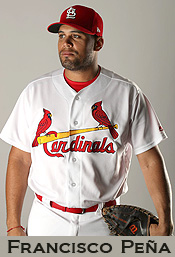
Francisco Pena provided one of the surprises of the Cardinals’ 2018 spring training, leapfrogging ahead of prospect Carson Kelly and earning the backup catcher spot behind Yadier Molina on the Opening Day roster.

Pena, son of former Cardinals catcher Tony Pena, played in the Mets’ system for seven seasons (2007-13) before reaching the majors with the Royals in 2014. After the 2015 season, his contract was sold to the Orioles and Pena was with them in 2016 and 2017.

The Cardinals signed Pena after he was granted free agency in October 2017.

Francisco Pena hit his first Cardinals home run, and his fourth overall in the major leagues, on May 18, 2018, versus the Phillies at St. Louis.

Tony Pena and Francisco Pena became the second father-son pair to hit home runs for the Cardinals, following Ed Spiezio and Scott Spiezio. Ed Spiezio played five years (1964-69) for the Cardinals and hit five home runs for them. His son, Scott Spiezio, played two years (2006-07) for the Cardinals and hit 17 home runs for them.

Tony Pena hit 107 big-league home runs, including 19 in three seasons (1987-89) with the Cardinals. Tony helped the Cardinals win the 1987 National League pennant and he was an all-star with them in 1989.

Francisco Pena never got to see his father Tony play for the Cardinals. Francisco was born on Oct. 12, 1989, 11 days after Tony played in his final game for the Cardinals. Tony Pena became a free agent on Nov. 13, 1989, and signed with the Red Sox two weeks later.

Francisco Pena hit .203 with two home runs in 58 games for the 2018 Cardinals. In 2019, the Cardinals sent Pena to the minor leagues and on May 2, 2019, they traded him to the Giants in a cash transaction.

Read Full Post »

(Updated Nov. 26, 2021)

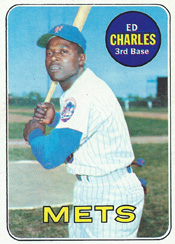
Ed Charles hit the most important home run of his major-league career against the Cardinals.

Charles, nicknamed “The Glider,” was a third baseman who played eight seasons in the big leagues with the Athletics (1962-67) and Mets (1967-69).
In 1969, Charles hit a home run against the Cardinals’ Steve Carlton that helped the Mets clinch their first postseason berth.

Carlton cursed

The 1969 season was the first for divisional play in the majors. The Cardinals were two-time defending National League champions. The Mets, who joined the league in 1962 as an expansion team, never had experienced a winning season.

Few predicted the Mets would be the league’s best team in 1969. Yet, entering their game against the Cardinals on Sept. 24 at New York, the Mets were in first place in the NL East and needed one win to clinch the division title.

The game matched Carlton, the future Hall of Fame left-hander, against Gary Gentry. A week earlier, on Sept. 15 at St. Louis, Carlton struck out 19 Mets, including Charles twice, but the Cardinals were beaten, 4-3, on a pair of two-run home runs by Ron Swoboda. Boxscore

Career climax

Determined to clinch the playoff berth before a sellout crowd at Shea Stadium, the Mets looked motivated from the start of their Sept. 24 match with the Cardinals. With one out in the first inning, Donn Clendenon hit a three-run home run and, after Swoboda walked, Charles came to the plate.

In the book “After the Miracle,” Mets outfielder Art Shamsky said, “Carlton would deliver his signature slider to Eddie. Willie Stargell once compared trying to hit it to drinking coffee with a fork, but the phrase, ‘Never throw a slider to The Glider,’ had become part of Mets folklore by that time.”

Charles hit a two-run home run, giving the Mets a 5-0 lead and prompting manager Red Schoendienst to remove Carlton from the game. The Mets cruised to a 6-0 victory.

“Boom. Boom. We’re dethroned,” Schoendienst said to the St. Louis Post-Dispatch in describing the first inning salvos by the Mets.

Said Carlton: “Tonight was the worst experience of my life.”

The home run by Charles was a drive to right-center. Curt Flood, the Cardinals’ center fielder, banged against the wall in pursuit of the ball and was taken out of the game after two innings because of a bruised knee.

Charles clapped his hands as he rounded the bases because, as he informed United Press International, “I wanted to tell the fans, and tell the world, this home run meant more to me than any other in my life.” Boxscore

At 36, Charles was a platoon player on a roster filled with teammates entering their primes. “I am in the twilight zone,” Charles said. “I’m not like these younger guys. There is going to be a next year for them. There may not be another next year for me.”

Pinch-hit power

Indeed, after the Mets went on to win the NL Championship Series against the Braves and the World Series versus the Orioles, Charles was released and didn’t play again.

A right-handed batter, Charles posted a .263 career batting average. He made his major-league debut two weeks before turning 29 and hit .288 with 17 home runs as a rookie with the 1962 Athletics.

In 37 career games against the Cardinals, Charles batted .228.

Before his home run against Carlton, Charles’ best performance versus the Cardinals occurred in 1968 when he delivered pinch-hit home runs in consecutive games. On June 1, Charles, batting for Kevin Collins, hit an eighth-inning home run against Joe Hoerner, Boxscore and on June 2, in the opener of a doubleheader, Charles batted for Al Jackson and hit a seventh-inning home run against Bob Gibson. Boxscore

In the book “Stranger to the Game,” Charles said, “Gibson was the single most intimidating pitcher I ever faced.” Recalling the home run he hit against him, Charles said, “I just sort of watched it for a moment in disbelief. When I got back to the bench, guys came over and sort of looked at me. They couldn’t believe it either.”

According to The Sporting News, Charles became the sixth National League batter to hit pinch-hit home runs in consecutive times at-bat and just the second to do it on consecutive days. Dale Long of the Cubs hit pinch-hit home runs on consecutive days vs. the Giants on Aug. 13-14, 1959.

Read Full Post »

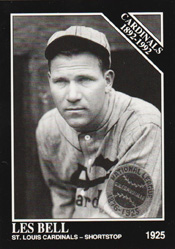
Rogers Hornsby brought out the best in the baseball talents of Les Bell, and soon after Hornsby departed the Cardinals, Bell did, too.

On March 20, 1928, the Cardinals and Braves swapped third basemen, with Bell going to the Braves for Andy High and cash.

The deal reunited Bell with Hornsby. They were Cardinals teammates from 1923 to 1926. When second baseman Hornsby became player-manager in May 1925, Bell blossomed, developing into a premier run producer. “His effect on Bell was almost instantaneous,” International News Service reported. “From a very commonplace third baseman, he became a ranking star in 1926.”

In 1926, when Hornsby led the Cardinals to their first National League pennant and a World Series title, Bell batted .325 with 33 doubles, 14 triples, 17 home runs and 100 RBI.

After Hornsby was traded by the Cardinals to the Giants in December 1926, Bell fell into a funk. Without his mentor, Bell slumped in 1927, batting .259 with nine home runs and 65 RBI for the Cardinals. He also made 24 errors at third base.

Let’s make a deal

After the 1927 season, the Cardinals demoted player-manager Bob O’Farrell, promoted a coach, Bill McKechnie, to replace him, and the Giants traded Hornsby to the Braves.

Determined to impress McKechnie, Bell reported a week early to the Cardinals’ 1928 spring training camp. Bell hit well but fielded poorly. “Ground balls were getting by him and going through his legs,” the St. Louis Post-Dispatch reported.

Meanwhile, Hornsby was urging the Braves to trade for Bell. Andy High was the Braves’ third baseman. Born in Ava, Ill., High grew up in St. Louis, where his father was an electrical engineer. High reached the major leagues with the Dodgers in 1922 and played for them until he was claimed on waivers by the Braves in 1925. He hit .302 with 46 RBI for the Braves in 1927 and committed 20 errors in 89 games at third base.

The Cardinals unsuccessfully tried to acquire third baseman Freddie Lindstrom from the Giants, the St. Louis Star-Times reported. They also asked the Phillies about Fresco Thompson, a second baseman whom the Cardinals intended to move to third, but that deal also failed to develop.

The Cardinals were talking with the Braves about a pair of infielders, Doc Farrell and Eddie Moore, and when the Braves offered High for Bell, Cardinals owner Sam Breadon approved the trade.

Effective platoon

Hornsby “was largely responsible for the deal,” United Press reported.

Hornsby told the Star-Times “the Braves consider Bell the greatest third baseman in the business.”

Said Bell: “I intend to … show the Cardinals why they made a mistake. Don’t think I won’t play great ball this summer.”

The Post-Dispatch reported the trade “came as a big surprise to the Cardinals players.” Braves manager Jack Slattery told the newspaper he didn’t think High could field well enough to be a starter.

Though he called High “a great hitter and a wonderful fielder,” McKechnie said Wattie Holm, a utility player, would be the Cardinals’ starter at third base and High would have a backup role.

“I can hardly believe McKechnie is going to give me a chance to be the regular third baseman,” Holm said. “I am going out to show Bill he has not made a mistake in giving me the job.”

Said High: “McKechnie is a wonderful man personally and a mighty shrewd manager. The Cards have a great club. I will try hard to get a regular job and it is my honest opinion that I can help the Cards win many ballgames.”

McKechnie ended up platooning Holm and High. Holm, a right-handed batter, made 82 starts at third base, hit .277 with 47 RBI and committed 22 errors. High, a left-handed batter, started 70 games at third base, hit .285 with 37 RBI and made 12 errors.

The 1928 Cardinals (95-59) won the pennant and finished 44.5 games ahead of the Braves (50-103). Bell batted .277 with 36 doubles and 91 RBI, but he and the hard-hitting Hornsby, who replaced Slattery as manager in May, couldn’t overcome a pitching staff that produced a 4.83 ERA.

Read Full Post »

« Newer Posts - Older Posts »