Feeds:
Posts
Comments

Archive for the ‘Hitters’ Category

Leo Durocher, combative shortstop of the Cardinals’ Gashouse Gang teams of the mid-1930s, fell out of favor with manager Frankie Frisch.
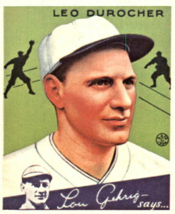
Their relationship deteriorated so badly Frisch issued an ultimatum to Cardinals executive Branch Rickey: Either Durocher goes or I go.

On Oct. 5, 1937, the Cardinals dealt Durocher to the Dodgers for third baseman Joe Stripp, second baseman Jim Bucher, outfielder Johnny Cooney and pitcher Roy Henshaw.

The trade, it turned out, created a career-boosting opportunity for Durocher. After a season as the Dodgers’ starting shortstop, he became their player-manager in 1939. Durocher went on to a successful, sometimes stormy, managerial career that earned him election to the National Baseball Hall of Fame.

Meanwhile, none of the players acquired by the Cardinals for Durocher contributed much. Frisch, who had been player-manager since 1933, was fired in September 1938 near the end of the Cardinals’ first losing season in six years.

Battle of wills

Durocher had come to the Cardinals from the Reds in a May 1933 trade. As their starting shortstop, Durocher helped the Cardinals to a World Series title in 1934. He led National League shortstops in fielding percentage in 1936.

Complaining of a kidney ailment and bad back, Durocher had a poor start to the 1937 season. After going hitless in a May 4 game at Boston against the Braves, Durocher’s batting average was at .132.

After the game, Durocher asked Frisch for permission to stay out of the hotel past the manager-mandated midnight curfew. The request upset Frisch, who accused Durocher, the team captain, of being focused more on fun than on performance.

The next day, May 5, Frisch benched Durocher and started Jimmy Brown at shortstop against the Braves.

After an off day on May 6, the Cardinals opened a series against the Giants at New York. Brown started at shortstop in the May 7 game.

When Frisch posted a lineup with Brown at shortstop again on May 8 against the Giants, Durocher declined to take batting or fielding practice at the Polo Grounds.

Durocher’s defiance was intolerable to Frisch.

“Nobody on my team _ even you _ can show such a lack of spirit,” Frisch said to Durocher.

When Durocher spoke up for himself, saying he had played earlier despite being ill and in pain, Frisch barked, “Get a train and go back to St. Louis. Get out of here.”

Durocher didn’t depart, but he didn’t get back into the starting lineup until May 12 against the Phillies at Philadelphia.

Big deal

Durocher, 32, played out the rest of the season as the Cardinals’ primary shortstop. He batted .203 in 135 games and grounded into a team-high 17 double plays.

In summarizing Durocher’s season, the St. Louis Star-Times wrote, “He was off stride at the very start, complained of illness and injuries, and was anything but the brilliant defensive player he had been. Durocher gained weight and was unable to handle the important shortstop position with his old-time finesse. Batted balls to his left and to his right became base hits.”

On Oct. 5, two days after the completion of the Cardinals’ season, Rickey was in New York to attend the World Series between the Giants and Yankees when he made the trade with the Dodgers.

Dick Farrington, in a column for The Sporting News, declared, “Leo Durocher’s passing from the Cards to the Dodgers was a case of ‘It’s Durocher or me’ with Frankie Frisch.”

A headline in The Sporting News blared, “Frisch Responsible For Durocher Going.”

The key players in the deal for the Cardinals were Stripp and Bucher. Stripp _ “Generally regarded as one of the best third sackers in the major leagues,” according to the Post-Dispatch _ long had been coveted by Frisch. Rickey liked Bucher, who had started his career in the Cardinals’ system before being drafted by the Dodgers.

“Bucher, alone, is a better ballplayer than Durocher,” Giants manager Bill Terry told International News Service in rating the deal a steal for St. Louis.

According to The Sporting News, “The first impulse of Brooklyn fans was heavily against the switch” because they thought four players were too high a price for Durocher.

However, Pie Traynor, Pirates manager, said, “The Dodgers got a great shortstop and they didn’t give up anybody who could help them.”

Dodgers benefit

The 1938 season was a failure for Frisch and the Cardinals.

Stripp squabbled with management over his contract and got a late start to the season. He batted .286 in 54 games but was sent to the Braves on Aug. 1.

Bucher, who spent most of the year in the minors, hit .228 in 17 Cardinals games.

Henshaw had a 5-11 record and 4.02 ERA for the Cardinals.

Cooney was released on the eve of the season opener.

On Sept. 11, with the Cardinals’ record at 63-72, Frisch was fired and replaced by a coach, Mike Gonzalez, for the rest of the season.

Durocher in 1938 led National League shortstops in fielding percentage and was named to the all-star team.

Previously: Rift with Branch Rickey led Cards to oust Frankie Frisch

Read Full Post »

(Updated Nov. 27, 2021)

Facing a collection of arms ranging from a 15-year-old making his big-league debut to a 36-year-old batting practice pitcher, the 1944 Cardinals became the first team in the majors to achieve two shutout wins by margins of 16 runs or more in the same month.

On June 10, 1944, the Cardinals beat the Reds, 18-0. Two weeks later, on June 24, the Cardinals beat the Pirates, 16-0.
Both of the lopsided June shutout victories by the 1944 Cardinals occurred on Saturday afternoons and in road games _ at Cincinnati and at Pittsburgh.

The Cardinals had a total of 43 hits _ one home run _ in the two games.

Stan Musial contributed seven hits in nine at-bats with four walks.

Mort Cooper pitched the shutouts: a five-hitter and a three-hitter.

Reaching base

The Cardinals’ game against the Reds took place at Crosley Field four days after the Allies launched the D-Day invasion in France. The game attracted 3,510 cash customers, 318 servicemen and 1,641 youths from the Knothole baseball program.

Though the Cardinals had 21 hits and received 14 walks, the game was completed in a relatively brisk 2:23.

Musial had three singles, three walks, three RBI and scored four times.

The Cardinals had 19 singles and two extra-base hits. Eighth-place batter George Fallon and leadoff man Johnny Hopp each doubled.

St. Louis stranded 18 base runners, tying a major-league record.

The 18-0 score was the most lopsided shutout win in the National League since 1906 when the Cubs beat the Giants, 19-0, the St. Louis Post-Dispatch reported.

Hey, Joe

With the Cardinals ahead, 13-0, Reds manager Bill McKechnie had Joe Nuxhall, 15, make his major-league debut in the ninth inning.

With their pitching staff depleted because of military service, the Reds had signed Nuxhall that year. His parents agreed to let him join the club for home games. Because he wasn’t old enough to drive, Nuxhall took a 30-minute bus ride from his home in Hamilton, Ohio, to Crosley Field for the games, according to the Washington Post.

Nuxhall, in the dugout while the Reds prepared to bat in their half of the eighth inning, heard McKechnie call out, “Joe!”

“I said to myself, ‘He can’t be talking to me,’ ” Nuxhall told Cincinnati TV station WCET in 2005. “We had a couple of Joes on the ball club. And he says ‘Joe!’ a little louder. I looked and he said, ‘Go warm up.’ ”

Nuxhall, wearing borrowed cleats, grabbed a glove and started up the dugout steps to head to the bullpen.

“I was scared to death,” Nuxhall recalled in a 1994 interview with the Associated Press. “I got all shook up and tripped over the top step and fell flat on my face in the dirt. It was embarrassing.”

After the Reds batted in the eighth, Nuxhall took the mound to pitch the ninth, becoming the youngest player to appear in a major-league game.

“I was kind of in awe of these guys, the way they were hitting line drives,” Nuxhall said of the Cardinals.

Cardinals shortstop Marty Marion told journalist Bob Fulton, “We didn’t know he was 15 years old. Didn’t hear it mentioned even.”

Wild thing

Nuxhall threw wildly but was managing his way through the inning. Of the first four batters he faced, Nuxhall walked two and retired two on infield outs.

Runners were on first and second when Musial stepped to the plate.

“Probably two weeks prior to that, I was pitching against seventh-, eighth- and ninth-graders, kids 13 and 14 years old,” Nuxhall said. “All of a sudden, I look up and there’s Stan Musial … It was a very scary situation.

“By that time, I was all over the place (with my pitches). It wasn’t two inches outside. It was high and inside, high and outside, bouncing pitches. When (Musial) walked up there, I guess he thought I was a needle threader. My first pitch, he just lined to right. Hit it hard.”

Musial’s single loaded the bases.

Unnerved, Nuxhall walked the next three batters, leading to three runs, and yielded a two-run single to Emil Verban.

McKechnie went to the mound _ “I believe he said, ‘Joe, that’s enough,’ ” Nuxhall recalled _ and took him out of the game after he yielded five runs in the inning. Boxscore

“What the cash customers saw in the ninth didn’t exactly meet with their hearty approval,” the Cincinnati Enquirer wrote of Nuxhall’s debut.

Said Nuxhall: “Those people that were at Crosley Field that afternoon probably said, ‘Well, that’s the last we’ll see of that kid.’ ”

After his debut, Nuxhall wouldn’t pitch in the big leagues again until 1952 at age 23. He went on to play 16 seasons in the majors, earning 135 wins, and later became a beloved broadcaster for the Reds.

Hit parade

Two weeks after their trouncing of the Reds, the Cardinals were at Forbes Field against the Pirates, and Ray Sanders led the attack with a single, double, home run and two walks. He drove in three and scored twice.

Musial had four hits _ three singles and a double _ and a walk. He scored twice and had a RBI.

The Cardinals used 22 hits and seven walks for their 16 runs. They stranded 14. The game was completed in a snappy 2:02 before 4,899 paying spectators. Cooper limited the Pirates to three singles.

Xavier Rescigno, who relieved Pirates starter Fritz Ostermueller with none out in the second, gave up 17 hits and 10 runs in seven innings.

With the score 15-0, “it finally reached such a stage that (Pirates) manager Frankie Frisch sent Joe Vitelli, his batting practice pitcher, to the mound to hurl the ninth,” the Post-Dispatch reported.

Vitelli, 36, yielded back-to-back doubles to pinch-hitter Pepper Martin, 40, and Sanders for the final run. Boxscore

Previously: How Giants beat John Tudor, Cardinals, 21-2

Read Full Post »

In a microcosm of their dismal 1997 season, the Cardinals used a record number of pinch-hitters in a game and none produced a hit.

On Sept. 25, 1997, the Cardinals tied a National League record with nine pinch-hitters in a game against the Reds at St. Louis.

Six of the St. Louis pinch-hitters made outs, two delivered sacrifices and one was hit by a pitch.

The Reds won, 4-3, in 14 innings. One of their pinch-hitters, Lenny Harris, singled and scored the winning run.

It was that kind of season for the 1997 Cardinals, who finished 73-89 and whose pinch-hitters had more strikeouts (67) than hits (49).

Making moves

The Cardinals, aiming to snap a five-game losing streak, trailed the Reds, 3-2, when manager Tony La Russa used his first pinch-hitter, Willie McGee, in the seventh. With a runner on first and none out, McGee, batting for Mike Difelice, flied out.

La Russa sent two more pinch-hitters to bat in the seventh. Tom Lampkin, batting for David Bell, grounded into a force out. Scott Livingstone batted for pitcher Rigo Beltran and flied out.

The Cardinals’ fourth pinch-hitter, Ron Gant, batted for Luis Ordaz in the eighth and struck out.

Rookie delivers

In the ninth, La Russa again used three pinch-hitters in an inning. This time, it produced a run.

With runners on first and third, one out, Lampkin was due to bat against left-hander Mike Remlinger. La Russa wanted a right-handed batter to face Remlinger in that situation. He sent Tom Pagnozzi to bat for Lampkin, a left-handed batter.

Reds manager Jack McKeon countered by replacing Remlinger with Stan Belinda, a right-hander.

Before Pagnozzi could see a pitch, La Russa removed him and put in John Mabry. A left-handed batter, Mabry hadn’t been in a game since breaking his jaw in mid-August.

Belinda drilled Mabry in the right knee with a pitch, loading the bases.

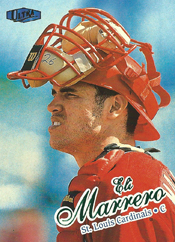
With pitcher Jose Bautista due to bat next, La Russa called on his seventh pinch-hitter of the game, Eli Marrero. A rookie, Marrero was making his first pinch-hit appearance in the big leagues.

Marrero drove a pitch from Belinda to the warning track in left, driving in the runner from third with the sacrifice fly and tying the score at 3-3.

Pitcher in a pinch

In the 11th, with two outs and none on, pitcher Lance Painter was scheduled to bat for the Cardinals. Painter had batted once in 1997 and struck out.

La Russa sent another pitcher, Todd Stottlemyre, to bat for Painter. It was the first and only pinch-hit appearance by Stottlemyre in a 14-year major-league career.

“My heart was racing,” Stottlemyre said to the St. Louis Post-Dispatch.

Stottlemyre, who hit .236 for the 1997 Cardinals, struck out.

Falling short

The Reds went ahead in the 14th. A single by Ed Taubensee against Mark Petkovsek scored Harris from second.

In the Cardinals’ half of the inning, McGee led off with a single against Gabe White. Batting for Petkovsek, the Cardinals’ ninth pinch-hitter, Jeff Berblinger, advanced McGee to second with a sacrifice bunt.

Marrero grounded out, with McGee holding second.

Down to the last out, Delino DeShields kept alive the Cardinals’ hopes with an infield single, moving McGee to third. DeShields, swiped second, giving the Cardinals two runners in scoring position.

The drama ended, though, when White struck out Royce Clayton. Boxscore

“We’ve been beaten too many times,” La Russa said. “Our confidence is not very good.”

Previously: Grant Dunlap: From Cardinals pinch-hitter to novelist

Read Full Post »

(Updated Sept. 8, 2022)

Looking to regain a role as a reliable run generator for the Cardinals, Todd Zeile took a step in the right direction with a key hit in an unusual game.

On Sept. 24, 1992, Zeile gave the Cardinals a walkoff 4-3 win over the Mets with a RBI-single in the 14th inning at St. Louis.
The game had been scoreless for 13 innings. All seven runs came in the 14th. The Mets scored three in the top of the inning and the Cardinals responded with four in their half.

Missed opportunities

Zeile, the Cardinals’ third baseman, was having a subpar 1992 season.

After producing 81 RBI and batting .304 with runners in scoring position in 1991, Zeile would finish with 48 RBI and bat .214 with runners in scoring position in 1992.

Entering the Cardinals’ game against the Mets, Zeile hadn’t driven in a run in more than a week.

Batting in the cleanup spot, Zeile stranded a runner in the first inning. In the 13th, he batted with runners at second and third, one out, and struck out.

“It was a weird game,” Zeile said to the St. Louis Post-Dispatch. “It seemed like it would never end.”

Action inning

In the 14th, Mets rookie Jeff Kent hit a three-run home run against Bryn Smith with two outs, giving New York a 3-0 lead.

Bernard Gilkey led off the bottom half of the inning with a single against Mark Dewey. Luis Alicea struck out and Rich Gedman singled, moving Gilkey to second.

With the pitcher due to bat next, Cardinals manager Joe Torre called on Felix Jose to pinch-hit. His single drove in Gilkey and made the score 3-1.

Mets manager Jeff Torborg lifted Dewey and brought in Wally Whitehurst. The first batter he faced, Chuck Carr, walked, loading the bases.

Ozzie Smith, 0-for-5 in the game, singled to center, driving in Gedman and Jose and tying the score at 3-3.

Another chance

Carr was on third and Smith on first, with Ray Lankford at the plate. With Carr representing the winning run, the Mets paid no attention to Smith. So he advanced to second uncontested.

With first base open, Whitehurst elected to issue an intentional walk to Lankford, loading the bases, and take his chances with Zeile.

“I was just happy to get another chance,” Zeile told the Post-Dispatch. “Real happy.”

Zeile lined a single to left, scoring Carr with the winning run. Boxscore

“I went from goat to hero,” Zeile said to the Associated Press. “That just goes to show how things can change in this game. I would have liked to have ended it an inning earlier.”

Regarding the Cardinals’ comeback, Torre said, “They don’t die. I love it.”

Zeile bounced back in 1993 and had a career-high 103 RBI for the Cardinals. He hit .270 with runners in scoring position, a mark more in line with his final career average of .267 in those situations.

Previously: The day Cardinals fired Joe Torre, traded Todd Zeile

Read Full Post »

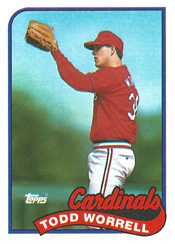
In the thick of a pennant race, Cardinals manager Whitey Herzog put pitcher Todd Worrell in right field in the ninth inning of a one-run game.

The move worked.

Ken Dayley, brought in to relieve Worrell and pitch to one batter, got an out. Worrell then returned to the mound and retired the last two batters, earning a save and preserving a Cardinals victory over the Phillies at St. Louis.

Herzog’s unorthodox maneuvering displayed the creativity and courage that helped make him a championship manager with the Cardinals. It also showed the confidence Herzog had in his players.

Mix and match

On Sept. 22, 1987, the Cardinals were looking to build their lead in the National League East Division with two weeks remaining in the regular season. Cardinals starter Danny Cox was matched against Shane Rawley of the Phillies.

With the Cardinals ahead, 3-1, Worrell relieved Cox with two outs, one on, in the eighth and retired Chris James on a force play.

In the ninth, Mike Schmidt led off with a home run against Worrell, getting the Phillies within a run at 3-2.

With Von Hayes, a left-handed batter with extra-base potential, up next, Herzog brought in Dayley, a left-handed pitcher, to face him.

Herzog wanted to keep Worrell in the game because Rick Schu, a right-handed batter, followed Hayes in the order. Herzog removed right fielder Lance Johnson and replaced him with Worrell.

Stand and watch

“I think Todd’s my best right fielder,” Herzog said to the St. Louis Post-Dispatch. “No kidding. He can play the … outfield.”

Said Cardinals second baseman Tommy Herr: “Todd is a good outfielder. He shags balls before the game and looks good. It’s not like he doesn’t have a clue out there.”

Still, Dayley didn’t want Hayes to pull a ball into right field. He threw pitches down and away. Hayes chased after those and struck out.

With that mission accomplished, Herzog lifted Dayley, put Worrell back to pitch and brought in outfielder John Morris off the bench to play right field.

“I didn’t get to use my blazing speed,” Worrell said of his uneventful stint in right.

Keep ’em guessing

It was the third time Herzog as Cardinals manager had sent a pitcher to the outfield, but the first time he brought that player back to the mound. In each of the other two times, the inning ended with the pitcher in the outfield.

“Just when you think you’ve seen it all, something else pops up,” Morris said.

When Dayley returned to the dugout, pitcher Bob Forsch asked him, “How does it feel to be replaced by the right fielder?”

Worrell got Schu to ground out for the second out of the inning. The next batter, Darren Daulton, lined out to shortstop Ozzie Smith.

The 3-2 victory gave the Cardinals four wins in a row and moved them 3.5 games ahead of the second-place Mets with 12 to play. Boxscore

Previously: Needing a strike for a save, Ken Dayley got hook instead

Read Full Post »

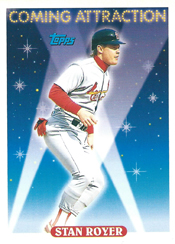
Rod Brewer and Stan Royer, corner infield prospects, each had his best performance in one of the Cardinals’ most productive games.

On Sept. 20, 1992, Brewer had five hits, a walk, four runs scored and a RBI, and Royer had four hits, a walk, four runs scored and four RBI, in the Cardinals’ 16-4 victory over the Cubs at Wrigley Field in Chicago.

Brewer, a first baseman, and Royer, a third baseman, combined for nine of the Cardinals’ 22 hits.

Rather than launch them into starting roles the next season, the performances represented the pinnacles of the short Cardinals careers of Brewer and Royer.

By July 1994, neither remained in the Cardinals’ organization.

Getting a look

Brewer and Royer came to the Cardinals by different paths. Brewer was taken by them in the fifth round of the 1987 amateur draft. Royer was one of three players acquired by the Cardinals in the August 1990 trade of Willie McGee to the Athletics.

In 1992, Brewer and Royer were standouts with Louisville, the Cardinals’ top farm club. Brewer, 26, batted .288 with 18 home runs and 86 RBI for Louisville. Royer, 25, hit .282 with 31 doubles and 77 RBI.

Both were called up to the Cardinals in September 1992 when rosters expanded. Manager Joe Torre started them in the Sunday afternoon series finale against the Cubs. Brewer played first base and batted fifth in the order. Royer played third base and batted sixth.

They would be facing Cubs starter Shawn Boskie, who had won his first three decisions and four of his first six before fading.

Head scratcher

Boskie faced seven Cardinals batters in the first inning without getting an out. He yielded six hits and a walk and was charged with six earned runs. Brewer and Royer each singled and scored in the inning. Royer’s hit drove in a run.

“My main problem is all in my head,” Boskie said to the Chicago Tribune. “That’s the last thing I want to admit _ that I’m a head case _ but if I was looking at it from the outside, that’s what I’d have to say.”

The Cardinals totaled 22 hits and five walks against five Cubs pitchers.

“The Cubs not only embarrassed themselves _ they humiliated everyone who paid to watch them wallow through perhaps their most wretched loss of the season,” wrote the Tribune.

Royer hit his first major-league home run, a two-run shot, in the sixth against Jeff Hartsock, who was making his second appearance in the big leagues. There to witness it was Royer’s father, Harold, who coached him at Charleston (Ill.) High School.

“I love this ball park,” Royer told the St. Louis Post-Dispatch. “It’s bricks and grass _ what a ball park should be.” Boxscore

Decisions, decisions

The breakout game for Brewer and Royer naturally raised questions about where they fit in the Cardinals’ plans for 1993.

“It was a good day,” said Torre, “but when you play 162 games you don’t get overly excited about one day. You’ve got to watch a number of at-bats and then make up your mind. That’s like a guy hitting two home runs on Opening Day and thinking he’s going to hit .320.”

Cardinals instructor George Kissell had called Royer “a Ken Boyer type” _ referring to the Cardinals’ standout third baseman of the 1950s and 1960s _ but Torre added, “Not that he has Boyer’s ability, obviously, but just the way he carries himself.”

The 1992 Cardinals had Andres Galarraga at first base and Todd Zeile at third base. Galarraga was an impending free agent, creating a potential opening at first in 1993, but Zeile was entrenched at third.

“It’s tough to see where he fits in,” Torre said of Royer, “but if you hit, they will find a place for you.”

Regarding the status of he and Brewer, Royer said, “If we both play well, something is going to happen. Somebody is going to want us. I would love to play for the Cardinals. I grew up watching them and St. Louis is close to my family (in Illinois), but I can’t say that if I had a chance to go somewhere else I wouldn’t be excited.”

Not in the Cards

Brewer and Royer both made the most of their opportunities with the 1992 Cardinals. Brewer hit .301 (31-for-103) in 29 games. Royer hit .323 (10-for-31) in 13 games.

Neither, though, won a starting job in 1993. After Galarraga departed for the Rockies, the Cardinals acquired Gregg Jefferies from the Royals to play first base. Zeile remained at third base.

Brewer spent 1993 as a Cardinals reserve. He hit .286 with two home runs and 20 RBI. After the season, he signed with a team in Japan.

Royer spent most of the 1993 season with Louisville. In 24 games for St. Louis, he hit .304 (14-for-46).

In 1994, Royer stuck with the Cardinals as a reserve, but hit .175 (10-for-57). He was released in July, picked up by the Red Sox and ended his big-league career with them that year.

Previously: Why Cardinals traded Willie McGee to Athletics

Read Full Post »

« Newer Posts - Older Posts »