Feeds:
Posts
Comments

Archive for the ‘Hitters’ Category

Jim Ray Hart had a prominent role in contributing to Bob Gibson’s worst start with the Cardinals, an outing so poor the pitcher was booed by the home crowd.

jim_hartHart, batting cleanup, had two key hits in the Giants’ 11-run first inning against the Cardinals on June 29, 1967, at St. Louis.

Nine of those runs, all earned, were charged to Gibson. Those are the most earned runs yielded in a game by Gibson in his Hall of Fame career.

The first eight batters Gibson faced reached base _ seven hits and a walk _ and the Giants led 7-0 before Gibson recorded an out. He was lifted before the Giants completed the inning.

In his book “Stranger to the Game,” Gibson called the outing “possibly the worst start of my life.”

In a Giants lineup that featured Willie Mays and Willie McCovey, no one did more damage that Thursday night than Hart, who drove in four runs in the opening inning with a single and a home run. Four years earlier, Hart suffered a fractured collarbone when hit by a Gibson fastball.

In 12 years (1963-74) with the Giants and Yankees, Hart, a third baseman and outfielder, batted .278 and produced 1,052 hits. He led the Giants in hits in each of three consecutive seasons (1965-67).

Stacking southpaws

The Giants began a four-game series with the first-place Cardinals on June 26, 1967, at St. Louis. The Cardinals won the opener, beating right-hander Gaylord Perry and dropping the fifth-place Giants 8.5 games behind the frontrunners.

The Giants, behind left-handed starters Mike McCormick and Ray Sadecki, won the second and third games. McCormick and Sadecki combined to limit the Cardinals to one run in 18 innings.

The series finale was scheduled to be a matchup of right-handed aces, Gibson for the Cardinals and Juan Marichal for the Giants. However, based on the performances of McCormick and Sadecki, Giants manager Herman Franks decided to start another left-hander against the Cardinals. Franks replaced Marichal with Joe Gibbon, a left-hander who had started and won against the Cardinals two weeks earlier, on June 17, at San Francisco. Gibbon had pitched in relief vs. the Cardinals on June 26 in the series opener at St. Louis.

All of the maneuverings were for naught. Gibson and Gibbon, similar in name, had similar results: Both were ineffective.

Opening salvo

The first two Giants batters, Jim Davenport and Tom Haller, each singled.

Willie Mays also singled, scoring Davenport and advancing Haller to second base.

Next up was Hart. He hit a line drive to left for a single, scoring Haller. Lou Brock, the left fielder, bobbled the ball, enabling Mays to score on the error and giving the Giants a 3-0 lead. Hart, credited with one RBI, reached second on the play.

With first base open, Gibson issued an intentional walk to Willie McCovey.

The next batter, Ollie Brown, singled, scoring Hart and putting the Giants ahead, 4-0. McCovey advanced to third.

Hal Lanier, the shortstop and son of former Cardinals pitcher Max Lanier, was up next. Lanier, batting .202, tripled, scoring McCovey and Brown and increasing the Giants’ lead to 6-0.

Unhappy fans

No. 8 batter Tito Fuentes singled, driving in Lanier and making the score 7-0.

Gibson struck out Gibbon and got Davenport to pop out to second.

When Gibson walked the next batter, Haller, Cardinals manager Red Schoendienst replaced him with Nelson Briles.

In the book “El Birdos,” author Doug Feldmann wrote that as Gibson departed “he was booed voraciously by the Busch Stadium crowd. Upon receiving the unfriendly goodbye from the home folks, Gibson tauntingly flung his cap in the air, which only increased the volume of the derision.”

Hammer from Hart

The first batter Briles faced was Mays, who singled, scoring Fuentes, advancing Haller to second and boosting the Giants’ lead to 8-0.

Hart, using a bat borrowed from Lanier, capped the outburst by hitting a three-run home run into the left-field bleachers, making the score 11-0.

The final line on Gibson: 0.2 innings, 9 runs, 7 hits, 2 walks.

Redbirds respond

Given a huge lead, Gibbon couldn’t taken advantage.

Brock led off the Cardinals’ half of the first with a triple. Julian Javier singled, scoring Brock. Curt Flood singled, moving Javier to third.

Orlando Cepeda delivered the Cardinals’ fourth consecutive hit, a single that scored Javier, moved Flood to third and made the score 11-2.

So much for using a left-hander.

Franks removed Gibbon, who failed to record an out, and replaced him with Bobby Bolin. The right-hander did the job. He got Mike Shannon to ground into a double play and Tim McCarver to fly out, ending the inning.

Bolin pitched nine innings of relief and got the win in a 12-4 Giants triumph. Boxscore

“So, a right-hander finally won one,” Giants pitching coach Larry Jansen said to the Oakland Tribune.

Beware of Bob

Gibson had entered the game with a 3.01 ERA and exited it with a 3.68 ERA.

“This, of course, put me in the mood to take it out on somebody and the opportunity quickly presented itself against the Reds,” Gibson said.

Facing the Reds in his next start, July 3, 1967, at St. Louis, Gibson struck out 12 in 7.2 innings, gave up three runs (two earned), took part in a brawl and got the win in a 7-3 Cardinals victory. Boxscore.


Read Full Post »

(Updated May 24, 2020)

Adam Wainwright turned a special at-bat into a special feat.

On May 24, 2006, Wainwright swung at the first pitch in his first major-league plate appearance and hit a home run for the Cardinals against the Giants at San Francisco.

adam_wainwright9Leading off the fifth inning, with the Giants ahead, 4-2, Wainwright hit a Noah Lowry pitch over the left field wall.

Wainwright, 24, had appeared in three games for the 2005 Cardinals and 14 games for the 2006 Cardinals before getting his first plate appearance. He hadn’t taken any batting practice since spring training.

Asked by the St. Louis Post-Dispatch what he was thinking once he realized he had hit a home run, Wainwright said, “I wasn’t thinking anything until I hit third (base). I was wandering around the bases, making sure I was going the right way. I hit third (base) and I said, ‘Oh, my goodness. I just hit a home run in my first at-bat.’ It was crazy.”

A win and a blast

Chris Carpenter had been scheduled to start for the Cardinals, but he developed bursitis under his right shoulder and was scratched.

Brad Thompson got the start and pitched two innings. After Tyler Johnson pitched the third inning, Wainwright relieved.

With the score tied at 2-2, Wainwright yielded two runs in the fourth.

Before Wainwright went to bat in the fifth, Cardinals manager Tony La Russa approached him.

“Tony told me to have a good at-bat, so I made sure I swung at the first pitch,” Wainwright told the San Jose Mercury News.

Lowry, a left-hander, threw a fastball. “One of the few fastballs Noah threw for strike one,” Giants manager Felipe Alou said to the Alameda Times-Star. Video of home run

After Wainwright pitched a scoreless fifth, the Cardinals scored twice in the sixth, taking a 5-4 lead. Wainwright held the Giants scoreless again in the sixth.

For his three innings of relief, Wainwright earned the win in the Cardinals’ 10-4 triumph. Boxscore

Wainwright was one of three Cardinals pitchers to get an extra-base hit in the game. Jason Marquis tripled and Braden Looper doubled. “They almost hit for the cycle, the pitchers,” Alou said to the San Francisco Examiner. “They surprised everybody.”

Sweet swings

Wainwright is one of 10 Cardinals to hit a home run in his first plate appearance in the major leagues.

The list:

_ Eddie Morgan, pinch-hitter, April 14, 1936, vs. Cubs.

_ Wally Moon, center fielder, April 13, 1954, vs. Cubs.

_ Keith McDonald, pinch-hitter, July 4, 2000, vs. Reds.

_ Chris Richard, left fielder, July 17, 2000, vs. Twins.

_ Gene Stechschulte, pinch-hitter, April 17, 2001, vs. Diamondbacks.

_ Hector Luna, second baseman, April 8, 2004, vs. Brewers.

_ Adam Wainwright, pitcher, May 24, 2006, vs. Giants.

_ Mark Worrell, pitcher, June 5, 2008, vs. Nationals.

_ Paul DeJong, pinch-hitter, May 28, 2017, vs. Rockies.

_ Lane Thomas, pinch-hitter, April 19, 2019, vs. Mets.


Read Full Post »

(Updated April 2, 2026)

Mired in a slump, Reggie Smith got into the right frame of mind and snapped out of his funk, hitting three home runs, including the winning shot, for the Cardinals in a game against the Phillies.

reggie_smith3Following the lead of teammate Ted Simmons, Smith practiced transcendental meditation for inner peace before the Cardinals played on May 22, 1976, at Veterans Stadium in Philadelphia.

“I had good meditation today,” Smith told The Sporting News.

Both sides now

Hampered by an ailing left shoulder, Smith entered the Saturday night game with a .168 batting mark and three homers for the season.

He connected with home runs in each of his last three at-bats.

A switch-hitter, Smith hit two of the home runs right-handed and one left-handed. It was the sixth time Smith hit a home run from each side of the plate in a game.

It also was the only time in his 17 years in the big leagues that Smith hit three home runs in a game. All three occurred with two outs.

Smith, 31, became the first Cardinals batter to hit three home runs in a game since Stan Musial, 41, did so on July 8, 1962, vs. the Mets.

“I’m sorry it took me so long to start hitting,” Smith said to the Bucks County (Pa.) Courier Times. “I haven’t been doing much to help the club.”

Smith, who had been moved from right field to first base to third base during the season, was approached before the game by manager Red Schoendienst, who may have helped put him in a proper state of mind.

“I called Reggie into my office and asked him if he was relaxed enough when he was being shifted from position to position,” Schoendienst said. “He told me that, if I had enough confidence in him, he’d play anywhere anytime. I told Reggie that we needed his power in the lineup.”

Smith usually hit well at Veterans Stadium. “The background here has a lot to do with it,” he told the Philadelphia Inquirer. “Most backgrounds around the league are green and tend to create fuzziness. Here it’s black and you see better.”

Going deep

In the fifth inning, with the Phillies ahead, 2-1, Smith, batting right-handed, hit a Jim Kaat slider to left for a three-run home run, giving the Cardinals a 4-2 lead.

With the Phillies ahead, 6-5, in the seventh, Smith, batting left-handed, hit a Ron Reed changeup to right for a solo homer.

In the ninth, with the bases empty and the score tied at 6-6, Smith, batting from the right side, hit a Tug McGraw fastball to center for his third homer, putting the Cardinals ahead. Smith told the St. Louis Post-Dispatch that McGraw “tried to run (the fastball) away from me … to set me up for his screwball.”

The Phillies nearly rallied in the bottom of the ninth. Smith, moved from first base to third, helped thwart them, making a diving catch of a Larry Bowa liner. “In a way, I’m more proud of the catch,” he told the Inquirer.

Cardinals coach Fred Koenig said to the Post-Dispatch of Smith’s catch, “It’s almost inhuman for a man to get that close to a ball after going that far for it.”

Later in the inning, the Phillies had runners on first and second with two outs when Garry Maddox, facing Al Hrabosky, ripped a line drive that appeared headed for extra bases before shortstop Don Kessinger made a diving catch, ending the game and preserving the 7-6 Cardinals triumph. Boxscore

Four weeks later, on June 15, 1976, with his batting average at .218 and his home run total at eight, the Cardinals traded Smith to the Dodgers for catcher Joe Ferguson and minor-leaguers Bob Detherage and Freddie Tisdale.


Read Full Post »

In 1961, Bob Gibson, Curt Flood and Bill White would leave Al Lang Field in St. Petersburg, Fla., after a Cardinals home spring training game, walk across the street and get into an orange station wagon that would take them to another part of town where they stayed in a boarding house. The rest of their Cardinals teammates went nearby to their spring training accommodations at the swank Vinoy Hotel along the waterfront.

adam_henig_bookSt. Petersburg was a segregated city and the Vinoy didn’t allow any blacks to stay at the hotel.

In his new book “Under One Roof,” author Adam Henig tells the story of how Dr. Ralph Wimbish, a physician, NAACP leader and civil rights activist, led a successful effort to end segregated housing during spring training in St. Petersburg.

The book is available in paperback and on Kindle at this Amazon link. It would make a unique and important addition to a Cardinals fan’s library.

Henig effectively balances the stories of Wimbish and the baseball teams, Cardinals and Yankees, that trained in St. Petersburg.

Reading the book is like taking a journey in a time machine. Henig gives the reader a deep sense of what it was like to be in St. Petersburg in 1961 and how segregation was so strongly in force.

Two examples:

_ When author Alex Haley arrived in St. Petersburg from New York to do a magazine story on Wimbish, Haley was directed at the airport to a black cab driver because white drivers weren’t permitted to accept black passengers.

_ Wimbish’s daughter, Barbara, recalled that one of the few integrated restaurants in St. Petersburg was a Jewish deli.

Henig also does an admirable job of describing the pain and humiliation felt by black ballplayers.

The author is a first-rate researcher and his writing is vivid.

This book will help every reader appreciate the courage of Bill White, who joined Wimbish in taking a stand again racism and injustice, and helping to bring the Cardinals under one roof in segregated St. Petersburg.


Read Full Post »

(Updated May 12, 2019)

In one of the most intriguing incidents in the long rivalry between the Cardinals and Dodgers, two of baseball’s most colorful characters, Leo Durocher and Casey Stengel, escalated a war of words into a post-game fight.

stengel_durocherThe animosity between the two was so strong Stengel brought a bat to the showdown.

Their tangle under the stands at Ebbets Field in Brooklyn occurred on May 12, 1936. Durocher was the Cardinals’ shortstop and Stengel was the Dodgers’ manager.

The Dodgers pummeled Dizzy Dean with 13 hits in eight innings and won, 5-2. Boxscore

Tempers flare

Throughout the game, Durocher, the Cardinals’ captain, and Stengel hollered at one another across the field.

“Stengel made the mistake of being personal,” the St. Louis Post-Dispatch reported. “He ought to have been in baseball long enough to think up something funny to say without casting reflections on a man’s ancestors.”

At some point during the bickering, Stengel told Durocher he’d see him after the game, The Sporting News reported.

According to the Post-Dispatch, the two had the following exchange on the field:

Durocher: “If you have nerve enough to say to my face what you’ve been saying under the protection of the ballgame, I’ll be surprised.”

Stengel: “I’ll be there _ and I’ll have a bat with me.”

Durocher: “You’ll probably need a bat.”

The Sporting News reported a different version. It said Durocher replied to Stengel, “You’d better have a bat with you.”

After the game, Durocher and Cardinals manager Frankie Frisch were in a runway that led from the dugout to the clubhouse under the stands when Stengel, holding a bat, confronted his nemesis.

In published accounts, Durocher and Stengel told different versions of what happened next.

Durocher’s version

According to the Post-Dispatch, Durocher went after Stengel and Stengel swung the bat. Durocher “took a glancing blow from the wooden weapon and then went to work on the disarmed Stengel,” the Post-Dispatch reported. “He landed a right to the mouth, cutting the Stengel lip and was swinging eagerly when dozens of pairs of arms seized him. He looked around and the runway was full of Dodgers players.”

The St. Louis Star-Times reported Durocher “took credit for landing a square right to Stengel’s mouth” and said Durocher admitted “Stengel struck him a glancing blow with the bat.”

“When we came out of the dugout under the stands, Stengel was waving the bat and shouting, ‘Don’t you come near me. I don’t want any trouble with you. I’ll hit you with this bat if you do,’ ” Durocher told the Star-Times. “I rushed in and in so doing got hit with the bat, right across the right ear, but I got in a few punches before what seemed like the entire Brooklyn ballclub landed on me.”

Frisch was knocked to the ground in the melee, the Star-Times reported.

Stengel’s version

According to the Brooklyn Daily Eagle, when Durocher made for Stengel in the runway, Stengel “dropped the bat and moved into close quarters, punching.”

Stengel said he hit Durocher with his fists.

“Stengel had his right hand behind Durocher’s head and was messing up the Durocher features with short, jolting left uppercuts,” according to the Daily Eagle.

“That fresh boob is lucky I didn’t knock out his few brains with that bat,” Stengel said, “but nothing like that was necessary. He can’t hit any harder with his fists than he can with a bat.”

Bruised egos

The Sporting News dubbed the incident, “Casey and His Bat.”

According to the Post-Dispatch, Durocher had a red mark “as big as a pencil” where the bat grazed the bridge of his nose. Stengel suffered a split lip.

The Daily Eagle reported Durocher “had bruised and slightly cut Casey’s mouth with a couple of long punches.”

National League president Ford Frick didn’t issue any fines because he said the fight occurred out of sight from the public, not on the field.

Hate to lose

After the season, the Dodgers fired Stengel. A year later, in October 1937, the Cardinals traded Durocher to the Dodgers. He became Dodgers manager in 1939.

Stengel eventually landed with the Yankees and won seven World Series titles and 10 American League pennants from 1949-60. Durocher won National League pennants with the Dodgers in 1941 and with the Giants in 1951 and 1954. His 1954 Giants brought him his lone World Series title as a manager. Cardinals owner Gussie Busch wanted to hire Durocher as manager in 1964 but changed his mind after the club won the World Series championship.

In 1951, in their only World Series matchup, Stengel’s Yankees won four of six games against Durocher’s Giants.

In his book “Nice Guys Finish Last,” Durocher said, “I would make the loser’s trip to the opposing dressing room to congratulate the other manager because that was the proper thing to do. But … I didn’t like it. You think I liked it when I had to go see Mr. Stengel and say, ‘Congratulations, Casey, you played great?’ I’d have liked to stick a knife in his chest and twist it inside him.”

Stengel and Durocher were elected to the National Baseball Hall of Fame for their achievements as managers.

Previously: Like Tony La Russa, ailing Casey Stengel left club


Read Full Post »

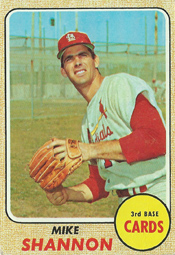
Mike Shannon and Jerry Buchek, the only St. Louis natives among the players on the 1966 Cardinals, had special roles in the first game played at Busch Memorial Stadium.

mike_shannon4On May 12, 1966, Shannon produced the first Cardinals hit and the first Cardinals RBI in the debut game at the $26 million circular stadium in downtown St. Louis. Buchek delivered a RBI-single that tied the score with two outs in the bottom of the ninth inning.

The Cardinals capped a successful evening when Lou Brock got a bases-loaded single in the 12th, giving the Cardinals a 4-3 victory over the Braves.

Sky high

A crowd of 46,048, a record for a sporting event in St. Louis at that time, turned out to see the Cardinals and their new home. Among those attending on that Thursday night were baseball commissioner William Eckert and National League president Warren Giles.

Each spectator was given a parchment “First Nighter” scroll as a souvenir. Many of the fans were dazzled by the scoreboard and its color graphics and animation. “No matter who hits a homer, the Anheuser-Busch eagle flaps its wings and a tiny, chirping redbird darts across one side of the board,” The Sporting News reported.

The seats were located farther from the field than those at the original Busch Stadium, formerly Sportsman’s Park, on North Grand Boulevard. The elevation of the upper deck was intimidating to some. “Fifteen more feet up and I’d be in heaven,” said former Cardinals manager Ray Blades.

Among the players, reviews of the stadium generally were favorable.

“This park is tailored to our type of club,” Cardinals outfielder Alex Johnson said to the Associated Press. “It’s a paradise for line drive hitters.”

Said Shannon: “There will be a lot of doubles and triples.”

Redbirds rally

Shannon had hoped his wife Judy and their four children would attend, but they couldn’t because they developed the mumps. “So Mike showed off his punch without Judy,” wrote Neal Russo of The Sporting News.

In the bottom of the first, Shannon singled against Braves starter Wade Blasingame for the first Cardinals hit. In the third, Shannon’s two-out triple off Blasingame scored Buchek from first with the first Cardinals run.

Braves leadoff batter Felipe Alou, playing on his 31st birthday, hit two solo home runs _ in the sixth off Ray Washburn and in the eighth against Tracy Stallard. The second home run gave the Braves a 3-2 lead.

In the bottom of the ninth, Alex Johnson was on third with two outs when Buchek batted against Billy O’Dell. With the count 2-and-2, Buchek swung at a pitch near his fists and looped a pop fly that fell into short right field for a single, scoring Johnson with the tying run.

As Buchek’s bloop fell safely between the Braves fielders, “a fast-retreating crowd set up a roar that would make the Metro-Goldwyn-Mayer lion sound like Mickey Mouse,” wrote St. Louis Post-Dispatch sports editor Bob Broeg.

Said Buchek: “It was a good pitch, in on me, and you’ve got to be lucky to hit the ball the way I did.”

Extra-inning drama

The Cardinals got a surprise in the 11th. Hal Woodeshick, a Cardinals relief pitcher, stroked a double off Phil Niekro. For Woodeshick, who had a career .092 batting average, it was his only extra-base hit in 11 big-league seasons. With two outs, Niekro issued an intentional walk to Julian Javier, then got Shannon to pop out to second, ending the inning.

In the 12th, the Braves threatened, putting runners on first and second, before Don Dennis escaped the jam by getting Alou to fly out to right.

The Cardinals took advantage of a Braves miscue in the bottom half of the 12th. Curt Flood led off and was hit by a Niekro pitch. Orlando Cepeda, the cleanup batter, bunted. Catcher Joe Torre fielded the ball and threw to second in a bid for a forceout. Instead, the ball sailed over the head of second baseman Frank Bolling. Flood advanced to third and Cepeda to second on the error.

After an intentional walk to Charlie Smith, filling the bases, Brock came to the plate against Niekro. With the infield drawn in for a play at the plate, Brock bounced a single up the middle, scoring Flood from third with the winning run. Boxscore

The next night, Shannon hit the first Cardinals home run at Busch Memorial Stadium. It was a solo shot off Braves starter Ken Johnson. Five days earlier, Shannon had hit the last Cardinals home run at the original Busch Stadium.

Previously: The story of the final game at original Busch Stadium

Previously: Here’s how Mike Shannon became a Cardinals catcher

Read Full Post »

« Newer Posts - Older Posts »