Feeds:
Posts
Comments

Archive for the ‘Hitters’ Category

(Updated Nov. 25, 2024)

Ron Hunt, best known for getting hit by pitches, made his biggest contribution to the Cardinals just by standing still at the plate and watching a ball zip into the catcher’s mitt.

On Sept. 5, 1974, the Cardinals acquired Hunt, a second baseman, after the Expos placed him on waivers. Born and raised in St. Louis, Hunt got to close out his playing career in his hometown with the 1974 Cardinals.

Adept at reaching base, Hunt was obtained to be a pinch-hitter who might ignite a spark for the Cardinals, contending for a division title.

Hunt did the job _ in eight plate appearances as a Cardinals pinch-hitter, he got on base five times (a .625 percentage), with two hits, two walks and one hit by pitch. Better yet, his patience at the plate enabled Lou Brock to break Maury Wills’ single-season stolen base record before the hometown fans.

Meet the Mets

Growing up in northeast St. Louis, Hunt considered himself a city kid before he moved with his mother and grandparents to nearby Overland. “My parents broke up when I was little,” Hunt said to Newsday. “My grandparents took care of me most of the time … They loved me so much they’d do anything for me.”

At Ritenour High School, Hunt was a third baseman and pitcher. He signed with the reigning National League champion Milwaukee Braves after graduating in June 1959. (Hunt’s favorite player, second baseman Red Schoendienst, helped the Braves win consecutive pennants in 1957-58.)

Assigned to play third base for the Class D team in McCook, Nebraska, Hunt, 18, was a teammate of pitchers Phil Niekro, 20, and Pat Jordan, 18. (Niekro went on to a Hall of Fame career and Jordan became a writer.)

Switched to second base in 1960, Hunt played three consecutive seasons in the minors for former Cardinals second baseman Jimmy Brown as his manager.

Late in the 1962 season, the Mets, on their way to losing 120 games, dispatched their coach, former Cardinals infielder and manager Solly Hemus, to scout prospects. After watching Hunt (.381 on-base percentage) play for Class AA Austin in the Texas League, Hemus recommended him to the Mets.

“I talked to Jimmy Brown about him,” Hemus told the New York Daily News. “He said he thought the kid could make the major leagues.”

In October 1962, the Mets purchased Hunt’s contract on a conditional basis. They had until May 9, one month after the start of the 1963 season, to decide whether to keep him or send him back to the Braves.

Gesundheit

Hunt appeared a longshot to make the leap from Class AA to the majors, but at 1963 spring training his rough and tumble style of play impressed manager Casey Stengel. “There’s a soft spot in the old man’s heart for his second baseman,” Newsday’s Joe Donnelly noted. “When he was a player, there must have been a bit of Ron Hunt in him.”

The 1963 Mets lost their first eight games before beating the Braves on Hunt’s two-run double in the ninth. Boxscore

Club owner Joan Payson showed her gratitude by sending a bouquet of roses to Hunt’s wife, Jackie, a gesture that prompted Hunt to run for a box of Kleenex.

“Ron is allergic to flowers,” Jackie told the St. Louis Post-Dispatch.

When he was a teen, “I went to an allergist,” Hunt said to the Los Angeles Times. “I found out I was allergic to just about everything.”

Hunt had asthma and, in addition to flowers, was allergic to two of the constant companions of an infielder _ grass and dust.

As St. Louis journalist Bob Broeg noted, Hunt “spends more time in the dirt than a grubworm.” Mets broadcaster Lindsey Nelson told Broeg, “My favorite recollection is of Ron sliding into second in a cloud of dust, coming up sneezing and borrowing umpire Augie Donatelli’s handkerchief to blow his nose.”

Hunt’s asthma and allergies required special attention. Mets trainer Gus Mauch kept under refrigeration a vial of medicine supplied by Hunt’s physician and administered the shots, the New York Daily News reported.

Neither his health issues nor the challenges of the big leagues deterred him. Hunt played with the same hustle, toughness and aggressiveness of another 1963 National League rookie second baseman, Pete Rose.

Bob Broeg described Hunt as “a back alley ballplayer.” Newsday’s George Vecsey observed that Hunt “slid hard with his spikes high and applied liberal dosages of knees to any runner who tried the same thing with him.”

“If anybody wants to get tough, I can get tougher than anybody else,” Hunt said to the Montreal Gazette.

On Aug. 6, 1963, the Cardinals’ Tim McCarver slid high and hard into Hunt at second base. McCarver’s spikes dug deep into Hunt’s thigh, causing two wounds. Hunt, hobbling, stayed in the game. Boxscore

Hunt led the 1963 Mets in total bases (211), hits (145), runs (64), doubles (28), batting average (.272) and most times hit by a pitch (13). He finished second to Rose in balloting for the National League Rookie of the Year Award.

Hit and run

In 1964, Hunt became the first Met to make the starting lineup for an All-Star Game. In voting by players, managers and coaches, Hunt was named the National League second baseman. He singled against Dean Chance in the game at New York’s Shea Stadium. Boxscore

(Hunt played in one other All-Star Game, in 1966 at St. Louis. His sacrifice bunt in the 10th inning moved Tim McCarver into position to score the winning run. Boxscore)

Hunt was sidelined for a chunk of the 1965 season because of a play involving the Cardinals’ Phil Gagliano. On May 11, with the bases loaded and one out, Lou Brock hit a slow grounder. Just as Hunt crouched for the ball, Gagliano, trying to advance from first to second, barreled into him. As Dick Young wrote in the lede to his story in the New York Daily News, “Ron Hunt was run over by an Italian sports car named Phil Gagliano.”

The impact separated Hunt’s left shoulder. He underwent an operation in which two metal pins were placed in the shoulder and was sidelined until August. Boxscore

In November 1966, Mets executive Bing Devine traded Hunt and Jim Hickman to the Dodgers for two-time National League batting champion Tommy Davis and Derrell Griffith. Hunt spent one season with the Dodgers, then went to the Giants (1968-70) and Expos (1971-74).

Black and blue

It was when he got to the Giants that Hunt began getting hit by pitches at an accelerated rate. He was the National League leader in most times getting plunked for seven consecutive seasons (1968-74).

Los Angeles Times columnist Jim Murray wrote, “Most batters dream of a pitcher they can hit. Hunt dreams of a pitcher who can hit him.”

Choking the bat up to the label, Hunt “couldn’t reach the ball unless two-thirds of his body was in the strike zone,” Jim Murray noted. Hunt told him, “I don’t stand close to the plate. I sit right on it.”

Hunt’s most remarkable seasons were with the Expos in 1971 (.402 on-base percentage, 145 hits, 58 walks, 50 hit by pitches) and 1973 (.418 on-base percentage, 124 hits, 52 walks, 24 hit by pitches).

On Sept. 29, 1971, when Hunt was plunked for the 50th time that season, the pitcher was the Cubs’ Milt Pappas, who told the Montreal Gazette, “He not only didn’t try to get out of the way, he actually leaned into the ball.” Pappas’ teammate, Ken Holtzman, said to the newspaper, “The pitch was a strike.” Boxscore

Hughie Jennings of the 1896 Baltimore Orioles holds the single-season record for most times hit by a pitch, with 51. Jim Murray wrote, “Hunt himself seems to go back to 1896. Crewcut, leather-faced, tobacco-chewing, his slight scarecrow appearance makes him look like something sitting with a squirrel gun and pointed black hat in front of an Ozark cabin.”

The pitcher who hit Hunt the most times with pitches was Bob Gibson (six). Tom Seaver and Nolan Ryan each plunked Hunt five times. In 1969, a Seaver fastball conked Hunt on the back of the batting helmet, knocking him out. The ball bounced high off his helmet and Seaver caught it near first base, according to the San Francisco Examiner. Taken off in a stretcher, Hunt was back in the lineup three days later. Boxscore

(As for Gibson, in a 2018 interview with Joe Schuster of Cardinals Yearbook, Hunt recalled, “When I was traded to the Cardinals, one day I was pitching batting practice to the pitchers and I must have thrown at Gibson 10 times, but as much as I tried, I couldn’t hit him once since he was jumping all over the place.”)

Helping hand

After the Cardinals acquired Hunt, their manager, Red Schoendienst, said to the Post-Dispatch, “He can help you win.”

Soon after, the Cardinals’ second baseman, Ted Sizemore, got injured when his spikes caught in a seam of the artificial turf while chasing a grounder. Hunt replaced him in the starting lineup.

Sizemore batted in the No. 2 spot, behind Lou Brock, and his patience in taking pitches enabled Brock to get a lot of stolen base attempts.

On Sept. 10, 1974, against the Phillies at St. Louis, Hunt, batting second, was at the plate when Brock stole two bases. The first was his 104th of the season, tying Maury Wills’ major-league mark. The second broke the record. Boxscore

Hunt, 34, went to spring training with the 1975 Cardinals, looking to earn a utility job. In the batting cage against the Iron Mike pitching machine, he got struck by pitches six times. Hunt “actually practiced getting hit by pitches,” Ira Berkow of the New York Times reported.

He didn’t do enough to get base hits, though, batting .194 in 12 spring training games, and was cut from the roster before the season began.

In 12 big-league seasons, Hunt had 1,429 hits, got plunked 243 times (Hughie Jennings is the leader with 287) and produced a .368 on-base percentage.

From his ranch in Wentzville, Mo., Hunt started a baseball program for youths ages 15 through 18. More than 100 of his players received college scholarships.
Read Full Post »

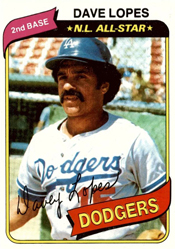
Imagine accomplishing a rare feat and doing it in the presence of the master of the craft. Davey Lopes knew the feeling.

On Aug. 24, 1974, Lopes had five stolen bases for the Dodgers against the Cardinals. Watching him perform was the National League’s all-time best base stealer, the Cardinals’ Lou Brock.
Lopes became the first National League player to swipe five bases in a game since Dan McGann did it for the Giants against Brooklyn on May 27, 1904. Boxscore

Though he holds the record for most career stolen bases (938) in the National League, Brock never swiped five in a game. Neither did other prominent base stealers such as Ty Cobb, Tim Raines, Vince Coleman, Max Carey, Honus Wagner and Maury Wills.

Lopes remains the only player with five steals in a game versus the Cardinals.

Tough part of town

Lopes was born and raised in East Providence, Rhode Island, a town of Irish, Portuguese and Cape Verdean immigrants who came looking for jobs in the factories and along the waterfront.

One of 12 children, Lopes was a toddler when his father died, according to the Los Angeles Times. A stepfather abandoned the family. Lopes’ mother, Mary Rose, worked as a domestic when she could.

Residing in a tenement, Lopes described the neighborhood to Times columnist Jim Murray as “roaches, rats, poor living conditions, drugs as prevalent as candy.”

“If it hadn’t been for sports, there’s no telling what I’d be or where I’d be,” Lopes said to the Times in 1973. “All I had to do is step off the porch to a choice of all the things you associate with a ghetto … It’s an easy step off the porch.”

Before he learned to steal bases in ball games, Lopes said he resorted to shoplifting. “I never stole anything major, just clothes and baseballs and bats,” he told Jim Murray.

Lopes also said to the Times, “When you don’t have money and can’t have what the other kids have, you get it any way you can. You live on the street. You steal.”

Though, as Jim Murray put it, “even by Rhode Island standards, Davey was little,” he excelled in high school baseball and basketball. Among those who admired Lopes’ play was an opposing coach, Mike Sarkesian. A son of an Armenian immigrant who worked in steel foundries, Sarkesian grew up in a Providence tenement house, but went on to graduate from the University of Rhode Island with dual degrees in biology and physical education.

In the same year Lopes graduated from high school, Sarkesian was named head basketball coach and athletic director at Iowa Wesleyan College. He recruited Lopes, offering him a college education and providing an escape from East Providence. After two years at Iowa Wesleyan, Sarkesian became athletic director at Washburn University in Topeka, Kansas. Lopes went with him, arriving shortly after a tornado left the campus in shambles.

An outfielder, Lopes did so well in baseball that he got selected by the Giants in the eighth round of the 1967 amateur draft but opted to stay in college. The Dodgers drafted him in the second round in 1968 and Lopes signed for $10,000. He gave most of the money to his mother, according to the Times.

Though he played in the minors in the summers of 1968 and 1969, Lopes skipped spring training both years so that he could complete his studies at Washburn. He graduated in 1969 with a degree in elementary education and taught sixth grade one winter.

(Lopes also got married in July 1968 but continued to contribute to the education of brothers and sisters still in school. “I try and send home as much as I can, even when it hurts my own wallet,” he told the Times in 1973.)

On the run

Lopes wanted to be a center fielder, but Tommy Lasorda, who managed him for three seasons (1970-72) in the minors, suggested his best path to the big leagues was as an infielder. Lopes learned to play second base. He was 5-foot-9 and tough. “A Billy Martin with more talent and speed,” noted San Francisco Examiner columnist Art Spander.

Leigh Montville of the Boston Globe described Lopes as “a dirty uniform ballplayer” whose “game is motion, as much motion as he can create.”

After hitting .317 with 48 stolen bases for Lasorda with Albuquerque in 1972, Lopes, 27, was called up to the Dodgers that September. The next year, he replaced Lee Lacy as the Dodgers’ second baseman and took off running, igniting the offense from the leadoff spot.

“He sets our mood,” Dodgers manager Walter Alston said to the Los Angeles Times. “I will give him a red light in certain situations, but otherwise he can run whenever he wants.”

Lopes told the newspaper, “The steals are something to talk about, but when they turn into runs, that’s what is important.”

Right conditions

The Dodgers became National League champions in 1974. Lopes’ special blend of speed and power were highlighted that August. He had four stolen bases against the Astros on Aug. 4, becoming the first Dodger since Maury Wills in 1962 to swipe that many in a game. On Aug. 20, Lopes clouted three home runs and totaled five hits versus the Cubs at Wrigley Field. Boxscore and Boxscore

Four nights later, he had his five-steal game against the Cardinals’ battery of pitcher John Curtis and catcher Ted Simmons. The Dodgers totaled a club-record eight steals in the game and won, 3-0, with Don Sutton pitching the shutout.

Lopes, who reached base on three hits, a walk and an error, swiped second three times and third twice. He also was thrown out twice by Simmons _ at third with Curtis pitching and at second with Al Hrabosky on the mound.

“All five steals were my fault,” Curtis told the St. Louis Post-Dispatch. “I was having trouble getting the ball over the plate.”

Curtis’ teammate, Lou Brock, said to the Los Angeles Times, “His delivery is systematic and easy (for a runner) to pick up.”

Brock also told the newspaper it was a myth that left-handers, such as Curtis, were more difficult to steal against. “Even though he’s looking right at you, you’re looking right at him, too,” Brock noted. “You can pick up so many keys to run from because they’re all there in front of you. Against a right-hander, all you see is his back and rear end. He can hide his motion better.”

Elite stealers

Brock also had a stolen base, his 88th of the season, in the game, and was headed for 118, breaking Wills’ record of 104.

In remarks to the Los Angeles Herald-Examiner, Lopes, 29, said of Brock, 35, “The first thing about him that amazes you is how he can steal all those bases at his age. The next thing is his ability to steal with the short lead he takes. Runners such as Joe Morgan, Cesar Cedeno, Bobby Bonds and myself take leads of at least seven to eight feet. Without that, we’d never get to second on time. Brock takes only five feet, mainly because of the speed he’s able to generate in a hurry.

“He picks up all those steals while only rarely attempting to take third. The other team knows he’s going to try for second. They get ready for him, but they seldom get him.”

Regarding Lopes’ five steals versus the Cardinals, Brock said to the Los Angeles Times, “So many conditions have to be exactly right. First, it has to be something a player wants very badly. He also has to defy a lot of things such as the unwritten rule that says you shouldn’t try to steal third with two outs … Also, it’s unusual for somebody to get that many opportunities _ that is, the number of pitches to the man batting behind him (Bill Russell).” Boxscore

The record for most steals in a game by one player is seven. George Gore did it for the Cubs in 1881 and Billy Hamilton matched the feat for the Phillies in 1894.

Those with six steals in a game: Eddie Collins for the Athletics twice in 1912, Otis Nixon of the 1991 Braves, Eric Young of the 1996 Rockies and Carl Crawford of the 2009 Rays.

Rickey Henderson, career leader in steals (1,406), had five in a game for the 1989 Athletics. The only Cardinals player with five steals in a game is Lonnie Smith, who did it Sept. 4, 1982, versus the Giants. Boxscore

Decades of service

Lopes finished the 1974 season with 59 steals. The next year, he swiped 38 in a row from June to August and led the league (with 77), ending Brock’s reign of four consecutive years. Lopes was the league leader again in 1976 (with 63 steals).

One of his best seasons was 1979 when he was successful on 44 of 48 steal attempts (his 91.67 percent success rate led the league) and slugged 28 home runs. His 28th homer was a walk-off grand slam against the Cubs’ Bruce Sutter. Boxscore

Lopes also was the league leader in stolen base percentage in 1985, swiping 47 in 51 tries (92.1 percent). For his career, he had a stolen base percentage of 83 percent, better than that of Henderson (80.7), Brock (75.3) and Wills (73.8).

In four World Series with the Dodgers, Lopes had 10 stolen bases in 12 tries.

His 16 years in the majors were with the Dodgers (1972-81), Athletics (1982-84), Cubs (1984-86) and Astros (1986-87), totaling 1,671 hits and 557 steals.

Lopes also managed the Brewers (2000-02) and coached for 27 years with the Rangers (1988-91), Orioles (1992-94), Padres (1995-99 and 2003-05), Nationals (2006 and 2016-17), Phillies (2007-10) and Dodgers (2011-15).

Read Full Post »

In a game in which both catchers were perfect at bat, Ernie Lombardi won it for the Reds with his mitt.

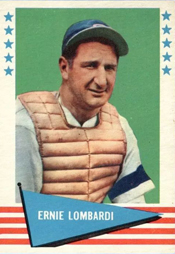
On July 6, 1934, the Reds edged the Cardinals, 16-15, at St. Louis. Lombardi, the Reds catcher and future Hall of Famer who was nicknamed “Schnozz” because of his big nose, produced five hits in five trips to the plate. Cardinals catcher Spud Davis, a career .308 hitter, was 4-for-4 with two walks.

The game ended when Lombardi tagged out Leo Durocher at the plate.

Theatre of the absurd

Played on a Friday afternoon, a paid gathering of 1,100 came to Sportsman’s Park to see the last-place Reds (22-46) and second-place Cardinals (41-28).

The home team gave what the St. Louis Star-Times described as a “burlesque performance,” committing three errors, stranding 12 runners and allowing the Reds to score in six of the first seven innings.

Of the seven pitchers used by the Cardinals, three were future Hall of Famers (Jesse Haines, Dizzy Dean and Dazzy Vance), but the only one who didn’t give up a run was Tex Carleton, who worked the ninth.

The Reds led 8-0 in the second and 15-8 in the sixth, but their pitchers were as ineffective as those on the Cardinals.

More to come

Ahead by five, the Reds scored the decisive run in the seventh when Lombardi drove in ex-Cardinal Chick Hafey from second with a two-out single, extending the lead to 16-10.

However, an error by Lombardi in the bottom half of the inning gave the Cardinals a chance to create some drama.

The first batter, Jack Rothrock, hit a pop fly near the plate in fair territory. Lombardi called for it, but dropped the ball, and Rothrock was safe at first. Frankie Frisch flied out and Joe Medwick, on what should have been the third out, fanned.

Rip Collins then drove a pitch onto the pavilion roof in right for a two-run home run, getting the Cardinals within four, at 16-12.

The Cardinals scored again in the eighth, making it 16-13.

In the ninth, Tex Carleton “showed his pals how real baseball should be pitched,” the Star-Times noted, and retired the Reds in order.

Fantastic finish

In the home half of the ninth, the Cardinals had runners on first and second, two outs, when their eighth-place batter, Leo Durocher, came to the plate against Si Johnson, who was on his way to a 22-loss season with the Reds.

Durocher hit a pop-up in foul ground, but “got a break when a boy in a grandstand box prevented Lombardi from reaching over for a catch,” the St. Louis Post-Dispatch reported.

Given a second chance, Durocher drilled a double to right, driving in both runners and making the score 16-15.

Next up was the pitcher, Carleton.

Cardinals player-manager Frankie Frisch had used 20 of his 22 players, including five as pinch-hitters. Only pitchers Paul Dean and Bill Hallahan hadn’t appeared in the game. Deeming neither a better option than Carleton, Frisch let Tex bat.

(Carleton produced 100 hits in the majors, including 17 in 1934.)

Carleton hit a sharp grounder to the right of shortstop Mark Koenig, who fielded the ball, but his low throw to first wasn’t in time to nail the runner.

When Durocher, who rounded third, saw first baseman Jimmy Shevlin fumble the ball, he dashed for the plate, hoping to score the tying run.

According to the Star-Times, “Shevlin quickly recovered the ball but his throw home was bad. Lombardi reached out, pulled in the ball and wheeled around just as Durocher tried to slide under him. Umpire Bill Klem whipped off his mask and cap and shouted, ‘You’re out!’ “

Believing he was safe, an angry Durocher “wanted to throw a fistful of dirt” at Klem, “but resisted the impulse,” the Post-Dispatch reported. Boxscore


Read Full Post »

The Cardinals took out an insurance policy on their shortstop position and it turned out the timing was fortuitous.

On July 1, 1984, the Cardinals and Expos swapped utility infielders, with Chris Speier coming to St. Louis for Mike Ramsey.
Though Ramsey, 30, had been a valuable backup for the World Series champion Cardinals in 1982, manager Whitey Herzog preferred a reserve with extra-base potential at the plate. Speier, 34, was better at that than Ramsey.

With Gold Glove Award winner Ozzie Smith at shortstop, Speier’s role figured to be mostly as a pinch-hitter who filled in at third for Andy Van Slyke against some left-handers and gave Smith an occasional breather.

The plan changed when Smith got hit on the wrist by a pitch and went on the disabled list for a month. All of the sudden, Speier was the Cardinals’ shortstop.

His stint as the emergency replacement started off with a bang.

Full steam ahead

Speier was from Alameda, just across the bay from San Francisco, but was playing for a semipro team in Stratford, Ontario (where his college pitching coach had gone), when Giants scout Herman Hannah discovered him. On Hannah’s recommendation, the Giants drafted Speier, 19, in January 1970.

After one season at the Class AA level of the minors, Speier, 20, went to the Giants’ 1971 spring training camp as a non-roster player and won the shortstop job from incumbent Hal Lanier. “Here, I took his job, and he ends up being my roommate on the road, and helping me learn pitchers,” Speier said to the San Francisco Examiner.

The 1971 Giants were 18-5 in April and Speier was a key contributor, batting .319 for the month, with 30 hits and 11 walks in 22 games. “He’s been the difference in our club,” Giants manager Charlie Fox said to the Associated Press.

Though a rookie making the leap from Class AA to the majors, Speier boldly stepped into a lineup featuring Willie Mays, Willie McCovey and Bobby Bonds.

“He didn’t so much play baseball then as attack it,” Dwight Chapin of the Examiner observed, “and he had a similar approach to life. He may have led the league in hell-raising. He’d yell at teammates, umpires, anybody in sight. He threw so many batting helmets that people lost count.”

That temperament carried over to his activities off the field. “I was single, brash and very immature,” Speier recalled to the Examiner. “I partied and caroused all the time. I guess I was trying to experience everything all at once.”

(Speier got married in October 1972 and that’s “what turned me around,” he told the Examiner. As Dwight Chapin put it, Speier’s wife became “an engineer to halt the runaway train.”)

The 1971 Giants were division champions. In the National League Championship Series, Speier hit .357, scored four runs and made just one error in 34 innings, but the Pirates prevailed and went to the World Series.

Named to the National League all-star team three years in a row (1972-74), Speier was a San Francisco treat, but in 1977 he and general manager Spec Richardson came to an impasse on contract negotiations. Eligible for free agency after the season, Speier wanted a five-year contract.

On April 27, 1977, Speier was sent to the Expos for shortstop Tim Foli. The Expos’ general manager was Speier’s first manager with the Giants, Charlie Fox. He gave the shortstop the five-year contract he wanted.

Canadian convert

While with the Expos, Speier, his wife and children became year-round residents of Canada, moving to the town of Sainte-Adele, 40 miles north of Montreal. They bought “a house built in the 1930s as a replica of a 17th-century Quebec farmhouse, with big casement windows, brick fireplaces and lots of charm,” the Montreal Gazette reported.

Speier’s wife and children learned to speak French. To show its gratitude for him becoming a year-round resident, the town presented Speier with a woodcut of him in uniform, the Gazette reported.

For six seasons (1977-82), Speier was the Expos’ everyday shortstop. He became the second Expo to hit for the cycle (in 1978 against the Braves) and the first to total eight RBI in a game (in 1982 versus the Phillies.) Boxscore and Boxscore

On June 14, 1982, Speier successfully worked the hidden ball trick on Ozzie Smith. After Willie McGee flied out, center fielder Andre Dawson threw to Speier, who returned to his shortstop position while still in possession of the ball. Pitcher Bill Gullickson instinctively knew what to do. He got set on the mound as Ken Oberkfell stepped to the plate. When Smith took a lead off second, “Speier swooped down” and tagged him for the third out, the St. Louis Post-Dispatch reported. Boxscore

“I bet I haven’t seen that play in 20 years,” Cardinals manager Whitey Herzog said to the Post-Dispatch.

Speier told the newspaper it was the first time he’d tried the play. Expos manager Jim Fanning added, “It was nothing that came from the bench. It was never plotted or rehearsed … Speier is capable of pulling that off on his own.”

In 1983, Bill Virdon became Expos manager and clashed with Speier, who called it a “personality conflict,” according to the Gazette. Speier gradually was phased out of the starting shortstop role in 1983. The next year, much to Speier’s chagrin, Virdon told him he’d be a utility player.

Speier asked to be traded and, when the Expos sent him to St. Louis, he told the Gazette, “I’m out of prison. They buried me here.”

Big blast

Speier knew at least one member of the 1984 Cardinals _ coach Hal Lanier, who lost the Giants’ shortstop job to him 13 years earlier.

Speier’s first two appearances for the Cardinals were starts at third.

Then, on July 13, 1984, in the second inning of a game against the Padres at St. Louis, an Ed Whitson pitch struck Ozzie Smith on the right wrist and fractured a bone. Smith was replaced by Speier.

In the 10th, with two on, two outs and the score tied at 4-4, Speier got a hanging slider from Luis DeLeon, a former Cardinal, and slammed it into the seats near the left field foul pole for a walkoff three-run home run. Boxscore

Speier hit just two walkoff home runs in the majors. The other was in August 1975 for the Giants against the Astros’ J.R. Richard.

Replacement player

With Smith sidelined, Speier became the starting shortstop and the Cardinals called up rookie Terry Pendleton to take over at third.

“I think I’m a capable shortstop,” Speier told the Post-Dispatch. “I think I can do an adequate job, but Ozzie … is on a plateau all by himself.”

Speier made 33 starts at shortstop for the Cardinals, committing three errors in 287.2 innings. Though he batted .178, 11 of his 21 hits were for extra bases _ seven doubles, one triple, three home runs.

(Mike Ramsey hit a total of two home runs in six years with the Cardinals.)

On Aug. 17, 1984, Speier had a RBI-double and home run against Pascual Perez in the Cardinals’ 3-1 victory over the Braves. Boxscore

Two days later, with Smith ready to return, Speier was traded to the Twins for cash and a player to be named (minor-league pitcher Jay Pettibone).

“Chris played well for us,” Herzog told The Sporting News, but he noted that with Smith back and Pendleton at third, Speier would mostly sit if he stayed with the Cardinals. Trading him to the Twins gave him a chance to play before becoming a free agent after the season.

Helping hand

Speier spent two seasons (1985-86) as a utility player with the Cubs. One of his highlights for them came on June 6, 1986, when he slugged two home runs in a 9-3 Cubs win at St. Louis Boxscore

Don Zimmer, a coach with the Cubs when Speier was there, became a Giants coach in 1987 and recommended Speier, a free agent, to general manager Al Rosen. The Giants signed him and it became a happy homecoming.

Speier, 36, was a reliable role player for the 1987 Giants, filling in when injuries sidelined their second baseman and third baseman. Speier made 35 starts at third, 33 at second and seven at shortstop. He batted .400 as a pinch-hitter. On May 5, 1987, Speier’s grand slam against reliever Ray Soff carried the Giants to a 10-6 victory at St. Louis. Boxscore

“Chris Speier is the most valuable player on this ballclub,” Giants manager Roger Craig told the Associated Press in August 1987.

The Giants in 1987 won a division title for the first time since Speier’s rookie season in 1971. In the National League Championship Series against the Cardinals, Speier was hitless in five at-bats and the Cardinals prevailed.

In 1988, Speier hit for the cycle in a 21-2 Giants rout of the Cardinals and scored four runs in a game for the only time in his career. Boxscore

His last season as a player was 1989, when the Giants won the pennant and went to the World Series, but a bad back kept him off the playoff roster.

Speier went on to coach for 13 seasons in the majors with the Brewers (2000), Diamondbacks (2001), Athletics (2004), Cubs (2005-06), Reds (2008-13) and Nationals (2016-17).

Read Full Post »

Gee Walker took a nap in St. Louis. Problem is, he did it on the base paths.

On June 30, 1934, Walker was picked off base twice in the same inning while sleep-walking for the Tigers against the Browns at Sportsman’s Park.

His blunders ruined a potential Tigers scoring threat, opening the door for the Browns to win in extra innings, and enraged Tigers player-manager Mickey Cochrane, who fined and suspended Walker.

Born to run

Gerald “Gee” Walker was an exciting ballplayer with multiple skills. He could run, hit for average and drive balls into the gaps for extra bases.

An outfielder and right-handed batter, Walker hit .300 or better in six of his 15 seasons in the majors with the Tigers (1931-37), White Sox (1938-39), Senators (1940), Indians (1941) and Reds (1942-45). He twice ranked among the top 10 in the American League in doubles, triples, RBI and total bases. He had 20 or more steals in a season five times.

At the University of Mississippi, Walker played football as well as baseball. He was a member of the “The Flying Five” backfield which also included Tadpole Smith, Rube Wilcox, Doodle Rushing and Cowboy Woodruff.

Walker brought a football-type aggressiveness to the diamond that could thrill but sometimes backfired. The Detroit News described him as a “base-running screwball” and the Detroit Free Press called it “dizzy base running.”

“He frequently was in hot water with his manager because of reckless running and his penchant for being picked off base,” The Sporting News noted.

Costly gaffes

The Tigers, who had not won a pennant since 1909, were challenging the Yankees for control of the American League in 1934. Entering a series-opening Saturday afternoon game with the Browns at St. Louis, the Tigers (40-25) were a mere half game behind the first-place Yankees (40-24). The Browns (28-34) were a team the Tigers were expected to beat, so Mickey Cochrane, Detroit’s manager and catcher, was looking for a strong start to the series.

With the score tied at 3-3, Hank Greenberg led off the Tigers’ eighth with a single. Walker followed with a grounder to third baseman Harlond Clift, who threw low trying to force out Greenberg at second.

Clift’s error gave the Tigers a scoring chance, with Greenberg at second, Walker at first, no outs and Marv Owen (who drove in 98 runs that season) at the plate.

Greenberg’s presence on second meant Walker had nowhere to go and thus didn’t need to take anything more than a normal lead, but after Jack Knott made a pitch to Owen, catcher Rollie Hemsley noticed Walker had drifted into a no-man’s land off first. Hemsley fired the ball to first baseman Jack Burns and Walker was trapped between first and second.

When Greenberg saw the predicament Walker was in, he tried to help by galloping toward third but got caught in a rundown. Before Greenberg was tagged out, Walker advanced to second. Owen then lined to left for the second out.

Though picked off once that inning, Walker wandered six feet from second base. Before making a pitch to the next batter, Knott whirled and threw to shortstop Alan Strange, covering second. Walker was caught flat-footed and tagged out, ending the inning. As the Detroit Free Press noted, Walker “broke up a rally with some of his characteristic crackpottery.”

The Browns won, 4-3, in 10 innings. Boxscore

Out of sight

“Cochrane was furious with Walker,” the Free Press reported. “Before he left the Tigers’ dugout at the end of the game, he almost blew four fuses.”

Citing Walker’s bungling on the base paths, Cochrane suspended him indefinitely and issued a fine.

“I’m through with that fellow,” Cochrane said to the Free Press. “I’ve done everything I could to help him. Then he goes and kicks away a ballgame through reckless, stupid base running. It would not be fair to the other players to keep a fellow of Walker’s type around.”

Walker told the Detroit newspaper, “I don’t blame Mickey for doing what he has done. I had it coming to me.”

(The contrite comments were in contrast to what Walker said years later. Walker said to Chicago reporter Edgar Munzel, “I thought it was a rotten deal because I had violated no baseball rule on the club. A base runner has to be given a lot of latitude. Cochrane never forgot that day … He never liked me after that.”)

The next day, Sunday, July 1, the Tigers and Browns split a doubleheader and Walker, not in uniform, watched from a box seat. Afterward, the Tigers departed by train for a series in Cleveland and Walker took a separate train back to Detroit.

“All I want to do is get that fellow out of my sight in a hurry,” Cochrane told the Free Press.

While the Tigers were splitting a doubleheader at Cleveland on Monday, July 2, Walker met with Tigers owner Frank Navin. Though it was a pleasant session, Navin told Walker he backed Cochrane’s right to fine and suspend the player.

Cochrane wanted to send Walker to the minors, but he needed to clear waivers first. When the Browns made a waiver claim for Walker, the Tigers scrapped the idea of a demotion, the Free Press reported.

After the Tigers beat the Indians at Cleveland on Tuesday, July 3, both teams headed to Detroit for a July 4 doubleheader.

Gee whiz

Walker met with Cochrane before the holiday games at Detroit and offered to make an apology to the team if given another chance. He also asked if he could work out with the club, but the request was denied. Walker watched from the stands as the Tigers and Indians split the doubleheader.

After the games, Cochrane asked his players to vote on whether Walker should be reinstated. Walker’s teammates supported his return. Cochrane then declared the suspension would end after 10 days. Because the punishment began July 1, Walker was eligible to play again July 11.

“When he returns, I’ll be for him again, provided he plays the right kind of ball,” Cochrane told the Free Press.

Three days later, on Saturday, July 7, Cochrane was the catcher when the Tigers faced the Browns at Detroit. In the first inning, Cochrane doubled, driving in a run. Then, lo and behold, Browns catcher Rollie Hemsley picked off Cochrane. He took off for third but was tagged out.

In the seventh, after Cochrane walked, Hemsley tried to pick off Cochrane again but he scrambled back to the bag in time.

The Tigers won, 4-0. Cochrane fined himself $10 for getting picked off second, the Free Press reported. Boxscore

He’s back

Although back in uniform on July 11, Walker didn’t get into a game until making a pinch-hit appearance against the Yankees’ Red Ruffing on July 13. He popped out to second.

The next day, July 14, Cochrane started Walker in center and he contributed a double, two singles and three RBI in the Tigers’ 12-11 victory at home versus the Yankees. Walker got an ovation from the crowd when he singled against Lefty Gomez in the first.

The game also was noteworthy because Lou Gehrig was listed in the starting lineup as the shortstop, batting leadoff. Gehrig was “weak from an attack of lumbago,” according to the Free Press, and was in the lineup “only long enough to extend to 1,427 the string of consecutive games in which he has played.”

After Gehrig led off the game with a single, Red Rolfe ran for him and stayed in to play shortstop. Boxscore

Walker went on to hit .300 with 20 stolen bases for the 1934 Tigers, who won the pennant, but Cochrane didn’t start him in any of the World Series games against the Cardinals. Walker was 1-for-3 in that Series as a pinch-hitter. In Game 2, his RBI-single against Bill Hallahan tied the score at 2-2. Bill Walker relieved _ and picked Walker off first. Boxscore

Most popular

Walker had outstanding seasons for the Tigers in 1936 (.353 batting average, 55 doubles, 105 runs scored) and 1937 (.335 batting average, 213 hits, 113 RBI, 105 runs scored). On Opening Day in 1937, he hit for the cycle against Cleveland. Boxscore

Walker “won the hearts of all Detroit baseball fans with his daring, hard play,” International News Service reported.

The Free Press referred to Walker as the “people’s choice” and rated him as “probably the most popular player on the Tigers.”

Thus, there was an outcry when on Dec. 2, 1937, in a trade engineered by Cochrane, the Tigers sent Walker, Marv Owen and Mike Tresh to the White Sox for Vern Kennedy, Tony Piet and Dixie Walker.

“Fans by the thousands were protesting” the trading of Gee Walker, the Associated Press reported. The angry phone calls and letters produced “the biggest fan protest in the club’s history,” according to The Sporting News.

John Lardner of the North American Newspaper Alliance noted that “Mickey Cochrane, hitherto a public monument, is being wildly reviled for trading” Walker.

Cochrane said he made the deal to get Kennedy, a pitcher who was 14-13 with a 5.09 ERA for the White Sox in 1937 after earning 21 wins the year before. “We had to have pitching, and the only way we could get it was by giving up Walker,” Cochrane told the Associated Press. “The Sox wanted him and they had the only pitcher I thought could help us.”

Asked his reaction to the trade, Walker, referring to Cochrane, said, “I am out of the doghouse for the first time in six years.”

Kennedy was 12-12 with a 5.20 ERA for the Tigers before they dealt him to the Browns in May 1939. Walker did well with the White Sox (.305 batting average in 1938; 111 RBI in 1939) before joining the Senators (96 RBI in 1940).

Walker finished his big-league career with 1,991 hits and a .294 batting average.

Read Full Post »

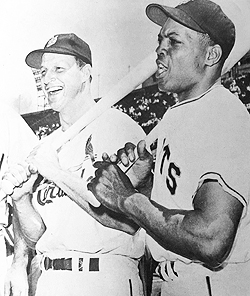
Imagine Willie Mays and Stan Musial in the same Cardinals lineup. The Cardinals could. They tried to make it happen.

In June 1957, the Cardinals offered the New York Giants a combination of cash and players for Mays, the St. Louis Globe-Democrat reported.

In the authorized biography, “Willie Mays: The Life, The Legend,” author James S. Hirsch wrote that Giants owner Horace Stoneham “seriously considered the deal but didn’t pull the trigger because of the club’s pending transfer to San Francisco.”

Opportunity knocks

The Cardinals opened the 1957 season with rookie Bobby Gene Smith as their center fielder, but he struggled to hit and, in desperation, the club shifted Ken Boyer from third base to fill the hole in center.

Meanwhile, the Giants were looking to move from New York. In 1956 and 1957, the only major-league team that drew fewer fans than the Giants was the Washington Senators.

As Mays biographer Hirsch noted, “Unlike their money-losing years from 1948 to 1953, the Giants did squeak out profits, but they could not keep pace with their Gotham rivals. Between 1947 and 1956, the Giants earned $405,926; the Dodgers earned $3.5 million, and the Yankees, $3.6 million.”

The Giants, Hirsch added, “made money only because of their increasing media revenue, receiving $600,000 a year for their television rights.”

In May 1957, National League club owners gave permission to the Giants to move from New York to San Francisco and for the Dodgers to transfer from Brooklyn to Los Angeles after the season.

A month later, the Cardinals made their pitch for Mays.

High stakes

Cardinals executive vice president Dick Meyer and general manager Frank Lane had the approval of Cardinals owner Gussie Busch to attempt a deal for Mays.

“Mr. Busch told me that I was a good general manager and that I ought to get Mays,” Lane told the Globe-Democrat. “I told him I’d try.”

Meyer said to the newspaper, “We were really anxious to get Mays … When we first told Lane to see what he could do about getting Mays, we fixed the cash price at $500,000. That apparently wasn’t enough and we authorized Lane to increase the ante.”

Lane said negotiations started with Giants vice president Chub Feeney and then club owner Horace Stoneham got involved.

“We made four offers for Mays, including one totaling $1 million,” Lane told the Globe-Democrat.

That offer was: $750,000 cash, outfielder Wally Moon, one or two other players on the Cardinals roster and several in the minors, the Globe-Democrat reported.

(According to the Federal Reserve inflation calculator, $750,000 in 1957 would be the equivalent of about $8.1 million today.)

Mays, 26, already had sparked the Giants to two National League pennants (1951 and 1954) and a World Series title (1954). In 1957, the Gold Glove center fielder would have another stellar season, leading the league in triples (20), stolen bases (38) and slugging percentage (.626). He slammed 35 home runs and scored 112 runs that season.

What a duo he and Musial would have formed. Musial, 36, won his seventh league batting title in 1957. He hit .351 and Mays was second at .333. Musial also was the 1957 league leader in on-base percentage (.422) and Mays was runner-up (.407). Musial had 29 home runs and 102 RBI for the 1957 Cardinals.

Mays and Musial had a bond. According to Mays’ biographer, the three players Mays followed as a youth in the 1940s were Joe DiMaggio, Ted Williams and Musial. When Mays traveled with the Negro League Birmingham Black Barons in 1948, he attended his first big-league game at Sportsman’s Park in St. Louis and got to see Musial hit.

On a plane to an All-Star Game in the mid-1950s, several black players were in the rear, playing cards. According to Mays’ biographer, Musial approached them and said, “Deal me in.” That was his way of telling those players they belonged. “That told me how classy he was,” Mays said, “and I never forgot that.”

Wrong time

The Giants’ gave “serious consideration” to the Cardinals’ offer for Mays, the Globe-Democrat reported, before opting to decline. Lane said to the newspaper, “Feeney told me the last time we talked about a Mays deal that it was out of the question. As I recall, Chub told me that if they traded Mays and then moved to San Francisco, the people out there would throw them into the bay.”

Stan Isaacs of Newsday wrote that moving the Giants to San Francisco “wasn’t nearly as shocking” as considering a trade of Mays to the Cardinals. 

The San Francisco Examiner noted, “Willie certainly must be a lot of baseball player to be worth that kind of money. Since the offer made by the Cardinals was turned down, it must be assumed Stoneham thinks Willie is worth even more.”

Stoneham told International News Service he “appreciated” the offer. In explaining why he rejected it, Stoneham said, “The money was not important. We’re not broke … What we want … above all else is a winning ballclub. All ballclubs have one special player … and to us it is Willie who is that ballplayer. We can build a team around Willie. Maybe that’s the answer to why we didn’t trade him to the Cardinals or anyone else.”

Then Stoneham, in that 1957 interview with International News Service, added, “Maybe we will sell him about 15 years from now, if somebody has a few ballplayers nearly as good.”

Fifteen years later, in May 1972, the Giants dealt Mays, 41, to the Mets for pitcher Charlie Williams and $50,000.

Read Full Post »

« Newer Posts - Older Posts »