Feeds:
Posts
Comments

Archive for the ‘Hitters’ Category

Enticed by the chance to add a left-hander to the starting rotation and a potential power hitter to the batting order, the Cardinals gave up a Gold Glove Award winner at third base.

ken_reitzThe deal didn’t work out the way either the Cardinals or Giants envisioned.

On Dec. 8, 1975, the Cardinals traded third baseman Ken Reitz to the Giants for pitcher Pete Falcone.

Though Reitz had been awarded the National League Gold Glove for his defensive work at third base in 1975, the Cardinals thought he was expendable because of the availability of Hector Cruz, who had excelled as a slugging third baseman for manager Ken Boyer at Class AAA Tulsa.

When Boyer, a five-time Gold Glove winner and seven-time all-star as a Cardinals third baseman, endorsed Cruz, the Cardinals were confident in dealing Reitz.

“Boyer is very high on Cruz,” Cardinals general manager Bing Devine said to the Associated Press.

Carpet cleaner

Reitz debuted with the Cardinals in 1972 and was their everyday third baseman from 1973-75. He led NL third basemen in fielding percentage in 1973 and 1974.

Mike Shannon, a Cardinals broadcaster and former third baseman, dubbed Reitz “Zamboni” because, like the machine, he cleaned up everything in his path on the artificial turf carpet at Busch Stadium in St. Louis.

The Sporting News praised Reitz for having “quick hands, an extremely accurate arm, superb lateral movement.”

Reitz, 24, committed 23 errors in 1975. Noting that only eight of those errors allowed scoring or led to scoring, The Sporting News wrote that Reitz’s “great stops and throws helped save many a game” and he “has displayed the same knack shown by such former Cardinals as Ken Boyer, Julian Javier and Dal Maxvill. They rarely killed you with an error in a tight situation.”

Reitz hit .269 for the 1975 Cardinals, with five home runs and 63 RBI.

Top prospect

In contrast, Cruz, 22, batted .306 with 29 home runs and 116 RBI in 115 games for Tulsa in 1975. He made 17 errors in 289 chances at third base.

Cruz, whose brothers Jose and Tommy had been Cardinals outfielders, was named winner of the 1975 Most Valuable Player Award in the American Association and Minor League Player of the Year by The Sporting News.

“He has been the best ballplayer in the minor leagues the past two years,” said Cardinals manager Red Schoendienst.

Devine told United Press International: “We feel he’s ready.”

Falcone fits

The Cardinals saw the Giants as an ideal trade partner. The Giants needed a third baseman and they had starting pitching depth.

Falcone, 22, debuted with the Giants in 1975, posting a 12-11 record and 4.17 ERA in 32 starts. He struck out 131 and issued a team-high 111 walks.

The Cardinals’ only other potential left-handed starter was John Curtis. The Cardinals envisioned Falcone joining a 1976 rotation with Bob Forsch, John Denny, Lynn McGlothen and either Eric Rasmussen or Curtis.

“We didn’t have any good left-hand pitching prospects in the minor leagues,” said Schoendienst. “We hope to start Falcone. That’s what we acquired him for.”

The Giants were seeking a defensive upgrade at third base. Their primary starter in 1975, Steve Ontiveros, hit .289 but committed 21 errors in 89 games at third base.

Jerry Donovan, assistant to Giants owner Horace Stoneham, said, “We haven’t had a third baseman since Jimmy Davenport retired (in 1970).”

Donovan, who engineered the trade with Devine, added, “We hated to give up Pete, but we needed a third baseman badly. The Cards insisted on Falcone if we were to make the deal.”

Giants fan

Reitz was born in San Francisco and grew up in nearby Daly City. As a youth, he would scale a fence to get into Giants games at Candlestick Park. He watched as many as 60 games a season there, according to the Oakland Tribune.

His favorite player was first baseman Willie McCovey. Like McCovey with the Giants, Reitz wore No. 44 with the Cardinals.

Still, Reitz was stunned and initially disappointed to be traded. He and his wife had bought a house in St. Louis.

“I thought they’d stick with me for a couple of more years at least,” said Reitz. “I thought there was maybe one chance in 100 that I’d be traded.”

Falcone was working an off-season job as a salesman in the New York garment center while staying with his parents in Brooklyn.

“When I first learned about (the trade), I was a little mad,” said Falcone. “It was a shock. Now that I’ve thought it all over, I kind of like the idea of going to St. Louis and getting out of the cold and fog.”

How they fared

In 1976, Falcone was 12-16 with a 3.23 ERA in 32 starts for St. Louis. He led the 1976 Cardinals in strikeouts (138) and innings pitched (212) and was second in wins.

After beating the Reds on a five-hitter on Aug. 24, he was 11-11 with a 3.29 ERA, but he lost five of his last six decisions while lowering his ERA to 3.23.

Cruz hit .228 with 13 home runs and 71 RBI with a team-high 119 strikeouts for the 1976 Cardinals. He made a NL-leading 26 errors at third base.

Reitz made 19 errors in 155 games at third base for the 1976 Giants. He hit .267 with five home runs and grounded into 24 double plays.

Return to sender

After the 1976 season, the Giants traded Reitz to the Cardinals for McGlothen.

The Cardinals moved Cruz to right field. He hit .236 with six home runs in 1977 and was traded after the season with catcher Dave Rader to the Cubs for outfielder Jerry Morales and catcher Steve Swisher.

Falcone had terrible second and third seasons with the Cardinals _ 4-8 with a 5.44 ERA in 1977 and 2-7 with a 5.76 ERA in 1978 _ and was traded to the Mets in December 1978 for outfielder Tom Grieve and pitcher Kim Seaman.

Reitz remained the Cardinals’ third baseman through 1980. He was traded with first baseman Leon Durham and third baseman Ty Waller to the Cubs for reliever Bruce Sutter in December 1980. Ken Oberkfell replaced Reitz at third base.
Read Full Post »

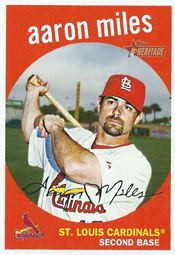
An undeterred underdog, Aaron Miles beat out the competition and emerged as the Opening Day starter at second base for the 2006 Cardinals.

aaron_miles2On Dec. 7, 2005, the Cardinals traded disgruntled reliever Ray King to the Rockies for Miles and outfielder Larry Bigbie.
King, 9-6 with a 2.91 ERA in two seasons with St. Louis, had asked to be traded after not pitching in any of the Cardinals’ nine postseason games in 2005.

For Cardinals general manager Walt Jocketty, Bigbie was the prize in the deal.

Bigbie, 28, was seen as a leading candidate to replace the departed Reggie Sanders as the Cardinals’ starting left fielder in 2006. Also competing for the job were So Taguchi and John Rodriguez.

“Right now, I see him (Bigbie) as a starter for us,” Jocketty said after the trade. “He’s still a young player who we believe has high upside.”

Bigbie had hit a combined .239 for the Orioles and Rockies in 2005. He missed most of the second half of the season because of a strained Achilles’ tendon. The year before, he batted .280 and hit 15 home runs for the 2004 Orioles.

Good hit, no field?

Miles, 29, Deivi Cruz and Hector Luna were perceived as second-tier candidates behind front-runner Junior Spivey to replace the departed Mark Grudzielanek as the Cardinals’ starting second baseman in 2006.

“Miles is considered below average defensively but is adept at reaching base,” wrote Joe Strauss of the St. Louis Post-Dispatch.

Miles hit .281 in 99 games, including 58 starts at second base, for the 2005 Rockies.

At Cardinals spring training in 2006, Miles jammed his left hand diving into a base on March 3 and sat out for nearly two weeks. That appeared to clear the path for Spivey to win the second base job.

Spivey had played for the Brewers and Nationals in 2005, became a free agent after the season and signed with the Cardinals for a guaranteed $1.2 million. However, Spivey “struggled in all aspects of the game” during spring training, the Post-Dispatch reported. He “appeared tight defensively” and his spring training batting average at the end of March was .152.

When Miles returned to the spring training lineup, he went on a tear, with six hits in 12 at-bats. He struck out once in a stretch of 34 at-bats.

“He’s been a good player,” Cardinals manager Tony La Russa said of Miles. “He takes good at-bats. He’s caught the ball well to his left and right. He starts double plays.”

Right decision

Before the regular season began, the Cardinals released Cruz, sent Spivey to Class AAA Memphis and declared Luna the backup at second base to Miles.

Meanwhile, Bigbie suffered a stress fracture above his left heel and was placed on the disabled list. Taguchi opened the regular season as the Cardinals’ starting left fielder, with Jim Edmonds in center and Juan Encarnacion in right.

(Bigbie would play in 17 games for the 2006 Cardinals and hit .240. He became a free agent in October 2006 and signed with the Dodgers. A year later, in the Mitchell Report on steroid abuse in baseball, Bigbie admitted to using performance-enhancing drugs from 2001-05.)

The 2006 Cardinals opened the regular season on April 3 at Philadelphia against the Phillies. Miles, batting eighth, was 4-for-5 with two RBI and two runs scored. He produced two doubles, a triple and a single. Boxscore

“It feels good to make sure these guys (the Cardinals) know they made the right decision with me,” Miles said.

Said La Russa: “He’s a tough out and any eighth hitter that gives you a tough out creates a lot of possibilities in the National League game.”

On July 30, 2006, the Cardinals traded Luna to the Indians for their second baseman, Ronnie Belliard, who displaced Miles as the St. Louis starter. In 54 games, including 53 starts at second base, Belliard hit .237 for the 2006 Cardinals.

Miles batted .263 with 20 doubles in 135 games for the 2006 Cardinals. He made 71 starts at second base and 33 starts at shortstop.

The Cardinals that year won their first World Series championship since 1982, defeating the Tigers in five games. Miles was 1-for-6 with a walk and two runs scored in the 2006 World Series.

In four seasons with St. Louis (2006-08 and 2010), Miles batted .288.

Previously: Mark Grudzielanek fit a need for 2005 Cardinals

Previously: Aaron Miles keyed Cardinals’ comebacks of 2006

Previously: Ronnie Belliard re-ignited Cardinals in 2006 playoffs

Read Full Post »

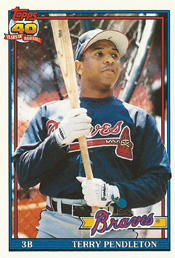
In the span of three days, two prominent players, third baseman Terry Pendleton and left fielder Vince Coleman, left the Cardinals for free-agent riches. For Pendleton, the move rejuvenated his career. For Coleman, it was a setback.

terry_pendleton2On Dec. 3, 1990, Pendleton, 30, left the Cardinals after seven seasons and signed with the Braves. Two days later, on Dec. 5, Coleman, 29, left the Cardinals after six seasons and signed with the Mets.
Pendleton, a career .259 hitter with St. Louis, helped the Braves win three National League pennants (1991, 1992 and 1996). In 1991, Pendleton won the NL Most Valuable Player Award and led the league in batting average (.319) and hits (187). In 1992, Pendleton tied with a former Cardinals teammate, the Pirates’ Andy Van Slyke, for the league lead in hits (199).

Coleman, who led the league in stolen bases in each of his six seasons with St. Louis, was a bust with the Mets. With the Cardinals, Coleman three times had more than 100 steals in a season and never had fewer than 65. With the Mets, Coleman had season totals of 37, 24 and 38 steals.

Plans for Zeile

The Cardinals had tried harder to keep Coleman than they did Pendleton.

With Todd Zeile converting from catcher to third baseman, the Cardinals figured Pendleton was expendable. The Cardinals offered Pendleton a contract for three years and $5.5 million. The Braves offered him a contract for four years and $10.2 million. Pendleton became the only Braves player besides outfielder Dale Murphy to be paid more than $2 million per season, the Atlanta Journal-Constitution reported.

“I never dreamed about making that kind of money,” Pendleton said.

Pendleton twice won a Gold Glove Award with the Cardinals (1987 and 1989) and three times led NL third basemen in assists (1986, 1987 and 1989). In 1989, Pendleton also led NL third basemen in fielding percentage (.971).

“He’s a good player with good makeup and he will be a very valuable asset to our club and to our organization,” Braves general manager John Schuerholz said to the St. Louis Post-Dispatch. “He has good leadership qualities and he’s been with a winner.”

Countered Post-Dispatch columnist Bernie Miklasz: “The Cardinals were justified in letting third baseman Terry Pendleton take his weight problem, deteriorating arm and narrowing fielding range to Atlanta.”

Pendleton praised Cardinals fans who “stuck by me even when I wasn’t playing well” and took a parting shot at Cardinals management, saying, “I’m excited about starting anew. I’m happy to go someplace where I’m wanted.”

Making an exception

Coleman and Pendleton were starters on Cardinals pennant-winning teams in 1985 and 1987. Coleman was named winner of the NL Rookie of the Year Award in 1985 when he had 110 stolen bases, scored 107 runs and produced 170 hits in 151 games.

Though the Cardinals had rookie Bernard Gilkey available to replace Coleman in left field in 1991, they wanted to keep Coleman atop their batting order.

The Cardinals initially made Coleman an offer of three years and $7.5 million. When the Mets offered him four years and $11 million, the Cardinals made what they considered a major concession. They offered Coleman four years and $10.5 million, according to the Post-Dispatch.

“Although it hasn’t been our policy in the past to offer four-year contracts, Vince is a premier player,” Cardinals general manager Dal Maxvill said. “Other players of his caliber are receiving contract offers like that and we thought it was proper to extend it a year.”

When the Mets countered with four years and $11.95 million, Coleman accepted.

“The Cardinals were in this thing until the very end,” said Richie Bry, Coleman’s agent. “He was torn by the decision.”

Asked by the Post-Dispatch what would have prompted him to choose the Cardinals over the Mets, Coleman said, “Match their offer, which they promised they’d do about a month ago.”

Maxvill denied the Cardinals promised to match any offer. “He was hoping we would match it,” Maxvill said.

Noting the difference between the Mets’ offer and Cardinals’ offer was $1.45 million, Miklasz wrote, “Spread over four years, it amounts to $363,000 a season … Why couldn’t the Cardinals come up with an extra $363,000 a year to keep Coleman?”

Separate paths

Coleman said he hoped to achieve 130 stolen bases in a season for the Mets. “I know when Lou Brock was 34 he stole 118 and I’m not close to being 34 yet,” Coleman said. “To steal 130 would be out of sight. You never know what Vince Coleman might do now that he’s got a new look on life.”

Coleman batted .270 in his three years with the Mets and totaled 99 steals. The Mets cut him loose after he was charged with a felony for throwing an explosive device similar to a grenade into a parking lot and injuring three people, including two children.

In a 13-year big-league career with the Cardinals, Mets, Royals, Mariners, Reds and Tigers, Coleman batted .264 with 1,425 hits and 752 stolen bases.

Twice an all-star with the Cardinals (1988 and 1989), Coleman never again was an all-star after leaving St. Louis and never again played for a pennant winner.

In a 15-year big-league career with the Cardinals, Braves, Marlins, Reds and Royals, Pendleton batted .270 with 1,897 hits.

Pendleton played in five World Series (two for the Cardinals and three for the Braves) and batted .298 with 28 hits in 27 games.

Previously: Why Cardinals traded Willie McGee to Athletics

Previously: Why Cardinals stopped being a Whitey Herzog team

Read Full Post »

The Dodgers had the cash. The Cardinals had the players. That combination led the National League rivals to make their second significant transaction of the year at the end of 1940.

mickey_owenOn Dec. 4, 1940, the Cardinals dealt the best young catcher in the league, Mickey Owen, to the Dodgers for $65,000, catcher Gus Mancuso and minor-league pitcher John Pintar.
Six months earlier, on June 12, 1940, the Cardinals had sent left fielder Joe Medwick to the Dodgers for $125,000 and four players whom a writer described as “a few ham sandwiches.”

The Dodgers, who hadn’t won a pennant since 1920, were willing to spend lavishly to acquire the talent needed to become champions.

The Cardinals, confident their farm system could replenish their big-league roster, were willing to deal players at their peak market value to increase profitability.

Also, Cardinals executive Branch Rickey had an incentive to trade players for cash because his contract called for him to get a percentage of the sale as remuneration in addition to his salary.

Daring Dodgers

After the 1940 season, Dodgers president Larry MacPhail spoke openly of his intention to acquire Owen.

Babe Phelps, 32, had been the primary catcher for the 1940 Dodgers. He hit .295 and was named an all-star for the third time in his 11-year career in the big leagues. The Dodgers, though, wanted a younger catcher with a better arm, better defensive skills and more agility than the lumbering Phelps, who was nicknamed “Blimp.” Owen, 24, met the criteria.

Owen entered the big leagues with the 1937 Cardinals and became their starting catcher in 1938. In four seasons with St. Louis, Owen hit .257. His prime asset was his ability to deter stolen base attempts.

In 1938, Owen ranked third among National League catchers in percentage of runners caught stealing (50.9 percent). Owen was the league leader in that category in both 1939 (61.1 percent) and 1940 (60.4 percent).

By comparison, Phelps caught 33.3 percent of runners attempting to steal in 1940.

Bidding battle

Owen “is No. 1 on the MacPhail shopping list because of his youth and speed. Larry, however, isn’t at all confident of landing the fiery Redbird receiver,” The Sporting News reported.

The Giants and Cubs also wanted Owen. Rickey and Cardinals owner Sam Breadon were delighted to have multiple bidders for him. They had a hard-hitting catcher at their Columbus farm club, Walker Cooper, who was deemed ready to replace Owen.

The Cardinals “will be on the listening end of one of the most interesting _ and profitable _ bidding contests in a long time,” The Sporting News reported. “… Cardinals chieftains need only to sit back and let the other fellows do the talking and bidding … They couldn’t have done better if they had written the plot themselves.”

At the baseball winter meetings in Atlanta, the Cubs reportedly made an aggressive play for Owen. MacPhail quickly countered and sealed the deal by increasing the cash offering.

Cash trumps talent

Some were surprised the Cardinals settled for Mancuso instead of Phelps in the deal.

Mancuso, 35, who began his big-league career with the 1928 Cardinals and played in the World Series for them in 1930 and 1931, hit .229 as backup to Phelps for the 1940 Dodgers. Pintar, 27, a right-hander, posted an 11-9 record and 2.77 ERA for the Dodgers’ Texas League affiliate in Dallas.

“At first glance, it looked like the Dodgers benefitted most” with the Cardinals “getting the money they like so well,” Judson Bailey of the Associated Press wrote. Bailey called Owen “a smart defensive player and the kind of aggressive worker that (Dodgers) manager Leo Durocher likes.”

In The Sporting News, Dodgers correspondent Tommy Holmes opined, “Everybody knew MacPhail wanted Owen … What no one expected was that Mickey would come to the Dodgers for so small an outlay of useful playing material. It seems Sam Breadon … preferred the cash.”

Why not? The $190,000 the Cardinals got from the Dodgers for Medwick and Owen was a staggering sum. In 1940, the highest-paid player in the big leagues was Tigers slugger Hank Greenberg at $35,000. The average player salary in the 1940s was $11,000.

Advantage, Cardinals

In the short term, the deal worked well for both teams. In the long term, the Cardinals did better.

With Medwick and Owen as regulars, the 1941 Dodgers finished 100-54 and won the pennant, 2.5 games ahead of the second-place Cardinals (97-56).

Medwick batted .318 with 18 home runs, 88 RBI and 100 runs scored for the 1941 Dodgers.

Owen was second in the league in fielding percentage among catchers and fourth in percentage of runners caught stealing (51.8). He was named an all-star for the first time and hit .231 with 44 RBI.

In the 1941 World Series against the Yankees, Owen failed to catch a third strike pitch with two outs in the ninth inning that should have clinched a 4-3 Dodgers victory in Game 4 and evened the series at 2-2. Instead, the Yankees rallied, won the game, 7-4, and went on to secure the championship with four wins in five games.

Mancuso and Cooper formed an effective catching platoon for the 1941 Cardinals. Mancuso ranked No. 1 among National League catchers in percentage of runners caught stealing (69.2 percent) and Cooper was fifth (51.4 percent).

Cooper was the starting catcher on Cardinals clubs that won three consecutive pennants (1942-44) and two World Series titles.

Previously: How Joe Medwick got traded by Cardinals to Dodgers

Read Full Post »

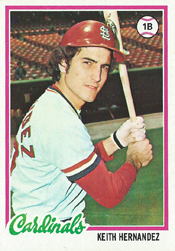
Playing for a new manager, Vern Rapp, and with a core of young, highly regarded players, such as Keith Hernandez, Garry Templeton and John Denny, the Cardinals enjoyed a successful opening to the 1977 season.

keith_hernandez5On April 7, 1977, amid strong winds and a mix of rain and light snow, the Cardinals beat the Pirates, 12-6, at Three Rivers Stadium in Pittsburgh.
New approach

The 1977 Cardinals opened the season as a franchise looking to rebuild.

In 1976, the Cardinals finished 72-90. Red Schoendienst, who had managed the Cardinals since 1965, was fired after that 1976 debacle. He was replaced by Rapp, a St. Louis native who had played and managed in the Cardinals’ system but who never had reached the major leagues.

A disciplinarian, Rapp instructed Cardinals players during 1977 spring training to shave off their moustaches and beards and keep their hair trim.

In the opener at Pittsburgh, the Cardinals started Denny, 24, against Jerry Reuss, a St. Louis native who began his career with his hometown team.

Along with established standouts such as left fielder Lou Brock and catcher Ted Simmons, the Cardinals’ lineup included Hernandez, 23, at first base and Garry Templeton, 21, at shortstop.

Denny and Templeton were making their first Opening Day starts in the big leagues.

Helped by three Pirates errors, the Cardinals scored four runs in the opening inning off Reuss. The Pirates’ sloppy start prompted “lusty boos from many of the 35,186 spectators,” the Associated Press reported.

The Cardinals never trailed. Denny held the Pirates to three runs in 5.2 innings and got the win. Templeton had two hits and scored three runs.

Hernandez, a left-handed batter, scored twice and had key hits against a pair of left-handed relievers. Hernandez hit a two-run double off Grant Jackson and a two-run home run (estimated at 425 feet) against Terry Forster. For Hernandez, it was his first four-RBI game in the big leagues.

Playing to win

“The thing about Vern Rapp is that he has us playing aggressive baseball, taking the extra base, playing at our maximum,” Hernandez said after the game. “We don’t have a lot of power, but we do have good hitting and exceptional speed and I think we’re going to make the most of it.”

Asked about playing without his signature moustache, Hernandez replied, “I’m here to play baseball. That’s what is important to me. I’ve got five months in the off-season to grow a moustache and long hair, but right now I want to help the Cardinals play winning baseball.” Boxscore

Behind stellars seasons by Hernandez (.291 batting average, 41 doubles, 91 RBI), Templeton (.322 batting average, 200 hits, 18 triples, 28 stolen bases), Simmons (.318 batting average, 21 home runs, 95 RBI) and pitcher Bob Forsch (20 wins), the 1977 Cardinals improved to 83-79.

Hernandez’s effective hitting against left-handers continued through the season. He batted .313 in 201 at-bats versus left-handers in 1977.

Previously: Cardinals debut was dream come true for Keith Hernandez

Previously: Pete Vuckovich was fearless in great escape for Cardinals

Read Full Post »

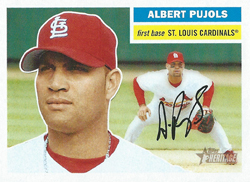
With the first of his three National League Most Valuable Player awards, Albert Pujols established himself as a dominant player, producing numbers that hadn’t been reached in decades by any Cardinals player who had earned the honor.

albert_pujols24On Nov. 15, 2005, Pujols, 25, was named NL MVP in balloting by 32 members of the Baseball Writers Association of America.

Pujols became the first Cardinals player to earn a NL MVP since Willie McGee in 1985.

Barry Bonds of the Giants had won the award in four consecutive years (2001-04). Pujols won NL MVP in three of the next five years (2005, 2008, 2009).

In 2005, Pujols batted .330 with 41 home runs, 117 RBI, 195 hits, 129 runs and a .430 on-base percentage.

Among the special achievements:

_ Before Pujols, no Cardinals NL MVP winner had hit 41 home runs in a season.

_ The 117 RBI by Pujols were the most by a Cardinals NL MVP winner since Joe Torre had 137 in 1971.

_ Pujols’  129 runs scored and his .430 on-base percentage each was the most by a Cardinals NL MVP winner since Stan Musial scored 135 and had a .450 on-base percentage in 1948.

_ Pujols and Chris Carpenter in 2005 became the first NL teammates to win the MVP Award and Cy Young Award in the same year since Terry Pendleton and Tom Glavine did so with the 1991 Braves.

Asked by St. Louis Post-Dispatch columnist Bernie Miklasz about Pujols being the NL MVP winner, Cardinals manager Tony La Russa said, “Our club gets a lot of its competitive nature from his personality. That’s what an MVP should be all about.”

Pujols received 378 vote points and 18 first-place votes in the balloting for the 2005 NL MVP Award.

Braves outfielder Andruw Jones was a close runner-up, with 351 vote points and 13 first-place votes. Jones batted .263 with 51 home runs, 128 RBI, 154 hits, 95 runs and an on-base percentage of .347.

“I think he deserved it,” Jones said to the Associated Press about Pujols winning the award. “The voting was the right vote. He was the right choice.”

Finishing third in balloting was Cubs first baseman Derrek Lee, with 263 vote points and one first-place vote. Lee hit .335 with 46 home runs, 107 RBI, 199 hits, 120 runs and a .418 on-base percentage.

Previously: Albert Pujols joins Stan Musial with 4 MVP seconds

Previously: Albert Pujols achieves unofficial Triple Crown

Read Full Post »

« Newer Posts - Older Posts »