Feeds:
Posts
Comments

Archive for the ‘Hitters’ Category

In the game that produced one of the most important Cardinals home runs, an exchange between Todd Worrell and his coach, Mike Roarke, played a critical role in setting the stage for the dramatic finish.
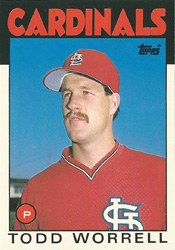
todd_worrell2On Oct. 14, 1985, Ozzie Smith hit a walkoff home run in the ninth inning against the Dodgers’ Tom Niedenfuer, lifting the Cardinals to a 3-2 victory in Game 5 of the National League Championship Series at St. Louis.

Smith’s blast became a beloved part of Cardinals lore, in part, because of broadcaster Jack Buck’s joyous, pitch-perfect call _ “Go crazy, folks! Go crazy!” _ and because of the shock value. Video

Smith, a switch hitter known more for his fielding than his hitting, had played eight seasons in the big leagues and hadn’t slugged a home run left-handed until doing so in the critical Game 5. The victorious shot gave the Cardinals their third win in a row after losing the first two games of the series and put them in position to clinch the pennant and a World Series berth in Game 6 at Los Angeles.

Circumstances might have been much different, though, if Roarke hadn’t connected with Worrell two innings earlier.

Rookie feels heat

In the seventh, with the score tied at 2-2, Ken Dayley was preparing to pitch his fourth inning in relief of Cardinals starter Bob Forsch. The first batter of the inning, Mike Scioscia, walked on four pitches. The next batter, Enos Cabell, hit the first pitch for a single, putting runners on second and first with none out.

Manager Whitey Herzog replaced Dayley with Worrell.

The hard-throwing rookie faced Steve Sax, who was instructed to bunt.

Worrell’s first two pitches were out of the strike zone and Sax took both for balls.

“The adrenaline was pumping and I was excited,” Worrell told Larry Harnly of The State Journal-Register of Springfield, Ill.

With the count 2-and-0, Sax got the take sign from third-base coach Joe Amalfitano.

Worrell threw another out of the strike zone, making the count 3-and-0.

Roarke to the rescue

From the top step of the dugout, Roarke, in his second season as pitching coach, shouted at Worrell and got his attention. Roarke had noticed Worrell’s pitches were being thrown from an angle that brought his arm up and over the top.

Roarke knew “Worrell’s accuracy improves when his delivery is from three-quarters rather than directly overhead,” the Daily News of Los Angeles reported.

Said Worrell: “Sometimes I try too hard and get myself mechanically screwed up.”

When Worrell threw from what appeared to the batter as an angle at 10 o’clock, he was effective. He lost command when his pitches were delivered from a 12 o’clock direction.

As Worrell peered into the dugout at his coach, Roarke held his arm at a 10 o’clock angle and moved it toward 12.

Worrell got the message.

Quick fix

Awaiting the 3-and-0 offering, Sax got another take sign. The pitch was a strike.

“After I got the first strike in there to Sax, I knew I would be all right,” Worrell said.

With the count 3-and-1, Sax got a third straight take sign. The pitch, another fastball, was a strike, making the count 3-and-2.

Said Worrell of Sax: “He’s aggressive _ he had doubled off me in another game _ so I knew if I got a fastball close, he would be hacking.”

Worrell threw a pitch that tailed away from the batter. Sax swung and missed, striking out.

Asked about being given three take signs, Sax told the Daily Breeze of Torrance, Calif., “I just have to do what I’m told.”

Said Dodgers manager Tommy Lasorda: “We were looking for a walk to Sax to load the bases.”

Out of danger

The next batter, pitcher Fernando Valenzuela, hit a groundball up the middle. Worrell knocked down the ball, recovered it behind the mound and made an accurate toss to first, retiring Valenzuela as the runners advanced to second and third.

“I let Fernando hit because I was happy with the way he was throwing the ball,” Lasorda said when asked why he didn’t use a pinch-hitter.

Mariano Duncan, the Dodgers’ slumping leadoff batter, followed by swinging at the first pitch and popping out to catcher Darrell Porter, ending the threat.

“First and second, nobody out and a 3-and-0 count,” said Dodgers outfielder Mike Marshall, lamenting the lost scoring opportunity. “You either have to say we blew it, or give them credit.”

The score remained tied until, with one out in the ninth, Smith worked his magic. Boxscore

Previously: How speedsters rattled Bob Welch in 1985 NLCS
Read Full Post »

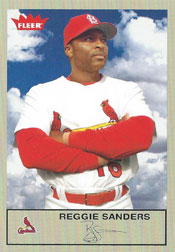
In a lineup of heralded run producers, including Albert Pujols, Jim Edmonds and Larry Walker, Reggie Sanders stole the spotlight with a standout RBI performance for the Cardinals in the 2005 National League Division Series.

reggie_sanders2Sanders had 10 RBI in three games for the Cardinals in their series sweep of the Padres.

Sanders, 37, established a NL Division Series record for most total RBI. Doing it in the minimum three games added to the awesomeness of the achievement.

To put the feat into perspective, consider that when Pujols and David Freese each had nine RBI for the Cardinals in the 2011 NL Championship Series against the Brewers, each did so in six games. When Pujols had nine RBI for St. Louis in the 2004 NL Championship Series versus the Astros, he played seven games.

Sanders had missed 54 games during the 2005 regular season after fracturing his right leg.

In five previous NL Division Series, Sanders had produced five total RBI, including one in 14 at-bats for the Cardinals against the Dodgers in four games in 2004.

Here is a breakdown of his 10-RBI effort against the Padres in the 2005 NL Division Series:

Game 1

Sanders was 2-for-4 with six RBI and a run scored in an 8-5 Cardinals victory on Oct. 4 at St. Louis.

In the third inning, the Cardinals led, 2-0. With the bases loaded and one out, Sanders, facing starter Jake Peavy, singled off the glove of first baseman Mark Sweeney, scoring Edmonds and Pujols.

Two innings later, Sanders again faced Peavy with the bases loaded and one out. With the count 3-and-0, Sanders got the green light to swing and ripped a high pitch for a grand slam over the left field wall, increasing the Cardinals’ lead to 8-0 and knocking Peavy from the game. Video

“You pretty much got to challenge him there and we lost the challenge,” said Padres manager Bruce Bochy to the St. Louis Post-Dispatch. Boxscore

The grand slam was the third by a Cardinals batter in a postseason game. The others: Ken Boyer in the 1964 World Series against the Yankees and Gary Gaetti in the 1996 NL Championship Series versus the Braves.

“Everything is all about results right now,” Sanders said. “It’s all about getting your ballclub where it needs to be and to continue to go as long as you can.”

Game 2

Sanders was 1-for-4 with two RBI in the Cardinals’ 6-2 victory on Oct. 6 at St. Louis.

In the seventh, with the Cardinals ahead, 4-1, Sanders hit a double against reliever Rudy Seanez, scoring Edmonds and Pujols. Boxscore

“For us, it’s all about timing,” Sanders said. “Manufacture runs when you have to manufacture. Really try to put pressure on the pitcher and the defense, no matter what the circumstances are.”

Game 3

The Cardinals completed the sweep with a 7-4 victory at San Diego. Sanders was 1-for-4 with two RBI.

With the Cardinals ahead, 3-0, in the second, Sanders batted with the bases loaded against starter Woody Williams, who had been his St. Louis teammate the year before. Sanders drilled a two-run double, knocking Williams out of the game. Boxscore

For the series, Sanders batted .333 (4-for-12) with two doubles, a home run, a single, a walk and a run scored.

Previously: Cards convinced Larry Walker to join pennant push


Read Full Post »

(Updated on Dec. 31, 2017)

Needing to win one of three games against the Mets to block them from taking a share of first place in the National League East, the Cardinals finally achieved the goal in the finale of an intense October series at St. Louis.

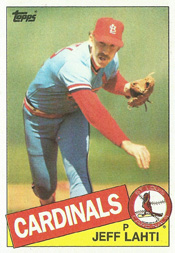
jeff_lahtiOn Oct. 1, 1985, the Mets trailed the first-place Cardinals by three games entering a weeknight series at Busch Stadium.

With the tension building after Mets wins in each of the first two games, the Cardinals got a one-run victory and held on to first place alone.

Here is a look at that critical Mets-Cardinals series:

Game 1

The Oct. 1 game was scoreless through 10 innings. John Tudor, the Cardinals’ starter, pitched 10 shutout innings. Mets starter Ron Darling went nine innings and Jesse Orosco pitched the 10th.

In the 11th, Ken Dayley relieved Tudor and struck out the first two batters, Keith Hernandez and Gary Carter.

Darryl Strawberry batted next.

With the count 1-and-1, Dayley delivered a breaking pitch. Strawberry hit a towering drive that slammed into the scoreboard clock for a home run.

“Darryl then may have made the slowest trot around the bases I ever saw,” Mets center fielder Mookie Wilson said in his book “Mookie.”

“He hit a curveball _ a hanging curveball,” Cardinals manager Whitey Herzog told Larry Harnly of The State Journal-Register of Springfield, Ill. Video

In the Cardinals’ half of the 11th, Orosco struck out Willie McGee. The next batter, Tommy Herr, lofted a fly ball to shallow center. Wilson got a late jump and attempted a basket catch, but dropped the ball for a two-base error.

Brian Harper, pinch-hitting for Darrell Porter, grounded out to second, advancing Herr to third with two outs.

Orosco ended the drama by getting Ivan De Jesus, pinch-hitting for Andy Van Slyke, to fly out to Wilson, giving the Mets a 1-0 victory.

“Tell me,” Mets manager Davey Johnson asked reporters in discussing the Strawberry home run, “is the clock still working?” Boxscore

Game 2

The pressure still was on the Mets, who trailed the Cardinals by two with five games remaining on Oct. 2.

The Mets responded to the challenge.

Starter Dwight Gooden went the distance. He allowed nine hits and issued four walks, but he struck out 10 and the Cardinals stranded 10.

The Mets scored five runs off Cardinals starter Joaquin Andujar and won, 5-2, slicing the St. Louis lead to one with four games to play.

In the bottom of the ninth, the Cardinals nearly rallied. Trailing 5-1, they scored a run and loaded the bases with two outs against Gooden.

“I knew he was tired and I knew it was draining him,” Johnson said. “At the same time, I thought Gooden was our best bet. He bends a little, but he doesn’t break.”

The move nearly backfired.

Herr laced a line drive that was caught by second baseman Wally Backman, ending the game. Video

“When Herr first hit the ball, I thought it was going to be over Wally’s head,” Gooden said. “It was panic time.” Boxscore

Game 3

After the Mets won Game 2 of the series, Johnson said, “We’ve done what we had to do so far. We’ve got two-thirds of the job done. The pressure is on them now.”

If the Mets won the Oct. 3 series finale, they’d be tied with the Cardinals and would have the momentum.

Instead, the Cardinals won, 4-3. Vince Coleman was 3-for-4 with two RBI. Ozzie Smith contributed two hits, two runs and a RBI. Starter Danny Cox held the Mets to two runs in six innings and the bullpen, especially Ricky Horton and Jeff Lahti, preserved the lead.

Horton retired the last two batters of the eighth and the first two batters of the ninth before Hernandez singled, representing the tying run. It was Hernandez’s fifth hit of the game.

“He broke his bat on the hit,” Horton said. “It was a fastball down and in. He makes a living on hitting good pitches.”

Lahti relieved and faced Carter. “We figured Carter might be looking for a slider,” Lahti said. “I asked (catcher) Darrell Porter what he wanted and he wanted a fastball. I go along with his suggestions.”

Lahti’s first pitch was a fastball away. Carter swung and drove a fly ball to right. Said Lahti: “When Carter hit it, I was screaming, ‘Catch it. Catch it.’ He’s beaten me to right field before.”

The ball carried to Van Slyke, who made the catch, ending the game and giving the first-place Cardinals a two-game lead with three to play. Boxscore

“It ended a series that was the greatest I had ever been a part of,” said Mookie Wilson. “Considering the magnitude and importance of each game and how each of the three came down to the final at-bat, it was like two gladiators fighting with the ultimate will to win.”

In the San Diego Union-Tribune, Herr said of the Mets: “They’re like the bowler who needed three strikes in the 10th (frame) to win. They got the first two, but they left the 10-pin standing on the third.”

On Oct. 4, the Cardinals beat the Cubs (Bob Forsch over Dennis Eckersley) and the Mets defeated the Expos, leaving St. Louis two ahead with two to play.

The Cardinals clinched on Oct. 5, beating the Cubs Boxscore while the Mets lost to the Expos.

Previously: Cesar Cedeno and his amazing month with Cardinals

Read Full Post »

Bob Gibson capped one of his best seasons as a hitter by slugging a grand slam against a fellow future Hall of Famer.

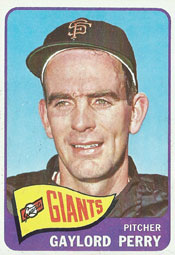
gaylord_perryOn Sept. 29, 1965, Gibson hit his first career grand slam. It came against Gaylord Perry at Candlestick Park in San Francisco, lifting the Cardinals to a victory that severely damaged the National League pennant hopes of the Giants.

The home run was the fifth of the season for Gibson, who batted .240 with 19 RBI in 1965. The year before, when the Cardinals won the pennant and World Series crown, Gibson batted .156 with no home runs.

In his book “Stranger to the Game,” Gibson said, “I was pleased that my stroke had returned after an off year in 1964.”

During his Cardinals career, Gibson hit 26 home runs _ 24 in the regular reason and two in the World Series. Each came against a different pitcher. Perry was the only one who, like Gibson, would be elected to the National Baseball Hall of Fame.

Doing it all

The Giants entered their Wednesday afternoon game against the Cardinals in second place, a game behind the Dodgers, with five remaining.

It was their misfortune to be matched against Gibson. He dominated the Giants for eight innings that day with his pitching and hitting.

Gibson singled twice and scored the Cardinals’ first two runs.

In the eighth, with the Cardinals ahead, 4-0, runners on second and third and one out, Perry relieved starter Bob Shaw.

With Gibson on deck, Giants manager Herman Franks instructed Perry to issue an intentional walk to Bob Skinner, pinch-hitting for Julian Javier.

Perry, 27, hadn’t yet mastered the spitball that would transform him into an ace.

The first pitch from Perry to Gibson was a strike. The next was a high slider and Gibson lined it over the fence in left-center, giving the Cardinals an 8-0 lead.

“I’m not going to find fault with my pitchers at this late stage,” Franks said to the Associated Press. “Maybe they haven’t been going so well lately, but they’ve been good all year. I’ve got no complaints.”

Unhappy exit

Gibson took a two-hit shutout into the ninth.

Seeing their pennant chances slipping away, the Giants rallied for five runs off Gibson on three singles, a walk and Jim Davenport’s three-run home run.

With one out and the bases empty, rookie pinch-hitter Bob Schroder was sent by Franks to face Gibson. The first pitch to the left-handed batter was a ball.

Cardinals manager Red Schoendienst decided to make a pitching change, bringing in left-hander Curt Simmons. Gibson was “seething” as he walked off the mound, the Oakland Tribune reported.

Simmons retired the first batter he faced, Bob Barton, who had replaced Schroder, for the second out of the inning.

The Giants, though, weren’t done. Cap Peterson reached second on an error by shortstop Dick Groat and scored on Jesus Alou’s single, cutting the Cardinals’ lead to 8-6.

That brought Willie Mays to the plate, representing the potential tying run.

High drama

Schoendienst removed Simmons and brought in the closer, Hal Woodeshick, a left-hander. Schoendienst told him to throw only fastballs at Mays’ fists. Explained Gibson: “He’d murder the ball if he could straighten his arms.”

Mays turned on one of the inside deliveries and bounced a single off the glove of third baseman Ken Boyer.

With Alou on second and Mays on first, slugger Willie McCovey was up next. A double likely would bring home both runners, tying the score. A home run would give the Giants a victory after being eight runs down entering the ninth.

The tension built with each pitch. McCovey slashed one long, but foul.

With the count 3-and-2, Woodeshick threw a curve. It broke down and away from the left-handed batter.

“The pitch was bad,” said Woodeshick. “I thought it was ball four.”

Said McCovey: “Everybody in the park could see it was a ball. I knew it, too _ too late.”

McCovey swung and missed.

“When you’re tensed up and excited like those guys are, that kind of thing happens,” Woodeshick said.

The Giants’ loss combined with a Dodgers victory over the Reds dropped San Francisco two behind with four to play. The Dodgers would go on to win the pennant. Boxscore


Read Full Post »

As a Cardinals rookie who had been in the major leagues for less than a month, Bernard Gilkey prevented perfection by delivering a nearly flawless performance of his own against the Phillies.

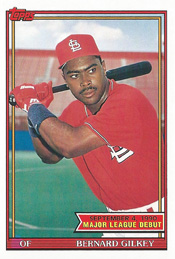
bernard_gilkey2On Sept. 25, 1990, at Philadelphia, Gilkey led the Cardinals to an unlikely 1-0 triumph.

Playing on the day after his 24th birthday, Gilkey tripled to lead off the first inning and doubled with two outs in the ninth. In between those two hits, Phillies starter Terry Mulholland retired 26 Cardinals in a row.

“That was as close to being perfect as anyone can be without being perfect,” Phillies manager Nick Leyva said to Calkins Newspapers.

Said Cardinals manager Joe Torre to the St. Louis Post-Dispatch: “You can’t pitch any better than that.”

Game of inches

Gilkey, a St. Louis native, had made his big-league debut with the Cardinals on Sept. 4, 1990, in his hometown against the Mets. With Class AAA Louisville in 1990, Gilkey had hit .295 with 147 hits in 132 games and 45 stolen bases.

He struggled early after his call-up to the Cardinals, hitting .212 entering the game against Mulholland and the Phillies.

Playing left field and batting in the leadoff spot, Gilkey opened the game by drilling a 2-and-2 pitch from Mulholland toward the right side of the second base bag. The second baseman, Randy Ready, dived to his right.

“The second baseman came within a whisker of catching the ball,” Torre told the Post-Dispatch.

The ball eluded Ready, skidding across the artificial turf and into the outfield. Center fielder Sil Campusano had shaded Gilkey to hit toward left field. The ball took a path into the gap between Campusano and right fielder Dale Murphy, rolling to the wall.

Gilkey raced to third with a triple.

“If (Gilkey) hits the ball two inches the other way, Randy Ready probably gets it,” Leyva said to the Philadelphia Daily News.

The next batter, Geronimo Pena, lifted a sacrifice fly to center, scoring Gilkey.

Terrific throw

After stinging the Phillies with his speed and hitting, Gilkey hurt them with his throwing.

In the bottom half of the first, Campusano was on second base when Murphy hit a single to left field. Gilkey fielded the ball and fired a strike to catcher Ray Stephens, whose sweep tag nailed Campusano before he could reach home plate.

“I have a pretty good arm and I charge the ball well,” Gilkey said to the Associated Press. “I figured I had a shot at him.”

Special pitching

Relying on a mix of sliders, sinkers and fastballs, Mulholland retired the Cardinals in order until Gilkey hit a double to right-center with two outs in the ninth.

“We only hit two balls hard,” said Torre.

The Phillies, though, couldn’t produce a run off starter Joe Magrane and relievers Mike Perez and Ken Dayley.

Magrane scattered eight hits over seven innings before he tired.

“Mulholland was cruising along so easily I didn’t have a chance to even get a drink of water,” Magrane said to the Post-Dispatch.

Perez and Dayley each worked an inning and each yielded a hit.

The Phillies had 10 hits and two walks, but stranded 11 base runners.

Several Phillies said Mulholland pitched better that night against the Cardinals than he had a month earlier, on Aug. 15, 1990, when he had a no-hitter versus the Giants.

“I pitched well enough to lose,” Mulholland said. “Gilkey hit the ball where we didn’t have anybody.”

Said Gilkey: “Mulholland is a real good pitcher. He spots the ball well and is always around the plate. I know I have to be ready, so I’m up there to hack.” Boxscore

Previously: How Bernard Gilkey spoiled Frank Castillo’s big moment

Read Full Post »

Rogers Hornsby was a 19-year-old scrawny shortstop from Texas when he was promoted from the lowest levels of the minor leagues to the Cardinals.

rogers_hornsby5Spurned by his teammates and intimidated by big-league cities, Hornsby seemed more outcast and misfit than elite prospect when he left the Class D Denison Railroaders of the Western Association and joined the Cardinals in Cincinnati on Sept. 3, 1915.

At 135 pounds, Hornsby appeared ill-equipped to handle power pitching in the big leagues. Cardinals manager Miller Huggins feared the rookie lacked the strength to generate enough bat speed.

Thus began the Cardinals career of the player who would develop into one of the all-time best hitters in the game.

Big break

Determined to become a professional ballplayer, Hornsby quit high school in Fort Worth and landed a spot with a minor-league club in Hugo, Okla. When the franchise folded, his contract was sold to the team in Denison, Texas.

During spring training in 1915, a Cardinals “B squad” club of prospects and reserves played an exhibition game against the Denison team.

In the book, “My War With Baseball,” Hornsby said, “It was my big break.”

Hornsby impressed Cardinals scout Bob Connery, who tracked the shortstop throughout the season.

The 1915 Cardinals were strapped for cash, especially after fighting the upstart Federal League’s efforts to woo players, and tended to seek inexpensive prospects from low-rung outposts rather than compete financially for top talent from the highest levels of the minor leagues.

Connery recommended Hornsby to the Cardinals. In August 1915, Roy Finley, president of the Denison team, agreed to sell Hornsby’s contract to the Cardinals for $600.

“They told me to meet the Cardinals in Cincinnati (where the club was playing the Reds on Sept. 3),” Hornsby said. “I had never been north before, let alone a big city like Cincinnati.”

Toughen up

When Hornsby arrived, he was a stranger to a team whose veterans saw him as a threat to take someone’s job.

“You didn’t have a bunch of coaches helping the rookies,” Hornsby said. “You had to scratch for everything you got. The veterans on the teams were so jealous of their jobs that most of them wouldn’t give you the time of day.”

In his first week with the Cardinals, Hornsby watched the games from the bench. He looked forward to batting practice, but sometimes was blocked by the veterans. When the club was in St. Louis, Connery was there and he pitched to Hornsby after games.

On Sept. 10, 1915, the Cardinals were playing the Reds at Robison Field in St. Louis. With the Reds ahead, 7-0, in the sixth, Huggins sent Hornsby into the game to replace shortstop Art Butler.

Hornsby went 0-for-2 against King Lear, who pitched a three-hitter in the Reds’ 7-1 victory. Boxscore

Huggins approached Hornsby after the game and said, “They throw a lot harder in the majors than Class D and you don’t have the strength to get the bat around. Try choking up on the bat.”

Fitting in

Hornsby followed his manager’s suggestion.

Four days later, on Sept. 14, Hornsby appeared in his third game, starting at shortstop and batting eighth against the Dodgers at St. Louis. Facing Rube Marquard (who, like Hornsby, would be elected to the National Baseball Hall of Fame), Hornsby got his first Cardinals hit, a single.

Hornsby was 2-for-2 with a sacrifice bunt in the game, a 6-2 Cardinals triumph. Boxscore

In 18 games with the 1915 Cardinals, Hornsby had 14 hits, batting .246.

Milking his chance

Before Hornsby went home to Texas for the winter, Huggins told him, “I think I’m going to have to farm you out for next year.”

In his book, Hornsby related, “I was just a country boy … so I took him at his word. I thought he meant a real farm and go to work. So I went down to my aunt and uncle’s farm at Lockhart, Texas, and went to work. I also drank all the milk I could and tried to put on some weight.”

When Hornsby reported to spring training in 1916, he was a strapping 160 pounds. Huggins told him to go back to gripping the bat at the knob. Hornsby performed so well Huggins kept him on the Opening Day roster and started him at shortstop before eventually shifting him to third base.

Hornsby was in the big leagues to stay. Second base became his primary position and hitting was his special skill.

Hornsby went on to win seven National League batting titles (six with the Cardinals). He twice won the Triple Crown (leading the league in batting average, home runs and RBI) and twice won the NL Most Valuable Player Award.

His .358 career batting average is best all-time for a right-handed batter and rates second overall to Ty Cobb’s .366.

Hornsby hit .359 with the Cardinals. He has the most career hits by a Cardinals right-handed batter (2,110). The only players with more hits as Cardinals are left-handers Stan Musial (3,630) and Lou Brock (2,713).

Previously: Rogers Hornsby tops Albert Pujols among Cards’ best

Previously: Rogers Hornsby raised bar for second basemen

Read Full Post »

« Newer Posts - Older Posts »