Feeds:
Posts
Comments

Archive for the ‘Hitters’ Category

(Updated Oct. 17, 2024)

Put at ease by management and welcomed by teammates, including those he might replace, Ray Lankford felt at home with the Cardinals and delivered a stellar performance in his big-league debut.
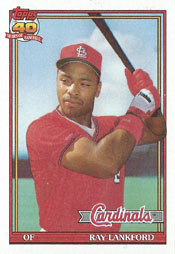
ray_lankford6On Aug. 21, 1990, Lankford, 23, went 2-for-4 with a RBI, a run scored and a stolen base against future Hall of Fame pitcher John Smoltz of the Braves in his first game with the Cardinals.

Batting sixth and starting in center field, Lankford singled in his first at-bat and swiped second base.

In the eighth, Lankford doubled with two outs, driving in Todd Zeile from second, and scored on a single by Rex Hudler.

“I did a little bit of everything,” Lankford said to the St. Louis Post-Dispatch. “I’m happy. I couldn’t have asked for much more.” Boxscore

Top prospect

Lankford was selected by the Cardinals in the third round of the 1987 amateur draft. He and another Cardinals outfield prospect, Bernard Gilkey, became friends and were road roommates with the 1990 Class AAA Louisville farm club.

With Willie McGee eligible to become a free agent after the 1990 season, speculation was Lankford would replace McGee as Cardinals center fielder in 1991.

“When he plays hard, he’s awesome,” Gilkey said of Lankford. “… He reminds me of Kal Daniels of the Los Angeles Dodgers, but he plays better defense and he runs better (than Daniels). His style is like Daniels and he’s built like Willie Mays.”

One of the few to cast doubts about Lankford was Whitey Herzog. After abruptly quitting as Cardinals manager in July 1990, Herzog remained with the club as a vice president and was sent in August to scout Cardinals prospects.

“You can talk about prospects all you want, but if you and I are hitting .270 at Louisville … those aren’t good credentials to take Willie McGee’s job,” Herzog said.

The Post-Dispatch reported Herzog said in a Louisville radio interview his opinions on Cardinals prospects “might not be the same” as those of director of player development Ted Simmons. Herzog concluded Lankford could benefit from another season at Class AAA.

No war zone

Disregarding Herzog’s advice, the Cardinals called up Lankford on Aug. 20, 1990. He was batting .260 for Louisville, but had a .362 on-base percentage, with 25 doubles, 72 RBI, 30 stolen bases, 72 walks and 123 hits in 132 games.

After reporting to Busch Stadium on Aug. 21, Lankford met with Simmons, manager Joe Torre and instructor George Kissell in Torre’s office.

“Teddy told him he wasn’t going to Vietnam,” Torre said. “This isn’t war here. Just go out and have a good time.”

Torre met with Cardinals starting outfielders McGee, Vince Coleman and Milt Thompson and explained to them he would start Lankford in center and move McGee to right, putting Thompson on the bench.

Torre said he wanted Lankford to play center “in the event McGee’s not here next year. We want to get him used to the bigger outfield here (at Busch Stadium).”

One of the first to greet Lankford in the clubhouse was Thompson. “I just have to keep my head up and keep working hard,” Thompson said.

McGee and Coleman also were friendly to Lankford. “Willie and Vince are both great players and I’m not here to take any jobs away,” Lankford said.

McGee said he hadn’t played right field since attending Diablo Valley College in California. Asked his reaction to being moved from center to right, McGee said, “I’m the employee. I do what I’m told.”

Let loose

Lankford batted .400 (6-for-15) in his first four games for the Cardinals.

“We’ll baby Lankford a little bit, but we want to get a good read on him so we know what to expect,” Torre said.

Post-Dispatch columnist Bernie Miklasz endorsed the decision to play Lankford. “The Cardinals need to turn Lankford loose, let him flail away at big-league pitching,” Miklasz wrote. “… Lankford can’t be held back. Stunting his progress at this stage is counterproductive.”

On Aug. 29, 1990, the Cardinals traded McGee to the Athletics for outfielder Felix Jose, infielder Stan Royer and minor-league pitcher Daryl Green.

In 39 games with the 1990 Cardinals, Lankford hit .286 with 10 doubles, eight stolen bases and a .353 on-base percentage.

After getting the chance to see Lankford, Gilkey and Jose play in the big leagues in September 1990, the Cardinals made the trio their regular outfield in 1991.

In the 1991 Cardinals Yearbook, Ted Simmons said of Lankford, “He has the best tools of any prospect we’ve had in the two years I’ve been here (as director of player development). He’s got the kind of tools that are as good as anybody and the kind that should let him have as good a rookie season as anybody.”


Read Full Post »

(Updated Dec. 21, 2024)

Having already worked one grand slam miracle as an Angel, David Eckstein performed another for the Cardinals.

david_eckstein2On Aug. 7, 2005, Eckstein hit a walkoff grand slam in the bottom of the ninth inning against Chris Reitsma, lifting the Cardinals to a 5-3 victory over the Braves.

“Every once in a while, you get a miracle like this,” Cardinals manager Tony La Russa told the St. Louis Post-Dispatch.

Eckstein, 5-foot-6 and slightly built, appeared better suited for singles than slugging.

However, the feat wasn’t a first for Eckstein. Three years earlier, on April 28, 2002, Eckstein hit a walkoff grand slam for the Angels against Pedro Borbon of the Blue Jays. It was one of three grand slams Eckstein hit for the Angels that season.

Eckstein’s grand slam for the Cardinals against the Braves was the fourth and last of his big-league career.

Subs deliver

The Braves scored a run in the top of the ninth against Jason Isringhausen, extending their lead from 2-1 to 3-1.

Reitsma, a right-hander who had yielded one run over his last 11 appearances and had converted nine consecutive save opportunities, was the choice of Braves manager Bobby Cox to pitch the bottom of the ninth.

Each of the first three Cardinals batters _ Abraham Nunez, So Taguchi and Hector Luna _ singled with two strikes, loading the bases with none out.

Nunez, subbing for injured Scott Rolen, hit a groundball single to center and Taguchi, subbing for injured Larry Walker, followed with a low liner up the middle.

Luna, pinch-hitting for catcher Mike Mahoney, who was subbing for injured Yadier Molina, slapped a grounder that deflected off Reitsma’s glove toward second baseman Marcus Giles. As Taguchi dashed in front of him, Giles tried to scoop the ball and swipe Taguchi with a tag, but he couldn’t get a handle on the ball and all the runners were safe on what was ruled an infield hit.

“If I let that go, maybe we turn two,” Reitsma said to the Associated Press. “You just react in that situation and it hit the top of my glove.”

Said Cox: “We butchered a double-play ball. You tell your pitchers not to touch a ball like that because it’s a routine double play.”

With the bases loaded and none out, La Russa called for Scott Seabol to bat for pitcher Ray King. Seabol, who hadn’t produced a hit for the Cardinals since June 21, popped out to third baseman Wilson Betemit.

Mighty mite

Next up was Eckstein, who had hit four home runs on the season and 21 since entering the major leagues in 2001.

After taking the first pitch from Reitsma for a ball, Eckstein swung at the next and drove the ball over the left-field fence and into the seats. Video

“I was trying to go down and away with a sinker for a double play,” Reitsma told the Atlanta Journal-Constitution. “I just left it down the middle.”

Said Eckstein of his home run swing: “That’s probably all I’ve got right there.” Boxscore

After being mobbed by his teammates at the plate, Eckstein doffed his helmet to the crowd of 47,714 who had turned out on what the Cardinals promoted as Transplant Awareness Day. Eckstein’s father was scheduled to become the fourth family member to receive a kidney transplant.

Walkoff winners

The seven previous walkoff grand slams hit by Cardinals:

_ Pepper Martin hit a grand slam off George Jeffcoat of the Dodgers, breaking a 7-7 tie in the ninth inning and giving the Cardinals an 11-7 victory on July 14, 1936, at St. Louis. Boxscore

_ Joe Cunningham hit a grand slam off Ruben Gomez of the Giants, breaking a 3-3 tie in the ninth and giving the Cardinals a 7-3 victory on July 30, 1957, at St. Louis. Boxscore

_ Carl Taylor hit a grand slam off Ron Herbel of the Padres, erasing a 10-7 San Diego lead in the ninth and giving the Cardinals an 11-10 victory on Aug. 11, 1970, at St. Louis. Boxscore

_ Joe Hague hit a grand slam off Mike Marshall of the Expos, breaking a 6-6 tie in the 10th and giving the Cardinals a 10-6 victory on Sept. 24, 1971, at St. Louis. Boxscore

_ Roger Freed hit a grand slam off Joe Sambito of the Astros, erasing a 6-3 Houston lead in the 11th and giving the Cardinals a 7-6 victory on May 1, 1979, at St. Louis. Boxscore

_ Darrell Porter hit a grand slam off Bob Lacey of the Giants, breaking a 4-4 tie in the 11th and giving the Cardinals an 8-4 victory on July 18, 1984, at St. Louis. Boxscore

_ Tommy Herr hit a grand slam off Jesse Orosco of the Mets, breaking an 8-8 tie in the 10th and giving the Cardinals a 12-8 victory on April 18, 1987, at St. Louis. Boxscore

Since Eckstein’s walkoff grand slam, five other Cardinals achieved the feat:

_ Gary Bennett hit a grand slam off Bob Howry of the Cubs, breaking a 6-6 tie in the ninth and giving the Cardinals a 10-6 victory on Aug. 27, 2006, at St. Louis. Boxscore

_ Aaron Miles hit a grand slam off Bryan Corey of the Padres, breaking a 5-5 tie in the ninth and giving the Cardinals a 9-5 victory on July 20, 2008, at St. Louis. Boxscore

_ Matt Carpenter hit a grand slam against J.P. Howell of the Blue Jays, breaking a 4-4 tie in the 11th and giving the Cardinals an 8-4 victory in the first game of a doubleheader on April 27, 2017, at St. Louis. Boxscore

_ Paul Goldschmidt hit a grand slam against Ryan Borucki with two outs in the 10th for a 7-3 Cardinals victory over the Blue Jays on May 23, 2022, at St. Louis. Boxscore

_ Nolan Arenado hit a curve from Trevor Megill of the Brewers for a grand slam with one out in the 10th inning for a 10-6 Cardinals triumph at St. Louis. Boxscore

Read Full Post »

(Updated Nov. 28, 2024)

A playful blonde in a flaming red dress gave an unexpected mix of sex appeal and comedy to the first regular-season night game played by the Cardinals.

kitty_burkeOn a sultry evening in Cincinnati, July 31, 1935, Kitty Burke, 25, a nightclub entertainer, emerged from an overflow crowd at Crosley Field during a game between the Cardinals and Reds, grabbed a bat and stood at the plate, expecting a delivery from St. Louis pitcher Paul Dean.

Amazingly, with the approval of the plate umpire and with the commissioner of baseball watching from the stands, Dean tossed a soft pitch, Burke swung at it and connected with a groundball to the pitcher.

Satisfied, she departed back into the crowd and the game resumed.

Night baseball

Two months earlier, regular-season night baseball had debuted in the major leagues with a game between the Phillies and Reds at Crosley Field.

The Cardinals, who wouldn’t have lights at their home field, Sportsman’s Park, until 1940, were the defending World Series champions in 1935 with a lineup of colorful Gashouse Gang characters such as Dizzy Dean, Pepper Martin, Joe Medwick, Frankie Frisch and Leo Durocher. That made the Cardinals-Reds night game at Cincinnati a big draw, even on a Wednesday.

(In the book “Voices From Cooperstown,” Stan Musial told author Anthony J. Connor, “I always thought I would’ve enjoyed playing in that Gashouse era, although I didn’t have the same color as a guy like Pepper Martin.”)

Crosley Field in 1935 seated 26,060. Thousands more than that turned out for the Cardinals-Reds game and were admitted. Many were in a partying mood.

Out of control

“A big part of the overflow came into the park shortly before game time on special trains from Dayton, Ohio _ and to say that a good many of these excursionists were feeling their oats is putting it mildly,” The Sporting News reported. “They had been hitting it up on the train and were out for a high time. When they found no seats for themselves at the park, they just leaped the field-box fences and made for the foul lines.”

Fans initially stood along both foul lines and in territory behind the plate. When some fans who were seated in box seats had their view of the playing field obstructed by those standing in foul territory, they left their seats and joined those on the grass. Eventually, the crowd swelled so much that spectators “completely encircled Crosley Field,” the Associated Press reported.

Wrote The Sporting News: “Fans were standing right against the base lines and so close behind the catcher that it was impossible for any player to catch a foul ball.”

Official attendance was listed as 30,000. The Sporting News estimated the crowd at 30,450. Among those in attendance were baseball commissioner Kenesaw Mountain Landis and Reds president Powel Crosley, who stood together for most of the game “because they couldn’t see the field while seated in box seats,” The Sporting News reported.

In the fourth inning, “irate fans stormed the field, holding up the game for 10 minutes” because of mixups in the seating arrangements, according to International News Service.

The Associated Press reported, “Players were forced to shoulder their way through to the plate. The heat _ on Cincinnati’s hottest day of the year _ added to police troubles, a number of fans being ejected from the park for disorderly conduct.”

Sizing up the boozy crowd, third-base umpire Cy Rigler ordered beer sales stopped in the fourth inning.

Kitty takes the stage

From her perch in a field-level seat, Kitty Burke was one of the patrons unable to see the playing field. Described by United Press as “a pretty young blonde wearing a flaming red dress,” Burke attracted attention when she left her seat and joined those standing near the field.

“I had a very good box seat and I figured I was entitled to see the game,” said Burke, “but it seems they oversold the park and about the sixth inning everybody started crowding in front of me … I just joined the crowd, which swarmed down on the field, and found places along the first-base line.”

The Cardinals had taken a 2-1 lead, with one of the runs being scored by Medwick. According to Burke, “The St. Louis players had been crowded out of their dugout by the mob and we were lined up behind them on the field.”

In the eighth inning, Burke found herself within shouting distance of Medwick and the two exchanged good-natured taunts.

Burke: “Medwick, you can’t hit anything.”

Medwick: “You can’t hit anything yourself.”

Burke: “I’d like to show you sometime.”

Medwick: “You can’t hit anything with an elephant.”

(Said Burke to United Press: “I think what he meant was you can’t hit an elephant.”)

Burke: “I’ll show you.”

Babe helps a babe

Burke looked toward the plate and saw a Reds player, Babe Herman.

Said Burke to United Press: “I yelled, ‘Hey, Babe, lend me your bat.’ ”

Herman said, “OK, Sis,” and handed the bat to the lady in red.

“Babe always is accommodating to his public,” The Sporting News slyly noted.

Said Burke: “So I took the bat up to the plate and made up my mind I was going to sock one if I had to stay there all night. (Dean) was on the mound when I came up, but was looking toward the outfield. You should have seen the dumb expression on his face when he turned around and saw me. He didn’t know what to do.”

The plate umpire, Bill Stewart, did nothing to stop Burke.

“The umpire was a good egg and yelled. ‘Play ball!’ ” Burke said.

Said The Sporting News: “How Stewart let her get away with it is beyond explanation. She would have had no chance pulling that on Bill Klem or some of the other umpires.”

Dean plays along

Dean, younger brother of Dizzy, was nicknamed Daffy. Burke yelled to him, “Hey, you hick, why don’t you go home and milk the cows?”

Said Burke: “That must have got him, because he started winding up to burn one in. I asked myself, ‘Should I get out of here?’ but just then Pepper Martin yells, ‘Take it easy, Daf.’ So, Daffy just grinned and lobbed one across.”

Dean made an underhanded toss.

Burke swung and hit a grounder to Dean.

Said Burke: “I smacked it … but Daffy was on first with the ball, waiting for me.”

Burke took a few steps up the line, then veered back toward the crowd.

“I saw that he had me beaten, so I stopped,” Burke said.

Before she departed, though, she gave a parting shot to Medwick.

“I said to Medwick, ‘I hit that one, didn’t I, big boy?” He was a good sport and said, ‘Yes.’ ”

When play resumed, the Reds scored two in the eighth to take the lead, the Cardinals rallied to tie the score, 3-3, in the ninth and the Reds rewarded their fans with a run in the 10th for a 4-3 victory. Boxscore

Previously: Why 1940 was year Cardinals saw the light

Read Full Post »

(Updated Nov. 19, 2024)

Concerned he would become forgotten in their vast minor-league system, Ted Williams rejected an offer to begin his professional career with the Cardinals.

ted_williamsIf he would have signed with the Cardinals, Williams likely would have been in their organization at the same time as Stan Musial, making it possible the 1940s Cardinals could have had two of the game’s best left-handed hitters, Musial and Williams, in the same lineup.

Instead, Williams played two years with his hometown minor-league San Diego Padres of the Pacific Coast League before signing with the Red Sox. In his only World Series, Williams opposed Musial and the Cardinals in 1946.

Meet me in St. Louis

In the book “Voices From Cooperstown,” Williams told author Anthony J. Connor that as a youth his favorite player was Giants first baseman Bill Terry. Williams said, “I’d be playing, or just swinging a bat, and I’d say to myself, ‘Bill Terry’s up, last of the ninth, bases loaded, 3-and-2 count.’ You know how kids announce their own games.”

In 1935, Williams was in his junior year at Herbert Hoover High School in San Diego. Playing mostly outfield and first base, he hit .588 in 15 games and also pitched, posting a 4-2 record.

Herb Benninghoven, a scout for the Cardinals in San Diego, took notice of Williams, began attending his games and befriended him.

In his book “My Turn at Bat,” Williams recalled Benninghoven would sit “way out in the outfield, looking at me with field glasses.”

Often, after games, Benninghoven “might drive Ted home, and they’d talk baseball, or he’d invite the boy over to his house. His wife was always cooking and baking something good,” wrote Ben Bradlee Jr. in his book “The Kid: The Immortal Life of Ted Williams.”

On Aug. 6, 1935, the San Diego Evening Tribune reported Williams had been invited to try out for the Cardinals in St. Louis. It was the first public indication Williams was considered a professional baseball prospect.

“Ted Williams, slim Herbert Hoover High pitcher, with whom local diamond fans are well acquainted, has received an offer to try out with the St. Louis Cardinals of the National League,” the Evening Tribune wrote. “Herb Benninghoven … tendered the offer and informed Williams his expenses would be taken care of should he care to make the trip east for the trial.”

The newspaper added, “Doubt was expressed that Ted would accept, however, since he still has one more year of high school and should he go into organized baseball he would be declared ineligible for further high school competition.”

Williams still was 16 _ he would turn 17 a few weeks later on Aug. 30, 1935 _ and speculation was his parents didn’t want him to leave home yet.

He didn’t attend the Cardinals tryout and instead returned to high school for his senior year.

In hot pursuit

Meanwhile, the Yankees joined the Cardinals in pursuing Williams. The Yankees offered Williams a chance to play for their Oakland affiliate in the Pacific Coast League and, according to the Bradlee book, Williams and his family agreed in principle that he would sign with New York after he graduated from high school.

Still, the suitors kept arriving, most notably the Tigers and Pacific Coast League Los Angeles Angels. Benninghoven and the Cardinals hadn’t given up either.

In January 1936, in the middle of Williams’ senior year, San Diego was granted a franchise in the Pacific Coast League and the team was named the Padres. Soon after, Benninghoven, looking to sign Williams before he graduated, invited him to attend a Cardinals tryout camp in Fullerton, Calif. This time, Williams accepted.

Cardinals general manager Branch Rickey, originator of their farm system, was overseeing the tryout camp. The night before, Williams was hit by a pitch in the thigh during a game. At the tryout camp, his sore thigh hampered his mobility and Rickey was unimpressed by Williams, according to the Bradlee book.

“That sore leg made me look like I was anchored,” Williams said in his autobiography. “I was discouraged, I didn’t hit particularly well, and they hardly gave me a look.”

Still, because of a strong endorsement from Benninghoven, the Cardinals offered Williams a contract, but he spurned the offer.

In “My Turn at Bat,” Williams said of the Cardinals, “They would have probably sent me to Oshkosh or Peoria or someplace, because they had a huge farm system and you could get lost.”

Bound for Boston

Money also may have been a factor in Williams’ decision to reject the Cardinals.

When Benninghoven died in January 1970, an obituary by the Associated Press reported, “He once said he missed signing Ted Williams out of high school when the St. Louis Cardinals refused an extra $1,000 which Williams demanded.”

Williams also turned his back on the Yankees and instead, with his parents urging him to stay home, signed with the Pacific Coast League Padres.

After two seasons with the Padres, Williams, 19, signed with the Red Sox in December 1937. He played one year for their Minneapolis farm team, joined the Red Sox in 1939 and embarked on a Hall of Fame career in which he would hit .344 with 521 home runs and 1,839 RBI with Boston. In 1941, Williams hit .406, becoming the last big-league player to achieve a .400 batting average.

In 104 American League games at Sportsman’s Park in St. Louis against the Browns, Williams hit .399 and had an on-base percentage of .531.

Two years after Williams first appeared with the Red Sox, Musial, who had converted from pitcher to outfielder, debuted with the 1941 Cardinals and launched his own Hall of Fame career in which he would hit .331 with 475 home runs and 1,951 RBI in 22 years with St. Louis.

In his book “Stan Musial: The Man’s Own Story,” Musial said of Williams: “Ted was a once-in-a-generation hitter, the best in our time. He knew his art and he knew his (opposing) pitchers. He had a keen appreciation of the strike zone, a great eye, quick hands and power.”

Read Full Post »

(Updated June 29, 2020)

Taking advantage of an unmotivated, jet-lagged team, Fernando Valenzuela pitched a no-hitter against the Cardinals. It was the second no-hitter pitched in the major leagues that night and the first versus the Cardinals in 12 years.

fernando_valenzuelaOn June 29, 1990, at Los Angeles, Valenzuela pitched the only no-hitter of his career in a 6-0 Dodgers victory over the Cardinals.

Earlier that night, Dave Stewart, Valenzuela’s former Dodgers teammate, pitched a no-hitter for manager Tony La Russa’s Athletics against the Blue Jays. It was the first time no-hitters had been pitched in both the American League and National League on the same day.

Valenzuela, 29, struck out seven and walked three. The Cardinals also had a runner reach on an error.

The left-hander pitched the first no-hitter against the Cardinals since Tom Seaver of the Reds on June 16, 1978.

Control, confidence

After beating the Pirates in a night game at St. Louis on June 28, the Cardinals stayed overnight at home and left the morning of June 29 for that night’s game against the Dodgers. The Cardinals arrived in Los Angeles about 12:30 in the afternoon Pacific Coast time.

The Dodgers watched on the clubhouse TV as Stewart completed his no-hitter at Toronto. Boxscore

Valenzuela turned to his teammates and said, “You’ve seen one on TV. Now come watch one live,” Rick Hummel of the St. Louis Post-Dispatch reported.

Valenzuela’s previous big-league best had been a two-hitter.

From the first pitch, Valenzuela was in command. “Throughout the game, I had excellent control,” he told the Orange County Register. “I had a lot of confidence.”

Timely tip

In the ninth, Vince Coleman led off for the Cardinals. The speedster was carrying a 10-game hitting streak and was the batter Valenzuela feared most in the St. Louis lineup. “Coleman makes a lot of contact and he can bunt,” Valenzuela said.

On a 2-and-1 pitch, Coleman hit a shot down the third-base line, but it was foul. With the count at 2-and-2, Coleman showed bunt, took a pitch outside and was called out on strikes by umpire Jerry Layne.

Referring to Layne’s strike zone, Cardinals manager Whitey Herzog told the Los Angeles Times, “I don’t want to take anything away from Fernando, but he had the right guy behind the plate.”

Willie McGee was up next and he walked on four pitches.

That brought to the plate Pedro Guerrero, who had been Valenzuela’s Dodgers teammate from 1980-88. Guerrero was playing on his 34th birthday.

“When Willie got on,” Guerrero told Hummel, “I said, ‘I’m going to be the one that’s going to do it.’ ”

With the count 0-and-2, Guerrero hit a grounder up the middle. As Valenzuela reached for the ball, it tipped his glove and was deflected to second baseman Juan Samuel, who stepped on second for the force on McGee and threw to first for the game-ending double play.

Jubilant Dodgers broadcaster Vin Scully told listeners, “If you have a sombrero, throw it to the sky.” Video of ninth inning

“Do you think if I don’t touch that ball, it goes through for a single? I think it does,” said Valenzuela. “I think if I don’t touch it, I’m in trouble.”

Said Guerrero: “I hit it pretty good. If he doesn’t get a glove on it, I think it’s through there.” Boxscore

Cardinals crusher

The loss was the fifth in six games for the Cardinals (30-44).

“We’re pathetic,” said Herzog.

Said Guerrero: “We didn’t look too good out there, but I think flying on game day had something to do with it.”

Stewart called the Dodgers clubhouse after the game to congratulate Valenzuela.

The no-hitter evened Valenzuela’s season record at 6-6 and lowered his ERA from 4.09 to 3.73.

Valenzuela was the fourth Dodgers pitcher to achieve a no-hitter since 1958 when the franchise moved from Brooklyn to Los Angeles. The others were Sandy Koufax, Bill Singer and Jerry Reuss.


Read Full Post »

(Updated June 23, 2020)

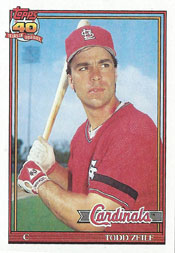
In June 1995, the Cardinals were a franchise in disarray. The depth of their dysfunction was revealed on one dismal day, June 16, when they fired their manager, Joe Torre, and traded their cleanup hitter, Todd Zeile.

todd_zeileRather than signal an inspiring beginning, the moves had the feel of surrender.

The termination of Torre largely was viewed as a lame effort to deflect attention from management’s shortcomings.

The trading of Zeile largely was viewed as spiteful.

A bad team

After being named Cardinals manager in August 1990, Torre led the Cardinals to winning seasons each year from 1991 through 1993. His best record was 87-75 in 1993. When the Cardinals fell to 53-61 in strike-shortened 1994, Torre’s friend, general manager Dal Maxvill, was fired and replaced by Walt Jocketty.

By then, the Anheuser-Busch ownership of the Cardinals seemed more interested in minimizing expense to enhance profitability than it did in investing in the team.

After splitting their first 18 games, the 1995 Cardinals lost 10 of their next 13 and fell to 12-19.

“This is a bad team and someone must pay the price,” columnist Bob Nightengale wrote in The Sporting News. “They don’t have a marquee power hitter. They’re awful defensively. They have no speed.”

Published reports indicated Cardinals president Mark Lamping was pressuring a reluctant Jocketty to appease a restless fan base by changing managers.

Cheap PR move

On the morning of June 16, with the Cardinals’ record at 20-27, Jocketty went to Torre’s home and informed him he was fired.

“It didn’t surprise me,” Torre told Rick Hummel of the St. Louis Post-Dispatch.

His overall record as Cardinals manager: 351-354. “We worked hard and we did a lot of things,” Torre said. “We just didn’t win enough.”

Said Jocketty: “We will not stand pat and let things keep going as they were.”

Unimpressed, Post-Dispatch columnist Bernie Miklasz concluded the Cardinals “dumped a classy guy, Torre, to feed the wolfpack.”

“All I see is a cheap PR move.” Miklasz wrote. “All I see is a twitch reflex from a panic attack.”

Change the dynamics

After considering Cardinals coaches Chris Chambliss and Gaylen Pitts as candidates to replace Torre, Jocketty chose director of player development Mike Jorgensen. “He is an intense guy … He’ll bring a little fire to the clubhouse as well as to the field,” Cardinals pitcher Tom Urbani said of Jorgensen. Said Jocketty: “I wanted to bring in someone who could change the dynamics a little.”

Jocketty, though, wasn’t done for the day. Next, he dealt Zeile.

Deal or no deal

Zeile was batting .291 with five home runs and 22 RBI as the first baseman and cleanup hitter for the 1995 Cardinals. In June that year, he revealed the Cardinals had reneged on a three-year, $12 million handshake agreement he said they made in April.

Lamping was furious and said, “There never was a deal with Todd Zeile.”

The Cardinals were paying Zeile a 1995 salary at a rate of $3.2 million, the Chicago Tribune reported. Zeile opted to seek a 1995 salary of $4.2 million in an arbitration hearing scheduled for June 16, according to the Tribune.

On the night of June 15, the Cardinals offered Zeile a $4 million contract for 1995, the Tribune reported, but he rejected it. “It wasn’t the brightest business decision, but based on principle, I would not accept that offer,” Zeile said.

Rather than go to arbitration, the Cardinals traded Zeile, 29, to the Cubs for pitcher Mike Morgan, 35, and a pair of minor-league players, first baseman Paul Torres and catcher Francisco Morales.

“Todd Zeile was not happy,” Jocketty told the Tribune. “He had asked that we trade him and I have been spending the last couple of weeks trying to accommodate him.”

According to the Post-Dispatch, Jocketty had offered Zeile to the Padres for pitcher Andy Benes, but the proposal was rejected.

“We’re not happy with the chemistry and the focus of this team,” Jocketty said. “If you saw Todd Zeile play, you could see he’s not a real aggressive person in his approach to the game. He was kind of at one gait.”

In seven seasons with St. Louis, Zeile started at three positions _ catcher, third base and first base _ and batted .267 with 75 home runs.

Zeile told Hummel he would depart “with a lot more fond memories than negative,” but added, “Unfortunately, this situation turned kind of ugly at the end. I think it will be better in the long run to go somewhere where I’ll be embraced.”

In comments to the Tribune, Zeile said, “The organization hasn’t made a commitment to the players to win. They should be able to produce winners.”

Miklasz blasted Lamping and Jocketty, saying the Cardinals executives “smeared Zeile, suggesting he was responsible for poor team chemistry. Zeile wasn’t any more at fault than any of the other veterans on the team. Why single him out as the villain?”

Noting the decisions by Jocketty to acquire underperforming third baseman Scott Cooper and pitcher Danny Jackson, Miklasz wrote: “Jocketty traded for Cooper and he’s a nervous wreck. Jocketty signed Jackson and he’s a physical wreck.”

The aftermath

Getting fired by the Cardinals turned out to be a blessing for Torre. He was hired to manage the Yankees and led them to four World Series titles and six American League pennants. Torre was inducted into the Baseball Hall of Fame in 2014.

Jorgensen managed the Cardinals to a 42-54 record and returned to the front office after the season. He was replaced as manager by Tony La Russa, who would lead St. Louis to two World Series championships and three National League pennants and would be inducted into the Hall of Fame with Torre.

Rookie John Mabry replaced Zeile as the Cardinals’ first baseman.

The Cubs signed Zeile for $3.7 million for one year, but he was a bust with them in 1995, hitting .227. He became a free agent after the season and signed with the Phillies.

Zeile played for 11 teams: Cardinals, Cubs, Phillies, Orioles, Dodgers, Marlins, Rangers, Mets, Rockies, Yankees and Expos. He had 2,004 hits and 1,110 RBI in 16 seasons in the majors, and also played in 29 postseason games with the Orioles, Rangers and Mets.

Morgan made 17 starts for the 1995 Cardinals and was 5-6 with a 3.88 ERA. The next year, he was 4-8 with a 5.24 ERA for St. Louis before he was released.

The two minor-league players acquired with Morgan from the Cubs never reached the big leagues.


Read Full Post »

« Newer Posts - Older Posts »