Feeds:
Posts
Comments

Archive for the ‘Managers’ Category

Three months after he was traded by the Giants to the Cardinals, Billy Southworth hit a home run against his former team, providing the winning run in the victory that clinched the first National League pennant for St. Louis.
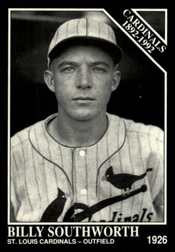
billy_southworth4It was sweet revenge for Southworth, whose deteriorating relationship with Giants manager John McGraw led to the trade.

On Sept. 24, 1926, Southworth broke a 3-3 tie with a two-run home run in the second inning, carrying the Cardinals to a 6-4 victory over the Giants at the Polo Grounds in New York. The victory gave the Cardinals a three-game lead over the second-place Reds with two remaining.

In a biography of Southworth by author John C. Skipper, Southworth said, “I couldn’t have asked for a better setting, in the Polo Grounds against the Giants who had traded me. That was the timeliest home run I ever hit and to have hit it against the Giants, with McGraw snarling his defiance from the bench, made it doubly thrilling and satisfying.”

Quite a comeback

Southworth, a right fielder, was traded by the Giants to the Cardinals on June 14, 1926. “I was unable to subordinate myself to McGraw’s rigid system,” Southworth explained. “So when he decided, in 1926, that I was, from his viewpoint, hopeless, he traded me with no personal feeling one way or the other.”

Contributing to their pennant push, Southworth hit .317 in 99 games for the 1926 Cardinals.

To pitch the potential pennant clincher against the Giants, Cardinals manager Rogers Hornsby chose 20-game winner Flint Rhem as his starter.

After the Cardinals failed to score in the top of the first against Hugh McQuillan, Bill Terry slugged a three-run home run off Rhem in the bottom half of the inning.

Said Southworth: “Hornsby poured acid on us when we came back to the bench. He told us we hadn’t been taking our full cuts at the ball for several games and to get out there and swing.”

Hornsby’s words woke up the Cardinals.

In the second, Les Bell doubled and, with one out, advanced to third on a wild pitch. Bell scored on Bob O’Farrell’s infield single. The No. 8 batter in the order, Tommy Thevenow, doubled, moving O’Farrell to third.

Rhem was due up next, but Hornsby lifted him for a pinch-hitter, Specs Toporcer.

Toporcer, who hit .391 as a pinch-hitter for the 1926 Cardinals, drilled a two-run double, tying the score at 3-3.

After Taylor Douthit flied out, Southworth batted and hit his home run into the upper deck in right field, giving the Cardinals a 5-3 lead.

Bill Sherdel, who relieved Rhem, held the Giants to one run in eight innings and got the win. Boxscore

Dancing downtown

In downtown St. Louis that Friday afternoon, the game was broadcast over loudspeakers set up for the public.

When Sherdel nailed down the final out, sealing the Cardinals’ victory, it “loosed bedlam in the downtown district,” according to the St. Louis Post-Dispatch.

“Scenes comparable only with the ending of the Great War were enacted in the business section and repeated upon a smaller scale in other centers of the city’s life,” the newspaper reported. “Blizzards of paper enveloped every office building in the downtown area between Twelfth Boulevard and Fourth.”

Wrote the Associated Press: “Traffic at the principal corners was in a hopeless jam. Policemen, trying vainly to keep some semblance of order, were unable to keep the automobiles and street cars moving. Parades formed on Olive Street, Washington Avenue and other principal thoroughfares.”

At the Polo Grounds, the victorious Cardinals “merely smiled as they hurried to the clubhouse, shaking hands and slapping one another on the back” wrote the Associated Press.

That night, reported J. Roy Stockton in the Post-Dispatch, “as the young men sat around the lobby of the Alamac Hotel, accepting congratulations and reading telegrams from friends back home, they appeared suddenly to have knocked 10 years off their age.”

Confident Cards

Contacted by the Associated Press, Cardinals owner Sam Breadon said, “Nothing could possibly have made me happier than the winning of the pennant. When I took charge of the club seven years ago, I did it with the sole hope of winning a championship for St. Louis.”

Asked about the Cardinals being matched against the American League champion Yankees in the 1926 World Series, Hornsby boasted to The Sporting News, “Of course we are going to win the world’s championship. We have the punch and that means we do not fear the Yankees’ pitchers. We have better pitchers of our own, for that matter. Also, a faster fielding team.”

The Cardinals went on to win four of seven games against the Yankees, earning the World Series title.

Previously: How Cardinals got Grover Cleveland Alexander

Read Full Post »

(Updated April 5, 2025)

On the day Ozzie Smith announced his plans to retire as a player, there was as much focus on his icy relationship with manager Tony La Russa as there was on his Hall of Fame career.

ozzie_smith9On June 19, 1996, Smith tearfully said he would retire after the Cardinals’ final game of the season. “I feel the time is here now,” Smith, 41, said to the Associated Press. “This is the best time. I’m ready for it.”
Impacting Smith’s decision, though, was his demotion to a reserve role at shortstop behind Royce Clayton, 26.

“I know that if I chose to do it I could play somewhere else,” Smith said to Rick Hummel of the St. Louis Post-Dispatch, “but my thinking was to finish my career as a St. Louis Cardinal.”

Smith used the attention created by his retirement announcement to express his unhappiness with La Russa.

Post-Dispatch columnist Bernie Miklasz wrote, “Unfortunately, Ozzie didn’t make it through (the day) without sniping at La Russa. Let’s hope the sourness will clear.”

Communication breakdown

Smith, who won 13 consecutive Gold Glove awards from 1980-92, went to spring training in 1996 determined to compete with Clayton for the starting shortstop job. La Russa, in his first year as Cardinals manager, said the player who performed best in spring training would be the shortstop during the season.

“I was told that the position would be earned in spring training,” Smith said at his retirement announcement. “I thought I did that.”

When La Russa declared Clayton the regular shortstop, Smith said he believed the manager hadn’t done what he said he would.

“This was the most disappointing thing in my career in St. Louis,” Smith told Hummel at the retirement announcement. “All I can go by is a person’s word. Going into spring training, I knew I had a job to do and I did that job.”

In response, La Russa said of Smith, “It’s fair to say he misunderstood how he compared to Royce in spring training. By what he was able to do defensively and on the bases, Royce deserved to play the majority of the games. Royce is capable of making more plays.”

Strain remains

Irked that Smith had brought up the controversy at the retirement announcement, La Russa complained to Hummel, “It doesn’t go away. It’s a constant irritation for him and for me _ his misunderstanding of that.”

Responding to a suggestion that the Cardinals owed a player of Smith’s caliber the chance to play regularly, La Russa said, “You can’t put a player ahead of any club … We don’t owe anybody. If Stan Musial comes back tomorrow and says, ‘I want to play’ _ that’s not what you do.”

Acknowledging that “there is a strain in the relationship” between he and Smith, La Russa added, “I’ll always feel like there’s a little edge in our relationship. I don’t think that ever will go away.”

Blame game

The next day, before the Cardinals faced the Expos at Montreal on June 20, 1996, Smith responded angrily to La Russa’s comments about Clayton performing the best in spring training.

“That’s cowardice as far as I’m concerned,” Smith told Hummel, “but should I expect anything different?”

Said La Russa of Smith: “All he’s got to do is look in the mirror and he can go out with honor and dignity rather than some kind of attempt at camouflage. I thought the purpose of his (retiring) was to be a positive influence on our ballclub. It doesn’t sound too positive to me.”

In a followup column, Miklasz reiterated that Smith is “a civic treasure” who “deserves a statue outside Busch Stadium,” but gave Smith an error for fueling the feud with La Russa.

“Ozzie is embarrassing himself … The only reputation that will be damaged is Ozzie’s,” Miklasz wrote.

In looking back on that 1996 tension with Smith, La Russa told Cardinals Yearbook in 2014, “Ozzie thought he played the best in spring training. It was obvious to us Royce would play better over 162 games. Both had a really important spot.”


Read Full Post »

(Updated May 12, 2019)

In one of the most intriguing incidents in the long rivalry between the Cardinals and Dodgers, two of baseball’s most colorful characters, Leo Durocher and Casey Stengel, escalated a war of words into a post-game fight.

stengel_durocherThe animosity between the two was so strong Stengel brought a bat to the showdown.
Their tangle under the stands at Ebbets Field in Brooklyn occurred on May 12, 1936. Durocher was the Cardinals’ shortstop and Stengel was the Dodgers’ manager.

The Dodgers pummeled Dizzy Dean with 13 hits in eight innings and won, 5-2. Boxscore

Tempers flare

Throughout the game, Durocher, the Cardinals’ captain, and Stengel hollered at one another across the field.

“Stengel made the mistake of being personal,” the St. Louis Post-Dispatch reported. “He ought to have been in baseball long enough to think up something funny to say without casting reflections on a man’s ancestors.”

At some point during the bickering, Stengel told Durocher he’d see him after the game, The Sporting News reported.

According to the Post-Dispatch, the two had the following exchange on the field:

Durocher: “If you have nerve enough to say to my face what you’ve been saying under the protection of the ballgame, I’ll be surprised.”

Stengel: “I’ll be there _ and I’ll have a bat with me.”

Durocher: “You’ll probably need a bat.”

The Sporting News reported a different version. It said Durocher replied to Stengel, “You’d better have a bat with you.”

After the game, Durocher and Cardinals manager Frankie Frisch were in a runway that led from the dugout to the clubhouse under the stands when Stengel, holding a bat, confronted his nemesis.

In published accounts, Durocher and Stengel told different versions of what happened next.

Durocher’s version

According to the Post-Dispatch, Durocher went after Stengel and Stengel swung the bat. Durocher “took a glancing blow from the wooden weapon and then went to work on the disarmed Stengel,” the Post-Dispatch reported. “He landed a right to the mouth, cutting the Stengel lip and was swinging eagerly when dozens of pairs of arms seized him. He looked around and the runway was full of Dodgers players.”

The St. Louis Star-Times reported Durocher “took credit for landing a square right to Stengel’s mouth” and said Durocher admitted “Stengel struck him a glancing blow with the bat.”

“When we came out of the dugout under the stands, Stengel was waving the bat and shouting, ‘Don’t you come near me. I don’t want any trouble with you. I’ll hit you with this bat if you do,’ ” Durocher told the Star-Times. “I rushed in and in so doing got hit with the bat, right across the right ear, but I got in a few punches before what seemed like the entire Brooklyn ballclub landed on me.”

Frisch was knocked to the ground in the melee, the Star-Times reported.

Stengel’s version

According to the Brooklyn Daily Eagle, when Durocher made for Stengel in the runway, Stengel “dropped the bat and moved into close quarters, punching.”

Stengel said he hit Durocher with his fists.

“Stengel had his right hand behind Durocher’s head and was messing up the Durocher features with short, jolting left uppercuts,” according to the Daily Eagle.

“That fresh boob is lucky I didn’t knock out his few brains with that bat,” Stengel said, “but nothing like that was necessary. He can’t hit any harder with his fists than he can with a bat.”

Bruised egos

The Sporting News dubbed the incident, “Casey and His Bat.”

According to the Post-Dispatch, Durocher had a red mark “as big as a pencil” where the bat grazed the bridge of his nose. Stengel suffered a split lip.

The Daily Eagle reported Durocher “had bruised and slightly cut Casey’s mouth with a couple of long punches.”

National League president Ford Frick didn’t issue any fines because he said the fight occurred out of sight from the public, not on the field.

Hate to lose

After the season, the Dodgers fired Stengel. A year later, in October 1937, the Cardinals traded Durocher to the Dodgers. He became Dodgers manager in 1939.

Stengel eventually landed with the Yankees and won seven World Series titles and 10 American League pennants from 1949-60. Durocher won National League pennants with the Dodgers in 1941 and with the Giants in 1951 and 1954. His 1954 Giants brought him his lone World Series title as a manager. Cardinals owner Gussie Busch wanted to hire Durocher as manager in 1964 but changed his mind after the club won the World Series championship.

In 1951, in their only World Series matchup, Stengel’s Yankees won four of six games against Durocher’s Giants.

In his book “Nice Guys Finish Last,” Durocher said, “I would make the loser’s trip to the opposing dressing room to congratulate the other manager because that was the proper thing to do. But … I didn’t like it. You think I liked it when I had to go see Mr. Stengel and say, ‘Congratulations, Casey, you played great?’ I’d have liked to stick a knife in his chest and twist it inside him.”

Stengel and Durocher were elected to the National Baseball Hall of Fame for their achievements as managers.

Previously: Like Tony La Russa, ailing Casey Stengel left club


Read Full Post »

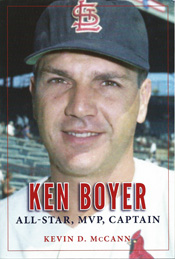
Ken Boyer is deserving of a book that accurately and completely tells his story. Fortunately, “Ken Boyer: All-Star, MVP, Captain” by Kevin D. McCann delivers.

ken_boyer_bookProduced by BrayBree Publishing, this Boyer biography is a must-read for a Cardinals fan as well as for anyone who appreciates baseball, clean writing and superb research.
McCann covers every aspect of Boyer’s life and career in a compelling and richly detailed narrative. Though McCann clearly admires Boyer, this book isn’t a sugarcoated story. McCann takes readers behind the scenes of the 1950s and 1960s Cardinals in an honest and fact-based style.

Also, the book is filled with rare photos of Boyer and his teammates. The photos alone are worth buying the book.

I have a bookcase filled with Cardinals books. “Ken Boyer: All-Star, MVP, Captain” has a place on the top shelf with the best of my collection.

Here are some of the insights the book provides:

_ After the 1954 season, Cardinals general manager Dick Meyer wanted to acquire Yankees catching prospect Elston Howard, a St. Louis native. Meyer offered the Yankees their choice of one of several minor-league shortstops in the Cardinals’ system. The trade talks ended when the Yankees asked for Boyer, a third baseman with the Cardinals’ Texas League affiliate at Houston.

_ Boyer played winter baseball in Cuba after the 1954 season. Pirates executive Branch Rickey, formerly of the Cardinals, scouted Boyer in Havana and filed a glowing report.

“At third base, I saw the best ballplayer on first impression that I have seen in many a day,” Rickey wrote. “Boyer by name. He can run with very deceptive speed … Never loafs. He has big hands and knows what to do with them.”

_ Cardinals manager Fred Hutchinson didn’t care for what he perceived as Boyer’s laid-back disposition. “Boyer has everything he needs to be a great player except one thing,” said Hutchinson. “He has to develop more drive, more aggressiveness. He doesn’t push enough.”

_ After the 1957 season, Cardinals general manager Frank Lane wanted to trade Boyer to the Pirates for outfielder Frank Thomas and third baseman Gene Freese, but club owner Gussie Busch and executive vice president Dick Meyer rejected the deal. Soon after, Lane resigned and became general manager of the Indians.

_ Bing Devine, Lane’s replacement, was tempted by a Phillies trade offer of outfielder Richie Ashburn and pitcher Harvey Haddix for Boyer, but rejected the proposal. Said Boyer: “I told my wife that if I’d have been the Cardinals, I’d have made that trade.”

_ Tim McCarver, longtime St. Louis catcher, told the author that on the Cardinals “(Stan) Musial was the star, but Kenny was the leader. No doubt about it.”

_ The work relationship between Boyer and Musial was one of mutual respect. “Stan had probably as much influence on my career as anyone,” Boyer said.

_ The grand slam Boyer hit to win Game 4 of the 1964 World Series came on a changeup from Al Downing after the pitcher had shook off catcher Elston Howard’s call for a fastball. “He got the ball up in my eyes and that’s where any hitter likes to swing,” Boyer said.

_ After his playing career ended, Boyer was offered a chance to manage in the Dodgers’ minor-league system. He instead accepted an offer from Devine to manage the Cardinals’ Class AA club at Arkansas in 1970 because he preferred to return to the Cardinals’ organization.

_ The Cardinals fired manager Red Schoendienst after the 1976 season. Boyer was one of three finalists for the job. The others: Vern Rapp and Joe Altobelli. The Cardinals chose Rapp, in part, because they thought Boyer was too much like Schoendienst. Rejected, Boyer became a manager in the Orioles’ farm system.

_ After the 1977 season, Boyer was runner-up for big-league manager jobs that went to Bobby Cox with the Braves and George Bamberger with the Brewers.

_ The Cardinals fired Rapp in April 1978 and replaced him with Boyer. “It was difficult to imagine the same people who had made the decision a year ago changing their minds and giving me another opportunity,” Boyer said.


Read Full Post »

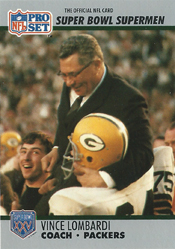
In his approach to managing the Cardinals, Mike Matheny adheres to a philosophy practiced by Vince Lombardi, with roots in Jesuit doctrine.

vince_lombardiMeeting with media before the Cardinals began workouts on Feb. 27, 2016, at their Jupiter, Fla., training base, Matheny was asked by columnist Mike Bauman of MLB.com about how the Cardinals, after attaining 100 wins in 2015, could improve in 2016.
Matheny provided an answer that recalled one of the leadership principles of Lombardi, who transformed the Green Bay Packers into NFL champions in the 1960s.

Lombardi, educated by Jesuits at Fordham University, believed in pursuing perfection. Like the Jesuits, Lombardi understood that perfection is humanly impossible, but he relished the challenge of the journey, experiencing how close one could come to achieving it.

Matheny philosophy

Matheny expressed the same belief.

“The idea is, we’re shooting for perfection, shooting for it while also knowing that it is not attainable,” Matheny said. “But the pursuit of it is. The idea really makes limitless expectations for ourselves, because we’re always pushing.

“And I think as each individual takes that perspective, we get into the place where we as a group always have a higher ceiling.

“So we don’t put a number as far as wins out there … It’s ‘How can we be better, each of us in what we do, and what we bring to the table?’ And then, with that being the case, keep pushing the needle forward.”

Lombardi philosophy

In his 1999 biography of Lombardi, author David Maraniss reported that Lombardi called the pursuit of perfection “a man’s personal commitment to excellence and victory.”

“Perfection was to be considered on a more ethereal realm than mere competition,” Maraniss wrote. “Winning was part of it, but not all of it. His mother, Matilda, had instilled in Lombardi an anxious perfectionism.

“The Jesuits had taught him that human perfection was unattainable, but that all human beings should still work toward it by using their God-given capacities to the fullest.”

Said Lombardi: “Complete victory can never be won. It must be pursued. It must be wooed with all of one’s might … The spirit, the will to excel, the will to win _ they endure, they last forever. These are the qualities, I think, that are larger and more important than any of the events that occasion them.”


Read Full Post »

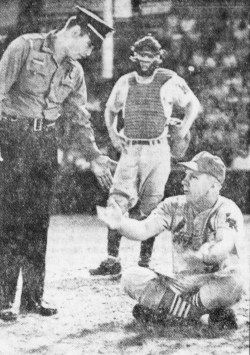
Vern Rapp, rebel? Indeed. As a manger in the Cardinals’ system, Rapp challenged authority in a manner that would have made the hairs on Al Hrabosky’s Fu Manchu stand on end.

vern_rapp2Known as an unyielding disciplinarian for implementing a policy against facial hair while Cardinals manager in 1977, Rapp clashed with several Cardinals players, including Hrabosky, who grew a Fu Manchu moustache while developing a persona as “The Mad Hungarian.”

They may have been surprised to learn Rapp once caused such a fuss in an argument with an umpire that a police officer was called onto the field to intervene.

Sit down strike

Rapp, manager of the Cardinals’ Class AA Arkansas club, staged a protest by sitting on home plate after being ejected following a dispute with umpire Larry Barnett in a game at Albuquerque, N.M., on Aug. 13, 1966.

When Rapp refused to move, the umpire called police, who escorted Rapp from the field.

Photographs show police officer Fred Leyva standing over Rapp at home plate while Arkansas catcher Danny Breeden watches the drama unfold.

According to the Albuquerque Journal, “Rapp actually sat down on home plate and didn’t leave until a policeman talked him into leaving.” Rapp “had to be escorted off the field” by the officer, the newspaper reported.

Wrong word

The incident began when Rapp argued a close play at second base. Frank Godsoe, associate sports editor of the Amarillo Daily News, reported this exchange:

Barnett: “One more peep out of you and you’re out of the ballgame.”

Rapp: “Peep.”

That did it. Barnett ejected Rapp, who refused to leave because he felt the punishment didn’t fit the crime. Rapp said it was the first time he’d been ejected for saying the word “peep.”

“Before a ballgame, he is as friendly as a collie dog,” Godsoe wrote of Rapp. “Once in a game, he’ll use anything up to poison gas to try to beat you. He is a tough loser and in the heat of battle he can erupt like a volcano.”

Godsoe asked Texas League president Hugh Finnerty which manager in the league was toughest on umpires. “Vern Rapp,” Finnerty replied.

Rapp likely was fined $25 for the ejection, Godsoe reported.

No harm, no foul

The theatrics didn’t damage the careers of Rapp or Barnett

Barnett became a big-league umpire in 1969 and stayed on the job through 1999.

Rapp managed Arkansas to an 81-59 record in 1966 and was named Texas League manager of the year.

He managed Arkansas again in 1967 and 1968 before leaving the Cardinals’ organization to join the Reds as manager of their Class AAA Indianapolis team.

Rapp, a St. Louis native, managed Class AAA clubs through the 1976 season before getting his first big-league managing chance with the 1977 Cardinals, replacing Red Schoendienst.

Previously: The pitfalls of Cardinals rookie manager Vern Rapp

Read Full Post »

« Newer Posts - Older Posts »