Feeds:
Posts
Comments

Archive for the ‘Managers’ Category

(Updated Feb. 2, 2022)

Whether mentoring a future Hall of Famer or helping a prospect change positions, George Kissell compiled a string of impressive successes as a minor-league manager in the Cardinals system.
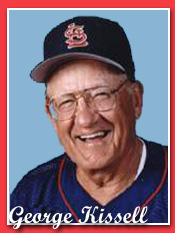
george_kissellKissell worked in the Cardinals organization from 1940 (when he started as a player in Class D) until his death at 88 in 2008. He was a Cardinals coach from 1969-75 and a longtime instructor. He also managed Cardinals minor-league clubs from 1948-57 and 1961-68.

The top 5 most interesting facts about George Kissell as a manager in the St. Louis system:

Educating Earl

Earl Weaver, the St. Louis native who was elected to the National Baseball Hall of Fame after managing the Orioles to four American League pennants and a World Series championship, played three seasons for Kissell in the Cardinals’ organization.

A second baseman, Weaver, 19, hit .276 with 20 doubles in 127 games for a 1950 Winston-Salem team managed by Kissell. Winston-Salem won the Carolina League championship with a 106-47 record.

In 1951, Kissell managed Weaver at Omaha. Weaver hit .279 with 35 doubles in 142 games. Omaha won the Western League title with a 90-64 mark and Weaver was named to the league’s all-star team.

Kissell and Weaver returned to Omaha in 1952. Weaver hit .278 with 15 doubles in 97 games. Omaha finished 86-68 under Kissell.

Weaver played in the Cardinals’ system from 1948-53. With three consecutive seasons playing for Kissell, it’s reasonable to assume the lessons and fundamentals Weaver learned from Kissell helped him become one of the game’s best managers.

Pitcher to third

Ken Boyer began his first two minor-league seasons, 1949-50, as a pitcher in the Cardinals’ system. During the 1950 season, he became a third baseman.

In 1951, Boyer, 20, played his first full season as a third baseman for an Omaha club managed by Kissell. Boyer hit .306 with 28 doubles and 14 homers, launching him on a path that would lead to him winning five Gold Glove awards and a 1964 National League Most Valuable Player Award with the Cardinals.

When Boyer missed some games with Omaha because of an injury, Kissell, 30, filled in for him at third base.

Power prospect

Playing for Kissell with the 1957 Winston-Salem team, Gene Oliver, 22, established himself as a Cardinals power-hitting prospect. Oliver, a first baseman and catcher, hit 30 home runs, breaking the Winston-Salem club record held by Steve Bilko.

Two years later, Oliver was called up by the Cardinals. beginning a 10-year career in the major leagues, including four seasons with St. Louis.

Comeback trail

After the Giants released minor-league third baseman Coco Laboy, he was signed by the Cardinals. Playing for Kissell at Raleigh in 1964, Laboy revived his career, hitting .340 with 29 doubles and 24 home runs in 112 games.

Chosen by the Expos in the 1968 expansion draft, Laboy was the starting third baseman for Montreal in its first two National League seasons, 1969 and 1970.

Prized potential

In 1967, Kissell managed a pair of teenagers in their first year as professional players: catcher Ted Simmons, 17, and pitcher Jerry Reuss, 18. Simmons was selected by the Cardinals in the first round of the June 1967 draft; Reuss was a second-round choice.

The first place the Cardinals sent them was to their Gulf Coast League club managed by Kissell.

Simmons hit .350 in six games for the Gulf Coast League Cardinals. He would go on to a 21-year big-league career, collecting 2,472 hits and 1,389 RBI.

In his Hall of Fame induction speech, Simmons said, “It was George Kissell, the Cardinals’ Mr. Everything, who had the greatest impact on me. He taught me fundamental baseball and how to play to win. I also learned from George how to win and lose with grace. He gave me my first taste of humility.”

Reuss was 0-0 with a 5.14 ERA in two appearances for Kissell’s team. Reuss would go on to a 22-year big-league career, earning 220 wins.
Read Full Post »

(Updated April 23, 2020)

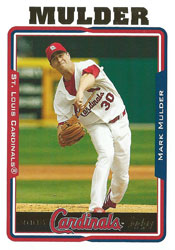
In the last classic pitchers duel at Busch Memorial Stadium, Mark Mulder gave the best performance of his Cardinals career, tossing 10 shutout innings and beating Roger Clemens and the Astros.

mark_mulder2On April 23, 2005, in the Cardinals’ final season at the ballpark that had been their home since 1966, Mulder pitched a masterpiece in a 1-0 victory.

Mulder, a left-hander, threw an efficient 101 pitches and faced 33 batters, three more than the minimum for 10 innings. Each of the Astros’ five hits was a single.

Clemens, 42, winner of seven Cy Young awards, was as good as expected, holding the Cardinals scoreless on four hits in seven innings before being relieved by Chad Qualls.

Mulder, 27, making his fourth Cardinals start after coming to St. Louis from the Athletics in a December 2004 trade, was up to the challenge of being matched against Clemens.

In a ballpark that had been the site of gems by Cardinals pitchers such as Bob Gibson, Steve Carlton, Bob Forsch, Joaquin Andujar and John Tudor, Mulder’s performance ranked among the best. It was the last 1-0 game played at Busch Memorial Stadium.

“Somewhere, Bob Gibson was smiling,” St. Louis Post-Dispatch columnist Bernie Miklasz wrote. “This was Gibby’s kind of hardball.”

Throwing strikes

Mulder became:

_ The first Cardinals starter to pitch an extra-inning shutout win since John Tudor did so on Sept. 11, 1985, in a 1-0 St. Louis victory over the Mets.

_ The first Cardinals starter to go 10 innings since Jose DeLeon went 11 against the Reds in a 2-0 Cincinnati victory on Aug. 30, 1989.

_ The first Cardinals starter to go 10 innings and win since Greg Mathews did so against the Mets in a 3-1 St. Louis victory on Aug. 16, 1986.

_ The first major-league starter to pitch a 10-inning shutout win since Roy Halladay of the Blue Jays did so against the Tigers in a 1-0 Toronto victory on Sept. 6, 2003.

“Any time it’s a 0-0 game or 1-0 game or 1-1, I love that,” Mulder told reporter Joe Strauss. “It makes me focus … I’m throwing strike one. I’m getting ahead. It’s enabling me to do a lot more things as far as working both sides of the plate.”

Said Cardinals pitching coach Dave Duncan: “He’s really changed his delivery, which has allowed him to repeat pitches better.”

Dodging trouble

In the fourth inning, Mulder escaped serious injury. Mike Lamb’s bat shattered when he hit a ground ball to second. The barrel of the bat struck Mulder on the ankle and he doubled over in pain. “It hit me right in a spot where it made my whole foot go numb,” Mulder said to MLB.com.

Feeling quickly returned to the ankle, though, and Mulder was able to continue.

Before sending Mulder to pitch the 10th, Cardinals manager Tony La Russa consulted with the pitcher. “He said he was OK to go,” La Russa said.

After setting down the Astros in the top half of the extra inning, Mulder was scheduled to lead off the bottom of the 10th. Reggie Sanders batted for him and produced an infield single. “It was a swinging bunt that feels just as good as a ringing line drive,” Sanders told the Associated Press.

Walker walkoff

The Cardinals capitalized on Sanders’ hit.

On a hit-and-run, David Eckstein grounded out, advancing Sanders to second.

With Larry Walker up next, Astros manager Phil Garner replaced Chad Qualls with Brad Lidge. Walker lined a hit into the right-center gap, scoring Sanders with the lone run. Boxscore and Video

“It was a fastball, down and away, and he reached for it,” Lidge said. “I’m not upset about the pitch at all.”

Said Walker: “To put the ball in play off (Lidge) is tough to do … He’s got phenomenal stuff.”

The victory gave La Russa 2,125 career wins as a major-league manager, moving him into a tie for fifth place with Joe McCarthy. “You win with great organizations and great players,” La Russa said. “I’ve been lucky enough to have had both.”

Read Full Post »

When the 1945 Cardinals reported to spring training at Cairo, Ill., they found the outfield better suited for fishing than for chasing fly balls. Unable to have fielding or batting practice because of flooding at Cotter Field, the Cardinals abandoned the Illinois river town and conducted spring training at Sportsman’s Park in St. Louis.

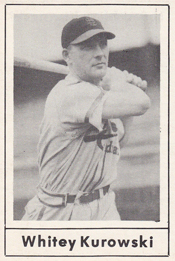
whitey_kurowskiIn March 1945, the defending World Series champion Cardinals planned to hold spring training in Cairo for the third consecutive year. St. Petersburg, Fla., was the Cardinals’ spring training base, but the Redbirds, like all big-league clubs, trained at sites closer to home from 1943-45 in order to conserve resources through reduced travel during World War II.

Training at Cairo worked well for the Cardinals in 1943 and 1944. They had more than 100 wins and earned a National League pennant in each of those years, including a World Series title in 1944.

River runs through it

Cairo is located on the southern tip of Illinois, where the Ohio River flows into the Mississippi River. In March 1945, rain swelled the rivers. Even with walls and levees protecting the town, water seeped into the ballpark used by the Cardinals.

The stages of the rivers were 10 feet above the level of the ballpark, according to the Associated Press. Under orders from club owner Sam Breadon, Cardinals traveling secretary Leo Ward searched throughout Cairo for an alternative spot to conduct batting and fielding practice, “but he mired in mud and returned gloomily to the hotel.”

“There was talk of moving the training camp back to St. Louis as early as March 13, the second day the players were in camp,” The Sporting News reported. “However, Breadon gave the Cairo people a few days more to get their park in shape.”

Losing battle

Cairo Mayor E.A. Smith and city fire and street departments “did everything they knew to get the field in shape. They dug draining ditches and put the fire pumps to work in the outfield, but each morning a new film of seepage water covered the infield,” The Sporting News wrote.

In a story filed on March 19, 1945, the Associated Press reported, “The outfield of the practice diamond was under four feet of water and it appeared doubtful that the park would be useable for baseball during the two weeks the team will be in town.”

Among those in camp for the Cardinals were pitchers Max Lanier, Blix Donnelly and Bud Byerly, first baseman Ray Sanders, second baseman Emil Verban, third baseman Whitey Kurowski, outfielder Debs Garms and rookie Red Schoendienst.

A picture in The Sporting News showed Kurowski, Lanier and Sanders casting fishing lines in the outfield water.

Ohio option

Coach Mike Gonzalez was running the club while manager Billy Southworth was at home in Sunbury, Ohio, after spending weeks in New York while joining in a mission to search for his son, who was killed in a crash of a B-29 he was piloting.

Southworth was trying to find a training site for the Cardinals in Ohio. “Breadon announced Southworth is looking for a place and that the squad will leave (Cairo) if satisfactory arrangements can be made,” the Associated Press reported.

The Sporting News revealed Southworth wanted to bring the Cardinals to Miami University in Oxford, Ohio, where the minor-league Columbus and Rochester teams were training.

“Miami University officials hustled around to find living quarters for the Cardinals and a series of games among the three clubs was being worked up,” The Sporting News wrote. “Manager Billy Southworth … believed the arrangement was set, but owner Sam Breadon vetoed the move to Oxford.”

Homeward bound

Breadon ordered the team instead to return to St. Louis. The last time the Cardinals had spent spring training at home was in 1919. The reason then was lack of finances.

Wrote The Sporting News of the deteriorating conditions in Cairo: “For a week, the Redbirds had no real baseball work. They indulged in pepper games on a hard cinder footing, did some throwing, running and calisthenics but had no batting practice or real infield workout … A soggy infield, no batting practice for five days and fishing in the outfield quickly convinced (Breadon) that he had to act quickly.”

Said Breadon: “Oh for a return to good old St. Petersburg.”

The Cardinals began workouts at Sportsman’s Park on March 26, 1945, and opened the season on April 17 at Chicago.

The disrupted spring training didn’t appear to hurt them much. The 1945 Cardinals had 95 wins and finished in second place, three games behind the Cubs.

Previously: Why the Cardinals chose Cairo, Ill., for spring training

Previously: Why Billy Southworth managed Cardinals with heavy heart

Read Full Post »

Instead of working with established big-leaguers, Bob Gibson spent the spring training of 1995 teaching basic grips to pitchers who normally would have had no chance to be in a Cardinals camp.

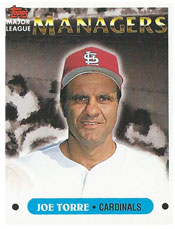
joe_torre6Spring training in 1995 was an odd, depressing experience for the Cardinals and other big-league teams because of the labor dispute between players and owners.

The players’ strike that began in August 1994 carried into spring training 1995. None of the players on the Cardinals’ big-league roster reported to camp at St. Petersburg, Fla. Instead, the Cardinals, like other clubs, brought in replacement players.

Hall of Fame helper

Manager Joe Torre and his staff were required to train the replacement players, with the intent of having them ready to open the regular season on April 3.

Gibson, the Hall of Fame pitcher who carried the Cardinals to two World Series championships, was hired by Torre to be a Cardinals coach.

Replacement player Paul Anderson, 26, a right-hander who was a combined 4-6 with a 6.65 ERA for two Cardinals farm clubs in 1994, asked Gibson for assistance in learning the proper grip to throw a slider.

“I was doing it wrong, so I did it the way he taught me,” Anderson told Rick Hummel of the St. Louis Post-Dispatch. “I like it a lot better. I’m learning from the best.”

Scribe and rejects

The 55-player Cardinals replacement team at training camp had no one who had appeared in a major-league game.

In the Cardinals’ exhibition opener against the Indians on March 4 at St. Petersburg, Mike Hinkle started and pitched three scoreless innings for St. Louis. Hinkle, 29, had last played professional baseball in Italy in 1993.

Outfielder Doug Radziewicz, 25, an aspiring journalist who was filing reports from camp for his hometown newspaper in Somerville, N.J., drove in the winning run with a pinch-hit single in the eighth, lifting the Cardinals to a 4-2 victory.

“You can’t judge baseball from one day, but it was well-played,” Torre said after the game. “The thing you’re concerned with is that playing for the first time they’re a little in awe.”

Walt Jocketty, hired in October 1994 to replace Dal Maxvill as general manager, was asked what it was like to watch replacement players instead of big-leaguers in his first Cardinals spring training game. “As long as I’ve got Joe (Torre) here, we can hold hands and go through this together,” Jocketty said.

Wrote Hummel: “There were no pickets, as the striking players earlier had advertised, which was good because the minor leaguers were nervous enough as it was. The clubhouse was very quiet before the game.”

Fans weren’t buying into replacement baseball. Hummel reported the Cardinals were averaging 1,470 tickets sold per exhibition game instead of the usual 5,000. In March, 54 percent of respondents to a Post-Dispatch poll said they probably or absolutely wouldn’t pay to see a game played by replacements.

Chasing a dream

The Cardinals broke camp with a roster of 32 replacement players, intending to open the season with them.

Anderson, Hinkle and Radziewicz were on the Opening Day roster. In a late move, the Cardinals also acquired Glenn Sutko, a catcher who had one hit in 10 at-bats for the 1991 Reds.

Among other replacement Cardinals on the Opening Day roster:

_ Ty Griffin, second baseman. A No. 1 pick of the Cubs in the 1988 amateur draft, Griffin also had played for the U.S. Olympic baseball team. He flopped in the Cubs system and spent the 1994 season with a pair of independent league teams.

_ Larry Shikles, starting pitcher. In eight seasons in the minor league systems of the Red Sox and Athletics, the right-hander compiled a 70-68 record.

_ Howard Prager, first baseman. He hit .239 for the Cardinals’ Class AAA Louisville club in 1994.

_ John “Skeets” Thomas, outfielder. He slugged 17 home runs for Louisville in 1994.

_ Tony Diggs, outfielder. A sixth-round draft choice of the Brewers in 1989, Diggs hit .215 for the Cardinals’ Class AA Arkansas team in 1994.

_ Anthony Lewis, outfielder. An eighth-round draft pick of the Cardinals in 1989, Lewis hit a combined .230 for two St. Louis farm clubs in 1994.

“We went with the players on the morning side of the mountain rather than the twilight side of the hill,” Torre said, explaining why the Cardinals (with the exception of Sutko) chose players without big-league experience.

On April 2, 1995, the day before the season was to open, the 234-day strike ended. The season opener was moved to April 26; spring training was re-opened for players on big-league rosters. The replacement players either were assigned to the minors or released.

Said Torre: “It feels weird starting all over again.”

Read Full Post »

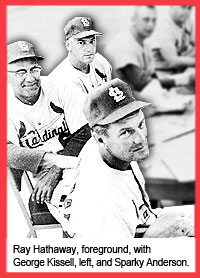
ray_hathawayAs a minor-league manager and pitching instructor for the Cardinals, Ray Hathaway worked closely with fellow teacher and Branch Rickey protégé George Kissell in helping prospects learn the fundamentals.

However, unlike Kissell, who devoted his career to the Cardinals, Hathaway left the organization amid a swirl of controversy.

Discovered by Dodgers

Hathaway, a right-handed pitcher, began his professional playing career in the Dodgers’ organization in 1939. His big-league career consisted of four appearances for the 1945 Dodgers. “My greatest thrill was walking into (Brooklyn’s) Ebbets Field for the first time,” Hathaway told the Asheville Citizen-Times.

Rickey, the Dodgers’ top baseball executive, was impressed by Hathaway, who earned a Bronze Star with the Navy in World War II’s Battle of Guadalcanal.

With the Cardinals, Rickey built a minor-league system that emphasized instruction based on an organizational philosophy. Rickey brought the same approach to the Dodgers. He saw Hathaway as someone who understood the system and could teach it.

In 1947, Rickey named Hathaway manager of the Dodgers’ farm club in Santa Barbara, Calif. It was the first of Hathaway’s 25 seasons as a minor-league manager.

“If I were starting a major-league franchise, I would have Ray Hathaway as my manager,” Bob Terrell, longtime sports editor of the Asheville Citizen-Times, said, according to the Web site MiLB.com. “He had the unique ability to get the most out of his players and was a master of baseball strategy.”

Joining the Cardinals

Hathaway was managing in the Pirates’ system when the Cardinals made him an offer after the 1964 season. He accepted and was named manager of the Cardinals’ Class A affiliate at Raleigh, N.C., in 1965.

Among those Hathaway mentored at Raleigh were future Cardinals pitchers Mike Torrez, Wayne Granger and Sal Campisi. Hathaway, 48, also pitched in a game for Raleigh, giving him 20 seasons as a minor-league player.

In 1966, Hathaway was the Cardinals’ minor-league pitching instructor. Among those also teaching Cardinals prospects then were Kissell, Sparky Anderson, Charlie Metro, Vern Rapp and Ron Plaza. Anderson, Metro and Rapp would manage in the majors.

Kissell, like Hathaway, devoted his career to teaching. Kissell joined the Cardinals’ organization under Rickey as a minor-league prospect in 1940 and worked for the Cardinals until his death at 88 in 2008.

Rookie welcome

After managing the Cardinals’ Class A Lewiston (Idaho) club in 1967, Hathaway replaced Kissell as manager of the Gulf Coast Cardinals rookie league team in 1968, enabling Kissell to become a roving instructor in the minor-league system.

Among the players on the 1968 Gulf Coast Cardinals was third baseman Bob Forsch. In his book, “Tales from the Cardinals Dugout,” Forsch, who would become a Cardinals pitcher, recalled his first encounter with Hathaway on the day he joined the team in Florida after traveling from his home in California.

“I hadn’t slept in almost two days, coming in from Sacramento, so I went up to my room and I overslept,” said Forsch. “I woke up at a quarter to five and I just jumped in a cab. I got to the complex … and ran to the bus. It was leaving right at five for the ballpark where we played the big night games.

“And Ray Hathaway, the manager, came up to me when I was getting on the bus. And the only thing he said to me was, ‘Don’t ever be late.’ That was it.”

Thank you, teacher

In 1969, the Cardinals named Hathaway manager of the Class AA Arkansas Travelers. Among the prospects on that team were future Cardinals outfielders Jose Cruz and Luis Melendez and pitchers Al Hrabosky and Reggie Cleveland.

According to his biography at SABR.org, Cleveland credited Hathaway and Cardinals coach Billy Muffett with teaching him how to pitch at the professional level. Cleveland had pitched for Hathaway at Lewiston and posted a 2.90 ERA with 11 complete games. He was the ace of Hathaway’s Arkansas club, compiling a 15-6 record with 13 complete games and a 3.39 ERA.

Trouble at Arkansas

The 1969 Arkansas team was 66-69 under Hathaway, finishing second to Memphis in the Eastern Division of the Texas League. After the season, Hathaway resigned and stunned the Cardinals by publicly criticizing the Arkansas front office headed by team president Max Moses and general manager Carl Sawatski.

“Ray Hathaway has tossed in the towel as manager of the Arkansas Travelers, firing an angry salvo at the front office as he departed,” The Sporting News reported. “It appears from a statement by Hathaway that in resigning he might have beaten management to the punch.”

Said Hathaway: “The Little Rock club has expressed its desire of not rehiring me as your manager for 1970. This request was made two days before I had planned on making the identical request to (Cardinals farm director) George Silvey. My decision is the result of a great number of problems our players have endured. They are too numerous and insulting to mention …

“Mr. Silvey and the entire (Cardinals) organization exerted themselves to help us succeed in producing a contending club, which we definitely were. This has been done without appreciation from anyone connected with the Little Rock club.”

Arkansas officials referred all comment to Silvey, who said, “It’s unfortunate Ray made a public statement of his grievances. We’re sorry this happened. He’s forthright and outspoken. That’s obvious. I had no idea he was planning anything like this.”

Ken Boyer replaced Hathaway as Arkansas manager. Hathaway spent the next three seasons managing teams in the Cleveland Indians organization. His final season as a manager was 1973 with Wilson, N.C., an independent team in the Carolina League.

Previously: Ron Plaza was mentor to Steve Carlton, Jose Cruz

Previously: Cardinals boosted managing career of Sparky Anderson

Read Full Post »

Four months after reaching the pinnacle of his managerial career with the Cardinals, Billy Southworth was dealt a devastating setback by the tragic death of his son.

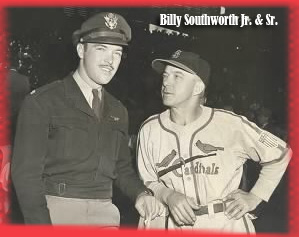
southworthOn Feb. 15, 1945, Major Billy Southworth Jr., son of the Cardinals manager, was killed when the B-29 Superfortress plane he was piloting crashed into Flushing Bay in New York.

The death of Billy Jr., 27, occurred four months after his father managed the Cardinals to their third consecutive National League pennant and second World Series championship in three years.

Baseball to bombers

Like his father, who was an outfielder for five big-league teams, including the Cardinals, Billy Jr. played professional baseball. He was a minor-league outfielder for five seasons, including three in the Cardinals’ system.

In September 1940, while with the Phillies’ Toronto affiliate, Billy Jr., 23, enlisted as a flying cadet in the U.S. Army Air Corps. He went overseas in October 1942. His first B-17 was nicknamed “Bad Check” because, he told the Sporting News, it always bounced back.

Billy Jr. piloted his B-17 on raids of U-boats and other enemy targets over occupied France and Germany. During his 25 combat missions, he wore a Cardinals cap given to him as a gift by his father.

Billy Sr. recalled his son completed those missions in Europe “without ever getting a scratch,” International News Service reported.

“I was just another Joe, occupying a lucky seat with a fine crew,” Billy Jr. said. “I tried to manage ’em like Dad manages his Cardinals.”

Billy Sr. managed the Cardinals to 105 wins or more each season from 1942-44. The Cardinals won the 1942 World Series title versus the Yankees and the 1944 World Series title versus the Browns.

Home front

After serving his full quota of missions in Europe and earning the Distinguished Flying Cross and Air Medal, Billy Jr. returned to the United States and was assigned to training. He met a Hollywood movie producer, Hunt Stromberg, who signed the major to a contract and urged him to pursue a film career after his military service was completed.

In November 1944, Billy Jr. visited his father and stepmother, Mabel, at their home in Sunbury, Ohio.

It would be the last time they’d see their son.

Final mission

Three months later, Billy Jr., with eight crew members and one civilian onboard, took off from Mitchel Field in Long Island on a routine training flight of a B-29 to Miami.

The warplane was near La Guardia Field in New York when Major W.L. Anken, an observer aboard the B-29, noticed heavy smoke from one of the engines. He informed Billy Jr. over the intercom. The pilot replied, “Keep an eye on it.”

Billy Jr. radioed to the La Guardia Field control tower that he would try an emergency landing.

“Witnesses said the bomber’s left outboard motor had stopped when the landing was attempted,” the Associated Press reported. “The pilot nosed the Superfortress up to circle the field.”

The runway was short for such a huge aircraft.

“He was unable to bank on one side because of the disabled engine and the location of the airport tower prevented him from turning the other way,” wrote The Sporting News.

The plane overshot the runway and headed straight toward the icy waters of Flushing Bay.

“The left wing clipped and struck the water,” the Associated Press reported. “The plane somersaulted and crashed” into the bay, then exploded.

The front section of the plane broke off and sunk into 30 feet of water. Billy Jr. and four crew members were killed. Their bodies could not be found.

There were five survivors: four crew members (including Major Anken) and the civilian, a technical expert for the Bendix Corporation of South Bend, Ind. All were seated in the back of the plane and saved by rescuers who fought through fire to reach them.

On the scene

At his home, Billy Sr., 51, received news of the tragedy. He and Mabel immediately prepared to head to New York.

In the book “Billy Southworth: A Biography of the Hall of Fame Manager,” author John C. Skipper wrote, “When they arrived at Flushing Bay, Billy, speaking in a cracked voice, asked someone to point out where the plane had gone down. He gazed at the site, said nothing, and became overcome with emotion.”

Billy Sr. and his wife joined daily search parties on barges in Flushing Bay. Billy Sr. still was in New York when the Cardinals opened spring training. He eventually joined the defending champions in training camp and was managing the club when the 1945 season began.

Closure

On Aug. 4, 1945, after the Cardinals defeated the Pirates in Pittsburgh, Billy Sr. got a call to come to New York. The body of his son had been recovered off Silver Beach in the Bronx on Aug. 3 by a New York Police Department launch.

“As grim as the situation is, my days, weeks and months of waiting have not been in vain,” Billy Sr. told The Sporting News.

From New York, Billy Sr. accompanied his son’s body to Ohio. Billy Jr. was buried with military honors at Green Lawn Cemetery in Columbus on Aug. 7, 1945. Among those attending the service was Casey Stengel, a friend and former teammate of Billy Sr.

Billy Sr. rejoined the Cardinals in New York on Aug. 9, 1945. He managed the Cardinals to 95 wins and a second-place finish. After the season, he accepted a more lucrative offer to manage the Braves.

Wrote Skipper: “For Billy Sr. there was a gaping wound to his soul that would never completely heal. He had lost his son, his pal, his best friend on earth. He would struggle with those thoughts for most of the rest of his life.”

Previously: How a B-17 nearly clipped Cardinals in World Series

Read Full Post »

« Newer Posts - Older Posts »