Feeds:
Posts
Comments

Archive for the ‘Managers’ Category

As Cardinals manager, Branch Rickey either was ahead of his time or hopelessly out of step with the times. Take your pick. Either way, Cardinals owner and president Sam Breadon decided Rickey no longer should be manager.

One hundred years ago, on May 30, 1925, Breadon changed managers, replacing Rickey with Rogers Hornsby. Rickey remained with the club in a front-office role.

The shakeup turned out to be good for the Cardinals. Player-manager Hornsby led them to their first National League pennant and World Series championship in 1926. Focused on baseball operations, vice president Rickey built the Cardinals into a perennial contender.

On shaky ground

After managing the St. Louis Browns (1913-15), Rickey joined the Cardinals and became their manager in 1919. In his first six years, he piloted the club to three winning seasons: 1921 (87-66), 1922 (85-69) and 1923 (79-74). Then the Cardinals took a big step backwards, finishing 65-89 in 1924 and drawing a mere 272,885 at its home games.

Knowing Breadon was considering a change, Rickey offered to resign during 1925 spring training but reconsidered, according to St. Louis Post-Dispatch columnist John Wray. “I look at this team I have put together and I can visualize it winning the flag,” Rickey told Breadon. “I have the stuff here and I want another chance. I think I deserve it because I assembled all this talent.”

Breadon wasn’t convinced. In his autobiography, “My War With Baseball,” Hornsby said Rickey sought his help with Breadon. “I went to Breadon and said that Rickey was the smartest man in baseball,” Hornsby recalled. “Breadon suggested I take the job as manager, but I wasn’t interested.”

Before spring training ended, Breadon formerly offered Hornsby the job, but he declined. “I recommended that Breadon keep Rickey,” Hornsby said in his autobiography. “I also told Breadon that if the Good Lord himself were to … manage this club, he couldn’t do any better. It was a lousy team.”

Decision time

The 1925 Cardinals won five of their first eight, then nosedived, losing seven in a row at home before mostly small crowds.

When the Cardinals were in Pittsburgh for a series with the Pirates, Breadon showed up. On Friday, May 29, Hornsby was having breakfast at the Hotel Schenley when traveling secretary Clarence Lloyd approached him and said Breadon wanted to meet. In his autobiography, Hornsby recalled that as he passed by the table of Rickey and coach Burt Shotton, Rickey said to him, “Breadon wants you to manage the team.”

Hornsby replied, “I don’t want to manage. He knows that.”

“Then will you ask Breadon to give me another chance?” Rickey said to Hornsby. “If he won’t, see if you can get him to let Shotton here be the manager.”

Hornsby said, “OK.”

(In addition to coaching, Shotton managed the Cardinals on Sundays, because Rickey promised his mother before signing his first professional contract that he would abstain from baseball activities on Sundays.)

Hornsby met in Breadon’s room and was offered the job. Hornsby said no.

According to the book “Branch Rickey: A Biography” by Murray Polner, Breadon barked back, “I won’t have any goddamned Sunday school teacher running my team. You’re going to run it.”

In his autobiography, Hornsby said he and Breadon had the following exchange:

Hornsby: “You mean, Rickey’s through?”

Breadon: “That’s exactly right _ as manager.”

Hornsby: “What about Shotton as manager?”

Breadon: “I don’t want any Rickey man either.”

It was agreed Hornsby should think over the proposal and inform Breadon of the decision the next day. “I went back down and told Rickey what Breadon had said,” Hornsby recalled in his autobiography. “Rickey didn’t cuss or anything, but he got pretty mad and said he would sell all his stock in the Cardinals.”

According to the Rickey biography, Rickey said to Hornsby, “Judas priest, the man (Breadon) is stabbing me in the back.”

At the ballpark that day, Hornsby slugged a two-run home run, but the Cardinals lost, dropping their record to 13-23. It turned out to be the last game Rickey would manage. Boxscore

Making the switch

According to his autobiography, Hornsby went to Breadon on Saturday, May 30, and told him “the only way I would be interested in becoming manager would be if I could buy Rickey’s stock … Then baseball could be my business for life.” Breadon assured him that would be arranged. The two agreed Hornsby would become player-manager, effective Sunday, May 31. “I expect him to put new fight into the Cardinals,” Breadon told the Associated Press.

In reporting on the managerial switch, James M. Gould of the St. Louis Star-Times wrote, “The pupil succeeds the master.”

Hornsby, 29, became the youngest manager in the National League. He was a few months older than player-manager Bucky Harris, 28, of the American League’s Washington Senators. Other player-managers in the majors in 1925 included Dave Bancroft of the Braves, Ty Cobb of the Tigers, Eddie Collins of the White Sox, George Sisler of the Browns and Tris Speaker of the Indians.

“I feel that with Rickey as vice president and business manager, and Hornsby as playing manager, we have one of the greatest combinations in baseball,” Breadon told the Post-Dispatch.

He also said to the Associated Press, “Rickey is a valuable man and we want to utilize his knowledge of baseball and his great judgment of players. He is a great organizer and a builder, and that is his sphere.”

Breadon’s words, though, didn’t appease Rickey, who resented being ousted as manager. According to Rickey’s biography, he described Breadon’s action as “clumsily brutal.”

According to author Murray Polner, Rickey felt betrayed and considered leaving the Cardinals to become athletic director at Northwestern University, but his wife Jane talked him out of it.

In his book “Mr. Rickey’s Redbirds,” author Mike Mitchell wrote that Rickey later said, “My fault as a manager … was due to my apparent zeal. I discussed the game every day … as if the game coming up was the game of the year.”

With Rickey out and Hornsby taking over effective May 31, coach Shotton was tasked with managing the Cardinals in the May 30 Saturday doubleheader at Pittsburgh, according to “Mr. Rickey’s Redbirds.” The Pirates won both, totaling eight triples in Game 2. Boxscore

Rickey’s reviews

Reaction to the managerial move mostly was favorable:

_ J. Roy Stockton, Post-Dispatch: “The Cardinals should do well under Hornsby. He will not overmanage the team. If there was any just criticism of Branch Rickey’s regime, it was that he burdened the team with too much management. He tried to pitch for the pitchers and to catch for the catchers … He lacked poise when directing his men … He decided on a plan of action and then … he hesitated, pondered over the danger and changed the plan.”

_ Tommy Holmes, Brooklyn Eagle: “Some attribute the failure of the team to Rickey’s attempt to mastermind the Cardinals. He wanted to do all the thinking that was to be done on the team … Branch exercised his managerial authority by requiring the batter to keep in constant touch with his wagging from the bench. A hitter up there with the bases full, to bust it and nothing else, had to strain his neck getting the signal on every ball pitched.”

_ Henry Farrell, United Press: “Rickey had a lot of trick ideas about handling of a ballclub that made some of the older athletes feel like they were being treated like children. He not only had blackboard talks on baseball but he extended his skull practice to include arithmetic and the grammar school arts and sciences.”

_ John B. Foster, Dayton Daily News: “The greatest weakness of (Rickey) was … his lack of playing instinct. He usually managed to change pitchers at the wrong time … Almost every manager in the National League figured upon his doing the wrong thing at the wrong time … Opposing managers figured they would get away with games if they forced Rickey to change pitchers.”

_ The Sporting News: “The elevation of Hornsby to the management was the most popular choice that could have been made for the fans.”

Different approach

Indeed, fans gave Hornsby a big reception when he was led to the plate by St. Louis mayor Victor Miller and presented with several floral pieces before the start of his managerial debut on Sunday, May 31. During the game, the Post-Dispatch noted “a new spirit exhibited by the players” and “a dash that had been missing for some time.” Hornsby contributed two hits, two walks, two runs scored and a RBI in a 5-2 Cardinals victory over the Reds. Boxscore

The next day, Hornsby started Jesse Haines against the Reds. In four starts for Rickey in 1925, Haines was yanked from the games and lost all four. In his first start for Hornsby, he pitched a complete game and won. Boxscore

A week later, Hornsby bought 1,167 shares of Rickey’s Cardinals stock at $43 a share, a total investment of $50,181, the St. Louis Globe-Democrat reported. As author Mike Mitchell noted, “Upset about being removed as manager, Rickey made an emotional and short-sighted decision.”

Meanwhile, Hornsby canceled the daily team meetings and daily morning workouts that had been the norm when Rickey managed. “You can’t drill for two hours and then get out in the afternoon with all your pep and play some more,” Hornsby explained to the Star-Times.

The Cardinals won 15 of their first 19 games with Hornsby as manager and finished at 77-76. Hornsby’s hitting helped, too. In 1925, he was named recipient of the National League Most Valuable Player Award and led the league in batting average, on-base percentage and slugging percentage for the sixth year in a row.

Read Full Post »

In a race to determine the slowest runner in the National League, the loser was the commissioner of baseball, and he didn’t even run.

A pair of catchers, Del Rice of the Cardinals and Rube Walker of the Dodgers, were the contestants in what Bob Broeg of the St. Louis Post-Dispatch described as “a snail versus tortoise match race.”
When some of the Cardinals made small, friendly wagers with their Dodgers counterparts on which of the two leadfoots would win, heavy-handed baseball commissioner Ford Frick initiated a gambling investigation.

Frick backed down quickly after baseball writers mocked him in their newspaper stories for being unable to see the difference between harmless fun and scandal.

Slow going

Signed by Cardinals scout Frank Rickey, brother of general manager Branch Rickey, Del Rice was 18 when he began his pro baseball career in the minors in 1941. Rice reached the majors with the Cardinals four years later.

Listed as 6-foot-2, Rice also played one season (1945-46) of pro basketball with the Rochester Royals. His teammates included Red Holzman (the future head coach of the St. Louis Hawks and New York Knicks), Otto Graham (better known as quarterback of the Cleveland Browns) and Chuck Connors (the big-league first baseman who became TV’s “The Rifleman”). Rochester won the National Basketball League (NBL) championship that season. (In 1949, the NBL merged with the Basketball Association of America and became the National Basketball Association, or NBA.)

Like Rice, Rube Walker also was 18 when he became a pro baseball player, signing with the Cubs in 1944 and advancing to the majors with them four years later. Joe Donnelly of Newsday described him as “a large man with a twinkle in his eye and a heart that reached out to people.”

Rice and Walker were good defensive catchers who didn’t hit much. In 17 seasons in the majors, mostly with the Cardinals and Braves, Rice batted .237. Walker hit .227 in his 11 seasons with the Cubs and Dodgers.

Both also were notorious plodders on the base paths. “Neither could outrun me,” Dodgers owner Walter O’Malley, who chain-smoked cigars, said to Dan Daniel of The Sporting News. (Rice managed to steal bases twice in the majors; Walker did it three times.) A good case could be made for either being the slowpoke of the league. Their teammates decided to settle the matter with a footrace.

Amazing race

During warmups before their game on May 17, 1955, at St. Louis, the Cardinals and Dodgers got into some good-natured bantering about who was the slowest man in the league. Rice and Walker were coaxed into having a 50-yard race across the outfield.

(Walker was not the type to back down from a test. According to the New York Times, “he once challenged manager Walter Alston to a billiards match after Alston had taken 130 shots without missing.”)

Members of the teams lined up in two rows _ Cardinals on one side; Dodgers on the other _ forming a lane for Rice and Walker to rumble through, the New York Times reported.

Cardinals manager Eddie Stanky joined some of his players in making bets with Dodgers on who would win, according to the Post-Dispatch. Most of the wagers were for $5. “All told, it was guessed that $45 rested on the outcome,” the St. Louis Globe-Democrat reported.

(Dick Young of the New York Daily News noted that the wagers on the Rice-Walker footrace were pocket change compared with what went on in earlier times. When speedy outfielder Ben Chapman was with the Yankees in the 1930s, he’d routinely race all challengers and usually won. According to Young, “Babe Ruth used to bet hundreds of dollars on every race.” Chapman’s teammate, Dixie Walker, told Young, “The first time, Babe bet against Chapman and lost. After that, Babe always bet on Chapman, and cleaned up.”)

In the St. Louis contest, Rube Walker trudged out to a lead but Rice steamed ahead at the finish and won by a yard. One of the observers, 19-year-old Dodgers rookie Sandy Koufax, recalled to the New York Times years later, “They didn’t go fast enough for a photo finish. It was a study in slow motion.”

Little big man

Walker took his loss in good spirit. “I once was a gazelle,” he told the New York Times. However, baseball commissioner Ford Frick was not amused when he learned wagering was involved. He decided to investigate. According to the Daily News, the wires Frick sent to managers Stanky and Alston read: “You are ordered to submit names and amounts bet by the ballplayers.”

While Frick awaited the reports from the managers, the newspapers ridiculed him for overreacting.

_ Dan Parker, syndicated columnist: “Ford Frick is a man of fine character, but a sense of humor forms no part of it.”

_ Morris McLemore, Miami News: “It would appear Ford Frick might have more to do than worry about the footrace between Del Rice and Rube Walker.”

_ Whitney Martin, Associated Press: “Frick probably feels that from such molehills mountains grow, and that the first thing you know the boys will be … gambling that when they put a penny in a (vending) machine a stick of gum will come out.”

_ Dick Young, New York Daily News: “Frick may have been watching too many ‘Dragnet’ shows.”

Soon after, Frick dropped the investigation, the Jersey Journal reported.

Changes afoot

Stanky, Rice and Walker made headlines for a variety of other reasons in the days following the slowest man contest.

On May 27, 1955, the Cardinals fired Stanky. A week later, they traded Rice to the Braves. (The footrace had nothing to do with either move.)

On June 30, 1955, Walker was carted off the field and sent to a hospital for treatment of a gashed shoulder after Willie Mays ran over him while trying to score. “Walker went down flat on his back, clutching the ball grittily,” the Daily News reported.

(Four years later, in June 1959, Rice suffered a broken left leg in a collision with Mays near home plate. Mays slid hard into Rice, who was straddling the line while awaiting a throw. “It wasn’t his fault,” Rice told the Associated Press. “He had to slide _ that’s baseball _ but he certainly slides hard.”)

After his playing days, Walker coached in the majors for 21 seasons. He was the pitching coach for the 1969 World Series champion Mets. He later was a scout for the Cardinals when Whitey Herzog was their manager.

Rice ended his playing career with the 1961 Angels. He was the first player signed by the American League expansion franchise and was the starting catcher in their first regular-season game. Boxscore

According to the Los Angeles Times, during his stint as an Angels coach in the 1960s, Rice “etched his name into the club’s lore by organizing and winning a golf tournament played in the halls of the team’s Boston hotel (Rice wore golf spikes, glove, hat and pajamas), with the players putting into cocktail glasses.”

After four seasons managing in the minors, Rice was the Angels’ manager in 1972, Nolan Ryan’s first season with the club after being coached by Rube Walker with the Mets.

Read Full Post »

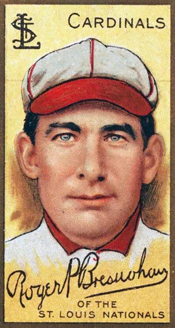
Trying to inspire a ballclub that had become accustomed to losing, Roger Bresnahan was willing to do whatever it took for the Cardinals to win, even if it meant playing second base.

Bresnahan, the Cardinals’ player-manager in 1911, would become the second catcher (after Buck Ewing) elected to the National Baseball Hall of Fame. Yet, when the Cardinals were in a pinch at second base, Bresnahan inserted himself there in a game against the Pirates.

According to researcher Tom Orf, Bresnahan is one of six Cardinals who have played both at catcher and at second base in the same game. The others: Art Hoelskoetter (1907), Jose Oquendo (1988), Scott Hemond (1995), Tony Cruz (2011) and Pedro Pages (2025).

Quality catcher

A 5-foot-9 scrapper, Bresnahan made his mark with the Giants, displaying the same kind of intensity as the club’s manager, John McGraw.

In the 1905 World Series, Bresnahan caught four shutouts _ three from Christy Mathewson; the other from Joe McGinnity _ in wins against the Athletics. Bresnahan also produced a .500 on-base percentage in that Series, with five hits, four walks and two hit by pitches in 22 plate appearances.

Two years later, Bresnahan became the first catcher to wear shin guards and brought other protective gear innovations, including a rudimentary batting helmet, to the sport, according to the Baseball Hall of Fame.

The Cardinals, who had the worst record in the majors (49-105) in 1908, acquired Bresnahan, 29, after the season and made him player-manager, giving him the task of injecting fight and hustle into the moribund ballclub.

As a syndicated item in The Cincinnati Post noted in 1911, Bresnahan “is a fighter, and dead anxious to make fighters of others. That’s why he keeps after his men all the time _ to keep them in a fighting mood while on the diamond.”

The Cardinals got a little bit better in each of Bresnahan’s first two seasons as player-manager _ 54-98 in 1909 and 63-90 in 1910 _ but he was looking for greater improvement in 1911. That also was the year Helene Britton took over the Cardinals as the first woman to own a major-league team.

Cincinnati commotion

Determined to establish an aggressive tone early on, Bresnahan gave the Reds a steady stream of trash talk from behind the plate during an April 18, 1911, game at Cincinnati. As the Cincinnati Enquirer put it, “Bresnahan had been using a great deal of coarse language and the Reds claim that his remarks were such that they could not be passed by unnoticed.”

On their way to the clubhouses after the game, Bresnahan and Reds left fielder Bob Bescher continued jawing at one another. “Both men were thoroughly angry,” the Enquirer noted. Bescher threw a punch, socking Bresnahan “flush on the mouth,” The Cincinnati Post reported. “Blood squirted right and left like thick spray from a wind-blown fountain.”

Bresnahan retaliated and the two engaged in what the Enquirer described as “a ferocious fistfight” before Bescher’s teammates, shortstop Dave Altizer and first baseman Dick Hoblitzell, joined in. According to the St. Louis Star-Times, though Altizer and Hoblitzell appeared to be trying to separate the men, “in reality they were taking sly punches at Bresnahan.”

Bresnahan fought back until police and other players broke up the melee, the Star-Times reported.

“Bescher hit at me and, of course, I came back,” Bresnahan told the St. Louis newspaper. “Then Hoblitzell and Altizer broke into the fray. I attended to them. The Cincinnati fans then tried to get us, but the police stopped the doings.”

Bescher said to the Star-Times, “Bresnahan had been goading me all afternoon to the point where I lost my temper. I did not need any help from Altizer and Hoblitzell, but as fellow teammates they felt called upon to interfere.”

The brouhaha made the headlines but another significant story was the injury suffered by Cardinals second baseman Miller Huggins in the game.

With two outs and the bases loaded in the eighth inning, the Reds’ Johnny Bates looped a fly ball to short right. Huggins, first baseman Ed Konetchy and right fielder Steve Evans all chased after the ball. As Huggins made the catch, Konetchy and Evans collided with him. Huggins injured a leg and had to remain in Cincinnati for treatment while the Cardinals returned to St. Louis. Boxscore

Rough and tumble

Beginning a homestand with four games against the Cubs, Bresnahan replaced Huggins with rookie Wally Smith at second base. Smith started two games, but then third baseman Mike Mowrey became bedridden with a severe cold. So, Bresnahan shifted Smith to third and put another rookie, Dan McGeehan, at second for the final two games of the Cubs series. The Cubs swept all four, dropping the Cardinals’ record to 2-5.

Then the Pirates came to town. In 1910, the Cardinals lost 17 of 21 against Pittsburgh. Bresnahan was determined to show the Pirates his 1911 club wasn’t intimidated by them, but three regulars (Steve Evans, Miller Huggins and Mike Mowrey) were sidelined and Bresnahan was playing with a bum knee “swollen to almost twice its normal size,” the St. Louis Post-Dispatch reported.

The series opener on Monday afternoon, April 24, 1911, at Robison Field in St. Louis was played with the intensity of a pennant race showdown. Pirates runners were tagged out at the plate by Bresnahan in the second and in the sixth.

In the seventh, the Cardinals’ Jack Bliss batted for Dan McGeehan, then stayed in the game at catcher as Bresnahan moved to second base. (He had filled in at second for nine games late in the 1909 season.)

With the Pirates ahead, 5-4, in the eighth, Honus Wagner was on third when Dots Miller tried a suicide squeeze bunt. He tapped the ball toward first but Ed Konetchy got to it quickly and flipped to Bliss. Wagner tried to knock over the catcher, but Bliss blocked the dish and tagged out The Flying Dutchman.

The Cardinals tied the score in the bottom half of the eighth and the game advanced to extra innings.

In the last half of the 11th, Bresnahan punched a single to right and Rebel Oakes moved him to second with a sacrifice bunt. Bliss followed with a tapper to pitcher Lefty Leifield, who fielded the ball and threw to rookie first baseman Newt Hunter.

According to the Pittsburgh Post-Gazette, Bliss “deliberately threw himself at Hunter, knocking him on his back.” The ball fell from Hunter’s grasp and rolled away as he writhed on the ground in agony. Bresnahan, who had reached third, streaked to the plate and scored the winning run.

“Bliss undoubtedly intentionally knocked Hunter down,” The Pittsburgh Press declared. “Bliss could have veered to the right instead of throwing his entire weight upon the Pirates’ first baseman. The Cardinals are evidently being taught by Bresnahan to be aggressive.”

Though Hunter dropped the ball, rookie umpire Bill Finneran ruled that Bliss was out for interference but allowed Bresnahan’s run to count. As the Post-Gazette noted, “If he called Bliss out for interference, why did he permit Bresnahan to move up on the play? Bresnahan should have been sent back to third, where he started from after Hunter had been rendered helpless.” Boxscore

Off the rails

Bresnahan and his Cardinals players faced a far more dire challenge three months later in July 1911 when they boarded the Federal Express train at Philadelphia’s Broad Street Station for a 10-hour ride to Boston.

Here’s an account by Tom Shieber, senior curator of the Baseball Hall of Fame:

“Originally, the ballplayers occupied a pair of Pullman sleepers located near the front of the train, close behind the 10-wheel locomotive and a U.S. Fishery coach. The position wasn’t ideal. Amid the sweltering heat that saw the mercury rise to 100 degrees that day, it was nearly impossible to sleep with the car windows closed, but opening the windows only made matters worse, letting in the unpleasantness of engine cinders and the stench of baby trout.

“Well past midnight, the cars were repositioned, with the Cardinals’ Pullmans moving to the very rear of the 10-car arrangement, while a day car and four other sleepers moved closer to the front. At 3:32 in the morning of July 11, the Federal Express roared through West Bridegport, Conn., barreling through a crossover at an estimated 60 mph, four times the regulation speed called for at the switch. The locomotive failed to negotiate the curve, jumped the tracks and plunged off the embankment into the street below. A frightful procession of derailed cars followed the mighty engine for some 400 feet as it plowed forward.

“The engine had been reduced to a mound of twisted metal and glowing coals. Behind the ruins of the engine lay a melee of crushed cars haphazardly strewn about, their structures mangled into splinters of wood and piles of iron.

“Miraculously, the last two cars, the ones that carried the Cardinals, remained on the rails and escaped serious damage, as did the individuals within. The rest of the scene, however, was one of calamitous destruction and horrifying injuries.”

Bresnahan led his players in rescue attempts and they removed 15 to 20 injured people from the day coach, the Washington Herald reported. Fourteen of the 150 passengers were killed.

The Cardinals boarded another train to Boston. At Bresnahan’s request, the Braves postponed that day’s game and rescheduled it as a doubleheader the following day. Because their uniforms were lost in the train accident, the Cardinals played the July 12 doubleheader wearing the Braves’ dark blue road uniforms. After the Cardinals won the opener, the nightcap was halted with the score tied.


Read Full Post »

During his time with the Cardinals, Juan Gonzalez lived up to his nickname, but not in the way he and the team hoped.

Invited to try out for a spot as an outfielder on the 2008 Cardinals, Gonzalez was Juan Gone _ as in, headed home _ before spring training ended.

In his heyday with the Rangers, Gonzalez was called Juan Gone because balls he hit frequently were sent into orbit and gone out of sight.

When he came to the Cardinals, though, Gonzalez, 38, looked different than he did in his prime. Gone was the bulk he had when he twice led the American League in home runs. Gone was a lot of the swagger, too.

Suspected in the 1990s of using banned performance-enhancing steroids to help him become one of the most powerful hitters, Gonzalez was trying to return to the majors for the first time in three years. The Cardinals, a haven for players linked to performing-enhancing drugs, welcomed him.

Great expectations

“Using a broomstick as a bat and a bottle cap as a ball on the dusty streets of Vega Baja,” Gonzalez developed into a baseball standout as a youth in Puerto Rico, according to the Los Angeles Times. His boyhood nickname was Igor because of his fascination with a professional wrestler of the same name.

At 16, when he was signed by Rangers scout Luis Rosa in May 1986, Gonzalez was “tall and gangly but with athleticism and serious bat speed,” according to MLB.com’s T.R. Sullivan.

The Rangers brought Gonzalez to Florida, where he was introduced by scouting director Sandy Johnson as the “next Babe Ruth,” and put in the outfield alongside 17-year-old Sammy Sosa on their Gulf Coast League rookie team. As Fort Worth Star-Telegram columnist Randy Galloway noted, “Babe Ruth’s bat had to have been heavier than young Juan.”

Three years later, Gonzalez, 19, made his big-league debut. He was 22 when he won his first American League home run crown. In April 1994, the Fort Worth newspaper did a story speculating whether Gonzalez would break Hank Aaron’s career record of 755. Gonzalez had 121.

Gonzalez also twice received the AL Most Valuable Player Award _ in 1996 (.314 batting mark, 47 homers, 144 RBI) and in 1998 (.318, 45 homers, 157 RBI). That 1998 season was his best. Gonzalez had 101 RBI before the all-star break and his final total of 157 were the most in the American League since 1949 Red Sox teammates Vern Stephens and Ted Williams each had 159. Gonzalez also scored 110 runs and produced 50 doubles.

“Juan in a million,” the Fort Worth Star-Telegram declared.

Success didn’t always bring happiness, however. Gonzalez was married and divorced three times before he turned 25. One of the failed marriages was to the sister of Braves catcher Javy Lopez. (A fourth marriage, to pop singer Olga Tanon, also resulted in divorce.)

“His mistakes, I think, were from a lack of education,” Luis Mayoral, the Rangers’ Latin American liaison and Gonzalez’s confidant, told Mike DiGiovanna of the Los Angeles Times. “He didn’t know what he needed to cope with fame and fortune.”

Columnist Randy Galloway noted, “No one who knows Gonzalez calls him a bad person. He’s not. He can be immature, he can pout, he can be unreasonable at times, and he can make stupid decisions.”

He also had a philanthropic side to him. In 1998, Gil LeBreton of the Fort Worth newspaper wrote, “In his old neighborhood on the rugged streets of Vega Baja, Gonzalez has opened a standing account with the local pharmacy. For those who can’t pay for their prescriptions, Juan will buy the medicine.”

Other Gonzalez projects included a $50,000 donation to build a youth ballpark in southeast Dallas; the purchase of Rangers tickets for underprivileged youngsters from 1995-99; donations for every RBI to Literacy Instruction for Texas reading and writing program from 1997-99; a $25,000 donation to help victims of Hurricane George.

Cheating with chemicals

In his book “Juiced,” Jose Canseco said he introduced Gonzalez to banned performance-enhancing drugs when they were Rangers teammates from 1992-94. Canseco said he injected Gonzalez with the steroids. Canseco was traded to the Rangers from the Athletics, where he played for manager Tony La Russa. In his book, Canseco said he injected Athletics teammate Mark McGwire with banned performance-enhancing drugs and witnessed McGwire and Jason Giambi administer needles to one another.

Rangers owner Tom Hicks told the Associated Press in June 2007 that he suspected Gonzalez used banned steroids when he was with the team. “His number of injuries and early retirement just makes me suspicious,” Hicks said.

In the December 2007 Mitchell Report, an investigation into the use of anabolic steroids and human growth hormone in big-league baseball, Gonzalez was linked to a bag of steroids discovered during a search at the Toronto airport in 2001.

The 2001 season was Gonzalez’s last big year in the majors. He hit .325 with 35 homers and 140 RBI for the Indians that season. After that, his body broke down. Injuries to his hamstrings, hands, shoulders and back cut short his seasons with the Rangers in 2002 and 2003, and with the Royals in 2004.

Gonzalez, 35, rejoined the Indians for spring training in 2005 but injured a hamstring while making a catch on the same day that manager Eric Wedge named him the starting right fielder. In his first game back with the Indians on May 31, Gonzalez injured the hamstring again while running to first base in the first inning. He never played in another big-league game.

Hear no evil, see no evil

The big-league totals for Gonzalez included 434 home runs and 1,404 RBI. In February 2007, he told USA Today he hoped to return to the majors and reach 500 homers. “That’s still my goal and I remain confident I will attain it,” he said.

To get himself into condition for a comeback, Gonzalez attended a training program in Puerto Rico operated by ex-Cardinal Eduardo Perez. “He really never stopped playing,” Perez told Derrick Goold of the St. Louis Post-Dispatch. “He looks great, like he hasn’t missed a beat. His legs look strong. Once a hitter, always a hitter.”

Perez recommended Gonzalez to Cardinals manager Tony La Russa. “You’re going to see a very humble guy,” Perez told the Post-Dispatch. “It’s a lot different than before. He just wants to prove he can still play.”

Intrigued, the Cardinals signed Gonzalez to a minor-league contract in February 2008 and invited him to compete at spring training for a role on the big-league club. The deal called for him to be paid $750,000 if he made the big-league team.

“We all know what he was in his prime,” La Russa told the Post-Dispatch. “He had one of the most gorgeous swings around.”

Cardinals general manager John Mozeliak said to reporter Joe Strauss, “There’s not a great deal of risk involved, but there is the potential for significant upside.”

Actually, there was a risk _ to the Cardinals’ image _ because club management looked like enablers, or protectors, for users of performance-enhancing drugs.

In December 2006, La Russa urged the Cardinals to sign free agent Barry Bonds. Even without Bonds, the Cardinals at 2008 spring training had five players (more than any other team) who were implicated in the Mitchell Report: Rick Ankiel, Ryan Franklin, Troy Glaus, Juan Gonzalez and Ron Villone. Also, La Russa had given Mark McGwire, whose use of banned performance-enhancing drugs created a fraudulent pursuit of the single-season home record, an open invitation to join the Cardinals that spring as an instructor.

Eyes wide shut

Here are excerpts from a February 2008 interview Post-Dispatch columnist Bryan Burwell did with La Russa at spring training:

Burwell: Does it bother you that there’s a perception that you give safe harbor to steroid guys?

La Russa: “No, and I’ll tell you why not … I know there isn’t anything we’ve done in all those years that was _ with one small exception where we stole signs, a little hiccup _ there isn’t anything else that has happened on our ballclubs in Oakland or St. Louis that there’s a hint of illegality. There isn’t anything that we didn’t actively and proactively attempt to do it right.”

Burwell: Does it bother you that you and coach Dave McKay have gained the unflattering label as the so-called godfathers of baseball’s steroids era with your connections to Jose Canseco and Mark McGwire?

La Russa: “That’s one of the crosses you have to bear … Dave McKay has as much or more integrity as any man I’ve met … There’s no chance that what happened officially at Oakland was tainted. Does it mean … when our guys are not in our facilities, not in our weight rooms, that guys didn’t experiment? No.”

Burwell: Would you have cared if you did know they were experimenting?

La Russa: “Yeah, I would care, because when I saw a guy who got stronger quickly without working hard, oh yeah, that implies a lot of other things about what he’s willing to do.”

Burwell: You still don’t believe McGwire used performance-enhancing drugs?

La Russa: “Absolutely not.”

Burwell: Come on.

La Russa: “Absolutely not. If you see Mark today, he still looks like he did then.”

Burwell: No he doesn’t.

La Russa: “Yes he does.”

Asked when he got to camp whether he’d ever used performance-enhancing drugs, Gonzalez told reporter Derrick Goold, “I never used it. I’m clear.”

Assigned uniform No. 22, Gonzalez singled twice and scored a run in the Cardinals’ exhibition opener against the Mets.

In 26 spring training at-bats, Gonzalez hit .308 with one homer (against Johan Santana) and five RBI before straining an abdominal muscle.

Placed on the temporarily inactive list, Gonzalez opted to go home to Puerto Rico. The Cardinals informed him he could return for an extended spring training when he felt ready to play.

“I told him he made a real good impression,” La Russa said to the Post-Dispatch. “I’m disappointed because he could have provided something special to our club.”

The Cardinals didn’t hear back from Gonzalez.

Six years later, in 2014, La Russa was inducted into the Baseball Hall of Fame. In an interview he did that year with Cardinals Yearbook, La Russa said McGwire did “a limited amount” of performance-enhancing drugs. Here are excerpts from that 2014 interview:

Cardinals Yearbook: How do you respond to those who say you were an enabler of baseball’s steroids era?

La Russa: “The only way you could know about what was going on was if you ran an investigation … I know on our team you couldn’t be a policeman and get detectives involved. Nobody is going to do that. If something is happening, it’s happening away from the ballpark.”

Cardinals Yearbook: How could it have been handled differently?

La Russa: “That’s the great unknown … All I know is on a personal basis I have no regrets. I don’t feel guilty about any part of it. We did what we could do.”

Read Full Post »

When he was ready to leave the Athletics, Tony La Russa was intending to manage the 1995 Red Sox.

“At the end of nine years, the A’s had given me permission to interview with the Red Sox, and I was going to Boston,” La Russa recalled to Cardinals Yearbook in 2014. “We even had a discussion about free agents … The one free agent we wanted was Larry Walker.”

If La Russa had gone through with the move, he likely never would have joined the Cardinals, the club he managed to three National League pennants, two World Series championships and a franchise-record 1,408 wins.

A lunch conversation with Athletics owner Walter Haas prompted La Russa to change his plans.

The times they are a-changin’

From 1988-90, La Russa led the Athletics to three consecutive American League pennants and a World Series title, but they finished 68-94 in 1993 and 51-63 in strike-shortened 1994. Though the 1994 Athletics had players such as Dennis Eckersley, Rickey Henderson and Mark McGwire, the club had a dismal 19-43 record until winning 19 of its next 22.

La Russa’s two-year contract with the Athletics expired at the end of 1994 and he was thinking it might be time to leave Oakland. “I came to realize that once you start amassing time _ eight or 10 years in one place _ there becomes a very real perception that the scene needs a change, more for the people around you than for yourself,” La Russa recalled to Cardinals Yearbook. “Fans get tired of reading your same quotes. The media starts to know what you’re going to say before you even say it. Players grow tired of you.”

Also, the Athletics were for sale and the uncertainty that created gave La Russa another reason to consider departing. “If the Haas’ (family) were still in Oakland, I’d still be there,” La Russa told Cardinals Yearbook in 2014.

After the players’ strike halted the season in August 1994, La Russa took his family on an extended vacation to England a month later “amid growing speculation that he could become Boston’s next manager,” the Sacramento Bee reported. “La Russa did nothing to downplay the speculation, acknowledging there are some ‘attractive situations’ out there. He sounded absolutely unsure if he will return to the A’s or seek grander challenges elsewhere.”

The Red Sox were seeking a replacement for Butch Hobson, who never produced a winning record in three seasons as their manager.

“I don’t think that Hobson’s firing will have any impact on our negotiations (with La Russa),” Athletics general manager Sandy Alderson told the Oakland Tribune.

Alderson also said to the Sacramento Bee, “Most of the Boston speculation is just that _ speculation.”

Please come to Boston

Actually, La Russa was the first choice of Red Sox general manager Dan Duquette, who viewed him as the person to lead the franchise to its first World Series crown since Babe Ruth played there in 1918. “The Red Sox are dying to hire La Russa and are willing to pay him a record-setting salary,” Baltimore Sun columnist Tom Keegan noted.

In explaining why La Russa would consider joining the Red Sox, Sacramento Bee columnist Mark Kreidler wrote, “Win it all in Boston, and La Russa’s fame is set for eternity, perhaps even the Hall of Fame … La Russa is not a man without ego. He would go into baseball-rabid Boston and he would own it within a year; and he would be paid millions; and he would work for a franchise that has the money and is willing to spend it in service of a diamond-encrusted ring. Heady stuff.”

Though it went unreported at the time, La Russa made up his mind to accept Boston’s offer. Before sealing the deal, he accepted an invitation to lunch with Walter Haas, the club owner who hired him to manage the Athletics in 1986 after La Russa was fired by the White Sox.

“(Haas) had always treated Elaine (La Russa’s wife) and me like family,” La Russa recalled to Cardinals Yearbook. “At this point, he was having serious health problems. He said he had one more year and he wanted me to manage the team. Going home, I told Elaine what Walter had said. At the time, I didn’t really know if he was talking about his health, selling the franchise, or both.”

Regardless, La Russa decided to honor Haas’ request. “I called Boston and declined the job,” he told Cardinals Yearbook.

Haas gave La Russa a three-year contract with a protective clause that enabled the manager to depart if there was an ownership change, the San Francisco Examiner reported.

As columnist Mark Kreidler noted, “You don’t have to make Tony La Russa a prince for accepting $1.25 million (per year) to continue managing the A’s, but know this: Finances and all, La Russa still made a decision of loyalty and personal feeling not to jump to the waiting Boston Red Sox.”

On the same day the Athletics signed La Russa, the Red Sox named Kevin Kennedy, formerly of the Rangers, as their manager.

“The specter of La Russa haunts Kennedy as Kennedy takes over the fabled Boston franchise,” wrote Boston Globe columnist Dan Shaughnessy. “It is well known that the Red Sox coveted the A’s manager above all others.”

Twists and turns

About the time he decided to stay with the Athletics, La Russa, a vegetarian and animal rights activist, caused a stir when he hammed it up in a national TV commercial for Wendy’s and its new chicken, bacon and Swiss cheese sandwich. “It was stupid on my part,” he told the Associated Press. “I screwed up.”

La Russa claimed he was misled, saying he thought the commercial was for a salad bar and baked potatoes, but Wendy’s spokesman Denny Lynch said Tony was full of baloney. “He knew that it was a chicken sandwich commercial,” Lynch told the Associated Press.

During the 1995 season, the Haas family completed the sale of the Athletics to Ken Hofman and Steve Schott. On Sept. 20, Walter Haas, 79, died. After that, the Athletics lost their last nine games and finished at 67-77, La Russa’s third consecutive losing season. “It wasn’t like the guys weren’t trying; they were grieving,” La Russa recalled to Cardinals Yearbook.

Meanwhile, Kevin Kennedy’s Red Sox, with a roster that included ex-Athletics slugger Jose Canseco as the designated hitter and former Cardinals such as second baseman Luis Alicea, pitcher Rheal Cormier and outfielder Willie McGee, were 1995 East Division champions at 86-58.

La Russa left Oakland after the season and became Cardinals manager. His first World Series appearance with them was in 2004. Their opponent was the Red Sox. Managed by Terry Francona, Boston swept, becoming World Series champions for the first time in 86 years.

Eventually, La Russa worked for the Red Sox, joining them in November 2017 as special assistant to president of baseball operations Dave Dombrowski. The Red Sox then won the 2018 World Series championship.

Read Full Post »

In a fundraising game to honor the memory of slain civil rights activist Dr. Martin Luther King Jr., two of the top performers on a genuine field of dreams were Cardinals Lou Brock and Bob Gibson.

On March 28, 1970, the East-West Major League Baseball Classic was played at Dodger Stadium in Los Angeles. According to the National Baseball Hall of Fame, the Saturday afternoon exhibition netted more than $30,000 for two beneficiaries:

_ Southern Christian Leadership Conference, a regional organization founded by King and others in 1957 to help coordinate grassroots efforts in civil rights and voting rights activities.

_ Martin Luther King Jr. Center for Nonviolent Social Change, also known as King Center. Located in Atlanta, the center was founded in 1968 by Coretta Scott King to preserve and advance her husband’s legacy. It houses a library, archives and exhibits. It’s also the burial site of Dr. King and his wife.

Most of baseball’s top players participated in the game, taking time out from spring training to show their support for King and his mission.

Baseball tribute

After King was assassinated on April 4, 1968 (the convicted murderer, James Earl Ray, was born in Alton, Illinois, 20 miles north of St. Louis), Bob Gibson spoke with emotion about the bitterness and frustration he felt. In his autobiography, “Stranger to the Game,” Gibson said, “I reeled from the impact of the assassination _ the cold-blooded murder of the one man in my lifetime who had been able to capture the public’s attention about racial injustice, break through some of the age-old social barriers and raise the spirits and hopes of black people across the country.”

According to the Baseball Hall of Fame, shortly after King was killed, ballplayers asked King’s associates what they could do as a public tribute to him, Joseph Peters, sports project director for the Southern Christian Leadership Conference, explained in a November 1968 letter to baseball commissioner William Eckert.

When Southern Christian Leadership Conference members suggested a fundraising game, Major League Baseball officials agreed to cooperate. The game initially was planned for March 1969, but the Southern Christian Leadership Conference asked for more time. That’s why the event was held in March 1970.

Though spring training exhibitions were under way, every big-league team made players available for the fundraising game and paid their expenses, the Associated Press reported.

Among those who came to Los Angeles to play were Hank Aaron, Ernie Banks, Johnny Bench, Lou Brock, Orlando Cepeda, Roberto Clemente, Bob Gibson, Reggie Jackson, Al Kaline, Willie Mays, Joe Morgan, Tony Oliva, Frank Robinson, Pete Rose, Ron Santo, Tom Seaver and Willie Stargell.

Mays traveled from Japan, where his club, the Giants, were playing goodwill games. In explaining why he made the long trip to Los Angeles, Mays told the Torrance Daily Breeze, “This cause is too important to pass up. At last, baseball players can show their feelings about the late Dr. King and his work through the medium of this game. I wouldn’t miss it.”

Players from the East divisions of the American and National leagues were placed on an East team. The West team had players from the West divisions of both leagues. That gave fans the chance to see Angels and Dodgers, Mets and Yankees, and Athletics and Giants perform as teammates.

Joe DiMaggio was chosen to manage the East team. His coaching staff: Billy Martin, John McNamara, Stan Musial and Satchel Paige.

The West team manager was Roy Campanella. His coaching staff: Don Drysdale, Elston Howard, Sandy Koufax and Don Newcombe.

Entertainer Bill Cosby held a reception for the teams at the Warner Brothers Studio the night before the game, the Los Angeles Times reported.

Star power

Starting lineups were selected by members of the Los Angeles-Anaheim chapter of the Baseball Writers Association of America and the Southern California Sportscasters Association.

The East batting order: 1. Ron Fairly, first base; 2. Reggie Smith, center field; 3. Frank Robinson, right field; 4. Willie Stargell, left field; 5. Ron Santo, third base; 6. Ernie Banks, shortstop; 7. Don Buford, second base; 8. Tim McCarver, catcher; 9. Tom Seaver, pitcher.

Banks, 39, a Cubs first baseman, was at shortstop for the first time in nine years.

East bench warmers included Lou Brock, Roberto Clemente and Al Kaline.

The West batting order: 1. Maury Wills, shortstop; 2. Pete Rose, center field; 3. Hank Aaron, left field; 4. Reggie Jackson, right field; 5. Johnny Bench, catcher; 6. Orlando Cepeda, first base; 7. Joe Morgan, second base; 8. Sal Bando, third base; 9. Don Wilson, pitcher.

Willie Mays and Tony Oliva couldn’t crack the starting lineup.

Ticket prices ranged from $10 to $2. Among the 31,694 spectators for the 2 o’clock game were baseball pioneers Jackie Robinson and Larry Doby, baseball commissioner Bowie Kuhn (successor to William Eckert) and entertainers Sammy Davis Jr. and Danny Kaye.

Mudcat Grant sang the national anthem, a recording of Dr. King’s “I Have A Dream” speech was played on the public address system, and Coretta Scott King threw the ceremonial first pitch to Johnny Bench.

(Bench, 22, impressed fellow catcher Roy Campanella, who told the Los Angeles Evening Citizen News, “Now there’s a kid who has it all. His future is unlimited.”)

A scheduled home run hitting contest featuring Frank Robinson, Ron Santo and Willie Stargell for the East versus Hank Aaron, Orlando Cepeda and Reggie Jackson for the West was canceled without explanation, the Long Beach Independent reported.

Aces prevail

The East’s pitching combination of Tom Seaver and Bob Gibson kept the West from scoring.

When Pete Rose batted in the first, Seaver surprised him with a blooper pitch. As Rose watched it drop into catcher Tim McCarver’s mitt, plate umpire Emmett Ashford gave his emphatic “stee-rike-ah” call. Rose stepped out of the box and smiled at Seaver, who grinned back. “It was a little slip curve,” Seaver told the Long Beach Independent. Rose finished the at-bat by flying out to left.

Seaver completed his three-inning scoreless stint with back-to-back strikeouts of Pete Rose and Hank Aaron. Then Bob Gibson took over and also held the West scoreless for three innings. The only hit against Gibson was a Sal Bando single.

Despite his performance, Gibson told Rich Roberts of the Long Beach Independent, “I sure didn’t feel good. I wouldn’t be telling no lie. I just used fastballs, but you better call them straight balls because they weren’t very fast.”

The East went ahead, 1-0, in the third when Ron Fairly hooked the first pitch from Lew Krausse into the stands in right, just inside the foul pole, for a home run. Ron Santo made it 2-0 when he led off the fourth with a homer to left against Krausse.

(Krausse was representing the Seattle Pilots, who were only a few days away from becoming the Milwaukee Brewers.)

Both managers substituted often, trying to get as many players as possible into the game. In a pinch-hit appearance, Willie Mays grounded into a force out.

The East went up 5-0 with three runs in the eighth against Mudcat Grant. After Al Kaline singled, Lou Brock lined a shot that carried over the head of left fielder Hank Aaron for a run-scoring double. A Roberto Clemente smash that eluded Maury Wills was ruled a double and scored Brock. Ken McMullen drove in Clemente with a single.

Facing Grant Jackson in the bottom half of the inning, the West scored a run when Willie Davis singled and came home on a Ken Berry double.

The East won, 5-1, but it wasn’t the outcome that mattered.

“I thank these fellows for giving their time,” West manager Roy Campanella told the Long Beach Independent.

As Pete Rose noted in a column he did for the Cincinnati Enquirer, “Even though it was an exhibition game, it had meaning … I feel good inside because I’ve contributed to a worthy cause.”

Read Full Post »

« Newer Posts - Older Posts »