Feeds:
Posts
Comments

Archive for the ‘Managers’ Category

In 14 seasons as a big-league manager, Don Zimmer was at his best in 1989. He won a division title with the Cubs and earned the admiration of his Cardinals counterpart, Whitey Herzog.
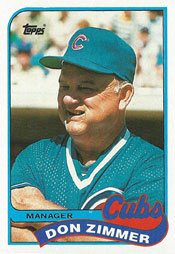
don_zimmerIn his book “You’re Missin’ a Great Game,” Herzog said, “The best year of managing I ever saw was Don Zimmer with the Cubs in 1989. Zim’s a great baseball man. For that one year, he could do no wrong. He tried everything _ and everything he tried worked. He called the hit-and-run, he ran squeezes, he pitched out, he ran double steals. He pitched guys on two, three days of rest … People say, ‘Don’t you think he was just lucky?’ It’s like I always say: It’s amazing how lucky you are when you’re good.”

Cardinals-Cubs showdown

Zimmer’s best effort that season may have occurred during a pivotal three-game series between the Cardinals and Cubs in early September at Chicago’s Wrigley Field.

After erasing a 7-2 deficit and winning, 11-8, in the series opener on Sept. 8, the Cardinals moved to within a half-game of the first-place Cubs in the National League East. A win over the Cubs the next day would put the Cardinals in first place for the first time since May 12.

The momentum appeared to be with the Cardinals when they took a 2-1 lead into the eighth inning of the second game of the series on Sept. 9. Then, the game _ as well as the Cardinals’ season _ turned on what transpired in that inning.

In the top half, the Cardinals, with runners on first and second and one out, looked poised to build their lead. Terry Pendleton, a switch-hitter, was the batter. In 1989, Pendleton hit 25 points higher against left-handed pitchers than he did versus right-handers. Still, Zimmer lifted right-hander Les Lancaster and brought in Steve Wilson, a left-hander, to face Pendleton.

Pendleton popped out to second base.

Next up for the Cardinals was right-handed slugger Tom Brunansky. Zimmer pulled Wilson for Jeff Pico, a right-handed reliever.

Brunansky struck out, ending the threat.

Against all odds

In the Cubs’ half of the inning, they got a runner to third base with two outs. A right-handed batter, Luis Salazar was at the plate. The Cardinals pitcher was Dan Quisenberry, a right-hander. Herzog figured Zimmer would send a left-handed batter to pinch hit for Salazar. Herzog was prepared to counter with a left-handed reliever, Ken Dayley.

“He (Zimmer) has got to take a shot. He’s got to force me to make a move and get Dayley in the game,” Herzog said to the St. Louis Post-Dispatch.

Instead, Zimmer stuck with Salazar.

Said Zimmer: “I called him down and said, ‘Have you ever faced Quisenberry before?’ And he said, ‘Yeah, I’ve had good luck with him.’ I took his word for it. You don’t know. I’ll probably look it up and find out he’d never even faced him before.”

Salazar rewarded Zimmer’s confidence by singling to left, driving in the runner, Dwight Smith, from third and tying the score at 2-2.

Said Herzog: “Quiz threw a terrible pitch.”

(Salazar was 3-for-8 in his career versus Quisenberry. He was 1-for-5 against him in 1985 and 2-for-3 in 1989.)

In the 10th, Salazar doubled off Dayley, scoring Andre Dawson from first and giving the Cubs a 3-2 victory. Boxscore

“Yes, Zimmer can manage,” wrote Post-Dispatch columnist Bernie Miklasz. “… He used four relief pitchers and the parade limited the Cardinals to one hit in three innings. Zimmer inserted Luis Salazar at third base in the late innings and Salazar drove in the tying and winning runs.”

Said Zimmer: “This was almost like a World Series and October atmosphere.”

What the heck

Instead of moving into first, the Cardinals dropped 1.5 games behind the Cubs.

In the series finale the next day, Sept. 10, right-hander Greg Maddux was scheduled to start for the Cubs. That morning, Zimmer decided instead to start Wilson, even though the left-hander had pitched in relief the previous day. Maddux was 0-1 with a 7.15 ERA in two starts versus the 1989 Cardinals. Zimmer informed Maddux he would start the following day against the Expos.

Said Zimmer: “I looked at the pitching chart and I said, ‘I know Greg Maddux pitches better against Montreal than St. Louis.’ I feel like a left-hander has a little better chance against St. Louis anyway. I said, ‘The heck with it’ and I changed it around.”

Wilson struck out 10 in five innings and limited the Cardinals to a run. Three relievers combined to hold the Cardinals scoreless, striking out eight. The Cubs won, 4-1. Boxscore

Zimmer used seven relievers in the final two games of the series and they didn’t allow a run.

Reeling, the Cardinals lost their next four in a row and slipped out of contention. They finished in third place. The Cubs won the division title, finishing six games ahead of the runner-up Mets.

Zimmer received the 1989 National League Manager of the Year Award.

Previously: Cardinals go 23 years between 2 straight shutouts of Cubs

Read Full Post »

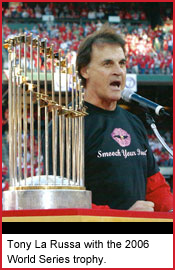
Managers Tony La Russa of the Cardinals and Lloyd McClendon of the Pirates engaged in a nose-to-nose public showdown, creating hard feelings that lasted deep into the following season.

tony_larussa13La Russa and McClendon were suspended for their actions.

On June 3, 2004, the Cardinals and Pirates were playing the last of a four-game series at Pittsburgh. The Cardinals won the first three and were leading, 4-2, in the ninth inning of the finale.

Tensions had run high since the series’ second game when the Cardinals’ Scott Rolen was hit in the head by a pitch from Ryan Vogelsong. Cardinals starter Jeff Suppan retaliated by plunking Daryle Ward in the at-bat after Ward had slugged a home run.

In the finale (in which catcher Yadier Molina got the start in his major-league debut), the Cardinals’ Albert Pujols was struck in the leg by an Oliver Perez delivery in the sixth inning. Jason Kendall, the Pirates’ first batter in the bottom half of the inning, got nailed by a Woody Williams pitch.

Bring it on

With two outs and none on in the ninth, Cardinals batter Tony Womack barely avoided a high, tight pitch from Mike Gonzalez.

From the dugout, La Russa yelled at Gonzalez.

Kendall, the catcher, yelled back at La Russa.

La Russa barked at Kendall, telling him to keep the pitches down.

Angered, McClendon charged onto the field and headed directly toward the Cardinals dugout.

Umpires Brian Gorman and Dale Scott tried to restrain McClendon, who called out La Russa.

Accepting the challenge, La Russa entered the field.

As both benches emptied, La Russa and McClendon stood toe to toe and exchanged heated words along the first-base line.

“As angry as the two were,” wrote Pittsburgh Post-Gazette columnist Ron Cook, “it’s surprising no punches were thrown.”

Gorman ejected both managers.

Crime and punishment

“I did what I feel I had to do,” McClendon said to the Post-Gazette. “He (La Russa) crossed the line by yelling at my players. If I don’t do anything there, I lose respect. I lose my team.”

Said La Russa to the St. Louis Post-Dispatch: “I can’t read anybody’s mind, but the way (Gonzalez) was looking and prancing, I was very suspicious (of his intent). That just doesn’t belong. If you’re going to pitch inside, get the ball below the shoulder.”

When the game resumed, Jason Isringhausen closed out the Pirates in the ninth and the Cardinals completed the sweep. Boxscore

The next day, Bob Watson, vice president of on-field operations for Major League Baseball, suspended each manager for two games and imposed fines.

La Russa and McClendon agreed the matter should be settled on the field.

“I think it’s really bad business,” La Russa said to the Associated Press. “But I also think Major League Baseball is not really attacking the problem _ of pitches up and in _ in the best way that they should.”

Said McClendon: “I guess what you’re supposed to do now … is when the opposing manager berates your players you should just sit there and not say a thing and allow your team to lose respect for you and for them to know that you’re not going to fight for them and stand up for them.”

Plot thickens

The story didn’t end there.

Two months later, in August 2004, McClendon asked umpires to check the cap of Cardinals pitcher Julian Tavarez for a foreign substance. The umpires found something suspicious and ejected Tavarez, who was suspended for 10 games.

In an interview with the Post-Dispatch, La Russa accused McClendon of “gamesmanship.”

Tavarez said McClendon “was trying to get back at Tony more than doing anything to me.”

Said McClendon to MLB.com: “Why would I hate the Cardinals? I don’t hate Tony … I respect them.”

A year later, however, in August 2005, McClendon and Pirates hitting coach Gerald Perry, a former Cardinals player, got into an altercation with Cardinals pitching coach Dave Duncan during batting practice. Perry may have struck Duncan in the jaw, according to published reports. Afterward, in discussing the incident with the media, Duncan labeled McClendon “an idiot.”

One month after that, the Pirates fired McClendon.

Previously: Wrangle at Wrigley: Tony La Russa vs. Dusty Baker

Previously: 1980s macho match: Whitey Herzog vs. Roger Craig

Read Full Post »

Their given names were John and George.

Their baseball names were Sonny and Sparky.

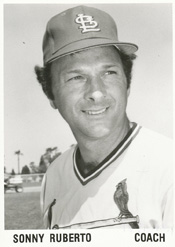
sonny_rubertoTogether, they contributed to a standard of teaching that became a hallmark of the Cardinals.
Sonny Ruberto, mentored by Sparky Anderson in the Cardinals’ system, influenced St. Louis players and prospects from 1977-81 as a big-league coach and minor-league manager.

Two of his pupils in the Cardinals system, Jim Riggleman and John Stuper, carried on with reputations as first-rate instructors. Riggleman managed five big-league teams. Stuper, who started and won Game 6 of the 1982 World Series for the Cardinals, coached the Yale University baseball team.

George “Sparky” Anderson, who built a Hall of Fame career as manager of the Reds and Tigers, was 30 when he began his managerial career with Class AAA Toronto in 1964. A year later, he became a manager in the Cardinals system.

John “Sonny” Ruberto was 24 when he began his managerial career with the Padres’ Class A Lodi club in 1970. At 31, he became the youngest coach in the major leagues when he joined the staff of first-year Cardinals manager Vern Rapp in 1977.

Cardinals prospect

A standout catcher at Curtis High School in Staten Island, N.Y., where he played with other future major leaguers such as Terry Crowley and Frank Fernandez, Ruberto signed with the Cardinals as an amateur free agent in 1964. Two years later, he was on a Class A St. Petersburg team managed by Anderson.

In a 1966 game that began on June 14 and ended at 2:30 a.m. on June 15, the visiting Miami Marlins beat St. Petersburg, 4-3, in 29 innings. “It was the darndest thing I’ve ever seen,” Anderson told The Sporting News.

Ruberto played all 29 innings _ the first nine as catcher and the last 20 at shortstop. He had two hits in 10 at-bats and scored a run.

Ruberto hit .283 in 88 games for St. Petersburg. The next year, he played for the Cardinals’ Class A Modesto club, managed by Anderson.

On May 22, 1969, the Cardinals traded Ruberto and second baseman John Sipin to the Padres for infielder Jerry DaVanon and first baseman Bill Davis. Ruberto made his big-league debut as a player with the Padres that month.

Big Red Machine

After a season managing Lodi, Ruberto in 1971 joined the Reds organization, where he was reunited with two key figures from his Cardinals days: Anderson (the Reds’ manager) and Bob Howsam, the former Cardinals general manager who took over the same role with Cincinnati.

Ruberto resumed his playing career and was sent to Class AAA Indianapolis. His manager there for the next five years, 1971 through 1975, was Rapp. As catcher, Ruberto was credited with helping the progress of several Reds pitching prospects, including Joaquin Andujar, Ross Grimsley, Tom Hume, Milt Wilcox and Pat Zachry.

“I feel I had something to do with their development,” Ruberto told The Sporting News.

When Rapp was named Cardinals manager, replacing Red Schoendienst, for the 1977 season, he selected Ruberto to be the first-base coach.

Wrote The Sporting News: “Like Rapp, Ruberto had been a career Triple-A catcher highly regarded for his ability to handle pitchers. Ruberto even has some ideas on helping Ted Simmons improve his backstopping duties.”

Rapp was brought to the Cardinals to instill discipline. At spring training in 1977, The Sporting News reported, “Rapp sized up his charges to make sure that the regulation baseball uniforms were worn properly. He had coach Sonny Ruberto demonstrate how he wanted the uniforms worn.”

At the helm

Rapp was fired in April 1978 and replaced by Ken Boyer. After the season, two of the coaches Boyer had inherited, Ruberto and Mo Mazzali, were replaced by Schoendienst and Dal Maxvill.

The Cardinals, though, kept Ruberto in the organization, naming him manager of the 1979 St. Petersburg club, succeeding Hal Lanier, who was promoted to Class AAA Springfield.

“What kind of manager will I be?” Ruberto said in response to a question from the St. Petersburg Times. “Well, a little of Vern Rapp, a little of Sparky Anderson, a little of Billy Martin and a lot of Sonny Ruberto.”

St. Petersburg finished 64-71, but the Cardinals were pleased with how their prospects, such as Stuper and fellow starting pitcher Andy Rincon, developed under Ruberto.

In 1980, Ruberto managed the Cardinals’ Class AA Arkansas team to an 81-55 record and a Texas League championship. Stuper had a 7-2 record for Arkansas. Riggleman, a third baseman, hit .295 with 21 home runs and 90 RBI in 127 games.

Ruberto managed the Cardinals’ Class A Erie team to a 44-30 record in 1981.

He operated a photography business in St. Louis and resided there with his family for 26 years.

Read Full Post »

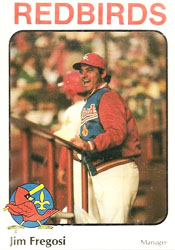
In 35 years as a major-league manager, Tony La Russa was fired once. The White Sox replaced him with Jim Fregosi.

jim_fregosiFregosi managed the Cardinals’ Class AAA club at Louisville from 1983 until he replaced La Russa as White Sox manager in June 1986. Among the prospects managed by Fregosi at Louisville were Vince Coleman, Danny Cox, Ken Dayley, Ricky Horton, Tito Landrum, Greg Mathews, Jose Oquendo, Terry Pendleton, Andy Van Slyke and Todd Worrell. Seventeen of the players on the 1985 National League championship Cardinals club played for Fregosi at Louisville.

Path to the majors

An all-star shortstop for the Angels in the 1960s, Fregosi managed the Angels from 1978-81, leading them to their first division title in 1979, before he was fired and replaced by Gene Mauch. After sitting out the 1982 season while running a food brokerage business, Fregosi became Louisville manager in 1983. Lee Thomas, the Cardinals’ director of player development, had been an Angels teammate of Fregosi and was instrumental in bringing him into the St. Louis organization.

Louisville won back-to-back American Association championships (1984-85) under Fregosi, but with Whitey Herzog entrenched as Cardinals manager Fregosi’s best hope of managing again in the major leagues was with another organization. The Mariners contacted him, but Fregosi wanted an opportunity with a franchise prepared to win.

In June 1986, White Sox general manager Ken “Hawk” Harrelson fired La Russa and pitching coach Dave Duncan. The White Sox were 26-38 and Harrelson had been clashing with La Russa and Duncan. “The record is not indicative of the talent involved,” Harrelson told the Chicago Sun-Times.

Fregosi was Harrelson’s first choice. Harrelson had sent scouts to Louisville and their reports on Fregosi were glowing, the Sun-Times reported.

Tireless teacher

Here is what others said about Fregosi’s work in the Cardinals system:

_ Rick Bozich, columnist, Louisville Courier-Journal: “When you roll the highlights films of what Fregosi has accomplished in Louisville, the two American Association championships won’t even make the top 10. No, the lingering images will be of the consistently long hours he worked developing the young players who carried the St. Louis Cardinals to the 1985 National League pennant and the wonderfully tranquil clubhouses he presided over. There was never a reason to check Fregosi’s time card. He reported to Cardinal Stadium at 2 every afternoon. One day he’d be in the cage convincing Vince Coleman he could make millions chopping down on the ball; the next day you could find him in the bullpen tinkering with Todd Worrell’s fastball grip.”

_ Mo Mozzali, Cardinals scout: “As fantastic as Jimmy has been for baseball in Louisville, he’s done even more for the players in the Cardinals organization. I’ve never seen anybody better working with young players.”

_ Dyar Miller, Louisville pitching coach: “Jim is a great teacher. He works on the field for three or four hours before every game, on theories of hitting, turning the double play, getting ready to pitch in the bullpen, whatever.”

_ Tony La Russa to the Sun-Times after learning Fregosi had replaced him: “When Jim Fregosi was in this league (as Angels manager), I thought he did an outstanding job. He’s been ready to manage in the big leagues for several years.”

Tales from Tony

White Sox owner Jerry Reinsdorf said La Russa told him, “If you have to fire me, hire Jim (Fregosi) or Jim Leyland … Fregosi is a good manager. I like him.”

La Russa went to the Athletics and won three American League pennants and a World Series title before joining the Cardinals. La Russa won two World Series titles and three National League pennants with the Cardinals and was elected to the National Baseball Hall of Fame.

Fregosi managed the White Sox from 1986-88 before stints as manager of the Phillies (1991-96) and Blue Jays (1999-2000). He won a National League pennant with the 1993 Phillies.

In 1996, La Russa’s first season as Cardinals manager, he was asked by the St. Louis Post-Dispatch about Fregosi during a series with the Phillies. La Russa replied, “The old line had me asking, ‘What does Fregosi have that I don’t have?’ The answer was, ‘Your job.’ “

Read Full Post »

(Updated April 4, 2025)

A tip of the cap to Sparky Anderson.

He did what Tony La Russa could not: choose a team logo to display on the cap for his plaque in the National Baseball Hall of Fame.

sparky_andersonAs managers, Anderson and La Russa won World Series titles with teams from both the National League and American League. Anderson was a role model for La Russa and mentored him.

La Russa differed from Anderson on the controversial cap choice.

La Russa, elected to the National Baseball Hall of Fame in December 2013, said he chose not to have a team logo on the cap for his plaque because he didn’t want to disrespect any of the three teams _ White Sox, Athletics and Cardinals _ he managed.

“They offered one logo or no logo,” La Russa recalled to Cardinals Yearbook in 2014. “I said no logo. That was an easy call for me.”

Because he won two of his three World Series titles with the Cardinals, became the all-time leader in wins (1,408) among Cardinals managers and spent 16 years as a manager with St. Louis, La Russa disappointed many Cardinals loyalists, including club owner Bill DeWitt Jr., with his decision.

“I understood how some people could be upset because the last 16 years (with St. Louis) were special,” La Russa told Cardinals Yearbook, “but I can’t forget the first 16 (with the White Sox and Athletics). ”

Contrast La Russa’s choice with that of Anderson’s:

Anderson, elected to the National Baseball Hall of Fame in 2000, chose to have a Reds logo on the cap for his plaque _ even though he was fired in Cincinnati and spent nearly twice as many years managing the Tigers as he did the Reds.

Cardinals connection

Anderson’s decision had roots from his three years as a minor-league manager in the Cardinals’ system.

Anderson said he chose the Reds cap for his plaque as a tribute to Bob Howsam.

As Reds general manager, Howsam hired Anderson to manage Cincinnati, launching him onto his Hall of Fame career.

As Cardinals general manager, Howsam saved Anderson’s career by hiring him to manage in the St. Louis system.

Anderson was unemployed after being fired as manager of Class AAA Toronto in 1964. In March 1965, Fred Koenig resigned as manager of the Cardinals’ Class A Rock Hill team. With the start of the season near, Howsam was scrambling to find a replacement.

Howsam took a chance on Anderson.

Anderson managed Rock Hill to a 59-63 record.

In 1966, the Cardinals named Anderson manager of Class A St. Petersburg. He led St. Petersburg to a 91-45 record and strengthened his reputation within the Cardinals organization as a first-rate instructor.

Howsam left St. Louis to become general manager of the Reds in January 1967. The Cardinals named Anderson manager of Class A Modesto. He led Modesto to a 79-61 mark and the league championship.

In the fall of 1967, Howsam wooed Anderson into the Reds organization as a minor-league manager at Class AA Asheville. Two years later, Oct. 9, 1969, Howsam introduced Anderson as manager of the Reds.

“He hired a 35-year-old nobody knew and he had the courage and fortitude to do that,” Anderson told the Associated Press in February 2000, explaining why Howsam inspired him to select a Reds cap for the plaque. “Had he not done that, I doubt very much, in all honesty, that I would have managed in the major leagues. And I owe that to him.”

Anderson won two World Series titles and four pennants with the Reds and posted an 863-586 record. Howsam retired after the 1977 season and was replaced by Dick Wagner, who, after one year on the job, fired Anderson in 1978.

The next year, the Tigers hired Anderson. He led them to the 1984 World Series title and earned 1,331 wins with Detroit from 1979-95.

Sparky: Tony isn’t a bozo

When La Russa became a big-league manager in 1979, with the White Sox, he sought advice from many, including Anderson.

“I never saw anyone catch on as fast as he did,” Anderson said of La Russa in the book “Tony La Russa: Man on a Mission” (2009, Triumph). “When you talk to him, you realize he is very intelligent. You’re not talking to a bozo. He learned so fast, you were never going to trick him. He knew what was going on. I always played him straight up, but I never let him play any tricks on me either.”

Roland Hemond, general manager of the 1979 White Sox, said, “Tony was smart enough to pick up the wisdom those guys were willing to pass along. I don’t think Sparky would have spent so much time with him if he thought he was talking to a guy who would not be around very long.”

After the 1995 season, when La Russa was trying to decide whether to leave the Athletics for the Cardinals, Anderson was an influencer in his decision.

“Going to the National League wasn’t something I considered initially,” La Russa said in his book “One Last Strike” (Morrow, 2012). “Several people, including Sparky Anderson, told me that I’d love it, and when the name St. Louis came up, I started to think seriously about it.”

His success with St. Louis sealed La Russa’s election to the Hall of Fame _ even if his cap won’t reflect that.


Read Full Post »

(Updated April 5, 2025)

Winning the 2006 World Series championship with the Cardinals sealed for Tony La Russa his eventual election to the National Baseball Hall of Fame.

tony_larussa12By joining Sparky Anderson as managers to win World Series titles in both the National League and American League, La Russa elevated himself into a special class.

La Russa and managers Joe Torre and Bobby Cox were elected to the Hall of Fame on Dec. 9, 2013. Each received 16 unanimous votes from the Expansion Era committee. Whitey Herzog, who, like La Russa and Torre, managed the Cardinals, was one of the voters.

La Russa (2,902), Cox (2,504) and Torre (2,326) rank second, fourth and fifth in career wins for managers. Connie Mack is No. 1 (3,731) and John McGraw (2,763) ranks third.

Herzog, Torre and La Russa managed St. Louis from 1980-2011, giving the Cardinals the distinction of having been led by Hall of Fame managers for 31 consecutive years.

High expectations

The Cardinals fired Torre in June 1995 and, after Mike Jorgensen finished that season as interim manager, La Russa joined the Cardinals in October 1995 after resigning as Athletics manager.

La Russa had won a World Series title and three consecutive American League pennants with the Athletics. In his first 10 seasons in St. Louis, he led the Cardinals into the National League playoffs six times and won a pennant in 2004, but the expectation was he would win a World Series title with the Cardinals.

Doing so with the 2006 Cardinals _ a club that won just 83 regular-season games and ranked fifth in the league in pitching and sixth in both batting and defense _ capped La Russa’s reputation for managerial excellence.

The 2006 World Series championship, achieved in five games against the Tigers, was the Cardinals’ first in 24 years (when Herzog led St. Louis against the Brewers in 1982).

Here is what a couple of St. Louis Post-Dispatch columnists wrote of La Russa after the 2006 championship:

_  Jeff Gordon: “If this is the worst team to ever win a World Series championship, as some will argue, then La Russa’s managerial performance ranks as his greatest effort. … By winning the World Series, La Russa has cemented his place in baseball history.”

_ Rick Hummel: “His reputation here this year has been enhanced by his ability to guide a talented yet flawed club through injury, illness and overzealous expectations.”

Classic Cardinal

Four Cardinals players in the Hall of Fame _ Stan Musial, Red Schoendienst, Bob Gibson and Lou Brock _ were on hand to witness the clinching of the 2006 World Series championship in Game 5 at St. Louis. All four “applaud La Russa as an equal,” Hummel wrote.

In a 2014 interview with Cardinals Yearbook, La Russa said, “Winning that Series, and how we did it, was one of the best moments I can recall. What added to it was winning it at home … It contributed something significant to a franchise that is so incredibly steeped in history. For me, the topper was having Bob Gibson walk by in the clubhouse afterward, shake my hand and say, ‘You’re officially in the club.’ That’s the standard the Cardinals have.”

La Russa capped his career with another World Series title with the Cardinals in 2011. That was another exceptional achievement _ La Russa became the first Cardinals manager to win two World Series crowns since Hall of Famer Billy Southworth did it in the 1940s _ but by then his reputation as being of Hall of Fame caliber already was secured because of what he accomplished in 2006.

Mike Shannon, the club broadcaster who played for Cardinals teams that won two World Series titles and three pennants in the 1960s, provided the Post-Dispatch with the most concise and astute analysis of La Russa after the 2006 World Series. “There’s no doubt he’s going into the Hall of Fame as a manager,” Shannon said in October 2006. “… The people who really understand the game know his worth, his greatness. His value and his greatness will be appreciated more in his absence than in his presence.”


Read Full Post »

« Newer Posts - Older Posts »