Feeds:
Posts
Comments

Archive for the ‘Managers’ Category

The Cardinals rejected a chance to acquire Chuck Tanner in June 1957 and he made them pay a couple of months later.

As an outfielder for the Braves and Cubs in the 1950s and as manager of the Pirates and Braves in the 1970s and 1980s, Tanner had a long history as a Cardinals opponent.

Tanner broke into the majors with the Braves in 1955. On Aug, 15, he had his first three-RBI game as a big leaguer in the Braves’ 12-1 victory over St. Louis. Boxscore Three days later, Tanner hit a home run against Larry Jackson in the second inning, sparking the Braves to a 5-3 win against the Cardinals. Boxscore

On Sept. 16, 1955, Tanner’s three-run home run against Brooks Lawrence erased a 3-1 Cardinals lead and paced the Braves to a 9-4 victory. Boxscore

In 1957, the Braves were headed to a National League championship. To help their pennant push, the Braves wanted St. Louis outfielder Del Ennis. On June 1, the Braves offered the Cardinals three players _ Tanner, reliever Dave Jolly and their choice of a pitcher, Ray Crone or Gene Conley _ for Ennis, the Associated Press reported.

Cardinals general manager Frank Lane wanted more _ either pitcher Juan Pizarro or pitcher Bob Trowbridge. When the Braves declined, trade talks ceased.

A week later, the Cubs claimed Tanner off waivers.

Inserted into the starting outfield, Tanner produced. In two games against the Cardinals in August 1957, he went 5-for-8 with two runs scored and three RBI. On Aug. 13, Tanner was 3-for-4 with two RBI in Chicago’s 6-2 victory over the Cardinals. Boxscore Two days later, Tanner’s seventh-inning home run against the Cardinals’ Sam Jones helped the Cubs to a 4-1 win. Boxscore

In 1958, Tanner’s last season as a National League player, he delivered a key blow against the Cardinals in an unusual situation. On Aug. 31, the Cubs led, 2-1, in the third with two on and Lee Walls at the plate. Cardinals starter Sal Maglie brushed back Walls with a pitch the Cubs batter claimed hit him.

Umpire Frank Secory ruled the ball missed Walls, who argued and was ejected. Tanner took over the at-bat and hit a three-run home run, helping Chicago to an 8-5 victory. Boxscore

Tanner batted .236 with four home runs and 20 RBI in his career against the Cardinals.

After managing the White Sox and Athletics, Tanner went to the National League as manager of the Pirates (1977-85) and Braves (1986-88).

Tanner had a 76-106 record as manager against the Cardinals. He was 29-25 versus St. Louis in the 1970s and 47-81 when facing the Cardinals in the 1980s.

Read Full Post »

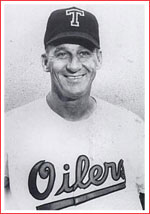
Less than a year after offering him their big-league pitching coach job, the Cardinals fired Hall of Fame left-hander Warren Spahn as manager of their Class AAA team.

The Tulsa Oilers were 15 games below .500 and in last place when Spahn was fired. The Cardinals said Spahn’s dismissal was based on a desire to give other managers in their system a chance to advance.

On Aug. 27, 1971, Cardinals general manager Bing Devine arrived unannounced in Tulsa, met with Spahn and told him his contract would be terminated after the completion of the American Association season.

Spahn responded he wouldn’t manage the remaining seven games. Tulsa outfielder Gary Geiger, a former big-leaguer, filled in for Spahn.

“I certainly respect Bing for flying to Tulsa to tell me,” Spahn said to The Sporting News. “He could have as easily picked up a phone and told me.”

Spahn, 50, said Devine informed him there were no other jobs for him with the Cardinals and “there were young prospective managers in the organization who needed to move up.”

Jack Krol, 35, who managed Class AA Arkansas in 1971, replaced Spahn at Tulsa for the 1972 season.

According to The Sporting News, Spahn had been offered the job of pitching coach on Cardinals manager Red Schoendienst’s staff in October 1970 after Billy Muffett was fired. Spahn chose to remain Tulsa manager.

Clyde King, a former Cardinals minor-league manager and pitching instructor, also was considered to replace Muffett, but King became manager of the Class AAA Richmond Braves, and the Cardinals settled for former reliever Barney Schultz as their pitching coach.

A day after Spahn’s firing, Aug. 28, 1971, Tulsa general manager Hugh Finnerty quit in protest, saying he hadn’t been consulted.

“I haven’t felt like I was general manager,” Finnerty said. “I felt like the releasing of Spahn was ill-timed, coming just seven days before the end of the season.”

Oilers owner A. Ray Smith told The Sporting News the Cardinals had contacted him two weeks before Spahn’s firing to advise him of their decision.

“The Cardinals pay 100 percent of the manager’s salary and I think that gives them the right to do what they want _ although they have never tried to cram anything down our throats,” Smith said.

Spahn had been Tulsa’s manager for five seasons _ the longest stint in franchise history. When he became Tulsa manager in 1967, it was at the urging of Smith and at great cost to the Cardinals.

According to The Sporting News, the Cardinals’ first choice to manage the 1967 Tulsa team was Sparky Anderson, who managed the Cardinals’ Class A St. Petersburg club to a Florida State League championship in 1966. Smith wanted Spahn, who never had managed. The Cardinals relented and assigned Anderson to manage their Class A Modesto team in 1967.

Upset he had been passed over for the Class AAA job, Anderson left the Cardinals’ organization after the 1967 season and accepted a minor-league managing job in the Reds’ system.  In October 1969, Anderson was selected manager of the Reds and embarked on his Hall of Fame career.

After the Cardinals fired him, Spahn became pitching coach of the 1972 Cleveland Indians. Gaylord Perry earned 24 wins and received the Cy Young Award with Spahn as his coach that season, and the Indians had a 2.92 team ERA.


Read Full Post »

(Updated April 13, 2025)

Hall of Fame left-hander Warren Spahn never pitched for the Cardinals, but his final games as a pitcher were with the St. Louis organization.

Spahn, who had 363 big-league wins, primarily with the Braves, got his first try at being a manager in 1967 with the Cardinals’ Class AAA Tulsa Oilers.

The Oilers were a team of former big-league veterans (pitcher Tracy Stallard, outfielder Joe Christopher) and a few prospects (pitchers Mike Torrez and Wayne Granger).

By August, Spahn’s pitching staff was weakened by injuries. So, at 46, he placed himself on the active roster and into the starting rotation.

Spahn had made his last big-league appearance in 1965, with the Giants. He pitched in three games with the Mexico City Tigers in 1966.

Former Braves catcher, Joe Torre told Cardinals Yearbook in 2014, “Spahn was easy to catch, a walk in the park, because his control was impeccable.”

On Aug. 7, 1967, a Monday night in Tulsa before a crowd of 4,238, Spahn started against the Hawaii Islanders and their 30-year-old right-hander, Bill Haywood. Catching for Tulsa was Pat Corrales.

Tulsa scored four times in the first. When Spahn held Hawaii scoreless through the first three innings, it appeared the old master was headed for a successful comeback. Then it fell apart. Hawaii scored a run in the fourth and four in the fifth, taking a 5-4 lead. After Spahn departed with one out in the fifth, the game unraveled in the hands of the bullpens. Tulsa won, 14-13.

Spahn’s line: 4.1 innings, 4 hits, 4 runs (3 earned), 4 walks and 4 strikeouts.

Five nights later, Aug, 12, Spahn started again, at Oklahoma City against the 89ers before a gathering of 1,028. When he left after two innings, Oklahoma City led, 3-0, and went on to win, 3-2, handing Spahn the loss in the last start of his professional career.

Spahn’s line: 2 innings, 3 hits, 2 runs, 1 walk, 1 strikeout.

Spahn also made a relief appearance, consisting of two-thirds of an inning, for Tulsa. In his three games for the Oilers, Spahn was 0-1 with a 6.43 ERA.

Spahn remained as Tulsa manager until 1971, but he never pitched again.

Read Full Post »

(Updated March 21, 2017)

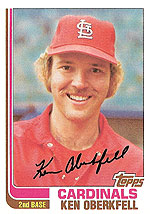
A disciple of the Whitey Herzog school of managing, Ken Oberkfell, third baseman on the Cardinals’ 1982 World Series championship club, was bench coach on Mets manager Terry Collins’ staff in 2011.

Before that, Oberkfell had been a minor-league manager for 17 years. In an interview for the 2010 Cardinals yearbook, Oberkfell discussed the advice he received from Herzog.

“When I started managing, I talked to Whitey a little bit,” Oberkfell said. “He just said, ‘You’ve got to have your own identity, your own way of managing things. You can take what you can from other managers you’ve had, but you have to be yourself.’

“And he also said, ‘If you make a decision, don’t second-guess yourself.’ And I’ve taken that to heart.”

Oberkfell began his managerial career in 1995 in the independent Northeast League. After managing there again in 1996, Oberkfell became a manager in the Phillies’ system. He managed Piedmont of the Class A South Atlantic League from 1997-99 and Clearwater of the Florida State League in 2000.

One of his players at Piedmont was 18-year-old shortstop Jimmy Rollins, who reached the majors in 2000, won the Gold Glove Award four times and a National League Most Valuable Player Award.

Rollins was the first of several outstanding prospects who were nurtured under Oberkfell’s care. Others include shortstop Jose Reyes, third baseman David Wright and outfielder Jason Bay. All became all-stars in the major leagues.

In 2001, Oberkfell joined the Mets organization. He managed Capital City of the South Atlantic League in 2001, St. Lucie of the Florida State League in 2002-03, Binghamton of the Eastern League in 2004, Norfolk of the International League in 2005-06, New Orleans of the Pacific Coast League in 2007-08 and Buffalo of the International League in 2009-10.

He was named minor league manager of the year by Baseball America magazine in 2005. In an article about the award, Oberkfell cited Herzog’s positive influence on his managing style. Story

“I learned a lot from Whitey in terms of handling players and communicating, especially with extra players,” Oberkfell told the magazine. “He always had a way of keeping them positive, keeping them ready. That’s so important if you want to have success at any level.

“And just like Whitey, I like to run. I like to be aggressive on the bases. I’m a pretty laid-back guy until we have runners on base.”

It was with the Cardinals that Oberkfell broke into the major leagues in 1977 as a second baseman. He played for Vern Rapp and Ken Boyer before Herzog joined the Cardinals in June 1980.

An outstanding fielder _ he led National League second basemen in fielding percentage (.985) in 1979 _ Oberkfell made a successful conversion to third base after Herzog traded incumbent Ken Reitz to the Cubs in December 1980.

Oberkfell led NL third basemen in fielding percentage in 1982 (.972) and 1983 (.960). His game-winning single off Gene Garber in Game 2 of the NL Championship Series gave the Cardinals a 4-3 victory over Atlanta. Boxscore Oberkfell batted .292 (7-for-24) with four runs scored in the 1982 World Series.

When Terry Pendleton proved ready to handle the third base job, Oberkfell was dealt to the Braves on June 15, 1984, for pitcher Ken Dayley and first baseman Mike Jorgensen.

From 1977-84 with St. Louis, Oberkfell batted .292 with a .364 on-base percentage.

Read Full Post »

(Updated Feb. 14, 2022)

The Cardinals almost dealt Bob Gibson to the Washington Senators.

In December 1960, the Cardinals and the Pirates had trade talks with the Senators regarding left-handed reliever Bobby Shantz.

“I wanted Shantz to cement our bullpen as the second man behind Lindy McDaniel, just as the Pirates wanted him behind Roy Face,” Cardinals general manager Bing Devine told Oscar Kahan of The Sporting News.

The Senators asked the Cardinals for right fielder Joe Cunningham, Devine said.

“When I would not make the deal,” Devine told Kahan, “they expressed interest in Bob Gibson.”

Gibson, 25, was unhappy with the way he was being utilized by Cardinals manager Solly Hemus. Gibson pitched in 27 games for the 1960 Cardinals, posting a 3-6 record and 5.61 ERA.

The Senators “said it would take a lot more than Gibson to get Shantz,” Devine told the St. Louis Post-Dispatch.

Kahan, citing an anonymous source, reported in the Dec. 28, 1960, edition of The Sporting News the Cardinals offered the Senators three players for Shantz:

1. Bob Gibson

2. Either pitcher Ron Kline or outfielder Walt Moryn.

3. Any one of these minor leaguers: pitchers Ed Bauta, Willard Schmidt and Dean Stone, and outfielders John Glenn and Ben Mateosky.

“Ron Kline and Bob Gibson, each of whom would be a starter for the Senators, have been mentioned as possible trade bait for Shantz,” the St. Louis Globe-Democrat reported.

Devine thought it was an offer the Senators couldn’t refuse. “I think I wound up offering more than they got from the Pirates, but we could not get together,” Devine said.

Senators manager Mickey Vernon had been a Pirates coach during the 1960 season and became impressed by several Pittsburgh prospects, especially first baseman R.C. Stevens.

The Senators swapped Shantz to Pittsburgh for Stevens, outfielder Harry Bright and pitcher Bennie Daniels.

Pirates general manager Joe Brown “beat me to the draw on Shantz,” Devine told the Post-Dispatch. “I feel that maybe I blew the thing, but we were ready to make a similar deal with Washington with players off our (big-league) roster.”

It was a deal the Senators would regret.

_ Stevens, who hit 37 home runs with 109 RBI for Class AAA Salt Lake City in 1960, played in 33 games for the Senators in 1961, with no homers and two RBI. He never played another season in the big leagues.

_ Bright, who hit 27 homers with 119 RBI for Salt Lake City in 1960, played two seasons with the Senators before he was traded to the Reds.

_ Daniels had a 37-60 record and 4.14 ERA in five seasons with the Senators.

When the Cardinals replaced Hemus with Johnny Keane in July 1961, Gibson blossomed into an ace, becoming the greatest Cardinals pitcher and leading St. Louis to two World Series championships and three pennants.

And, Devine ended up acquiring Shantz, after all.

After one season with Pittsburgh, the Pirates lost Shantz to the Houston Colt .45s in the expansion draft. On May 7, 1962, Houston traded Shantz to the Cardinals for outfielder Carl Warwick and pitcher John Anderson.

In three years with St. Louis, Shantz had a 12-10 record, 15 saves and a 2.51 ERA.

A final twist: While many recall pitcher Ernie Broglio was the key player Devine traded to the Cubs on June 15, 1964, for outfielder Lou Brock, what often gets overlooked is Shantz also was part of the deal.

So, instead of trading Gibson for Shantz, Devine ended up keeping Gibson, acquiring Shantz and trading him for Brock. Today, Gibson and Brock are members of the National Baseball Hall of Fame.

Read Full Post »

(Updated Aug. 11, 2024)

On Dec. 9, 1980, in a trade that successfully altered the course of the franchise, the Cardinals acquired closer Bruce Sutter from the Cubs for first baseman Leon Durham, third baseman Ken Reitz and utility player Ty Waller.

Sutter gave the Cardinals the reliable closer they had been lacking. With Sutter as the anchor, manager Whitey Herzog built a deep bullpen that handcuffed the opposition and took pressure off the starting staff.

Sutter, who would be elected to the National Baseball Hall of Fame, was a key to turning the Cardinals from underachievers throughout the 1970s to World Series champions in 1982.

In his first year with St. Louis, the strike-hampered 1981 season, Sutter had a National League-leading 25 saves. In 1982, he led the NL in saves again, with 36.

In the five years before Sutter’s arrival, no Cardinals reliever had recorded more than 13 saves in a season.

In his book, “White Rat: A Life in Baseball,” Herzog said, “Relief pitchers like Bruce Sutter are worth their weight in gold.”

Wheeling and dealing

At the 1980 baseball winter meetings in Dallas, Herzog, who had the dual role of general manager and manager, completed a multiplayer deal in which he acquired closer Rollie Fingers from the Padres. He still wanted Sutter, who had won the 1979 National League Cy Young Award. Herzog viewed Fingers as insurance in case a deal with the Cubs couldn’t be completed.

Herzog called Fingers “the great relief pitcher I needed, but not the one I really wanted. The guy I was really after was Bruce Sutter.”

The Cubs were willing to deal Sutter because he had been awarded a $700,000 yearly salary, about twice as much as the club wanted to pay, in an arbitration ruling the year before.

When Herzog first approached the Cubs about Sutter, their general manager, Bob Kennedy, wanted Durham, Waller and second baseman Tom Herr, Herzog said.

Regarding Durham, Herzog told the St. Louis Post-Dispatch, “I hate to give him up. Durham is one of the top five prospects in the game.”

Cardinals scout Fred McAlister told the Chicago Tribune, “Quite frankly, in Durham, the Cubs may be getting another Dave Parker. If this guy ain’t a prospect, then nobody is.”

Herzog said he tried to get the Cubs to accept a package of players excluding Durham and Herr, but Kennedy responded, “No Durham, no Sutter.”

Herzog offered first baseman Keith Hernandez instead of Herr.

“I offered them Hernandez in a package deal,” Herzog said in the book, “You’re Missin’ A Great Game.” “But … Kennedy didn’t want to take on that big salary.”

When the Cardinals countered with an offer of Durham, Reitz and Waller, the Cubs accepted.

Upping the ante

Herzog was ready to part with Reitz, who he deemed “a fine-fielding third baseman but a streak hitter and maybe one of the slowest runners I’ve seen.” He hoped to shift Ken Oberkfell from second to third and put Herr at second.

Reitz, however, had a no-trade clause in his contract and wasn’t eager to approve a move to the Cubs. According to the Post-Dispatch, Reitz finally consented when the Cubs offered to increase his salary and the Cardinals agreed to compensate him for waiving the no-trade clause. Herzog said the Cardinals gave Reitz $50,000 to approve the trade. Newspapers reported the price was $75,000.

Chicago Tribune columnist Bob Verdi wrote, “It would have been nice had Kennedy held out for Ted Simmons, whose average for 81 games in Wrigley Field might have bordered on astronomical.”

Because he had signed free-agent catcher Darrell Porter, Herzog wanted to move Simmons from catcher to first base and put Hernandez in left field.

When Simmons balked at moving to first base, Herzog shipped Simmons, Fingers and pitcher Pete Vuckovich to the Brewers for pitchers Dave LaPoint and Lary Sorensen and oufielders David Green and Sixto Lezcano.

Good as expected

“The Cardinals have a chance to win the pennant with Bruce,” Kennedy told the Chicago Tribune, “but we have to rebuild, and he couldn’t win the pennant for us.”

Sutter said he was glad to leave the Cubs.

“I just don’t see any chance of the Cubs becoming a winner,” Sutter told the Chicago Tribune. “There’s not much in their minor-league system and it’s pretty obvious we didn’t have enough talent up here. It seems like the minute you become good around here, and they have to pay you for being good, they get rid of you because they don’t want to pay you. You just can’t operate that way.”

Sutter added, “The ballclub I’m going to is going to be a winner, and that matters more than anything.”

Using a split-fingered pitch Herzog described as looking “like a rock skipping on water _ tough to pick up, let alone hit,” Sutter was the stopper Herzog desired.

“When I got to St. Louis, I was sure I got myself a top-flight closer,” Herzog said. “…I realized it was smarter to start building my staff at the back, with that one potent guy, and move forward from there. I’d get that guy who could shut the door the last two innings, cut the other guy’s chance from 27 (outs) to 21, and hope my starters were good enough to get me through the sixth (inning).”

Sutter changed the dynamics of the game for the Cardinals. “Sutter might be the most important pitcher I ever had,” Herzog said. “He was sure the best relief pitcher I ever saw.”

Sutter led the league in saves in three of his four seasons with St. Louis. In the 1982 World Series, in which the Cardinals won four of seven games against the Brewers, Sutter had a win and two saves, closing out the decisive Game 7. Video

In an interview for the 2006 Baseball Hall of Fame yearbook, Sutter said, “I had a great time playing there. Whitey Herzog was the best. I learned a lot of baseball from Whitey Herzog.”

Claude Osteen, who pitched and coached in the big leagues, said most hitters couldn’t resist swinging at Sutter’s split-fingered pitch.

“So many times I’ve seen him come in to pitch and not be sharp and the majority of his out pitches are balls,” Osteen told the Philadelphia Daily News in 1985, “but the pitch just looks so appealing to the hitter that they can’t lay off of it. I’ve only seen one of two hitters _ Mike Schmidt is one and Ted Simmons was one of the best _ who were good at laying off of that pitch. Those two hitters constantly have Sutter behind in the count because they don’t swing at that pitch. That’s the secret to it.”

Read Full Post »

« Newer Posts - Older Posts »