(Updated Sept. 8, 2024)
Ralph Houk, who won three American League pennants and two World Series championships as Yankees manager from 1961-63, was an important mentor to Whitey Herzog.
 Houk, who earned more than 1,600 wins as manager of the Yankees, Tigers and Red Sox, began his managing career with the Class AAA Denver Bears of the American Association in 1955. His center fielder that season was 23-year-old Whitey Herzog.
Playing on a Yankees farm club that included Marv Throneberry at first, Bobby Richardson at second and pitchers Don Larsen and Ralph Terry, Herzog batted .289 with 21 home runs, 98 RBI and a .412 on-base percentage in 149 games.
He also learned lessons from Houk’s managerial style that he later utilized when he managed the Cardinals.
“Ralph Houk was the best I ever saw at handling people,” Herzog said in his 1999 book, “You’re Missin’ a Great Game.”
“Ralph was a great manager because he knew how to keep 24, 25 different personalities happy. That’s harder than it looks. He let us know what he wanted us all to do, but he dealt with each of us on our own terms, too.
“I played some of my best ball for Mr. Houk, and I never forgot his example. Whether a player was a star or a scrub, I always made sure he felt important … I also tried to spend some time, even a minute or two, with each player every day … My players appreciated that.
“Maybe what I learned best from Ralph Houk was how important every guy is.”
(Herzog wasn’t alone in his admiration of Houk. In his book “The Quality of Courage,” Yankees slugger Mickey Mantle called Houk “the man I admire more than anybody else in baseball.”)
Mike Jorgensen, a reserve first baseman and outfielder for Herzog with the Cardinals in 1984 and 1985, told Cardinals Magazine, “I got to watch (Herzog) work his magic with strategy, particularly with the bullpen and bench players. I was a bench player at that time. He let you know when you were going to play.”
Here’s what other players said to Cardinals Magazine about Herzog’s skill at connecting with them:
_ Dane Iorg: “You felt he was your friend. He was always genuine. He was able to do that because he had confidence in his abilities to manage a baseball team … He could relate to players in a way that nobody else could that I ever played for.”
_ Danny Cox: “Whitey called a team meeting one time. We were kind of flat, not winning, not playing well. He said, ‘Guys, I hate to do this. We’re going to have a little curfew.’ There was this soft rumble from the guys. Whitey said, ‘Yeah, we’re going to have a little curfew _ it’s 4 a.m.’ Everyone laughed. Whitey said, ‘If I check rooms and you’re in before that, you’re going to get fined.’ He just wanted us to relax. He knew the problem was that we were trying too hard, not that we weren’t trying hard enough.”
_ Ken Oberkfell: “We were struggling, not playing really good baseball, and we were getting beat in games that lasted 3.5 hours. Whitey called a meeting. We thought, ‘Uh-oh, we’re going to get our butts chewed out, and we deserve it.’ He said, ‘If you guys are going to play this horseshit, do it faster. I’m tired of watching it.’ So we obliged him. We went out and got beat in two hours, but we got the point. He didn’t have to rant and rave. He was trying to loosen us up.”
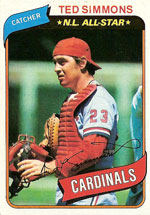 Herzog, who doubled as the Cardinals’ general manager, traded 13 players and received nine in return in deals with the Padres, Cubs and Brewers. The biggest stunner was the last one on Dec. 12, 1980: popular catcher Ted Simmons, the soul of the team, was traded with pitchers Rollie Fingers and Pete Vuckovich to the Brewers for pitchers Lary Sorensen and Dave LaPoint and outfielders Sixto Lezcano and David Green.
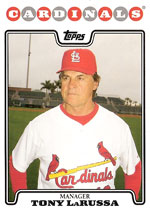 Of the eight Cardinals teams to qualify for the postseason since Tony La Russa became manager, seven have won 42 or more games after the All-Star Game.
 RetroSimba