Feeds:
Posts
Comments

Archive for the ‘Managers’ Category

Though the minor leagues were where Gaylen Pitts spent most of his long and accomplished baseball career, he twice reached the majors _ and both times with the help of Dal Maxvill.

Pitts was a player, manager, coach and instructor in the minors, primarily with the Cardinals.

An infielder, he played 13 years in the farm systems of the Cardinals, Athletics and Cubs. He managed in the minors for 19 years for the Cardinals, A’s and Yankees.

Pitts got to the big leagues with the A’s for the first time in 1974 as an infield replacement for Maxvill, who got injured. Then, after the 1990 season, it was Maxvill, the Cardinals’ general manager, who recommended Pitts for the role of bench coach on the staff of manager Joe Torre.

Down on the farm

Pitts moved with his family from Wichita, Kan., to Mountain Home, Ark., when he was a boy. He listened to Cardinals games on the radio, played baseball in high school and caught the attention of scout Fred Hawn, who arranged for a tryout in St. Louis. Pitts was 18 when the Cardinals signed him for $8,000 in 1964. “I bought a car; a good one,” he recalled to the Arkansas Democrat Gazette.

Early in the 1966 season, Pitts was drafted into the Army and served in Vietnam. He returned to baseball in 1968. Two years later, Pitts, a utility infielder candidate, got invited to the Cardinals’ big-league spring training camp for the only time. He didn’t make the club, but he did become pals with the Cardinals’ shortstop, Dal Maxvill, Pitts recalled to the Society for American Baseball Research.

“When I was with the Cardinals, they wanted only veteran players,” Pitts told the Wichita Beacon. “If something went wrong with the big club, they’d go out and trade or buy a veteran. When they started their youth movement, I was traded.”

During the 1971 season, his seventh in the Cardinals’ farm system, Pitts was dealt to the A’s for Dennis Higgins, and sent to Class AAA Iowa, where he took the place of another veteran infielder, Tony La Russa, who got called up to Oakland.

Pitts never hit .300 in the minors. His single-season career highs in home runs (12) and RBI (58) were not robust. His hope for reaching the majors came from his ability to play multiple infield positions (second, short and third).

In May 1974, 10 years after he started out in the minors, Pitts got the call. With A’s second baseman Dick Green and third baseman Sal Bando sidelined because of injuries, Maxvill, their reserve infielder, got hurt. Needing someone who could fill in at multiple spots, the A’s promoted Pitts.

That’s a winner

When Pitts arrived in Oakland, Maxvill’s name was marked above the locker he was given, indicating the club didn’t expect the 27-year-old rookie to be around long. Nonetheless, his teammates “treated me great, from Catfish Hunter to Reggie Jackson,” Pitts recalled to the Memphis Commercial Appeal.

A highlight came on May 14, 1974, at Oakland against the Royals when Pitts drove in both runs with doubles in a 2-1 victory for the A’s.

Facing Lindy McDaniel, the 38-year-old former Cardinal _ “I used to follow him when I was a kid,” Pitts told the Oakland Tribune _ Pitts drove in Angel Mangual from second with a double in the fifth.

With the score tied at 1-1 in the 10th, Ted Kubiak was on first, one out, when Pitts lined a McDaniel slider over the head of left fielder Jim Wohlford. Kubiak slid around catcher Fran Healy to score just ahead of the relay throw and give the A’s a walkoff win.

Ron Bergman of the Oakland Tribune wrote of Pitts’ game-winning double, “He put some cream in his major league cup of coffee.”

Pitts told the newspaper, “I’ll remember this no matter what happens.” Boxscore

A month later, Pitts was back in the minors. He returned to the A’s in September 1975 and got three at-bats, his last as a big leaguer.

Follow the leader

After playing his final season in the minors in 1977, Pitts was named manager of an A’s farm club at Modesto, Calif. On a salary of $8,000, he couldn’t afford a car, so he rode a bicycle back and forth from his residence to the ballpark.

Recalling that first season as manager, Pitts told the Modesto Bee, “They say you learn from your mistakes, and I want to tell you, I did a lot of learning.”

After two years with Modesto, Pitts rejoined the Cardinals and spent 16 seasons managing their farm clubs. In other years with them, he was special assistant for player development, minor league field coordinator and a coach on the staff of Louisville manager Jim Fregosi.

“I’ve picked up a little from every manager I’ve ever played for or worked with,” Pitts told the Louisville Courier-Journal, “but I probably learned the most with Fregosi, not just on the field, but off the field, too.”

(According to the Courier-Journal, in 1990, when Pitts was Louisville manager, the team was waiting in the Denver airport for a flight when he struck up a conversation with a woman. They hit it off and eventually married.)

Among the Cardinals prospects Pitts managed were Rick Ankiel, Allen Craig, Daniel Descalso, J.D. Drew, Bernard Gilkey, Jon Jay, Ray Lankford, Joe McEwing, Adam Ottovino, Placido Polanco and Todd Zeile. Pitts also managed Andy Van Slyke and later Andy’s son, A.J. Van Slyke.

Future big-league managers who were managed by Pitts included Terry Francona, Oliver Marmol and Jim Riggleman.

“I’m really impressed with the job that Gaylen does,” Tony La Russa, the Cardinals’ manager, said to the St. Louis Post-Dispatch in 2000.

In describing Pitts as a manager who stressed fundamentals, Don Wade of the Memphis Commercial Appeal noted, “Pitts was old school before old school was retro. He’s brick foundation old school, not prefab.”

Regarding his managing style, Pitts told the Courier-Journal, “You’ve got to know when to bark and when not to. It’s just mutual respect. There’s a fine line there.”

Pitts briefly left the Cardinals’ organization. In 2003, he was the hitting coach on the staff of manager Cecil Cooper at Indianapolis, a Brewers farm team. Noting that Cooper had 2,192 big-league hits and Pitts had 11, the Post-Dispatch suggested the roles should be reversed. Pitts said with a laugh, “Cecil told me he would help me with the hitting stuff if I would help him with the managing.”

In 2006, Pitts managed a Yankees farm club, Staten Island, to the championship of the New York-Pennsylvania League.

Cardinals candidate

After Cardinals manager Whitey Herzog quit the team in July 1990, general manager Dal Maxvill interviewed seven candidates for the job: Don Baylor, Pat Corrales, Mike Jorgensen, Hal Lanier, Gene Tenace, Joe Torre and Pitts, according to the Post-Dispatch. (Ted Simmons removed himself from consideration.)

Noting that Pitts “has done a good job developing talent for the Cardinals,” columnist Bernie Miklasz wrote that Pitts would be “in over his head” as Cardinals manager because he “doesn’t have any experience working with major league players.” Miklasz suggested Pitts “needs to become a major league coach first to receive the needed exposure.”

Maxvill hired Torre in August 1990. After the season, Torre chose Pitts for his coaching staff on the suggestion of Maxvill, Pitts told researcher Gregory H. Wolf.

Pitts was Torre’s bench coach from 1991-94 and third-base coach in 1995.

When Torre was fired in June 1995 by Maxvill’s replacement, Walt Jocketty, Pitts and fellow coach Chris Chambliss were considered for the role of interim manager, but the job went to the club’s director of player development, Mike Jorgensen.

According to the Post-Dispatch, Jocketty said Pitts and Chambliss “were very qualified to manage, but I wanted to bring in someone who could change the dynamics a little … someone familiar with the situation, yet who was not there on the front line every day.”

Though he never got the chance to manage in the majors, Pitts told the Baxter (Ark.) Bulletin in 2004, “For a country boy from Arkansas who had never been out of Mountain Home much before I got out of high school, I’ve had a great ride.”

Read Full Post »

Gee Walker took a nap in St. Louis. Problem is, he did it on the base paths.

On June 30, 1934, Walker was picked off base twice in the same inning while sleep-walking for the Tigers against the Browns at Sportsman’s Park.

His blunders ruined a potential Tigers scoring threat, opening the door for the Browns to win in extra innings, and enraged Tigers player-manager Mickey Cochrane, who fined and suspended Walker.

Born to run

Gerald “Gee” Walker was an exciting ballplayer with multiple skills. He could run, hit for average and drive balls into the gaps for extra bases.

An outfielder and right-handed batter, Walker hit .300 or better in six of his 15 seasons in the majors with the Tigers (1931-37), White Sox (1938-39), Senators (1940), Indians (1941) and Reds (1942-45). He twice ranked among the top 10 in the American League in doubles, triples, RBI and total bases. He had 20 or more steals in a season five times.

At the University of Mississippi, Walker played football as well as baseball. He was a member of the “The Flying Five” backfield which also included Tadpole Smith, Rube Wilcox, Doodle Rushing and Cowboy Woodruff.

Walker brought a football-type aggressiveness to the diamond that could thrill but sometimes backfired. The Detroit News described him as a “base-running screwball” and the Detroit Free Press called it “dizzy base running.”

“He frequently was in hot water with his manager because of reckless running and his penchant for being picked off base,” The Sporting News noted.

Costly gaffes

The Tigers, who had not won a pennant since 1909, were challenging the Yankees for control of the American League in 1934. Entering a series-opening Saturday afternoon game with the Browns at St. Louis, the Tigers (40-25) were a mere half game behind the first-place Yankees (40-24). The Browns (28-34) were a team the Tigers were expected to beat, so Mickey Cochrane, Detroit’s manager and catcher, was looking for a strong start to the series.

With the score tied at 3-3, Hank Greenberg led off the Tigers’ eighth with a single. Walker followed with a grounder to third baseman Harlond Clift, who threw low trying to force out Greenberg at second.

Clift’s error gave the Tigers a scoring chance, with Greenberg at second, Walker at first, no outs and Marv Owen (who drove in 98 runs that season) at the plate.

Greenberg’s presence on second meant Walker had nowhere to go and thus didn’t need to take anything more than a normal lead, but after Jack Knott made a pitch to Owen, catcher Rollie Hemsley noticed Walker had drifted into a no-man’s land off first. Hemsley fired the ball to first baseman Jack Burns and Walker was trapped between first and second.

When Greenberg saw the predicament Walker was in, he tried to help by galloping toward third but got caught in a rundown. Before Greenberg was tagged out, Walker advanced to second. Owen then lined to left for the second out.

Though picked off once that inning, Walker wandered six feet from second base. Before making a pitch to the next batter, Knott whirled and threw to shortstop Alan Strange, covering second. Walker was caught flat-footed and tagged out, ending the inning. As the Detroit Free Press noted, Walker “broke up a rally with some of his characteristic crackpottery.”

The Browns won, 4-3, in 10 innings. Boxscore

Out of sight

“Cochrane was furious with Walker,” the Free Press reported. “Before he left the Tigers’ dugout at the end of the game, he almost blew four fuses.”

Citing Walker’s bungling on the base paths, Cochrane suspended him indefinitely and issued a fine.

“I’m through with that fellow,” Cochrane said to the Free Press. “I’ve done everything I could to help him. Then he goes and kicks away a ballgame through reckless, stupid base running. It would not be fair to the other players to keep a fellow of Walker’s type around.”

Walker told the Detroit newspaper, “I don’t blame Mickey for doing what he has done. I had it coming to me.”

(The contrite comments were in contrast to what Walker said years later. Walker said to Chicago reporter Edgar Munzel, “I thought it was a rotten deal because I had violated no baseball rule on the club. A base runner has to be given a lot of latitude. Cochrane never forgot that day … He never liked me after that.”)

The next day, Sunday, July 1, the Tigers and Browns split a doubleheader and Walker, not in uniform, watched from a box seat. Afterward, the Tigers departed by train for a series in Cleveland and Walker took a separate train back to Detroit.

“All I want to do is get that fellow out of my sight in a hurry,” Cochrane told the Free Press.

While the Tigers were splitting a doubleheader at Cleveland on Monday, July 2, Walker met with Tigers owner Frank Navin. Though it was a pleasant session, Navin told Walker he backed Cochrane’s right to fine and suspend the player.

Cochrane wanted to send Walker to the minors, but he needed to clear waivers first. When the Browns made a waiver claim for Walker, the Tigers scrapped the idea of a demotion, the Free Press reported.

After the Tigers beat the Indians at Cleveland on Tuesday, July 3, both teams headed to Detroit for a July 4 doubleheader.

Gee whiz

Walker met with Cochrane before the holiday games at Detroit and offered to make an apology to the team if given another chance. He also asked if he could work out with the club, but the request was denied. Walker watched from the stands as the Tigers and Indians split the doubleheader.

After the games, Cochrane asked his players to vote on whether Walker should be reinstated. Walker’s teammates supported his return. Cochrane then declared the suspension would end after 10 days. Because the punishment began July 1, Walker was eligible to play again July 11.

“When he returns, I’ll be for him again, provided he plays the right kind of ball,” Cochrane told the Free Press.

Three days later, on Saturday, July 7, Cochrane was the catcher when the Tigers faced the Browns at Detroit. In the first inning, Cochrane doubled, driving in a run. Then, lo and behold, Browns catcher Rollie Hemsley picked off Cochrane. He took off for third but was tagged out.

In the seventh, after Cochrane walked, Hemsley tried to pick off Cochrane again but he scrambled back to the bag in time.

The Tigers won, 4-0. Cochrane fined himself $10 for getting picked off second, the Free Press reported. Boxscore

He’s back

Although back in uniform on July 11, Walker didn’t get into a game until making a pinch-hit appearance against the Yankees’ Red Ruffing on July 13. He popped out to second.

The next day, July 14, Cochrane started Walker in center and he contributed a double, two singles and three RBI in the Tigers’ 12-11 victory at home versus the Yankees. Walker got an ovation from the crowd when he singled against Lefty Gomez in the first.

The game also was noteworthy because Lou Gehrig was listed in the starting lineup as the shortstop, batting leadoff. Gehrig was “weak from an attack of lumbago,” according to the Free Press, and was in the lineup “only long enough to extend to 1,427 the string of consecutive games in which he has played.”

After Gehrig led off the game with a single, Red Rolfe ran for him and stayed in to play shortstop. Boxscore

Walker went on to hit .300 with 20 stolen bases for the 1934 Tigers, who won the pennant, but Cochrane didn’t start him in any of the World Series games against the Cardinals. Walker was 1-for-3 in that Series as a pinch-hitter. In Game 2, his RBI-single against Bill Hallahan tied the score at 2-2. Bill Walker relieved _ and picked Walker off first. Boxscore

Most popular

Walker had outstanding seasons for the Tigers in 1936 (.353 batting average, 55 doubles, 105 runs scored) and 1937 (.335 batting average, 213 hits, 113 RBI, 105 runs scored). On Opening Day in 1937, he hit for the cycle against Cleveland. Boxscore

Walker “won the hearts of all Detroit baseball fans with his daring, hard play,” International News Service reported.

The Free Press referred to Walker as the “people’s choice” and rated him as “probably the most popular player on the Tigers.”

Thus, there was an outcry when on Dec. 2, 1937, in a trade engineered by Cochrane, the Tigers sent Walker, Marv Owen and Mike Tresh to the White Sox for Vern Kennedy, Tony Piet and Dixie Walker.

“Fans by the thousands were protesting” the trading of Gee Walker, the Associated Press reported. The angry phone calls and letters produced “the biggest fan protest in the club’s history,” according to The Sporting News.

John Lardner of the North American Newspaper Alliance noted that “Mickey Cochrane, hitherto a public monument, is being wildly reviled for trading” Walker.

Cochrane said he made the deal to get Kennedy, a pitcher who was 14-13 with a 5.09 ERA for the White Sox in 1937 after earning 21 wins the year before. “We had to have pitching, and the only way we could get it was by giving up Walker,” Cochrane told the Associated Press. “The Sox wanted him and they had the only pitcher I thought could help us.”

Asked his reaction to the trade, Walker, referring to Cochrane, said, “I am out of the doghouse for the first time in six years.”

Kennedy was 12-12 with a 5.20 ERA for the Tigers before they dealt him to the Browns in May 1939. Walker did well with the White Sox (.305 batting average in 1938; 111 RBI in 1939) before joining the Senators (96 RBI in 1940).

Walker finished his big-league career with 1,991 hits and a .294 batting average.

Read Full Post »

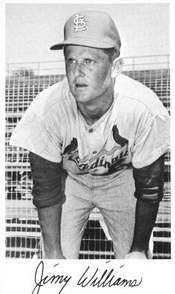
An introduction to the big leagues with the 1966 Cardinals was about as challenging as it gets for Jimy Williams.

A middle infielder whose professional baseball experience consisted of one season at the Class A level of the minors, Williams got his first at-bat in the majors against none other than Sandy Koufax. His second plate appearance also came against a future Hall of Famer, Juan Marichal.
As if that wasn’t enough of a test, the rookie leaped into a frog-jumping contest involving Cardinals and Giants players.

Though his stint with the Cardinals was short, Williams went on to become a manager in the majors with the Blue Jays, Red Sox and Astros. He also managed the Cardinals’ top farm team.

Name of the game

James Francis Williams, known as Jimmy, was the son of farmers who raised cattle and garbanzo beans on 800 acres in Arroyo Grande, Calif. (Asked where Arroyo Grande is located, Williams told the Boston Globe, “It’s about three miles past ‘Resume Speed.’ “)

In high school, Williams changed the spelling of Jimmy, dropping one “m” as a prank. “I spelled it that way on a term paper or a test, and the teacher didn’t say anything about it, so I kept it,” he told the San Luis Obispo Tribune.

Williams played college baseball at Fresno State, earned a degree in agribusiness and was signed in June 1965 by Red Sox scouts Bobby Doerr and Glenn Wright. With Class A Waterloo (Iowa) that summer, Williams led the Midwest League’s shortstops in fielding percentage and hit .287.

When the Red Sox didn’t protect Williams on their winter roster, the Cardinals drafted him in November 1965 on the recommendation of scout Joe Mathes.

After Cardinals manager Red Schoendienst got his first look at Williams during 1966 spring training, he said to the St. Louis Post-Dispatch, “I can see why Joe was so hot about the kid. He sure looks like a comer.”

According to the Post-Dispatch, Williams at shortstop displayed “agility as he moved with speed to field balls hit to either side.”

Schoendienst, whose career as a second baseman got him elected to the Baseball Hall of Fame, mentored Williams on how to play that position and was pleased by the rookie’s progress in making the double play, the Post-Dispatch reported.

By being able to play both shortstop and second base, Williams enhanced his value as a utility player and earned a spot on the 1966 Cardinals’ Opening Day roster, joining Jerry Buchek, Phil Gagliano, Julian Javier and Dal Maxvill as the middle infielders.

On their way from St. Petersburg to St. Louis to begin the season, the Cardinals stopped in Kansas City to play exhibition games against the Athletics. In one, Williams entered as a replacement for Javier at second base and produced two hits and three RBI in the Cardinals’ 7-6 triumph.

Candlestick croakers

When the 1966 season opened, Williams sat for two weeks. His debut came on April 26 at Dodger Stadium when he replaced Maxvill at shortstop in the sixth inning. The first batter, Nate Oliver, hit a ground ball to Williams. The next, John Kennedy, hit a pop fly to him. Williams handled both chances flawlessly.

In the eighth, Williams got his first at-bat, facing Koufax. Asked what he was thinking as he came to the plate, Williams replied to the San Luis Obispo Tribune, “That I was going to get a hit. That’s the only reason to get into the batter’s box.”

Koufax struck him out. “I punched out two foul balls and got a hook (curveball) and it was, ‘Sit down, Jimy Williams,’ ” the rookie said to the San Luis Obispo newspaper. Boxscore

Two weeks later, at St. Louis, Williams got his second plate appearance. Facing Marichal, he grounded out, but two innings later, he singled to center versus Marichal, driving in Tim McCarver from third. Boxscore

In the time between his at-bats versus Koufax and Marichal, Williams and the Cardinals were in San Francisco for a series. A frog-jumping contest was planned at Candlestick Park before the Sunday finale. Ten players _ five Cardinals (Nelson Briles, Curt Flood, Mike Shannon, Bob Skinner and Williams) and five Giants (Bob Barton, Len Gabrielson, Bill Henry, Ron Herbel and Bob Priddy) _ were the participants. The player who coaxed his frog to make the longest jump would win $50 and the frog would be entered in the Calaveras Frog Jumping Contest made famous in the Mark Twain short story.

“I can sure use the $50 prize,” Williams told the Post-Dispatch. According to the newspaper, Williams practiced at a pond the day before the contest. (In a line Twain might have appreciated, Williams said to the Boston Globe, “If a frog had wings, he wouldn’t bump his booty.”)

The winner, however, was Gabrielson, whose frog (named Bat Legs) jumped 11 feet, eight inches. Priddy placed second (10 feet even) and Williams was third (nine feet, one inch).

In the game that followed, Gabrielson hit a home run against Bob Gibson, and the Giants won. “What a day,” Gabrielson exclaimed to the Oakland Tribune. Boxscore

Big break

Williams, 22, rarely played for the 1966 Cardinals. He had three hits in 11 at-bats before his season was cut short by a six-month stint in the Army reserve.

The Cardinals sent Williams to the minors in 1967. He returned to them in September, played in one game and was traded after the season with Pat Corrales to the Reds for Johnny Edwards.

Williams never again played in the big leagues. He was in the farm systems of the Reds, Expos and Mets before a bum shoulder ended his career in 1971. Williams hurt the shoulder in 1969 while working an off-season job at a Ford plant in St. Louis. “An employee who was playing around threw a Styrofoam cup at me,” Williams recalled to the San Luis Obispo Tribune. “When I threw it back at him, I felt something pop in my shoulder.”

After his playing career, Williams returned to St. Louis and operated a convenience store for two years, according to the San Luis Obispo newspaper.

A former Fresno State teammate, Tom Sommers, brought Williams back into baseball. Sommers was director of minor league operations for the Angels and needed a manager in 1974 for the Class A Quad Cities team in Davenport, Iowa. He gave the job to Williams, 30. “I was the happiest man in the world when Sommers called,” Williams said to the El Paso Times.

Williams rose through the Angels’ system and managed their top farm team, the Salt Lake City Gulls, in 1976 and 1977.

“I like to get young players to do things they don’t think they can,” Williams told the Deseret News. “That way, they boost their confidence and increase their potential. Our players will have freedom on the field to expand their talents.”

Back and forth

In October 1977, Tom Sommers was fired by Angels general manager Harry Dalton. Many of Sommers’ hires, including Williams, got fired, too.

Williams landed back in the Cardinals’ organization as manager of their Class AAA Springfield (Ill.) club in 1978. He accepted the job after Florida State University baseball coach Woody Woodward turned it down, according to Larry Harnly in The Sporting News.

Springfield had players such as Terry Kennedy, Dane Iorg, Tommy Herr, Ken Oberkfell, Silvio Martinez and Aurelio Lopez. The club finished 70-66.

According to the Salt Lake Tribune, Williams and A. Ray Smith, owner of the Springfield franchise, had “a personality conflict” and Williams was looking to manage somewhere else in 1979.

Art Teece, owner of the Salt Lake City franchise, pushed for the Angels to rehire Williams, and they agreed. “Bringing Jimy back to Salt Lake was the key in my resuming a working agreement with the Angels,” Teece told The Sporting News.

Williams said to the Salt Lake Tribune, “I enjoyed being with the Cardinals. They have a good organization and good people, but I really had a nice time in Salt Lake and I’m anxious to return.”

Major moves

Salt Lake City was nice but it wasn’t the majors. When Williams was offered a chance to be third-base coach on the staff of Blue Jays manager Bobby Mattick in 1980, he took it. After Bobby Cox replaced Mattick in 1982, he retained Williams.

After leading the Blue Jays to their first division title in 1985, Cox became general manager of the Braves and Williams replaced him. “Cox did a great job with the players, but I think Jimy’s style might be a little more imaginative,” Blue Jays general manager Pat Gillick told The Sporting News.

(When Gillick fired him in 1989, he told the Toronto Star that Williams was “too nice a guy and too honest.”)

In 12 seasons as a big-league manager with the Blue Jays (1986-89), Red Sox (1997-2001) and Astros (2002-04), Williams had a 909-790 record, but never had a pennant winner.

(When the Red Sox fired Williams in 2001, Cardinals manager Tony La Russa said he was “shocked,” the Post-Dispatch reported. “I think he’s a hell of a baseball man,” La Russa said. “He’s as qualified as anybody around and he got results. You kind of scratch your head.”)

As a coach with the Braves (1990-96) and Phillies (2007-08), Williams was part of five National League pennant winners and two World Series championship teams.

Read Full Post »

The 1982 Cardinals had no player hit 20 home runs. One of their best relievers was 43 and had been in the majors since the 1950s. Only one of their pitchers struck out as many as 90 batters.

Yet, the 1982 Cardinals may be the franchise’s greatest team since baseball went to a divisional alignment. Since 1969, the only Cardinals club to finish a regular season with the best record in the National League and win a World Series title was the 1982 team.
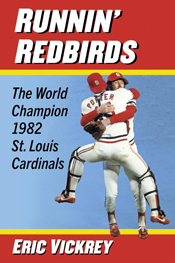
A new book, “Runnin’ Redbirds: The World Champion 1982 St. Louis Cardinals,” provides insights into why that team was so special.

Written by Eric Vickrey, a member of the Society for American Baseball Research, the book is available on Amazon and direct through the publisher, McFarland Books. Until Nov. 27, there is a 40 percent discount (the discount code is HOLIDAY23) for those who order direct from McFarland.

Here is an email interview I did with the author in November 2023:

Q: Hi, Eric. What prompted you to do a book on the 1982 Cardinals?

A: “Growing up in Alton, Illinois, during the 1980s, I fell in love with baseball watching the Cardinals sprint around the bases and play amazing defense. Ozzie Smith, Willie McGee, Vince Coleman and Tommy Herr were my heroes as a kid. Fast-forward to 2020. During the early days of the pandemic, when I was stuck inside and there was no baseball to watch, I started writing player bios for the Society for American Baseball Research. I enjoyed the research and writing process as well as the nostalgia of revisiting the roots of my baseball fandom. I miss the Cardinals’ style of play in the 1980s, which was so different than the game today. I thought it would be interesting to really dig into one season as a longer narrative project. I chose 1982 because it included the arc of Whitey Herzog’s rebuild and the pinnacle of a championship.”

Q: What makes your book different from other books, such as those from Whitey Herzog or Keith Hernandez, about the 1982 Cardinals?

A: “Herzog’s memoir, White Rat, was incredibly insightful, particularly in regard to his roster reconstruction in 1980 and 1981. In typical Whitey fashion, he pulled no punches. Ozzie, Hernandez, Bob Forsch and Darrell Porter also authored books that touched on their experiences in 1982. But there had not been a book that focused primarily on the Cardinals’ 1982 season. In addition to delving into the on-field highlights of that year, Runnin’ Redbirds examines the team in the context of baseball history with some modern analytics sprinkled in. It is also very much a human-interest story. The Cardinals were an eclectic group, and I tell a bit of each player’s story.”

Q: Could you provide an example or anecdote about a 1982 Cardinal who was the most fun or enjoyable for you to interview?

A: “I interviewed Dane Iorg, who was one of the stars of the World Series for St. Louis. In his 17 at-bats against Milwaukee, he recorded nine hits, five of which went for extra bases. If there is such a thing as a clutch player, he was it. I’m sure he has been asked about the 1982 World Series a million times, but to hear the pure joy in his voice while describing the thrill of a championship more than 40 years ago was really cool.”

Q: Since baseball went to a divisional format in 1969, 1982 is the only year in which the Cardinals finished with the best record in the National League and won the World Series title. Do you think then the case can be made that the 1982 group is the last great Cardinals team? 

A: “I think that depends on how you define greatness. I’d consider the 1985, 2004 and 2005 Cardinals great teams even though they fell short of a championship. Anything can happen once you get to the postseason and sometimes a bit of luck swings things in favor of one team. The 1982 Cardinals, for example, benefitted from a rainout in Game 1 of the National League Championship Series when they were trailing the Braves in the fifth inning. Then there was Game 6 of the 1985 World Series, but let’s not go there.”

Q: Who do you think is the most under-appreciated member of the 1982 Cardinals, and why so?

A: “That’s a really tough question because the Cards received contributions from so many players during the course of the season. Unheralded guys like Mike Ramsey, Doug Bair, Ken Oberkfell and Glenn Brummer all made key contributions. But perhaps the most under-appreciated player, relative to his production, is Lonnie Smith. He led the league in runs scored and led the Cardinals in hits, extra-base hits, stolen bases and Wins Above Replacement _ an MVP-level season.”

Q: Could you provide an example of something surprising you learned about the 1982 Cardinals in doing your research and interviewing?

A: “The 1982 Cardinals are most remembered for their speed and defense, and rightly so. But until I dug into the numbers, I never realized how historically dominant the Cardinals’ pitching staff was during the playoff push. They had a stretch in September in which they allowed two earned runs or less in 11 straight games. Only three pitching staffs in the live-ball era have longer streaks, and two of those occurred during the pitching-dominant season of 1968.”

Q: In the postseason, the 1982 team came face to face with prominent Cardinals of the past. In the National League Championship Series, the Braves were managed by Joe Torre and coached by Bob Gibson and Dal Maxvill. In the World Series, the Brewers had players Ted Simmons and Pete Vuckovich. Did that create any drama?

A: “It certainly made things more intriguing. Torre and Gibson were still beloved in St. Louis and got enormous ovations at the start of the NLCS, but Cardinal fans wanted to see them lose. Gibson, on the other hand, said before the series he wanted the Braves to ‘beat the blazes’ out of the Cards. Simmons was another St. Louis icon, and there were many fans who wished he could have been a part of the 1982 team. Now if Garry Templeton had been in the opposing dugout, that may have created some drama.”

Q: Thanks, Eric. To wrap it up, I’m going to list five names from the 1982 Cardinals and ask you to respond, in a sentence or two, with the first thing that comes to mind for you on each. First up: Lonnie Smith?

A: “Lonnie could not seem to crack the Phillies lineup, but Herzog shrewdly traded for him before the 1982 season and what a steal that was. The guy was a winner. He played in five World Series.”

Q: Joaquin Andujar?

A: “Andujar is probably more remembered for his off-the-wall quotes and blowup in the 1985 World Series, but the 1982 team probably doesn’t win it all without him. He was nearly unhittable down the stretch.”

Q: George Hendrick?

A: “Silent George was a solid all-around player and accounted for nearly a third of the Cardinals’ home runs in 1982. One of my favorite anecdotes from Game 7 is that after the last out, Hendrick headed straight for his car and listened to the postgame celebration on his drive home.”

Q: Jim Kaat?

A: “Kitty pitched to Ted Williams during the Eisenhower administration and to Ryne Sandberg during the Reagan administration. He kept reinventing himself and was the quintessential crafty lefty.”

Q: Whitey Herzog?

A: “Pure baseball genius who was not afraid to take risks. An excellent communicator. Every player I talked to who played for him raved about the way he communicated with his players.”

Read Full Post »

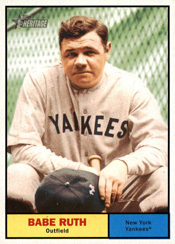
The Sultan of Swat struck out in his bid to become St. Louis Browns manager.

After finishing last in the eight-team American League in 1937, the Browns were looking for a manager and Babe Ruth wanted the job.

Considering that the Browns drew a total home attendance of 123,121 in 1937, Ruth’s willingness to manage the team in 1938 seemed a special opportunity to infuse interest in the moribund franchise, but his overture was rejected.

Manager material?

Approaching his final years as a player, baseball’s home run king wanted to manage in the majors. Ruth and Yankees manager Joe McCarthy, who took over the club in 1931, didn’t get along. Ruth began campaigning for the job, but Yankees general manager Ed Barrow was happy with McCarthy and uninterested in Ruth as a field leader.

In his book, “Babe: The Legend Comes to Life,” author Robert Creamer noted, “Ruth’s obtuseness about the Yankees managing job was almost pitiful. It was obvious Barrow was convinced he was incapable of managing.”

Other clubs thought differently. Opportunities developed for Ruth to manage the Red Sox, Tigers and Athletics, but plans went haywire.

In the summer of 1932, when the Red Sox were on their way to a 43-111 record (and Ruth, with 41 home runs, was powering the Yankees to a pennant), they talked to him about becoming player-manager, but “Babe did not want to leave” New York, Creamer reported. “The Red Sox post came up again in 1933 when Tom Yawkey bought the club. Yawkey wanted to hire Ruth but was persuaded not to by general manager Eddie Collins.”

After the 1933 season, according to Creamer, “the Tigers definitely wanted him. Tigers attendance had been declining and club owner Frank Navin felt Ruth as player-manager would help the gate and possibly help the team.”

The Yankees agreed to a deal. They “were looking for a way to dump Ruth gracefully and this seemed an ideal situation,” Creamer reported.

Navin asked Ruth to come to Detroit to work out the details, but when Ruth left instead for a planned trip to Hawaii, Navin became annoyed and changed his mind. He acquired Mickey Cochrane from the Athletics to be player-manager. (Cochrane led the Tigers to the 1934 pennant and a World Series berth against the Cardinals.)

The Yankees offered to make Ruth manager of their Newark farm club, but he told them he didn’t want to go to the minor leagues, Creamer reported.

Ruth, 39, stayed with the Yankees in 1934, hit 22 home runs and lobbied to become their manager, but club owner Jacob Ruppert reaffirmed his commitment to Joe McCarthy. An angry Ruth told Joe Williams of Scripps-Howard’s New York World-Telegram, “I’m through with the Yankees. I won’t play with them again unless I can manage. They’re sticking with McCarthy, and that lets me out.”

Amid the hullabaloo his comments caused in Gotham, Ruth said sayonara and left with an all-star team for a goodwill tour of Japan. Connie Mack, who owned and managed the Athletics, was leader of the tour, but Ruth was given the chance to manage the all-star team.

According to Creamer, Mack, nearing 72, was considering stepping down as Athletics manager “and liked the idea” of Ruth replacing him. “Ruth’s presence would help the sagging gate, and Connie had always got along well with Babe,” Creamer noted.

Mack used the Japan tour as a test to see how Ruth would do as manager, but Babe got a failing grade, in part, because he feuded with teammate Lou Gehrig, creating divisions among the all-star group.

Promises, promises

In February 1935, soon after Ruth turned 40, the Yankees released him so that he could accept an offer from the Braves to become team vice president, assistant manager and player. Ruth accepted the proposal because he was convinced Braves owner Emil Fuchs intended to make him the manager in 1936, replacing Bill McKechnie.

Early in the 1935 season, though, Ruth became disenchanted. As Creamer noted, “His duties as vice-president seemed confined to attending store openings and other such affairs to get the publicity Fuchs said the club needed. As assistant manager, all he did was tell McKechnie when he was able to play. He soon found out Fuchs had no intention of forcing McKechnie out to make way for Babe.”

On June 2, 1935, Ruth quit the Braves. “I’d still like to manage,” he told columnist Grantland Rice, “but there’s nothing in sight.”

Support for Babe

Two years later, though no offers had come to him, Ruth still was determined to manage in the majors. The Browns looked to be a possibility.

In July 1937, Browns manager Rogers Hornsby was fired and replaced by another former Cardinals player, Jim Bottomley, who had no managing experience. Former Cardinals manager Gabby Street was hired to be a coach on Bottomley’s staff and provide him with on-the-job training. 

The Browns, 25-52 with Hornsby, were 21-56 with Bottomley and finished 46-108, 56 games behind the champion Yankees. “We had two managers in 1937, and we thought we made the right guess each time, yet we finished in last place,” Browns general manager Bill DeWitt Sr. told the St. Louis Star-Times.

According to Sid Keener of the Star-Times, DeWitt and Browns owner Donald Barnes “have been advised by stockholders and friends to make a big play for important publicity by hiring none other than George Herman Ruth, The Babe himself” to be the next manager.

“Ruth would have a powerful magnet at the box office _ at the start, anyway,” Keener advised. “The Babe, back in a major-league uniform as manager of the Browns, would go over in a big way for publicity.”

Advocating for the hiring of Ruth, John Wray of the St. Louis Post-Dispatch wrote, “Some club might do worse than give The Bambino a workout. It could not go broke with a one-year experiment. The Bambino’s name might have some pulling power at the gate _ for a while.”

Wray’s Post-Dispatch colleague, L.C. Davis, suggested that choosing Ruth to manage “would make the turnstiles play a merry tune.”

Babe makes his pitch

In an interview with author William B. Mead for the 1978 book, “Even the Browns,” DeWitt (father of 2023 Cardinals owner Bill DeWitt Jr.) recalled, “Babe Ruth called me up. Out of the blue. I didn’t know him. Never met him. He said, ‘Hey, kid, this is Babe Ruth. I know you haven’t got a good ballclub, but I’d like to be your manager. I can’t get a job managing anyplace else, so I’d like to be the manager of the Browns.’ 

“I said, ‘Now, let me think about it. We’ve just about made up our minds on a guy. Let me talk to some people.’ I took his phone number.”

The guy Barnes and DeWitt wanted for the job was Gabby Street, not Ruth.

Regarding Ruth, DeWitt told Mead, “He would be a great attraction for a year, but we’d probably have to pay him a pretty good salary, and at the end of the year his attractiveness is gone. We had a lousy ballclub, and you know he’s not going to be a good manager, and we were going to try to develop some young players. So we decided not to do it.”

Barnes told the Star-Times, “We did not consider Ruth for a moment. Ruth is a great name in baseball _ or, was a great name _ but, after all, the public will only pay to see a winning ballclub.”

In comments to the Post-Dispatch, Barnes said, “We never had an idea of seeking Ruth as manager at any time. He is not the type we believe would make a successful leader.”

Sid Keener concluded in the Star-Times, “Ruth’s salary demand is considered the major stumbling block in his behalf. George Herman, no doubt, would request a contract calling for a salary in the neighborhood of $30,000.”

According to the Post-Dispatch, Joe McCarthy of the Yankees and Bill Terry of the Giants were the highest-paid managers. Each made $35,000.

Oscar Melillo, a former Browns second baseman who would become a coach for them in 1938, wanted Ruth to be their manager and told the New York Daily News, “Whatever the Browns paid Ruth would be back in the till the first time they played the Yankees in New York.”

Ruth said to the New York Journal-American, “The way I look at it, it must be because those owners want to keep the small-salaried guys in there as long as the public will stand for it.”

Street signed a one-year contract with the Browns for between $7,500 and $10,000, the Star-Times reported. The 1938 Browns were 53-90 when Street was replaced by Melillo with 10 games left in the season.

Missing out

In June 1938, the Dodgers hired Ruth, 43, to be a coach on the staff of manager Burleigh Grimes. It was a publicity stunt, but Ruth hoped it might put him in position to take over for Grimes. Instead, Leo Durocher replaced Grimes after the season and Ruth was out of a job. The chance to manage never came.

“I think I’d make a good manager,” Ruth told Jimmy Powers of the New York Daily News. “I’ve followed the game closely. I know men, I know batters, and I know pitchers.”

In his biography of Ruth, Robert Creamer wrote, “Could he have managed? Of course. Ruth had certain obvious qualities. He was baseball smart, he was sure of himself, he was held in awe by his fellow players and he was undeniably good copy. He may not have been a success _ most managers are not _ but he should have been given the chance.”

Read Full Post »

Not even a dugout full of four-leaf clovers would have been enough to help Patsy Donovan turn the 1903 Cardinals into winners.

What Donovan needed more than the luck of the Irish was a dugout full of run producers and premium pitchers.

As player-manager of the 1903 Cardinals, Donovan (pictured here) did all he could. He was a crafty hitter and a smart manager _ and he also had a rookie pitcher who would become a Hall of Famer _ but that was not enough to compete in the National League.

The 1903 Cardinals finished in last place in the eight-team league at 43-94. Their .314 winning percentage is the lowest in Cardinals franchise history, and the 43 wins are the fewest by a Cardinals club in a season not shortened by labor strife or pandemic.

Popular lad

Born in County Cork, Ireland, Patsy Donovan immigrated to the United States with his family when he was a boy and settled in Massachusetts.

An outfielder and left-handed batter, Donovan reached the big leagues in 1890 and replaced Connie Mack as player-manager of the Pirates in 1896. “As a field general, Patsy ranks with the best in the business,” The Pittsburgh Press noted.

After the 1899 season, the Pirates had an ownership change and Donovan’s contract was sold to the Cardinals. Playing right field for them in 1900, Donovan hit .316 with 45 stolen bases, but the team finished 65-75.

Donovan became Cardinals player-manager in 1901 and led them to a 76-64 record. He hit .303 with 73 RBI and 28 steals. The St. Louis Post-Dispatch declared that “Donovan comes very near to being the best-versed man in the inside workings of the game.”

Many eyes, Irish or otherwise, were smiling on Donovan, whose “classic features (unlike those of some roughhouse ballplayers) don’t look as if they had been chiseled out with a crowbar,” the Post-Dispatch observed.

As the newspaper noted, “The ladies turned out in full force to see the old favorite of the fair fans, Patsy Donovan.”

Shuffling the Cards

Any hopes the Cardinals had of continuing a rise in the National League standings in 1902 were dashed when the fledgling American League made a raid on their roster. Five of their eight starting position players (first baseman Dan McGann, second baseman Dick Padden, shortstop Bobby Wallace, left fielder Jesse Burkett and center fielder Emmet Heidrick) and three top starting pitchers (Jack Harper, Jack Powell and Willie Sudhoff) were enticed to jump to the American League. Most went to the St. Louis Browns.

Donovan hit .315 with 34 steals in 1902, but with so much of his supporting cast departed, the Cardinals fell to 56-78.

Discouraged, Donovan resigned and planned to quit baseball. “He had no money (from the Cardinals) with which to build up a team,” the Post-Dispatch reported in November 1902. “With the prospect of going through another season like the one closed, Donovan concluded he wanted to change.”

Cardinals owners Frank and Stanley Robison convinced Donovan to change his mind and come back for the 1903 season. To help appease him, they acquired a third baseman, Jimmy Burke, from the Pirates and purchased the contract of a minor-league pitcher, Mordecai Brown.

Helping hands

A son of Irish immigrant parents, Jimmy Burke was born and raised in Old North St. Louis. Playing for the Shamrocks, an amateur sandlot team, Burke developed a reputation as a scrappy competitor. As The Sporting News noted, “He made up in hustle and fight what he may have lacked in exceptional ability.”

Mordecai Brown hailed from Nyesville, Ind., 30 miles northeast of Terre Haute. He was a youth when he mangled his right hand in a corn chopper accident, the Chicago Tribune reported. Soon after, he fell while chasing an animal on the family farm and did more damage to the hand.

As a teen, Brown worked in a coal mine and played baseball. Because of the unusual way he was forced to grip the ball in his deformed hand, Brown’s pitches had an unorthodox spin that often baffled batters, the Chicago Tribune noted.

Brown was 24 when he entered professional baseball with a minor-league team in Terre Haute in 1901. After posting 27 wins for Omaha in 1902, he was signed by the Cardinals, and by then he had a nickname _ Mordecai “Three Finger” Brown.

On the skids

Donovan began to feel optimistic about his 1903 team. In February, he told The Pittsburgh Press, “The Cardinals will be much stronger than they were last year.”

The good vibes continued when the Cardinals won their season opener, beating the Cubs, 2-1, on a five-hitter by Clarence Currie. Boxscore

“Three Finger” Brown made his big-league debut against the Cubs and pitched a one-hit shutout for the win in a game shortened to five innings because of rain. Boxscore

Before Brown’s next start, against Pittsburgh, “Patsy Donovan warned the Pirates that they would be surprised when they saw his find in the person of a pitcher with only three (usable) digits on his throwing hand,” The Pittsburgh Press reported. “The (Pirates) laughed, but their laughs turned to weeping when the battle was on.”

Brown gave up five runs in the fourth inning, held the Pirates scoreless for the other eight innings, and got the win. Boxscore

The good times faded fast. After a 6-7 record in April, the Cardinals were 4-23 in May. They collapsed over the last two months, losing 38 of 48 games. Their 43-94 mark for the season put them 46.5 games behind the National League champion Pirates (91-49).

The Cardinals gave up the most runs (787) in the league and scored the fewest (505). Their top home run slugger, Homer Smoot, hit four.

Patsy Donovan, 38, was the club’s leading hitter (.327) and also had 25 stolen bases. Jimmy Burke hit .285 with 28 steals.

“Three Finger” Brown led the pitching staff in ERA (2.60) and strikeouts (83), and tied Chappie McFarland for the team high in wins (nine).

On the move

After the season, the Cardinals made matters worse, trading “Three Finger” Brown and catcher Jack O’Neill to the Cubs for pitcher Jack Taylor and catcher Larry McLean. Patsy Donovan left to manage the Washington Senators.

Brown went on to help the Cubs win four National League pennants and two World Series titles. He was elected to the Baseball Hall of Fame.

Donovan finished with 2,256 hits and a .301 batting average. He managed the Senators, Dodgers and Red Sox after leaving the Cardinals.

In 1914, when he was a Red Sox scout, Donovan was sent to Baltimore to check out a pitching prospect, Dave Danforth. The player who got his attention was Babe Ruth. Donovan told the Red Sox to sign Ruth immediately and, acting on his recommendation, they did, The Sporting News reported.

According to the Associated Press, Donovan’s acquaintance with one of the Xavierian brothers who coached Ruth at a Baltimore orphanage helped get The Babe to sign with the Red Sox.

Described by The Sporting News as “a great developer of young players,” Donovan was hired to manage the minor-league Buffalo Bisons in 1915. He encouraged one of their infielders, Joe McCarthy, “to study the strategy of the game,” The Sporting News reported.

McCarthy followed Donovan’s advice and embarked on a managing career with the Cubs, Yankees and Red Sox that led to his election to the Baseball Hall of Fame.

Read Full Post »

« Newer Posts - Older Posts »