Feeds:
Posts
Comments

Archive for the ‘Managers’ Category

Rich Hacker, a protege of Whitey Herzog, developed and coached players for championship Cardinals clubs.

Hacker managed teams in the St. Louis farm system for four years and was a big-league coach on Herzog’s staff for five seasons, including 1987 when the Cardinals were National League champions. Hacker also was a coach for the Blue Jays when they won consecutive World Series titles in 1992 and 1993.

From boyhood in southern Illinois to his days as a big-league shortstop and later as a scout, manager and coach, Hacker was strongly influenced by Herzog.

Early learner

Hacker was born in Belleville, Ill., and raised in New Athens, Ill., Herzog’s hometown. Rich’s uncle, Warren Hacker, pitched in the majors for 12 seasons and was a 15-game winner for the 1952 Cubs.

Herzog was a big-league outfielder from 1956-63 and “when he would come home to New Athens, there would be a freckle-faced, redheaded kid waiting on his front porch, hoping for a game of catch. The kid’s name was Richie Hacker,” wrote Kevin Horrigan of the St. Louis Post-Dispatch.

“We always knew when he was home,” Hacker recalled. “He drove this big, old Edsel and you couldn’t miss it. He’d bring home bats and balls for us to play with and we’d get a game up out in the street. We’d play pepper and the kid who caught the most balls got to take the bat and ball home.”

Hacker played baseball and basketball at New Athens High School. The Cardinals selected him in the 39th round of the 1965 amateur draft but he enrolled at Southern Illinois University. After his sophomore year, the Mets, whose director of player development was Herzog, took him in the eighth round of the 1967 draft and signed him.

Hacker fielded well but couldn’t hit much. On March 31, 1971, the Mets traded Hacker and Ron Swoboda to the Expos for Don Hahn. Hacker began the season at minor-league Winnipeg, but got called up to the Expos in late June when shortstop Bobby Wine went on the disabled list.

Reaching the top

On July 2, 1971, Hacker made his big-league debut, starting at shortstop in both games of a doubleheader versus the Phillies at Montreal. In the first game, Hacker went hitless against Rick Wise but played flawless defense for winning pitcher Dan McGinn. Boxscore

“Hacker is just a great shortstop,” McGinn told the Montreal Gazette. “He should find it a cinch here after fielding balls on the bumpy infield at Winnipeg.”

In the second game, Hacker got his first big-league hit, a double versus Woodie Fryman to drive in Coco Laboy from third, and “showed the fans why the Expos feel he has a major-league glove,” the Gazette reported. Boxscore

A few days later, when Wine returned, Hacker went back to Winnipeg with instructions to try switch-hitting.

Hacker rejoined the Expos in September. His last hit in the majors came Sept. 26, 1971, when he singled versus Cardinals reliever Dennis Higgins at St. Louis. Boxscore

After spending 1972 and 1973 in the minors, Hacker, 26, was finished as a player. “I knew I wasn’t a prospect anymore,” Hacker said.

Earning respect

Out of baseball for two years, Hacker wanted back in. He spent three seasons (1976-78) as head baseball coach at Southeastern Illinois College and two years (1979-80) as a Padres scout. In 1981, the Blue Jays hired him to scout and to manage their Gulf Coast League team.

Herzog, who joined the Cardinals in 1980, had the dual roles of general manager and manager, and his influence was substantial. The Cardinals hired Hacker to manage their farm club at Johnson City, Tenn., in 1982. Among the prospects at Johnson City were Vince Coleman and Terry Pendleton.

Hacker managed three seasons at Johnson City and one at Erie, Pa.

In November 1985, Hacker was named to the Cardinals’ coaching staff, replacing Hal Lanier, who became Astros manager. Hacker got the job after rejecting a chance to be Astros director of player development, the Post-Dispatch reported.

Herzog regarded Hacker “as one of the brightest minds in the organization,” the Post-Dispatch noted.

“I’ll tell you one thing,” Herzog said. “I wouldn’t have made a guy coach just because he comes from New Athens. Otherwise, I would have brought the bartender in here. He was better to me than anyone else.

“Rich Hacker has a hell of a future in baseball,” Herzog said. “He was a smart player, a smart minor-league manager and a smart scout.”

Hacker was Cardinals first-base coach from 1986-88. When Nick Leyva left the Cardinals’ coaching staff to become Phillies manager, Hacker replaced him as third-base coach in 1989.

Accident victim

After Herzog abruptly quit in July 1990, Joe Torre became manager and wanted to bring in different coaches for 1991. Hacker departed and became third-base coach on the staff of Blue Jays manager Cito Gaston. The Blue Jays won a division title in 1991 and a World Series championship in 1992.

In 1993, when the Blue Jays were on their way to a second straight World Series crown, Hacker made plans to visit his family at home in Belleville, Ill., during the all-star break.

On Sunday, July 11, 1993, Hacker took a flight to St. Louis and arranged to drive himself home. At about 11:45 p.m., Hacker was driving across the Martin Luther King Bridge from downtown St. Louis “when one of two speeding cars that were drag racing across the bridge from Illinois crashed into Hacker’s eastbound vehicle head-on,” the Post-Dispatch reported.

Hacker suffered head injuries and a broken right ankle.

“He was wearing his seat belt,” said Dr. Marc Shapiro, director of trauma services at the St. Louis University Medical Center. “If Mr. Hacker was not wearing his seat belt, his injuries would be much more serious. We might not even be talking about him now.”

Hacker told the Post-Dispatch his condition “was touch and go for a while.” Regarding the accident, Hacker said, “I don’t remember a darn thing. I guess that is the body’s way of protecting us.”

Hacker was in a rehabilitation hospital until Sept. 3, 1993. Among his visitors were Blue Jays team doctor Ron Taylor, the former Cardinals pitcher, and Cardinals coach Red Schoendienst and his brother Elmer. When Elmer Schoendienst was a Cardinals prospect in 1948, he was injured and five teammates were killed when their team bus was hit head-on by a truck near St. Paul, Minn. “He’s been very kind to me,” Hacker told the Post-Dispatch.

On Oct. 8, 1993, Hacker threw the ceremonial first pitch before Game 3 of the American League Championship Series at Toronto.

With Hacker unable to work on the field, the Blue Jays, in a fitting twist, hired Leyva to replace him as third-base coach. Hacker remained on the Blue Jays’ coaching staff in 1994 and was given special assignment duties, including charting every pitch of each game from the press box, Toronto’s National Post reported.

Hacker was out of baseball in 1995, though the Blue Jays paid him his full salary of $75,000, the Post-Dispatch reported. In 1996, he became a Padres scout, a position he held until he retired after the 2003 season.

Several retired Cardinals players posted tributes to Hacker on his obituary page.

John Tudor called Hacker “a class act and great person” and said “he was such an unheralded part of those 1980s teams.”

Ozzie Smith said, “Rich was one of the nicest people I have ever met. We spent a lot of time talking baseball and him hitting me ground balls.”

Read Full Post »

The Cardinals gave Terry Francona a chance to finish his playing career as part of a Louisville outfield with Ray Lankford and Bernard Gilkey.

On May 5, 1990, the Cardinals signed Francona, 31, after he was released by the Brewers and put him on their Class AAA farm club at Louisville.

The Cardinals made the move because Francona provided insurance in case their left-handed pinch-hitter, Denny Walling, faltered, and because he brought experience to a Louisville lineup featuring prospects Lankford, Gilkey and first baseman Rod Brewer.

Francona’s lone season in the Cardinals’ system was his last as a player, but hardly the end of his baseball career.

In 2004, Francona managed the Red Sox to a World Series sweep of the Cardinals, and in 2011 he was a candidate to replace Tony La Russa as St. Louis manager.

All in the family

Tito Francona, Terry’s father, was an outfielder and first baseman in the majors for 15 years with nine teams, including the 1965-66 Cardinals.

Terry Francona followed his father into baseball. He batted .769 as a high school senior in New Brighton, Pa., and went on to play at the University of Arizona for coach Jerry Kindall, a teammate of Tito Francona with the 1962-64 Indians.

In 1980, Arizona won the College World Series championship. Terry Francona was named outstanding player of the tournament and he won the Golden Spikes Award as the top college baseball player of the year.

The Expos selected Francona in the first round of the 1980 amateur draft and he made his major-league debut with them a year later in August 1981. Like his father, Terry Francona batted left-handed and played outfield and first base.

On Sept. 16, 1981, Francona hit his first major-league home run and it came against Cardinals closer Bruce Sutter at Montreal. Francona said “Mr. Fanning,” Expos manager Jim Fanning, told him to take the first pitch from Sutter, the St. Louis Post-Dispatch reported. Francona did and it was called a ball. He swung at the second and hit it over the right-field wall.

“We felt that wasn’t a bad pitch,” said Cardinals manager Whitey Herzog.

Said Sutter: “The kid hit a home run. It couldn’t have been a good pitch.” Boxscore

Francona went on to hit .274 in a big-league career with the Expos (1981-85), Cubs (1986), Reds (1987), Indians (1988) and Brewers (1989-90). He batted .311 versus the Cardinals and had more career hits (46) against them than he did any other team.

Kentucky home

Francona’s last appearance in a big-league game was April 19, 1990, when he ran for Dave Parker. The Brewers released him April 27 and the Cardinals signed him a week later.

On May 5, 1990, in his first game for Louisville, Francona had a double and triple against Buffalo. Louisville’s outfield was Francona in right, Lankford in center and Gilkey in left.

Four days later, on May 9, 1990, those three played central roles in a wild inning.

Louisville scored 16 runs in the third inning of an 18-4 win at home against Nashville. Gilkey had two singles, a home run and four RBI in the inning. Francona and Lankford also hit home runs in the inning. Francona’s was a two-run shot and Lankford’s was his first grand slam as a professional.

Francona’s home run came against starter Rodney Imes, the first of three Nashville pitchers in the inning. The others were Bobby Moore and Neil Allen, the former Cardinal. Francona pitched the eighth and ninth innings of the blowout for Louisville and allowed one run on one hit, a home run by Keith Lockhart.

The next day, Louisville, naturally, was held to three hits, but one was a two-run home run by Francona, in a 4-1 win versus Indianapolis.

Francona played mostly against right-handers and finished the season with a .263 batting average, six home runs and 30 RBI. “We thought he’d hit better and for more power,” manager Gaylen Pitts told the Louisville Courier-Journal.

A left-handed thrower, Francona was an effective mopup reliever for Louisville. In five appearances as a pitcher, he had a 1.17 ERA, allowing one earned run in 7.2 innings and striking out six.

New career

After the 1990 season, Francona had reconstructive knee surgery. Receiving no offers to play again, he tried selling real estate but didn’t like it. He got back into baseball when his former Reds teammate, Buddy Bell, who was in the White Sox front office, offered him a job to coach in the minors. In 1992, Francona became manager of a White Sox farm team in South Bend, Ind.

Francona managed the Phillies from 1997-2000 and Red Sox from 2004-2011 before becoming Indians manager in 2013. He led the Red Sox to World Series titles in 2004 and 2007. The 2004 World Series championship was their first since 1918. He also managed the Indians to the 2016 American League pennant.

When Tony La Russa retired after managing the Cardinals to the 2011 World Series title, Francona was a candidate to replace him. Others were Mike Matheny, Ryne Sandberg, Jose Oquendo, Joe McEwing and Chris Maloney, the St. Louis Post-Dispatch reported.

A search committee interviewed Francona on Nov. 8, 2011, in Cincinnati where Cardinals owner Bill DeWitt Jr. resided and operated a private equity firm.

“We discussed pretty basic philosophy,” Francona told the Post-Dispatch. “I’d call it an enjoyable, casual conversation.”

A week later, on Nov. 14, 2011, Matheny was named manager of the Cardinals.

Read Full Post »

Jim Frey was the Texas League batting champion when the Cardinals acquired him and gave him a chance to compete for a spot on their Opening Day roster. Frey didn’t get to the majors as a player, but he did as a manager.

An outfielder who played in the minors for 14 years, including four in the Cardinals’ system, Frey managed the Royals to their first American League pennant in 1980 and led the Cubs to their first division championship in 1984.

A left-handed batter, Frey could hit, but a weak throwing arm kept him out of the big leagues. He played in the farm systems of the Braves, Dodgers, Phillies, Cardinals and Pirates from 1950-63.

Looks deceive

As a student at Western Hills High School in Cincinnati, Frey and classmate Don Zimmer became lifelong friends. Western Hills was the alma mater of multiple major-league players, including Pete Rose, Russ Nixon and Zimmer. Frey, Zimmer, Rose and Nixon all managed in the majors.

In 1957, Frey, 26, was in his eighth season in the minors. Playing left field for Tulsa, a Phillies farm club, Frey batted .336, 28 points better than any other player in the Texas League. He also led the league in hits (198), runs (102), doubles (50), triples (11) and total bases (294).

The Cardinals purchased’s Frey contract and put him on their 40-man winter roster. At spring training in 1958, Frey was a candidate for a reserve outfielder spot with the Cardinals.

“We’ll take a long look” at him, Cardinals general manager Bing Devine told The Sporting News.

Listed at 5 feet 9 and 170 pounds, Frey “actually looks smaller,” The Sporting News noted, “but doubts as to his ability are dispelled when he takes his turn at the plate. The little guy, who wears specs and resembles an oversized jockey rather than a big-leaguer, has an A-1 batting style.”

The St. Louis Post-Dispatch reported Frey “swings a business-like bat. He wears glasses and looks more like a sophomore who leads his class in chemistry and mathematics than he resembles a ballplayer, but he hits the ball where it is pitched, instead of trying for home runs, and what a pleasure it is to see a player so intelligent.”

Have bat, will travel

Cardinals manager Fred Hutchinson “gave me a real shot” to make the club, Frey told the Kansas City Star. “I hit everything they tossed up that spring, but I couldn’t throw a ball from center to second base. My arm was dead after I banged my shoulder against the fence the year before.”

The Cardinals sent Frey and another outfield prospect, Curt Flood, to their Omaha farm club.

Frey “was handicapped by the fact he has only a mediocre throwing arm and the Cards already are well prepared with left-handed pinch-hitters, Joe Cunningham and Irv Noren,” the St. Louis Globe-Democrat reported.

“I’ve always been overlooked,” Frey told The Sporting News.

Playing for manager Johnny Keane, Frey hit .283 for Omaha in 1958 and had a team-leading .382 on-base percentage, but the Cardinals kept him off the 40-man winter roster entering 1959.

Frey spent the 1959 and 1960 seasons with the Cardinals’ farm club at Rochester. He hit .296 with a team-leading .387 on-base percentage in 1959. In 1960, he was the International League batting champion, hitting .317. Frey tied Leon Wagner for the club lead in home runs (16) and again was the best on the team in on-base percentage at .381.

In September 1960, the Cardinals traded Bob Sadowski and four Rochester players, Frey, Dick Ricketts, Wally Shannon and Billy Harrell, to the Phillies for Don Landrum.

Frey played in the Phillies’ system in 1961 and 1962. He opened the 1963 season with a Pirates minor-league club, got released and was signed by the Cardinals, who sent him to their Atlanta farm team. Frey, 32, finished his playing career there that season.

Coach and manager

From 1970-79, Frey was an Orioles coach on the staff of manager Earl Weaver. Like Frey, Weaver never played in the majors but he spent multiple years in the Cardinals’ farm system. The Orioles won three American League pennants during Frey’s time as coach.

In October 1979, when Frey became Royals manager, he told The Sporting News, “I think of myself as a guy who helped Weaver win games, not as his protege.”

On replacing the popular and successful Whitey Herzog as manager of the Royals, Frey said, “The name is Frey, as in, ‘Out of the frying pan and into the fire.’ ”

Four years later, when he was named manager of the Cubs, who played their home games at Wrigley Field, a ballpark then without lights, Frey said, “We’re going to try to win every night.”

Read Full Post »

In his return to the Cardinals, Ken Boyer prepared to manage some of their best prospects while preparing veteran Joe Torre to play third base.

In March 1970, Boyer attended spring training with the Cardinals for the first time since he was traded five years earlier.

Boyer, 38, was back as an instructor and as manager of the Cardinals’ Class AA Arkansas farm club. The Cardinals hired him after he retired as a player near the end of the 1969 season.

Stanky protege

Boyer played 11 seasons for the Cardinals, won the Gold Glove Award five times at third base and produced 1,855 hits and 1,001 RBI. He was the recipient of the National League Most Valuable Player Award in 1964 when the Cardinals won the World Series title.

The Cardinals traded Boyer to the Mets after the 1965 season and he went on to play for the White Sox and Dodgers as well.

The Dodgers wanted Boyer to manage in their farm system in 1970, but he accepted an offer from Cardinals general manager Bing Devine to manage at Arkansas because he preferred to return to the franchise where he began his career, according to the book “Ken Boyer: All-Star, MVP, Captain.”

“There is a line of tradition here,” Boyer told the St. Louis Post-Dispatch. “… When you put on a Cardinals uniform, you just seem to fall in step with people like Rogers Hornsby and Frank Frisch.”

Boyer said as a player he enjoyed analyzing games in clubhouse talks with Cardinals teammate Dick Groat, and those discussions prompted him to think about becoming a manager, Post-Dispatch sports editor Bob Broeg reported.

Eddie Stanky was Boyer’s first manager in the majors in 1955. Though Stanky was fired two months into the season, his influence on Boyer was significant.

“I agree entirely with Stanky that safety-first baseball is second-division baseball,” Boyer said. “You’ve got to be aggressive and take chances. Speed is baseball’s only two-way weapon. It’s necessary on both offense and defense.

“I’m glad I broke in under a manager as smart as Stanky … I’m fortunate I learned so many little things from him, including how to run the bases. If he had pitching to go with the offense he developed, the Cardinals in the mid-1950s would have been outstanding.”

Regarding Johnny Keane, manager of the 1964 World Series champion Cardinals, Boyer said, “He encouraged individual ingenuity.”

Teaching skills

At Cardinals spring training in 1970, Boyer was one of the instructors who worked with Joe Torre, the catcher who was learning to play third base. With Cardinals third baseman Mike Shannon sidelined because of a kidney disease, Torre and first baseman Richie Allen were the candidates to take over the position.

“I told Bing Devine that Torre had good enough hands and a strong, accurate arm,” Boyer said. “The only questions are his range and knowing what to do in certain situations.”

As spring training neared an end, the Cardinals named former pitcher Dick Hughes to be a coach on Boyer’s staff at Arkansas. Boyer’s former Cardinals teammate, Carl Sawatski, was the Arkansas general manager.

Boyer’s brother, Len, 24, was the Opening Day third baseman for Arkansas. “I don’t think it’s going to cause any problems,” Ken Boyer told The Sporting News.

Arkansas lost 13 of its first 17 games. Len Boyer struggled, hitting .230 in 24 games, and was sent down to Class A Modesto.

Even with the slow start and his brother’s demotion, Ken Boyer was poised and patient. The club followed his lead, recovered and finished with a 67-67 record.

“The challenge is to get kids to go out and play the game relaxed,” Boyer said. “(Stan) Musial enjoyed playing. That’s a big reason he lasted so long.”

Two of the top prospects at Arkansas were outfielder Jose Cruz (90 RBI, .300 batting average) and pitcher Al Hrabosky (8-1, 3.26 ERA).

“There’s more emphasis on development in double-A.” Boyer said. “When I played, we had four or five players over 30 who didn’t have anywhere to go, or maybe had already been and were coming back.”

Back in the majors

After the 1970 season, Boyer was named Cardinals hitting coach, replacing Dick Sisler, who was fired.

“The young players at Arkansas liked Boyer,” said Cardinals manager Red Schoendienst.

Devine said Boyer “has impressed a lot of people with his work with young players.”

Boyer’s ascension to the big-league coaching staff fueled speculation he was waiting in the wings to replace Schoendienst, whose clubs didn’t contend in 1969 and 1970.

In the Post-Dispatch, Bob Broeg wrote, “Red’s heir apparent now is Ken Boyer.”

Boyer was a Cardinals coach in 1971 and 1972 before returning to managing in their farm system from 1973-76.

When Schoendienst was fired after the 1976 season, the Cardinals bypassed Boyer and hired Vern Rapp. Disheartened, Boyer left the organization and became a manager in the Orioles’ farm system.

Boyer was managing Rochester of the International League when the Cardinals fired Rapp in April 1978. Boyer finally got his chance to manage in the majors, replacing Rapp.

In three seasons as Cardinals manager, Boyer was 166-191 before he was fired in June 1978 and replaced by Whitey Herzog.

Read Full Post »

(Updated April 5, 2023)

Dusty Baker was 19 when he debuted in the majors with the Braves against the Astros in 1968.

Baker was 73 when he managed the Astros to a World Series championship in 2022.
Music man

Johnnie B. Baker was born in Riverside, Calif. When he was a boy, his mother called him Dusty because he often got dust all over himself while playing, according to The New Yorker magazine.

Baker was a gifted athlete with a passion for music. He played the piano as a youth.

“Deep down inside, I don’t think of myself so much as a baseball man as I see myself as a music man, a blues man and much more than that,” Baker said in his 2015 book “Kiss The Sky.”

When he was 10, Baker wanted to stop playing baseball. “I couldn’t figure out what the big deal was playing ball,” Baker recalled to The Sporting News, “but, thankfully, my father wouldn’t let me quit. He kept me going, kept up my interest in playing.”

After he moved with his parents to the Sacramento area, Baker was the lead singer and only black member of a garage band. “I was going to be Hootie and the Blowfish before Hootie,” Baker said.

He excelled in multiple prep sports, including baseball, and was selected by the Braves in the 26th round of the amateur draft in June 1967, a week before he turned 18. The scout who recommended him to the Braves was Bob Zuk, who signed Willie Stargell for the Pirates and Reggie Jackson for the Athletics.

As an 18th birthday present, Baker’s mother bought tickets for him and a friend to the three-day June 1967 Monterey Pop Festival, featuring performances by Jimi Hendrix, the Who, Buffalo Springfield, Jefferson Airplane and Otis Redding, among others.

Turning pro

In a Zoom interview with the Baseball Hall of Fame on April 4, 2023, Baker recalled, “As a kid, I was always a Dodgers fan … I prayed that the Braves would not draft me. I didn’t want to go to the South.”

In August 1967, two months after they drafted him, the Braves brought Baker for a workout at Dodger Stadium and he said he got a warm welcome from the likes of Hank Aaron, Felipe Alou and Joe Torre.

After signing with the Braves that month, Baker reported to their Austin, Texas, farm club. Austin was managed by Hub Kittle, who would become the pitching coach for the 1982 World Series champion Cardinals.

Two of Austin’s most prominent players were Cito Gaston and Walt Hriniak. Like Baker, Gaston would become a Braves outfielder and a big-league manager, leading the Blue Jays to World Series titles in 1992 and 1993. Hriniak would become an influential hitting coach who mentored Hall of Famers Wade Boggs and Frank Thomas, among others.

Baker joined Austin too late in the season to do much, but it was a different story the next year. He hit .342 for the farm club at Greenwood, S.C., in 1968 and was called up to the Braves in September.

Big time

On Sept. 7, 1968, the Astros led the Braves, 2-0, at Atlanta when Baker appeared in a big-league game for the first time, batting for a future Hall of Famer, pitcher Phil Niekro, with one out and the bases empty. Facing Denny Lemaster, Baker grounded out to short.

Baker’s teammates in the game included four future Hall of Famers: players Hank Aaron, Joe Torre and Niekro, plus coach Satchel Paige.

The game had four players who would become big-league managers: Baker, Felipe Alou, Torre and the Astros’ Doug Rader. Boxscore

Baker made the most of his stint with the 1968 Braves. “You see the way he’s hitting the ball in batting practice?” Braves manager Lum Harris said to the Atlanta Constitution.

Baker’s first big-league hit was a single against the Astros’ Mike Cuellar, a former Cardinal. Boxscore His second hit was a single versus future Hall of Famer Juan Marichal of the Giants. Boxscore

“Baker will be a big-league star,” Lum Harris said. “I’d bet on that.”

After the season, Baker returned to California. In his book, he said he was on a street in San Francisco when he had a chance encounter with Jimi Hendrix and smoked a joint with him.

Distinguished career

In 1972, Baker’s first full season with the Braves, Hank Aaron said, “He does everything now but hit with consistent power. He’ll do that. I think he’ll hit between 25 and 30 homers a year in the future.”

Baker hit 20 or more home runs in a season six times, including a career high of 30 with the 1977 Dodgers.

In 19 seasons as a big-league player with the Braves, Dodgers, Giants and Athletics, Baker had 1,981 hits and 1,013 RBI.

Before accepting the Astros job in January 2020, Baker managed the Giants, Cubs, Reds and Nationals. The 2022 World Series title was his first as a manager.

Baker played for 11 managers in the big leagues: Lum Harris, Eddie Mathews, Clyde King and Connie Ryan with the Braves; Walter Alston and Tommy Lasorda with the Dodgers; Frank Robinson and Danny Ozark with the Giants; and Jackie Moore, Jeff Newman and Tony La Russa with the Athletics.

Read Full Post »

(Updated March 14, 2024)

Jim Leyland needed a break from managing, but he wasn’t done with baseball.

On Nov. 30, 1999, the Cardinals hired Leyland to be a special assignment scout.

The move came two years after Leyland managed the 1997 Marlins to a World Series championship and two months after he managed the Rockies to a last-place finish.

In leaving the Rockies with two years remaining on his contract, Leyland said he wanted more time with family and was done managing.

Who you know

Leyland began managing in the Tigers’ farm system in 1972 when he was 27. In 1979, Leyland was managing Evansville of the American Association when he and rival manager Tony La Russa of the White Sox’s Iowa farm team developed a mutual respect.

“He was impressive to manage against,” La Russa said in a 2024 article for Memories and Dreams magazine. “He was very creative on offense, his team played hard and he really had a feel for pitching. He looked like he was going to be an outstanding coach and manager in the major leagues if given the opportunity.”

In August 1979, La Russa became White Sox manager. Leyland was stuck in Evansville because the Tigers were content with their manager, Sparky Anderson. After the 1981 season, Leyland became a coach on La Russa’s White Sox staff. They bonded with a young White Sox executive, Dave Dombrowski.

“With his expertise in all phases of the game, Jim was immediately embraced by the players as somebody who would contribute to the chemistry you need on a winning team,” La Russa said in Memories and Dreams magazine.

The Pirates hired Leyland in 1986. He managed them for 11 seasons and won three division titles before Dombrowski, who’d become general manager of the Marlins, lured him to Miami. In 1997, Leyland’s first season as their manager, the Marlins won the World Series championship, a stunning feat for a franchise which entered the National League just four years earlier. The joy quickly faded when Marlins owner Wayne Huizenga ordered player payroll slashed. With the roster depleted, the Marlins were 54-108 in 1998 and Leyland wanted out.

Burned out

Leyland became Rockies manager but it wasn’t a good fit. The 1999 Rockies finished 72-90 and Leyland grew disinterested. He missed his wife and two children, who were home in suburban Pittsburgh, and after 14 consecutive seasons as a big-league manager he’d had enough. Leyland told the Rockies he was retiring from managing and would forfeit the $4 million left on his contract.

Years later, he told the Associated Press he walked out because “it would’ve been more of a disaster and morally wrong to go back and take their money for two more years.”

Leyland said he did “a lousy job” with the Rockies. “I stunk because I was burned out,” he said. “When I left there, I sincerely believed I would not manage again.”

In Memories and Dreams magazine, La Russa said, “He left Colorado when he didn’t think he was making a difference. He walked away from money. That’s integrity.”

Leyland signed with the Cardinals two weeks before he turned 55. The arrangement called for him to scout National League teams in Pittsburgh and American League clubs in Cleveland. Leyland also would attend Cardinals spring training and evaluate players.

Though Leyland reported directly to general manager Walt Jocketty, he also had the support of La Russa, who said he was comfortable having his friend in the organization. “I’m not going to be the manager of the Cardinals,” Leyland said to the St. Louis Post-Dispatch. “He knows that. I know that.”

Baseball whisperer

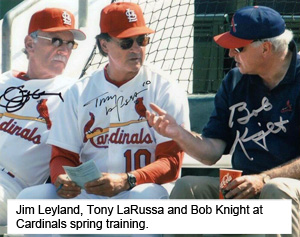
When Leyland attended his first Cardinals spring training in 2000, the club wanted to issue him a uniform with No. 10, the same number worn by La Russa and the number Leyland wore when he managed. La Russa said he was OK with it, but Leyland declined, the Post-Dispatch reported.

“I thought it would have made a joke out of it,” said Leyland. “It would have called too much attention and it wasn’t necessary to draw that kind of attention.”

Leyland requested and got a uniform with no name or number.

In September 2000, when the Cardinals were nearing a return to the postseason for the first time in four years, La Russa was asked how much Leyland had helped. “He set the tempo in spring training (with) evaluations and suggestions about strategy,” La Russa replied.

Leyland spent six seasons (2000-2005) as Cardinals special assignment scout and they got to the postseason in five of those. During spring trainings, La Russa and Leyland sat together at games. Leyland also managed or coached intra-squad and “B” games on the back fields at the Jupiter, Fla., complex.

“Jim Leyland is the best baseball man I’ve ever been around in my life,” La Russa said in April 2005. “He’s got this special feel for the game and that includes his giving you his honest evaluation.”

In Memories and Dreams magazine, La Russa said Leyland became “re-energized” working for the Cardinals. “He really helped us, and evidently we helped him,” said La Russa.

In October 2005, Dombrowski, who’d become Tigers general manager, fired manager Alan Trammell and hired Leyland to replace him. Getting the chance to return to the organization where he started was one reason Leyland accepted the job. Another is he felt haunted by the way he left the Rockies. “I did not want my managerial career to end like that,” Leyland said.

In a storybook twist, Leyland, 61, led the Tigers to the American League pennant in 2006 and a World Series matchup with La Russa’s Cardinals.

“It’s actually the greatest situation you could imagine _ to be in a situation against somebody you respect so much,” La Russa said.

Years later, in Memories and Dreams magazine, La Russa had a different perspective. He said, “When you manage against a friend, it’s a very difficult thing because, at the end of the day, one of us will be happy and the other will be upset. You don’t want to see your friend upset. The best example of that was in the 2006 World Series when Jim was with Detroit. That wasn’t fun.”

The Cardinals won four of five against the Tigers and became World Series champions for the first time in 24 years.

Leyland managed the Tigers for nine seasons and won another pennant in 2012. He came close to having a World Series rematch with La Russa and the Cardinals in 2011, but the Tigers were ousted by the Rangers in the American League Championship Series.

Read Full Post »

« Newer Posts - Older Posts »