Feeds:
Posts
Comments

Archive for the ‘Opponents’ Category

(Updated Oct. 6, 2019)

Bert Blyleven usually pitched impressively against the Cardinals, but that didn’t always translate into wins for him.
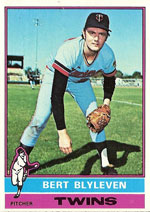
Blyleven, elected to the National Baseball Hall of Fame on Jan. 5, 2011, was 4-2 with a 2.84 ERA against the Cardinals while he was with the Pirates from 1978-80.

He also started twice for the Twins against the Cardinals in the 1987 World Series, winning Game 2 and losing Game 5.

In a 2019 edition of the Baseball Hall of Fame magazine, “Memories and Dreams,” Blyleven credited former Cardinals reliever Marv Grissom with helping him become a better pitcher. Grissom was pitching coach of the Twins in 1970 when Blyleven was a rookie.

“I threw across my body really bad,” Blyleven said. “(Grissom) actually put a folding chair down and I had to step to the left of that folding chair. That really changed my delivery to where my body went toward home plate rather than recoiling.

“I did ask him at one time, ‘What if I land on that folding chair with my left foot?’ He said, ‘Well, you’ll break your neck, won’t you?’ So that was the way for him to get me to open up and utilize the lower part of my body and my pitching delivery.”

Blyleven twice beat the Cardinals on complete-game five-hitters for the Pirates _ a 7-1 win at Pittsburgh on Sept. 13, 1978, Boxscore and a 2-1 win at St. Louis on Sept. 11, 1980. Boxscore

Blyleven also lost twice to the Cardinals in April 1980 despite pitching well. That stretch also contributed to one of the most controversial incidents of his career.

On Opening Day, April 10, 1980, at Busch Stadium, Blyleven started and held the Cardinals to a run (a George Hendrick RBI-double) and two hits in five innings. Cardinals starter Pete Vuckovich was better, pitching a complete-game three-hit shutout for a 1-0 win. In the ninth, Pittsburgh had runners on second and third with no outs, but Vuckovich finished with a flair, striking out Tim Foli, Dave Parker and Willie Stargell. Boxscore

Nine days later, at Pittsburgh, Blyleven faced the Cardinals again and struck out 12 in seven innings before being lifted for a pinch hitter with the score 1-1. In the eighth, the Cardinals scored (a Hendrick RBI-single) off reliever Dave Roberts and won, 2-1. Though Blyleven didn’t get the loss, he was deprived of a win despite a dominant performance. Boxscore

Blyleven then faced Montreal twice without a decision. After five starts, including the two against St. Louis, Blyleven was 0-2 with no complete games for the defending World Series champions.

On April 30, 1980, he quit the team, went home to California and demanded a trade, complaining that manager Chuck Tanner was lifting him from games too quickly.

In an article by Charley Feeney in the May 17, 1980, edition of The Sporting News, Blyleven said he told Pirates executive Pete Peterson he would retire if the Pirates didn’t trade him. Blyleven said Tanner “took a lot of competitiveness away from me” and blamed the manager for “non-support and lack of confidence.”

“I felt I had to speak up,” Blyleven said. “If I didn’t, maybe 20 years from now I’d be wishing that I had spoken up. Maybe 20 years from now I’ll wish I hadn’t spoken up.”

Said Pirates third baseman Bill Madlock: “I can understand a lot of things about ballplayers, but going home … I don’t know why he did that.”

The Yankees reportedly offered to trade pitcher Ed Figueroa for Blyleven but the Pirates declined. Blyleven was placed on the disqualified list.

Bill Conlin, a columnist for The Sporting News, wrote, “Blyleven’s incredible sulk is sending shock waves through National League front offices.” Conlin quoted an unnamed big-league general manager as saying, “I don’t think I’d want a player who so obviously places individual goals over team goals.”

On May 11, 1980, Blyleven offered to return and the Pirates reactivated him. Two days later, Blyleven started against the Giants, pitched a complete game _ and lost, 5-0. Boxscore

In the 1987 World Series, Blyleven had a solid start in Game 2, striking out eight, holding St. Louis to two runs in seven innings and earning the win in an 8-4 Twins victory. Boxscore In the fifth, Cardinals manager Whitey Herzog complained to umpires that Blyleven was balking by not coming to a full stop in his motion. Blyleven said Herzog was “trying to get something in my mind.”

In Game 5 at St. Louis, Blyleven held St. Louis scoreless through five innings. In the sixth, the Cardinals scored three runs off Blyleven (two on Curt Ford’s two-out bases-loaded single) and won, 4-2. Boxscore


Read Full Post »

Second baseman Roberto Alomar, who was elected to the National Baseball Hall of Fame, enjoyed some of the hottest hitting of his career over a two-game stretch against the Cardinals.

Playing for the Padres, Alomar went 7-for-8 with two walks, two runs scored and two RBI in two games, May 9-10, 1990, at St. Louis. Five of those seven hits were doubles.
Overall against the Cardinals in his career, Alomar batted .294 (53-for-180) with a .352 on-base percentage.

St. Louis had lost five in a row and had slumped to 10-16 when the Padres came to Busch Stadium for a two-game midweek series.

In the opener on Wednesday night, May 9, the Cardinals won, 11-5, behind 3.2 innings of scoreless relief from Rick Horton and the hitting of leadoff batter Vince Coleman, who had three singles, a walk, two RBI and two runs scored.

Alomar was a one-man wrecking crew for the Padres, going 3-for-4 with a walk, a RBI and a run scored. He laced three doubles _ one apiece against John Tudor, Horton and Tom Niedenfuer _ and reached Scott Terry for a walk.  Boxscore

The next day, Thursday afternoon, May 10, San Diego routed the Cardinals, 9-1, behind Alomar, who went 4-for-4 with a walk, a run and a RBI.

Alomar had two doubles and a single off Cardinals starter Joe Magrane. He also singled against Niedenfuer and drew a walk from Frank DiPino.  Boxscore

Overall in 1990, Alomar batted .364 (16-for-44) against the Cardinals.

After the 2004 season, the National League champion Cardinals strongly pursued Alomar as a free agent to replace second baseman Tony Womack, who had departed St. Louis for the Yankees.

In December 2004, Newsday reported Alomar had signed with the Cardinals, but the report was inaccurate. Alomar instead signed with Tampa Bay in January 2005, but retired during spring training.

The Cardinals replaced Womack with free-agent Mark Grudzielanek.

Read Full Post »

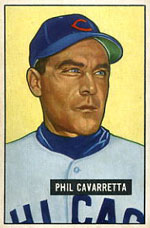
Phil Cavarretta hit one of the most important home runs in the long rivalry between the Cubs and Cardinals.

Cavarretta, who died Dec. 18, 2010, at 94, was a 19-year-old first baseman for the Cubs in 1935.
On Sept. 25, the first-place Cubs brought an 18-game winning streak to St. Louis to begin a season-ending, make-or-break five-game series with the Cardinals.

Chicago (97-52) had a three-game lead over St. Louis (94-55).

The series opener paired Chicago’s Lon Warneke against Paul Dean, brother of Dizzy Dean. Paul Dean had beaten the Cubs five times in six decisions that season. Warneke had lost four of six against the Cardinals.

Paul Dean struck out four of the first five Cubs. That brought Cavarretta to the plate with two outs in the second inning.

Dean hung a one-strike curve and Cavarretta belted it over the right-field pavilion. It was the hit that lifted the Cubs into the World Series.

Warneke shut out the Cardinals on two hits and the Cubs won, 1-0, clinching a tie for the pennant. Boxscore

After a rainout the next day, the Cubs beat Dizzy Dean and the demoralized Cardinals, 6-2, in the opener of a doubleheader, eliminating St. Louis from contention.

Playing for the Cubs from 1934-52, Cavarretta batted .291 (260-for-893) against the Cardinals, with 12 home runs, 110 RBI and a .370 on-base percentage.

In 1944, Cavarretta and Stan Musial of the Cardinals were the National League co-leaders in hits (197).

Musial trailed Cavarretta by six hits as the Cardinals went into a doubleheader against the Giants at New York on the final day of the season.

Musial went 6-for-9 (4 hits in the opener and 2 in the second game).

His final hit, the one that tied Cavarretta, came on his last at-bat _ a two-run home run off Ken Brondell.  Boxscore

Read Full Post »

(Updated Nov. 20, 2024)

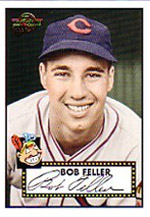
Bob Feller pitched against major leaguers for the first time when he faced the Cardinals as a 17-year-old.

Feller is hailed as one of the great pitchers in baseball history and the Cardinals were the first big-league opponents to glimpse his greatness.

On July 6, 1936, the Cardinals played an exhibition against the Indians at Cleveland during the All-Star Game break. Interleague play didn’t exist then, so any matchup between National League and American League teams was an event.

The Indians, who signed Feller because of his fastball, wanted to test him against big-league batters and the exhibition provided an ideal opportunity.
Feller, who a month earlier completed his junior year of high school in Iowa, entered in relief of starter George Uhle in the fourth inning with the score 1-1. In his 1990 book, “Now Pitching, Bob Feller,” Feller said he wasn’t scared of facing a team he’d seen play two years earlier in the 1934 World Series at St. Louis.

“Not in my entire pitching career was I ever scared of any hitter or any situation,” Feller said.

In the book “Baseball When the Grass Was Real,” Feller told author Donald Honig, “I never had any concern about the hitters as long as I could get that ball over the plate. My only concern that day was the crowd. I’d never seen so many people before in my life.”

Cleveland manager Steve O’Neill, a former big-league catcher celebrating his 45th birthday, wanted to see Feller firsthand and decided to catch when Feller came into the game. He told the teen to just throw fastballs. Feller was flattered the manager would make such an effort.

“He wanted to give me his personal treatment because he thought I had the potential to make it big,” Feller said.

Cardinals manager Frankie Frisch intended to play second base, but after watching Feller sail a fastball over the catcher and against the backstop in warmups, he changed his mind. “I’m getting too old to get killed in the line of duty,” Frisch said, according to author Bob Broeg in the book “Memories of a Hall of Fame Sportswriter.”

Feller said to author Donald Honig, “If anybody was nervous that day, it was the Cardinals. I was very wild and had them scared half to death.”

The first batter to face Feller was Bruce Ogrodowski.

“My first pitch to Ogrodowski was a called strike, and it made something of a smacking sound as it hit O’Neill’s mitt,” Feller said. “Ogrodowski turned to O’Neill and said, ‘Let me out of here in one piece.’ He was serious and he laid the next pitch down, bunting down the third-base line.”

Third baseman Odell Hale fielded the ball and threw out Ogrodowski. “He achieved the purpose — he got out of there in one piece,” Feller said.

The next batter was Leo Durocher. According to the book “Bob Feller: Ace of the Greatest Generation,” written by John Sickels, Durocher stepped to the plate, glared at Feller and growled, “Keep the ball in the park, busher.”

One of Feller’s fastballs sailed over Durocher’s head. Another went behind his back. According to Feller, Durocher stepped out of the batter’s box and said to the plate umpire, “I feel like a clay pigeon in a shooting gallery.”

With the count at 2-and-2, Durocher went into the dugout and “pretended to hide behind the water cooler,” Feller said.

After umpires ordered him to return to the plate, Durocher struck out swinging.

The next batter, Art Garibaldi, also struck out.

“I had a big windmill windup and a habit of glancing into left field and then flashing my eyes past third base as I turned toward the plate,” Feller said. “It scared the hitters even more.”

Cleveland scored in the bottom of the fourth.

In the fifth, Feller struck out Les Munns before Terry Moore singled to left and Stu Martin walked. Attempting to rattle Feller, Frisch called for a double steal. Feller rushed the pitch and his fastball eluded O’Neill. Moore raced home, tying the score 2-2, and Martin advanced to third.

The Cardinals had two of their top veterans due up next, but Feller collected himself and struck out Pepper Martin and Rip Collins.

In the sixth, Ogrodowski led off with a double near the foul line before Feller struck out Durocher, Charlie Gelbert and Munns.

Impressed, O’Neill lifted Feller. In three innings, eight of the nine outs he recorded were strikeouts. Cleveland won, 7-6.

In the book “Voices From Cooperstown, Feller said to author Anthony J. Connor, “That day, I was as fast as I’ve ever been.”

Plate umpire Red Ormsby said Feller is “the best pitcher I have seen come into the American League in all my experience,” the St. Louis Post-Dispatch reported.

“He showed me more speed than I have ever seen uncorked by an American League pitcher,” Ormsby said. “I don’t except Walter Johnson either.”

According to the John Sickels book, a photographer asked Cardinals ace Dizzy Dean to pose with Feller afterward. “If it’s all right with him (Feller), it’s all right with me,” Dean replied. “After what he did today, he’s the guy to say.”

Feller said Dean told him, “You sure poured that ol’ pea through there today.”

Feller said “praise from Dizzy Dean was approval from the baseball gods.”

Feller’s outing convinced the Indians he was major-league ready. Two weeks later, on July 19, 1936, Feller made his big-league debut with an inning of relief against the Senators. Boxscore

It was the start of a Hall of Fame career.

Read Full Post »

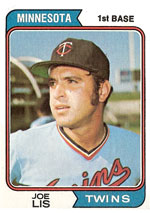
In his fifth big-league game, Phillies left fielder Joe Lis belted a home run against the Cardinals’ Steve Carlton.

Afterward, manager Frank Lucchesi called Lis to his office and handed him the home run ball. “This is the first of many for you, Joe,” Lucchesi said.

The prediction didn’t turn out to be quite accurate. Lis hit 32 homers in eight years (1970-77) in the majors.

But, with the way he hit against the Cardinals after his call-up to the Phillies from Class AAA in September 1970, Lucchesi wasn’t alone in forseeing big days ahead for Lis.

After his home run against Carlton on Sept. 8, 1970, at Connie Mack Stadium in Philadelphia, Boxscore Lis followed that with another big game against the Cardinals at St. Louis.

Playing left field and batting fifth, Lis went 3-for-5 with two doubles and three RBI in the Phillies’ 10-6 win on Sept. 19. His RBI-double off Frank Bertaina in the second gave Philadelphia a 1-0 lead. In the seventh, Lis smacked a two-run double off Frank Linzy. Boxscore

Lis hit .313 (5-for-16) with four RBI in five games against St. Louis that month.

He kept it up the next year, too, going 3-for-5 with a home run and two runs scored in an 8-6 Phillies win at St. Louis on April 23, 1971.

With St. Louis ahead 3-2 in the fourth, Lis doubled and scored on Don Money’s inside-the-park homer. In the eighth, Lis broke a 6-6 tie with a homer off reliever George Brunet. Boxscore

Injuries and a reputation as a below-average fielder kept Lis from becoming an everyday player. He lost the left field job to Greg Luzinski, then was sent to the Twins, where he was given a chance to replace Harmon Killebrew at first base. When that didn’t work out, Lis went to the Indians, then the Mariners.

Lis finished his career as a .233 hitter with a .332 on-base percentage. But against the Cardinals, he hit .255 with three homers, 11 walks and a .390 on-base percentage.

Read Full Post »

« Newer Posts