Feeds:
Posts
Comments

Archive for the ‘Opponents’ Category

Golden Richards was a NFL glamour boy with a glittery name and the look to match. A blonde mane flowed from beneath his helmet when he streaked down the field. As columnist Jim Murray noted, “He’s so golden from his hair on down that he glows in the daylight. He’s perfect for the part of Sir Galahad.”

Richards could play, too. Few were faster than he was. A Dallas Cowboys receiver, Richards had sure hands, the strength to catch in a crowd and the ability to haul in long passes over the shoulder.

He got both his first NFL reception and first touchdown catch against the St. Louis Cardinals. Later, as an established starter, Richards made a game-winning touchdown grab at St. Louis. For his career, the foe he had the most catches against (19) were the Cardinals.

In his first five seasons with Dallas, Richards took part in nine playoff games, including two Super Bowls. The glory came at a terrible price. Richards suffered injuries, became addicted to prescription painkillers and struggled with alcohol abuse.

Burnishing bright

John Golden Richards was born on Dec. 31, 1950, in Salt Lake City. According to the Salt Lake Tribune, his parents gave him the distinctive middle name because they thought a baby born on New Year’s Eve must be extra special. Everyone called him Golden.

Richards’ specialness came through in athletics. He participated in five sports _ baseball, basketball, football, tennis and track _ at Granite High School in Salt Lake City. As a senior in 1969, Richards ran the 100-yard dash in 9.4 seconds and cleared 24 feet in the long jump at the Golden West Invitational in Sacramento.

Colleges recruited him for track, but Richards preferred football. The only football offers he got were from Air Force, Brigham Young University (BYU), Utah, Utah State and Westminster College, the Salt Lake Tribune reported.

Richards, a Mormon, planned to bypass BYU and go with Utah because of the football program’s strong passing game. “Next thing, I was called into my bishop’s office, and he told me he wanted me to go to BYU, or else he would call me on (a Latter-day Saints) mission,” Richards said to the Tribune.

Richards did what he was told and found he was right about BYU’s quarterback situation. None could get the ball to him consistently. In his two varsity seasons (1970-71), Richards caught a total of two touchdown passes.

He made up for it with punt and kickoff returns. As a junior in 1971, he was the NCAA’s top punt returner, with 624 yards and four touchdowns.

Richards didn’t put the same kind of effort into his studies. He was declared academically ineligible for his senior season at BYU. “It was my fault,” he told the Deseret News. “The situation arose simply because of my own laziness.”

He transferred to the University of Hawaii for the 1972 season and snared five touchdown passes in five games before he tore ligaments in his right knee.

Seeing stars

Before the injury, Cowboys scout Bob Griffin twice tested Richards in the 40-yard dash and both times he clocked 4.4 seconds. Impressed, the Cowboys took Richards in the second round of the 1973 NFL draft. “We haven’t had anybody this quick on our team since we picked up (two-time Olympic gold medalist) Bobby Hayes,” Cowboys head coach Tom Landry said to the Honolulu Advertiser.

As a teen, the Cowboys were the team Richards dreamed of playing for someday. When he walked into their locker room for the first time at training camp in 1973, “I was standing there next to Bob Lilly, Jethro Pugh and Roger Staubach,” Richards said to the Salt Lake Tribune. “I wanted to get everybody’s autograph.”

(Before a 1975 game against the New York Jets at Shea Stadium, Richards “stuck a pen and paper in his uniform pants and ran over to Joe Namath, begging for his signature right at the 50-yard line. Namath told Richards it was an honor and sent him a signed glossy photo the following the week,” the Tribune reported.)

On Sept. 30, 1973, the Cowboys were routing the Cardinals at Texas Stadium. In the fourth quarter, Landry began putting in his reserves, including the rookie Richards and quarterback Craig Morton. Soon after, Richards caught his first NFL pass, a five-yard toss from Morton. “I just broke out smiling and was just about laughing all the way to the huddle,” Richards said to the Fort Worth Star-Telegram.

Two plays later, Morton called for Richards to go deep. “I thought it might be a touchdown pass when it (the play) was called,” Richards told the Star-Telegram. “That’s what the play was designed for _ six points.”

Sure enough, Richards broke free and Morton connected with him on a 53-yard scoring pass. Game stats

Big playmaker

More good times followed. Richards returned a punt 63 yards for a score in a 1973 playoff game against the Minnesota Vikings and caught touchdown passes in playoff wins against the Los Angeles Rams (1976) and Vikings (1978).

Richards averaged 17.5 yards a catch in the NFL. Of his 17 regular-season touchdown receptions, 11 were of 40 yards or more.

On Oct. 9, 1977, Richards made the play that beat the Cardinals.

With 6:53 remaining and St. Louis ahead, 24-23, the Cowboys were at the Cardinals’ 17-yard line. Quarterback Roger Staubach called an audible but Richards couldn’t hear him above the din at Busch Memorial Stadium.

“I was able to read Roger’s lips and pick it up, though,” Richards told the Fort Worth Star-Telegram.

As Richards dashed to the goal line down the right side, covered by cornerback Lee Nelson, Staubach floated a pass. “It was a little bit underthrown,” Richards said to the Fort Worth newspaper. “So I just kept going like it was coming. Then, at the last second, I stopped and tipped it back to me with one hand. Then I got a hold of it and just went sliding in to score.”

Nelson, filling in for injured Perry Smith, told the Belleville (Ill.) News-Democrat, “The guy made a hell of a catch. He caught it with one hand, one arm. I batted one of his arms away.”

The Cowboys won, 30-24. Game stats They would lose only twice all season (to the Cardinals at Dallas and to the Steelers at Pittsburgh) and rolled to the Super Bowl for a matchup against the Denver Broncos.

Richards was one of the game’s stars, catching a 29-yard touchdown pass from fullback Robert Newhouse to highlight a 27-10 Cowboys victory. Game stats and video

Troubled times

Richards was popular. His first wife, Barbara, said at his peak he got 1,000 pieces of fan mail a week. At the Super Bowl in Miami in 1976, Richards was “chased up and down the streets by the females, some handing him their telephone numbers, others just wanting to touch him,” the Associated Press reported. 

Richards told the wire service, “It’s kind of overwhelming. I mean, they walk right up with my wife standing next to me.”

He hobnobbed with celebrities such as Olivia Newton-John and model Jerry Hall. “It was glamorous,” Richards told the Salt Lake Tribune.

The glamour masked a dark side. Richards was hurting. He took a pounding in the games. A hit from the Steelers’ Mel Blount broke five of Richards’ ribs. His back ached all the time and so did his teeth from getting belted under the face mask.

Seven times, dentists did root canals to repair damage from hits to Richards’ face, the Dallas Morning News reported. He was prescribed Percodan. Codeine was another. Richards became addicted and “depended on painkillers to play,” according to the Dallas newspaper.

“I never took drugs to get high,” he told reporter Barry Horn. “I took drugs because I couldn’t stand the pain.”

His craving for painkillers spun out of control. “In the bleakest moments,” Gordon Monson of the Salt Lake Tribune reported, “he fished through his own vomit in a toilet for unabsorbed painkillers so he could taken them again.”

Richards told Monson, “There were times when I lived through the darkest dark you can imagine. With the painkillers, you fight and struggle to get up to ground zero, but then you discover you’re still 150 miles below the surface of the earth.”

In April 1978, three months after he scored his Super Bowl touchdown, Richards was rushed to a hospital when it was feared he had overdosed. Five months later, the Cowboys traded him to the Chicago Bears for two draft picks.

Richards spent two seasons with Chicago, got released and was done as a player at 29. His third wife, Amy, told the Salt Lake Tribune, “He got hooked on the narcotics in the NFL. When the NFL was taken away, he no longer had football but he still had the narcotics.”

His problems expanded. Richards turned to booze. “I was living in an alcohol fog,” he said to the Tribune.

He was in and out of treatment centers multiple times.

In December 1992, Richards was arrested on charges he forged his father’s signature on nearly $700 in checks to pay for painkillers. He pleaded guilty.

“This has been a horrible, horrible way of life,” Richards told the Dallas Morning News in January 1993. “Like any addict, I have been deceitful, manipulative and cunning. People who suffer from my kind of addiction can lose everything that means everything to you. I know. I have.”

Richards was sober for the last decade of his life, his brother, Doug, told the Deseret News.


Read Full Post »

The number stands out from the stats line like a wart, ugly and embarrassing: 162.00. That’s the earned run average Tom Qualters had in his rookie season with the Phillies.

The Cardinals were responsible for giving him that statistical shiner. Qualters, 18, made his big-league debut against them. He faced seven Cardinals and retired one. Six scored. His line: 0.1 innings, six runs, 162.00 ERA in his lone appearance of the 1953 regular season.
To his credit, Qualters recovered from that clobbering. He eventually went to the minors and became a teammate of Satchel Paige and Whitey Herzog. Then he returned to the majors and pitched for an American League pennant contender, retiring the likes of Mickey Mantle and Ted Williams.

Bonus baby

A standout amateur athlete in McKeesport, Pa., near Pittsburgh, Qualters developed into a dominating right-handed pitcher. He struck out 22 in a no-hitter against Donora (hometown of Stan Musial). In 1951, at Pittsburgh’s Forbes Field, Qualters started for a team of American Legion all-stars managed by Hall of Famer Pie Traynor.

After he graduated from high school in June 1953, Qualters was offered a signing bonus of at least $25,000 by Pirates general manager Branch Rickey, according to The Pittsburgh Press, but instead accepted a $40,000 offer from the Phillies. Qualters “had his heart set on joining the Phillies from the time he was in knee pants,” The Sporting News reported.

Major League Baseball had a rule then that any amateur who got a signing bonus of more than $4,000 had to stay with the big-league club for two full years. (It was intended to keep the wealthiest clubs from signing scores of prospects and stockpiling them in the minors.) That meant Qualters, who signed on June 16, 1953, had to remain in the majors with the Phillies until at least June 16, 1955.

“I might have been better off going to the minors for experience and a chance to pitch regularly, but I just couldn’t pass up that money,” Qualters said to The Pittsburgh Press. “I used most of it to fix up our home in McKeesport and also pay for an operation on my mother.”

(More than 30 years later, in a 1987 interview with the Pittsburgh Post-Gazette, Qualters said baseball’s bonus rule “was devastating to me” because “I had no business being there” in the majors.)

Learning curve

When he joined the Phillies, “I was really scared,” Qualters said to The Pittsburgh Press. “It was the first time I ever had been away from home and I didn’t know what kind of a reception I’d receive … Being a bonus player, I thought they’d give me the cold shoulder, but they treated me like one of the boys and were always giving me advice. I spent a lot of time with Jim Konstanty in the bullpen and he went out of his way to be nice. Robin Roberts, too.”

(Decades later, Qualters gave conflicting versions of how his Phillies teammates received him. In 1984, Qualters said to the Philadelphia Daily News, “Guys like Robin Roberts, Curt Simmons, Richie Ashburn _ they were great. They made the ride a little smoother, and they certainly didn’t have to.” Three years later, Qualters told the Pittsburgh Post-Gazette, “The players and the manager (Steve O’Neill) were from the old school and didn’t accept me. You can imagine the resentment. As a result, I was off by myself most of the time.”)

The Phillies’ plan was for Qualters to learn by observing rather than pitching. Though he was occupying a roster spot, there was no desire to put him into a regular-season game. “I was a batting practice pitcher, a high-priced batting practice pitcher,” Qualters told the Philadelphia Daily News.

On June 29, 1953, in an exhibition between the Phillies and Athletics for the benefit of the Junior Baseball Federation of Philadelphia, Qualters started before a crowd of 15,293 at Shibe Park. The jittery teen got through the first inning, but gave up six runs in the second before he was lifted.

Two weeks later, Qualters pitched in another exhibition game for the Phillies against the minor-league Baltimore Orioles and yielded five runs in three innings.

Though those exhibition performances did nothing to entice manager Steve O’Neill to pitch Qualters when the Phillies played for keeps, he told the Philadelphia Bulletin, “The boy has everything he needs, a fastball and a terrific curve. If he isn’t a real pitching prospect, then I’ve never seen one.”

Rough stuff

On Sept. 13, 1953, a Sunday at St. Louis, the Cardinals led the Phillies, 11-1, entering the bottom of the eighth. With the outcome not much in doubt, O’Neill waved a proverbial white flag, choosing to let Qualters make his official debut. The Cardinals, though, were all business.

The first batter Qualters faced, hulking slugger Steve Bilko, slammed a home run. The next to come up was Bilko’s physical opposite, Peanuts Lowrey. He drew a walk, then scooted to second on a Qualters wild pitch.

Qualters hit the next batter, Rip Repulski, with a pitch. Harvey Haddix, the Cardinals’ pitcher, followed with a single, loading the bases. Solly Hemus also singled, scoring Lowrey, and reloading the bases.

The first out Qualters recorded came when a future Hall of Famer, Red Schoendienst, grounded to first. Hemus was forced out at second, but Repulski scored from third on the play.

Next up was Stan Musial.

“I was told never to give him the same pitch twice, and this stuck with me like a nursery rhyme,” Qualters said to The Pittsburgh Press. “Our catcher (Stan Lopata) called for a slow curve and Musial swung and missed. I felt pretty good. Then the catcher decided to call for the same pitch and I shuddered. I knew what the boys in the bullpen told me, but who was I to shake off the catcher? So I threw the slow curve again and Musial hit it against the wall.”

Musial’s two-run double knocked Qualters out of the game. Jim Konstanty relieved and gave up a single to Enos Slaughter, driving in Musial and making the score 17-1. Boxscore

It would be four years before Qualters pitched in another regular-season game in the majors.

Starting over

Qualters spent the entire 1954 season with the Phillies and, though healthy, never played in a regular-season game. 

In 1955, as mandated by the bonus rule, the Phillies began the season with Qualters on their roster but he again didn’t get into a regular-season game. The Sporting News referred to him as “Money Bags” because he was being paid without having to perform.

When Qualters completed his two-year stint on the big-league roster in June 1955, he was sent to a Class B farm club in Reidsville, N.C. “I just want to pitch in games, somewhere, anywhere,” Qualters said to the Associated Press.

Years later, he told the Pittsburgh Post-Gazette, “When I went to Reidsville, I found I had lost my velocity. I didn’t have my riding fastball anymore.”

With the Class AAA Miami Marlins in 1956, Qualters, 21, was a teammate of Satchel Paige, 50. Paige was 11-4 with a 1.86 ERA. Qualters had his first good season as a pro _ 5-5 with a 3.38 ERA.

Paige and Qualters were back with Miami in 1957. Joining them was an outfielder, Whitey Herzog, 25, who hit .272. Qualters led the pitching staff in appearances (46) and innings pitched (186) and won 11. Paige had 10 wins and a 2.42 ERA.

Qualters admired the glove Paige used, an aged Mort Cooper model. “It looks like it belongs in the museum at Cooperstown but I like the way it handles,” Qualters told the Miami News. Qualters swapped Paige a new glove for his relic.

The Phillies called up Qualters in September 1957 and he made six relief appearances for them. In one, against the Cardinals, he gave up two runs in 0.2 innings. Boxscore

Qualters began the 1958 season with the Phillies, pitched in one game, got waived and was claimed by the White Sox.

A highlight came on May 25, 1958, in a game against the Red Sox. Qualters relieved starter Dick Donovan with the bases loaded and got Ted Williams to fly out to center. Boxscore

Two months later, at Yankee Stadium, Qualters pitched two scoreless innings and retired Mickey Mantle on a pop-up to second. Boxscore

Qualters made 26 relief appearance for the 1958 White Sox, who finished second behind the American League champion Yankees.

The White Sox had Qualters in their plans for 1959 until he injured his pitching elbow in spring training. Assigned to Class AAA Indianapolis, managed by Mort Cooper’s brother, Walker Cooper, Qualters developed nerve problems in his pitching hand and never got back to the majors. The 1959 White Sox won the American League pennant. “I was all set to be on that pitching staff (until getting injured),” Qualters said to the Pittsburgh Post-Gazette. “That really hurt.”

Qualters became a regional supervisor for the Pennsylvania Fish Commission and was responsible for overseeing enforcement for 10 counties, according to the Pittsburgh Post-Gazette. He was in charge of 15 field officers and 80 deputies.

Read Full Post »

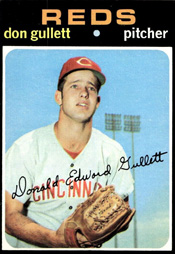
On a Big Red Machine team of Johnny Bench, Joe Morgan, Pete Rose and Tony Perez, the player who consistently confounded the Cardinals was Don Gullett.

A left-handed pitcher, Gullett was 14-3 versus the Cardinals, including 7-0 at Busch Memorial Stadium. He also liked to hit in St. Louis. His batting average there was .281.
Gullett played for six pennant winners in nine seasons in the majors and pitched in five World Series with the Reds and Yankees. His career record was 109-50.

Teen talent

In high school at South Shore, Ky., on the south bank of the Ohio River, Gullett excelled in football (scoring 11 touchdowns and kicking six extra points in one game) and basketball (scoring 47 points in one game) but turned down college scholarship offers because he wanted to become a professional baseball player.

He dazzled scouts when he pitched a seven-inning perfect game in high school, striking out 20 and retiring one batter who bunted.

The Reds selected him in the first round of the June 1969 amateur draft. (The Cardinals also chose a left-handed high school pitcher in that first round, but Charles Minott never advanced above the Class A level of the minors.)

Sent to the Sioux Falls (S.D.) Packers of the Northern League, Gullett, 18, struck out 87 in 78 innings and was 7-2 with a 1.96 ERA.

Invited to Reds spring training in 1970 as a non-roster player, Gullett, 19, impressed first-year manager Sparky Anderson. “For a kid his age, Gullett’s poise is amazing,” Anderson said to The Sporting News. “He just doesn’t scare.”

After striking out against Gullett in spring training, Pirates slugger Willie Stargell told The Sporting News, “Man, that kid throws nothing but wall to wall heat.”

Gullett got a spot on the 1970 Reds Opening Day roster as a reliever.

Rookie sensation

A year after pitching against high schoolers, Gullett made his big-league debut with 1.1 scoreless innings in relief of Ray Washburn versus the Giants. Boxscore

In his first win, against the Dodgers, Gullett pitched five scoreless innings in relief of Jim Maloney. “The kid showed them smoke,” catcher Johnny Bench told The Cincinnati Post. “I mean it was real heat.” Gullett also walked, stole a base, tripled and scored twice. Boxscore

A week later, facing the Cardinals for the first time, Gullett got his first save. With the Reds ahead, 3-2, in the ninth, the Cardinals had a runner on first, two outs, and Jim Campbell at the plate when Gullett replaced closer Wayne Granger.

Asked why he brought in the rookie, Sparky Anderson replied to the Dayton Daily News, “If you’ve got a guy with a lot of stuff like Gullett on your staff and you’re afraid to use him just because he’s 19, then you shouldn’t have him on the team.”

Gullett got Campbell to hit a fly to short center. Center fielder Bobby Tolan couldn’t get to the ball _ “It looked like an in-betweener base hit to me,” Gullett said to the Dayton newspaper  _  but shortstop Dave Concepcion made a twisting catch on the run to end the game. Boxscore

Near the end of Gullett’s rookie season, Dodgers manager Walter Alston told The Sporting News, “Gullett comes as close to matching Sandy Koufax’s fastball as anyone I’ve seen.”

(Gullett said he met Koufax at Cincinnati’s Crosley Field early in the 1970 season. “He showed me how he threw his curveball, how he put his fingers on the seams, and all that,” Gullett said to Dick Kaegel of the St. Louis Post-Dispatch. The next year, Sparky Anderson arranged a meeting of Gullett and Koufax in Chicago. Anderson told the Post-Dispatch, “Sandy told him to think not up and down with his pitches. He told him to think in and out.”)

In 44 games for the 1970 Reds, Gullett was 5-2 with six saves and a 2.43 ERA. He also earned two saves and yielded no runs in the National League Championship Series versus the Pirates and one earned run in three World Series games against the Orioles. Video

Hot stuff

Gullett, 20, moved into the Reds’ starting rotation in 1971 and responded with a 16-6 record. He was 3-0 against the Cardinals, shutting them out twice, and would have had a fourth win if he’d protected a ninth-inning lead.

On June 16, 1971, Gullett pitched a four-hitter in a 1-0 Reds victory. The Cardinals threatened in the eighth, getting a runner to third with two outs, but Matty Alou struck out looking. (Alou, a National League batting champion, had one hit in 19 career at-bats versus Gullett.)

“He threw a fastball right on the black part of the plate,” catcher Pat Corrales told the Dayton Daily News. “As hard as he can throw, and with the location of that pitch, there wasn’t anything else for Alou to do but look at it and go sit down.”

Gullett said to the Cincinnati Enquirer, “I had my best fastball of the year” and an effective slider. Corrales told the newspaper that with Gullett’s slider, “You can’t tell when it’s coming. The rotation is just like on his fastball. A right-hander goes to swing at it, and all of a sudden it hits him on the fists.” Boxscore

Two months later, Gullett was matched against Bob Gibson. In their previous starts, Gibson pitched a no-hitter against the Pirates and Gullett limited the Cubs to one hit in eight innings.

The showdown turned out to be no contest. Gullett and the Reds won, 5-0. Joe Torre (the league batting champion that year) and Ted Simmons were a combined 0-for-8.

“Gullett’s got a fastball that rides away from you, plus a slider that comes in on you,” Torre told the Post-Dispatch. “You can’t tell which one’s coming.”

(Torre adjusted impressively. He had 20 career hits versus Gullett, batting .370.)

Asked whether Gullett was equal to American League left-hander Vida Blue, Sparky Anderson said to the Cincinnati Enquirer, “I wouldn’t trade him even up for Blue.” Boxscore

The Cardinals got some satisfaction against Gullett 11 days later. Gullett and the Reds led, 3-2, with two outs in the bottom of the ninth, but Lou Brock tied the score with a home run. The Cardinals went on to win in the 11th when Clay Carroll walked Ted Sizemore with the bases loaded. Boxscore

(Like Torre, Brock had success against Gullett, totaling 19 hits and batting .322.)

Bat man

Gullett also caused trouble for the Cardinals with his bat.

On July 16, 1974, Gullett, who batted right-handed, had three hits, three RBI and was the winning pitcher in a 12-7 Reds triumph against the Cardinals.

Gullett had a two-run double that knocked Bob Forsch from the game in the first inning, and drove in another run with a single versus John Curtis in the second. He added a single against Rich Folkers in the sixth. Boxscore

In 1975, Gullett, 24, was 4-0 with an 0.28 ERA versus the Cardinals. He allowed one run (a Ted Simmons home run) in 32 innings against them. One of those wins beat Gibson, who was trying for his 250th career victory. Boxscore

Gullett experienced an array of health problems and injuries, including hepatitis (1972), chronic back spasms (1974), a fractured left thumb (1975) and a dislocated ankle tendon (1976).

After the Reds repeated as World Series champions in 1976, Gullett became a free agent and signed a six-year contract with the Yankees. “We feel Gullett is a modern Whitey Ford,” Yankees president Gabe Paul told the New York Times.

Late in September 1978, Gullett underwent surgery for a double tear of the rotator cuff in his left shoulder and was done pitching at age 27. “Sometimes, I dream that I come back as a right-handed pitcher,” Gullett said years later to Bill Peterson of The Cincinnati Post.

In 1986, Gullett, 35, had a heart attack. Four years later, he had triple bypass surgery. Gullett recovered and coached for the Reds for 13 seasons (1993-2005).

Read Full Post »

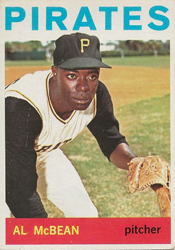
Stan Musial and Red Schoendienst had a high regard for Pirates pitcher Al McBean; so much so that there was talk of a swap involving him and Curt Flood.

A right-hander from the Virgin Islands who pitched 10 years (1961-70) in the majors, McBean was a good pitcher (67-50, 63 saves) who was as effective with a bat as he was with his arm against the Cardinals.
McBean twice hit home runs in wins versus the Cardinals. In turn, the Cardinals used home runs to beat him. The most striking example came in 1964 when McBean was as good as any reliever in the National League. He yielded a mere four home runs that season _ and all were hit by Cardinals.

A sinkerball specialist with a showman’s flair, McBean struck out more Cardinals (92) than he did any other foe, but his record against them was 6-8.

Picture this

McBean played baseball as a youth on St. Thomas, one of the U.S. Virgin Islands, but had no plans to become a pro. When he finished his schooling, he worked as a photographer for a local daily newspaper, The Home Journal. “I only played ball on Sundays because there was nothing else to do on Sundays,” he recalled to columnist Larry Merchant.

The Pirates held a tryout camp on St. Thomas and McBean’s newspaper assigned him to cover it. A former coach saw him and encouraged McBean to join the prospects on the diamond. According to the Philadelphia Daily News, McBean was sent to center field, told to throw a ball toward home plate and delivered a missile. Then he was instructed to try it from the mound. The Pirates liked what they saw and signed him.

McBean, 20, began his pro career in the Pirates’ farm system in 1958. Three years later, in July 1961, he got called up to the big leagues and pitched in relief for the reigning World Series champions.

In a game against the Cardinals that season, the rookie gave up a grand slam to Bill White. The towering drive carried to the back of the screen on the pavilion roof at St. Louis. (White would torment McBean throughout his career, hitting .440 with four home runs against him.) Boxscore

Two weeks later, Stan Musial slugged a two-run homer versus McBean. Boxscore

Overall, though, McBean (3-2, 3.75) showed enough for the Pirates to put him in their plans for 1962.

Bold buccaneer

With Joe Gibbon and Vern Law having arm ailments in 1962, the Pirates moved McBean into the starting rotation. He delivered a 15-10 record, including 3-1 versus the Cardinals.

McBean got married in Pittsburgh during that 1962 season. Serving as best man at the wedding was his road roommate, Roberto Clemente.

McBean embraced the spotlight _ both on and off the field.

A lithe (165-pound) athlete, McBean’s voice had “the lilt of a calypso melody and is as bouncy as a bongo,” according to Milton Gross of the North American Newspaper Alliance.

McBean wore clothes designed for attention. A purple suit. A white Nehru jacket. Or, as Milton Gross described, “The large red bandana he pulls from his hip pocket to wipe his face on the mound is only a pale reflection of his vivid personality. He may, for instance, be seen coming to or leaving the ballpark clothed in an ascot, a Rex Harrison (houndstooth) hat, red vest, canary yellow shirt, dark sports jacket, checked pants and a rolled umbrella swinging from his arm.”

His flashy style wasn’t limited to his wardrobe.

Before games, McBean put on shows during infield practice, scooping grounders with behind-the-back moves. “He makes an infield drill look like a Harlem Globetrotters warmup with his uncanny fielding style and non-stop chatter,” Bill Conlin of the Philadelphia Daily News observed.

Red Schoendienst said to the Pittsburgh Post-Gazette, “Funniest guy I’ve ever seen in a uniform. McBean is full of fun, especially before a game in practice.”

In his prime years, when he went back to being a reliever, McBean walked from the bullpen to the mound with a swagger.

“McBean saunters into a game,” Pirates manager Danny Murtaugh said to the Philadelphia Daily News.

Columnist Stan Hochman wrote, “He sashays out of the bullpen.”

Or, as Pittsburgh Courier sports editor Bill Nunn Jr. noted, “If one envisions a rooster strutting, you have McBean’s walk. The swaying of his fanny is the equal to the backlash generated by most show girls. His quick gait does justice to a fancy-stepping drum major.”

One time, when he got called into a 1963 game, McBean reached the mound, handed his sunglasses to the bat boy, then sent him to the dugout for a different shade of glove, according to columnist Stan Hochman.

“He wants to be noticed,” Pirates general manager Joe Brown said to the North American Newspaper Alliance. “He does things to be seen. He’s an individualist who doesn’t want to stay in a mold. Everything he does, he wants to be different _ his clothes, his windup, the way he walks, the way he talks. He’s like a faucet. Turn him on and he goes until you turn him off.”

Trading places

McBean had the stuff to back up his struts.

He was 13-3 with 11 saves in 1963 and 8-3 with 21 saves and a 1.91 ERA in 1964. “He’s good, all right, and he’s cocky, too, but he gets the job done,” Cubs slugger Ron Santo said to The Pittsburgh Press. “McBean is as fast as anybody in the league. He just throws the ball right by you.”

From late July 1963 to mid August 1964, McBean pitched in 62 games for the Pirates without a defeat, totaling 11 wins and 19 saves.

He threw from a variety of arm angles and his pitches darted in a maze of directions. One year, when McBean struggled, his manager, Larry Shepard, advised him to quit trying to be so precise with location of his pitches. “I told him to throw the ball down the middle,” Shepard recalled to the Philadelphia Daily News. “The way his ball moves, there’s no way he can throw a strike down the middle anyway. So why try to hit the corners?”

According to the Pittsburgh Courier, Stan Musial described McBean as a “pitcher who moves the ball around on every pitch.”

Al Abrams of the Pittsburgh-Post Gazette wrote that Musial and Schoendienst “persisted for years in asking, ‘What’s a guy with Al McBean’s pitching talent doing in the bullpen?’ They would have loved to have had him pitch for the Cardinals. They almost did.”

In June 1967, when the Cardinals had Musial as general manager and Schoendienst as manager, the Pirates offered to trade McBean, outfielder Manny Mota and catcher Jim Pagliaroni to St. Louis for outfielder Curt Flood, reliever Hal Woodeshick and catcher Johnny Romano, The Sporting News reported.

The Pirates “came close” to making the deal, but “word is that Cardinals owner Gussie Busch vetoed the trade at the last minute,” according to the Pittsburgh Post-Gazette.

Muscling up

At the plate, McBean usually swung with all his slender might (in 1962, for instance, he struck out 32 times in 67 at-bats), but when he connected the ball could carry.

On June 16, 1963, at St. Louis, the score was tied at 3-3 in the 12th inning when McBean faced Ed Bauta and walloped a 400-foot home run halfway up the bleachers in left.

“Nobody believes me when I say I’m a good hitter,” McBean said to The Pittsburgh Press, “but when Ed Bauta gave me what I like _ a high, slow curve _ I almost jumped. This was right down my alley.”

In addition to his home run, McBean pitched six innings of scoreless relief and got the win. Boxscore

Five years later, in a 1968 game against the Cardinals at Pittsburgh, McBean hit a grand slam against Larry Jaster in a 7-1 Pirates victory. The Cardinals collected 13 hits and a walk against McBean but stranded 12 runners and hit into two double plays. Boxscore

In 1964, when McBean pitched in 58 games, the only team to hit home runs against him was St. Louis. Bill White hit two and Ken Boyer and Lou Brock had one apiece. Brock’s was a walkoff shot _ his first in the majors _ in the 13th inning. It landed on the right field roof and gave the Cardinals a 7-6 victory.

“He gave me a high, inside fastball and I jumped on it,” Brock told The Pittsburgh Press. “It was too good to be true.” Boxscore

For his career, Brock hit .476 with three home runs against McBean.

Some other future Hall of Famers didn’t fare as well. Hank Aaron batted .176 with one home run versus McBean and had more strikeouts (10) than hits (nine) against him. In 57 at-bats versus McBean, Ernie Banks hit .175 with no homers.

In 1967, after Jim Lonborg’s one-hitter versus St. Louis in World Series Game 2, Brock told the Boston Globe, “He had darn good stuff, but he’s not a (Juan) Marichal or a (Gaylord) Perry. He doesn’t even have the speed of Al McBean.”

Read Full Post »

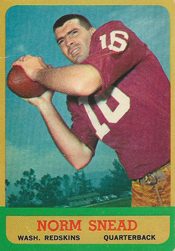
Quarterback Norm Snead lost a lot more often than he won in the NFL. Some of it was his fault. Some of it had to do with his supporting casts.

A classic drop-back passer, Snead was 6-foot-4, smart and had a strong arm. Teams traded quarterbacks Sonny Jurgensen and Fran Tarkenton to acquire him.
He was with the Washington Redskins (1961-63), Philadelphia Eagles (1964-70), Minnesota Vikings (1971), New York Giants (1972-74 and 1976) and San Francisco 49ers (1974-75). Most of those were bad teams.

Snead’s clubs had losing records in 13 of his 16 NFL seasons. The exceptions: 1966 Eagles (9-5), 1971 Vikings (11-3) and 1972 Giants (8-6).

In 178 games played (159 as a starter), Snead was 57-114-7 (52-100-7 as a starter). He was 3-12 versus the Cleveland Browns; 3-14-2 against the Redskins.

The St. Louis Cardinals, with their relentless blitzing, also were a tormentor. Snead was 7-12-1 against them. The Cardinals sacked him more times (53) than any other foe, but he also totaled his most passing yards (3,832) against them.

(Cardinals receiver Sonny Randle was a friend, but more on that later.)

Snead threw 196 career touchdown passes _ more than luminaries such as Ken Stabler (194), Bob Griese (192), Sammy Baugh (187), Otto Graham (174), Joe Namath (173), Norm Van Brocklin (165) and Troy Aikman (165).

Sink or swim

In high school at Newport News, Va., Snead excelled in baseball (he struck out 16 in a game) and basketball (he averaged 21 points a game as a senior) as well as football. He went on to play college football at Wake Forest and set multiple Atlantic Coast Conference passing records.

The Washington Redskins, with the second overall pick in the first round of the 1961 NFL draft, chose Snead ahead of quarterbacks Fran Tarkenton of Georgia and Billy Kilmer of UCLA. Then they traded their starter, Ralph Guglielmi, to the Cardinals and gave the job to Snead.

With no running game (the 1961 Redskins ranked last in the NFL in rushing), Snead was put in a tough spot. Opponents, knowing he was going to pass most of the time, teed off on him.

When Snead faced Guglielmi and the Cardinals on Oct. 22, 1961, at Washington, he was sacked seven times, intercepted once and booed by the home crowd before being replaced in the second half. “I felt sorry for him,” Guglielmi told the Associated Press. “I sure was glad it wasn’t me.”

Led by blitzing linebackers Bill Koman, Dale Meinert and Ted Bates, the Cardinals won, 24-0 _ the franchise’s first shutout win since the Chicago Cardinals beat the Detroit Lions, 7-0, in 1942. Game stats

Snead started all 14 games his rookie season but didn’t get a win until the finale against the Dallas Cowboys. Years later, he told the Philadelphia Daily News, “I should have sat on the bench when I first came up instead of starting right away … I’d just go in and throw. I developed some bad habits, like throwing in a crowd, things like that.”

Helping hand

In 1962, Washington became the last NFL team to integrate. Among the black players acquired was future Pro Football Hall of Famer Bobby Mitchell. He and Snead made an immediate connection. Snead threw 22 touchdown passes in 1962. Eleven of those went to Mitchell.

After the season, Snead volunteered with the Peace Corps as a consultant in recruiting college students.

“I had thought about joining the Peace Corps while I was still at Wake Forest,” he said to the Associated Press. “I think all of us have some sort of idealism or patriotism in us that we want to express. This is a fine chance to do it.”

He also told United Press International, “It’s one way to contribute to a fine cause. I believe in what the Peace Corps is doing throughout the world.”

Snead became the first pro football player to work for the Peace Corps, according to the Associated Press. 

“I don’t think football builds character,” Snead told Joe Donnelly of the Los Angeles Times-Washington Post Service, “but it is the greatest thing I’ve ever participated or come in contact with at revealing character.”

Not so Sonny

Snead’s fortitude got put to the test during his third season with Washington in 1963. He took a step backwards, getting intercepted 27 times, and became “the victim of unmerciful booing and criticism by Washington fans,” the Associated Press reported.

After the season, Snead and defensive back Claude Crabb were traded to the Eagles for quarterback Sonny Jurgensen and defensive back Jimmy Carr. The deal was unpopular in Philadelphia. As Jack McKinney of the Philadelphia Daily News noted, “Jurgensen, gifted with the best arm in pro football, is an established star. Snead, who has a pretty good pump of his own, is still merely promising.”

Then there was the matter of style. Sonny had swagger; Norm didn’t. Jurgensen “is an irrepressible, flamboyant man who moves through the football world laughing and enjoying himself,” the Philadelphia Inquirer reported. Snead “is a soft-spoken and reserved man who has little to say except in the huddle.”

Or, as the Philadelphia Daily News put it, Jurgensen’s antics off the field were “something less than that of a Boy Scout leader.” Snead was “a non-drinking, non-swearing all-American boy type.”

To be sure, there were successes for Snead with the Eagles. Like the time in 1965 that he picked apart a depleted Cardinals secondary (safeties Jerry Stovall and Larry Wilson were sidelined because of injuries) and threw three touchdown passes to his road roommate, Pete Retzlaff, in a win at St. Louis. Game stats

Or, the 1967 season, when Snead in 14 games had 29 touchdown passes (including two to tight end Mike Ditka).

The bad times, though, literally were torture. In a 1966 loss to the Cardinals, Snead was sacked nine times and had five passes intercepted. Two of the picks were returned for touchdowns by Stovall and Wilson. “Snead was being slung around like a string of hot dogs by a pack of mad bulldogs,” the Philadelphia Daily News reported. The Philadelphia Inquirer called it “his darkest hour as a professional quarterback” and noted that the Cardinals “did everything but separate Snead from his right arm.” Game stats

Though the Eagles had many weaknesses, Snead often shouldered the blame. “The criticism has been harsh and steady,” wrote columnist Sandy Padwe.

After the 1970 season, the Eagles traded Snead to the Vikings for offensive tackle Steve Smith and three draft picks.

“The Philadelphia fans never forgave him for the fact the Eagles traded Sonny Jurgensen for him,” United Press International concluded.

Hot and cold

Vikings coach Bud Grant rotated three quarterbacks during the 1971 season. Gary Cuozzo made eight starts and Bob Lee started four times. Snead’s two starts resulted in wins _ one against the Buffalo Bills and the other versus the Eagles at Philadelphia. He also replaced Cuozzo in the fourth quarter of a game against the Giants and threw a game-winning touchdown pass to Bob Grim. Game stats

After the season, the Vikings sent Snead, Grim, running back Vince Clements and two draft choices to the Giants for Fran Tarkenton.

Snead, 33, had a rebirth with the 1972 Giants. He started 13 games (the Giants won eight of those) and led the NFL in completion percentage (60.3). He was the starter in both of the Giants’ wins against the Eagles that season. Eagles owner Leonard Tose, who had guaranteed his team would beat Snead and the Giants at Philadelphia, said to United Press International, “I can’t believe Snead beat this team. I’m sick. I just can’t believe we’re this bad.”

One more highlight: The last time Snead faced the Cardinals was Nov. 18, 1973. He came off the bench near the end of the first quarter to replace Randy Johnson, who suffered a concussion, and completed 14 of 20 passes, leading the Giants to a 24-13 victory. Some of those completions were to Johnny Roland, the former St. Louis running back, who told the St. Louis Post-Dispatch, “It gave me a lot of personal satisfaction to show the Cardinals I can still play football.” Game stats

The Virginians

Like Snead, Sonny Randle, a wide receiver for the 1960s Cardinals, was born and raised in Virginia and played college football in the Atlantic Coast Conference. He and Snead became friends.

When Randle was head football coach at East Carolina and then at his alma mater, the University of Virginia, Snead aided him in developing offenses for those college teams. He also assisted every year at Randle’s summer football camps for youths in Fork Union, Va. “There’s no better offensive man in football,” Randle told the Newport News Daily Press.

After his playing days, Snead became director of admissions and head football coach at Newport News Shipbuilding Apprentice School. Randle became head football coach at Massanutten Military Academy. 

On Nov. 5, 1977, Randle’s team beat Snead’s team, 25-6.

Randle went on to become head football coach at Marshall. Snead stayed with Apprentice School and was credited with “having restored the school’s football program to respectability,” the Newport News Daily Press reported. NFL Films video

Read Full Post »

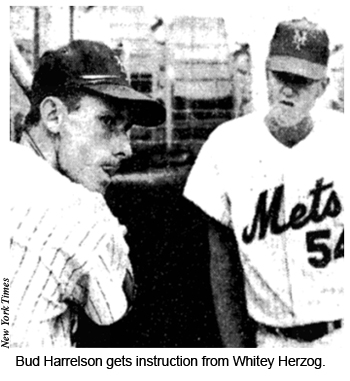
Whitey Herzog helped Bud Harrelson hit well enough to stay in the big leagues. What he likely couldn’t have imagined is that the scrawny shortstop of the Mets would become a terror at the plate against Bob Gibson.

In 16 big-league seasons, Harrelson hit .236 and had a modest on-base percentage of .327. Against Gibson, he turned into the reincarnation of Ty Cobb. Harrelson batted .333 versus the Cardinals ace and, with 20 hits and 14 walks, had a .459 on-base percentage.

If not for Herzog, a Mets coach who later became Cardinals manager, Harrelson might not have stuck around long enough to do so much damage against Gibson. “Whitey Herzog really taught me what the game is all about here,” Harrelson said to the New York Daily News.

A Gold Glove fielder, Harrelson helped the Mets win two National League pennants and a World Series title.

Making a switch

Signed by the Mets in June 1963, a day after he turned 19, Harrelson got brought up to the majors two years later. His first plate appearance for the 1965 Mets came at St. Louis when he grounded out against the Cardinals’ Ray Washburn. Boxscore

At 155 pounds, Harrelson “looked like a high school shortstop,” the New York Times noted. He fielded like a pro but didn’t hit like one. In 37 at-bats for the 1965 Mets, Harrelson hit .108. Columnist Arthur Daley described him as a “frail little guy” and “a batter of feeble skills.”

Desperate to make himself useful as a hitter, Harrelson, a natural right-hander, took some swings from the left side against a pitching machine at spring training in 1966. Mets director of player personnel Bob Scheffing (a former Cardinals catcher) and minor-league manager Solly Hemus (a former Cardinals player and manager) “noticed his smooth left-handed stroke, and suggested that he continue,” the New York Times reported.

Assigned to Class AAA Jacksonville, managed by Hemus, Harrelson made himself into a switch-hitter, but the results were not immediate. He batted .221 overall, and .210 from the left side, for Jacksonville.

Called up to the Mets in August 1966, Harrelson worked before every game with Herzog, a coach on manager Wes Westrum’s staff, to get better at hitting from both sides. Herzog urged him to “hit that ball like it’s your enemy” and “smash it,” the New York Times reported.

Harrelson told the newspaper, “That half-hour I put into the batting cage is like two hours work for me … but I know I’m knocking on the door. I know I’ve got to make it as a switch-hitter. That’s the way it is.”

Whitey ball

Herzog boosted Harrelson’s confidence and encouraged his scrappy play.

On Sept. 16, 1966, at San Francisco, the score was tied at 3-3 with two outs in the ninth when Harrelson batted from the right side against Giants left-hander Billy Hoeft. A runner, Johnny Lewis (a former Cardinal), was on second.

Harrelson drove the ball over the head of rookie left fielder Frank Johnson, who played shallow, for his second triple of the game, scoring Lewis and giving the Mets a 4-3 lead. “I get to third base, I’m dusting myself off, just happy to be there, and Whitey (Herzog, coaching at third) says, ‘So steal home,’ ” Harrelson told the New York Daily News.

While Harrelson pondered that, the Giants lifted Hoeft and replaced him with Lindy McDaniel, the former Cardinal. On McDaniel’s first pitch to Eddie Bressoud, Harrelson took a normal lead and noticed McDaniel didn’t pay much attention to him. “Herzog told me if McDaniel wasn’t looking at me and I thought I could make it, I should go ahead and try it,” Harrelson said to the San Francisco Examiner.

On McDaniel’s second pitch, Harrelson broke for home as Herzog suggested. McDaniel’s pitch was high and went past catcher Tom Haller to the backstop. Harrelson scored easily with a steal of home, extending the Mets’ lead to 5-3.

The Giants scored a run in the bottom of the ninth, but the Mets prevailed, 5-4, on Harrelson’s dash to the dish. As Newsday noted, “A skinny kid … ran right over the Giants. He just about took their pennant hopes and buried them under home plate with his flashing spikes.” Boxscore

Different strokes

Harrelson became the Mets’ starting shortstop in 1967. “He had to make himself into a ballplayer, and he did it,” Herzog recalled years later to Bernie Miklasz of the St. Louis Post-Dispatch.

Described by Dick Young of the New York Daily News as “a hard-working slap hitter who can fly,” Harrelson took a tip from coach Yogi Berra to use different bats and different grips from each side of the plate.

“Yogi got me to start using a big bat when I hit left-handed,” Harrelson told Dave Anderson of the New York Times. “I use a 36-inch, 35-ounce bat and choke up about four or five inches from the handle. Right-handed, I’m using a light bat that (utility man) Bob Johnson gave to me. It is only 34 inches, 30 ounces. I choke up only about an inch with that one.”

Because batting right-handed was natural to him, resulting in a quicker swing, a lighter bat was sufficient, Harrelson said. From the left side, he became “a sweep contact hitter” who needed the help of a heftier bat, he told Dave Anderson.

“They use a Little League defense against me as a lefty,” Harrelson said to the New York Times. “The outfield plays shallow with the infield in.”

It was as a left-handed batter, his weak side, that Harrelson faced Bob Gibson. All that practicing and experimenting he did paid off.

Bring it on, Bob

The Cardinals won consecutive National League pennants in 1967 and 1968, and were expected to contend again in 1969, but the Mets, who never had experienced a winning season, dethroned them.

On Sept. 23, 1969, the Mets clinched at least a tie for a division title with a 3-2 win versus Gibson and the Cardinals in 11 innings. Batting left-handed, Harrelson had two hits and two walks, and drove in the winning run.

With the score tied at 2-2 in the bottom of the 11th, the Mets had runners on first and second, one out, when Harrelson lined a 1-and-2 pitch from Gibson into center for a single.

“I thought it was gong to be close at the plate,” Mets manager Gil Hodges told Newsday, but Curt Flood’s throw was up the first-base line, enabling Ron Swoboda to score from second. Boxscore

For the 1969 season, Harrelson hit .248 and had an on-base percentage of .341, but against the Cardinals he had a .317 batting mark and reached base in 45.1 percent of his plate appearances. In 17 plate appearances versus Bob Gibson in 1969, Harrelson’s on-base percentage was .625.

In his autobiography, “Stranger to the Game,” Gibson said, “Most of my energy was spent working on and worrying about the guys with the biggest sticks. Although the ping hitters may have put more nicks in me from game to game, I didn’t fear them whatsoever … If I wanted the batter to hit the ball, as I wanted singles hitters to do in most cases, I didn’t see the merit of throwing pitches that weren’t strikes.”

Two years later, on May 7, 1971, Gibson and the Cardinals had a 1-0 lead on Tom Seaver and the Mets at New York’s Shea Stadium when Harrelson led off the bottom of the seventh with a triple to the alley in right-center.

“Maybe he has only four super fastballs in him a game now,” Harrelson said to Newsday of Gibson, “but he’s a great self-analyst. He knows what he’s got and how to use it. He sets you up now instead of blowing you down.”

After Ken Boswell grounded out to first, Dave Marshall batted. “I put down two fingers for a curve and Bob saw only one,” catcher Ted Simmons told Newsday. “That fastball just sailed over my left shoulder.”

The wild pitch enabled Harrelson to scamper home with the tying run. 

“That wasn’t Ted’s fault,” Gibson said to Newsday. “I blew the sign.”

The Mets scored twice in the eighth against Gibson and won, 3-1. Boxscore

In 1973, when the Mets edged the Cardinals for the division title, Harrelson hit .258 overall and .325 against St. Louis.

For his career, Harrelson had more hits versus Steve Carlton (23) and Bob Gibson (20) than he did against any other pitchers.

Read Full Post »

« Newer Posts - Older Posts »