Feeds:
Posts
Comments

Archive for the ‘Opponents’ Category

In Montreal, where the predominant language is French, he’s “Un Dominicain Coriace.” In his homeland, where Spanish is spoken, it’s “Un Dominicano Duro.”

Regardless of the locale, Joaquin Andjuar, the self-proclaimed “One Tough Dominican” pitcher, could back up his image with astonishing results.

One such instance occurred on April 27, 1984, for the Cardinals against the Expos at Montreal. Brushed back by a pitch, Andujar retaliated by belting the next delivery for a home run that put the Cardinals ahead for good.

Head games

For the Friday afternoon game at Olympic Stadium, the Expos produced a lineup that included Pete Rose in left, three future Hall of Famers _ Gary Carter at catcher, Andre Dawson in right, Tim Raines in center _ and a probable future Hall of Fame manager at first, Terry Francona.

The player who drew Andujar’s attention (and ire), though, was the Expos’ spunky second baseman, Bryan Little. Batting with one out and none on in the first inning, Little bunted for a single. He advanced to third on a hit by Raines and scored on Dawson’s sacrifice fly.

Andujar didn’t think much of a batter who used a puny bunt to get on base against him. When Little came up again in the third, he was sent spinning to the ground by a fastball. “He was throwing at me,” Little told the Montreal Gazette.

Andujar expected the Expos to seek retribution because when he batted in the fifth he wore a helmet with a protective ear flap, an unusual choice for him, when he dug in from the right side of the plate. “I didn’t want to get hit in the ear,” Andujar told the St. Louis Post-Dispatch.

Sure enough, Steve Rogers’ first pitch to him was a fastball near the head. Umpire Bruce Froemming warned Rogers he’d be ejected if he threw another like that.

My way

Andujar had his own system for determining which side of the plate to take as a batter. Though a right-hander, he sometimes batted from the left side, as he did in his first plate appearance of the game against Rogers.

According to the Post-Dispatch, Andujar said he batted from the left side versus right-handers when there were runners in scoring position because, “I make better contact left-handed.” He generally went to the right side when he was bunting or trying to slug a home run.

Usually, Andujar was trying for the long ball.

Cutting loose with savage cuts, he struck out 315 times in 607 career at-bats in the majors. As Rick Hummel of the Post-Dispatch noted, “If one watched Andujar swing his 40-ounce bat as if he were trying to beat a rug, one wondered what would happen if bat ever met ball.”

After throwing the brushback pitch to him, Rogers found out.

On with the show

Andujar powered the next pitch to deep left for a home run, breaking a 2-2 tie.

“He was pumped up and I threw a bad pitch right in his wheelhouse,” Rogers told the Post-Dispatch. “I was trying to throw a slider away and I threw a spinning nothing ball, middle in.”

Milking the moment, “Andujar majestically flipped his bat aside and watched his homer sail over the wall,” Rick Hummel wrote. “Then he literally walked the last 90 feet in his home run trot, pausing to step dramatically on home plate before continuing to the dugout.”

Cardinals infielder Ken Oberkfell told the Montreal Gazette, “We were all stunned … Now we’re going to have to listen to him talk about his power for a week.”

Andujar finished with a complete-game win. (His first 10 decisions versus the Expos all were wins and he ended his career with a 15-6 record against them.) Boxscore

Power supply

A career .127 hitter in his 13 major-league seasons, Andujar had five home runs, including two versus Rogers. With the Astros in 1979, Andujar homered against Rogers at Montreal. Boxscore

In addition to the two home runs off Rogers, Andujar hit another against the Expos _ in 1979, an inside-the-park poke versus Bill Lee at the Astrodome in Houston. Boxscore

Andujar’s first four home runs were right-handed. His last, a grand slam at St. Louis against the Braves’ Jeff Dedmon, was from the left side. Like Babe Ruth, Andujar called that shot.

Read Full Post »

In high school at suburban St. Louis and in college at the University of Missouri, Andy Russell helped make every football team he played for a winner and was at his best in the most important games.

A hometown standout would seem a natural choice for the St. Louis Cardinals. Instead, Russell played his entire NFL career as an outside linebacker with the Pittsburgh Steelers.

He was named to the Pro Bowl seven times in 12 seasons and was captain of the Steel Curtain defense that transformed the franchise into Super Bowl champions.

In his rookie season in 1963, Russell stung the Cardinals, intercepting a pass in a Steelers win.

Executive’s son

Charles Andrew “Andy” Russell was born in Detroit and lived in Chicago and New York before his family moved to the St. Louis suburb of Ladue. His father’s job as an executive with Monsanto, the chemical company, required the relocations.

According to the Pittsburgh Post-Gazette, Andy Russell said his father William “was an immigrant who came to the United States from Scotland in 1922 at age 11. He was proud of making his way in this new world. It’s a million miles from the tenements of Glasgow to the top ranks of Monsanto.”

Andy Russell became an accomplished fullback on the Ladue Horton Watkins High School football team. Nicknamed “The Horse” because of his power and ability to stiff-arm tacklers, Russell led the team to an 8-0 record his senior season in 1958.

He chose Missouri from among 25 college scholarship offers because, in part, “I was impressed particularly with the members of the faculty whom I met,” Russell told the St. Louis Post-Dispatch.

As Russell entered college, his father got promoted to lead Monsanto’s overseas division. Andy’s parents moved to Brussels, Belgium (and later Geneva, Switzerland), and Monsanto provided Andy with roundtrip airfare each summer during his college years to join them in Europe, according to the Post-Dispatch.

Missouri Tiger

In Russell’s three varsity seasons (1960-62) as a fullback and linebacker for head coach Dan Devine, Missouri was 25-4-3, including victories against Navy in the Orange Bowl and Georgia Tech in the Bluebonnet Bowl.

As a junior in 1961, Russell was Missouri’s leading rusher, but defense was where he excelled the most. At linebacker, he played “aggressively and with intuition, diagnosing running plays and wheeling back to knock down and intercept passes,” columnist Bob Broeg noted in the Post-Dispatch.

Playing before 71,218 spectators, including President-elect John F. Kennedy, in the Orange Bowl, Russell intercepted two passes from Navy quarterback Hal Spooner.

In Missouri’s 10-0 victory versus Oklahoma State in 1961, Russell scored the lone touchdown, intercepting a pass and returning it 47 yards for the score. The next year, he picked off two passes to help Missouri beat Nebraska, 16-7.

In his final game for Missouri at the Bluebonnet Bowl in Houston, Russell made two interceptions and nine tackles. He also threw the key block to spring Bill Tobin on a 77-yard touchdown run.

As the St. Louis Globe-Democrat noted, Russell “always seems to rise to the occasion in important games.”

Join the club

During a visit to St. Louis, William Russell took Andy to a Cardinals football game and was disheartened by the brutality he witnessed on the field. According to Los Angeles Times columnist Jim Murray, the father said, “Son, promise me one thing: You will never play pro football.” Andy replied, “Don’t worry.”

Andy Russell planned to start a business career in St. Louis after he graduated. He also was facing a stint in the Army because he had completed the Reserve Officers Training Corps (ROTC) program at Missouri.

“I never even considered pro football,” Russell said to The Pittsburgh Press. “I can honestly say the thought never occurred to me.”

During his senior year, when NFL teams sent Russell questionnaires that included a query on whether he wanted to play pro football, Russell checked the box marked “no.” According to the Associated Press, the only team that didn’t mail him a survey was the Steelers. So they didn’t know he was uninterested.

The Steelers had traded their top seven spots in the 1963 NFL draft and didn’t have a pick until the eighth round. When their turn came in the 16th round, the Steelers selected Russell, then sent scout Will Walls to meet with him. Walls “gave me a real sales talk on the (team’s) shortage of linebackers,” Russell recalled to the Post-Gazette. “That convinced me that I had a chance.”

After graduating from Missouri in June 1963 with a degree in economics, Russell signed with the Steelers. According to the Associated Press, he got a $12,000 contract and $3,000 signing bonus. Russell planned to play one season for the money, then pursue a graduate degree. At the Steelers’ suggestion, he asked the Army for a delay in fulfilling his ROTC commitment and it was granted.

Making the grade

The 1963 Steelers were loaded with characters. “That was a fun team,” Russell recalled to the Post-Gazette. “They used to drink a lot of ‘fluids’ to ward off colds. I had played for Dan Devine at Missouri and things were so disciplined that you couldn’t even cough in a meeting. At my first meeting with the Steelers, you could barely see the blackboard through all the cigarette smoke. Some guys would snore in the back of the room and others would argue with the coaches on whether or not plays would work.”

Russell said to Jim Murray, “We were a wildly reckless team … We were about as disciplined as a litter of puppies.”

The Steelers accepted Russell because of how well he played in training camp. Defensive coordinator Buster Ramsey told United Press International, “You don’t often see a rookie work into a system that quickly. He has speed and lateral movement and should develop into one of the best linebackers in the league.”

Early in the season, when linebackers John Reger and Bob Schmitz got injured, Russell stepped in and impressed. On Sept. 29, 1963, facing the Cardinals at Pittsburgh, Russell intercepted a Charley Johnson pass, helping the Steelers to a 23-10 victory. Game stats

“The Cardinals had little success with rookie Andy Russell, even though they picked on the St. Louis youngster time and again,” The Pittsburgh Press reported. “His best play was an interception of a pass intended for fullback Joe Childress. The Cardinals tried to play it cute. On the preceding play, they tried the same over-the-middle pass to fullback Mal Hammack, but Russell broke it up at the last instant. Figuring the rookie wouldn’t expect the same play immediately, Childress came in with orders to come right back with the same thing, but Russell wasn’t guessing. He played his man and wound up with the ball.”

Russell was the Steelers’ only rookie regular in 1963. He started in 13 of 14 games, according to pro-football-reference.com.

Rags to riches

In January 1964, Russell was ordered to begin a two-year tour of duty as an Army lieutenant. He spent most of that time at a base in Stuttgart, Germany, where he played football for a service team, and missed the 1964 and 1965 NFL seasons.

Discharged in January 1966, Russell enrolled in graduate school at Missouri before going to Steelers training camp in the summer. He picked up where he left off, returning to the Steelers’ starting unit.

On Nov. 13, 1966, in a game against the Cardinals at Pittsburgh, Russell blocked a Jackie Smith punt, recovered the ball and returned it 14 yards for a touchdown, putting the Steelers ahead to stay. Boxscore

“We normally don’t attempt to block a punt,” Russell told the Post-Dispatch, “but we had seen in films that they left an opening in their line. When they set up the same way on a punt just before the one we blocked, we decided to try it. The punt hit me right in the face, then it was bouncing on the ground. I picked it up, got a good block and ran it in.”

In 1967, Russell was named Steelers defensive captain (a title he held for 10 years) and earned a master’s degree in business administration at Missouri.

Russell played for losing teams from 1966 to 1971 before experiencing a turnaround under head coach Chuck Noll. From 1974-76, the Steelers’ linebacking unit of Jack Ham, Jack Lambert and Russell was considered “the best in football,” Baltimore Colts running back Lydell Mitchell told the Post-Gazette.

The Steelers were NFL champions in 1974 and 1975, beating the Minnesota Vikings and Dallas Cowboys in the Super Bowls those seasons.

Russell played in 168 consecutive regular-season games for the Steelers. Video He was 35 when he stopped playing and opened an investment securities firm in Pittsburgh. Russell also did extensive charitable work there.

Adventure seeker

According to the Post-Gazette, Russell became “the ultimate mountain man,” summiting all 54 14,000-foot peaks in Colorado. He also climbed Mount Kenya and Mount Kilimanjaro in Africa.

Russell and former Steelers center Ray Mansfield completed the Hunter’s Island Route, a 145-mile canoe adventure through the Canadian wilderness.

“I had always been curious about the limits of physical endurance,” Russell told Neil Amdur of the New York Times. “After football games, I was so exhausted that I used to get this tremendous feeling of peace, as if I had used every bone in my body. I always wondered whether it was possible to achieve this same feeling somewhere else.”

Read Full Post »

Picture this: You’re a rookie starting pitcher from a hamlet in Iowa, making your big-league debut on the road against the reigning World Series champions. The opposing starter is a future Hall of Famer who rarely has allowed a run during a winning streak on his way to a Cy Young Award.

That’s the challenge Mets right-hander Jim McAndrew faced when he got the start in his first major-league game against Bob Gibson and the 1968 Cardinals.

The degree of difficulty McAndrew faced hardly lessened. In his first four starts, McAndrew allowed six runs total, but the Mets scored none _ and he lost all four.

McAndrew finally got his first win by pitching a shutout, beating the Cardinals and their other future Hall of Famer, Steve Carlton.

A hard-luck hurler, McAndrew nearly quit when he was in the minors but Whitey Herzog convinced him to stay. McAndrew had one winning season in seven years in the majors, but played for two National League pennant winners and a World Series champion.

Help from Herzog

McAndrew grew up on his parents’ 750-acre farm in Lost Nation, Iowa, and developed into a top prep ballplayer. Cardinals scout Ken Blackman showed interest but advised McAndrew he’d be better off playing college baseball, according to the Society for American Baseball Research.

A psychology major, McAndrew pitched for the University of Iowa. On the recommendation of their St. Louis-based scout, Charlie Frey, the Mets took him in the 11th round of the 1965 amateur draft. (Their 12th-round pick was another right-hander, Nolan Ryan.)

After producing 10 wins and 1.47 ERA for a Class AA club managed by St. Louisan Roy Sievers in 1967, McAndrew was dejected when the Mets didn’t put him on their 40-man big-league winter roster. He thought about quitting and going to graduate school. “I had confidence in myself but nobody else seemed to,” McAndrew recalled to Newsday.

When Mets director of player development Whitey Herzog learned McAndrew was thinking of leaving, he talked him out of it. McAndrew was assigned to Class AAA Jacksonville in 1968, but manager Clyde McCullough moved him to the bullpen. “Whitey told McCullough to put McAndrew back into the starting rotation,” Newsday reported.

In July 1968, when Nolan Ryan reported for military duty, the Mets called up McAndrew to replace him.

The heat is on

On a sweltering Sunday, July 21, 1968, McAndrew made his debut against Bob Gibson and the Cardinals at Busch Memorial Stadium. “Some people thought it was throwing a lamb to a lion.” Newsday noted.

Instead, “for five innings he matched zeroes with Gibson, who is in the midst of one of the hottest streaks in all baseball history,” the New York Times reported.

Then, in the Cardinals’ half of the sixth, Bobby Tolan drove a pitch to right-center. Outfielders Cleon Jones and Larry Stahl pursued it, thinking a catch could be made, but the ball hit against the wall. Neither Jones nor Stahl was in position to get the carom and the ball got between them and rolled away. Tolan circled the bases with an inside-the-park home run, giving the Cardinals a 1-0 lead.

After the inning, McAndrew left the game because the searing 94-degree heat got to him more than the Cardinals batters did. “He needed oxygen between innings,” the St. Louis Post-Dispatch reported. 

The Cardinals added a run in the eighth and won, 2-0. Gibson completed his seventh shutout of the season, stretching his win streak to 10 and improving his career mark against the Mets to 20-3. He threw 144 pitches and struck out 13.

McAndrew told the New York Daily News he felt good about how he pitched, “but I didn’t win, and that’s what I’m supposed to do.” Boxscore

Runs are scarce

In his next three starts, McAndrew and the Mets lost 2-0 to the Dodgers, 1-0 to the Giants and 1-0 to the Astros, giving him an 0-4 record. The Mets finally scored in his fifth start, but McAndrew got shelled and lost to the Giants, a 13-3 final.

McAndrew brought an 0-5 record and 3.38 ERA into his next start, a return to St. Louis against Steve Carlton on Aug. 26.

The game was scoreless in the seventh when Tim McCarver lined a pitch deep to left. “McCarver would have had a three-base hit, two bases, at least,” Mets manager Gil Hodges said to the Post-Dispatch, but Cleon Jones made a diving catch. “Maybe the best play we’ve had in the outfield all year,” Hodges said.

The importance of the play was underlined when the next batter, Mike Shannon, singled. Instead of driving in a run, it was a harmless hit because McAndrew worked out of the inning unscathed. “I don’t win it if Cleon doesn’t get that one,” McAndrew told the New York Daily News.

The Mets manufactured the run McAndrew needed against Carlton in the eighth. Tommie Agee singled, moved to second on a Phil Linz sacrifice bunt, stole third and scored on a Cleon Jones sacrifice fly.

Given the 1-0 lead, McAndrew did the rest, retiring the Cardinals in order in the eighth and ninth to secure the shutout and his first win.

Recalling how Whitey Herzog stuck with him earlier in the year, McAndrew said to Newsday, “I attribute my being here tonight to him.” Boxscore

Five nights later, in a rematch at New York, Carlton and Joe Hoerner combined on a shutout and beat McAndrew and the Mets, 2-0. Boxscore

In three starts against the 1968 Cardinals, McAndrew allowed three runs in 23 innings and was 1-2.

Fit for a king

After the 1968 season, the Mets offered the Reds Dick Selma, Larry Stahl and their choice of either McAndrew, Gary Gentry or Steve Renko for Vada Pinson and Hal McRae, according to columnist Dick Young, but Pinson went to the Cardinals for Bobby Tolan and Wayne Granger.

The Mets also offered McAndrew to the Expos for Donn Clendenon but were turned down, The Sporting News reported. (Later, in June 1969, the Mets acquired Clendenon for a package of players and he was a key run producer for them.)

McAndrew stayed with the Mets in 1969 and contributed to their championship season. On a staff with Tom Seaver, Nolan Ryan and Jerry Koosman, McAndrew pitched in 27 games, including 21 starts, and was 6-7. One of those wins was a three-hitter against the Cardinals on June 30. Boxscore

The Mets won four of five against the Orioles in the 1969 World Series, but McAndrew didn’t pitch in any of the games.

“He was the team intellectual, the quiet one of the clubhouse, the loner,” Joseph Durso wrote in the New York Times. “On the field, he was even more isolated than that _ the sixth man in a five-man rotation, the hard-luck pitcher nobody scored any runs for, the trade bait whenever deals were discussed.”

To the people of his hometown, though, McAndrew was someone special. On Nov. 1, 1969, residents of Lost Nation held a parade and dinner in McAndrew’s honor. “McAndrew received a number of gifts, including a plaque from Lost Nation mayor Shorty Ales noting Jim’s inspiration for the youth of the community, and a specially designed gold ring,” the Quad-City Times reported.

“Everyone has treated me just like a king,” McAndrew said to the newspaper.

Ups and downs

In 1971, McAndrew twice was injured in on-field accidents. At spring training, he was running in the outfield when a line drive off the bat of teammate Art Shamsky struck him in the jaw. “I lost four teeth,” McAndrew told the Post-Dispatch.

In July that year, during batting practice at Houston, McAndrew was fielding balls hit to the outfield and pitcher Gary Gentry was shagging tosses from coach Rube Walker. While chasing a liner, McAndrew collided with Gentry. McAndrew needed 20 stitches and plastic surgery for a wound over his right ear. Gentry took 15 stitches for facial cuts.

McAndrew had his best season in 1972, finishing 11-8 with a 2.80 ERA. Two of the wins were against the Cardinals, including his first complete game in two years. Boxscore

“He’s sneaky fast,” Mets catcher Duffy Dyer told Newsday. “He’s not a strikeout pitcher and there’s a lot of first-ball swinging.”

The Mets were National League champions in 1973, but McAndrew wasn’t much of a factor. He was 3-8 and had no wins after May 13. The Mets didn’t use him in any of the seven World Series games against the champion Athletics.

Afterward, the Cardinals offered to trade Joe Torre to the Mets for Jerry Koosman. The Mets countered with a package that included McAndrew, but the Cardinals said no. The Mets then sent McAndrew to the Padres. He pitched his final season in the majors with them in 1974.

McAndrew had a career mark of 37-53, including 6-6 versus the Cardinals.

In 1989, his son, pitcher Jamie McAndrew, was taken by the Dodgers in the first round of the 1989 amateur draft. He got to the big leagues with the Brewers in 1995. The catcher in his debut game was Mike Matheny. Boxscore


Read Full Post »

Golden Richards was a NFL glamour boy with a glittery name and the look to match. A blonde mane flowed from beneath his helmet when he streaked down the field. As columnist Jim Murray noted, “He’s so golden from his hair on down that he glows in the daylight. He’s perfect for the part of Sir Galahad.”

Richards could play, too. Few were faster than he was. A Dallas Cowboys receiver, Richards had sure hands, the strength to catch in a crowd and the ability to haul in long passes over the shoulder.

He got both his first NFL reception and first touchdown catch against the St. Louis Cardinals. Later, as an established starter, Richards made a game-winning touchdown grab at St. Louis. For his career, the foe he had the most catches against (19) were the Cardinals.

In his first five seasons with Dallas, Richards took part in nine playoff games, including two Super Bowls. The glory came at a terrible price. Richards suffered injuries, became addicted to prescription painkillers and struggled with alcohol abuse.

Burnishing bright

John Golden Richards was born on Dec. 31, 1950, in Salt Lake City. According to the Salt Lake Tribune, his parents gave him the distinctive middle name because they thought a baby born on New Year’s Eve must be extra special. Everyone called him Golden.

Richards’ specialness came through in athletics. He participated in five sports _ baseball, basketball, football, tennis and track _ at Granite High School in Salt Lake City. As a senior in 1969, Richards ran the 100-yard dash in 9.4 seconds and cleared 24 feet in the long jump at the Golden West Invitational in Sacramento.

Colleges recruited him for track, but Richards preferred football. The only football offers he got were from Air Force, Brigham Young University (BYU), Utah, Utah State and Westminster College, the Salt Lake Tribune reported.

Richards, a Mormon, planned to bypass BYU and go with Utah because of the football program’s strong passing game. “Next thing, I was called into my bishop’s office, and he told me he wanted me to go to BYU, or else he would call me on (a Latter-day Saints) mission,” Richards said to the Tribune.

Richards did what he was told and found he was right about BYU’s quarterback situation. None could get the ball to him consistently. In his two varsity seasons (1970-71), Richards caught a total of two touchdown passes.

He made up for it with punt and kickoff returns. As a junior in 1971, he was the NCAA’s top punt returner, with 624 yards and four touchdowns.

Richards didn’t put the same kind of effort into his studies. He was declared academically ineligible for his senior season at BYU. “It was my fault,” he told the Deseret News. “The situation arose simply because of my own laziness.”

He transferred to the University of Hawaii for the 1972 season and snared five touchdown passes in five games before he tore ligaments in his right knee.

Seeing stars

Before the injury, Cowboys scout Bob Griffin twice tested Richards in the 40-yard dash and both times he clocked 4.4 seconds. Impressed, the Cowboys took Richards in the second round of the 1973 NFL draft. “We haven’t had anybody this quick on our team since we picked up (two-time Olympic gold medalist) Bobby Hayes,” Cowboys head coach Tom Landry said to the Honolulu Advertiser.

As a teen, the Cowboys were the team Richards dreamed of playing for someday. When he walked into their locker room for the first time at training camp in 1973, “I was standing there next to Bob Lilly, Jethro Pugh and Roger Staubach,” Richards said to the Salt Lake Tribune. “I wanted to get everybody’s autograph.”

(Before a 1975 game against the New York Jets at Shea Stadium, Richards “stuck a pen and paper in his uniform pants and ran over to Joe Namath, begging for his signature right at the 50-yard line. Namath told Richards it was an honor and sent him a signed glossy photo the following the week,” the Tribune reported.)

On Sept. 30, 1973, the Cowboys were routing the Cardinals at Texas Stadium. In the fourth quarter, Landry began putting in his reserves, including the rookie Richards and quarterback Craig Morton. Soon after, Richards caught his first NFL pass, a five-yard toss from Morton. “I just broke out smiling and was just about laughing all the way to the huddle,” Richards said to the Fort Worth Star-Telegram.

Two plays later, Morton called for Richards to go deep. “I thought it might be a touchdown pass when it (the play) was called,” Richards told the Star-Telegram. “That’s what the play was designed for _ six points.”

Sure enough, Richards broke free and Morton connected with him on a 53-yard scoring pass. Game stats

Big playmaker

More good times followed. Richards returned a punt 63 yards for a score in a 1973 playoff game against the Minnesota Vikings and caught touchdown passes in playoff wins against the Los Angeles Rams (1976) and Vikings (1978).

Richards averaged 17.5 yards a catch in the NFL. Of his 17 regular-season touchdown receptions, 11 were of 40 yards or more.

On Oct. 9, 1977, Richards made the play that beat the Cardinals.

With 6:53 remaining and St. Louis ahead, 24-23, the Cowboys were at the Cardinals’ 17-yard line. Quarterback Roger Staubach called an audible but Richards couldn’t hear him above the din at Busch Memorial Stadium.

“I was able to read Roger’s lips and pick it up, though,” Richards told the Fort Worth Star-Telegram.

As Richards dashed to the goal line down the right side, covered by cornerback Lee Nelson, Staubach floated a pass. “It was a little bit underthrown,” Richards said to the Fort Worth newspaper. “So I just kept going like it was coming. Then, at the last second, I stopped and tipped it back to me with one hand. Then I got a hold of it and just went sliding in to score.”

Nelson, filling in for injured Perry Smith, told the Belleville (Ill.) News-Democrat, “The guy made a hell of a catch. He caught it with one hand, one arm. I batted one of his arms away.”

The Cowboys won, 30-24. Game stats They would lose only twice all season (to the Cardinals at Dallas and to the Steelers at Pittsburgh) and rolled to the Super Bowl for a matchup against the Denver Broncos.

Richards was one of the game’s stars, catching a 29-yard touchdown pass from fullback Robert Newhouse to highlight a 27-10 Cowboys victory. Game stats and video

Troubled times

Richards was popular. His first wife, Barbara, said at his peak he got 1,000 pieces of fan mail a week. At the Super Bowl in Miami in 1976, Richards was “chased up and down the streets by the females, some handing him their telephone numbers, others just wanting to touch him,” the Associated Press reported. 

Richards told the wire service, “It’s kind of overwhelming. I mean, they walk right up with my wife standing next to me.”

He hobnobbed with celebrities such as Olivia Newton-John and model Jerry Hall. “It was glamorous,” Richards told the Salt Lake Tribune.

The glamour masked a dark side. Richards was hurting. He took a pounding in the games. A hit from the Steelers’ Mel Blount broke five of Richards’ ribs. His back ached all the time and so did his teeth from getting belted under the face mask.

Seven times, dentists did root canals to repair damage from hits to Richards’ face, the Dallas Morning News reported. He was prescribed Percodan. Codeine was another. Richards became addicted and “depended on painkillers to play,” according to the Dallas newspaper.

“I never took drugs to get high,” he told reporter Barry Horn. “I took drugs because I couldn’t stand the pain.”

His craving for painkillers spun out of control. “In the bleakest moments,” Gordon Monson of the Salt Lake Tribune reported, “he fished through his own vomit in a toilet for unabsorbed painkillers so he could taken them again.”

Richards told Monson, “There were times when I lived through the darkest dark you can imagine. With the painkillers, you fight and struggle to get up to ground zero, but then you discover you’re still 150 miles below the surface of the earth.”

In April 1978, three months after he scored his Super Bowl touchdown, Richards was rushed to a hospital when it was feared he had overdosed. Five months later, the Cowboys traded him to the Chicago Bears for two draft picks.

Richards spent two seasons with Chicago, got released and was done as a player at 29. His third wife, Amy, told the Salt Lake Tribune, “He got hooked on the narcotics in the NFL. When the NFL was taken away, he no longer had football but he still had the narcotics.”

His problems expanded. Richards turned to booze. “I was living in an alcohol fog,” he said to the Tribune.

He was in and out of treatment centers multiple times.

In December 1992, Richards was arrested on charges he forged his father’s signature on nearly $700 in checks to pay for painkillers. He pleaded guilty.

“This has been a horrible, horrible way of life,” Richards told the Dallas Morning News in January 1993. “Like any addict, I have been deceitful, manipulative and cunning. People who suffer from my kind of addiction can lose everything that means everything to you. I know. I have.”

Richards was sober for the last decade of his life, his brother, Doug, told the Deseret News.


Read Full Post »

The number stands out from the stats line like a wart, ugly and embarrassing: 162.00. That’s the earned run average Tom Qualters had in his rookie season with the Phillies.

The Cardinals were responsible for giving him that statistical shiner. Qualters, 18, made his big-league debut against them. He faced seven Cardinals and retired one. Six scored. His line: 0.1 innings, six runs, 162.00 ERA in his lone appearance of the 1953 regular season.

To his credit, Qualters recovered from that clobbering. He eventually went to the minors and became a teammate of Satchel Paige and Whitey Herzog. Then he returned to the majors and pitched for an American League pennant contender, retiring the likes of Mickey Mantle and Ted Williams.

Bonus baby

A standout amateur athlete in McKeesport, Pa., near Pittsburgh, Qualters developed into a dominating right-handed pitcher. He struck out 22 in a no-hitter against Donora (hometown of Stan Musial). In 1951, at Pittsburgh’s Forbes Field, Qualters started for a team of American Legion all-stars managed by Hall of Famer Pie Traynor.

After he graduated from high school in June 1953, Qualters was offered a signing bonus of at least $25,000 by Pirates general manager Branch Rickey, according to The Pittsburgh Press, but instead accepted a $40,000 offer from the Phillies. Qualters “had his heart set on joining the Phillies from the time he was in knee pants,” The Sporting News reported.

Major League Baseball had a rule then that any amateur who got a signing bonus of more than $4,000 had to stay with the big-league club for two full years. (It was intended to keep the wealthiest clubs from signing scores of prospects and stockpiling them in the minors.) That meant Qualters, who signed on June 16, 1953, had to remain in the majors with the Phillies until at least June 16, 1955.

“I might have been better off going to the minors for experience and a chance to pitch regularly, but I just couldn’t pass up that money,” Qualters said to The Pittsburgh Press. “I used most of it to fix up our home in McKeesport and also pay for an operation on my mother.”

(More than 30 years later, in a 1987 interview with the Pittsburgh Post-Gazette, Qualters said baseball’s bonus rule “was devastating to me” because “I had no business being there” in the majors.)

Learning curve

When he joined the Phillies, “I was really scared,” Qualters said to The Pittsburgh Press. “It was the first time I ever had been away from home and I didn’t know what kind of a reception I’d receive … Being a bonus player, I thought they’d give me the cold shoulder, but they treated me like one of the boys and were always giving me advice. I spent a lot of time with Jim Konstanty in the bullpen and he went out of his way to be nice. Robin Roberts, too.”

(Decades later, Qualters gave conflicting versions of how his Phillies teammates received him. In 1984, Qualters said to the Philadelphia Daily News, “Guys like Robin Roberts, Curt Simmons, Richie Ashburn _ they were great. They made the ride a little smoother, and they certainly didn’t have to.” Three years later, Qualters told the Pittsburgh Post-Gazette, “The players and the manager (Steve O’Neill) were from the old school and didn’t accept me. You can imagine the resentment. As a result, I was off by myself most of the time.”)

The Phillies’ plan was for Qualters to learn by observing rather than pitching. Though he was occupying a roster spot, there was no desire to put him into a regular-season game. “I was a batting practice pitcher, a high-priced batting practice pitcher,” Qualters told the Philadelphia Daily News.

On June 29, 1953, in an exhibition between the Phillies and Athletics for the benefit of the Junior Baseball Federation of Philadelphia, Qualters started before a crowd of 15,293 at Shibe Park. The jittery teen got through the first inning, but gave up six runs in the second before he was lifted.

Two weeks later, Qualters pitched in another exhibition game for the Phillies against the minor-league Baltimore Orioles and yielded five runs in three innings.

Though those exhibition performances did nothing to entice manager Steve O’Neill to pitch Qualters when the Phillies played for keeps, he told the Philadelphia Bulletin, “The boy has everything he needs, a fastball and a terrific curve. If he isn’t a real pitching prospect, then I’ve never seen one.”

Rough stuff

On Sept. 13, 1953, a Sunday at St. Louis, the Cardinals led the Phillies, 11-1, entering the bottom of the eighth. With the outcome not much in doubt, O’Neill waved a proverbial white flag, choosing to let Qualters make his official debut. The Cardinals, though, were all business.

The first batter Qualters faced, hulking slugger Steve Bilko, slammed a home run. The next to come up was Bilko’s physical opposite, Peanuts Lowrey. He drew a walk, then scooted to second on a Qualters wild pitch.

Qualters hit the next batter, Rip Repulski, with a pitch. Harvey Haddix, the Cardinals’ pitcher, followed with a single, loading the bases. Solly Hemus also singled, scoring Lowrey, and reloading the bases.

The first out Qualters recorded came when a future Hall of Famer, Red Schoendienst, grounded to first. Hemus was forced out at second, but Repulski scored from third on the play.

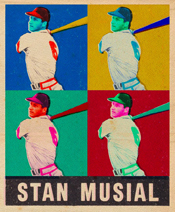
Next up was Stan Musial.

“I was told never to give him the same pitch twice, and this stuck with me like a nursery rhyme,” Qualters said to The Pittsburgh Press. “Our catcher (Stan Lopata) called for a slow curve and Musial swung and missed. I felt pretty good. Then the catcher decided to call for the same pitch and I shuddered. I knew what the boys in the bullpen told me, but who was I to shake off the catcher? So I threw the slow curve again and Musial hit it against the wall.”

Musial’s two-run double knocked Qualters out of the game. Jim Konstanty relieved and gave up a single to Enos Slaughter, driving in Musial and making the score 17-1. Boxscore

It would be four years before Qualters pitched in another regular-season game in the majors.

Starting over

Qualters spent the entire 1954 season with the Phillies and, though healthy, never played in a regular-season game. 

In 1955, as mandated by the bonus rule, the Phillies began the season with Qualters on their roster but he again didn’t get into a regular-season game. The Sporting News referred to him as “Money Bags” because he was being paid without having to perform.

When Qualters completed his two-year stint on the big-league roster in June 1955, he was sent to a Class B farm club in Reidsville, N.C. “I just want to pitch in games, somewhere, anywhere,” Qualters said to the Associated Press.

Years later, he told the Pittsburgh Post-Gazette, “When I went to Reidsville, I found I had lost my velocity. I didn’t have my riding fastball anymore.”

With the Class AAA Miami Marlins in 1956, Qualters, 21, was a teammate of Satchel Paige, 50. Paige was 11-4 with a 1.86 ERA. Qualters had his first good season as a pro _ 5-5 with a 3.38 ERA.

Paige and Qualters were back with Miami in 1957. Joining them was an outfielder, Whitey Herzog, 25, who hit .272. Qualters led the pitching staff in appearances (46) and innings pitched (186) and won 11. Paige had 10 wins and a 2.42 ERA.

Qualters admired the glove Paige used, an aged Mort Cooper model. “It looks like it belongs in the museum at Cooperstown but I like the way it handles,” Qualters told the Miami News. Qualters swapped Paige a new glove for his relic.

The Phillies called up Qualters in September 1957 and he made six relief appearances for them. In one, against the Cardinals, he gave up two runs in 0.2 innings. Boxscore

Qualters began the 1958 season with the Phillies, pitched in one game, got waived and was claimed by the White Sox.

A highlight came on May 25, 1958, in a game against the Red Sox. Qualters relieved starter Dick Donovan with the bases loaded and got Ted Williams to fly out to center. Boxscore

Two months later, at Yankee Stadium, Qualters pitched two scoreless innings and retired Mickey Mantle on a pop-up to second. Boxscore

Qualters made 26 relief appearance for the 1958 White Sox, who finished second behind the American League champion Yankees.

The White Sox had Qualters in their plans for 1959 until he injured his pitching elbow in spring training. Assigned to Class AAA Indianapolis, managed by Mort Cooper’s brother, Walker Cooper, Qualters developed nerve problems in his pitching hand and never got back to the majors. The 1959 White Sox won the American League pennant. “I was all set to be on that pitching staff (until getting injured),” Qualters said to the Pittsburgh Post-Gazette. “That really hurt.”

Qualters became a regional supervisor for the Pennsylvania Fish Commission and was responsible for overseeing enforcement for 10 counties, according to the Pittsburgh Post-Gazette. He was in charge of 15 field officers and 80 deputies.

Read Full Post »

On a Big Red Machine team of Johnny Bench, Joe Morgan, Pete Rose and Tony Perez, the player who consistently confounded the Cardinals was Don Gullett.

A left-handed pitcher, Gullett was 14-3 versus the Cardinals, including 7-0 at Busch Memorial Stadium. He also liked to hit in St. Louis. His batting average there was .281.

Gullett played for six pennant winners in nine seasons in the majors and pitched in five World Series with the Reds and Yankees. His career record was 109-50.

Teen talent

In high school at South Shore, Ky., on the south bank of the Ohio River, Gullett excelled in football (scoring 11 touchdowns and kicking six extra points in one game) and basketball (scoring 47 points in one game) but turned down college scholarship offers because he wanted to become a professional baseball player.

He dazzled scouts when he pitched a seven-inning perfect game in high school, striking out 20 and retiring one batter who bunted.

The Reds selected him in the first round of the June 1969 amateur draft. (The Cardinals also chose a left-handed high school pitcher in that first round, but Charles Minott never advanced above the Class A level of the minors.)

Sent to the Sioux Falls (S.D.) Packers of the Northern League, Gullett, 18, struck out 87 in 78 innings and was 7-2 with a 1.96 ERA.

Invited to Reds spring training in 1970 as a non-roster player, Gullett, 19, impressed first-year manager Sparky Anderson. “For a kid his age, Gullett’s poise is amazing,” Anderson said to The Sporting News. “He just doesn’t scare.”

After striking out against Gullett in spring training, Pirates slugger Willie Stargell told The Sporting News, “Man, that kid throws nothing but wall to wall heat.”

Gullett got a spot on the 1970 Reds Opening Day roster as a reliever.

Rookie sensation

A year after pitching against high schoolers, Gullett made his big-league debut with 1.1 scoreless innings in relief of Ray Washburn versus the Giants. Boxscore

In his first win, against the Dodgers, Gullett pitched five scoreless innings in relief of Jim Maloney. “The kid showed them smoke,” catcher Johnny Bench told The Cincinnati Post. “I mean it was real heat.” Gullett also walked, stole a base, tripled and scored twice. Boxscore

A week later, facing the Cardinals for the first time, Gullett got his first save. With the Reds ahead, 3-2, in the ninth, the Cardinals had a runner on first, two outs, and Jim Campbell at the plate when Gullett replaced closer Wayne Granger.

Asked why he brought in the rookie, Sparky Anderson replied to the Dayton Daily News, “If you’ve got a guy with a lot of stuff like Gullett on your staff and you’re afraid to use him just because he’s 19, then you shouldn’t have him on the team.”

Gullett got Campbell to hit a fly to short center. Center fielder Bobby Tolan couldn’t get to the ball _ “It looked like an in-betweener base hit to me,” Gullett said to the Dayton newspaper  _  but shortstop Dave Concepcion made a twisting catch on the run to end the game. Boxscore

Near the end of Gullett’s rookie season, Dodgers manager Walter Alston told The Sporting News, “Gullett comes as close to matching Sandy Koufax’s fastball as anyone I’ve seen.”

(Gullett said he met Koufax at Cincinnati’s Crosley Field early in the 1970 season. “He showed me how he threw his curveball, how he put his fingers on the seams, and all that,” Gullett said to Dick Kaegel of the St. Louis Post-Dispatch. The next year, Sparky Anderson arranged a meeting of Gullett and Koufax in Chicago. Anderson told the Post-Dispatch, “Sandy told him to think not up and down with his pitches. He told him to think in and out.”)

In 44 games for the 1970 Reds, Gullett was 5-2 with six saves and a 2.43 ERA. He also earned two saves and yielded no runs in the National League Championship Series versus the Pirates and one earned run in three World Series games against the Orioles. Video

Hot stuff

Gullett, 20, moved into the Reds’ starting rotation in 1971 and responded with a 16-6 record. He was 3-0 against the Cardinals, shutting them out twice, and would have had a fourth win if he’d protected a ninth-inning lead.

On June 16, 1971, Gullett pitched a four-hitter in a 1-0 Reds victory. The Cardinals threatened in the eighth, getting a runner to third with two outs, but Matty Alou struck out looking. (Alou, a National League batting champion, had one hit in 19 career at-bats versus Gullett.)

“He threw a fastball right on the black part of the plate,” catcher Pat Corrales told the Dayton Daily News. “As hard as he can throw, and with the location of that pitch, there wasn’t anything else for Alou to do but look at it and go sit down.”

Gullett said to the Cincinnati Enquirer, “I had my best fastball of the year” and an effective slider. Corrales told the newspaper that with Gullett’s slider, “You can’t tell when it’s coming. The rotation is just like on his fastball. A right-hander goes to swing at it, and all of a sudden it hits him on the fists.” Boxscore

Two months later, Gullett was matched against Bob Gibson. In their previous starts, Gibson pitched a no-hitter against the Pirates and Gullett limited the Cubs to one hit in eight innings.

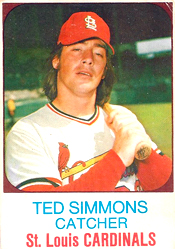
The showdown turned out to be no contest. Gullett and the Reds won, 5-0. Joe Torre (the league batting champion that year) and Ted Simmons were a combined 0-for-8.

“Gullett’s got a fastball that rides away from you, plus a slider that comes in on you,” Torre told the Post-Dispatch. “You can’t tell which one’s coming.”

(Torre adjusted impressively. He had 20 career hits versus Gullett, batting .370.)

Asked whether Gullett was equal to American League left-hander Vida Blue, Sparky Anderson said to the Cincinnati Enquirer, “I wouldn’t trade him even up for Blue.” Boxscore

The Cardinals got some satisfaction against Gullett 11 days later. Gullett and the Reds led, 3-2, with two outs in the bottom of the ninth, but Lou Brock tied the score with a home run. The Cardinals went on to win in the 11th when Clay Carroll walked Ted Sizemore with the bases loaded. Boxscore

(Like Torre, Brock had success against Gullett, totaling 19 hits and batting .322.)

Bat man

Gullett also caused trouble for the Cardinals with his bat.

On July 16, 1974, Gullett, who batted right-handed, had three hits, three RBI and was the winning pitcher in a 12-7 Reds triumph against the Cardinals.

Gullett had a two-run double that knocked Bob Forsch from the game in the first inning, and drove in another run with a single versus John Curtis in the second. He added a single against Rich Folkers in the sixth. Boxscore

In 1975, Gullett, 24, was 4-0 with an 0.28 ERA versus the Cardinals. He allowed one run (a Ted Simmons home run) in 32 innings against them. One of those wins beat Gibson, who was trying for his 250th career victory. Boxscore

Gullett experienced an array of health problems and injuries, including hepatitis (1972), chronic back spasms (1974), a fractured left thumb (1975) and a dislocated ankle tendon (1976).

After the Reds repeated as World Series champions in 1976, Gullett became a free agent and signed a six-year contract with the Yankees. “We feel Gullett is a modern Whitey Ford,” Yankees president Gabe Paul told the New York Times.

Late in September 1978, Gullett underwent surgery for a double tear of the rotator cuff in his left shoulder and was done pitching at age 27. “Sometimes, I dream that I come back as a right-handed pitcher,” Gullett said years later to Bill Peterson of The Cincinnati Post.

In 1986, Gullett, 35, had a heart attack. Four years later, he had triple bypass surgery. Gullett recovered and coached for the Reds for 13 seasons (1993-2005).

Read Full Post »

« Newer Posts - Older Posts »