Feeds:
Posts
Comments

Archive for the ‘Opponents’ Category

For pitcher Pete Richert, fatigues became as much a part of his wardrobe as a baseball uniform in 1968.

In April, he served with the National Guard, trying to quell riots in Washington, D.C. In the fall, he went to Vietnam, looking to boost the spirits of U.S. troops. In between, he pitched in relief for the Baltimore Orioles.

Among those who accompanied Richert to Vietnam was Cardinals general manager Bing Devine. Five years later, on Dec. 5, 1973, Devine acquired Richert for the Cardinals in a trade with the Dodgers.

A left-hander, Richert was a two-time American League all-star and pitched on Orioles teams that won three pennants and a World Series title. His stint with the Cardinals, though, didn’t go the way either he or the team had hoped it would.

Blazing heat

Richert was from Floral Park, N.Y., a village on Long Island. He went to Sewanhaka High School. (The name translates to “island of shells.”) Its alumni also include actor Telly Savalas and Heisman Trophy winner Vinny Testaverde.

In August 1957, Richert, 17, signed with the Brooklyn Dodgers, the day before the club declared it was moving to Los Angeles after the season.

Richert steadily worked his way through the Dodgers’ farm system as a starting pitcher. In 1960, for the Class AA Atlanta Crackers managed by Rube Walker, Richert had 19 wins and struck out 251 batters in 225 innings. The Atlanta Journal called him “the Cracker with the golden arm” and described his best pitch as a “miracle whip fastball.”

He was 22 when he made a spectacular big-league debut with the Dodgers on April 12, 1962. Relieving Stan Williams, Richert struck out the first six batters he faced _ Vada Pinson, Frank Robinson, Gordy Coleman (who advanced to first on a passed ball by John Roseboro), Wally Post, Johnny Edwards and Tommy Harper. Boxscore

(Until then, the only pitcher to strike out six consecutive batters in his debut in the majors was the Dodgers’ Karl Spooner against the Giants in 1954. Boxscore)

“I always say a little prayer when I’m nervous and excited, and I was tonight as I started walking to the mound,” Richert told the Los Angeles Times. “My father, who always wanted me to be a baseball player, died when I was 15. When I decided to try baseball, my brother told me that when I was nervous or excited to always say a prayer and dad would help me. As soon as I threw a pitch to Pinson, the nervousness left me.”

Called upon three days later, Richert struck out five, including Joe Torre twice, in two innings against the Braves. Boxscore

Setback in St. Louis

Richert’s robust rookie season got derailed on May 12, 1962, at St. Louis. Relieving in the 11th, he allowed no runs or hits to the Cardinals in 2.2 innings. Then, as Richert pitched to Bill White with two outs in the 13th, “the ball bounced to the plate, his glove sailed 15 feet away and he grabbed his left elbow in obvious agony,” The Sporting News reported.

Taken to a hospital, it was discovered Richert had tore ligaments in the elbow. Boxscore

He came off the disabled list two months later and was sent to the Dodgers’ Omaha farm team. Worried about reinjuring his arm, Richert resisted throwing hard. According to the New York Times, Omaha manager Danny Ozark said to Richert, “Pete, you’re scared to throw the ball. If you’re going to be a pitcher, you’ve got to make up your mind. It’s the difference between spending the rest of your life in the minors or going back to the big time.”

Richert responded, got brought back to the Dodgers in August and was put into their starting rotation.

He split each of the next two seasons (1963-64) between the Dodgers and their Spokane farm team (managed by Danny Ozark).

On Sept. 16, 1963, the first-place Dodgers went to St. Louis for a three-game showdown series with the Cardinals, who were a game behind them. Dodgers manager Walt Alston opted to start three left-handers. After Johnny Podres and Sandy Koufax prevailed in the first two games, Richert started the finale. He was knocked out in the third inning but the Dodgers got brilliant relief from another left-hander, Ron Perranoski, and completed the sweep. Boxscore

Capital gains

In December 1964, the Dodgers sent Richert to the Washington Senators. The trade reunited him with his former Atlanta manager, Rube Walker, who was a coach on the staff of Senators manager Gil Hodges.

Richert led the 1965 Senators in wins (15), ERA (2.60), innings pitched (194) and strikeouts (161). He also pitched two scoreless innings for the American League in the All-Star Game, striking out Willie Mays and Willie Stargell. Boxscore

He was the Opening Day starter for Washington in 1966 when Emmett Ashford became the first black umpire in the majors. Boxscore

On April 24, 1966, Richert struck out seven consecutive Tigers batters _ Don Demeter, Ray Oyler, Orlando McFarlane, Bill Monbouquette, Dick Tracewski, Don Wert and Norm Cash. Boxscore

Named again to the all-star team, Richert pitched in the 1966 game at St. Louis and gave up the game-winning hit to former teammate Maury Wills. Boxscore

Richert led the 1966 Senators in wins (14), innings pitched (245.2) and strikeouts (195). He was the first Washington Senators pitcher to strike out 195 in a season since Walter Johnson (228) in 1916.

War zones

Sent by the Senators to the Orioles in May 1967, Richert was moved to the bullpen in 1968 and never went back to starting.

Richert was a reservist with a National Guard unit in Washington, D.C. When rioting broke out there after Martin Luther King Jr. was murdered, Richert left the Orioles to join his outfit. His two weeks of emergency riot-control duty “consisted of street patrol with D.C. police, guarding the Washington jail and protecting firefighters,” the Baltimore Sun reported.

“I saw some things you couldn’t believe,” Richert said to the Sun. “The city and its destruction, burning, looting, violence … Two entire streets of 15 blocks and another 22-block street were leveled … Firemen would be fighting fires and there were arsonists throwing Molotov cocktails at the fire trucks.”

After the 1968 baseball season, in a trip arranged by the United Service Organizations (USO) and the baseball commissioner’s office, Richert went to Vietnam with Bing Devine, players Ernie Banks of the Cubs, Larry Jackson of the Phillies and Ron Swoboda of the Mets, and St. Louis publicist Al Fleishman.

“We’d fly by helicopter to a firebase (artillery post), spend a couple hours chatting with the men, then take off and fly to another post nearby,” Fleishman told the St. Louis Post-Dispatch. “We hit five or six small bases a day that way for 17 days.”

In his memoirs, Devine recalled, “One time, we were in a whaleboat going up this canal … They gave me a grenade launcher” in case of an ambush.

Devine told the soldiers, “I don’t know how to shoot a gun. If I need it, we’re hopeless.”

Richert said to the Baltimore Sun, “We visited 57 hospitals and they figured the six of us came in contact with better than 10,000 troops.”

According to the Post-Dispatch, Richert and Devine bonded during the Vietnam trip and exchanged Christmas cards each year after that.

Fall classics

Richert’s first World Series appearance came in 1969. With the score tied in Game 4, the Mets had runners on first and second, none out, in the bottom of the 10th when Richert relieved Dick Hall. His first pitch to J.C. Martin was bunted along the first-base line. Richert got to it but his throw hit Martin in the wrist and the ball rolled away, enabling Rod Gaspar to score from second with the winning run. Photos showed Martin interfered by running inside the base line and should have been called out, the Baltimore Sun reported. Boxscore Video

Richert had a better experience in Game 1 of the 1970 World Series. In the bottom of the ninth, with Pete Rose on first and two outs, Richert relieved Jim Palmer, looking to protect a 4-3 lead. His first pitch jammed Bobby Tolan, who hit a soft liner to shortstop Mark Belanger for the final out. Boxscore

On the move

In December 1971, Richert was reunited with the Dodgers when they acquired him from the Orioles.

Two years later, when the Dodgers dealt for closer Mike Marshall, they deemed Richert expendable and traded him to the Cardinals for Tommie Agee.

Richert, 34, joined Al Hrabosky and Rich Folkers as left-handers in the bullpen for the 1974 Cardinals, but he lacked command of his fastball, walking 11 in 11.1 innings. The highlight was the save he earned when he retired the Pirates’ Al Oliver with the potential tying runs on base. Boxscore

Placed on waivers in June 1974, Richert was claimed by the Phillies at the urging of their manager, Danny Ozark.

In 21 appearances for the 1974 Phillies, Richert was 2-1 (the loss was to the Cardinals) with a 2.21 ERA. In September, it was discovered he had a blood clot in his left arm and needed surgery, bringing an end to his pitching days.
Read Full Post »

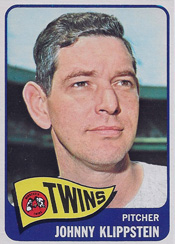
Johnny Klippstein was 16 when he pitched his first season of professional baseball in the Cardinals’ system. When he got to the big leagues at 22, it was with the Cubs, not the Cardinals.

A right-hander who converted from starter to reliever, Klippstein spent 18 years in the majors and pitched in two World Series _ one for the Dodgers and the other against them.

The Cardinals tried to reacquire him, along with a rangy first baseman who would become the star of a hit television series, but it didn’t work out.

Young and restless

Born at Walter Reed Army Medical Center in Washington, D.C., Klippstein was raised in suburban Silver Spring, Md. His father, who immigrated to America from Germany as a boy in 1894, served 30 years in the U.S. Army and retired as a master sergeant, according to the Brooklyn Daily Eagle.

A lanky kid with a strong arm, Johnny Klippstein learned to pitch in his one season playing American Legion baseball. In the summer of 1943, when he was 15, Klippstein and his mother took a bus to visit relatives in Appleton, Wis. By coincidence, the Cardinals were holding a tryout camp there and Klippstein went.

In the book “We Played the Game,” he recalled, “I arrived with a softball glove and softball hat and looked like a dope.”

Nonetheless, he impressed the Cardinals, who told him he would hear from them the following spring after he turned 16. With many young men in military service during World War II, ballclubs were reaching into the prep ranks to fill the talent pipeline. When Klippstein completed his junior year of high school, the Cardinals signed him and he was sent to their farm club in Allentown, Pa., in June 1944.

“All the guys were between 18 and 21 and I felt they were old enough to be my father,” Klippstein said to author Danny Peary. “The first time I went to the mound, I was so scared that my knees shook.”

Playing for manager Ollie Vanek (who a few years earlier gave a tryout to an amateur left-hander named Stan Musial and recommended him to the Cardinals), Klippstein pitched in six games for Allentown before spending the rest of the summer at a farm club in Lima, Ohio.

Afterward, Klippstein went back home to attend his senior year of high school. When he graduated in June 1945, Klippstein was so eager to return for a second season in the Cardinals’ system, “I didn’t even wait for my diploma. I told them to mail it to me,” he recalled to the Philadelphia Daily News.

Johnny on the spot

Klippstein, 17, was with Winston-Salem, N.C., for most of the summer of 1945. He posted an 8-7 record and led the team in ERA (2.48) but he also threw 19 wild pitches and hit batters with pitches eight times.

“He was rated (by the Cardinals) as a real prospect from the start, but he was young, didn’t even have his full growth,” the Winston-Salem Sentinel noted. “He was temperamental. He had a lot of stuff on the ball, but he was wilder than the usual rookie.”

Klippstein spent all of 1946 in the Army, returned to baseball the next year and pitched in the minors through 1948. After four years in the Cardinals’ system, Klippstein’s progress seemed to have stalled. As the Winston-Salem Sentinel noted, “The Cardinals did not want to let him go because they knew he had the stuff. They didn’t want to send him up because he was so wild.”

In the “We Played the Game” book, Klippstein said, “I was getting discouraged because I felt I was failing … The Cardinals didn’t have me in their plans.”

In November 1948, the Dodgers selected Klippstein in the minor-league draft. Sent to their farm club at Mobile, Ala., in 1949, he won 15 and had a 2.95 ERA.

The Cardinals wanted to get Klippstein back. In October 1949, Cardinals owner Fred Saigh met with Dodgers general manager Branch Rickey in Brooklyn and talked trade. The Cardinals offered pitcher Red Munger, a 15-game winner in 1949, for outfielder Gene Hermanski, first baseman Chuck Connors and Klippstein, the Associated Press reported.

(Connors, 28, made his big-league debut with the 1949 Dodgers, hitting into a double play in his lone at-bat. He later did better as an actor, playing the lead role of Lucas McCain in the TV Western series “The Rifleman.”)

Regarding the proposed trade, Rickey told the Associated Press, “Our greatest need is one more pitcher. I am willing to trade one of my outfielders for a good front-line pitcher. There is a chance to make that deal.”

Ultimately, the Dodgers decided to fill their need from within (Carl Erskine moved into the rotation in 1950) and the trade wasn’t made.

The Dodgers projected Klippstein for a spot with their Montreal affiliate, but the pitching-poor Chicago Cubs, who gave up the most runs in the National League in 1949, claimed him in the November Rule 5 draft.

In the big leagues

At spring training in 1950, Cubs manager Frankie Frisch said Klippstein would be part of the club’s pitching staff on Opening Day. “All he needs is confidence,” Frisch told the Brooklyn Daily Eagle. “He seems to have everything else.”

Klippstein had mixed results with the 1950 Cubs. He was bad as a starter (1-8, 7.99 ERA) and good as a reliever (2.98 ERA in 22 appearances) and as a hitter (.333 in 33 at-bats).

After the season, the Cubs acquired Chuck Connors from the Dodgers. He and Klippstein were teammates with the 1951 Cubs.

Klippstein did not have a winning record in any of his five seasons with the Cubs. He was sent to the Reds in October 1954 and had his most success as a starter with them.

On Sept. 11, 1955, Klippstein pitched a one-hit shutout against the Dodgers, who were on their way to becoming World Series champions that year. As Dick Young noted in the New York Daily News, “This was no humpty dumpty lineup. It had all the big sticks available.” Included were five future Hall of Famers: Roy Campanella, Gil Hodges, Pee Wee Reese, Jackie Robinson and Duke Snider.

The Dodgers’ hit came with one out in the ninth when Reese blooped a single to right-center. According to Dick Young, when the inning ended, Reese crossed paths with Klippstein, patted him on the rump and said, “Tough luck, John. It’s just one of those things.”

Klippstein just smiled at him. Boxscore

On the move

In 1956, his seventh year in the majors, Klippstein had his first winning season, finishing 12-11 for the Reds. On May 26, he held the Braves hitless for seven innings before manager Birdie Tebbetts lifted him for a pinch-hitter, with the Reds trailing, 1-0. (The Braves scored on a Frank Torre sacrifice fly after Klippstein loaded the bases by hitting Hank Aaron with a pitch and walking two.) Boxscore

“I don’t blame Birdie for taking me out,” Klippstein told the Chicago Tribune. “We were a run behind, had a man in scoring position, and only one more turn at bat.”

After a good spring training with the Reds in 1957, Klippstein was their Opening Day starter against the Cardinals. He got shelled, giving up five doubles (including two to Stan Musial). Boxscore

He ended the season much better than he started it. On Sept. 28, 1957, Klippstein pitched a one-hit shutout against the Braves, who were headed to a World Series title. The Braves’ hit was a Bob Hazle single with two outs in the eighth. Boxscore

Traded by the Reds to the Dodgers for Don Newcombe in June 1958, Klippstein was used mostly in relief the rest of his career.

In Game 1 of the 1959 World Series versus the White Sox, he pitched two scoreless innings for the Dodgers. Boxscore The Cleveland Indians obtained him in 1960 and he had an American League-leading 14 saves for them.

He went on to pitch for the Senators (1961), Reds (1962), Phillies (1963-64), Twins (1964-66) and Tigers (1967).

On Aug. 6, 1962, at Houston, Klippstein pitched three scoreless innings and walloped a Don McMahon slider for a home run, breaking a 0-0 tie with two outs in the 13th. Boxscore  (Klippstein hit five home runs in the majors, but was hitless in 37 career at-bats against the Cardinals.)

He had a 1.93 ERA for the 1963 Phillies and was 9-3 with five saves and a 2.24 ERA for the 1965 Twins, who became American League champions. Klippstein pitched in Games 3 and 7 of the 1965 World Series against the Dodgers and didn’t allow a run. Boxscore and Boxscore and Video

For his big-league career, Klippstein was 101-118 with 65 saves.

After his playing days, he was a Cubs season ticket holder. In October 2003, Klippstein was listening at his bedside to a Cubs game (a 5-4 win over the Marlins) when he died. His son John told the Chicago Tribune, “He passed away just after the Cubs scored that fifth run” in the 11th.

Read Full Post »

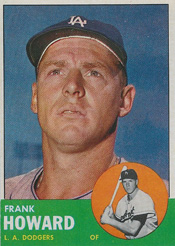
The first time Frank Howard came to the plate against the Cardinals he did what came naturally to him. He hit a home run. Not just any home run. A tape-measure clout, befitting a giant who stood 6-foot-7 and weighed more than 250 pounds.

As Jim Murray of the Los Angeles Times noted, “He’s Gulliver in a baseball suit.”

A right-handed batter capable of launching balls into distant places, Howard ht 382 home runs in 16 years with the Dodgers (1958-64), Senators (1965-71), Rangers (1972) and Tigers (1972-73). He spent another 20 years as a big-league coach and managed the Padres (1981) and Mets (1983).

Hoops hot shot

In Columbus, Ohio, Frank Howard was “kind of a scrawny-looking, mangy-looking kid,” he told the Green Bay Press-Gazette. A son of a railroad machinist, he did construction work during high school and college summers. “I ran a jackhammer on asphalt crews,” Howard told the Press-Gazette, “and I was a hod carrier’s helper (carrying supplies to bricklayers). You work like that, and you’re going to have a strong body.”

When he enrolled at Ohio State, he was 6-foot-6 and 220 pounds. Basketball and baseball were the sports he played. “A lot of people thought I was better at basketball,” Howard said to the Press-Gazette.

In 1955-56, his first varsity basketball season as a sophomore, Howard averaged 15.1 points per game and led the Big Ten Conference in rebounding (12.9).

As a junior in 1956-57, Howard averaged 20.1 points and again was the Big Ten’s top rebounder (15.3). He snared 32 rebounds in a game against Brigham Young at New York’s Madison Square Garden. In Ohio State’s 74-54 home win versus the St. Louis University Billikens, Howard contributed 22 points and 11 rebounds.

In Howard’s senior year, Ohio State came to St. Louis’ Kiel Auditorium and he dazzled with 27 points and 10 rebounds, but the Billikens won, 88-77. Howard averaged 16.9 points as a senior and scouts for the NBA St. Louis Hawks “rated him as an outstanding pro basketball prospect,” The Sporting News reported.

New home

Howard played varsity baseball his sophomore and junior seasons at Ohio State and was “coveted by all 16 major-league clubs” because of his extraordinary power, the Los Angeles Times reported. According to The Sporting News, Dodgers scouts rated Howard higher than Dave Nicholson, the teenage slugger from St. Louis who signed with the Orioles for more than $100,000.

On March 5, 1958, the Dodgers signed Howard for $108,000. When he stepped into the batting cage for the first time at the Dodgers’ training camp in Vero Beach, Fla., Howard “was scared to death” and “actually was shaking,” according to the Los Angeles Times. On his third swing, he hit the ball 400 feet.

Teammates watched in wonder one morning when Howard consumed eight eggs, 24 strips of bacon, two bowls of cereal with sliced bananas, four glasses of orange juice and 10 slices of toast, The Sporting News noted.

The next month, the Philadelphia Warriors took Howard in the third round of the 1958 NBA draft, but by then he was on his way to the Dodgers’ farm club in Green Bay, Wisconsin. Playing for manager Pete Reiser, the St. Louis native and former Dodgers outfielder, Howard hit 37 home runs. “He’s simply fabulous,” Reiser told the St. Louis Post-Dispatch. “He could do for baseball what Babe Ruth did. He hits many a ball completely out of sight in every park.”

Green Bay became important to Howard for reasons other than baseball. He met Carol Johanski, who worked in the circulation department of the Press-Gazette. She recalled to the newspaper, “We met in a pizza place in 1958. I was out with girlfriends and Frank and some fellows came over to our table and introduced themselves. We didn’t believe them when they said they were baseball players.”

Howard asked Carol for a date and they married a year later. Green Bay became Howard’s off-season residence. He spent several winters doing sales and promotional work for a Green Bay paper products company.

Big bopper

After his big season with Green Bay, Howard got called up to the Dodgers in September 1958. In his first game, he hit a home run against a future Hall of Famer, Robin Roberts of the Phillies. Howard’s blast landed atop the left field roof at Philadelphia’s Connie Mack Stadium. Boxscore

In the book “We Played the Game,” Dodgers reliever Johnny Klippstein recalled, “He was frightening looking and the strongest guy I ever saw in baseball, but he was mild and meek and called everybody Mister.”

Howard spent most of 1959 in the minors before a September promotion to the Dodgers, who were headed to becoming World Series champions.

The first time he faced the Cardinals was Sept. 22, 1959, at St. Louis. Batting for reliever Danny McDevitt, Howard drove a pitch from Lindy McDaniel 400 feet to left-center for a three-run home run. The Cardinals “couldn’t recall a ball that was hit as hard” as Howard’s line drive, the Post-Dispatch reported. Boxscore

Howard stuck with the Dodgers in 1960 after his recall from the minors in May, slugged 23 home runs and won the National League Rookie of the Year Award. On July 10, 1960, against the Cardinals at the Los Angeles Memorial Coliseum, Howard had his first 5-RBI game in the majors. Boxscore

In a five-year stretch (1960-64), Howard led the Dodgers in home runs four times. He slugged 31 for them in 1962 and 28 the next year when they became World Series champions.

Howard hit .354 versus the Cardinals in 1961 and .340 in 1964. His home run against Craig Anderson in the 11th inning at St. Louis on July 22, 1961, struck the scoreboard in left, more than 400 feet from home plate. Boxscore

All was not well, though, for Howard with the Dodgers. Manager Walter Alston platooned him in right field and wanted Howard to change his batting stance in order to reach curveballs low and away.

Howard threatened to retire in 1964 and made it known he’d welcome a trade. The Dodgers accommodated him, sending Howard, Ken McMullen, Phil Ortega, Pete Richert and Dick Nen to the Washington Senators for Claude Osteen and John Kennedy on Dec. 4, 1964.

Washington monument

As the Senators’ everyday left fielder, Howard became “the most frightening home run hitter in baseball,” the New York Times noted. On a last-place team in 1968, he led the American League in total bases (330), home runs (44), extra-base hits (75) and slugging percentage (.552).

Ted Williams became the Senators’ manager in 1969 and Howard again was the league leader in total bases (340).

“That son of a gun is the biggest and strongest hitter who ever played this game,” Williams told the New York Times, “and that includes Babe Ruth, Lou Gehrig, Jimmie Foxx, Hank Greenberg _ all of them. Nobody ever hit the ball harder and further, nobody.

“There was only one thing I talked to him about this spring,” Williams said. “He always used to swing at the first pitch that was anywhere near the plate. That’s just like swinging as if you had two strikes on you every time up. Wait. Wait for the pitch you want to hit.”

Howard, who never had more than 60 walks in a season, had 102 walks and 175 hits in 1969 _ an on-base percentage of .402. He was even better in 1970 (.416 on-base mark with 132 walks and 160 hits) and led the league that season in home runs (44) and RBI (126) in addition to walks. Video

Asked about Williams’ influence, Howard said to the New York Times, “He convinced me. I used to be swinging from the time I left the bench. Now I’m not afraid to give them a strike to be more selective … He’s made me more aware of what I’m doing as a hitter, and it has helped.”

Staying busy

After ending his big-league playing career with the 1973 Tigers, Howard returned to baseball as manager of a Brewers farm club in 1976. The next year, Howard became a coach on the staff of Brewers manager Alex Grammas. When Grammas was fired after the 1977 season, general manager Harry Dalton replaced him with George Bamberger. Howard told the Press-Gazette he was disappointed he was bypassed for the job, but Bamberger retained him as a coach.

Howard spent the ensuing winters in Green Bay operating a tavern. He described “Frank Howard’s Lounge” to the Press-Gazette as “intimate, the Fenway Park of saloons.” Howard tended bar and made it a point to talk with customers. As the Press-Gazette noted on a visit, “There he was, pulling on the beer taps, measuring shots of brandy, trying to stab olives and pouring delicate glasses of wine.”

In 1980, Howard’s fourth season as Brewers coach, George Bamberger took a leave of absence because of a heart condition. Howard wanted the job, but Harry Dalton gave it to another coach, Buck Rodgers. “It is tough to live with when you know you can do the job and no one else seems to know it,” Howard told the Associated Press.

After coaching for the 1980 Brewers, Howard was hired to be manager of the Padres, inheriting a last-place team. Howard’s 1981 Padres had Ozzie Smith at shortstop and a former Cardinal, Terry Kennedy, at catcher but not much else. Howard was fired after one strike-shortened season.

George Bamberger, who had replaced Joe Torre as Mets manager, hired Howard for a coaching job in 1982. The next year, Bamberger resigned in June and Howard replaced him. General manager Frank Cashen told Howard the job was only for the remainder of the season.

“He didn’t want to do it under those conditions,” Cashen told the New York Times, “but he finally acceded for the good of the organization … Nobody symbolizes professionalism more than Frank Howard did.”

Howard took over a last-place club. His shortstop was Jose Oquendo and a couple of weeks later the Mets got Keith Hernandez from the Cardinals to play first base.

Davey Johnson became Mets manager in 1984 and Howard was on his coaching staff. Howard went on to coach for the Mariners, Yankees and Rays as well as the Brewers and Mets again.

Read Full Post »

In his nine seasons with the Dallas Cowboys, running back Walt Garrison scored three touchdowns in a game just once. He did it against the St. Louis Cardinals.

Though used as the No. 2 running back behind the likes of Calvin Hill, Don Perkins and Duane Thomas during his NFL playing days, Garrison was an important member of the Cowboys’ offense.

As Los Angeles Times columnist Jim Murray noted, “He wasn’t fast. He wasn’t big. He was just dangerous.”

An effective receiver and rugged runner, Garrison played in two Super Bowls and helped the Cowboys win their first NFL championship. He also competed in rodeos, roping and wrestling steers. 

College cowboy

Garrison was born in Denton, Texas, and went to high school in Lewisville, a town 10 miles north of the Dallas/Fort Worth International Airport. He started playing football in seventh grade and first competed in rodeos a year later, according to United Press International.

Though a standout high school fullback, Garrison got no interest from the Texas schools in the Southwest Conference, the Denton Record-Chronicle reported. “He was considered too slow for offense and too small for defense in the Lone Star State,” Jim Murray wrote.

Garrison accepted a scholarship offer to play football for the Oklahoma State Cowboys of the Big Eight Conference and major in veterinary medicine.

A linebacker for the freshman team, Garrison was moved to running back when he joined the varsity as a sophomore in 1963 and had a 48-yard touchdown run against Texas.

Garrison was the Big Eight rushing leader (730 yards) as a junior in 1964, finishing ahead of Oklahoma’s Jim Grisham (725) and Kansas’ Gale Sayers (633).

After Garrison rushed for 121 yards versus Nebraska his senior season, Cornhuskers head coach Bob Devaney called him “the best fullback I’ve ever seen in the Big Eight,” according to the Associated Press.

Garrison finished the 1965 season with 924 yards rushing and was second in the conference to Missouri’s Charlie Brown (937).

Big decisions

In 1966, Garrison was drafted in the fifth round by the Dallas Cowboys of the National Football League and in the 17th round by the Kansas City Chiefs of the American Football League. (The Cardinals bypassed Garrison in the fifth round and took Michigan receiver Jack Clancy, who signed with the AFL Miami Dolphins.)

Regarding the Chiefs, “They made me a real good offer and I gave a lot of thought to signing with them, but figured the NFL was the best place to play,” he told the Denton Record-Chronicle. “Its pension plan and other benefits give it the edge.”

The Cowboys sealed the deal with him when they included a horse trailer as part of his bonus, according to the Denton newspaper.

Garrison spent his first three NFL seasons (1966-68) as a backup to Don Perkins, a six-time Pro Bowl selection in his eight years with Dallas. Don Meredith was the Cowboys’ quarterback. Garrison told the Dallas Morning News, “Don used to say, ‘If you need three yards, give the ball to Walt and he’ll get you three yards. If you need 12 yards, give the ball to Walt and he’ll get you three.’ “

Garrison’s main contribution his first two seasons with Dallas was as a kick returner. As a rookie in 1966, he averaged 22.3 yards on 20 kick returns. He was the Cowboys’ leading kick returner (18.3-yard average) in 1967.

On June 30, 1967, after his rookie season, Garrison signed a two-year contract with the Cowboys in the morning and married Pamela Kay Phillips that night at Lovers Lane Methodist Church in Dallas, the Denton Record-Chronicle reported.

Pamela was the daughter of B.F. Phillips, an independent oilman and “one of the nation’s most prominent quarter horse breeders,” according to the Los Angeles Times. Jim Murray called him “one of Texas’ richest men.”

According to the Corpus Christi Caller-Times, Walt and Pamela “met at a horse sale at the Phillips Ranch in Frisco, Texas” and started dating in November 1966. “Pam has ridden in barrel races in rodeo,” the newspaper noted.

Put me in, coach

After Don Perkins retired, rookie Calvin Hill of Yale and Garrison became the Cowboys’ top rushers in 1969.

When the Cowboys played the San Francisco 49ers for the 1970 NFC championship, Garrison came out of the game because of a severely sprained ankle. He also had back spasms, a twisted right knee and a chipped collarbone, according to the Fort Worth Star-Telegram.

Garrison talked head coach Tom Landry into letting him back in and caught a pass from Craig Morton for the winning touchdown. Landry told the Associated Press, “He came up to me and said he was OK, but I knew he was lying. No other player in football would have gone back into the game.” Game stats

Bob Broeg of the St. Louis Post-Dispatch described Garrison as “tough as a worn saddle.” Jim Murray wrote, “He looks like 190 pounds of trouble just sitting there. He’s coiled.”

Two weeks later, before the Cowboys played in the Super Bowl for the first time, team trainer Larry Gardner told the Associated Press how he got Garrison prepared. “That guy has so much tape on him he’s almost a mummy,” Gardner said. “I wrap him with 36 yards of tape and sometimes I have to get out more during the game.”

With Calvin Hill sidelined because of a knee injury, Garrison was the Cowboys’ leading rusher (65 yards on 12 carries), but the Baltimore Colts prevailed in the Super Bowl, 16-13. Game stats

The next season, Garrison led the 1971 Cowboys in receptions (40), finishing ahead of the likes of Bob Hayes (35), Lance Alworth (34) and Mike Ditka (30). The Cowboys returned to the Super Bowl and won their first NFL title with a 24-3 triumph versus the Dolphins. The rushing leaders were Duane Thomas (95 yards) and Garrison (74). Game stats

Real deal

Garrison competed in professional rodeos after each NFL season. He rode broncos and bulls before the Cowboys asked him to stop, but he continued to rope steer and wrestle steer, United Press International reported.

“Ranching and rodeoing are the great life for me,” Garrison told the Denton Record-Chronicle.

Jim Murray wrote, “He was the genuine spurs-on-the-boots, chaps-on-the-Levis, hammered copper-on-the-belt buckle article, the cowboy on the Dallas Cowboys.”

Asked about his Super Bowl ring, Garrison told John Hall of the Los Angeles Times, “I only wear it when I’m traveling. People want to see it, but I take it off around the rodeo guys. They’re not too impressed.”

Garrison also became a promoter of moist snuff, cut tobacco placed in the mouth. The Los Angeles Times described him as “a tidy chewer. No big lump in the cheek, and he swallows the juice. No spitting.”

Big scorer

On Dec. 3, 1972, the Cowboys faced the Cardinals in a cold drizzle at Busch Memorial Stadium in St. Louis.

In the second quarter, with Dallas ahead, 3-0, Craig Morton passed to Garrison on the right flat. Garrison got past strong safety Larry Wilson and then free safety Roger Werhli and went into the end zone for an 18-yard touchdown reception. “A great individual effort,” the Fort Worth Star-Telegram declared.

Garrison had a three-yard touchdown run in the third quarter. Then, with Dallas on the Cardinals’ 26-yard line and ahead, 17-6, in the fourth quarter, Morton again tossed to Garrison in the right flat. He ran untouched into the end zone for his third touchdown. Larry Wilson “just took a chance, went for the down-and-in and Walt outraced him to the goal,” Tom Landry told the Star-Telegram.

Garrison said to the Associated Press, “They were checking our tight end (Mike Ditka) and that left me open. They weren’t paying attention to me.”

The Cardinals fumbled seven times. Dallas recovered four of those, leading to scores each time, and won, 27-6. Game stats

Time to go

In June 1975, Garrison tore knee ligaments in a steer wrestling exhibition at Bozeman, Mont., and underwent surgery. Two months later, Garrison, 31, told the Cowboys he was done playing football.

“Nine years in the NFL. Just about six too many,” Garrison told John Hall of the Los Angeles Times.

Garrison scored 39 regular-season touchdowns _ 30 rushing and nine receiving _ for the Cowboys. He also had two more receiving touchdowns in playoff games. Video

Read Full Post »

Joe Christopher was from St. Croix, largest of the U.S. Virgin Islands. Once a port of call for pirates, it is known for its exquisite beaches and excellent rum.

Christopher Columbus visited the island in 1493 and named it Santa Cruz (Holy Cross), and over the years, through multiple translations, it derived into St. Croix.

Almost 500 years later, Christopher _ Joe, that is _ played in Columbus, for a baseball team affiliated, naturally, with the Pirates.

An outfielder trained in a Branch Rickey farm system, Joe Christopher played for both a World Series champion (1960 Pirates) and a team with 120 losses (1962 Mets). After making a fielding blunder, Christopher got a letter of encouragement from Jackie Robinson and went on to have the best season of his career.

A .260 hitter in the majors with the Pirates (1959-61), Mets (1962-65) and Red Sox (1966), Christopher was a terror against the Cardinals. He batted .418 against them in 1964, a season when he led the Mets in nearly every hitting category. Three years later, he was playing in the Cardinals farm system.

Path to the pros

A right-handed batter with speed, Christopher, 18, was playing shortstop with a team from St. Croix at the National Baseball Congress amateur tournament in Wichita, Kansas, in 1954 when he drew the attention of Howie Haak, the same Pirates scout who signed second baseman Julian Javier. According to The Pittsburgh Press, Haak convinced Christopher to accept a Pirates offer of $200.

Branch Rickey was Pirates general manager and he made a lasting impression on Christopher. “Branch Rickey enhanced my spirit,” Christopher told author Edward Kiersh in the book “Where Have You Gone, Vince DiMaggio?” “What a courageous man. He knew all about the hidden order and the way to higher realms.”

In 1959, Christopher, 23, was in his fifth year in the minors, playing for the Columbus (Ohio) Jets, when he got called up to the Pirates in May to replace Roberto Clemente, who went on the disabled list.

“It was tough for me when I joined the Pirates,” Christopher recalled to The Pittsburgh Press. “I knew what the fans thought of Clemente and I knew what they expected of me. I was too tense and I just wasn’t ready.”

Christopher went hitless in 12 at-bats, sprained his right hand making a diving catch, jammed an ankle on the base path and was sent back to Columbus in July.

An energizer

At spring training in 1960, Christopher played so well, hitting better than .400, that the Pirates had to put him on the Opening Day roster as a reserve outfielder.

“The only candidate in the last few years to challenge Roberto Clemente as the most exciting player in Pirates camp is Joe Christopher,” The Sporting News declared. “He has speed to burn and has captured the fancy of the fans and his teammates with his head-first slides. He goes from first to third on singles and scores on short sacrifice flies.”

In the 10th inning of a game against the Dodgers on July 1, 1960, Christopher energized the Pirates and the crowd at Forbes Field in Pittsburgh when he scored from second on Clemente’s infield single. The fans “were up screaming at this burst of speed,” The Sporting News reported. Boxscore

Christopher appeared in three games of the 1960 World Series against the Yankees, reached base in his lone plate appearance and scored twice.

After another season with the Pirates as a reserve in 1961, Christopher was chosen by the Mets in the National League expansion draft. “I thought this was the break I was looking for,” Christopher told the Pittsburgh Post-Gazette.

Mets miseries

The 1962 Mets, who would finish the season 40-120, needed talent, and Christopher seemed to be a plus for them, but near the end of spring training he was sent to Class AAA Syracuse to make room on the Opening Day roster for a utility player, rookie Rod Kanehl.

Christopher, 26, resented the demotion. When Syracuse manager Frank Verdi saw him play, he told the Syracuse Post-Standard, “I think he’s the best outfielder the Mets own.”

(According to Dick Young of the New York Daily News, when the Syracuse team went to Atlanta, a Cardinals affiliate in 1962, and checked into the Henry Grady Hotel downtown, Christopher and three black teammates “were told they had to go across town, to the Negro section, where reservations had been made for them. They went, and it was such a fleabag that Christopher refused to check in.”)

Christopher hit .336 with six home runs for Syracuse and was called up to the Mets on May 21 to replace outfielder Gus Bell, who got shipped to the Braves. A week later, in a doubleheader versus the Dodgers, Christopher got three hits against Sandy Koufax in the opener, then tripled and scored versus Johnny Podres in the second game. Boxscore and Boxscore

Another 1962 highlight for Christopher came on Sept. 2 when his two-run single with two outs in the ninth knocked in the winning run against Cardinals reliever Bobby Shantz, a former teammate with the 1961 Pirates. Boxscore

Christopher hit .244 for the 1962 Mets but .346 versus the Cardinals that season. With nine hits and four walks in 30 plate appearances, his on-base percentage against the 1962 Cardinals was .433.

The Mets again sent Christopher to the minors at the end of spring training in 1963. He ended up with more at-bats (295) for Buffalo that year than he did for the Mets (149).

Breakout season

Based on his first two years with the Mets, it’s hard to imagine anyone could have predicted how productive Christopher would become for them in 1964.

He made the team in spring training, hit a home run on Opening Day against the Phillies’ Dennis Bennett and kept on delivering. Christopher batted .375 in April and .321 in May.

On May 8, 1964, he beat the Cardinals’ Bobby Shantz again with a RBI-single in the ninth. Boxscore

In July, Christopher was 7-for-13 at the plate in a three-game series against the Cardinals at New York. A week later, in four games at St. Louis, he was 8-for-18.

Even then, not all went smoothly for Christopher. On July 14, 1964, Billy Cowan of the Cubs lofted a soft fly ball to right at Chicago’s Wrigley Field. It looked to be an easy catch to end the inning, but Christopher struggled to get under the ball. “So crookedly did he run toward the line, any cop worth his badge would have demanded that Christopher take a sobriety test,” Newsday reported.

The ball plopped to the ground, enabling a runner on second to score the winning run and putting Cowan on third with a triple. To Newsday, Mets pitcher Tracy Stallard said of Christopher, “He’s the only .300 hitter I ever saw in my life who hurts a ballclub.” Boxscore

Soon after, Christopher told The Sporting News, “I received a letter from Jackie Robinson in which he wrote that things like that happen in baseball. He told me not to let it bother me but go out and play my game as if nothing had happened. His advice couldn’t have come at a better time. It gave me confidence just when I needed it most.”

On the next-to-last day of the 1964 season, with the Cardinals needing a win to help their bid for a National League pennant, Christopher had three hits, including a home run versus Mike Cuellar, and scored twice in a Mets rout. Boxscore

For the season, Christopher batted .300 and led the Mets in total bases (253), runs scored (78), hits (163), doubles (26), triples (eight), RBI (76), walks (48) on-base percentage (.360) and slugging (.466).

His on-base percentage against the 1964 Cardinals was .431 in 58 plate appearances.

When former Cardinals general manager Bing Devine joined the Mets as assistant to team president George Weiss in October 1964, he told The Sporting News, “Joe Christopher has progressed as a hitter. There’s an example of a fellow who showed what he could do when he got the chance.”

If the spirit’s willing...

Christopher, paid $10,000 in 1964, was offered $12,500 for 1965. He instead wanted a 100 percent raise to $20,000. When he settled for $17,750 on March 9, he was the last Mets player to sign for 1965, the New York Times reported.

His 1965 season was a bust _ he hit .249 and, according to The Sporting News, was “having a fretful time in the field.” _ and when it ended he was traded to the Red Sox for Eddie Bressoud.

After 13 at-bats for the 1966 Red Sox, Christopher was sent in June to the Tigers, who placed him in the minors. He never returned to the big leagues.

In 1967, Christopher, 31, began the season back in the Pirates’ system at Columbus, but on June 10 he was traded to the Cardinals for pitcher Fritz Ackley. The Cardinals assigned Christopher to the Class AAA Tulsa Oilers, whose manager was Warren Spahn. Three years earlier, Christopher hit a home run against Spahn, who was pitching for the 1964 Braves. Boxscore

Christopher joined a Tulsa outfield with another ex-Met, Danny Napoleon. Among the Tulsa pitchers was Christopher’s former teammate and critic, Tracy Stallard.

Christopher hit .273 in 68 games for Tulsa in 1967. He was put on the roster of the Cardinals’ Class AA Arkansas club in 1968. Cardinals farm director George Silvey told the Tulsa World in March 1968 that Christopher would be given a chance to make the Tulsa club, but it didn’t work out. He spent the 1968 season, his last, with a Class AA Phillies farm team at Reading, Pa.

For his 1983 book about former ballplayers, author Edward Kiersh visited Christopher at his Queens, N.Y., apartment. Kiersh described Christopher as a spiritualist involved in astral geometry.

“Through my mathematical system, I can give you the spiritual characterization of any man, or coordinate him to nature,” Christopher said to Kiersh. “Numerology is sacred. You just have to gain entrance into the hidden order, learn the equations, and the potential for any person becomes visible.”

When Kiersh naturally wondered whether Christopher was touting science or hocus-pocus, Christopher told him, “Most people think I’m into some kind of black magic, but baseball spends millions of dollars on a player’s physical attributes while they should be spending it on his spiritual attributes … This isn’t voodoo. This is truth.”

Read Full Post »

(Updated Dec. 27, 2025)

Even as a NFL rookie, Dick Butkus wreaked havoc on the St. Louis Cardinals. In his first regular-season appearance against them, the Chicago Bears middle linebacker intercepted a pass and got into a fight.

An eight-time Pro Bowl selection in nine seasons (1965-73) with the Bears, Butkus prowled the football field “like a hungry grizzly,” the Dallas Morning News noted. “His vicious hits and ferocious demeanor made the middle linebacker position synonymous with pain.”

The Associated Press called him “the most devastating middle linebacker in pro football” during his time in the NFL.

In his book “Tarkenton,” Minnesota Vikings quarterback Fran Tarkenton said, “Dick Butkus is the greatest football player I have ever seen. Certainly the toughest … He kept his team in a frenzy every game. He was the most dominating single player I’ve ever seen in a football defense … He was a sight. He snorted and cursed and looked like Godzilla’s brother crouching there in front of the center.”

Butkus played in five regular-season games versus the Cardinals, though in one of those he left early because of an injury. He was elected to the Pro Football Hall of Fame in his first year of eligibility.

Humble beginning

Richard Marvin Butkus “was 13 pounds, 6 ounces at birth, the eighth Butkus kid but the first born in a hospital,” according to the Chicago Tribune. He needed to be incubated for a week because his skin turned blue from low oxygen in the blood.

His father, John, an electrician, was a Lithuanian immigrant, according to the Tribune. Mother Emma worked 50 hours a week in a laundry. 

At their four-room home on Chicago’s South Side, Butkus slept in an 8-by-10 room with four brothers, according to the Tribune.

Playing football at Chicago’s Vocational High School, Butkus was a 230-pound fullback and linebacker. He chose the University of Illinois for his college career.

(“Northwestern was … well, they ain’t my kind of people,” Butkus told Sports Illustrated in 1964. “Notre Dame looked too hard.”)

Illini head coach Pete Elliott used him as a linebacker and center. In his junior season, when the Illini were Big Ten Conference champions, Butkus made 145 tackles in 10 games, including 23 versus Ohio State.

The St. Louis Post-Dispatch described him as “a savage tackler whose body slams led to six fumble recoveries for Illinois” in 1963.

On offense, Butkus was an outstanding center, “with his blocks gouging holes in the enemy line for key short yardage plays.”

Staying home

By the end of his senior season in 1964, Butkus was regarded the top defensive player eligible to turn pro. At that time, the National Football League and American Football League were rivals and held separate drafts.

With the first pick in the 1965 NFL draft, the New York Giants said they considered taking Butkus but went instead for Auburn’s Tucker Frederickson “because he is the best all-around fullback in the country,” team executive Wellington Mara told the Chicago Tribune.

The San Francisco 49ers, picking second, selected North Carolina running back Ken Willard.

Counting their lucky stars, the Bears, who had the third and fourth picks in the first round, went with Butkus and Kansas running back Gale Sayers. “We’ve been after Butkus ever since he led Illinois to the Big Ten title,” Bears head coach George Halas told the Tribune. “We’ve got to have him. He’s a great one.”

(With the 12th pick in the first round, the Cardinals took Alabama quarterback Joe Namath. Opting for Broadway rather than Lindbergh Boulevard, Namath signed with the AFL’s New York Jets.)

The Jets had visions of signing both Namath and Butkus. After the Denver Broncos took Butkus in the AFL draft, they gave their rights to him to the Jets.

“Most people think that I am already sewed up for the Bears,” Butkus said to the Tribune. “They can think it if they want to, but it isn’t so. As far as I’m concerned, it’s still wide open.”

Chicago attorney Arthur Morse, who represented Butkus in negotiations, told the Tribune that the Jets made an offer which “I would have to consider more substantial than that of the Bears.”

Butkus signed with the Bears anyway. “I had a big offer from the New York Jets to go to the AFL,” Butkus told the New York Times, “but I accepted less money to play with the Bears just because they were in Chicago where I grew up.”

Seeing Big Red

In the ninth game of his rookie season in 1965, Butkus faced the Cardinals at Wrigley Field in Chicago. He contributed to a defense that harassed quarterback Charley Johnson, who was sacked four times.

In the fourth quarter, Butkus intercepted a Johnson pass and returned the ball 38 yards to the St. Louis 6-yard line. “Butkus was barging over one Cardinal after another until he finally came crashing down in a heap with guard Ken Gray,” the Tribune reported. “Gray and Butkus had been tiffing, mostly with censored language, all afternoon, but on this occasion it went beyond words.”

Butkus and Gray squared off in a fight, the Post-Dispatch reported. The Bears won, 34-13. Game stats

The next year, with the Bears at St. Louis on Halloween night, Butkus got in for only a few plays before he was injured, according to the Post-Dispatch. An understudy, Mike Reilly, replaced him, but, as the Tribune noted, “Nobody backs up the line with Butkus’ violence.” Johnny Roland rushed for two touchdowns and the Cardinals won, 24-17. Game stats

Butkus and the Bears’ defense were at their best on Nov. 19, 1967, against the Cardinals at Wrigley Field. The Bears intercepted seven passes (five on Jim Hart throws and one each on throws from Charley Johnson and Johnny Roland) and recovered two fumbles in a 30-3 victory.

“Hart, pressured by the Bears blitz and often hit hard after he got off his passes, was off target,” the Post-Dispatch reported. “Several times he threw directly to Bears defenders, who could have had a few more interceptions if they had held the ball.”

Years later, recalling the game for Sports Illustrated, Roland said, “I have a bruise under my lip to this day where he (Butkus) shattered my mask.” Game stats

Making of a legend

Stories about Butkus’ bruising antics became part of NFL lore.

A Bears teammate, Doug Buffone, told Dan Pompei of the Tribune, “I used to line up at the outside linebacker position and look inside. I’d see him hulking over the center. He always had a little blood trickling down his face. I don’t know if he would cut himself or what, but I’d always say to myself, ‘Thank you, Lord, he’s on my side.’ “

With about a minute to go in a game the Bears were losing big, the Detroit Lions had first down and were intending to run out the clock. After the first play, Butkus called a timeout.

“We line up,” Buffone recalled. “He is over the top of the center, Ed Flanagan, then takes five steps back. The center snaps it and Dick comes running 100 mph and just smashes the center. Then he jumped up and called timeout again. He just wanted three more cracks at the center before the game ended.”

In a 1969 exhibition game against the Miami Dolphins, Butkus got into a brawl and was ejected by referee Red Morcroft, who accused Butkus of biting his finger during the melee, causing it to bleed. “If I bit his finger,” Butkus said to United Press International, “he wouldn’t have it on his hand now.”

According to the Tribune, during a game versus the Bears, Lions running back Altie Taylor saw Butkus closing in on him and stepped out of bounds to avoid being walloped. Enraged, Butkus kept chasing him around the perimeter of the field. “That man’s crazy,” Taylor told teammate Charlie Sanders.

The image Butkus created helped make him famous, but it wasn’t the full picture. He read Shakespeare after being introduced to the playwright’s work by Robert Billings, a Chicago Daily News reporter. He also got into acting (he spent half his life residing in Malibu, Calif.) and enjoyed watching classic movies. He married his high school sweetheart in 1963 and they remained together.

“Butkus has been caricatured as a monosyllabic creature who communicates only by grunts and groans and savage growls, a half man, half beast,” the Tribune noted. About his persona as a brute, Butkus told the paper, “I was just saying shit to go along with what everybody wanted. It actually was playing a role.”

On the ball

On Sept. 28, 1969, at St. Louis, Butkus blocked a Jim Bakken extra-point attempt (ending the kicker’s streak of converting 97 in a row). Bakken’s left shoulder got battered when Butkus crashed into him. “Sometimes you get mad at that Butkus, but you’ve got to respect him,” Cardinals head coach Charley Winner told the Post-Dispatch. “He makes the big play all the time.”

The Cardinals won the game, 20-17. Game stats

(In an exhibition game between the Bears and Cardinals on Aug. 29, 1970, four 15-yard personal foul penalties were called on Butkus, the Post-Dispatch reported.)

Butkus opposed the Cardinals for the final time on Oct. 29, 1972, at St. Louis. He led a defense that rattled quarterback Tim Van Galder (intercepted three times, sacked twice) in a 27-10 Bears triumph. Game stats

Restricted by a damaged right knee, Butkus, 30, called it quits after the ninth game of the 1973 season.

Butkus had four years remaining on a five-year contract. When he and the Bears were unable to come to terms on a payout, he sued them for breach of contract. In the lawsuit, Butkus said extensive injections of cortisone and other drugs caused irreparable damage to his right knee and that he had not been advised what the long-term effects of the drugs might be, the Associated Press reported.

In 1976, the Bears agreed to pay Butkus $600,000 to settle the suit.

Because of the conflict, Butkus and George Halas didn’t speak for several years. Then, in 1979, Butkus asked Halas, 84, to autograph a copy of the retired coach’s autobiography. According to the Tribune, Halas wrote, “To Dick Butkus, the greatest player in the history of the Bears. You had that old zipperoo.” Video highlights

Read Full Post »

« Newer Posts - Older Posts »