Feeds:
Posts
Comments

Archive for the ‘Opponents’ Category

Whether as a player or as a coach, Maxie Baughan was good at sizing up situations and calling the shots.

An outside linebacker who played in the NFL primarily from 1960 to 1970 with the Philadelphia Eagles and Los Angeles Rams, Baughan was the captain of the defense and chose the alignment for each play during a game.

Described by the New York Times as “one of the most fearsome linebackers of the 1960s,” Baughan was named to the Pro Bowl in nine of his first 10 seasons in the NFL. He knocked heads with the St. Louis Cardinals multiple times.

Baughan went on to have a long coaching career as an assistant in the NFL and as head coach in college at Cornell.

Ramblin’ Wreck

Baughan attended high school in Bessemer, Ala., a major steelmaking center. Recalling his boyhood days, Baughan told Gannett News Service, “I was going into the mills since as long as I can remember. I knew the first time I went in I didn’t want to work in there the rest of my life.”

(According to The Birmingham News, Baughan’s father, an electrician, died when he fell from a ladder at a coal mine near Birmingham in June 1961. He was 52. Baughan Sr. suffered a heart attack, fell onto high-voltage wires and was electrocuted, the Binghamton [N.Y.] Press and Sun-Bulletin reported.)

Maxie Baughan played football at Georgia Tech and excelled as a linebacker and center. “He’s one of the most consistently great football players I have coached,” head coach Bobby Dodd told the Philadelphia Inquirer.

(Baughan was quite a baseball fan, too. While at Georgia Tech, “I used to go all the time to old Ponce de Leon Park in Atlanta to see the [minor-league] Crackers and I loved it,” he said to The Montogmery [Ala.] Advertiser.)

Baughan graduated from Georgia Tech with a degree in industrial engineering.

As a youth, Baughan earned the Boy Scouts of America’s highest rank, the Eagle Scout Award. As a professional football player, Baughan became a Philadelphia Eagle. The team selected him in the second round of the 1960 NFL draft.

The Natural

The 1960 Eagles were a tough, talented group featuring Chuck Bednarik, Tom Brookshier, Tommy McDonald, Pete Retzlaff, Joe Robb and Norm Van Brocklin. Though a rookie, Baughan fit right in.

A brawl broke out on the field in a 1960 exhibition game between the Eagles and San Francisco 49ers. Hugh McElhenny, the 49ers running back who was nicknamed “The King” and who was destined for election to the Pro Football Hall of Fame, “was dropkicking the back of the head” of Eagles defensive tackle Ed Khayat, the Philadelphia Daily News reported.

According to the newspaper, Baughan came to Khayat’s rescue, “driving McElhenny clear across the field, pumping the heels of his hands into the veteran’s chest and finally lifting his helmet to deliver the fist de grace.”

Baughan said to the Daily News, “When I saw him kick Ed in the head, I just had to go after him.”

The rookie’s action earned him the respect of his teammates. His play as a linebacker earned him a spot as a starter. “He’s quick as a cat,” Eagles assistant coach Nick Skorich told the Daily News. “He uses his hands beautifully. He has good play sense, and he’s a hard, sharp tackler.”

Baughan looked the part, too. The Sporting News described him as “pug-nosed, weather-beaten.” Sandy Grady of the Philadelphia Bulletin put it this way: “A face that was forged in a furnace … pugnacity, intelligence and violence written on it.”

The first time he faced the St. Louis Cardinals, on Oct. 9, 1960, Baughan made 10 tackles, including seven unassisted, and broke up a pass, United Press International reported. Game stats

“He’s one of the hardest tacklers on the team, a quick thinker, fast, alert and as gung-ho as they come,” The Sporting News noted. “He took over on the starting unit as if the position had been made for him.”

The Eagles won the 1960 NFL championship, in part because of a defense that limited Vince Lombardi’s Green Bay Packers to 13 points in the title game.

L.A. story

In 1965, the Eagles opened the season against the Cardinals. With the score tied 20-20 at halftime, Baughan, captain of the defense, convinced head coach Joe Kuharich to call off the blitzes against quarterback Charley Johnson.

“We couldn’t blitz too much against them,” Baughan said to the Philadelphia Daily News. “Heck, they invented the blitz. They can pick it right up.”

Instead, with Baughan calling the defensive signals, the Eagles faked the blitz, then realigned their formation at the last instance. The jitter-bugging defense “completely confounded” Johnson, according to the Daily News. The Eagles limited the Cardinals to seven points in the second half and won, 34-27. Game stats

As the season progressed, the relationship between Baughan and Kuharich got rocky. “Near the end, the two of them were getting along like Richard Burton and Elizabeth Taylor in ‘Virginia Woolf,’ ” the Philadelphia Inquirer noted.

After the season, amid reports Baughan wanted to be traded, Los Angeles Rams head coach George Allen called Kuharich “31 times in as many days,” trying to make a deal for the linebacker, The Sporting News reported.

In April 1966, Kuharich relented. The Eagles dealt Baughan to the Rams for defensive tackle Frank Molden, linebacker Fred Brown and a draft choice. “Maxie Baughan is the best right side linebacker in the game,” Allen told The Sporting News.

The 1966 Rams defense featured the Fearsome Foursome front line of Deacon Jones, Merlin Olsen, Rosey Grier and Lamar Lundy. Joining Baughan as the linebackers were Bill George (a future Pro Football Hall of Famer) in the middle and Jack Pardee on the left side. Another standout, Eddie Meador, was the safety.

Amid all that talent, Allen chose Baughan to be the defensive captain and entrusted him to call the plays. “As the Rams’ defensive signal caller, Baughan was responsible for some 250 different defenses and 180 audible signals,” The Sporting News reported.

Baughan told the publication, “I would say that I audibilize about 85 percent of the time. A lot of things enter into my decision, like down and distance, the hash marks, field position, the particular formation.”

The Los Angeles Times noted, “His vast knowledge of Allen’s intricate defense and execution of the many audibles from a variety of formations has made the Rams one of pro football’s most effective defensive units. Equally important is the fact Maxie is a leader and serves as an inspiration to the team.”

Baughan thrived playing for Allen. He told the Ithaca (N.Y.) Journal, “I probably learned more about football from George Allen than anyone else.”

The Sporting News called Baughan “the brains of the Rams defense” and dubbed him “The Battering Ram.” 

Eventually, the battering took its toll. Baughan underwent knee surgeries after the 1967, 1968 and 1969 seasons. He suffered a concussion in a 1969 game against the Atlanta Falcons and was unconscious for almost 15 minutes, The Sporting News reported. The cumulative pain became unbearable.

“I’m allergic to some medicine, including pain killers,” Baughan told The Sporting News. “I can’t even take an aspirin. It started back in 1962 when I was with Philadelphia. I took a muscle relaxer and had a violent reaction. The Eagles’ trainer literally saved my life.”

Coaching carousel

The Rams fired Allen after the 1970 season and Baughan retired from playing. When Allen became head coach of the Washington Redskins in 1971, Baughan assisted him. That began a long second career as a coach.

Baughan was defensive coordinator at Georgia Tech for two years (1972-73). In 1974, he left to become defensive coordinator of the New York Giants, but before the season began he quit and rejoined Allen with the Redskins as a player-coach.

After stints as defensive coordinator of the Baltimore Colts (1975-79) and Detroit Lions (1980-82), Baughan became head coach at Cornell. He was recommended for the job by former Colts running back Tom Matte, who became a friend of Baughan when he was with Baltimore. Matte had connections to an influential almnus at Cornell.

Replacing Bob Blackman, who retired, Baughan coached six seasons (1983-88) at Cornell. The Ivy League program had losing records his first three seasons, then finished 8-2, 5-5 and 7-2-1 the last three seasons.

In April 1989, the Ithaca Journal reported a rift between Baughan and assistant coach Peter Noyes stemmed from a romantic relationship between Baughan and Noyes’ wife. Citing “personal tensions” for his decision, Baughan resigned.

He went on to be linebackers coach for the Minnesota Vikings (1990-91), Tampa Bay Buccaneers (1992-95) and Baltimore Ravens (1996-98). Among the linebackers he coached were standouts Derrick Brooks of the Buccaneers and Ray Lewis of the Ravens.

Read Full Post »

Willie Mays was the first right-handed batter to hit 400 home runs in the National League. The milestone homer came against a familiar foe, Curt Simmons of the Cardinals, and was witnessed by another 400-homer hitter, Stan Musial.

On Aug. 27, 1963, at Candlestick Park in San Francisco, Mays capped a two-month hot streak with his 400th career home run for the Giants.

At the time, nine others had achieved the feat: Babe Ruth (714), Jimmie Foxx (534), Ted Williams (521), Mel Ott (511), Lou Gehrig (493), Stan Musial (472), Eddie Mathews (419), Mickey Mantle (415) and Duke Snider (403).

(Musial, Mathews, Mantle and Snider still were active. Musial would finish with 475, Mathews 512, Mantle 536 and Snider 407.)

The only right-handed batter in the 400-homer group besides Mays was Foxx. (Of his 534 home runs, Foxx hit 524 as an American Leaguer and 10 as a National Leaguer.) All the others, except Mantle (a switch-hitter), batted from the left side.

Mays, 32, was considered the best bet to break the National League career home run mark of 511 held by Mel Ott.

On a roll

After leading the National League in home runs (49) and total bases (382) and powering the Giants to a pennant in 1962, Mays got baseball’s highest salary in 1963 _ $105,000.

He had a substandard start to the season, hitting .233 in April and .257 in May. At the urging of the Giants, Mays got his eyes examined “and was told they were fine,” according to his biographer James S. Hirsch.

He found a groove after the all-star break and nearly was unstoppable. Mays hit .322 in July, .387 in August and .378 in September.

From July 28 through Aug. 27, Mays hit safely in 27 of 28 games. In that stretch, he raised his 1963 season batting average from .274 to .308.

His only hitless game in that period came on Aug. 13 when Jim Maloney of the Reds shut out the Giants on a two-hitter.

(The game was noteworthy for another reason. It was the first time Mays played a position other than center field in the majors. In the eighth inning, after Norm Larker batted for shortstop Ernie Bowman, manager Al Dark put Larker at first base, moved Orlando Cepeda from first to left, Harvey Kuenn from left to right, Felipe Alou from right to center and Mays from center to shortstop. Mays had no fielding chances in his one inning at short, but he told the Associated Press, “Man, that’s too close to the plate.” Boxscore)

Numbers game

On Aug. 25, 1963, facing the Reds’ Joe Nuxhall at Candlestick Park, Mays hit his 399th home run. Later , with Joey Jay pitching, Mays drove a pitch to deep left. “If Frank Robinson hadn’t caught the ball a scant foot from the top railing, Willie would have had his 400th major-league homer,” The Sporting News reported.

The next day, Aug. 26, the Cardinals opened a series at San Francisco. Mays got two singles, but no home run, against Ernie Broglio. Curt Simmons provided another opportunity on Aug. 27.

Mays had a history of success against Simmons. In 1961, for instance, Mays had a .692 on-base percentage versus the Cardinals left-hander, reaching base nine times (six hits, two walks, one hit by pitch) in 13 plate appearances. For his career, Mays finished with a .423 on-base percentage (39 hits, 22 walks, two hit by pitches) versus Simmons.

In the Aug. 27 game, with the Giants ahead, 3-0, Mays led off the third inning and lined a 2-and-1 pitch from Simmons the opposite way to right. The ball carried over the outstretched glove of George Altman, struck a railing and went over the fence for home run No. 400.

Orlando Cepeda followed with another homer against Simmons, who then was lifted for Barney Schultz. The first batter he faced, Felipe Alou, hit the Giants’ third consecutive home run of the inning. Boxscore

“I stay in good shape and I think I can hit a lot more,” Mays said to United Press International. “I may be able to reach the 500 mark.”

Stan Musial, stationed in left field when Mays hit his 400th homer, told The Sporting News, “He has an excellent chance to beat Mel Ott’s National League mark of 511 before he decides to call it quits.”

Asked about Musial, who had declared two weeks earlier that he would retire after the 1963 season, Mays said to Si Burick of the Dayton Daily News, “Nicest man I ever knew. When I was a kid coming up, I never thought a star on another team would help you, but he talked to me a lot about hitting. He even let me use his lighter bat a couple times when I was in a slump.”

(The kindness shown by Musial was paid forward by Mays. A week after Mays’ 400th home run, Cardinals pitcher Bob Gibson hit a 400-foot homer against the Pirates’ Don Schwall with a bat Mays had given him, The Sporting News reported. At 34 ounces, it was two ounces heavier than Gibson’s bat. Boxscore)

Join the club

On the same day Mays hit his 400th home run, Hank Aaron of the Braves slugged his 333rd (against Don Nottebart of the Houston Colt .45s). Three years later, on April 20, 1966, Aaron achieved home run No. 400 versus the Phillies’ Bo Belinsky.

Aaron went on to hit 755 home runs and Mays finished with 660.

In his book, “I Had a Hammer,” Aaron said, “I considered Mays a rival, certainly, but a friendly rival. At the same time, I would never accept the position as second best (to him). I’ve never seen a better all-around ballplayer than Willie Mays, but I will say this: Willie was not as good a hitter as I was. No way.”

In August 2023, 60 years after Mays became the 10th player to reach 400 career home runs, the total number of players achieving the feat had risen to 58.

Read Full Post »

A right-handed batter with power, Mike Ivie couldn’t cope with the expectations and pressures of professional baseball.

When he felt overwhelmed, he walked out on his team. He did that multiple times in stints with the Padres, Giants and Astros.
He kept getting chances to return because, when he was focused rather than fearful, he hammered the ball. The Cardinals encountered that side of him a lot.

A .269 hitter in 11 seasons in the majors, Ivie batted .316 against the Cardinals in his career.

Head game

A standout high school athlete in Atlanta, Ivie, 17, was taken by the Padres with the No. 1 overall pick in the 1970 amateur baseball draft. Projected to be a catcher, “He’s got better hands than Johnny Bench,” Padres scout Leon Hamilton said to the Tri-City Herald of Pasco, Washington.

Ivie told the newspaper, “I don’t anticipate any problems making the adjustment to pro ball.”

In September 1971, after his second season with a Class A farm team, Ivie, 19, got called up to the Padres. He caught 39 innings for them and hit .471.

All eyes were on Ivie when he came to spring training in 1972. The Padres expected him to compete for their starting catcher spot. Instead, Ivie unraveled. “He couldn’t throw the ball back to the pitcher in batting practice without hitting the protective screen,” the Miami Herald reported.

In his first intrasquad game, he double- and triple-pumped before returning the ball to the pitcher, Sports Illustrated reported.

Frustrated, Ivie quit, went home, and said he didn’t want to be a catcher. “I’ve developed a mental block about catching,” Ivie told The Sporting News.

He sat out all of spring training. When the 1972 season started, he reported to the Padres’ Class AA affiliate in Alexandria, Louisiana, and was put at first base. Playing for manager Duke Snider, Ivie hit .291 with 24 home runs. When the Padres offered to promote him to the majors during the season, he declined because they wanted him to be a catcher, The Sporting News reported.

Blue in Hawaii

When Ivie came to spring training in 1973, he did an about-face, telling the Padres he wanted to compete for the starting catching job. Visits to a psychiatrist during the winter helped him change his mind about catching, Ivie told The Sporting News. “The psychology sessions convinced me my problem was fear of failure in baseball,” Ivie said.

He was having a good spring until he injured both hands. Damaged blood vessels in his left hand caused Ivie to lose feeling in a finger. That put an end to the catching plans.

The Padres assigned Ivie to Class AAA Hawaii in 1973 and put him back at first base. In June, he told manager Roy Hartsfield he couldn’t cope with the travel, quit and sat out the rest of the season.

He came back in 1974 and played the season in the minors. Ivie, 22, finally stuck with the Padres in 1975, sharing first base with Willie McCovey and playing some third base, too.

Cardinals nemesis

From 1976-79, Ivie pounded Cardinals pitching.

In 29 plate appearances versus the 1976 Cardinals, Ivie had 12 hits and four walks _ a .552 on-base percentage. Two of those hits were home runs against John Curtis and Pete Falcone. (Ivie batted .450 versus Falcone for his career.)

The next year, Ivie posted a .438 on-base percentage (17 hits, four walks) in 48 plate appearances versus the Cardinals. One of those hits won a game highlighted by a record-setting Lou Brock achievement.

On Aug. 29, 1977, at San Diego, Brock’s second stolen base of the game broke Ty Cobb’s major-league career record. In the eighth, with the Cardinals ahead, 3-2, Ivie spoiled their fun, hitting a two-run home run against Al Hrabosky, and the Padres won, 4-3. Boxscore

“I fouled off the first fastball he threw me and decided right then he was probably going to challenge me all the way, so I was looking for fastballs,” Ivie told the Associated Press. “If he had thrown me a breaking pitch after that, I probably would have screwed myself to the ground swinging at it.”

As the St. Louis Post-Dispatch noted, “Ivie would like to make a career of hitting against the Cardinals.”

For certain, he didn’t want to make a career of playing for the Padres. He wanted to be traded, preferably to the Braves, so he could be at home in Georgia. “He has a wealth of talent,” Braves manager Bobby Cox said to The Sporting News. “I hope we can get him.”

Instead, the Padres dealt him to the Giants.

Bench strength

Filling in for Willie McCovey at first base and Terry Whitfield in left, Ivie hit .308 overall and .387 as a pinch-hitter for the 1978 Giants. He clubbed four pinch-hit homers., including the only walkoff of his big-league career, against the Cardinals.

On July 25, 1978, at San Francisco, the Cardinals led, 2-1, when Larry Herndon singled against Bob Forsch with one out in the bottom of the ninth. Ivie, batting for shortstop Roger Metzger, followed with a two-run home run to left, giving the Giants a 3-2 victory Boxscore

“When you are a little kid, you play the dream game,” Ivie said to the Sacramento Bee. “You pretend you’re in a real game and you pretend you just hit a home run. You dream of the day you can do it for real. Now that I’ve done it, now that I’m living my dream, I can’t believe this is happening to me. I just feel numb all over.”

Asked to explain his pinch-hitting success. Ivie said to the San Francisco Examiner, “It’s more of a mental thing than a physical one. I drink a lot of coffee, smoke a lot of cigarettes, try to keep my hands warm and wait for the opportunity to be called upon.”

Ivie told the Post-Dispatch he shared tips with Cardinals pinch-hitter Roger Freed. “Freed and I talk a lot about what size bats to use in certain pinch-hitting situations,” Ivie said. “I’ve been studying pinch-hitters, especially guys like (the Phillies’) Tim McCarver, who seems to get good wood on the ball every time he bats. I watch Tim like a hawk.”

Down and out

Ivie had his best season in 1979 with the Giants. Sharing first base with Willie McCovey, he had 27 home runs and 89 RBI in 402 at-bats.

On June 7, 1979, at St. Louis, the score was tied at 9-9 with two outs in the ninth when Ivie slugged a Mark Littell fastball 420 feet to center for a three-run home run. The Giants won, 12-10. Boxscore

The good times didn’t last.

In December 1979, Ivie sliced a tendon in a finger while cleaning a hunting knife and underwent surgery. He had a poor spring training and a shaky start to the 1980 season, hitting no home runs in April and batting .209 in May.

The Giants were going to trade him to the Phillies, who planned to flip him to the Astros in exchange for pitcher Joaquin Andujar, but the deal got canceled when Ivie landed on the disabled list in late May 1980. Giants general manager Spec Richardson told The Sporting News that Ivie was experiencing “mental exhaustion.” Ivie called it “depression.”

When his stint on the disabled list ended, Ivie, 27, appeared in one game, then quit. “I was right at the point of a nervous breakdown,” he told Sports Illustrated.

About a month later, in July 1980, he changed his mind and returned to the club. “The guys can handle Mike’s return, but I just don’t know if he can,” outfielder Jack Clark told The Sporting News. “I think Mike is really sick.”

Troubled times

In April 1981, the Giants dealt Ivie to the Astros. A month later, he was found weeping in the locker room. Again, he quit and sought treatment for what he called “problems of anxiety,” The Sporting News reported.

“He was afraid to fail and he was afraid to succeed,” Astros owner John McMullen told the New York Times.

In June, big-league players went on strike. When play resumed in August, Ivie was with the Astros for a road trip that began in San Francisco. After one day there, he quit again.

“It goes back to when I was a kid in the Little League and was supposed to get six hits every five times I went to bat,” Ivie told Joe Durso of the New York Times in September 1981. “It’s professional pressure, I guess. When I was a kid, I was pretty near the best. Then, after I got to the big leagues, I found that I wasn’t the best player in the world. After a couple of seasons, it started getting to me. Now I go to the doctor, the psychiatrist, three times a week.”

Released by the Astros in April 1982, Ivie was signed by the Tigers.

Asked about Ivie’s history, Tigers manager Sparky Anderson said to Ira Berkow of the New York Times, “If he says he’s scared, or fears failure, let me tell you, he’s not a special case. This is a tough business, and all of us are scared to various degrees. I’ve seen guys so scared, they’re shaking. I’ve gone to guys in pressure situations to pinch-hit, and they said they couldn’t. I’ve had guys come to me and ask me to take them out of ballgames. I’ve seen a pitcher’s hand swell up when he was told he’s going to pitch a big game the next day.”

Ivie hit .232 with 14 home runs as a designated hitter for the 1982 Tigers. He was 30 when he played his last game in the majors for Detroit in May 1983.

Read Full Post »

(Updated Jan. 9, 2025)

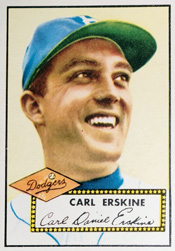
A couple of Hoosiers made life miserable in Brooklyn for the Cardinals.

In 1953, the Cardinals were 0-11 for the season against the Dodgers at Ebbets Field in Brooklyn’s Flatbush section.

The players most responsible for the Cardinals’ troubles there were pitcher Carl Erskine of Anderson, Ind., and first baseman Gil Hodges of Princeton, Ind.

Dominant Dodgers

The 1953 Brooklyn Dodgers, subjects of the Roger Kahn book, “The Boys of Summer,” were a powerhouse, featuring a lineup with five future Hall of Famers _ Roy Campanella, Gil Hodges, Pee Wee Reese, Jackie Robinson and Duke Snider.

They rolled to the National League pennant with a 105-49 mark, finishing 13 games ahead of the runner-up Braves (92-62) and 22 ahead of St. Louis (83-71).

The Cardinals won seven of 11 against the 1953 Dodgers at St. Louis, but it was a much different story at Brooklyn. Not only did they lose all 11 games at Ebbets Field, they often got crushed. The Dodgers outscored them, 109 to 36, in those 11 games at Brooklyn.

The Cardinals were beaten by scores of 10-1 on June 7, 9-2 on July 16, 14-0 on July 17, 14-6 on July 18, 20-4 on Aug. 30 and 12-5 on Sept. 1.

There were two one-run games, the Dodgers winning both by scores of 5-4. The cruelest for the Cardinals was on June 6, when Hodges wiped out a 4-2 St. Louis lead with a three-run walkoff home run versus Stu Miller in the ninth. Boxscore

Home sweet home

Many players contributed to the Dodgers’ perfect home record against the Cardinals in 1953, but Erskine and Hodges did the most damage.

A right-hander who mixed an overhand curve and changeup with his fastball, Erskine, 26, was nearly unbeatable at Ebbets Field that year. He ended the regular season with a home record of 12-1, including 4-0 versus the Cardinals. All four of his home wins against St. Louis were complete games.

Erskine also won Game 3 of the 1953 World Series at Ebbets Field, setting a record by striking out 14 Yankees batters, including Mickey Mantle four times. “Erskine made the Yankees look like blind men swatting at wasps,” J. Roy Stockton reported in the St. Louis Post-Dispatch. Boxscore

(Since then, the only pitchers with more strikeouts in a World Series game are Bob Gibson, who fanned 17 Tigers in Game 1 in 1968, and Sandy Koufax, who struck out 15 Yankees in Game 1 in 1963.)

“Look, up in the sky….”

When Erskine beat the Cardinals with a five-hitter on May 6, 1953, at Brooklyn, it was his seventh consecutive win against them, dating back to September 1950. Erskine went undefeated versus the Cardinals in 1951 (4-0) and 1952 (2-0). Boxscore

The streak was snapped a week later, May 14, 1953, at St. Louis when Erskine was knocked out in the first inning without retiring a batter. “He had no control, no stuff and no outs,” Dick Young reported in the New York Daily News. “He warmed up for 15 minutes and pitched for five.” Boxscore

Back in Brooklyn, Erskine ducked into a phone booth, donned his Superman cape and beat the Cardinals for the second time in 1953, a four-hitter in a 10-1 rout on June 7. “It was the sort of affair that grew progressively more one-sided and monotonous, finally reaching the stage where many of the fans amused themselves by launching paper planes onto the field,” Dick Young reported. “Some of these came close to hitting Erskine. So did the Cardinals, but not many succeeded.” Boxscore

A month later, Erskine beat the Cardinals at Brooklyn for a third time, even though he gave up nine hits and two walks, threw a wild pitch and committed two errors. Boxscore

Erskine’s fourth home win against the 1953 Cardinals, on Aug. 30, also was his 13th consecutive win at Ebbets Field. Erskine contributed three RBI and scored a run. Boxscore

“Some pitchers were spooked by the thought of working in Ebbets Field with its cozy fences, but not Erskine,” the New York Times noted.

(In his next start, the Braves gave Erskine his lone home loss of 1953. With the score tied at 1-1 in the eighth, Eddie Mathews hit a three-run home run and Jim Pendleton had a two-run shot. Boxscore)

Erskine finished 1953 with a regular-season record of 20-6, including 6-2 versus the Cardinals.

For his career with the Dodgers, Erskine was 122-78, including 66-28 at Brooklyn. He was 23-8 against the Cardinals _ 13-2 at Ebbets Field.

(Erskine’s second win in the majors came against the Cardinals in a 1948 relief appearance. In the book “We Would Have Played For Nothing,” Erskine recalled, “I beat Howie Pollet and he waited for me after the game in the runway to congratulate me. He said, ‘I like the way you throw.’ He was a class act. I think he identified with me because he had a unique pitch _ a straight change _ and I could throw that pitch.” Boxscore)

Among the Cardinals regularly baffled by Erskine were Enos Slaughter (.162 batting average against) and Red Schoendienst (.211). The exception, naturally, was Stan Musial. He batted .336 with eight home runs versus Erskine. According to Time Magazine, Erskine said, “I’ve had pretty good success with Stan by throwing him my best pitch and backing up third.”

In July 2023, Erskine, 96, recalled to Tyler Kepner of the New York Times that Musial “almost never missed a swing. He always hit the ball somewhere.”

In his book, “Stan Musial: The Man’s Own Story,” Musial said, “Erskine had control, a remarkable changeup and a great overhand curve.”

(Erskine had an association with the Cardinals in 1971 when he joined play-by-play men Jack Buck and Jim Woods as a guest analyst on select telecasts of games on KSD-TV Channel 5 in St. Louis.)

Lots of lumber

Three pitchers _ Stu Miller (0-3), Joe Presko (0-3) and Gerry Staley (0-2) _ accounted for eight of the 11 Cardinals losses at Ebbets Field in 1953.

Dodgers hitters were led by Gil Hodges, who had eight home runs and 23 RBI against Cardinals pitching in the 11 games at Brooklyn. Hodges had 16 hits and seven walks in those games.

(In 31 at-bats at St. Louis in 1953, Hodges had no home runs, no RBI and batted .129.)

Others who hammered the 1953 Cardinals at Ebbets Field were Roy Campanella (18 hits, 18 RBI), Jackie Robinson (18 hits, 11 RBI) and Duke Snider (four home runs and 11 RBI).

Read Full Post »

Danny Cox began the 1983 baseball season in the low level of the minors and ended it as a member of the starting rotation of the reigning World Series champion Cardinals.

Matched against Steve Carlton and facing a lineup with Pete Rose, Joe Morgan and Mike Schmidt, Cox pitched 10 scoreless innings versus the Phillies in his big-league debut on Aug. 6, 1983.

The stellar performance didn’t get Cox a win, though. That came a couple of weeks later when he opposed another future Hall of Fame pitcher, Nolan Ryan.

Fun in Florida

A right-hander attending Troy University, Cox, 21, was chosen by the Cardinals in the 13th round of the 1981 amateur draft, a couple of picks after the Mets took a high school outfielder, Lenny Dykstra, in the same round.

Cox pitched for a rookie team and a Class A club his first two seasons in the Cardinals’ farm system. Then in 1983, he was assigned to rookie manager Jim Riggleman’s Class A team, the St. Petersburg Cardinals. Even at that level, Cox was matched against an exceptional pitching opponent.

After losing his first two decisions in 1983, Cox, 23, started on May 12 at home against the Fort Myers Royals. Their starter, Bret Saberhagen, 19, was in his first season of professional ball. (Two years later, Saberhagen received the first of his two American League Cy Young awards with the Kansas City Royals.)

Pitching before 882 spectators at Al Lang Stadium in St. Petersburg, Cox threw a four-hitter in a 2-1 victory. Saberhagen went six innings and allowed both runs.

Facing a Fort Myers lineup that included future big-leaguers Mike Kingery and Bill Pecota, Cox retired the last 11 batters in a row. “He dominated,” St. Petersburg catcher Barry Sayler told the St. Petersburg Times. “He was working the inside of the plate, mixed his fastball and slider, and threw hard.”

Cox credited the advice he received from St. Petersburg teammate and closer Mark Riggins (who went on to become pitching coach of the St. Louis Cardinals, Chicago Cubs and Cincinnati Reds). “I started off throwing my fastball inside, and then Mark Riggins told me to take a little off my slider and mess up their timing,” Cox said to the St. Petersburg Times. “I was wanting to win real bad.”

Five days later, in a rematch at Fort Myers, Cox, with relief help from Riggins, again beat Saberhagen in a 7-2 St. Petersburg triumph.

On the rise

After five starts for St. Petersburg (2-2, 2.53 ERA), Cox was promoted to Class AA Arkansas. Playing for manager Nick Leyva, Cox was 8-3 with a 2.29 ERA in 11 starts. In July, he got promoted again, to manager Jim Fregosi’s Class AAA Louisville club. Cox made two starts for Louisville and pitched well (2.45 ERA).

Then came a special audition. The St. Louis Cardinals chose him to start against the Baltimore Orioles in the Baseball Hall of Fame exhibition game at Cooperstown, N.Y., on Aug. 1.

The Orioles, on their way to an American League pennant and World Series championship in 1983, were limited to three hits and no runs in the six innings Cox worked against them. “He was very impressive,” Cardinals manager Whitey Herzog said to the St. Louis Post-Dispatch.

Herzog wanted to see more. The Cardinals put Cox on their roster. His next start came in a big-league game against the Phillies.

Tough task

Cox’s debut assignment was daunting. The opposing starter, Steve Carlton, had dominated the Cardinals since being traded by them to the Phillies in 1972.

The matchup was intriguing for other reasons as well:

Chase Riddle, head coach of Troy’s baseball team when Cox pitched there, was the Cardinals scout who signed Carlton two decades earlier.

_ Like Cox, Carlton also impressed the Cardinals by pitching well in a Hall of Fame exhibition game. On July 25, 1966, Carlton, 21, was at Class AAA Tulsa when the Cardinals chose him to start against the Minnesota Twins in the Cooperstown exhibition. Carlton pitched a complete game, striking out nine, and was the winning pitcher. He never went back to the minors.

Carlton and Cox engaged in a mighty duel. The ace was in top form, pitching nine scoreless innings. The newcomer matched him, then surpassed him, pitching a scoreless 10th after Carlton was relieved by Al Holland.

Cox “didn’t look like a rookie to me,” Joe Morgan told the Associated Press. “I was really impressed by the way he located his pitches and hit the corners.”

Phillies manager Paul Owens said to the Philadelphia Inquirer, “He moved the ball around and threw strikes. That kid was excellent.”

Bruce Sutter, who hadn’t pitched in a week because of the funeral of his father, took over for Cox in the 11th and gave up a run. The 1-0 victory moved the Phillies ahead of the Pirates and into first place in the National League East.

“That was a World Series type of game,” Owens told the Inquirer. “Nobody even left the park.”

Morgan said, “These are the games that win pennants.”

Indeed, the Phillies went on to become National League champions in 1983. Boxscore

Sweet win

In his next start, Cox gave up a grand slam to ex-Cardinal Leon Durham and was beaten by the Cubs. Boxscore

His first win came in his fourth start on Aug, 21. Matched against Nolan Ryan and the Astros, Cox prevailed in a 5-2 Cardinals victory. Cox pitched 7.2 innings and allowed two runs. Ryan surrendered five runs in six innings. Cox also got his first big-league hit in that game, a single against Ryan in a two-run sixth. Boxscore

Cox made 12 starts for the 1983 Cardinals and was 3-6 with a 3.25 ERA. He pitched a total of 218 innings _ 129.1 in the minors, 83 with the Cardinals and another six in the Hall of Fame exhibition game.

Money ball

Two years later, Cox had his best year in the majors. He was 18-9 for the Cardinals during the 1985 regular season, flirted with a perfect game bid against the Reds, and won Game 3 of the National League Championship Series versus the Dodgers.

The 1985 World Series matched Cox and the Cardinals against Bret Saberhagen and the Royals. In starts against Joaquin Andujar and John Tudor, Saberhagen beat the Cardinals twice, including Game 7, and was named most valuable player of the World Series. Cox was just as good but not as fortunate. He started Games 2 and 6, allowed just two runs in 14 total innings, but didn’t get a decision in either game.

Cox helped the Cardinals win another pennant in 1987. He shut out the Giants in Game 7 of the National League Championship Series. Video

In the World Series versus the Twins, Cox won Game 5, beating Bert Blyleven, but was the losing pitcher in relief of Joe Magrane in Game 7.

In six seasons with St. Louis, Cox was 56-56. As a reliever with the 1993 Blue Jays, he got to be part of a World Series championship club.

Read Full Post »

There was a time in the late 1950s when the Cardinals thought a left-handed slugger from the streets of New York City might be the successor to Stan Musial.

Duke Carmel certainly fit the part. He was named after Duke Snider, had the mannerisms of Ted Williams and could hit with the power of Mickey Mantle.

Rangy (6-foot-3) and strong (200 muscular pounds), “Duke Carmel on a baseball field looks like the player you’d put together if somebody asked you to draw a picture of a prospect destined for major-league stardom,” The Buffalo News reported. “The throwing arm, the running speed, the hitting power, the ideal size, the versatility.”

Problem was, he also had a hitch in his swing.

From city to country

Born and raised in East Harlem (“A pretty rugged neighborhood,” he told The Sporting News. “I’ve had to fight my way through all my life.”), Leon James Carmel was nicknamed Duke for his favorite player.

“All the kids there at the time rooted for either the Yankees or Giants,” Carmel told The Sporting News. “When I took up for the Dodgers, and particularly for Duke Snider, they started calling me Duke, too, and it stuck.”

As for his given name of Leon, Carmel said, “If anyone called me that, I might not turn around. I wouldn’t know who they meant.”

A first baseman and pitcher at Benjamin Franklin High School, Carmel, 18, was signed by Cardinals scout Benny Borgmann in 1955.

His breakout season came in 1957 for the Class C farm club at Billings, Mont., 2,000 miles (and worlds apart) from East Harlem. Carmel, 20, hit .324 with 29 home runs and 121 RBI. Moved from first base to the outfield, he had 18 assists. “The best prospect I have ever managed,” Billings manager Eddie Lyons told The Sporting News.

Though Carmel tried to downplay the achievements _ “The pitchers there are mostly throwers and sooner or later they run out of gas,” he told The Sporting News _ the Cardinals were intrigued and brought him to spring training in 1958.

Carmel has “a batting form and a willowy swing that remind observers of Ted Williams,” The Sporting News reported in February 1958.

A manager in the Cardinals’ farm system, former pitcher Cot Deal, said, “Carmel reminds you of Ted Williams.”

J. Roy Stockton of the St. Louis Post-Dispatch noted, “Carmel seems to have most of the requisites _ sharp eyes, lithe muscles, a cocky, happy disposition, and a sparkling desire to bash a baseball to distant places.”

Blind spot

Facing better pitching at Cardinals camp than he did at Billings, Carmel struggled to hit pitches with movement, especially those that jammed him. That’s when the flaw in his swing became evident.

Cardinals hitting coach Stan Hack, who batted .301 in 16 seasons in the majors, told the Post-Dispatch, “He has a hitch. He lowers his hands, holding the bat, and when the pitch is high, he’s helpless. He can correct it if he listens, understands and keeps trying, but it takes a lot of work. You can’t correct a thing like that in an hour, or a day, or a month.”

Carmel said to The Buffalo News, “You have to stay loose and relaxed to play this game, and every time I go up to the plate determined to hit that long ball, I hitch too much. Then I get upset, and before you know it, I’m in a slump. I have to conquer myself, not the pitcher.”

Looking to find a groove, Carmel spent most of 1958 and 1959 at the Class AA and AAA levels of the minors. He played for Johnny Keane at Omaha, Cot Deal at Rochester, Harry Walker at Houston and Vern Benson at Tulsa. There were flashes of brilliance, but nothing like the kind of season he’d had at Billings.

Carmel, 22, got called up to the Cardinals in September 1959. He and teammate Tim McCarver, 17, made their big-league debuts in the same game. After striking out against Braves reliever Don McMahon, Carmel told The Sporting News, “I still haven’t seen any of the three pitches he threw by me.” Boxscore

Cardinals general manager Bing Devine said Carmel was in the club’s plans for 1960. “He’s showing signs of arriving,” Devine told the Rochester Democrat and Chronicle. “His possibilities for the future look very good.”

Traveling man

Carmel went to spring training with the Cardinals for the third straight year in 1960, and, like the other times, didn’t make the Opening Day roster.

The Cardinals traded him each of the next three seasons and reacquired him every time. They traded him to the Dodgers in 1960, reacquired him that year, traded him back to the Dodgers in 1961 and reacquired him again. In 1962, Carmel was sent to the Indians, then the Cardinals got him back a third time. In his stints with the Dodgers and Indians, Carmel never got out of the minors.

Carmel was not on the Cardinals’ roster when he went to spring training with them in 1963. Little was expected, but he became “the pleasant surprise of the spring,” The Sporting News reported. In his first 29 at-bats in the exhibition games, Carmel made 14 hits, including two home runs, two doubles and a triple.

The performance earned him a spot as a reserve outfielder and first baseman on the 1963 Opening Day roster of Cardinals manager Johnny Keane.

In his first at-bat of the season, Carmel hit his first big-league home run, tying the score in the bottom of the ninth against Pirates closer Roy Face. Boxscore

The highlights, though, were too few. Carmel was batting .227, with more strikeouts (11) than hits (10), when the Cardinals traded him for the fourth time. He was shipped to the Mets on July 29, 1963. This time, there would be no return.

Carmel had mixed emotions about departing. “I had been with that organization for eight years and it had become like a home to me,” he said to The Sporting News. However, he told the New York Daily News, “I didn’t want to sit around there, playing maybe 60 games a year. I want to make money in this game, and if I do the job, I’ll make it here (with the Mets).”

Meet the Mets

In joining the Mets, Carmel, 26, became a teammate of his boyhood idol, Duke Snider. In his Mets debut, Carmel started at first base and Snider was the right fielder. Boxscore

A week later, Aug. 8, 1963, Carmel hit a game-winning home run against Cardinals left-hander Bobby Shantz at the Polo Grounds in New York. Shantz threw him a slow curve and Carmel propelled it “onto the overhanging scaffold which fronts the upper tier in right,” the New York Daily News reported. Boxscore

(That was the first major-league game I attended. I was 7, and to my eyes, Duke Carmel was quite a mighty player.)

Carmel hit .235 with three home runs for the 1963 Mets. After the season they acquired two outfielders who, like Carmel, batted from the left side (George Altman from the Cardinals and Larry Elliot from the Pirates). Another left-handed batter, Ed Kranepool, 19, was projected to take over at first base.

Carmel did himself no favors at spring training in 1964, hitting .217 and getting into a personality clash with manager Casey Stengel, according to the New York Daily News.

Expecting to make the 1964 Mets’ Opening Day roster, Carmel instead was sent to the Buffalo farm club. “I don’t think they have anybody on the Mets better than I am,” Carmel told The Buffalo News.

Playing for Buffalo manager Whitey Kurowski, a former Cardinals third baseman, Carmel, 27, had a big season _ 35 home runs, 99 RBI and 100 walks. In August, the Yankees tried to acquire him for the 1964 pennant stretch but the Mets wouldn’t deal, general manager Ralph Houk told United Press International.

(If the Yankees, who won the 1964 American League pennant, had gotten Carmel, he would have faced the Cardinals in the World Series.)

New York, New York

After the Cardinals won the 1964 World Series title, manager Johnny Keane left for the same job with the Yankees. Two of the coaches he hired were Vern Benson and Cot Deal. All three had managed Carmel in the Cardinals’ system. On their recommendations, the Yankees chose Carmel in the November 1964 draft of players left off big-league rosters.

Keane told Carmel he would open the 1965 season as a Yankees utility player. “He had a golden chance to have a glorious new life in his hometown, playing for the team that cashes checks every fall,” George Vecsey wrote in Newsday. “All he had to do was not get hit by the D train.”

Carmel avoided getting hit by a train, but also avoided getting any hits for the Yankees. He was 0-for-26 in spring training exhibition games and then 0-for-8 in the regular season.

Released in May 1965, Carmel returned to the minors. His last season was in 1967 with Buffalo, then a Reds farm club. Among his teammates was a 19-year-old catching prospect, Johnny Bench.

New game

In 1972, five years after Carmel’s professional baseball career ended, Joe Gergen of Newsday found him playing as a ringer for a CBS-TV softball team in New York’s Central Park.

At 230 pounds, Carmel was the team’s catcher and slugger. In the game Gergen saw, Carmel had a single, a triple and a three-run home run, “a towering fly ball which carried over the right fielder’s head.”

“Between innings,” Gergen wrote, “there was time for Duke to eat an ice cream pop, drain a bottle of soda, puff on a cigarette and sit with the kids.”

Carmel said, “I enjoy this. Here, there’s no curfew.”

Read Full Post »

« Newer Posts - Older Posts »