Feeds:
Posts
Comments

Archive for the ‘Opponents’ Category

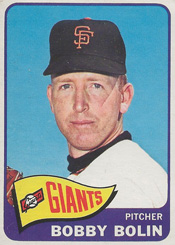
Though Juan Marichal and Gaylord Perry were the most prominent pitchers on the 1960s Giants, Bobby Bolin was an important member of those staffs, too.

A right-hander with a fastball rated among the best in the National League, Bolin was effective both as a starter and a reliever.

In 1968, when Bob Gibson led the league in ERA (1.12), the pitcher who was next-best was not Marichal or Perry or Ferguson Jenkins or Tom Seaver or any of the other future Hall of Famers pitching then. It was Bolin (1.99).

In the only game they started against one another that year, Bolin beat Gibson.

For his career, Bolin was 9-5 with a 2.75 ERA versus the Cardinals.

Country kid

Bolin was raised on a farm in Hickory Grove, S.C., a town of about 300 residents, located 55 miles from Charlotte, N.C. Years later, in a chat with the Rock Hill (S.C.) Herald, his mother, Blanche, said of Bobby and his two brothers, “It was hard to get any work out of those boys. They were either listening to a ballgame on the radio, or out in the backyard throwing rocks.”

Bolin switched from rocks to baseballs and became a pitcher. “Bobby played three years of baseball at Hickory Grove High School. The other year, when he was a junior, Hickory Grove had no team, so he pitched for York High School,” the Rock Hill Herald reported.

A gangly 6-foot-4, Bolin overpowered batters in high school and American Legion games with a fastball thrown from a sidearm delivery. His “big hand so completely covers the horsehide that you expect to see the stuffing fly out at any time,” the Charlotte Observer noted.

Herman Crump, Bolin’s American Legion coach, told the Charlotte newspaper, “It was hard to believe any 16-year-old could throw the ball as hard as Bobby did.”

According to the Rock Hill newspaper, the Pittsburgh Pirates signed Bolin, but the deal was voided because he was ineligible. Bolin was 17 when he signed with the Giants in December 1956.

Rookie year

Bolin, 22, reached the majors with the Giants in 1961 and was made a reliever. His first save came in his second appearance, on April 23, 1961, against the Cardinals at Candlestick Park in San Francisco.

In the ninth inning, with the Giants ahead, 2-1, the Cardinals had runners on first and third, one out, when Bolin was brought in to work out of the jam.

The first batter he faced, Daryl Spencer, looked at a 2-and-2 pitch for strike three. Upset with the call by umpire Tom Gorman, Spencer slammed his bat to the ground and was ejected. “I thought the pitch was four inches inside,” Spencer said to the St. Louis Post-Dispatch. Bolin told the San Francisco Examiner, “I thought it was a good pitch _ high enough and over the plate.”

The next batter, Mickey McDermott, lined a pitch foul before striking out swinging to end the game.

Noting that Bolin delivered only fastballs to the Cardinals, Giants catcher Hobie Landrith told the Examiner that the rookie threw “faster than anyone on our club can throw, and maybe as fast as anybody in the league.” Boxscore

Bolin said to the Charlotte Observer, “As my fastball goes, so go I.”

Two months later, on June 23, 1961, Stan Musial timed a Bolin fastball and belted it onto the roof of the right field pavilion “as Busch Stadium trembled with uproarious acclaim,” the Examiner reported. The grand slam was Musial’s ninth, and last, of his career and gave him seven RBI for the game. Boxscore

Learning on the job

The next year, Bolin (seven wins, six saves) helped the Giants win the 1962 pennant and pitched in two games of the World Series against the Yankees.

In 1964, Bolin appeared in more games as a starter than as a reliever for the first time since reaching the majors. In the first game he pitched that season, a start against the Cardinals, Bolin limited them to four hits in seven innings, but three were solo home runs _ by Johnny Lewis, Ken Boyer and Curt Flood _ and St. Louis won, 3-2. Boxscore

At the urging of his road roommate, pitcher Billy Pierce, 37, Bolin, 25, ditched the sidearm delivery and began throwing with more of an overhand motion. “As a result, his fastball moves _ and never the same way twice,” Pierce told The Sporting News.

On Aug. 14, 1964, Bolin pitched a one-hit shutout against the Braves. “A blind hog will find an acorn once in a while,” he modestly told the Examiner. Boxscore

Eight days later, he struck out 11 Cardinals, including Lou Brock four times, and got the win. Down by three in the seventh, the Cardinals had the bases loaded with two outs when Bolin struck out Brock on three consecutive fastballs. “I don’t think anyone could have hit those pitches,” Brock’s teammate, Tim McCarver, told the Examiner. “They tailed away and caught a sliver of the back of the plate.”

Giants catcher Tom Haller told the newspaper, “He’s as fast as he ever was, but he’s hitting spots. He’s got to throw it there to be effective.” Boxscore

Different look

Even with his overpowering fastball, Bolin needed a breaking pitch to keep batters from digging in. After much tinkering, he developed a slider. 

Bolin had 14 wins (eight in relief) in 1965 and 11 in 1966 (when he made 34 starts and pitched 10 complete games).

In his first appearance at the Cardinals’ new Busch Memorial Stadium, on June 28, 1966, Bolin pitched a two-hitter for the win. His former teammate, Orlando Cepeda, grounded a single to right for the Cardinals’ first hit in the seventh and Charlie Smith got the other on an infield hit in the eighth.

“I was missing with the fastball the last couple of innings, so I threw mostly sliders at the end,” Bolin told the Examiner. “Both the hits were on good pitches. Cepeda hit an outside slider and so did Smith.” Boxscore

A year later, on June 29, 1967, Bolin pitched the equivalent of a complete game in a relief stint against the Cardinals at St. Louis. The Giants scored 11 runs in the top of the first, nine against Bob Gibson, but, when Giants starter Joe Gibbon allowed two runs without recording an out in the bottom half of the inning, he was relieved by Bolin, who pitched nine innings for the win. Boxscore

Classic duels

To his disappointment, Bolin was used mostly in relief in the first half of the 1968 season. Moved into the starting rotation after the all-star break, he prospered. Bolin was 8-3 in the second half of the season. In those three losses, the Giants totaled one run.

On Sept. 6, 1968, fans came to Busch Memorial Stadium in St. Louis, hoping to see Juan Marichal and Bob Gibson as the starting pitchers in Game 1 of a doubleheader, but Giants manager Herman Franks had other ideas. He opted to start Bolin (7-4, 1.89) versus Gibson (20-6, 0.99) and save Marichal (24-7, 2.33) for Game 2 against Steve Carlton (12-9, 2.83).

Regarding his choice of Bolin to oppose Gibson, Franks told the Post-Dispatch, “I didn’t pitch any humpty-dumpty, you know.”

When the public address announcer read Bolin’s name in giving the Game 1 lineups, the crowd booed, the Post-Dispatch reported.

Bolin was up to the challenge. He limited the Cardinals to two runs (both earned) in 7.2 innings before Frank Linzy took over and provided scoreless relief. Gibson gave up three runs (two earned) in eight innings and lost for only the second time in his last 20 starts. Boxscore

(Neither Marichal nor Carlton pitched especially well in the second game, an 8-7 victory for the Giants. Boxscore)

Two weeks later, when the Cardinals were in San Francisco, Gaylord Perry pitched a no-hitter against them. The next day, the Cardinals’ Ray Washburn turned the tables, pitching a no-hitter versus the Giants. Bolin was the losing pitcher in that game. He shut out the Cardinals on two hits before they struck for a run in the seventh and another in the eighth. Boxscore

Changing leagues

In December 1969, Bolin was traded to the Seattle Pilots, who moved to Milwaukee before the start of the 1970 season and became the Brewers. He was sent to the Red Sox in September 1970 and became a relief specialist.

Bolin led the Red Sox in saves (15) in 1973 when Eddie Kasko was manager. Darrell Johnson, who replaced Kasko after the season, wanted to shake up the roster. In March 1974, in what Peter Gammons of the Boston Globe described as “the biggest single surprise of spring training,” Bolin, 35, was released. He opted to return home to South Carolina rather than try to extend his playing career.

He later quipped to the Rock Hill Herald, “I had to quit in 1974 for health reasons. The Red Sox were sick of me.”

In 13 seasons in the majors, Bolin totaled 88 wins and 51 saves. He three times finished in the top 10 in the National League in ERA _ 1965 (2.76), 1966 (2.89) and 1968 (1.99).

Read Full Post »

Pitchers Dizzy Dean and Paul Derringer didn’t get along as Cardinals teammates. As opponents, their dislike for one another erupted into public view.

On June 6, 1933, Dean and Derringer got into a fight on the field before a game at Cincinnati. Only their egos got bruised.

Dean, the consummate showman, was a flamboyant flamethrower who craved attention. Derringer, a skilled but less flashy pitcher, was “a belligerent man who often used his fists to settle disputes,” according to the Society for American Baseball Research.

Dean became a Hall of Famer, but Derringer earned far more career wins (223) than Dizzy did (150).

Intramural rivalry

Conflict between Dean and Derringer began in 1931 when both competed at spring training for a spot as a rookie in the Cardinals’ starting rotation. The Cardinals chose Derringer, 24, and returned Dean, 21, to the minors.

Derringer responded with an excellent rookie season for the 1931 Cardinals, helping them to repeat as National League champions. Derringer was 18-8, leading National League pitchers in winning percentage (.692). He also was the Cardinals’ team leader in shutouts (four).

While Derringer thrived with the Cardinals, Dean pitched for minor-league Houston and took out his frustrations on Texas League foes, crafting a 26-10 record and 1.57 ERA in 1931. 

Dean joined Derringer in the 1932 Cardinals’ starting rotation. Smug after his successful debut season, Derringer “strutted too much” and “became his worst enemy,” Sid Keener observed in the St. Louis Star-Times.

That made Derringer a target for Dean’s barbs. “Derringer had trouble with Dean,” the Dayton Daily News reported, “and he was prepared to report to the league president that Dean had been nasty in riding him all season.”

June of 1932 was a turning point for the two rivals. Dean was 3-1 with a 1.91 ERA in June. Derringer’s June numbers: 2-3 and 6.09. From then on, manager Gabby Street turned increasingly to Dean, prompting Derringer to accuse the club of favoritism, according to the book “Diz.”

True to his nature, Derringer “challenged Gabby Street to a fistic duel in the clubhouse,” the Star-Times reported, “because he objected to the managerial maneuvers.”

Dean finished his rookie season as the National League leader in strikeouts (191), shutouts (four) and innings pitched (286). He was 18-15 with a 3.30 ERA. Pitching with “a chip on his shoulder,” according to the Star-Times, Derringer was 11-14 with a 4.05 ERA.

On the move

After Derringer lost his first two decisions in 1933, the Cardinals traded him and two others to the Reds on May 7 for shortstop Leo Durocher, plus two pitchers.

The Cardinals beat Derringer the first time they faced him, on May 30 at St. Louis. Boxscore Five days later, when the Cardinals came to Cincinnati, Derringer turned the tables and won. Boxscore

Derringer was one of eight former Cardinals on the 1933 Reds, according to the Dayton Daily News. Others included Sparky Adams, Jim Bottomley and Chick Hafey. When the series started, “the boys were all pals,” Si Burick noted in the Dayton newspaper. “Leo Durocher, the famous (bench) jockey, was kidding all his former teammates good-naturedly, and the Reds kidded right back. There was entirely too much fun going on.”

That all changed on June 6 before the start of a Tuesday afternoon game.

Fighting words

According to the Dayton Daily News, “Derringer was pitching in batting practice and Dean was razzing him from the Cardinals dugout.”

Dean was “riding the life out of me,” Derringer told the Associated Press.

According to the St. Louis Post-Dispatch, Derringer said Dean was “questioning his courage.”

Derringer approached Dean and “asked him if he meant what he had been saying,” the Dayton newspaper reported.

“I replied, ‘I meant every word of it,’ ” Dean said to the Post-Dispatch.

Derringer threw a punch and claimed it landed square in Dean’s eye, the Dayton newspaper reported.

Dean told the Post-Dispatch, “I’m skillful at the manly art of self-defense and I ducked very cleverly.”

To prove his point, Dean “showed an eye that had no shiner,” according to the Dayton newspaper.

After the punch, Derringer grabbed Dean, “and when I saw he wanted to wrestle I caught him around the neck and threw him to the ground,” Dean explained to the Post-Dispatch.

As the clinched pair rolled around, Cardinals pitcher Dazzy Vance, 42, “strolled out and sat on them until the situation was in hand,” the Dayton Daily News reported.

Derringer told the newspaper that he “would have won by a knockout if Vance hadn’t stopped the bout.”

Dean claimed he gave Derringer “a right to the side of the head” before Vance arrived.

The Three Stooges-like antics carried over into the game. Cardinals player George Watkins was ejected for throwing his cap at an umpire after being called out on the base path, the Cincinnati Enquirer reported, and Reds coach Jewel Ens also was ejected for arguing a call.

After the ejection of Ens, a woman spectator heaved a soda bottle from the stands, intending it for the umpire. Instead, it struck Cardinals infielder Burgess Whitehead on the shoulder as he stood on a dugout step, according to the Associated Press. Boxscore

Postscript

Dean was a 20-game winner for the 1933 Cardinals, then followed with 30 wins in 1934, plus two more in the World Series. He is the last National League pitcher to achieve 30 wins in a season.

Though his ERA was 3.30, Derringer was 7-27 in 1933 _ 0-2 with the Cardinals and 7-25 with the last-place Reds.

Despite that, he posted more wins (223) than losses (212) in his 15 seasons in the majors. He also pitched in four World Series for three franchises _ Cardinals (1931), Reds (1939 and 1940) and Cubs (1945).


Read Full Post »

Before his fastball faded and spray hitters such as Ozzie Smith could pull it with power, the Cardinals saw the vintage Vida Blue, the one who, as Sports Illustrated noted, threw heat that “explodes in all directions.”

Blue was 28 when he came to the National League in a trade from the Athletics to the Giants in 1978. Though he would continue to pitch in the majors until 1986, his first year as a Giant was the last of his prominent seasons.

A left-hander who totaled 209 wins, Blue helped the Athletics win three World Series titles.

Rhapsody in Blue

Blue, 18, made his big-league debut with the Athletics on July 20, 1969. Two years later, he was the best pitcher in the American League, winning the Cy Young and Most Valuable Player awards. His numbers in 1971: 24-8 record, 1.82 ERA, 24 complete games, eight shutouts and 301 strikeouts in 312 innings.

“He throws harder than Sandy Koufax did,” Orioles slugger Boog Powell said to Sports Illustrated.

After Blue produced three seasons of 20 or more wins, Athletics owner Charlie Finley wanted to cash in on that success. In June 1976, he tried to trade Blue to the Yankees in exchange for $1.5 million, but baseball commissioner Bowie Kuhn voided the deal, declaring he did so in the best interests of baseball. (At the same time, Kuhn also canceled Finley’s attempt to swap reliever Rollie Fingers and outfielder Joe Rudi to the Red Sox for $1 million apiece.)

A year later, in December 1977, Finley sent Blue to the Reds for $1.75 million and first baseman Dave Revering. “They call Cincinnati the Big Red Machine. Now they have to call it the Big Blue Machine,” Vida said to The Sporting News.

The Reds envisioned a starting rotation led by Blue and Tom Seaver, but Kuhn again voided the deal. Part of the reasoning for Kuhn’s decision is he said he didn’t think the Athletics were getting enough talent in return. (In his nine seasons with the Athletics, Blue had a 124-86 record and 2.95 ERA.)

Ace vs. Cards

Giants general manager Spec Richardson sensed an opportunity. On March 15, 1978, Blue was traded to the Giants for seven players and nearly $400,000 in cash. Kuhn had no objections.

Naturally, Blue’s Giants debut came against the Reds at Cincinnati and he was the losing pitcher. Boxscore

After that, he went on a roll, winning six in a row. Two of those wins came against the Cardinals.

Blue’s first appearance versus the Cardinals was on May 1, 1978, at St. Louis. He limited them to four hits through seven innings on a mere 57 pitches. Trailing 2-0, the Cardinals scored a run against him in the eighth, but Blue got the win with strong relief help from Randy Moffitt in the ninth. Boxscore

Two weeks later, Blue faced the Cardinals at San Francisco and pitched a complete game for the win. He also singled, walked and scored a run in the Giants’ 9-3 triumph. Boxscore

Blue made three starts against the 1978 Cardinals and was 3-0 with a 2.08 ERA. For the season, he was 18-10 with four shutouts and a 2.79 ERA.

The Padres’ Gaylord Perry (21-6, 2.73) was selected as the 1978 National League Cy Young Award recipient by the Baseball Writers Association of America, but Blue was named The Sporting News National League pitcher of the year in voting by the players.

Throughout the season, Blue was backed by the hitting of 22-year-old Jack Clark, who batted .306 and led the 1978 Giants in doubles (46), home runs (25), RBI (98) and runs scored (90).

Hard time

In an eight-year stretch from 1971 to 1978, Blue pitched 258 innings or more in seven of those seasons. He wouldn’t work that many again.

In 1979, he was 0-2 with a 4.84 ERA in three starts against the Cardinals. On Aug. 29 that year, he gave up a career-high 14 hits to the Cardinals. Tony Scott had four hits and scored twice in the 5-1 Cardinals triumph at San Francisco. George Hendrick, Blue’s former teammate with the Athletics, hit a home run. Boxscore

Cardinals first baseman Keith Hernandez told the St. Louis Post-Dispatch, “That’s the slowest I’ve seen him throw.”

In March 1982, the Giants traded Blue to the Royals. A year later, he pleaded guilty to a cocaine possession charge and was sentenced to three months in federal prison. Kuhn suspended him for the 1984 season.

Blue returned to the Giants in 1985 and eventually joined a starting rotation with ex-Cardinal Dave LaPoint and Atlee Hammaker, one of the players acquired from the Royals in the Blue trade.

On July 10, 1985, at St. Louis, Blue started, gave up five runs in three innings and took the loss. With two outs in the second, Blue threw a waist-high fastball to Ozzie Smith, who yanked it over the wall in left for a two-run home run. “A terrible pitch,” Giants manager Jim Davenport told United Press International.

An inning later, Blue’s former teammate, Jack Clark, also launched a two-run homer. “He challenges you,” Clark told the Post-Dispatch. “He gives you the fastball.” (Clark produced four hits, including two home runs, in five career at-bats versus Blue.)

In 17 career appearances, including 12 starts, versus the Cardinals, Blue was 5-5 with a 5.36 ERA.

Ted Simmons hit .316 (12-for-38) against Blue. Those with high on-base percentages against him included Tommy Herr (.500, with six hits and three walks in 18 plate appearances) and Keith Hernandez (.421, with 13 hits and three walks in 38 plate appearances).


Read Full Post »

Stan Musial won a game for the Cardinals with a walkoff pop-out.

It happened on May 31, 1963, against the Giants at St. Louis.

In the ninth inning, with the score tied at 5-5, reliever Don Larsen, the former Yankee who pitched a World Series perfect game, walked Cardinals leadoff batter Curt Flood.

Bill White tried to move Flood to second with a sacrifice bunt, but fouled off two attempts. Then he swung away, rapping a grounder to second baseman Cap Peterson. A rookie, Peterson’s throw to shortstop Jose Pagan covering second was too late to get Flood, and White was safe at first on the fielder’s choice.

Bobby Bolin relieved and Dick Groat bunted, pushing the ball between the mound and third base. Bolin fielded it and tried getting Flood at third, but Flood beat the toss and Groat was credited with an infield single, loading the bases for Musial.

A left-hander, Billy Pierce, was brought in to face him.

Giants manager Al Dark moved the infield in and called for his outfielders to play shallow, hoping to make a play at the plate if necessary.

Musial swung at Pierce’s first pitch and hit a pop-up toward the right side of the infield. The umpires shouted, “Infield fly,” meaning Musial automatically was out.

Dazed and confused

The infield fly rule is called on a fair ball that can be caught by an infielder with ordinary effort when runners either are on first and second, or when the bases are loaded, before two are out. The rule is for the benefit of the runners because it keeps infielders from letting a shallow fly drop with the intention of causing a force play at second and third, or second, third and home, according to MLB.com. A runner is allowed to attempt to advance at his own risk.

When Musial’s pop fly went into the air, Peterson turned and started back toward his normal second base position, the San Francisco Examiner reported. Then he froze, according to the St. Louis Globe-Democrat.

When center fielder Willie Mays and right fielder Felipe Alou saw Peterson fail to react, they raced in to try for a catch.

“Mays came closest to getting the ball,” the St. Louis Post-Dispatch reported, but it fell among he and Alou and Peterson. According to the Examiner, “the ball landed right where Peterson was standing when the ball was pitched.”

When Curt Flood on third saw that the ball was unlikely to be caught, he dashed to the plate. Mays tried to grab the ball on one bounce so that he could throw home, the Post-Dispatch reported, but he could not come up with it. Flood streaked across the plate with the winning run and Musial was credited with a RBI.

Disgusted, Mays kicked his glove about 30 feet, the Post-Dispatch reported. Boxscore

The pop fly was Peterson’s responsibility to catch, Dark said to the Post-Dispatch. Regarding the outcome of a game being decided on an infield fly rule out, Dark told the newspaper, “I’ve never seen such a play at any point in any game.”

The wining pitcher was Bob Gibson, who had entered in the top of the ninth and pitched a scoreless inning of relief. He retired Willie McCovey, Matty Alou and Harvey Kuenn in order.

Read Full Post »

Bob Uecker’s speed, whatever there was of it, was no match for the arm of Jesus Alou.

A perfect throw by Alou in a game against the Cardinals nailed Uecker at the plate, aiding a win for the Giants that moved them into sole possession of first place in the 1964 National League pennant race.

Alou, youngest of three brothers to play in the majors, was an outfielder and contact hitter who excelled against premier pitchers. St. Louis University students formed a fan club in his honor.

Oh, brother

Jesus Alou was a right-handed pitcher when he joined the Giants’ Class D farm team at Hastings, Neb., in 1959. Alou, 17, “developed a sore arm and was sure he was about to be released,” the Fort Lauderdale Sun-Sentinel reported. Instead, he became an outfielder, the same position played by his brothers Felipe and Matty.

“I always thought that maybe they just kept me because Felipe and Matty were moving up and they didn’t want them to feel bad,” Alou told the newspaper.

All three Alou brothers were born and raised in the Dominican Republic. In his autobiography, “Alou: My Baseball Journey,” Felipe said, “Our home was the size of an average bedroom in the United States _ 15 by 15 feet _ some of it with an uneven cement floor, and the rest, particularly our kitchen floor, was dirt.”

Felipe recalled Jesus would take meat “right out of the pot when it was still cooking over an open fire. He loved meat and always seemed to have a ravenous appetite … Jesus was the one who grew the tallest and filled out the most.”

Felipe entered the Giants’ system in 1956 and Matty joined him a year later. Felipe reached the majors with the Giants in 1958 and Matty got there in 1960.

Jesus Alou hit .324 or better in four consecutive seasons in the minors before he was brought up to the Giants in September 1963.

In Jesus Alou’s debut against the Mets, he, Matty and Felipe batted consecutively in the eighth inning (Jesus and Matty as pinch-hitters) and became the first trio of brothers to appear in the same big-league game. Boxscore

Five days later, Felipe (in center), Matty (in left) and Jesus (in right) were the Giants outfielders for two innings in a game against the Pirates. Boxscore

In his book, Felipe said, “People have asked me what I felt. Pride, to some degree, but mostly what I felt was an overwhelming sense of responsibility to look out for my younger brothers. I was more concerned for them than anything.”

After seeing Jesus Alou play, Giants manager Al Dark told the San Francisco Examiner, “He’ll be something special one of these days, perhaps next year.”

The three Alou brothers appeared in a game together eight times, but never started a game together.

After the season, Felipe was traded to the Braves and Dark said Jesus would get first crack at Felipe’s right field job. “In Dark’s expert opinion, (Jesus) is destined to become a better all-around ballplayer than Felipe, a development which would qualify him to rub shoulders with the best in the business,” the Examiner noted.

Forgive me, Father

A son of a carpenter _ naturally _ Alou was the first player in the majors to be named Jesus. Some of the less enlightened had a devil of a time accepting this.

“In the Dominican Republic, as well as elsewhere in Latin America, the name Jesus is a common one, but in this country … the name is sacred to the Savior and a jarring note is struck when the name is not so honored,” Examiner columnist Prescott Sullivan wrote in March 1964.

“It’s a grand name, a wonderful name, and Jesus Alou wears it proudly,” Sullivan wrote, but “we’ve been thinking that what Jesus Alou needs is a nickname.”

Sullivan suggested Alou should be called “Jay or Jess or even Chi Chi.”

(Sullivan provided playwright Neil Simon with the inspiration for the Oscar Madison character in “The Odd Couple,” according to the Associated Press.)

Sullivan contacted several San Francisco holy men, who told him that, by God, they agreed with the notion that Alou should not be called by his given name.

Monsignor Eugene Gallagher, director of the Catholic Youth Organization, confessed, “A nickname for Alou would eliminate the danger of disrespect for a name sacred to our Savior.” A spokesman for Episcopal Bishop James Pike of Grace Cathedral said, “It would be simpler all around to call him by a name other than the one given to our Lord.” Rabbi Alvin Fine of Temple Emanuel offered, “For baseball purposes, I’d rather call him Butch.”

The advice was taken as gospel. Some broadcasters and reporters referred to the player as Jay Alou instead of Jesus.

Good impressions

On May 28, 1964, Alou was the left fielder for the Giants at St. Louis. In the seventh inning, the Cardinals led, 1-0, and had Bob Uecker on second when Carl Warwick lined a single to left. “With two out, we had to try for the run and send Uecker in,” Cardinals manager Johnny Keane told the St. Louis Post-Dispatch. “We had to hope for a wide throw, or a bounce that got past the catcher.”

Instead, Alou charged the ball, scooped it on one hop and fired a strike on the fly to catcher Del Crandall, who was waiting when Uecker slid into the tag. “That ball passed Uecker like a roadrunner,” coach Vern Benson said to the Post-Dispatch.

In the next inning, Willie Mays hit a Curt Simmons pitch off a girder in right-center for a two-run home run. The Giants won, 2-1, and moved into first place. Boxscore

(Mays “used to play cards with us all the time,” Jesus Alou told the Fort Launderdale Sun-Sentinel. “Every time he won, he gave us our money back.”)

Two months later, Alou had six hits (five singles and a home run) in a game against the Cubs at Wrigley Field. Boxscore

The Giants stayed in contention but finished three games behind the champion Cardinals.

The next year, Alou had 22 hits, including five doubles and two home runs, in 18 games against the 1965 Cardinals.

When the Giants played at St. Louis on June 28, 1966, a fan club of 48 graduate students from St. Louis University came to Busch Memorial Stadium and supported Alou with banners and cheers, the Post-Dispatch reported.

Alou had three hits in the game, scored twice and stole a base, then posed for pictures with the students. He hit .333 versus the Cardinals in 1966. Boxscore

Close call

After the 1968 season, Alou was chosen in the National League expansion draft by the Expos, who flipped him to the Astros for Rusty Staub.

In a June 1969 game against the Pirates, Alou fractured his jaw in a collision with shortstop Hector Torres while chasing a pop fly. On the ground, Alou “looked like he was dead,” Astros player Denis Menke told the Associated Press.

Alou swallowed his tongue and struggled to breathe before Pirates trainer Tony Bartirome “pulled Alou’s tongue up, inserted an inflationary tube in his throat and blew into it to open the passage,” Astros trainer Jim Ewell told the wire service.

Alou recovered and in 1970 he hit .306 for the Astros and .460 (17-for-37) against the Cardinals. In a May 1 game at St. Louis, he had three hits, three RBI and two runs scored. Boxscore

In 1971, the Cardinals acquired Matty Alou from the Pirates. In a game at Houston that year, Matty had two hits for the Cardinals and Jesus had three for the Astros. Boxscore

Bruce Bochy, who went on to manage the Giants to three World Series championships, began his professional playing career in the Astros’ system. In Felipe Alou’s book, Bochy said, “When I was a player, Jesus Alou was a guy who took me under his wing _ something I will never forget. I would sit next to Jesus in the dugout whenever I had the chance, soaking in his sage wisdom.”

In his book “I’m Glad You Didn’t Take It Personally,” Jim Bouton said Astros teammate Jesus Alou “is one of the most delicate, sensitive, nicest men I have ever met. He’d walk a mile out of his way to drop a coin in some beggar’s cup.”

Playing to win

In 1973 and 1974, Jesus Alou got to play in two World Series for the champion Athletics. The manager of the 1974 team was Al Dark. Jesus was joined on the A’s by an Angel, fellow reserve outfielder Angel Mangual.

Jesus Alou played 15 seasons in the majors and had 1,216 hits. He was at his best against some future Hall of Famers, batting .436 (24-for-55) against Steve Carlton, .370 (17-for-46) against Don Sutton, .353 (12-for-34) against Sandy Koufax and .333 (14-for-42) against Tom Seaver.

After his playing days, Jesus Alou was a scout for the Expos, and then director of Dominican Republic operations for the Marlins and later the Red Sox.

Read Full Post »

(Updated July 6, 2024)

For a guy who hit .154 in the 1964 World Series, Yankees first baseman Joe Pepitone was at the center of several significant plays against the Cardinals.

Pepitone got hit by a Bob Gibson pitch at a key moment in Game 2, lined a ball that struck Gibson in Game 5, and belted a grand slam in Game 6.

The Cardinals prevailed in seven games, but Pepitone wasn’t done with them. After he joined the Cubs in 1970, Pepitone thrived against the Cardinals. A career .258 hitter in the majors, Pepitone batted .331 in 36 regular-season games versus the Cardinals.

Pepitone also played for, and had conflicts with, former Cardinals managers Johnny Keane and Harry Walker.

A power hitter and Gold Glove fielder who had a well-earned reputation as a carouser, Pepitone played for the Yankees, Astros, Cubs and Braves.

Survival skills

In spring 1958, Pepitone, 17, was approached at his Brooklyn high school by an acquaintance who displayed a .38 Colt revolver and simulated a hold-up. The gun discharged and a slug ripped through Pepitone and came out his back. A priest administered last rites before Pepitone was rushed into surgery.

In his book, “Joe, You Coulda Made Us Proud,” Pepitone said, “I was in surgery for nine hours. The bullet had struck a rib and caromed out my lower back, missing three vital organs by inches.”

He spent 12 days in the hospital. Soon after, Pepitone’s father, Willie, 39, died from complications following a heart attack.

In August 1958, the Yankees signed Pepitone for $25,000. He said in his book he splurged on a Thunderbird, a speedboat and several silk suits.

Four years later, in April 1962, Pepitone reached the majors. His first hit, a single, came against a future Hall of Famer, Jim Bunning. After the season, the Yankees traded first baseman Bill Skowron, opening the door for Pepitone to replace him in 1963. On Opening Day, he smacked two home runs. Boxscore

Pepitone, 22, had 27 home runs for the 1963 Yankees and led the club in RBI (89) and total bases (260). He followed that with 28 home runs and 100 RBI for the 1964 Yankees.

The Yankees won their fifth consecutive American League pennant in 1964 and faced the Cardinals in the World Series.

Bad actor

The Cardinals won Game 1 and part of the reason was Pepitone’s inability to deliver on scoring chances. In the fifth and seven innings, he batted with two runners on base and made the final outs both times. Boxscore

In Game 2, with the score tied at 1-1 and Mickey Mantle on first, Bob Gibson threw a pitch inside to Pepitone. “I was going to swing at the ball, but then it started coming in on me and I checked my swing,” Pepitone told the St. Louis Post-Dispatch.

Plate umpire Bill McKinley said the ball struck Pepitone in the right thigh and awarded him first base, with Mantle moving to second. The Cardinals argued the ball hit Pepitone’s bat first. “That play was the turning point of this game,” Cardinals manager Johnny Keane told the Associated Press.

The next batter, Tom Tresh, singled, scoring Mantle and giving the Yankees the lead. They went on to win. Boxscore and Video at 12:22 mark

During batting practice before Game 3 at Yankee Stadium, Pepitone spotted Cardinals first baseman Bill White. Pepitone had a photo he wanted White to sign. “So Pepitone, emerging from the first base dugout, limped pitiably” toward White, the New York Times reported. “The Cardinals whooped and sneered. Pepitone limped harder. The Cardinals couldn’t avoid laughing.”

“If that ball hit you,” Cardinals catcher Tim McCarver yelled out, “you’ve got a wooden leg.”

White autographed the photo and Pepitone headed back to the dugout, but forgot to limp. When the Cardinals called him on it, Pepitone began “limping worse than ever,” the Times noted.

Then, according to the New York Daily News, White hollered, “Hey, you’re limping on the wrong leg,”

“Oops,” said Pepitone, who switched his limp.

On his first trip to the plate in Game 3, Pepitone was decked by Curt Simmons’ first pitch. He also had to spin away from two other Simmons pitches. Throughout the game, “Cardinals bench jockeys gave Pepitone a solid riding every time he came to bat,” The Sporting News reported.

Crucial out

The Cardinals, with Gibson pitching, led, 2-0, in the ninth inning of Game 5. With Mantle on first and one out, Pepitone hit a hard liner that struck Gibson in the right hip. As the ball darted toward the third base line, Gibson “was off the mound in a flash, grabbed the ball and fired off balance” to White at first base, The Sporting News reported. Umpire Al Smith called Pepitone out.

The next batter, Tom Tresh, hit a home run, tying the score. If not for Gibson’s play, Pepitone would have joined Mantle on the bases and Tresh’s homer would have won the game for the Yankees. Instead, the Cardinals prevailed on Tim McCarver’s home run in the 10th. Boxscore and Video

Rare feat

In Game 6 at St. Louis, the Yankees led, 4-1, when Pepitone faced Gordon Richardson with the bases loaded in the eighth. Twice, with the count 2-and-2, Pepitone fouled off balls “that just skipped off McCarver’s glove,” according to the Post-Dispatch. Then he hit a grand slam onto the roof in right. Boxscore and Video at 2:45 mark

Pepitone became the 10th player to hit a World Series grand slam, The Sporting News noted. Ken Boyer did it for the Cardinals in Game 4. The 1964 World Series was the second to have two grand slams. In 1956, Bill Skowron and Yogi Berra did it for the Yankees versus the Dodgers.

Authority issues

After the Cardinals clinched the championship in Game 7, Johnny Keane resigned and became Yankees manager. In his autobiography, Pepitone said, “Keane and I didn’t hit it off from the beginning.”

Pepitone said Keane fined him multiple times and benched him indefinitely for missing batting practice, the Associated Press reported.

“There was a moment in 1965 when I came close to punching Johnny Keane,” Pepitone said in his book.

Pepitone was deep in debt in 1965, he said in his book, and trying to hide from bill collectors. Near the end of the season, he said, Yankees general manager Ralph Houk convinced him to enter a hospital for psychiatric evaluation.

“For me, the 1965 baseball season was one long agonizing scream,” Pepitone said in his book. “I tried to muffle it with endless partying and rebelling against authority. Before the season was over, I was feeling my mind snap, crack, pop at any minute.”

Keane was fired in May 1966. Pepitone led the Yankees that season in home runs (31), RBI (83), runs scored (85) and total bases (271).

Pepitone also got attention for what was considered a bold step in a macho culture _ using a hairdryer in the clubhouse.

After hitting 27 home runs in 1969, Pepitone was traded to the Astros for Curt Blefary. The trade reunited Pepitone with former Yankees teammate Jim Bouton. In his book, “Ball Four,” Bouton wrote about how Pepitone wore two hairpieces, one for ballgames and another for going out on the town. Pepitone opened a men’s hair styling boutique in New York and was looking to franchise the business, the New York Daily News reported.

The Astros’ manager, Harry Walker, had been a Cardinals manager (1955) and coach on Keane’s staff (1961-62). Walker and Pepitone didn’t get along either.

Pepitone hit 14 home runs in 279 at-bats for the 1970 Astros, but in July he was told by Walker he no longer could room alone on road trips. Fed up with what he considered petty rules, Pepitone walked out on the team and asked to be put on the voluntary retirement list. In his book, Pepitone said, “I couldn’t stand Harry Walker and all his rules and regulations.”

Placed on waivers, Pepitone was claimed by the Cubs.

Moving on

Cubs manager Leo Durocher put Pepitone in center field and he did well. He produced 12 home runs and 44 RBI in 213 at-bats for the 1970 Cubs and made one error in 459 innings in center.

The next year, primarily playing first base, Pepitone hit .307 for the 1971 Cubs and .411 against the Cardinals. His success versus the Cardinals extended to 1972, when he hit .438 against them. During that season, Durocher left the Cubs and replaced Harry Walker as Astros manager.

One of Pepitone’s last big games came against the Cardinals on April 15, 1973, when he had five RBI and scored three runs. “Pepitone can play well,” Cubs manager Whitey Lockman told the Post-Dispatch. “It depends whether he wants to.” Boxscore

A month later, Pepitone, 33, was dealt to the Braves. He played in three games for them, the last against the Cardinals, and quit. “I’d had it with major league baseball,” Pepitone said in his book. “I just didn’t have any feeling for the game.”

The next year, he went to Japan, didn’t like it, hurt his ankle and played in 14 games before seeking his release.

In his book “The Mick,” Mickey Mantle said of Pepitone, “If he had just cared about anything, he could have been on top, among the very best. He had all the tools. A natural home run hitter who played center field better than I did and he was a great first baseman. He never took the game seriously.”

Read Full Post »

« Newer Posts - Older Posts »