Feeds:
Posts
Comments

Archive for the ‘Opponents’ Category

Stan Musial played in 3,026 regular-season games for the Cardinals. Only once did he strike out three times in a game. The pitcher who did it: Dick Ellsworth.
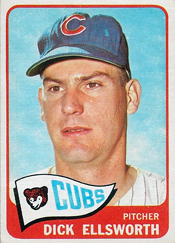
A left-hander who pitched in 13 seasons with the Cubs, Phillies, Red Sox, Indians and Brewers, Ellsworth had a career record of 115-137. He twice lost 20 in a season with the Cubs (9-20 in 1962 and 8-22 in 1966).

Ellsworth’s most noteworthy season was 1963. He was 22-10 for the Cubs and his 2.11 ERA ranked second in the National League to the Dodgers’ Sandy Koufax (1.88).

That also was the year Ellsworth did to Musial what no other pitcher had been able to do.

Top talent

As a youth in Fresno, Calif., Ellsworth followed the local minor-league team, an affiliate of the Cardinals. One of the players who made a strong impression on him was Larry Jackson, who had a 28-4 record for the 1952 Fresno Cardinals.

Ellsworth developed into an outstanding pitcher with Fresno High School. He had a 15-0 record his senior season and struck out 195 in 100 innings, according to the Fresno Bee. He was one of three future big-league players on the 1958 Fresno High School team. The others: Jim Maloney and Pat Corrales. Later, Tom Seaver attended the school.

The day after he graduated in June 1958, Ellsworth, 18, signed with the Cubs. Brought to Chicago, he started in a charity exhibition game against the White Sox at Comiskey Park and pitched a four-hit shutout.

A week later, Ellsworth made his official big-league debut in a start against the Reds at Cincinnati. With the bases loaded and the score tied at 1-1, Ellsworth was lifted for Glen Hobbie, whose belt-high fastball was slugged for a grand slam by Gus Bell. Boxscore

Sent to the minors, Ellsworth came back to stay with the Cubs in 1960. In his first appearance against the Cardinals, on May 14, 1960, at Chicago, he pitched seven scoreless innings and got the win. Boxscore

A year later, on May 20, 1961, Ellsworth earned his first big-league shutout, a 1-0 win against the Cardinals at Chicago. Matched against the pitcher he used to watch at Fresno, Larry Jackson, Ellsworth won the duel, tossing a three-hitter. After Ellsworth got Musial to tap to the mound with a runner at second for the final out in the top of the ninth, Ed Bouchee led off the bottom of the inning and walloped Jackson’s first pitch for a walkoff home run. Boxscore

Words of wisdom

After Ellsworth’s 20-loss season in 1962, two former Cardinals _ Cubs pitching coach Fred Martin and (there’s that name again) Larry Jackson _ helped convert him into a 22-game winner in 1963.

Ellsworth had stopped using a slider because the pitch caused him elbow pain, but at spring training in 1963 Martin showed him a better way to throw it, the St. Louis Post-Dispatch reported.

(Martin later taught Bruce Sutter to throw the split-fingered pitch that put him on the path to the Hall of Fame.)

Larry Jackson, acquired by the Cubs from the Cardinals after the 1962 season, helped Ellsworth develop the slider taught by Martin. “When Jackson joined our club, I asked him how he threw his slider because he has one of the best in the business,” Ellsworth told The Sporting News. “He showed me how to grip the ball and release it without jerking my arm. Now I can throw it without the slightest twinge in my arm.”

Jackson and another veteran Cubs pitcher, Bob Buhl, mentored Ellsworth on his approach to pitching. “I’d sit and talk to them after a game and they’d ask, ‘Why did you throw this pitch to that hitter in that spot?’ or ‘Why didn’t you curve with a 3-and-2 count?’ They helped teach me to think.”

Ellsworth, 23, learned his lessons well. He won eight of his first 11 decisions in 1963. One of the losses was to Ernie Broglio and the Cardinals by a 1-0 score. Boxscore

The next time Ellsworth faced the Cardinals, on July 15, 1963, at St. Louis, he used his bat, as well as his arm, to beat them. Ellsworth pitched 6.2 scoreless innings, exiting after a strikeout of Musial, and drilled a two-run single to center versus Broglio in the 2-0 victory. Boxscore 

Though his sinking fastball remained his best weapon, “the slider gave me a pitch that kept them honest,” Ellsworth explained to The Sporting News. “I’d push the right-handers back by jamming them on the wrists with the slider.”

Special stuff

Two weeks later, on July 28, 1963, Ellsworth started against the Cardinals at Chicago and beat them for his 15th win of the season. Ellsworth pitched a complete game, drove in a run, and struck out 10. Most remarkable, though, were his three strikeouts of Musial. No one had done that to The Man. Boxscore

With his whiff on July 15, followed by the three on July 28, Musial struck out in four consecutive plate appearances versus Ellsworth.

“It surely marked the lowest point of his 1963 season,” author James N. Giglio wrote in his book “Musial: From Stash to Stan the Man.”

Though 42 and in his final season as a player, Musial remained a tough out. That month, for instance, he belted a home run against Juan Marichal and produced two hits in a game versus Warren Spahn. He still made consistently hard contact and would finish his 22-year career never having struck out as many as 50 times in a season.

Against Ellsworth, it was different. Musial hit .219 with 10 strikeouts versus Ellsworth for his career. All seven of his hits against him were singles.

“I just can’t seem to pick up his ball,” Musial told the Post-Dispatch. “My timing hasn’t been right against him.”

Ellsworth said to the Fresno Bee, “I never think about strikeouts. I try to make them hit my pitch. I get more satisfaction in using my head than my arm. I don’t think I’m doing a real good job when I strike out a batter.”

On Sept. 2, 1963, Ellsworth beat the Giants for his 20th win of the season. That same day, his former high school teammate, Jim Maloney of the Reds, beat the Mets for his 20th win of the season.

Ellsworth was the first Cubs left-hander to achieve 20 wins in a season since Hippo Vaughn did it in 1919. 

“I wouldn’t trade him for Sandy Koufax,” pitching coach Fred Martin told The Sporting News. “Dick has more pitches than Koufax and he gets them over.”

Moving on

Ellsworth had losing records in each of the next four seasons. On July 18, 1966, at St. Louis, he gave up a pair of three-run home runs. Tim McCarver hit one and Mike Shannon belted the other 450 feet to left. Boxscore

In 1968, Ellsworth had a resurgence with the Red Sox, posting a 16-7 record for the defending American League champions.

Ellsworth finished with a career record of 15-14 versus the Cardinals. He had more wins against the Cardinals than he did versus any other club.

A son, Steve Ellsworth, pitched for the Red Sox in 1988.


Read Full Post »

Looking to cap a comeback from an injury that nearly shattered his season, pitcher Tommy Boggs was expecting to start Game 2 of the National League Championship Series for the Braves against the Cardinals.

Instead, his hopes for a storybook ending got washed away on a stormy St. Louis night.

After suffering a partial tear of the rotator cuff in his right shoulder early in the season, Boggs wasn’t expected to pitch again in 1982, but he defied the odds and returned to the starting rotation on the last day of August, helping the Braves over the final month in their bid for a National League West Division title. The Braves felt so confident about Boggs’ recovery that they planned to give him a start in the playoff series versus the East Division champion Cardinals.

A right-hander, Boggs pitched nine seasons in the majors for the Rangers and Braves.

Top talent

Born in Poughkeepsie, N.Y., Boggs was a year old when his family moved to Lexington, Ky. Boggs later played youth baseball there and rooted for the Reds, according to the Lexington Herald and the Austin American-Statesman.

After the family relocated to Austin, Texas, Boggs became a standout pitcher at Lanier High School. The Rangers took him with the second overall pick in the first round of the 1974 amateur baseball draft. Boggs was selected ahead of other first-rounders such as Lonnie Smith (Philies), Dale Murphy (Braves), Garry Templeton (Cardinals), Willie Wilson (Royals) and Rick Sutcliffe (Dodgers).

The Rangers called up Boggs, 20, from their Sacramento farm club in July 1976 and he joined a starting rotation with the likes of Gaylord Perry, Bert Blyleven and former Cardinal Nelson Briles. Boggs made his major-league debut in a start against the Red Sox, The first batter he struck out was Fred Lynn. The first hit he gave up was to Carl Yastrzemski. Boxscore

Relying on his fastball, Boggs impressed many, including Cleveland Indians manager Frank Robinson, who told The Sporting News, “He’s good now and he can be a great one. He has poise. He gives the impression he’s in total command, and that’s rare for one his age.”

After Boggs got his first big-league win against Whitey Herzog’s Royals, Rangers manager Frank Lucchesi told the Kansas City Times, “The kid is something special. He reminds me of a young Tom Seaver.” Boxscore

Trials and tribulations

The high expectations created a strain not even an exceptional fastball could overcome. Boggs’ record in two seasons with the Rangers was 1-10. In December 1977, they traded him to the Braves.

“Everything was always, potential, potential,” Boggs told the Austin newspaper. “You really get sick of hearing about it. One time, in triple-A, I saw this sign, one of those Charlie Brown things, that said, ‘The greatest burden in life is potential.’ For about three years, I really believed that.”

Boggs lost 21 of his first 24 decisions in the majors.

It wasn’t until 1979, when he was with the Braves’ farm club in Richmond, Va., that Boggs, 23, began fulfilling his potential. He credited Richmond pitching coach Johnny Sain, who taught him to throw a slider. “Before that, I was a two-pitch pitcher, fastball and curve,” Boggs told the St. Louis Post-Dispatch. “When my curve was off, the batters would just sit on my fastball.”

Boggs had his best season as a pro with Richmond, posting a 15-10 record with 16 complete games.

“I finally got the confidence that I could win again, and the slider was a big part of it,” Boggs said to the Austin American-Statesman. “The pitch, and the confidence, were the two big differences.”

In 1980, Braves manager Bobby Cox and pitching coach Cloyd Boyer, the former Cardinal, gave Boggs a spot in the starting rotation. Mixing his pitches effectively, he finished 12-9, including 3-0 versus the Cardinals.

“The key to pitching against the Cardinals is to keep Garry Templeton off base in front of the big guys,” Boggs told the Atlanta Constitution.

Boggs regressed in 1981 (3-13 record), but showed enough at spring training in 1982 to be a starter for manager Joe Torre and pitching coach Bob Gibson. In the Braves’ home opener, Boggs and Al Hrabosky combined to beat Don Sutton and the Astros. Boxscore

After two more starts in April 1982, Boggs felt pain in his right shoulder.

Down, not out

“When they told me it was a rotator cuff, it really scared me,” Boggs said to the Atlanta Constitution. “There goes your livelihood.”

Torre said, “If he helps us before the end of the season, I’d consider it a plus. I’m not thinking of him coming back before the end of the year.”

Specialists advised Boggs that rest, rather than surgery, was best. Two months later, Dr. Frank Jobe informed Boggs the tear in the rotator cuff had healed and cleared him to begin workouts.

When the Braves played the Cardinals that season, Boggs sought the advice of catcher Darrell Porter, who had experienced a similar injury in 1981. “It’s healed as much as it can, but I still have pain,” Porter told the Atlanta Constitution. “I can’t throw over the top like I used to. I can’t extend my arm. Boggs is facing something difficult.”

After working to strengthen the shoulder, Boggs made three starts for Richmond and was called up to the Braves.

On Aug. 31, 1982, in a start against the Phillies, Boggs made his first big-league appearance since the injury. He pitched six shutout innings and got the win. The two batters he struck out were Pete Rose and Mike Schmidt. Boxscore

“His control was phenomenal,” pitching coach Bob Gibson told the Atlanta Constitution. “I didn’t expect him to have control. He could be a big lift for us.”

Boggs said, “There were times in the last four months when I didn’t know if I could pitch again. Just to go out there was more gratifying than I can explain.”

Boggs made six starts in September for the Braves, showing he could contribute in the playoff series against the Cardinals.

Tough break

Torre chose Phil Niekro, Pascual Perez and Rick Camp as the starting pitchers for the first three games of the best-of-five National League Championship Series. Boggs was picked to start if a Game 4 was necessary.

Wet weather in St. Louis altered those plans. In Game 1 on Wednesday Oct. 6, Niekro pitched 4.1 scoreless innings and had a 1-0 lead when the game was called off because of rain. In the rescheduled Game 1 on Thursday Oct. 7, the Cardinals routed Perez and won, 7-0, on Bob Forsch’s three-hitter.

After the loss, Torre said he would start Niekro in Game 2 on Friday night Oct. 8, but on the morning of the game he changed his mind and said Boggs would start that night against the Cardinals. Torre told the Atlanta Constitution he based his decision on two factors: (1) Whether it’d be fair to pitch Niekro on one day’s rest, and (2) the possibility of having another Niekro start rained out that night.

Gibson called Boggs in his hotel room and informed him of Torre’s decision. Pitching in the playoffs is “something you prepare yourself for all your life,” Boggs told the Post-Dispatch.

Unfortunately for Boggs, it rained relentlessly and the game was called off before a pitch was thrown.

Afterward, Torre changed his mind again, saying Niekro, not Boggs, would start the rescheduled Game 2 on Saturday Oct. 9.

“Someone once told me that changing your mind is a sign of intelligence,” Torre said to the Atlanta Constitution. “After all the times I’ve changed my mind about pitching this year, I must be the most intelligent guy in the world.”

Though Torre said Boggs would start Game 4, if one was necessary, it didn’t soothe the sting Boggs felt about having his Game 2 assignment rained out and being bypassed for Niekro in the rescheduled game. “I’m disappointed,” Boggs told the Post-Dispatch. “I thought I had earned a right to pitch.”

The Cardinals won Game 2, rallying against reliever Gene Garber after Niekro went six innings, and clinched the pennant by beating Rick Camp in Game 3.

Boggs never got to pitch in a playoff game. His last season in the majors was 1985. He ended with a career record of 20-44.

Read Full Post »

The Cardinals acquired the player who might have helped them win a division title in 1973, but gave him away before he played a game for them.

On Oct. 26, 1972, the Cardinals got outfielder Larry Hisle from the Dodgers for pitchers Rudy Arroyo and Greg Milliken.
Hisle might have been a fit to join a Cardinals outfield with Lou Brock and either Jose Cruz or Bake McBride.

Instead, on Nov. 29, 1972, a month after acquiring him, the Cardinals traded Hisle to the Twins for reliever Wayne Granger.

Hisle fulfilled his potential with the Twins and later with the Brewers. Granger, in his second stint with St. Louis, was a disappointment.

The 1973 Cardinals, who ranked last in the National League in home runs, finished 1.5 games behind the division champion Mets. Hisle’s 15 home runs for the 1973 Twins would have made him the team leader on the 1973 Cardinals.

Prized prospect

Born in Portsmouth, Ohio, Larry Hisle was named by his mother, a baseball fan, in honor of Larry Doby, who became the first black player in the American League, according to the Society for American Baseball Research (SABR). Hisle’s parents died when he was a youth and he was adopted by Orville and Kathleen Ferguson, “two of the finest people in the world,” Hisle told United Press International.

Hisle played youth baseball with two other future big-leaguers, Al Oliver and Gene Tenace, according to SABR, but he also was a standout prep basketball player. When Oscar Robertson, recruiting for the University of Cincinnati, called, “I almost dropped the phone,” Hisle told The Sporting News.

After agreeing to play basketball at Ohio State, Hisle was picked by the Phillies in the second round of the 1965 baseball draft and signed with them. A right-handed batter, he played two seasons at the Class A level in the minors, then reported in 1968 to Phillies spring training camp, where he roomed with Bill White.

In choosing Hisle, 20, to be the Phillies’ 1968 Opening Day center fielder, manager Gene Mauch told The Sporting News, “Hisle is the best center fielder I’ve ever had.”

The experiment didn’t last long. Though he hit .364 in 11 at-bats for the 1968 Phillies, Hisle was sent to the minors before the end of April.

Rookie season

The Phillies named Hisle their center fielder for 1969, but he had a shaky start. He hit .159 in April and removed himself from a game because of what the team physician described to The Sporting News as “acute anxiety.”

“We’re all aware he’s a very intense, high-strung young man who is going to take a little longer to adjust up here,” Phillies manager Bob Skinner said to The Sporting News.

Hisle did better in May, producing four hits, two RBI, two runs and two stolen bases in a game against the Cardinals. Boxscore

Before a game in Philadelphia, the Giants’ Willie Mays chatted with Hisle and told him, “Open your stance, take it easy and concentrate on just meeting the ball,” The Sporting News reported. Hisle responded with four hits and two RBI that day. Boxscore

Phillies teammate Dick Allen aided Hisle, too, and became a mentor. “I’ll never forget how much he helped me,” Hisle told the Philadelphia Inquirer.

Hisle hit .266 with 20 home runs and 18 stolen bases for the 1969 Phillies.

Too far, too fast

Dick Allen was traded to the Cardinals after the 1969 season in a deal involving center fielder Curt Flood, who refused to report.

With neither Allen nor Flood, the Phillies needed Hisle to step up, but he didn’t, hitting .205 in 1970 and .197 in 1971.

“I put too much pressure on myself,” Hisle said to the Chicago Sun-Times. “I doubted my ability.”

In October 1971, the Phillies dealt Hisle to the Dodgers for Tommy Hutton.

Hisle “was built up as the potential superstar who would lead the Phillies out of the wilderness, and he wasn’t ready to handle the role,” Philadelphia Inquirer columnist Frank Dolson wrote. “The enormous pressures beat him down, sent his batting average plummeting, and turned the fans who had cheered him as a rookie into a booing mob that virtually chased him out of town.”

Mind games

At spring training in 1972, Hisle was the last player cut by the Dodgers, according to the Albuquerque Journal. Rather than go to the minors, Hisle said he considered quitting baseball. He was attending Ohio University in the off-seasons, studying math and physical education, “and has thought of teaching and social work,” the Los Angeles Times reported.

A voracious reader of authors as diverse as B.F. Skinner and James Joyce, Hisle “dabbles in analytic geometry, and worries about what happened to his hitting,” the Los Angeles Times noted. “He may be, he says, too much of a thinker for his own good.”

The Dodgers assigned Hisle to Albuquerque, hoping the manager there, Tommy Lasorda, would help him overcome self-doubts.

Playing for Lasorda, “I learned that the most important thing a person can say about himself is, ‘I believe in myself,’ ” Hisle told the Philadelphia Inquirer.

Hisle hit .325 with 23 home runs and 91 RBI for Albuquerque in 1972.

The Twins tried to acquire him after the season, but the Dodgers wanted pitcher Steve Luebber in return. Luebber was rated the best pitching prospect in the Twins’ system and they didn’t want to trade him, so the Dodgers dealt Hisle, 25, to the Cardinals.

Coming and going

“Hisle could play a big part in the youth movement of the Cardinals,” the St. Louis Post-Dispatch declared. 

The Cardinals brought Hisle to St. Louis and told him “they were hoping I could help the outfield defense,” Hisle told the Minneapolis Star Tribune. “From what I heard, it needed help. I was really happy to join the Cardinals.”

General manager Bing Devine also was seeking help for the bullpen, and approached the Twins about Wayne Granger, a former Cardinal. Granger’s 19 saves for the 1972 Twins were six more than Cardinals pitchers totaled that year.

“We had talked with the Twins about Granger shortly after the season ended, but they wanted a hitter in return and we didn’t have anyone available,” Devine told The Sporting News. “After we got Hisle, they expressed a strong interest in him.”

The Twins hardly could believe their good luck. Granger “had not endeared himself to the front office with charges that the Twins weren’t a first-class organization,” The Sporting News reported, and they were eager to trade him.

“It was fortunate for us that Bing Devine was interested in Wayne Granger,” Twins owner Calvin Griffith told columnist Sid Hartman. “We talked to Devine about Hisle. He was reluctant to give him up, but he wanted Granger.”

Devine said to The Sporting News, “We really had figured on Hisle as an extra man on the club because he can do so many things.”

Nothing personal

Hisle was at home when the Cardinals called, informing him of the trade to the Twins. “I was disappointed and hurt,” he told the Minneapolis Star Tribune.

According to the newspaper, “Hisle later received a handwritten note from Bing Devine. Devine apologized for the quick trade to Minnesota, explaining it was not intentional nor a snub at Hisle, but merely something which Devine felt could help the Cardinals. Hisle appreciated the letter, and still has it.”

The Twins made Hisle feel at home, naming him their center fielder. “I’m getting a chance to play regular here,” he told the Minneapolis newspaper. “I don’t know if I would have played every day for the Cardinals.”

Hisle scored 88 runs and drove in 64 for the 1973 Twins. His 230 total bases ranked third on the team, behind only Rod Carew and Tony Oliva.

Granger was 2-4 with five saves and a 4.24 ERA for the 1973 Cardinals before he was traded to the Yankees in August.

Hisle had big seasons for the Twins in 1976 (96 RBI, 31 stolen bases) and 1977 (28 home runs, 119 RBI). Granted free agency, he signed with the Brewers and had 34 home runs, 115 RBI and 96 runs scored for them in 1978.

A two-time all-star, Hisle played 14 seasons in the majors. He was the hitting coach for the World Series champion Blue Jays in 1992 and 1993.

Read Full Post »

Even in a rivalry as intense as Cubs vs. Cardinals, sometimes a little common courtesy prevails.

On Sept. 28, 1947, at Chicago, the Cardinals and Cubs created their own rule during the last game of the season.

When a Cubs baserunner, slugger Bill Nicholson, needed to leave the field for treatment of a minor foot problem, the Cardinals agreed to let the Cubs use a substitute, or courtesy runner, and then allow Nicholson to return to the game.

Under standard baseball rules, a player leaving the game needs to stay out of the game. The Cardinals, with nothing at stake in the standings, opted to make an exception for the Cubs.

A goodbye game

Regardless of the outcome of the 1947 season finale, the Cardinals were assured of finishing in second place in the National League behind the champion Dodgers, and the Cubs were guaranteed to end up sixth in the eight-team league.

Cardinals manager Eddie Dyer had just one regular, second baseman Red Schoendienst, in the starting lineup. Among those getting the day off were Marty Marion, Terry Moore, Stan Musial and Enos Slaughter.

Cubs manager Charlie Grimm started most of his top hitters, including first baseman Eddie Waitkus and outfielders Phil Cavarretta and Bill Nicholson.

Nicholson had the nickname “Swish” because of his propensity for striking out. Nicholson led the National League in most times whiffing in 1947 (83), but in 16 seasons in the majors he never struck out 100 times in a year.

(Today’s swing-and-miss hackers include Joey Gallo, who struck out 213 times in 2021 and received a salary of $6.2 million, according to baseball-reference.com. In 2022, Gallo batted .160 for the season and received $10.2 million.)

Nicholson gave the Cubs a 1-0 lead in the second inning with a home run, his 26th of the season, against Cardinals starter Ken Burkhart.

Give me a break

With one out in the fourth, Burkhart issued walks to Nicholson and Bob Scheffing. On ball four to Scheffing, Cardinals rookie catcher Del Wilber, who lost track of the count, made a wild throw to second in a futile bid to nab Nicholson.

As the ball sailed into the outfield, Nicholson headed to third. Sliding safely into the bag, he scraped an ankle, the Chicago Tribune reported. (According to the St. Louis Globe-Democrat, Nicholson damaged a shoe sliding into third.)

Regardless of the reason, Nicholson needed to leave the field for a quick patch-up, but all indications were he’d be fit to return _ if the Cardinals would permit it.

With 17,414 spectators on hand at Wrigley Field, the Cubs were eager to keep the club’s top home run and RBI producer in the game.

“By courtesy of the Cardinals,” the Chicago Tribune reported, pitcher Hank Borowy was permitted to run for Nicholson, with the understanding Nicholson would return to the game as soon as he was able.

Thus, Borowy became known as the courtesy runner.

Headed home

With Scheffing on first and Borowy on third, Ray Mack singled to left. Borowy scored, extending the Cubs’ lead to 2-0. Scheffing reached second safely on the hit, took a step or two toward third and was caught flat-footed on Erv Dusak’s strong throw to Schoendienst, who applied the tag for the out.

Nicholson re-entered the game in right field in the top of the fifth. An inning later, he singled but Scheffing followed by grounding into a double play.

In the seventh, with Joe Medwick on first, Dusak launched a drive “that for a moment appeared headed for the seats,” the Tribune reported, but Nicholson caught it near the wall.

The Cubs prevailed, 3-0, behind the five-hit shutout of Johnny Schmitz in a game completed in one hour, 35 minutes. Boxscore

A slender left-hander, Schmitz finished the 1947 season with a 13-18 record, leading the league in losses, but he was 5-4 versus the Cardinals that year.

“The Cardinals left by train for St. Louis shortly after the game, and were ready to return to their various homes,” the Globe-Democrat reported. “For the first time, players will be given expense money to their hometowns under the provisions of the player-owner agreements reached last season.”

Read Full Post »

Three impact players who defined the style of the National League in the 1960s were Maury Wills of the Dodgers and Lou Brock and Bob Gibson of the Cardinals. Wills and Brock brought speed with their base stealing, Gibson brought power with his pitching, and all three brought savvy and smarts to a championship brand of baseball.

In the 10-year period from 1959 to 1968, the Cardinals and Dodgers combined to win seven league pennants and five World Series titles.

Wills (1962) and Gibson (1968) each earned a National League Most Valuable Player Award.

From 1960 to 1969, the only players to lead the National League in steals were Wills and Brock. Wills led each year from 1960 to 1965. Brock was the leader each year from 1966 to 1969.

In 1962, Wills established the major-league record for stolen bases in a season (104). Twelve years later, Brock broke the mark (with 118).

A switch-hitting shortstop, Wills totaled 2,134 hits and 586 stolen bases in 14 seasons in the majors with the Dodgers, Pirates and Expos.

Record in St. Louis

On Sept. 23, 1962, at St. Louis, Wills, 29, had two stolen bases against the Cardinals, giving him 97 for the season and breaking the major-league record (96) established by Ty Cobb of the 1915 Tigers.

“Mercurial Maury Wills, a preacher’s son with the heart of a burglar, became the greatest base stealer in modern times,” Frank Finch wrote in the lead to his game story in the Los Angeles Times.

Wills twice stole second in the game against the battery of pitcher Larry Jackson and catcher Carl Sawatski. Boxscore

For the season, Wills finished with 104 steals in 117 tries. He was successful on 11 of 12 stolen base attempts versus the 1962 Cardinals.

In his book “Oh, Baby, I Love It,” Cardinals catcher Tim McCarver said of Wills, “He opened up baseball’s eyes to what speed can do for a team.”

“Maury Wills is the greatest slider and the quickest starter in the history of the game,” Phillies manager Gene Mauch told Los Angeles Times columnist Jim Murray in 1965. “He gets the base stolen the first five feet. He’s the most unafraid runner I’ve ever seen.”

In the book “We Played the Game,” McCarver said, “Maury Wills was smart. No one was better at sliding into a base. He had a sixth sense that told him how to be safe. If he knew it would be a close play, he’d slide into the glove and kick the ball out, or he’d avoid the tag and reach the corner of a base with his hand.”

One reason the Cardinals acquired catcher Bob Uecker from the Braves on the eve of the 1964 season opener was to try to slow down the base stealing of Wills.

Walks will haunt

Wills could field (two Gold Glove awards) and hit (five times in the top 10 in the National League in hits) as well as steal bases. Video

With the Dodgers in 1965, he had five hits in a game against the Cardinals. Boxscore

In the 1966 All-Star Game at St. Louis, Wills’ single in the 10th inning drove in Tim McCarver with the winning run for the National League.

With the Pirates in 1967, Wills slugged a three-run home run against the Cardinals’ Steve Carlton in Pittsburgh. “That’s the first one I’ve ever hit over the left field wall at Forbes Field,” Wills told the St. Louis Post-Dispatch. “I was the most surprised person in the ballpark when the ball cleared the wall.” Boxscore

Wills had 15 hits versus Carlton in his career, but the home run was the only one that wasn’t a single.

Against another future Hall of Famer, Bob Gibson, Wills batted .211 and had a paltry on-base percentage of .261. Of Wills’ 26 hits in 123 at-bats versus Gibson, 22 were singles and four were doubles.

In his book “On the Run,” Wills said, “Bob Gibson was the toughest pitcher for me to hit. He had a little slider he’d throw in on my fists. It was small but hard, and I just couldn’t get around on it.”

In the book “From Ghetto to Glory,” Gibson said, “I don’t have any trouble with Maury. I try to throw him high fastballs and let him hit it in the air. He’s not strong enough to hit the ball out. When he’s batting left-handed, he’ll hit a lot of fly balls to left field if you get it up and away.”

Wills drew nine career walks from Gibson, but only one from 1963 to 1971.

In the book “Sixty Feet, Six Inches,” Gibson explained, “If you’re pitching to Maury Wills, for heaven’s sake don’t walk him. I learned to not be too fancy with the little guys who couldn’t hit home runs. Make them take their cuts.”

When Wills did reach base against Gibson, the Cardinals’ ace would try to keep him from stealing by going into the stretch position and then pausing for as long as possible. In the book “Stranger to the Game,” Gibson said, “After I’d been in the league a few years, I stopped wasting my time and energy by throwing to first to hold runners on. I eventually learned that I didn’t have to throw the ball to keep the runner close. I just held it a little longer. That drove Maury Wills crazy.”

In a typical Gibson wisecrack, he also said in the “Sixty Feet, Six Inches” book, “Honestly, though, when Wills was on base it didn’t bother me as much as you might think because I was resigned to the fact that Tim McCarver, my good buddy and catcher, wasn’t going to throw him out. I loved pitching to McCarver, but we both know that he wasn’t about to throw out Maury Wills.”

(McCarver, no doubt, would like to have it noted that on July 16, 1964, at St. Louis, he twice threw out Wills attempting to steal second. The first time was with Ray Sadecki pitching and the other was with Mike Cuellar on the mound. Boxscore)

Running a stop sign

In 1974, Lou Brock was 35 when he made his bid to break Wills’ record for stolen bases in a season. Though he’d led the National League in steals seven times before 1974, Brock never had achieved 100. His highest total was 74 in 1966.

In Brock’s autobiography, “Stealing is my Game,” Hall of Famer Stan Musial said, “I don’t think Lou or anybody else believed Maury Wills’ mark would topple after only 12 years. It looked like one of those eternal records. What Maury did was magnificent. Lou had to have everything going for him in 1974 to do even better.”

In his book “On the Run,” Wills recalled, “As the season went on and Lou Brock got closer to my record, I found myself watching the games on TV and rooting for the pitchers. Nothing worked.”

According to Wills, Brock called him for advice during the season.

“My legs are hurting, Maury,” Brock said. “What should I do?”

Wills said he jokingly replied, “Ice them down, Lou. Take a couple weeks off. Then quit.”

In his book, Wills said, “The record was my identity. I was the stolen base king. I didn’t want to see my record broken. It meant a lot to me. Records were made to be broken, but not mine.”

On Sept. 10, 1974, Brock got his 105th stolen base of the season, breaking Wills’ record, in a game against the Phillies at St. Louis,

“I wasn’t at the game when Brock stole his 105th base,” Wills said in his book. “I was at the NBC studio waiting to comment on it.”

Asked how he felt about seeing the record surpassed, Wills said he replied, “I don’t like it at all. I wasn’t pulling for him. I wasn’t wishing him any bad experiences or any harm, but I wasn’t pulling for him.”

In Brock’s autobiography, his collaborator, Franz Schulze, wrote of Wills, “The way he responded to it warms my heart. He took an attitude which to me is as rational as Brock’s. He grieved over the winnowing away of the single accomplishment in which he had taken the greatest pride. He didn’t like to give up what was precious and hard-earned. So far as I’m concerned, that’s a perfectly healthy outlook. Lou, just as smart, just as honest, thought so, too.”

Hall of Famer Ernie Banks said in the Brock autobiography, “People like to contrast Lou and Maury. You know, Lou has the short slide. Maury had the great, broad hook slide.

“Well, I think they’re much more alike than different because the best thing about both of them is their brains. I’ve seen Lou and Maury both psyche out a pitcher as if they were inside the man’s head, just reading the meter. After the smarts, it’s their motivation. Both wanted tremendously to get where they are.”


Read Full Post »

On the day he secured his sixth National League batting title, Stan Musial learned he should stick to hitting instead of pitching.

Musial pitched for the only time in a big-league game on Sept. 28, 1952, in the Cardinals’ season finale against the Cubs at St. Louis.

He threw one pitch to one batter, his closest pursuer for the batting title, Cubs outfielder Frankie Baumholtz, then returned to the outfield.

Musial’s pitching appearance was prearranged by the Cardinals, who hoped it would generate interest in a game with nothing at stake in the standings.

Instead, the stunt was an embarrassment to Musial.

Show time

The Cardinals (88-65) entered the final day of the 1952 season in third place in the National League and the Cubs (76-77) were in fifth. Regardless of the outcome in the season finale, both teams were assured of finishing in those spots in the standings.

On the morning of the final game, the St. Louis Post-Dispatch reported Musial would pitch that Sunday afternoon, but only to Baumholtz. Cardinals manager Eddie Stanky told the newspaper Musial would pitch at least once to Baumholtz.

According to The Sporting News, the Cardinals received permission from National League president Warren Giles for Musial to pitch against Baumholtz.

In his book, “Stan Musial: The Man’s Own Story,” Musial said he “was persuaded” to pitch to Baumholtz “as a box office promotion.”

Musial entered the game with a league-leading .336 batting average. Baumholtz was second at .326. According to the Post-Dispatch, it remained mathematically possible for Baumholtz to surpass Musial for the batting title. For that to happen, Baumholtz would have to go 5-for-5 in the finale and Musial would need to go hitless in at least four at-bats.

If Baumholtz went 5-for-5, he’d finish with a batting average of .334. If Musial went 0-for-4 or 0-for-5, he’d finish at .333.

Though the odds were stacked against Baumholtz overtaking Musial, the Cardinals thought having Musial pitch to him would make it more intriguing.

On the mound

Musial began his professional career as a left-handed pitcher in the Cardinals’ system. After pitching two seasons (1938-39) for Williamson (W.Va.), Musial pitched for another Class D farm, the Daytona Beach (Fla.) Islanders, in 1940.

Musial was 18-5 with a 2.62 ERA for Daytona Beach. On days he didn’t pitch, he often played the outfield. In August 1940, he was playing center field against Orlando when he damaged his left shoulder trying to catch a sinking line drive.

The injury ended Musial’s pitching career. Moved fulltime to the outfield in 1941, Musial, 20, rose through the farm system, impressing with his hitting, and reached the majors with the Cardinals in September that year.

Eleven years later, he was asked to give pitching another try in order to end Frankie Baumholtz’s last-gasp bid to snatch the batting crown from him.

Having regrets

A crowd of 17,422 gathered at Sportsman’s Park for the 1952 season finale. Rookie left-hander Harvey Haddix was the Cardinals’ starting pitcher. Musial began the game in center field.

Haddix walked the Cubs’ leadoff batter, Tommy Brown. Then, with Baumholtz coming up, Musial went to pitch, Haddix moved to right field, and Hal Rice shifted from right to center.

“Musial took only a couple of pitches for warmup,” the Post-Dispatch reported.

In his autobiography, Musial said, “I didn’t relish the contrived show. I didn’t like it particularly because the one batter I’d face would be Baumholtz. I didn’t want to give any impression I might be trying to show him up.”

As Musial warmed up, Cubs manager Phil Cavarretta said to Baumholtz, “They’re trying to make a fool of you, Frank,” Baumholtz told author Danny Peary for the book “We Played the Game.”

Baumholtz said he replied, “I don’t think so. I think it’s just a gimmick to get a lot of people in the stands to watch two also-rans on the last day of the season.”

Send in the clowns

Baumholtz was strictly a left-handed batter, but he stood in from the right side to face Musial. Baumholtz never had batted right-handed. According to The Sporting News, Baumholtz made the switch as a gesture of sportsmanship because he “refused to try for a cheap hit” against the National League batting leader posing as a pitcher.

Or, as the St. Louis Globe-Democrat put it, “Baumholtz didn’t want to get something for nothing.”

Musial threw Baumholtz a fastball, the Post-Dispatch reported. In describing the pitch in his book, Musial said, “I flipped the ball.”

Baumholtz “met the ball squarely and it bounced on a big hop” to third baseman Solly Hemus, the Post-Dispatch reported. “Figuring on a double play, Hemus fumbled the ball. He then threw late and wide to first, and Brown took third.”

As United Press noted, “Baumholtz was safe on an error on what should have been a double play ball.”

Reaching on an error made Baumholtz 0-for-1 for the game and virtually eliminated his chance of overtaking Musial for the batting crown.

“I’m not proud of that circus,” Musial said in his autobiography.

After the Baumholtz at-bat, Musial, Haddix and Rice returned to their original positions. Haddix got the next batter, Bill Serena, to ground into a double play, but Brown scored from third for a 1-0 Cubs lead.

When Musial batted in the third inning, Cubs starter Paul Minner “tried to tease him with a slow underhand toss but it was wide of the plate,” the Globe-Democrat reported. On a curve, Musial fouled out to the catcher.

In the ninth, Musial lined a 3-and-2 pitch from Minner to left for a single. In going 1-for-3 in the game, Musial finished the season with a .336 batting average.

Baumholtz went 1-for-4 _ his hit was a bunt single in the sixth _ and placed second in the batting race at .325.

Haddix pitched eight innings and allowed three runs. Minner pitched a shutout in a 3-0 Cubs victory. Boxscore

Higher standards

In the seven seasons in which he won batting titles, Musial’s .336 mark in 1952 was his lowest. It also was the lowest figure by a NL batting leader since Ernie Lombardi of the Reds hit .330 in 1942.

“I had a bad year,” Musial said to the Globe-Democrat. “I wish I could have done better. My timing was off during the season.”

Yep, it was terrible. In addition to winning the batting crown, Musial, 31, led the National League in slugging percentage (.538), hits (194), total bases (311) and doubles (42) in 1952.

In his autobiography, Musial said he was “most disappointed” in his RBI total of 91 in 1952. It was the only time in a 10-year stretch from 1948-57 that Musial didn’t drive in 100 runs in a season.


Read Full Post »

« Newer Posts - Older Posts »