Feeds:
Posts
Comments

Archive for the ‘Opponents’ Category

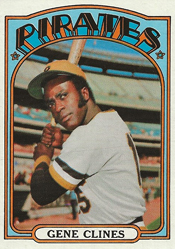
A clever bit of baserunning by Gene Clines fooled Cardinals center fielder Jose Cruz and helped the Pirates to a comeback victory.

An outfielder who played 10 seasons (1970-79) in the majors, primarily with the Pirates and Cubs, Clines hit for average and ran well.

He was especially effective against the Cardinals. A career .277 hitter in the majors, he batted .316 versus the Cardinals.

Hit and run

A right-handed batter, Clines was 19 when he was picked by the Pirates in the sixth round of the 1966 amateur baseball draft. He reached the majors with Pittsburgh in June 1970.

In his first three big-league seasons, Clines, used mostly as a backup outfielder and pinch-hitter, batted .405 in 31 games in 1970, .308 in 97 games in 1971 and .334 in 107 games in 1972.

Clines figured he’d earned a shot to be a starter. “All He Does Is Bat .300,” declared a headline in The Sporting News.

What he didn’t do was hit home runs. He totaled one in his first three big-league seasons.

The Pirates went to spring training in 1973 with outfield openings in right and left.

Clines was bypassed for both.

Pirates manager Bill Virdon chose a catcher, Manny Sanguillen, to be the Pirates’ 1973 Opening Day right fielder, replacing the late Roberto Clemente, and a first baseman with creaky knees, Willie Stargell, to play left.

“It seems like they don’t have any plans for me,” Clines said to The Pittsburgh Press.

Virdon explained that playing Stargell in left opened a spot at first for another slugger, Bob Robertson. Virdon said he liked Sanguillen in right because he threw better than Clines and was a better run producer.

“A home run and RBI man can give the team more of a boost,” Virdon told The Pittsburgh Press. 

Timely triple

The Pirates opened the 1973 season at Pittsburgh against the Cardinals. St. Louis led, 5-2, until the Pirates scored five runs in the eighth inning.

Batting for pitcher Jim Rooker, Clines’ triple against Diego Segui drove in the tying and go-ahead runs. Clines hit the ball into the gap in left-center. Lou Brock attempted a backhanded grab, but the ball bounced off his glove.

“That ball was catchable,” Brock said to The Pittsburgh Press. “When it hits off the glove like that, you’ve just got to hang on.”

Cardinals manager Red Schoendienst told the St. Louis Post-Dispatch, “You got to make those plays if you’re going to win.” Boxscore

Faked out

Two days later, in their second game of the season, the Cardinals led the Pirates, 3-2, in the bottom of the ninth.

With one out and none on, Clines batted for pitcher Nelson Briles and singled against starter Rick Wise. Rennie Stennett followed with a single to center.

Center fielder Jose Cruz gloved the ball just as Clines rounded second base. “No one in the stadium, particularly Jose Cruz, expected Clines to go to third,” The Pittsburgh Press reported.

Clines did what he called “a little stutter step” and appeared to be applying the brakes.

“A magnificent decoy,” Bob Smizik of The Pittsburgh Press observed.

Cruz dropped his arms. When Clines saw that, he shifted into high gear, bolted toward third and got there without drawing a throw.

“Cruz appeared befuddled, not knowing where to throw the ball,” Al Abrams of the Pittsburgh Post-Gazette noted. “He could have thrown out the fleet Clines by 10 feet had he been thinking.”

Schoendienst told the Post-Dispatch, “If he throws to third, the runner has to stop at second.”

Virdon, a center fielder before becoming Pirates manager, said, “You don’t make any money holding the ball out there.”

Cruz explained to the Pittsburgh Post-Gazette, “I heard Brock yelling, ‘Third base,’ but I thought it would be too late.”

Clines said to The Pittsburgh Press, “It’s a gamble, but I don’t think about being thrown out.”

Big run

The significance of Clines’ daring dash was illustrated when the next batter, Sanguillen, lofted a fly ball to medium right-center.

If Clines had held at second, Sanguillen’s fly ball would have been a harmless second out and the Cardinals still would have led by a run.

With Clines at third, Sanguillen’s fly ball became a scoring opportunity.

Stennett, thinking the ball might drop for a hit, moved part way toward second. Cruz, sensing he might nab Stennett, looked to first base, but no one was on the bag. First baseman Joe Torre had moved to the center of the diamond to cut off a throw if Stennett attempted to continue to second.

When Cruz hesitated, “I thought I could make it,” Clines told The Pittsburgh Press.

He raced toward the plate and easily beat Cruz’s throw, scoring the tying run.

In the 10th, Bob Robertson belted a home run against Wayne Granger, giving the Pirates a 4-3 victory. 

Asked about Cline’s performances, Virdon told the Post-Gazette, “You know, I think Gene is trying to give me some kind of message.”

Clines told The Sporting News, “I just want to remind them that I’m here and can do the job.” Boxscore

Gene the machine

Sanguillen eventually returned to catching, and Clines became the right fielder on June 15, but a month later he tore ligaments in his right ankle and was replaced by Richie Zisk.

Clines, who was hitting .291 before the injury, finished at .263 for the season, but he batted .368 against the Cardinals. It was one of four seasons in which Clines hit better than .360 versus the Cardinals. The others were 1971 (.361), 1975 (.364) and 1978 (.368).

In that 1978 season, when he was with the Cubs, Clines had a .500 on-base percentage against the Cardinals, getting seven hits and five walks in 24 plate appearances.

Clines was productive versus two of the era’s best pitchers _ Bob Gibson and Tom Seaver. He had the same career batting average against each (.364), producing four hits in 11 at-bats versus Gibson and the same versus Seaver.

On Sept. 1, 1971, Clines, the center fielder, was part of the first big-league starting lineup of all African-American and Hispanic players. Boxscore and Video interview

After his playing days, Clines coached for 20 years in the majors with five clubs _ Cubs, Astros, Mariners, Brewers and Giants.

Read Full Post »

In the span of eight months, Bob Cain was the starting and winning pitcher in two of the most unusual baseball games _ one against the St. Louis Browns and the other for them.

On Feb. 14, 1952, Cain was acquired by the Browns in a trade with the Tigers.

Six months earlier, when baseball’s greatest showman, Browns owner Bill Veeck, devised the stunt of sending 3-foot-7 Eddie Gaedel to bat in a game versus the Tigers, Cain was the pitcher who stood on the mound in disbelief.

The following spring, as a member of Veeck’s Browns, Cain used artistry instead of antics to make a mark, prevailing against Bob Feller in a duel of one-hitters.

Cain is able

Born in Longford, Kansas, Cain was a youth when his family moved 35 miles south to Salina, Kansas, the heart of wheat country. His father operated a taxicab company. Cain impressed in amateur baseball and was 18 when he signed with the Giants.

A left-handed pitcher, Cain played one season of minor-league ball at the Class D level in 1943 before serving two years (1944-45) in the military. When he returned, the Giants kept him in their farm system until he was traded to the White Sox in June 1949.

Called up by the White Sox in September 1949, Cain, 24, made his debut with three scoreless innings of relief against the Red Sox. He struck out Ted Williams the first time he faced him. In the book “We Played the Game,” Cain recalled, “He was surprised a rookie would throw a 3-and-2 curveball.” Williams would hit .200 in 10 career at-bats versus Cain. Boxscore

In May 1951, Cain was traded to the Tigers. A month later, he pitched a shutout against a Yankees lineup featuring Mickey Mantle, Joe DiMaggio and Yogi Berra. It was the first time the Yankees failed to score that season. Boxscore

Two weeks later, Cain held the Indians to two runs, but was a hard-luck loser. The opposing starter, Bob Feller, pitched a no-hitter. Boxscore

Then came the encounter with Eddie Gaedel.

Show time

Cain was the Tigers’ starter against the Browns in the second game of a doubleheader on Aug. 19, 1951, at Sportsman’s Park in St. Louis.

The Browns posted a lineup with rookie Frank Saucier as the leadoff batter, but, when it came time for him to bat in the first inning, Bill Veeck, always eager to upstage the buttoned-down Cardinals, sprung his surprise with Eddie Gaedel.

Wearing a uniform with the fraction one-eighth as his number and holding a toy bat, Gaedel, 26, who worked in Chicago as a courier for a livestock business journal, approached the plate with strict instructions from Veeck to not swing at any pitches.

When plate umpire Ed Hurley saw Gaedel in the Browns uniform of 9-year-old Bill DeWitt Jr. (the current Cardinals owner who was the son of Browns general manager Bill DeWitt Sr.), he went toward the Browns’ dugout and demanded an explanation from manager Zack Taylor. After Taylor showed Hurley the paperwork proving Gaedel had signed a Browns contract that was sent to the American League office, Hurley permitted Gaedel to bat.

“You should have seen the look on the face of Bob Cain,” Gaedel told The Sporting News. “His jaw dropped and his eyes almost popped out of his head.”

Cain called out to his catcher, Bob Swift, “Got any idea what to do with this fellow?”

Swift, who, like Cain, hailed from Salina, Kan., went to the mound for a conference with his pitcher.

When Swift went back behind the plate, he stretched out on his stomach to give Cain a low target, but Hurley told him to get up. So Swift knelt on both knees.

Gaedel crouched in the batter’s box, making the strike zone microscopic. Standing in against Cain was a risk for any batter. He finished second in the league that year in most batters hit by pitches (14).

In “We Played the Game,” Cain said, “I didn’t know whether to throw the ball underhanded or overhanded to Gaedel. I just wanted to be careful not to hit him. Dizzy Trout told me later that if he’d been the pitcher he’d have thrown the ball right between his eyes.”

While Swift was urging him to get the ball lower, Cain threw four overhanded pitches, all high, and Gaedel was awarded first base.

“The balls I threw to him, they were over his head, even though they’d have been strikes on normal batters,” Cain told the Salina Journal. “He was bending over to where the strike zone was only about an inch.”

In “We Played the Game,” the left-hander said, “I’d have given my right arm just to have gotten one strike on him.”

Gaedel later told Bob Broeg of the St. Louis Post-Dispatch that as he made his way to first, “For a minute, I felt like Babe Ruth.”

Gaedel was lifted for pinch-runner Jim Delsing and Cain settled down. He allowed no earned runs in 8.1 innings and got the win in the Tigers’ 6-2 victory. Boxscore

Cain was 11-10 for the 1951 Tigers. He ranked second on the club in wins, but his ERA was 4.70 and he totaled more walks (82) than strikeouts (58).

Pair of aces

Looking to shake up the roster after finishing 73-81 in 1951, the Tigers traded Cain, pitcher Gene Bearden and first baseman Dick Kryhoski to the Browns in February 1952 for pitcher Dick Littlefield, first baseman Ben Taylor, outfielder Cliff Mapes and catcher Matt Batts.

“Cain was the most valuable parcel the Tigers gave up in the deal,” the Detroit Free Press declared.

The last-place Browns (52-102) were happy to get a pitcher of Cain’s caliber. Veeck told The Sporting News, “He’s a bona fide starter. Just what we need.”

Cain liked the Browns because Veeck gave him the salary he wanted. In “We Played the Game,” Cain said, “Veeck was one of the nicest, most honest men in baseball, a great guy to play for.”

Cain’s first regular-season start for the Browns came against his former team, the Tigers, at Detroit. He yielded one run in nine innings and got the win. Boxscore

A week later, Cain was matched in a start versus Bob Feller for the first time since Feller pitched his no-hitter against him the year before.

Cain pitched a one-hitter. So did Feller.

The win went to Cain, who pitched a shutout in a 1-0 Browns victory at St. Louis.

“I owed this one to Feller,” Cain told The Sporting News. “It was just my turn to get the good break.”

It was the second time two pitchers achieved one-hitters in the same game in the majors. In 1906, the Cubs’ Mordecai Brown and the Pirates’ Lefty Leifield did it in a 1-0 Cubs triumph. Boxscore

The Browns got their run against Feller in the first inning. Bobby Young led off with a triple over the head of left fielder Jim Fridley. Marty Marion followed with a hard grounder to third baseman Al Rosen, who bobbled the ball for an error, enabling Young to score. Boxscore

It was the 11th of Feller’s 12 one-hitters in the majors, and the only one he lost. Feller also pitched three no-hitters.

The Indians’ lone hit was a single by Luke Easter in the fifth inning. Easter tormented Cain, hitting .368 with five home runs against him in his career.

In “We Played the Game,” Cain said, “I’d like people to remember how I pitched against Bob Feller. Being able to pitch against someone I knew would be a Hall of Famer gave me inspiration.”

Cain finished the 1952 season with a 12-10 record for the Browns. He and Satchel Paige, 48, tied for the team lead in wins.

The next year, his last in the majors and the last for the Browns in St. Louis, Cain was 4-10 with a 6.23 ERA.

After his playing career, Cain worked for Kraft Foods.

In June 1961, when Eddie Gaedel died at 36, Cain and his wife drove from their home near Cleveland to attend the funeral in Chicago. Veeck was ill and unable to be there. Cain was the only baseball person who went.

“I never even met him,” Cain said, “but I felt obligated to go.”

Read Full Post »

Gene Oliver didn’t deliver as many home runs as the Cardinals hoped he would, but he did hit one for them that made him popular in San Francisco.

In 1962, Oliver was the Cardinals’ starting catcher. He got the job because the Cardinals thought he could hit with consistent power and drive in runs. Instead, he finished fourth on the club in home runs (14) and sixth in RBI (45).

Oliver’s shining moment came in the Cardinals’ last game of the season when his game-winning home run against the Dodgers kept them from clinching the National League pennant and gave the Giants a chance to enter a playoff.

Big bopper

Oliver was born in Moline, Ill., one of the Quad Cities along the Mississippi River. He was a standout high school athlete in neighboring Rock Island, Ill. Oliver was considered a professional baseball prospect until, as a prep football player, he suffered a shoulder separation that hindered his ability to throw a baseball.

He went to Northwestern on a football scholarship for one year, returned to Moline, got a job with IBM and married, according to The Sporting News.

“I was ready to forget about pro baseball,” Oliver said, “but my wife insisted I try again because she didn’t want me to go through life wondering whether I might have made it.”

Oliver worked out daily at the YMCA and rebuilt his arm strength. Acting on a tip, the Cardinals monitored him and liked what they saw. Oliver was 21 when Cardinals scout Joe Monahan signed him to a contract in 1956.

Playing mostly outfield and first base, Oliver hit 39 home runs for Class D Ardmore (Okla.) in 1956 and 30 home runs for Class B Winston-Salem in 1957. He advanced to Class AAA Rochester in 1958 and, with his arm strength improving, he also did some catching.

The Cardinals called up Oliver in June 1959, but he spent the next season in the minors.

Because of his power potential and ability to play three positions, Oliver was a candidate for a utility spot with the Cardinals in 1961, but he reported to spring training at 238 pounds.

Describing his physique as “balloon-like,” The Sporting News reported the Cardinals were close to giving up on Oliver until he made amends by focusing on conditioning. He was 210 pounds when the Cardinals opened the 1961 season with him on the roster as a reserve.

In May 1961, the Cardinals sent Oliver to their Portland farm club in Oregon. A month later, the Cardinals’ catcher, Hal Smith, had to quit playing because of a heart ailment. Oliver, playing first base, was hitting with power for Portland. With Bill White having a lock on the Cardinals’ first base job, the club sent Smith to Portland to tutor Oliver in becoming a catcher.

“His throwing has improved and, yes, I think he has a good chance to stick in the majors,” Smith told The Sporting News.

Oliver hit .302 with 36 home runs and 100 RBI for Portland. His on-base percentage was .422. He returned to the Cardinals in September 1961, started 12 games at catcher and “showed 100 percent improvement behind the plate,” The Sporting News reported.

Getting his chance

The top three home run hitters for the 1961 Cardinals _ Ken Boyer (24), Bill White (20) and Stan Musial (15) _ totaled fewer home runs than Roger Maris had (61) for the 1961 Yankees. The Cardinals “desperately needed a power hitter,” The Sporting News reported. “They may have the answer in Gene Oliver.”

Oliver, 27, reported to spring training in 1962 at a fit 210 pounds and won the starting catcher job. His backups when the season opened were left-handed batter Carl Sawatski, 34, and defensive specialist Jimmie Schaffer, 26. Catching prospect Tim McCarver, 20, was deemed not ready and sent to the minors.

To the disappointment of the Cardinals, Oliver failed to provide power production early in the 1962 season. He hit one home run in April and one in May.

On April 22 at St. Louis, the Cardinals, trailing the Cubs, 5-1, loaded the bases with two outs in the bottom of the ninth. Curt Flood, hitting .519 on the young season, was due to bat. Flood had two singles and a walk in the game, but manager Johnny Keane sent Oliver to bat for him.

“We needed the knockout blow,” Keane told The Sporting News. “We knew we could count on Flood for a hit, but we needed more than that.”

Oliver struck out looking against Cal Koonce, ending the game. Boxscore

In June, Oliver switched from a 33-ounce bat to a 35-ounce model, but it didn’t help increase his home run totals much.

Decking the Dodgers

Through August, Oliver had seven home runs for the season. He told The Sporting News that Keane said to him, “We’ve got a lot of singles hitters on this club, and we need punch from you.”

Keane determined Oliver had become defensive in his swing because he was reluctant to strike out. He advised Oliver to take “a good cut because we don’t care how many times you strike out.”

Oliver hit seven home runs in September. The big blow was the last.

On Sept. 30, 1962, the last scheduled day of the regular season, the first-place Dodgers were one game ahead of the Giants in the National League standings. If the Dodgers beat the Cardinals that afternoon in Los Angeles, they’d clinch the pennant and advance to the World Series.

At San Francisco, the Giants beat the Colt .45s, 2-1, on a tie-breaking home run by Willie Mays against Turk Farrell in the eighth inning. Boxscore

At Los Angeles, the Cardinals and Dodgers were locked in a scoreless duel. About the time the Giants’ win was posted on the scoreboard, Oliver batted against Johnny Podres with one out in the eighth.

“I went up to the plate looking for a curve, looking for the long ball,” Oliver told the St. Louis Post-Dispatch. “That’s all Podres throws me, breaking stuff.”

Podres, pitching on his 30th birthday, threw two fastballs to Oliver for strikes. Oliver turned to catcher John Roseboro and said, “You’ve really fooled me.”

The next pitch was a curve that missed, making the count 1-and-2. Podres came back with another curve, and Oliver lined it over the fence in left for a home run.

Oliver’s home run, combined with the five-hit shutout pitched by Curt Simmons, gave the Cardinals a 1-0 victory and dropped the Dodgers into a first-place tie with the Giants. Boxscore

“I pitched the best game of my life,” Podres said to the Los Angeles Times. “Even the pitch to Oliver was a good one, a curve in tight.”

Yes, Podres said, his performance against the Cardinals was better than the shutout he pitched to win Game 7 of the 1955 World Series for the Dodgers versus the Yankees. Boxscore

In the ensuing best-of-three playoff to determine the 1962 National League champion, the Giants prevailed.

Toast of the town

Restaurant owners Leo Giorgetti and Sam Marconi invited Oliver and his wife to San Francisco on an all-expenses paid trip for the first two games of the 1962 World Series.

Giorgetti and Marconi owned The Iron Horse restaurant and the Gold Street saloon. The Iron Horse was popular with athletes and entertainers. Joe DiMaggio and Marilyn Monroe had their wedding reception there.

Dubbing Oliver’s appearance as “San Francisco Appreciation Day,” the restauranteurs took out an advertisement in the San Francisco Examiner, informing fans that, after the Thursday afternoon Game 1 of the World Series, an autograph party with the Cardinals catcher would be held at the Gold Street saloon from 7 pm to 9 pm, followed by dinner at The Iron Horse.

Oliver also was “the key figure in an impromptu parade” on the first day of the World Series, Bob Burnes of the St. Louis Globe-Democrat reported.

According to Burnes, Oliver “has become the most lionized visitor in recent San Francisco history.”

Moving on

The fanfare in San Francisco was heady stuff for a player who hit .258 overall for the 1962 Cardinals and .190 with runners in scoring position.

Back in Moline, Ill., for the winter, Oliver worked for a clothing store, Mosenfelder’s, selling suits.

Entering spring training in 1963, Stan Musial told The Sporting News, “We can look for more long ball from Gene Oliver. He seems to have found himself.”

It became apparent, though, that Tim McCarver was the Cardinals’ best catcher in 1963. In the book “We Played the Game,” McCarver said Oliver “was a good hitter but had a weak throwing arm.”

On June 15, 1963, the Cardinals traded Oliver and pitcher Bob Sadowski to the Braves for pitcher Lew Burdette. To make room for Oliver on their roster, the Braves sent catcher Bob Uecker to the minors.

Oliver had his best season with the 1965 Braves, hitting 21 home runs. In June 1967, the Braves traded him to the Phillies _ for Bob Uecker.

As a big-leaguer, Oliver hit 93 home runs, including four versus Sandy Koufax. Oliver had a career batting average of .392 against Koufax (20 for 51).

Read Full Post »

(Updated Feb. 26, 2022)

Every time Steve Carlton pitched against the Cardinals in 1972, it was a vivid reminder of the overbearing bungling of Gussie Busch.

Busch, the Cardinals’ owner, had a temper tantrum because Carlton wouldn’t agree to the club’s contract terms. Ordered by Busch to trade Carlton, general manager Bing Devine dealt him to the Phillies for another pitcher, Rick Wise, in February 1972.

Carlton made Busch pay for his heavy-handiness in ways greater than any salary amount he sought. In four starts against the 1972 Cardinals, Carlton was 4-0 with an 0.50 ERA. Two of those wins were shutouts. In 36 innings pitched versus the 1972 Cardinals, Carlton allowed no home runs and two runs total.

First test

On April 15, 1972, Carlton made his Phillies debut and beat the Cubs at Chicago. Boxscore

His next start, his first in Philadelphia for the Phillies, was April 19 against the Cardinals. Not only would Carlton face his former team for the first time, he also would oppose their ace, Bob Gibson.

On the eve of the showdown, Carlton told Stan Hochman of the Philadelphia Daily News, “Pitching against old teammates, that’s a new challenge. They know what you throw and how you set up hitters. You go out there with them knowing that, and you have to handle it.”

Asked what it was like having been Gibson’s teammate, Carlton replied, “I learned things, but not the mechanics of pitching. What I learned involved ideas, competitive spirit, the intense concentration he brings to the job. I admire him. I enjoyed watching him pitch.”

Told Gibson wouldn’t discuss the matchup, Carlton said, “The way he feels is that he’s pitching against the other club, not against some other pitcher.”

Cardinals outfielder Lou Brock said, “Carlton is one of the few guys who really cares. Some guys get taken out of games in late innings, even though they’ve pitched well, and they’re satisfied. Not Carlton. He feels like it’s his game. He’s got a lot of killer instinct.”

Speed game

Carlton, 27, and Gibson, 36, delivered a classic. Relying on the slider he learned on a trip to Japan with the Cardinals in 1968, Carlton pitched a three-hit shutout and the Phillies won, 1-0, in a game played in one hour, 33 minutes.

Phillies catcher Tim McCarver, another former Cardinal, told the Philadelphia Daily News that Carlton “was working quicker than he usually does. A couple of times he was winding up to pitch before I gave him the sign.”

The Cardinals’ hits were singles by Ted Sizemore, Matty Alou and Ed Crosby, who filled in at third base when Joe Torre was sidelined because of a bad back.

The Phillies scored in the sixth when former Cardinals prospect Willie Montanez hit a triple into the right field corner and Deron Johnson followed with a sharply grounded single to center.

With two outs and none on in the ninth, Ted Sizemore represented the Cardinals’ last hope.

“Tim called for a fastball and I shook him off,” Carlton told the Philadelphia Daily News. “I was thinking slider. I wanted to run it down and in on him.”

Instead, Carlton got the pitch up and in, and Sizemore drove it deep. “The ball fled Sizemore’s bat as though it had important business in a distant city,” Bruce Keidan wrote in the Philadelphia Inquirer.

Center fielder Willie Montanez turned and gave chase. He leaped near the wall and caught the ball in the web of his glove. As he came down, his glove hit the wall, the ball popped out and Montanez snared it again near his knees.

Cardinals manager Red Schoendienst and his coaches said the ball touched the wall after it came out of Montanez’s glove and should have been ruled a hit, but umpire Andy Olsen, who had run into the outfield from his post near second base, called it a catch and Sizemore was out, ending the game.

“Body and glove made contact with the wall,” Olsen explained to the St. Louis Post-Dispatch, “but the ball did not hit the wall.”

The loss was Gibson’s first versus the Phillies since April 1969. He’d won seven in a row against them. Boxscore

Home on the road

On Aug. 5, 1972, Carlton, playing in St. Louis for the first time since the trade, pitched a five-hit shutout in a 5-0 Phillies victory against the Cardinals. The game was completed in one hour, 48 minutes.

Carlton was “received warmly by a crowd of 25,505 in the city where he still makes his home,” the Philadelphia Inquirer reported.

Asked about what it was like pitching in St. Louis as the opponent, Carlton told the Post-Dispatch, “There was a little tightness and feeling of anxiety.”

Bill Robinson and Greg Luzinski each hit a two-run home run against Cardinals starter Reggie Cleveland.

The win was Carlton’s 12th in a row. His catcher for the last 10 wins in the streak was John Bateman, who was acquired in June from the Expos for McCarver. Boxscore

On a roll

On Sept. 7, 1972, in his third appearance against the Cardinals, Carlton again made quick work of them, getting his 23rd win of the season in a 2-1 Phillies victory at Philadelphia. The game was played in one hour, 49 minutes.

Carlton displayed a moustache, a symbol of personal grooming independence that must have made Busch choke on his braunschweiger sandwich. Five months earlier, Busch demanded the trade of another talent, starting pitcher Jerry Reuss, because he dared to grow a moustache.

Carlton got his 100th career win against a Cardinals lineup that featured six rookies _ Bill Stein, Mike Tyson, Skip Jutze, Ken Reitz, Jorge Roque and Mick Kelleher. Boxscore

(Years later, reflecting on the trades of Carlton and Reuss, Tyson told Cardinals Magazine, “You know how important pitching is. If we had not traded all that pitching, we would have won three, maybe four, division titles.”)

Traded foes

On Sept. 20, 1972, at St. Louis, Carlton and Rick Wise were matched against one another for the first time since the trade. The Phillies prevailed, 2-1, and Carlton got his 25th win of the season.

“So many of his former comrades have been shuffled away, Carlton feels no extra surge of adrenaline when he faces the Cardinals,” Bill Conlin wrote in the Philadelphia Daily News. “Only the sight of Gussie Busch and Bing Devine at the plate could turn him on.”

The game was played in two hours, 20 minutes before a mere 5,569, the second smallest crowd to attend a Cardinals game at Busch Memorial Stadium since it opened in May 1966.

“St. Louis fans are resigned that the trade was a blunder conceived in spite,” Conlin noted.

Asked by the Associated Press to pose for a picture before the game with Carlton, who agreed, Wise said, “Absolutely not.”

The loss gave Wise a season record of 15-16. Twelve of his losses were by one run _ six by scores of 3-2, three by 2-1, two by 4-3 and one by 1-0.

“Everybody says things even out,” Wise told the Post-Dispatch. “It will take a couple of years to even that out.” Boxscore

Special talent

Wise finished the season 16-16 with a 3.11 ERA. Carlton was 27-10 with a 1.97 ERA and received the first of his four National League Cy Young awards. Carlton had 27 wins for a team that won 59. Video

Carlton went on to have other spectacular seasons against the Cardinals, including 1980 (6-0, 1.38 ERA) and 1982 (5-1, 2.37 ERA). From May 1979 to May 1981, he had 10 consecutive wins versus the Cardinals.

Carlton’s career record against the Cardinals: 38-14, 2.98 ERA, five shutouts.

Read Full Post »

When push came to shove during a game at Cincinnati, both the Cardinals and the plate umpire behaved badly.

On April 22, 1952, Cardinals manager Eddie Stanky confronted umpire Scotty Robb, who responded with a shove.

Two weeks later, Robb submitted his resignation to National League president Warren Giles, then accepted a surprise offer to continue umpiring in the American League.

Law and order

A Baltimore native, Douglas Walker Robb, known as Scotty, played semipro baseball until an arm injury prompted him to move into umpiring. He umpired college and minor-league games before serving two years (1944-45) in the Navy.

Robb was 38 when he became a National League umpire in August 1947. In his debut game, Cardinals versus Giants at the Polo Grounds in New York, he umpired at third base. Johnny Mize drove in four runs against his former club, powering the Giants to a 6-5 victory. Boxscore

Three years later, on July 2, 1950, Robb had a confrontation with Stanky in a game between the Braves and Giants at the Polo Grounds.

With the score tied at 2-2 in the seventh inning, the Giants had a runner on first, none out, when Stanky came to the plate with “visions of a game-winning rally,” the New York Daily News reported.

Nicknamed “The Brat,” Stanky got upset when Robb, working the plate, called Bob Chipman’s first pitch to him a strike. Stanky took an angry swing at the next delivery and missed badly. Strike two. After watching a pitch go outside, Stanky grounded into a rally-killing double play.

“Angrier than ever when he reached the bench, Stanky threw a couple of water buckets onto the grass,” the Daily News reported, and Robb ejected him.

Giants manager Leo Durocher came out of the dugout to argue and Robb tossed him, too.

As Stanky and Durocher made the long walk across the outfield to the clubhouse behind the bleachers in center, Giants outfielder Bobby Thomson threw a towel in the direction of Robb and he also was ejected.

In a flash, the Giants had lost their second baseman, center fielder and manager.

“It was a senseless rhubarb and strictly the Giants’ fault,” declared the Boston Globe.

Robb took “a wicked booing” from Giants fans the remainder of the game, the Globe noted, especially after the Braves struck for four runs in the ninth and won, 6-3. Boxscore

Boiling point

The Giants traded Stanky, 36, to the Cardinals in December 1951 and he became their player-manager, replacing Marty Marion.

After the Cardinals split their first six games in 1952, Stanky selected rookie pitcher Vinegar Bend Mizell, 21, to make his big-league debut in a start against the Reds at Crosley Field.

Mizell, who allowed the Reds two runs in the first and none for the rest of the game, showed more poise than Stanky and some of his veteran players.

In the third inning, Robb, the plate umpire, called out the Cardinals’ Solly Hemus on strikes for the second time in the game. Hemus barked at Robb before heaving his bat toward the grandstand on the first-base side near the visitors’ dugout.

Robb ejected Hemus, prompting Stanky to rush out of the dugout. Robb ordered Stanky to leave the field, but instead he got as close as he could to the umpire. Stanky stood toe to toe with Robb, gestured excitedly, waved his index finger in his face and berated him, the Cincinnati Enquirer reported.

“I wanted to know why Hemus was put out of the game,” Stanky told the St. Louis Globe-Democrat.

According to the Dayton Journal Herald, Stanky and Robb “were jostling each other in a startling fashion.”

During what the Globe-Democrat described as a “tornadic argument,” Robb thought Stanky touched or bumped him.

According to Bob Broeg of the St. Louis Post-Dispatch, “As far as press box observers could tell, it was a phantom touch, as light-fingered and as unobtrusive as a pickpocket.”

Stanky said to the Globe-Democrat, “I told Robb that I never touched him. If I did, it was not intentional, and probably was caused by the fact that his momentum as he was walking toward our dugout carried him into me.”

Enraged, Robb threw down his mask, put both hands on Stanky’s chest and vigorously shoved him back a few steps. “The umpire squared off and Stanky, obviously stunned, then started toward Robb,” the Post-Dispatch reported.

“It appeared as if the two might start swinging at each other,” the Globe-Democrat noted. 

Umpires joined Cardinals players and coaches in getting between the two and preventing further damage.

Stanky told the Post-Dispatch, “Getting shoved that way and not being able to strike back was the most embarrassing, the most humiliating thing that’s ever happened to me on a ball field.”

Robb ejected Stanky and the game continued. Gene Mauch replaced Hemus at shortstop.

Stan the Mad

More trouble happened in the seventh. With the Cardinals trailing, 2-1, Stan Musial batted with two outs and a runner on first. Musial hit a grounder sharply down the line at first. Umpire Lon Warneke, Musial’s former Cardinals teammate, ruled it a foul ball. “From the press box, the ball appeared to be foul by at least two feet,” the Cincinnati Enquirer noted.

Musial thought otherwise.

“Stan, who seldom protests a decision, kicked the dirt viciously several times,” the Globe-Democrat reported.

According to the Post-Dispatch, Musial was “drop-kicking dirt with the skill of a football field goal specialist.”

Perhaps to prevent Musial from getting ejected for the only time in his career, Cardinals reliever Al Brazle ran from the bullpen onto the field to argue on Musial’s behalf. Warneke ejected Brazle. Boxscore

Tough job

National League president Warren Giles was at the game and witnessed the shenanigans. The next day, Giles met for 45 minutes with Stanky, Hemus and the four umpires _ Robb, Warneke, Babe Pinelli and Dusty Boggess _ to get their versions of what happened.

As the meeting ended, Robb and Stanky shook hands. “It’s all over now,” Stanky told The Sporting News. “We’ll forget it and start anew.”

A few hours later, Giles, a former Cardinals minor-league executive, announced he was fining Hemus $25 and Stanky $50 for their roles in the incident. Giles publicly reprimanded Robb and said he fined the umpire an amount greater than the combined fines of Hemus and Stanky. Years later, The Sporting News reported Robb was fined $200.

Robb “seemed to feel he had been humiliated by Giles’ reprimand and fine,” The Sporting News reported.

The next game Robb worked was on April 26 when the Cardinals played the Cubs at St. Louis. In the seventh inning, Warneke ejected Stanky for arguing a call at third base. Boxscore

Unable to overcome the feeling that Giles hadn’t supported him, Robb resigned on May 5 and said he would operate a printing business in New Jersey.

Two days later, Robb was stunned when American League president Will Harrirdge offered him an umpiring job.

“When Mr. Harridge approached me with an offer, I was so choked up I couldn’t talk for a minute or two,” Robb told The Sporting News.

Harridge said, “I signed what I believed to be a good umpire and the kind of gentleman we would like to have on our staff.”

Robb umpired in the American League through June 1953, then retired from baseball at age 44.

“It’s a lonesome, difficult life,” Robb told The Sporting News. “An umpire must live like a hermit, avoiding casual acquaintances and not associating with players, managers or coaches. The travel is bad … and the pay wasn’t too good either.”

Read Full Post »

In the last regular-season game he played in the NFL, running back Jim Brown was ejected for fighting with a St. Louis Cardinals defensive lineman.

The incident occurred on Dec. 19, 1965, in the regular-season finale between the Cardinals and Cleveland Browns at Busch Stadium in St. Louis.

Just before halftime, Brown and Cardinals defensive end Joe Robb hit and kicked one another. The referee tossed both from the game. Brown still finished as the NFL rushing leader for the eighth time in nine seasons.

Despite a stellar performance by Cardinals safety Larry Wilson, who intercepted three passes and returned one 96 yards for a touchdown, the Browns won, 27-24, and advanced to the NFL championship game against the Green Bay Packers. Video

Brown, 29, played in the title game, won by the Packers, and then retired from football, launching an acting career with a role in the film “The Dirty Dozen.”

Tough guy

Joe Robb was born and raised in the east Texas town of Lufkin, near the Davy Crockett National Forest. His father was a professional wrestler.

Described by the Waco News-Tribune as “a carefree sort unused to a tight harness,” Robb played on the defensive line at Texas Christian University with future Pro Football Hall of Fame tackle Bob Lilly.

A rangy 6 feet 3 and 215 pounds, Robb was chosen by the Chicago Bears in the 14th round of the 1959 NFL draft. He was cut from the roster near the end of training camp and claimed by the Philadelphia Eagles.

A year later, Robb, who bulked up to about 240 pounds, was a starting defensive end for the Eagles when they won the 1960 NFL championship. In the title game against the Packers, Robb was matched against the future Hall of Fame offensive tackle, Forrest Gregg.

“Robb is a tough, hard-nosed kid,” Gregg told the Philadelphia Daily News. “He was charging the same on the last play as he was the first.”

When it came time to discuss a contract for the 1961 season, Robb said, “I went in and asked for $13,000. (General manager) Vince McNally said I was asking for a quarterback’s salary.”

The Eagles traded Robb to the Cardinals for defensive end Leo Sugar and linebacker John Tracey.

Trench battles

In joining the 1961 Cardinals, Robb and Jim Brown nearly became teammates. The Cardinals claimed they turned down a trade offer of Brown for running back John David Crow.

Wally Lemm became the Cardinals’ head coach in 1962 and Robb thrived in the system designed by defensive coordinator Chuck Drulis. Robb had 8.5 sacks in 14 games in 1963. “I really learned something about football at St. Louis,” Robb told the Fort Worth Star-Telegram. “Chuck Drulis taught me everything I know.”

The Eagles’ Bob Brown, the future Hall of Fame offensive tackle, said Deacon Jones of the Los Angeles Rams, the Packers’ Willie Davis and Robb were the toughest defensive linemen to block. Regarding Robb, Bob Brown told The Sporting News, “There’s bad blood between us. We just don’t like each other.”

Before the December 1965 game against the Cardinals, Cleveland’s Jim Brown had been ejected once since entering the NFL in 1957. It happened on Oct. 27, 1963, when he tried to block blitzing New York Giants linebacker Tom Scott on a play in the closing minute of the game. Brown and Scott traded punches and were ejected for fighting.

In an interview with author Alex Haley for Playboy magazine, Brown said he had been gouged in the eye “seven or eight times until I was half blinded” in an earlier game against the Giants.

“I made up my mind that if anybody ever again came deliberately close to my eyes, I would retaliate in spades,” Brown said. “So when I felt Scott’s fingers grabbing for me, I just swung on him and we had that little scuffle.”

Rough stuff

Jim Brown seemed headed toward a stellar performance against the Cardinals in the 1965 regular-season finale. He ran for a touchdown early in the second quarter and was averaging better than five yards per carry in the game.

Just before halftime, with Cleveland ahead, 17-7, Brown took a handoff from Frank Ryan and was hit by Robb.

“Robb hit me with a clothesline blow,” Brown told the Mansfield News-Journal.

The clothesline hit usually is defined as a strike to the head or neck with an extended stiff arm.

Robb told the Fort Worth Star-Telegram, “I tried to clothesline him. I missed.”

Brown said Robb hit him a second time _ in the back of the head with an elbow when Brown was returning to the huddle.

“He hit me twice,” Brown told Alex Haley. “I didn’t mind being hit _ that’s part of the game _ but he hit me for no reason, no reason at all, and that I did mind.”

Come and get it

On the next play, a deep pass, with Brown assigned to stay in the backfield to block, he motioned for the offensive linemen to let Robb advance unimpeded.

“When they came out of the huddle, he pointed his finger and said he was going to get me,” Robb told the Fort Worth Star-Telegram.

As Robb rushed into the backfield, Brown met him and raised his forearm. “It hit Joe like a machete,” the Fort Worth Star-Telegram reported.

Robb struck back and hit Brown.

“Brown swung again at Robb and landed,” the Fort Worth newspaper reported.

Robb said, “I grabbed his face mask with my left hand and busted his lip with the other.”

“He hit me on the jaw,” Brown told the Associated Press.

Brown knocked down Robb and kicked him. “I’ve got two cleat marks on the inside of my thigh,” Robb said to the Fort Worth newspaper.

“It was boom, boom, boom,” Brown said to the Mansfield News-Journal.

The two were kicking one another on the ground when the officials intervened and ejected them.

Robb said, “I told Brown, ‘Well, it’s over now, let’s shake hands.’ He didn’t want to, but he did.”

Brown said, “There’s no bad blood between us. We shook hands.”

Brown told the Mansfield newspaper he shouldn’t have let Robb anger him.

“I’m very disappointed when anything like this occurs,” Brown said. “An offensive man should not be looking for trouble. Every man is a cog in the team. I eliminated myself. It was a failure on my part. An offensive player should school himself to take such things.”

Career change

The Browns played the second half without Jim Brown and their top receiver, Gary Collins, who suffered a rib injury in the second quarter, but rallied to win after the Cardinals took a 24-17 lead.

Jim Brown finished the game with 12 carries for 74 yards, giving him 1,544 rushing yards for the season. The touchdown he scored was his career-high 21st of the season. Game stats

The Browns advanced to face the Packers in the NFL championship game on Jan. 2, 1966. Led by Paul Hornung, who had 105 yards rushing and a touchdown, the Packers won, 23-12. In what turned out to be his last game, Jim Brown had 50 yards rushing and 44 yards receiving but didn’t score.

The next summer, while acting in “The Dirty Dozen” in London with Lee Marvin, Brown announced his retirement from football. He followed “The Dirty Dozen” with another classic action film, “Dark of the Sun” with Rod Taylor.

Moving on

In June 1968, after he was traded to the Detroit Lions for linebacker Ernie Clark, Robb told the St. Louis Post-Dispatch, “I think there is a mutual lack of respect between players and management” on the Cardinals.

Asked about dissension that plagued the 1967 Cardinals under head coach Charley Winner, Robb said to the Fort Worth Star-Telegram, “It was just a bad situation. In fact, you could call it terrible. Most of the players were simply demoralized … A head coach’s job is to get his team psychologically prepared to play and Winner was incapable of that.”

Robb played for the Lions from 1968-71. He and former baseball Cardinals outfielder Carl Warwick went into the real estate business together in Texas.

In 1974, when he made a comeback at age 37 with the Houston Texans of the World Football League, Robb told the Philadelphia Daily News he had broken his nose 15 times while playing football and had undergone three knee operations. He was 50 when he died in 1987.

Read Full Post »

« Newer Posts - Older Posts »