Feeds:
Posts
Comments

Archive for the ‘Opponents’ Category

(Updated Dec. 8, 2024)

Bob Klinger, a good pitcher put into a bad spot by his manager, was involved in one of the most exciting plays in Cardinals lore.

On Oct. 15, 1946, Klinger was the Red Sox pitcher who gave up the winning run to the Cardinals in World Series Game 7.

Though he hadn’t pitched in a month, Klinger was brought into a situation packed with pressure: bottom of the eighth inning, score tied, a championship on the line.

Adding to the degree of difficulty, the first man Klinger, a right-hander, had to face was a fearsome left-handed hitter.

He almost completed the task unscathed, but Enos Slaughter’s daring dash from first base on a Harry Walker hit lifted the Cardinals to victory and made Klinger the losing pitcher.

Rescued by Pirates

Klinger was born in Allenton, Mo., before the small railroad town was annexed by Eureka, Mo., home to the Six Flags St. Louis amusement park.

The Cardinals signed him and he spent nine years in their farm system.

After posting a 16-12 record for Elmira, N.Y., in 1933, Klinger was called up to the Cardinals in September but didn’t get into a game, according to the Society for American Baseball Research. He was on the Cardinals’ roster at spring training in 1934, but was returned to the minors before the season started.

Selected by the Pirates in the Rule 5 draft for $7,500 in October 1937, Klinger, 29, made his major-league debut on April 19, 1938, pitching two scoreless innings of relief and getting the win against the Cardinals at St. Louis. Boxscore

Moved into the starting rotation at the end of May, Klinger had a splendid rookie season (12-5, 2.99 ERA) for the second-place Pirates. Against the Cardinals that year, he was 4-1 with a 1.66 ERA.

Klinger was 62-58 in six seasons with the Pirates before he entered the Navy in April 1944. Discharged in December 1945, Klinger was released by the Pirates before he got to pitch for them again in the regular season. The Red Sox signed him on May 9, 1946, hoping he would bolster their bullpen.

“Klinger has the reputation of being a fireball pitcher,” the Boston Globe reported, “and that is the kind of fellow any club needs … for relief work.”

Title contender

Klinger, 38, joined a smoking hot Red Sox team that won 21 of its first 24 games and cruised to the American League championship.

At a time when most starting pitchers took pride in completing games, Klinger contributed nine saves, tops in the American League in 1946, and was 3-2 with a 2.37 ERA, but his season ended on a downbeat note.

On Sept. 19, against the Browns at St. Louis, Klinger entered in the ninth inning to protect a 5-4 lead, but all four batters he faced reached base and two scored, giving the Browns a victory and Klinger a loss. He didn’t appear in any more games that month. Boxscore

Ten days later, before the Red Sox played their Sept. 29 season finale at home against the Senators, Klinger learned his 2-year-old son was seriously ill “with what was feared to be polio,” the Boston Globe reported. Klinger left immediately to return home to Pacific, Mo.

The Red Sox, who finished 12 games ahead of the second-place Tigers, waited to learn who they would play in the World Series. The Cardinals and Dodgers completed the National League schedule tied for first and needed a best-of-three playoff to determine the champion.

After the Cardinals clinched the pennant on Oct. 3, the World Series opened in St. Louis on Oct. 6. The Cardinals and Red Sox split six games, setting up the finale at Sportsman’s Park.

Trailing 3-1, the Red Sox rallied for two runs in the top of the eighth. Reliever Joe Dobson was lifted for a pinch-hitter during the inning, and Red Sox manager Joe Cronin had two possible replacements warming in the bullpen, Klinger and Earl Johnson, a left-hander.

Controversial choice

With Enos Slaughter, a left-handed batter who led the National League in RBI in 1946, due to lead off the bottom of the eighth, Earl Johnson seemed to some to be the obvious choice, but Cronin opted for Klinger.

“Why bring in Bob Klinger, a National League castoff, to pitch to the Cardinals in the eighth inning of the deciding game with the score tied?,” New York Sun columnist Herbert Goren wrote. “With Slaughter leading the inning, the percentage selection would have been Johnson.”

Others thought Cronin should have used right-hander Tex Hughson, a 20-game winner. Two days earlier, Hughson pitched 4.1 scoreless innings of relief in Game 6. As Sid Keener of the St. Louis Star-Times noted, Hughson held “a higher rating than Klinger in any manager’s book.”

Klinger hadn’t pitched in a game since his shelling against the Browns on Sept. 19, but Cronin apparently chose him because he was the club’s saves leader and had knowledge of National League hitters.

The problem with that logic was hitters were familiar with Klinger, too. Slaughter had a career batting average against Klinger of .338, with 23 hits. Harry Walker, who also batted left, had a career batting average versus Klinger of .300, with nine hits.

Hitting and running

Slaughter greeted Klinger with a sharp single to center. Whitey Kurowski, attempting to bunt Slaughter to second, popped out to Klinger.

Del Rice, a right-handed batter who had one home run for the season, hit “a towering fly to deep, darkest left field,” the Boston Globe reported, but Ted Williams caught it for the second out and Slaughter held at first base.

Harry Walker was up next. The Cardinals called for a hit-and-run. Slaughter started running as Klinger delivered a 2-and-1 pitch and Walker stroked it to the gap in left-center.

“Slaughter turned second base, approaching third base at full speed, and was hell-bent for home,” the St. Louis Star-Times reported.

Center fielder Leon Culberson, who had replaced an injured Dom DiMaggio, gloved the ball and threw to the cutoff man, shortstop Johnny Pesky. With Slaughter steaming toward home, Pesky threw to the plate “a looping toss with no oomph behind it,” the Star-Times noted.

Red Schoendienst, Slaughter’s teammate, recalled to Cardinals Yearbook, “If it had been a better throw, he would’ve gotten Enos.”

Slaughter slid in safely, giving the Cardinals a 4-3 lead. They survived a Red Sox threat in the ninth, clinching their third World Series title in five years. Boxscore and Video

Klinger pitched one more season in the majors, going 1-1 with five saves for the 1947 Red Sox. At 40, he returned to the Cardinals’ system in 1948, pitching for manager Johnny Keane at Houston.
Read Full Post »

For a team that finished out of contention in fifth place, the Cardinals had a lot of players others valued.

On Oct. 10, 1961, seven Cardinals were chosen in the National League expansion draft. No other club lost more players in filling the rosters of the Houston Colt .45s and New York Mets.

“I think it proves we have a lot of good players in our organization,” Cardinals general manager Bing Devine told the St. Louis Globe-Democrat.

Two of the seven selected from the Cardinals went on to become National League all-stars, and another would play in three World Series.

Cash transactions

The expansion draft was held at the Netherland-Hilton Hotel in Cincinnati the day after the Yankees and Reds completed the 1961 World Series at Crosley Field.

The draft was held in two phases:

_ In Phase One, the Colt .45s and Mets drafted players left unprotected by the eight existing National League clubs. The expansion club paid from $50,000 to $75,000 for each player it took. The money went to the club that lost the player.

_ Phase Two was described as a premium draft. Each existing National League club had to offer two players who had been protected from the regular draft. The Colt .45s and Mets each could take four players in the premium draft, but no team could lose more than one player. Each premium player taken cost the expansion club $125,000.

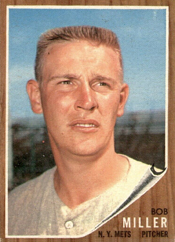
The Cardinals, who finished with an 80-74 record, 13 games out of first in 1961, lost pitcher Bob Miller to the Mets in the premium draft.

Of the six Cardinals chosen in the regular draft, pitcher Craig Anderson, catcher Chris Cannizzaro and outfielder Jim Hickman went to the Mets, and infielder Bob Lillis and outfielders Ed Olivares and Don Taussig went to the Colt .45s.

As compensation, the Cardinals received $525,000 _ $125,000 for Miller, $75,000 each for Anderson, Cannizzaro, Lillis and Taussig, and $50,000 each for Hickman and Olivares.

“The $525,000 will be needed to balance the books on a red ink season at the gate,” the St. Louis Post-Dispatch reported.

Among the available Cardinals not taken in the draft were utility player Red Schoendienst, outfielder Don Landrum and infielder Alex Grammas.

Like Miller, Grammas was made available in the premium draft. After Miller was chosen, the Cardinals were able to protect Grammas, a valued utility player.

“Grammas is important until Jerry Buchek is completely ready to take over at shortstop,” Cardinals manager Johnny Keane told the Globe-Democrat.

As for Landrum, who hit .313 in the Cardinals’ farm system in 1961, Keane said to the Post-Dispatch, “I’ll be glad to have him available as center field insurance in case anything happens to Curt Flood.”

Pitching potential

The players the Cardinals disliked losing in the draft were the two right-handed pitchers, Miller, 22, and Anderson, 23.

Miller “has all the tools to be a real good pitcher,” Keane told the Globe-Democrat. He said Anderson “has a fine potential.”

Solly Hemus, who was replaced by Keane as Cardinals manager in July 1961, had become a Mets coach and advocated for the drafting of the Cardinals pitchers.

As a rookie in 1961, Anderson was 4-3 with a save and a 3.26 ERA in 25 relief appearances for the Cardinals.

Miller, a St. Louis native, was 18 when he signed with the Cardinals on June 20, 1957, after graduating from Beaumont High School. Cardinals scout Joe Monahan rated Miller “the finest pitching prospect in the St. Louis area in all the years I’ve scouted,” The Sporting News reported.

A week after turning pro, Miller made his big-league debut with the Cardinals. Boxscore

Miller was one of two 18-year-olds on the 1957 Cardinals’ pitching staff. The other was Von McDaniel.

In four seasons (1957 and 1959-61) with the Cardinals, Miller was 9-9 with three saves and a 3.83 ERA.

Talent search

The first player selected by the Mets in the regular draft was Giants catcher Hobie Landrith, a former Cardinal. Giants shortstop Eddie Bressoud was the first choice of the Colt .45s. Bressoud finished his career in 1967 as a utility player for the World Series champion Cardinals.

The Reds, Dodgers and Pirates lost six players apiece in the draft. The Giants, Phillies and Cubs each had five players drafted.

Here, in alphabetical order, is a look at what became of the seven players drafted from the Cardinals:

_ Craig Anderson: On May 12, 1962, Anderson won both games of a doubleheader for the Mets against the Braves. Then he lost his next 16 decisions, finishing the season with a 3-17 record. Anderson’s four saves led the Mets’ staff.

_ Chris Cannizzaro: The 1962 Mets used seven catchers, but Cannizzaro played more games than any of them. Cannizzaro threw out 55.6 percent of the runners attempting to steal against him in 1962. Seven years later, Cannizzaro was with another National League expansion team, the Padres, and was their representative on the all-star team.

_ Jim Hickman: He spent five seasons with the Mets and was the franchise’s first player to hit for the cycle and to hit three home runs in a game. With the Cubs in 1970, Hickman was an all-star and hit 32 home runs with 115 RBI. He finished his career with the 1974 Cardinals.

_ Bob Lillis: He started the most games at shortstop for the 1962 Colt .45s. As Astros manager from 1982-85, Lillis had a .514 winning percentage.

_ Bob Miller: He was one of two Bob Millers who pitched for the 1962 Mets. The former Cardinal was 1-12 that season. The other Bob Miller was 2-2. St. Louis’ Bob Miller went on to pitch 17 seasons in the majors for 10 teams. With the 1964 Dodgers, he led National League pitchers in appearances (74). Miller pitched in the World Series for the Dodgers in 1965 and 1966, and for the Pirates in 1971.

_ Ed Olivares: He never got to play for the Colt .45s, or any other team in the majors, after leaving the Cardinals, but his son, Omar Olivares, pitched for the Cardinals from 1990-94. Ed and Omar Olivares were the first father and son to play for the Cardinals.

_ Don Taussig: His one home run for the 1962 Colt. 45s came against the Cardinals’ Larry Jackson and was the winning run in a 4-3 victory. Boxscore

Read Full Post »

The Cardinals’ climax to a year of strangeness was fittingly bizarre.

On Oct. 2, 1981, the Cardinals’ chances of reaching the playoffs evaporated in the ninth inning of a game played in a mostly empty stadium on a night with the feel of winter in Pittsburgh.

After the Cardinals came from behind with a pair of home runs in the top of the ninth to tie the score, the last-place Pirates got a run in the bottom half of the inning against the National League’s best closer and won, 8-7.

The loss dropped the Cardinals 1.5 games behind the first-place Expos with two left to play. The Expos clinched the division title the next day, beating the Mets.

In a year when baseball made a sick joke of the season _ foreshadowing a series of decisions that purposely devalue regular-season excellence and reward mediocrity _ the Cardinals finished the 1981 schedule with the best record in the National League East and were excluded from the farce called the postseason.

Bonehead baseball

After major-league players went on strike in June 1981 and ended the walkout in August, those who run baseball decided to have two regular seasons in 1981. All division leaders at the time the strike began were declared champions of the first season. The second season consisted of games played after the strike. Like with the first season, those who finished in first place in a division went to the playoffs.

It didn’t matter to baseball officials that all teams didn’t play the same number of games in either season, or that some played more road games than home games. Baseball held an expanded playoffs _ with four division champions in each league instead of two _ and hoped the manufactured excitement would make fans forget being spat on by the strike.

The Cardinals (30-20) placed second to the Phillies (34-21) in the East Division in the first season.

With three games remaining in the second season, the Cardinals (27-22) trailed the first-place Expos (28-22) by a half-game. The Cardinals closed with a series at Pittsburgh versus the Pirates while the Expos were at New York against the Mets.

Winter wonderland

The series opener at Pittsburgh’s Three Rivers Stadium was played on a Friday night when the temperature at game time was 39 degrees and the wind chill made it feel like 25.

“A swirling wind made pop-ups adventurous, and intermittent drizzle felt like snowflakes,” the Pittsburgh Press reported.

According to the Pittsburgh Post-Gazette, “The weather conditions were fitting for a Steelers playoff game in late December.”

A mere 2,348 spectators attended in a stadium with capacity for 47,971. It was the smallest attendance for a Pirates game since the stadium opened in 1970.

The brand of baseball the frozen faithful witnessed that Friday night caused shivers, too. The Pirates made four errors, one more than the Cardinals.

“Even on ordinary plays, balls popped out of gloves like in a game of flip,” the Pittsburgh Press noted. “There were more drops than in an eye doctor’s office.”

Blaming the weather, Pirates manager Chuck Tanner said, “Hard gloves and cold hands produce a lot of errors.”

Cardinals catcher Darrell Porter suggested frayed nerves played a factor, too. “I wouldn’t say we’re tight, but we haven’t played like we’re in a pennant race,” Porter said.

Coming back

Trailing 7-2, the Cardinals scored three in the sixth to get within two.

In the ninth, George Hendrick led off with a home run against Rod Scurry, working his third inning of relief, but the next two batters made outs.

Porter was the Cardinals’ last hope. After he fell behind in the count, 1-and-2, Porter pounced on an inside fastball.

“I don’t know if I’ve ever hit a ball better than that,” Porter told the St. Louis Post-Dispatch.

The ball barely stayed inside the foul pole but cleared the wall in right by plenty for a home run, tying the score at 7-7.

“When something like that happens, you think you’re going to win,” Porter said to the Pittsburgh Post-Gazette.

Especially, Porter might have added, when the Cardinals had Bruce Sutter to pitch the bottom of the ninth.

Sutter led the National League in saves for the third consecutive year in 1981.

Walks will haunt

Speedster Omar Moreno led off the ninth for the Pirates and drew a walk. After Tim Foli’s sacrifice bunt moved Moreno to second, Sutter gave an intentional pass to Dave Parker.

Mike Easler batted next. He played in the Cardinals’ farm system in 1976, and he would become the Cardinals’ hitting coach for three years when Tony La Russa was manager.

With the count 2-and-2, Easler sliced a double to left-center, scoring Moreno with the winning run. Boxscore

“Sutter has to pitch low to be effective,” Easler told the Pittsburgh Press. “His pitches dropped a foot. The one I hit did, too, only it was high and dropped right into my swing.”

Flim-flam

In its game story, the Pittsburgh Press declared, “The Pirates didn’t bury the Cardinals. The Cardinals picked up the shovel, dug the hole and jumped in.”

The loss to the Pirates, coupled with the Expos’ 3-0 victory that night, meant the Expos would have to lose their remaining two games for the Cardinals to have a chance to finish atop the division. It didn’t happen. The Expos finished (30-23) a half-game ahead of the Cardinals (29-23).

The Cardinals completed the 1981 schedule with the best overall record in the East Division at 59-43, two games ahead of the Expos (60-48) and 2.5 ahead of the Phillies (59-48).

The Reds had the best overall record in the West Division at 66-42, but, like the Cardinals, didn’t finish atop the division in either season, and didn’t get into the 1981 playoffs.

Incredibly, baseball devised a system in which four National League teams got into the 1981 playoffs, but excluded the two with the best overall records.

Whitey Herzog, who served the dual roles of Cardinals manager and general manager, said baseball’s hierarchy were “dumb dips,” The Sporting News reported.

“This second season is a farce,” Herzog said. “As good as the game was, I can’t believe they messed with it. You wonder why you beat your brains out.”

Since then, baseball has continued to dilute the regular season. Now, a team with the fifth-best record in its league qualifies for the playoffs.

It will get worse. Team owners want to expand the playoffs, following the model from 2020, when 16 teams qualified after the regular season was reduced because of the pandemic. Two of the playoff qualifiers had losing records. Three others, including the Cardinals, who didn’t even play all their scheduled games, got in by finishing two wins over .500.

Read Full Post »

Though he no longer was with the Cardinals, Mort Cooper prevented their elimination from the 1946 pennant race.

On Sept. 29, 1946, the Cardinals and Dodgers entered the final day of the season tied for first place in the National League.

The Cardinals lost to the Cubs at St. Louis that Sunday, but dodged elimination because Cooper, their former ace, pitched a four-hit shutout for the Braves and beat the Dodgers at Brooklyn.

The losses left the Cardinals and Dodgers tied for first place with 96-58 records, necessitating an unprecedented best-of-three playoff series to determine the league champion. The Cardinals prevailed and advanced to the World Series, beating the Red Sox for the title.

Big winner

A husky right-hander, Cooper got to the big leagues with the Cardinals in September 1938 and became a mainstay of their starting rotation. With his younger brother, Walker, doing the catching, Mort helped the Cardinals win three National League pennants and two World Series championships from 1942-44.

Mort earned the National League Most Valuable Player Award in 1942 when he was 22-7 with a 1.78 ERA. He followed that with a 21-8 record and 2.30 ERA in 1943 and 22-7 and 2.46 in 1944.

In 1945, Cooper got crossways with Cardinals owner Sam Breadon regarding salary. Breadon responded by trading Cooper to the Braves in May 1945.

After the season, manager Billy Southworth departed the Cardinals for a more lucrative offer from the Braves. Eddie Dyer replaced him and led the Cardinals through a season-long pennant fight with the Dodgers in 1946.

Tough task

On Sept. 26, 1946, Cooper pitched a three-hit shutout against the Giants, boosting his season record to 12-11. Boxscore

Three days later, on the morning of the season finale against the Dodgers, Southworth met Cooper for breakfast. According to the Boston Globe, Southworth asked Cooper, “How about pitching this last one?”

Though Cooper, 33, had just two days rest since beating the Giants, he replied, “Sure, I’ll pitch it _ and more than that. If the club will get me two runs, I’ll guarantee to win.”

According to the Associated Press, Cooper, well aware a Dodgers loss would enable the Cardinals to clinch the pennant if they beat the Cubs, sent a telegram to President Harry Truman, a fellow Missourian: “You try and pull the Cards in today. I will try to beat the Dodgers.”

Based on his season performance, Cooper’s task was formidable. He was 0-4 with a 6.48 ERA against the Dodgers in 1946. “We have taken him apart all year,” Dodgers manager Leo Durocher said to the Brooklyn Daily Eagle.

Dyer told the Associated Press, “I didn’t see how Mort Cooper could beat the Dodgers with only two days of rest.”

Furthermore, the Dodgers chose as their starter Vic Lombardi, who was 3-0 with an 0.67 ERA versus the 1946 Braves. 

Doing it all

A raucous crowd of 30,756 filled Ebbets Field nearly to capacity on an overcast afternoon.

“Money rode on each pitch, and the nervous tension, like the gray haze that hung over the field, could almost be cut with a knife,” Dick Young wrote in the New York Daily News.

Cooper took command with his pitching as well as his hitting. He singled and scored in the third, giving the Braves a 1-0 lead.

The Dodgers’ lone threat came in the eighth. With one out, Bruce Edwards reached on an error. After Cooper’s former Cardinals teammate, Joe Medwick, singled, moving Edwards into scoring position, “the reverberations from the stands were ear-splitting,” the Boston Globe reported,

Cooper, though, was “all icicles,” and retired the next two batters. In the ninth, the Braves scored three times against the Dodgers bullpen. Cooper contributed a RBI-single, then retired the Dodgers in order for the win. Boxscore

Cooper “pitched his most elegant nine innings of the entire season,” The Sporting News declared. “Mort applied himself with a determination and technical perfection.”

Durocher told the Brooklyn Daily Eagle, “We could have batted against Cooper until midnight and still wouldn’t have scored a run off him.”

As stunned Dodgers fans started what the Brooklyn Daily Eagle described as “a mournful procession” from the ballpark, the public address announcer invited them to stay, saying updates on the Cardinals’ game would be posted on the scoreboard.

“Many hundreds did, milling around the field and the stands,” the New York Daily News reported.

Just about then, the Cardinals collapsed.

Missed opportunity

On a crisp, sunny afternoon at Sportsman’s Park in St. Louis, 34,124, the Cardinals’ biggest home crowd of the season, saw the Cubs erase a 2-1 deficit with a five-run sixth.

Eddie Waitkus started the Cubs’ rally with a double against starter Red Munger.

Complaining of a sore right elbow, Munger was lifted for Murry Dickson with two on and one out. The Cubs tied the score, 2-2, against Dickson and had the bases loaded, two outs, when starting pitcher Johnny Schmitz came to the plate.

Schmitz was “working with the discomfort of an infected left foot,” the New York Daily News reported. “He had the toe section of his shoe slashed to relieve pressure on the swelling.”

Schmitz smashed a Dickson delivery on the ground to the right of first baseman Stan Musial, who dived, gloved the ball and, while prone, made a wild toss to Dickson, who was racing Schmitz to the bag. The ball sailed high over Dickson’s head and, as the New York Daily News noted, “the Cubs ran around like rabbits with tails afire.”

Two runners scored on the play, putting the Cubs ahead, 4-2. After Harry Brecheen relieved Dickson, Stan Hack greeted him with a single, scoring two more for a 6-2 lead.

The Cardinals knew the Dodgers lost to the Braves, but they couldn’t rally against Schmitz, who pitched a complete game for the win. Boxscore

“We lost because we played bad ball,” Dyer said to the Associated Press. “Nobody can call it bad luck.”

Happy ending

Back in Brooklyn, the faithful who gathered around the Ebbets Field scoreboard “went into ecstasy” when the final from St. Louis was posted, the Boston Globe reported.

“Hearing how the Cubs went to work on the Cards was like getting a reprieve from the electric chair,” Durocher said to the Brooklyn Daily Eagle.

According to the St. Louis Globe-Democrat, Cardinals fans trudged out of Sportsman’s Park “wreathed in gloom.”

“They brought cowbells, horns, drums, tin pans and other jingle-jangle equipment to celebrate,” Sid Keener of the St. Louis Star-Times noted, but departed “without a single toot-toot.”

That night, President Truman sent a telegram reply to Mort Cooper: “Congratulations, Mort. You did a better job than I did.”

Two days later, on Oct. 1, the Cardinals beat the Dodgers, 4-2, in the opener of the playoff series at St. Louis. Howie Pollet pitched a complete game and Joe Garagiola contributed two RBI and three hits. Boxscore

The Cardinals clinched the pennant on Oct. 3 in Brooklyn with an 8-4 victory. Murry Dickson started and got the win. Boxscore

Read Full Post »

Joe Hague experienced a shining moment late in a bleak season with the Cardinals.

On Sept. 24, 1971, Hague hit a 10th-inning walkoff grand slam, giving the Cardinals a 10-6 victory over the Expos.

A left-handed batter who was the Cardinals’ Opening Day first baseman for three consecutive seasons (1970-72), Hague did his best hitting against the Expos.

Decision time

A son of a career military man, Hague was born in Huntington, W.Va., and grew up in El Paso, Texas. After excelling in multiple high school sports, he played football and baseball as a freshman at the University of Texas.

Football coach Darrell Royal wanted him to quit baseball, Hague told the St. Louis Post-Dispatch. Instead, he quit football.

“I had to make a decision that season,” Hague recalled to the Montreal Gazette. “I was playing defensive end in football and weighed 218, but I had a lot to learn. I figured the minuses were greater for me in football and I gave that up to concentrate on baseball. It was a difficult decision.”

Hague played varsity baseball for coach Bibb Falk, a former big-leaguer. He led Texas in hitting in 1965, but was overlooked in the major league draft. “I was so musclebound,” Hague explained to the Post-Dispatch, “I couldn’t pull the ball.”

In the summer of 1965, Hague slimmed down and played for Galesburg in the Central Illinois Collegiate League. He led the league in batting average, home runs and RBI, drawing the attention of Cardinals scout Fred McAllister. A Stan Musial fan as a kid, Hague signed with the Cardinals in August 1965.

Prospect with power

In his first time at-bat in a regular-season game as a professional in 1966, Hague hit a grand slam for Cedar Rapids, a Class A farm team. The next year, he produced 27 home runs and 95 RBI for Class AA Arkansas.

Warren Spahn was the manager when Hague reported to Class AAA Tulsa in 1968. “I’m really pleased with Hague,” Spahn told the El Paso Herald-Post. “He’s as tough as a bull.”

Hague hit .293 with 23 home runs and 99 RBI for Tulsa, and was rewarded with a promotion to the Cardinals in September 1968. He got into seven games for the National League champions and got his first big-league hit, a home run versus the Dodgers’ Bill Singer. Boxscore

In 1969, Hague, 25, made the Cardinals’ Opening Day roster as a reserve, struggled, got sent back to Tulsa in June, hit .332 and returned to the big leagues in September.

When Mike Shannon needed treatment for a kidney ailment in 1970, the Cardinals moved Dick Allen to third base, opening the first base job for Hague.

Bob Broeg of the Post-Dispatch described Hague as “an intense young man who often tries to squeeze the bat handle into sawdust.”

Besides the pressure he put on himself, Hague felt pressure from the Cardinals’ staff. According to The Sporting News, hitting coach Dick Sisler called Hague “a blockhead because he is receptive to advice but he won’t put it into practice.”

Years later, recalling his Cardinals career, Hague told the Cincinnati Enquirer, “They were always checking weight and had me worrying about it. They changed the way I stood at the plate. You see how high I’m holding the bat here? They wouldn’t let me do that in St. Louis. If I have my hands down, I have a tendency to over-stride.”

Hague played in 139 games for the 1970 Cardinals, making 67 starts at first base, 44 in right field and five in left. He also hit .412 as a pinch-hitter. Overall, Hague hit .271 with 68 RBI, but was ineffective (.190) versus left-handers.

French connection

Hague was the incumbent first baseman in 1971.

Though Ken Boyer replaced Dick Sisler as hitting coach, and the Cardinals contended for a division title, the season was a disappointment for Hague, a frustratingly streaky hitter.

One source of encouragement was the Expos. Against them, Hague played like an all-star. For instance:

_ In 1970, Hague hit .355 in 17 games versus the Expos. His on-base percentage was .452 (22 hits and 11 walks) against them.

_ In 1971, Hague hit .354 in 18 games versus the Expos. His on-base percentage was .419 (23 hits and eight walks) against them.

On May 10, 1971, Hague, batting .169 for the season, hit a pair of home runs versus the Expos’ Steve Renko at Montreal. He barely missed hitting a third. Batting with the bases loaded in the seventh, Hague walloped a Mike Marshall screwball far down the line but foul. Boxscore

Four months later, Hague faced Marshall again with the bases loaded in the 10th inning at St. Louis. He drove Marshall’s first pitch over the wall in right for his first grand slam in the majors.

Hague’s blast was the Cardinals’ only grand slam of the season and the fourth walkoff grand slam in franchise history.

“I was glad to chip in a little bit,” Hague said to the Post-Dispatch. “I haven’t done much this year.”

Expos manager Gene Mauch unsuccessfully tried to get umpires to credit Hague with a single instead of a home run, saying Hague passed Jose Cruz on the basepath when Cruz stopped to shake Hague’s hand as Hague rounded first.

“Anybody who passes a runner doesn’t deserve a home run,” Mauch harrumphed to the Post-Dispatch.

Cardinals manager Red Schoendienst said, “I told Jose to shake hands at home plate the next time.”

Pennant winner

Hague hit .226 with 16 home runs for the 1971 Cardinals. His batting average against left-handers was .180. Hague made 64 starts at first and 33 in right.

Speculation was the Cardinals might trade him.

“If I had to be traded, I would like to go to Montreal,” Hague said to the Montreal Gazette. “I have always hit well in that park.”

Unmoved, Mauch replied, “It seems he hits .600 against us, so he can’t be hitting anything against the rest of the league. I don’t need that.”

Hague was the Cardinals’ first baseman when the 1972 season opened, but Schoendienst told The Sporting News, “This is going to have to be Hague’s year. He’s probably going to have to make it or break it.”

Hague was hitting .237 on May 19, 1972, when the Cardinals traded him to the Reds for Bernie Carbo.

Noting that Cardinals owner Gussie Busch demanded the trades of Steve Carlton and Jerry Reuss earlier in the year, Hague took a shot on his way out, telling the Post-Dispatch, “Mr. Busch is more concerned about personalities than he is building a winning ballclub.”

The 1972 Reds, a contender in the West Division, had a prominent Cardinals connection. Their general manager, Bob Howsam, was Cardinals general manager when Hague signed with them. Other former Cardinals on the 1972 Reds included Bobby Tolan, Julian Javier, Pedro Borbon and Ed Sprague.

Acquired to be a role player, Hague hit .345 as a pinch-hitter for the 1972 Reds, who won the division title.

In the 1972 National League Championship Series against the Pirates, Hague made three plate appearances as a pinch-hitter, walked twice and struck out.

In the 1972 World Series versus the Athletics, Hague again made three plate appearances as a pinch-hitter and all came against future Hall of Famers.

Hague flied out facing Catfish Hunter in Game 2, and grounded out versus Rollie Fingers in Game 5.

In Game 7, Hague faced Fingers again. Batting with runners on second and third, none out, with the Reds behind by two in the eighth, Hague popped out to shortstop Bert Campaneris. The Athletics won, 3-2. Boxscore

The next year, Hague dislocated his right hand in June, got replaced on the roster by Dan Driessen and never returned to the big leagues.

Hague, 30, played his last season in 1974 in the Mexican League for Yucatan, a club managed by Julian Javier.

After baseball, Hague earned a bachelor’s degree in business and went into commercial real estate in San Antonio, according to the El Paso Times.

Read Full Post »

Feeling ridiculed by the needling he got from former Cardinals teammates, Tim McCarver lashed out at a friend, Lou Brock, and started a fistfight with him.

On Sept. 6, 1971, during a game between the Cardinals and Phillies at Philadelphia, McCarver punched Brock in the face on the field at Veterans Stadium. Brock fought back, swinging at McCarver and landing a couple of shots, before they wrestled to the ground and were separated.

The sight of influencers from Cardinals glory days tearing into one another was, as broadcaster Jack Buck put it, “a bit sickening,” St. Louis Post-Dispatch columnist Bob Broeg noted.

A week later, McCarver and Brock got physical again _ not in a fight, but in a jarring collision at home plate. 

Sticks and stones

Brock and McCarver were integral players on Cardinals clubs that won three National League pennants and two World Series titles in the 1960s. After the 1969 season, McCarver was traded to the Phillies.

On Sept. 6, 1971, the Cardinals and Phillies had a Monday night doubleheader in the City of Brotherly Love. The opener matched pitchers Bob Gibson of the Cardinals against Rick Wise. Brock, the Cardinals’ left fielder, was in his customary leadoff spot. McCarver was the Phillies’ catcher and batted second.

The game was scoreless in the third when Brock led off with a single and stole second. After Ted Sizemore coaxed a walk, Matty Alou hit a pop fly in foul territory near the Cardinals’ dugout. McCarver dropped it for an error.

Cardinals manager Red Schoendienst told the Post-Dispatch, “McCarver was mad because of missing that pop-up.”

From the dugout and from the basepaths, Cardinals players heckled McCarver about botching the play.

“To say there was a little noise drifting out of the Cardinals’ dugout whenever McCarver was in earshot thereafter is to put it mildly,” the Philadelphia Daily News noted.

Cardinals first-base coach George Kissell said, “They were getting on Tim pretty good.”

Given the chance to continue his plate appearance, Alou drew a walk, loading the bases.

The next batter, Joe Torre, singled, scoring Brock and Sizemore. In his book, “Oh, Baby, I Love It,” McCarver said, “I was still burning from my error.”

When Brock got to the dugout, he continued to taunt McCarver, who had allowed more steals than any other National League catcher in 1971.

“Brock kept trying to show me up,” McCarver told the Post-Dispatch. “When Torre was on first base, Brock was yelling, ‘There he goes! There he goes!’ “

As The Sporting News noted, “The inference was McCarver’s arm was so bad that he couldn’t even throw out a slow runner like Torre.”

In his book, McCarver said, “I really snapped … I took my catching and throwing seriously.”

Unsympathetic, Schoendienst told the Post-Dispatch, “It’s not anyone else’s fault that McCarver can’t throw anybody out.”

Brock said to Philadelphia Inquirer columnist Frank Dolson, “Yelling, ‘There he goes!’ shouldn’t be enough to upset McCarver, who is one of the biggest agitators in the game.”

According to George Kissell, McCarver yelled to Brock, “We’re going to stick one in your ear.”

While McCarver stewed, Wise unraveled. He gave up a RBI-double to Ted Simmons and a three-run home run to Joe Hague before being replaced by rookie Manny Muniz.

McCarver’s miscue had opened the gates to a 6-0 Cardinals lead. Adding to the embarrassment, his former teammates laughed at him, he told the Post-Dispatch.

“Guys beating you 6-0 know better than to laugh at you,” McCarver said to the Philadelphia Inquirer.

Regarding Brock, McCarver told Stan Hochman of the Philadelphia Daily News, “We played together long enough and he knows my boiling point … I just don’t like to be shown up.”

Macho man

Brock was the first batter for the Cardinals in the fourth. In his book, McCarver said, “I encouraged my pitcher, Manny Muniz, to intimidate Lou.”

“The first pitch crowded Brock back from the plate,” the Post-Dispatch reported. “The second pitch, another inside serve, also made him give ground.”

Brock took two or three steps in the direction of the mound. McCarver followed and heard Brock shout something to Muniz.

“I just asked Muniz, ‘What’s going on?,’ ” Brock said to the Post-Dispatch. “The kid was making me a dartboard.”

According to the Philadelphia Daily News, McCarver said Brock warned Muniz he’d come after him if another pitch came close.

“No, you’re not,” McCarver replied to Brock.

Brock turned and headed to the plate, his arms at his sides, when McCarver punched him.

“A sucker punch,” George Kissell told the Post-Dispatch.

“It was a sucker punch,” Bob Gibson agreed, “and I didn’t think much of it.”

Brock retaliated, landing a couple of punches, and then grabbed McCarver. They fell to the ground before being pulled apart by teammates.

“I’ve known McCarver since he was a kid, but I lost a lot of respect for him tonight,” Kissell said to the Post-Dispatch. “He shouldn’t let his emotions take over like that.”

What are friends for?

McCarver was ejected by plate umpire Al Barlick.

“I’m sorry the thing happened, but I felt I was right when I did it,” McCarver said to the Philadelphia Daily News. 

In his book, McCarver added, “I can’t say I’m proud of what I did, but I do have to say that put in the same situation I’m sure I would react the same way.

“In moments like that, however irrationally, your instincts simply take over.”

Brock told the Philadelphia Daily News, “I was surprised Tim punched at me, but sometimes these things just explode. Tim’s too much of a pro to do what he did, but when there’s a feeling of frustration you do strange things. I have no hard feelings against him.”

McCarver said, “As far as I’m concerned, it’s all over. He’s a good friend of mine.”

Long may you run

After McCarver’s ejection, Brock continued his plate appearance versus Muniz, drew a walk and swiped second against McCarver’s replacement, Mike Ryan.

Leadng off the bottom of the fourth, Ryan was the first batter Bob Gibson faced after the fight. Gibson’s first pitch to Ryan sailed over his head.

In the sixth, Brock reached on an error, stole second and was thrown out by Ryan attempting to steal third.

An inning later, the Phillies brought in their third-string catcher, rookie Pete Koegel, after Ryan was injured. Brock swiped second _ his fourth steal of the game _ against Koegel in the eighth. Boxscore

Encore performances

The next night, Sept. 7, the Cardinals and Phillies played the series finale, and emotions remained raw.

In the first inning, Brock walked, tried to steal second and was thrown out by McCarver.

Brock noted to the Post-Dispatch, “He threw me out trying to steal, and I didn’t go punching him.”

McCarver countered to the Philadelphia Daily News, “I threw him out, and I didn’t go prancing over to the dugout like King Kong.” Boxscore

Six days later, on Sept. 13, the Phillies were in St. Louis for a two-game series.

Before the opener, Bob Broeg asked McCarver whether he regretted punching Brock. McCarver replied, “From practically the very minute I threw the punch. It was, I’m afraid, a sucker punch and I’m not proud of it.”

McCarver added, “I was agitated and apparently misunderstood something Lou had said … I like to think that out of this unfortunate flare-up we’re better friends than before. I hope so.”

In that night’s game at Busch Memorial Stadium, McCarver “was lustily booed by a crowd that used to adore him,” the Philadelphia Daily News reported.

McCarver produced three hits, scored twice and threw out Dal Maxvill attempting to steal. Boxscore

Storybook stuff

Hollywood would have a tough time coming up with a better script for what happened in the Sept. 14 series finale.

In the first inning, Brock was awarded first base on catcher’s interference when McCarver accidentally tipped his bat. Brock stole second and advanced to third on McCarver’s errant throw. Matty Alou’s infield out scored Brock.

In the ninth, the Phillies led, 5-4, but the Cardinals had Brock on third with one out and their top run producer, Joe Torre, at the plate.

Facing Chris Short, Torre hit a fly ball to medium right. Willie Montanez, a former Cardinals prospect, caught it for the second out. Brock tagged and sped for the plate, trying to score the tying run.

The throw reached McCarver on a hop. McCarver snared it and spun around to tag Brock, who was barreling toward him.

“Brock went into McCarver like a NFL bomb-squader goes into a punt returner,” Bill Conlin wrote in the Philadelphia Daily News. “The collision was tremendous, McCarver getting flipped over backwards, Brock landing in a heap on the first-base side of the plate.”

McCarver held onto the ball and Brock was called out by umpire John McSherry, ending the game. Boxscore

As Phillies players congratulated McCarver, he “broke away from them and went for Brock, grabbed his hand and shook it,” the Philadelphia Daily News reported.

“I told Lou to have a nice winter,” McCarver said.

Read Full Post »

« Newer Posts - Older Posts »