Feeds:
Posts
Comments

Archive for the ‘Opponents’ Category

Hank Aaron, baseball’s all-time leader in RBI, was at his run-producing best against the Cardinals.

Aaron is remembered most for hitting 755 home runs and breaking Babe Ruth’s all-time record. Just as impressive, but often overlooked, is that Aaron has more RBI (2,297), more total bases (6,856) and more extra-base hits (1,477) than anyone who played in the majors.

A right-handed batter who played 21 seasons for the Braves and two for the Brewers, Aaron had more career RBI (290) versus the Cardinals than he did against any other foe.

The most RBI Aaron had in a game was six. He did it six times, the last coming against the Cardinals.

Hot hitter

The Cardinals and Braves both were in third place in their divisions entering a game on Aug. 21, 1971, at Atlanta.

Aaron had a troublesome right knee and had been shifted from the outfield to first base to replace Orlando Cepeda, the former Cardinal who was sidelined after having knee surgery.

Though 37, Aaron hit “as if he were 27,” The Sporting News noted. From July 19 to Aug. 15, he had a 22-game hitting streak.

Aaron entered the game against the Cardinals with a batting average for the season of .313. A month earlier, at the All-Star Game, he noticed Willie McCovey was wearing a knee brace. “He said it helped him,” Aaron said, “and his knee is a lot worse than mine.” Aaron started wearing a brace ‘and it has helped a lot,” he told The Sporting News.

Starry night

Steve Carlton was the Cardinals’ starting pitcher in the Saturday night game against the Braves. Carlton was one of six future Hall of Famers who played in that game. The six were Aaron and Tony La Russa for the Braves, and Lou Brock, Joe Torre, Ted Simmons and Carlton for the Cardinals. La Russa and Torre are in the Hall of Fame as managers. The others are in as players.

The Cardinals struck first, scoring three in the fourth. The Braves got a run in the bottom of the inning on Aaron’s RBI-single. They tied the score, 3-3, in the sixth when Aaron hit a Carlton changeup over the wall in left for a two-run home run.

In the seventh, the Braves took charge, scoring five times for an 8-3 lead. The key hit again came from Aaron, who sent a high curve from Carlton over the wall in right for a three-run home run. 

“Anytime you have a night like this against a guy like Carlton you know he’s just making mistakes,” Aaron told the St. Louis Post-Dispatch. “He’s a guy who has great stuff.”

The Braves went on to an 8-5 victory in a game played in one hour, 59 minutes. Boxscore

Real deal

Aaron’s six RBI gave him a career total of 1,935 and moved him ahead of Ty Cobb for fourth all-time. Cobb was thought to have 1,933 RBI then. Cobb’s total since has been adjusted to 1,944, according to baseball-reference.com

The pair of home runs against Carlton put Aaron at 627 for his career. He hit a total of six versus Carlton and his lifetime batting mark against him was .342.

Only the Reds (97) and Dodgers (95) gave up more home runs to Aaron than the Cardinals did (91).

In 354 games versus the Cardinals, Aaron produced 290 RBI and hit .308.

Aaron finished the 1971 season with 47 home runs and 118 RBI. It was his 11th and last season of 100 RBI or more. In 11 games against the Cardinals in 1971, Aaron had 16 RBI and hit .439. His on-base percentage against them that season was .521.

As Braves pitcher George Stone said to the Atlanta Constitution, “That guy is unreal.”

Read Full Post »

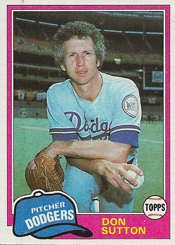
Don Sutton pitched some gems against the Cardinals, but they deprived him of the win he wanted most.

Sutton was a consistent winner. He is tied with Nolan Ryan for 14th all-time in wins (324). He had 18 regular-season wins versus the Cardinals, including seven shutouts. Sutton came up empty, though, when he faced them in the 1982 World Series.

A member of the Baseball Hall of Fame, Sutton died on Jan. 18, 2021, at 75. 

Rookie success

After graduating from high school in Pensacola, Fla., Sutton, a right-hander, signed with the Dodgers as an amateur free agent at age 19 in 1964. Two years later, he was part of a Dodgers starting rotation with Don Drysdale and Sandy Koufax.

On June 2, 1966, Sutton faced the Cardinals for the first time. He pitched 6.2 scoreless innings at St. Louis and got the win. Boxscore

“He’s the most developed young pitcher I’ve ever seen,” Dodgers reliever Bob Miller, a former Cardinal, told the St. Louis Post-Dispatch. “He has a good idea of what he’s going to do every pitch.”

According to the Post-Dispatch, Sutton threw a fastball, slider and curve. The curve was delivered at three different speeds. Cardinals batters Curt Flood and Bob Skinner said Sutton also threw a spitter. For the rest of his 23-year career in the majors, Sutton faced allegations of doctoring the ball.

Old school

In 1968, when the Cardinals were National League champions for the second consecutive year, Sutton was 3-1 with a 1.82 ERA against them.

Two years later, the Cardinals got one of their most satisfying wins against Sutton.

On Aug. 28, 1970, at Los Angeles, Sutton and Cardinals rookie Jerry Reuss were locked in a scoreless duel for eight innings. In the ninth, Joe Torre hit a home run, giving the Cardinals a 1-0 victory. Boxscore

Two weeks earlier, Sutton had been rocked for six runs in two innings in a start at St. Louis. Jose Cardenal and Dal Maxvill had key hits against him.

When Sutton faced the Cardinals again at Dodger Stadium, he hit Cardenal in the hand with a pitch in the first inning. In the second, Maxvill hit the dirt to avoid being struck by Sutton’s fastball.

Reuss retaliated, throwing a pitch behind Sutton and at the level of his head. Sutton found his control after that.

In the ninth, Torre led off and worked the count to 3-and-2. Sutton threw a fastball into the heart of the strike zone and Torre walloped it over the wall in center.

“I was trying to keep from walking Torre and I was trying not to give him anything good to hit,” Sutton said. “That’s a tough situation.”

For Torre, who arrived in the majors 10 years earlier, it was just the third home run he hit at Dodger Stadium. The others came against Koufax and Drysdale.

Torre hit five home runs versus Sutton in his career.

Good stuff

Sutton was 3-0, with two shutouts, and a 1.33 ERA against the Cardinals in 1976.

The Dodgers and Mets were in serious talks during spring training that year about a trade of Sutton for Tom Seaver, the Los Angeles Times reported. The Mets backed away when they and Seaver agreed on contract terms.

On April 29, 1976, Sutton pitched a five-hit shutout against the Cardinals at Los Angeles. It gave him 41 career shutouts, one more than Koufax. Boxscore

Asked how Sutton was able to stop a Cardinals lineup with nine left-handed batters, slugger Reggie Smith told the Post-Dispatch, “When you have good stuff, it doesn’t matter who you’ve got in there.”

Smith’s teammate, Lou Brock, countered, “Yeah, he’s good as long as he has the Vaseline pitch going. He threw me a good one.”

Two weeks later, at St. Louis, Sutton pitched another five-hit shutout. Boxscore

Sutton’s third win against the 1976 Cardinals was an unusual one for him. In the Dodgers’ last game before the all-star break, manager Walter Alston asked Sutton whether he could pitch in relief that afternoon at St. Louis. Sutton hadn’t made a relief appearance in five years. “What could I say except, ‘OK, Skip,’ ” Sutton recalled.

Sutton entered the game in the seventh, pitched three innings and got the win, his first as a reliever since 1968. Boxscore

Series showdowns

On July 14, 1978, Sutton, trying for his 200th career win, was ejected from a game against the Cardinals at St. Louis. Umpire Doug Harvey tossed Sutton “for pitching a defaced baseball.” Harvey had three scuffed baseballs as evidence. Boxscore

Sutton became a free agent after the 1980 season and signed with the Astros. They traded him to the Brewers in August 1982. On the final day of the regular season, Sutton beat the Orioles, clinching a division title for the Brewers. He also got a win in the American League Championship Series versus the Angels.

The Brewers advanced to play the Cardinals in the World Series. They won the opener, 10-0, and started Sutton against rookie John Stuper in Game 2 at St. Louis. Sutton had leads of 3-0 and 4-2, but the Cardinals tied the score on Darrell Porter’s two-run double in the sixth. Sutton was lifted and the Cardinals went on to win. Boxscore and Video

Asked by the Post-Dispatch about Porter’s key hit, Sutton replied, “A good piece of hitting. That’s why he is so well-respected by those of us who stand in the middle of the mound.”

The Brewers won two of the next three, giving them a chance to clinch the championship in Game 6 at St. Louis. The matchup again was Sutton versus Stuper.

With the Dodgers, Sutton played for four league champions (1966, 1974, 1977 and 1978) but none won a World Series crown. At 37, he finally could be part of a World Series champion if he beat the Cardinals in Game 6.

“Nothing in my life comes close in magnitude to this game,” Sutton told the Post-Dispatch.

The Cardinals made it a blowout. Porter and Keith Hernandez each hit a two-run home run against Sutton. He gave up seven runs before being lifted with one out in the fifth. Stuper pitched a four-hitter and the Cardinals won, 13-1. Boxscore and Video

“He wasn’t vintage Sutton,” said Cardinals second baseman Tommy Herr. “He was up in the strike zone a lot. He has to pitch to spots.”

Sutton told the Post-Dispatch, “I had good stuff, but bad location. I have no excuse.”

Years later, for the book “Where Have You Gone ’82 Brewers,” Sutton said, “When I got to St. Louis, I was out of gas … There wasn’t a whole lot left. That’s why I always said I wish I could have given Milwaukee younger innings in the World Series.”

Sutton continued to pitch until he was 43. His last season was in 1988 with the Dodgers. They released him in August and he was a spectator when they won the World Series championship in October.

Read Full Post »

Bernard Gilkey hoped to cap his playing career with a second stint for his hometown team, the Cardinals, but it didn’t work out.

On Jan. 5, 2001, the Cardinals signed Gilkey, a free agent, to a minor-league contract for $700,000 and invited him to spring training to try for a spot as a reserve outfielder.

The Cardinals’ top three outfielders, J.D. Drew, Jim Edmonds and Ray Lankford, all batted from the left side. A right-handed batter, Gilkey, 34, was projected as someone who could fill in against left-handed pitching.

Making his mark

Gilkey, a St. Louis native, began his career with the Cardinals and played for them from 1990-95. He had his best season as a Cardinal in 1993, hitting .305, with 40 doubles, and scoring 99 runs.

In January 1996, a month after the Cardinals acquired outfielder Ron Gant, Gilkey was traded to the Mets. He had a career year for the 1996 Mets, hitting .317, with 44 doubles and 30 home runs. He drove in 117 runs and scored 108.

The Mets traded Gilkey to the Diamondbacks in July 1998. Two months later, he had laser eye surgery to fix a retina and improve his vision.

On the outs

In February 1999, the Diamondbacks and Pirates agreed to a trade of Gilkey for Al Martin and Tony Womack.

One issue needed to be resolved for the trade to be completed: the clubs wanted to revise terms about deferred money in Gilkey’s contract. The revision required Gilkey’s approval in order for the trade to go through.

According to the Pittsburgh Post-Gazette, “that deferred money, $5 million paid into an annuity that will pay Gilkey $1 million a year for 25 years, was the rub in this trade.”

The Diamondbacks came up with a new plan for paying the deferred money, but Gilkey rejected it and refused to approve the trade.

Two days later, the Pirates sent Womack to the Diamondbacks for a pair of prospects.

Womack, who played second base for the Pirates, was put in right field by the Diamondbacks and Gilkey was moved to the bench.

A year later, Gilkey seldom played and struggled to hit. In one miserable stretch, he had one hit in 47 at-bats.

“It was just like I wasn’t part of the team,” Gilkey told the St. Louis Post-Dispatch. “There’s only so much cheering you can do.”

In June 2000, with his batting average for the season at .110, Gilkey was released. A few days later, the Red Sox signed him. Gilkey hit .231 in 36 games for the 2000 Red Sox and became a free agent after the season.

Good opportunity

The Cardinals got a good report on Gilkey from Red Sox assistant general manager Lee Thomas, who was director of player development for the Cardinals in 1984 when Gilkey first signed with them as an amateur.

“I think he’s got enough left where he could be a productive player off the bench,” Thomas told the Post-Dispatch.

Gilkey was one of several free-agent outfielders signed by the Cardinals in January 2001 to compete for spots as reserves. Others included Bobby Bonilla and John Mabry.

Regarding his return to the Cardinals, Gilkey said, “When I got the opportunity, I thought the baseball gods were back on my side.”

Gilkey said he was motivated to keep playing because he wanted to regain respect he thought had been lost. “I’m playing for pride now,” he said.

No vacancy

The Cardinals gave Gilkey a long look at spring training in Florida. The emergence of rookie Albert Pujols provided more competition for the outfield spots on the roster.

Before opening the season in Denver, the Cardinals went to Oakland and Seattle to play exhibition games. Gilkey made the trip, along with Bonilla, Mabry and Pujols. The Cardinals figured to keep two of the four as outfielders on the Opening Day roster. Drew, Edmonds and Lankford had locks on the other outfield spots.

On April 2, the eve of the 2001 season opener, the Cardinals put Mabry and Pujols on the roster, placed Bonilla on the disabled list and released Gilkey. According to the Post-Dispatch, Gilkey batted .196 in spring training exhibition games, but hit the ball better than the average showed.

“Gilkey had a pretty good spring training,” Cardinals manager Tony La Russa said. “He just had some guys do better.”

Gilkey said, “It’s just the way the ball bounces. I don’t feel like I was deprived or deceived or anything like that.”

Still in the game

According to the Post-Dispatch, Gilkey had indicated he might retire if he didn’t get a spot on the Cardinals’ roster, but the Braves contacted him and made a convincing pitch. “They told me there was a very good chance things would work out,” Gilkey said.

On April 12, 2001, Gilkey signed a minor-league contract with the Braves. He went to their Richmond farm team and hit .271 in 13 games.

The Braves called up Gilkey on May 4 when they were in Atlanta for a series against the Cardinals. 

“I thought I had a pretty decent spring training,” Gilkey told the Atlanta Constitution, “but when I went down to Richmond I got a lot of at-bats, so that helped.”

In his Braves debut, Gilkey was sent into the May 4 game against the Cardinals in the ninth inning. Dave Veres struck him out on a split-fingered pitch to end the game. Boxscore

The next night, manager Bobby Cox started Gilkey in left field and batted him seventh in the order. Gilkey responded with two hits, including a two-run home run, against starter Rick Ankiel in a 6-5 victory for the Braves. Boxscore

“Without that home run, we wouldn’t be quite so happy right now,” Cox said.

Gilkey hit .274 in 69 games for the 2001 Braves, who qualified for the playoffs and reached the National League Championship Series before being defeated by the Diamondbacks.

Read Full Post »

Throughout his career in the major leagues, Miguel Batista created drama and suspense in connection with the Cardinals. It was precisely what might be expected from a pitcher who was a novelist.

On Jan. 14, 2011, the Cardinals signed Batista, a free agent, to a minor-league contract and invited him to their spring training camp. Batista, 40, earned a spot on the 2011 Cardinals’ Opening Day roster as a reliever.

The notion of Batista becoming a Cardinal might have seemed unimaginable to some who remembered him as a villain when he played for the Diamondbacks. Batista beat the Cardinals in the 2001 playoffs. Two years later, he was the instigator in an Easter Sunday brawl at Busch Memorial Stadium in St. Louis.

Mixed emotions

A right-hander from the Dominican Republic, Batista debuted in the majors with the 1992 Pirates. He also pitched for the Marlins, Cubs, Expos and Royals before joining the Diamondbacks in 2001.

Relying on a fastball with exceptional movement, Batista was 11-8 for the 2001 Diamondbacks and helped them win a division title. He made 18 starts and 30 relief appearances. “He’s been invaluable to me because of his versatility,” Diamondbacks manager Bob Brenly told the St. Louis Post-Dispatch.

Diamondbacks first baseman Mark Grace, who also was Batista’s teammate with the 1997 Cubs, said Batista learned to stop falling behind in the count and developed off-speed pitches to go with his fastball.

“Big-league hitters, we can get wood on a bullet if we know it’s coming,” Grace said. “So, if you’re 2-and-0, 3-and-1 consistently, you’re going to get in trouble.”

In the 2001 National League Division Series versus the Cardinals, Batista started and won Game 3. Boxscore

The next year, the reverse happened. Batista started and lost Game 3 of the 2002 Division Series against the Cardinals. Boxscore

The next time Batista faced the Cardinals was in a start for the Diamondbacks on April 20, 2003. In the fifth inning, Tino Martinez was struck on the shoulder by a Batista pitch. Martinez and Batista glared at one another. Cardinals manager Tony La Russa yelled at Batista in Spanish.

Martinez charged the mound and threw a punch. Batista fired the ball at him. Both missed. A brawl ensued. In addition to be ejected, Batista was suspended 10 games by Major League Baseball for his role in the incident. Boxscore

Poetry in motion

Batista played rough, but he was no dope. He kept a picture of Albert Einstein in his locker for inspiration. “He says imagination is the best tool you can have because talent and knowledge have their limits,” Batista told the Post-Dispatch. “In other words, man is as big as his dreams.”

Batista spent his free time reading. He became an avid reader, he said, when a friend told him books “are a window to another world.”

Reading inspired Batista to write a book of poetry. The title in English is “Feelings in Black and White.”

A team owner in the Dominican Republic gave Batista the nickname “El Poeta.”

Asked about writing poetry, Batista told the Post-Dispatch, “It’s a moment in time. You just grab a pen and paper. If not, it’s gone. If you don’t write it, then you never remember it the same way.”

Batista also wrote a novel, “The Avenger of Blood,” about a serial killer. In an interview with Trafford Publishing, Batista said of the subject matter, “I took two of the most sensitive issues in our society, the law and religion. I tried to create a scenario where facts and faith could face one another in the court of law.”

Regarding future works, Batista said, “When you become a writer, you will always write. You might not publish, but you never stop writing.”

Joining the roost

After the Cardinals won the 2006 World Series championship, they tried to sign Batista, a free agent, for their starting rotation. The Mariners offered more money, $25 million over three years, and he chose them instead.

Five years later, in 2011, Batista and the Cardinals finally connected. Though he wasn’t guaranteed a spot on the roster, Batista signed with the Cardinals because of La Russa.

At spring training in Jupiter, Fla., Batista said, “I’ve always wanted to play for a manager like Tony. So far, it’s been a real good learning experience, especially from the mental part of the game … When I was a free agent, he called me. He said, ‘If you play for me, you’re my family. If you don’t, I hate you.’ “

Batista had a 1.93 ERA in spring training games and was placed on the Cardinals’ 2011 Opening Day roster. “He’s earned it,” said La Russa.

Production problems

After Ryan Franklin had four blown saves in his first five chances, Post-Dispatch columnist Bernie Miklasz suggested the Cardinals try Batista as the closer. “The role wouldn’t scare Batista,” Miklasz wrote.

The next day, La Russa said Franklin was being relieved of the closer’s role. Fernando Salas eventually replaced him.

On April 22, 2011, Batista was involved in an unusual move that paid off for the Cardinals. Kyle McClellan was scheduled to start against the Reds at St. Louis, but when the forecast showed severe weather was on the way, La Russa made a late switch, naming Batista the starter.

Batista was pitching to the second batter of the first inning when the game was halted because of rain and tornado warnings. After a delay of 2 hours, 10 minutes, the game resumed. McClellan came in, pitched six innings and got the win. The Reds’ scheduled starter, Edinson Volquez, who warmed up before the first inning, could not resume after the rain delay. His replacement, Matt Maloney, gave up three runs in two innings and was the losing pitcher. Boxscore

The next night, Batista pitched in relief against the Reds and got the loss. Boxscore

Batista entered June with an ERA of 2.01 for the season, but he faltered after that, yielding 10 earned runs in seven innings.

The Post-Dispatch reported Batista “drew high marks” from La Russa “for his impact on the Cardinals’ team chemistry,” but it wasn’t enough to keep his job. The Cardinals released him on June 22 and called up Lance Lynn from the minors.

“Miguel has been a terrific pro … so it’s a tough move,” La Russa said. “He handled it really well. He understands the business.”

In 26 appearances for the Cardinals, Batista was 3-2 with a 4.60 ERA. La Russa said he’d give a “glowing recommendation” to anyone who asked about Batista.

A month later, Batista signed with the Mets. Meanwhile, the Cardinals, with a restructured bullpen, went on to become 2011 World Series champions.

Read Full Post »

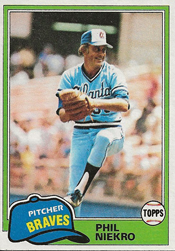
Phil Niekro made two starts in the 1982 National League Championship Series versus the Cardinals. Only one counted.

A right-handed knuckleball master who pitched in the majors until he was 48, Niekro earned 318 wins in the majors and was elected to the National Baseball Hall of Fame, but he never pitched in the World Series.

In 1982, when he was 17-4 for the West Division champion Braves, Niekro was the choice of manager Joe Torre to start Game 1 of the National League Championship Series. Niekro shut out the Cardinals for 4.1 innings and had a 1-0 lead before the game was called off because of rain. Niekro was two outs away from completing the five innings needed for an official game.

Three days later, Niekro started Game 2. He pitched six innings, allowed two runs and was lifted for a pinch-hitter with the Braves ahead, 3-2, but the Cardinals rallied against Gene Garber and won, 4-3.

Knuckle under

Niekro, 43, ended the 1982 regular season on a roll, winning 11 of his last 12 decisions. His last two wins were shutouts.

“That’s what you expect from someone who wants something as badly as he wants this championship,” Torre told the Atlanta Constitution.

As the Braves headed into the best-of-five National League Championship Series, Niekro was matched against Joaquin Andujar in Game 1. 

Niekro was 1-0 with a 1.29 ERA in 21 innings pitched against the Cardinals in the 1982 regular season. Many of the Cardinals struggled against him throughout their careers. The list included Keith Hernandez (.233 batting average against), Gene Tenace (.211), George Hendrick (.178), Tommy Herr (.143) and Willie McGee (.100). An exception was Lonnie Smith (.514).

“What makes Niekro so tough is there’s no telling where the ball will go,” Herr told the St. Louis Post-Dispatch. “I don’t even think he knows. You have to wait longer to swing because the ball is going to move.”

Tenace said, “His ball does everything and anything. It gets to the plate and it explodes up there. I’d just as soon take a beating as to have to hit that thing.”

In batting practice the day before the series opener, Cardinals coach Hal Lanier threw knuckleballs to try to help the hitters prepare for Niekro, “but it’s not quite the same,” said Hernandez.

“He’s not unhittable,” Hernandez said of Niekro, “but you have to be a disciplined hitter. You have to relax and wait until the last possible second before you pull the trigger.” Video of Niekro knuckler

Mind games

In the series opener on Oct. 6 at St. Louis, the Braves got a run in the first inning when Claudell Washington doubled and scored on a Chris Chambliss single.

The Cardinals threatened, loading the bases in the first and getting a runner to third base in the third, but couldn’t score against Niekro.

“I’ve seen him better,” Hernandez told the Atlanta Constitution. “I’ve seen his knuckleball do more. He wasn’t as sharp, and he still got us out. He’s smart.”

Niekro said it was the “worst knuckler I had in a couple of months.”

Cardinals manager Whitey Herzog, seeking an edge, complained to the umpires that Niekro regularly was committing a balk by not coming to a set position with a runner on base.

“I think he balked about seven or eight times,” Herzog said to the Post-Dispatch. “It’s a farce … There’s no doubt in my mind he doesn’t pause at all. I’ll guarantee you if one of my pitchers did that it would be a balk.”

Niekro, who was called for one balk during the 1982 season, responded, “If I was doing something wrong, it would have been called.”

Wiped out

Pitching in a light rain in the bottom of the fifth, Niekro got one out before plate umpire Billy Williams halted play. The forecast showed heavy rain was on the way. Williams indicated a playoff game shouldn’t be decided in a mere five innings, and that was likely to happen if he allowed the inning to be completed. 

“I didn’t want to rush and play two outs, and then have the outcome decided because we didn’t have common sense,” Williams told the Post-Dispatch. “I would have done the same thing if the score was 4-0 or 10-0.”

With rain continuing after a delay of two hours and 28 minutes, National League president Chub Feeney made the decision to call off the game.

“I’ve pitched many times when it was raining much harder than it was when the game was called,” Niekro said to the Atlanta Constitution. “I’m confident they would have completed the inning in the regular season. I’m really disappointed I didn’t get an opportunity to get two more outs.”

Torre, a former Cardinal, said he he understood the decision by Williams to stop play when he did. Torre told the Post-Dispatch, “I don’t think a team should play 162 games and then lose a playoff game in five innings. What I mean is, we don’t want to come in here and steal a game.”

Niekro had a different point of view: “It really doesn’t matter how you win a playoff game as long as you win it,” he said.

Series sweep

The rescheduled Game 1 was played the next day, Oct. 7, with Pascual Perez starting for the Braves against Bob Forsch. Forsch pitched a three-hit shutout and the Cardinals won, 7-0. Boxscore

Game 2, scheduled for Oct. 8, was rained out, enabling Torre to start Niekro when it was rescheduled for Oct. 9 at St. Louis.

In the seventh, with the Braves ahead, 3-2, they had runners on first and second, one out, when Torre sent Biff Pocoroba to bat for Niekro against Doug Bair. Pocoroba grounded out.

“I felt I could have gone two or three more innings,” Niekro told the Atlanta Constitution. “I can’t say I wasn’t disappointed. You start a ballgame, you want to finish it. I thought I had a good knuckleball. It was moving quite a bit.”

Facing closer Gene Garber, the Cardinals scored a run in the eighth and another in the ninth, and won, 4-3. Boxscore

The next night, at Atlanta, with Rick Camp starting for the Braves, the Cardinals completed the sweep, winning 6-2, and advanced to a World Series for the first time in 14 years. Boxscore

Summarizing the disappointment of the Braves falling short in their bid for a pennant, Niekro said, “How can you be so close and be so far at the same time?”

Niekro pitched five more seasons, including stints with the Yankees, Indians and Blue Jays, but never got to pitch in a World Series.

Read Full Post »

Joe Torre guided Alex Trevino into the majors and was with him again 13 years later when he left.
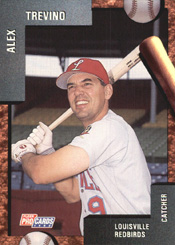
On Jan. 2, 1991, the Cardinals signed Trevino, a free agent, as backup catcher.

The deal reunited Trevino with Torre, the Cardinals’ manager and former catcher. Torre was manager of the Mets when Trevino, 21, made his major-league debut with them in September 1978. Trevino and Torre were together with the Mets for four seasons (1978-81). Trevino also played for Torre in 1984 when Torre was managing the Braves.

Torre and the Cardinals projected Trevino to back up starting catcher Tom Pagnozzi in 1991, but it didn’t work out. Instead, Trevino got released near the end of spring training. The next season, Trevino was back in the Cardinals’ organization and, though he played in the minors, he made a major contribution in helping a top pitching prospect get acclimated to baseball in the United States.

From Mexico to Mets

A native of Monterrey, Mexico, Trevino was 7 and playing youth baseball when he saw the World Series on television for the first time in 1964, the Cardinals versus the Yankees. “I was impressed so much by Bob Gibson because I was a pitcher then,” Trevino told United Press International.

Trevino was 16 when the Mets signed him in May 1974 with the intention of making him a shortstop. Assigned to a rookie league club in Marion, Va., Trevino became a catcher for manager Chuck Hiller, a future Cardinals coach.

Four years later, Trevino got called up to the Mets and he and Torre bonded.

“To me, he’s like my second father,” Trevino told the St. Louis Post-Dispatch. “He took me under his wing when I came to the big leagues. I owe him a lot. He gradually gave me playing time and let me build my confidence.”

Torre said, “He had such great hands. I always like the way he caught.”

Trevino was a backup to John Stearns with the Mets in 1978 and 1979. An agile catcher with a strong throwing arm, Trevino got more starts than Stearns in 1980, but went back to a reserve role in 1981 because Stearns was the better hitter.

Trevino led National League catchers in throwing out the highest percentage of runners attempting to steal in 1979 (47.7 percent) and 1980 (44.3 percent).

Torre said Trevino became the favorite player of his daughter, Tina. Also, Trevino got to be a teammate of his favorite player from the 1964 World Series, Bob Gibson, who became a coach on Torre’s staff with the 1981 Mets.

“Several clubs are interested in Trevino, but Torre won’t part with the kid,” The Sporting News reported.

On the move

After the 1981 season, Torre became manager of the Braves, and the Mets packaged Trevino in a trade to the Reds for slugger George Foster. Trevino took over for future Hall of Famer Johnny Bench, who no longer could catch regularly.

When the Reds opened the 1982 season, Trevino was the catcher and Bench was at third base. Boxscore

A contact hitter with little power, Trevino was no Bench, and he fell into disfavor with the Reds.

“They expected me to hit .300 and throw out every baserunner,” Trevino told The Sporting News. “It was a bad time … They played with my head there.”

In April 1984, the Reds sent Trevino to the Braves to be the backup to Bruce Benedict. Torre was the manager and he “treasured Trevino’s skills,” The Sporting News reported. Also, Bob Gibson was on the coaching staff.

After the 1984 season, Torre was fired and Trevino was traded to the Giants. Trevino went from the Giants (1985) to the Dodgers (1986-87) and to the Astros (1988-90).

On June 13, 1986, Trevino and Dodgers pitcher Fernando Valenzuela formed what is believed to be the first all-Mexican battery in the majors, according to the Los Angeles Times. Boxscore

One of Trevino’s best games came on May 22, 1988, at St. Louis when he got four hits and scored the winning run in the Astros’ 2-1 victory over the Cardinals. Boxscore

Ups and downs

In 1990, Trevino was the backup to Astros catcher Craig Biggio, but in July he was released and replaced by Rich Gedman, who was acquired from the Red Sox.

The Mets signed Trevino in August 1990, but the reunion started badly. In his first start for the Mets, on Aug. 5, 1990, against the Cardinals at St. Louis, Trevino was hitless, committed two errors and allowed two passed balls. Boxscore

“It was the worst game of my career,” Trevino told the Post-Dispatch. “I’ve never had a day like that.”

A month later, the Reds selected Trevino off waivers. Trevino got three hits in seven at-bats for the Reds, who went on to become 1990 World Series champions.

Change in plans

Trevino became a free agent in December 1990 and the Cardinals arranged for him to reunite with Torre again. The Cardinals had decided to move Todd Zeile from catcher to third base, and were seeking a veteran backup to Tom Pagnozzi, who became the starting catcher.

The Cardinals also had considered Gary Carter (36) and Ernie Whitt (38) as the backup catcher but took Trevino (33) because he was younger, the Post-Dispatch reported. Carter signed with the Dodgers and Whitt went with the Orioles.

Cardinals general manager Dal Maxvill, who had been a coach on Torre’s staffs with the Mets (1978) and Braves (1984) when Trevino was there, said, “We’re not trying to look beyond this year, but, if the guy is still catching decently and throwing decently, it could be something beyond a year. I’m not ruling out he could be here four or five years.”

A month later, the Cardinals signed Rich Gedman, the catcher who in 1990 had replaced Trevino on the Astros, to a minor-league contract. “Gedman figures to be Louisville’s starting catcher this season unless he beats out Alex Trevino for the backup catching job” with the Cardinals, the Post-Dispatch reported.

At Cardinals spring training in 1991, Trevino was “erratic on defense,” according to the Post-Dispatch. Gedman, a left-handed batter, hit .375. Trevino, a right-handed batter, hit .353.

Torre liked having a catcher who batted left-handed to back up Pagnozzi, who hit from the right side. On March 31, 1991, Torre told Trevino he was being placed on waivers for the purpose of giving him his release. “It was hard, really hard,” Torre said of his talk with Trevino.

A stoic Trevino said, “Gedman had a good spring. It was obvious.”

Keep on going

Trevino signed a minor-league contract with the Angels and was assigned to their Class AA club at Midland, Texas, where he was reunited with Fernando Valenzuela, who was attempting a comeback.

After playing in 14 games for Midland, Trevino joined his hometown team, Monterrey, in the Mexican League.

In February 1992, the Cardinals invited Trevino to spring training as a non-roster player, and he earned a spot with their Louisville farm club.

The Cardinals had signed a promising pitching prospect, Cuban defector Rene Arocha, and assigned him to Louisville. Trevino caught most of Arocha’s games, served as his interpreter and mentored him. 

In September 1992, after the end of Louisville’s season, Trevino was rewarded for his effort. He was called up to the Cardinals, though not activated, and spent the final month of the season in the big leagues.

Read Full Post »

« Newer Posts - Older Posts »