Feeds:
Posts
Comments

Archive for the ‘Opponents’ Category

The Cardinals were convinced Mike Hampton. who kept them from getting to the World Series in 2000, would enable them to get there in 2001.
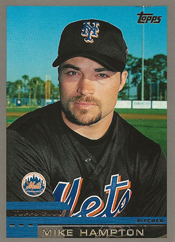
In December 2000, the Cardinals thought Hampton, a left-handed pitcher and free agent, would accept their offer of a seven-year contract for $91 million.

Instead, Hampton signed a deal with the Rockies for $121 million over eight years, making him the highest-paid pitcher in baseball.

Two months earlier, Hampton made two starts against the Cardinals in the 2000 National League Championship Series and won both, carrying the Mets into the World Series against the Yankees.

Later, when Cardinals manager Tony La Russa made a pitch to Hampton to join the Cardinals, he told him, “With you, we go to the World Series” in 2001.

Right stuff

After entering the majors with the Mariners in 1993, Hampton was traded to the Astros and developed into an ace. He was 22-4 for them in 1999.

Knowing Hampton could become a free agent after the 2000 season, the Astros dealt him to the Mets in December 1999. The Mets, expecting to contend in 2000, were willing to risk having Hampton leave after a year.

Hampton was 15-10 for the 2000 Mets, who qualified for the postseason as a wild-card entry and defeated the Giants in the National League Division Series.

The Mets advanced to face the Cardinals in a best-of-seven series to determine the 2000 National League pennant winner.

In Game 1, Hampton started, pitched seven shutout innings and got the win. Boxscore

In Game 5, he pitched a three-hit shutout for the pennant-clinching victory. Boxscore and video

“He isn’t a dominating left-hander by any means, relying on good movement and location of his pitches rather than sheer velocity,” Mike Eisenbath of the St. Louis Post-Dispatch noted. “The tougher the situation, though, the better he is.”

Sales pitch

The Cardinals were a team Hampton was interested in joining. According to columnist Bernie Miklasz, Hampton told Cardinals players Darryl Kile, a former Astros teammate, and Fernando Vina he’d “like to sign with the Cardinals.”

The interest was mutual. Cardinals general manager Walt Jocketty said the club wanted a starting pitcher “who can put us over the top,” and viewed Hampton, 28, as that kind of talent.

Joining the Cardinals as leading contenders for Hampton were the Braves, Cubs, Indians, Mets and Rockies.

The Cardinals were invited to meet with Hampton and his agent, Mark Rodgers.

“Several Cardinals employees helped the team’s recruiting pitch by posing for photos in front of various Hampton Avenue street signs throughout St. Louis,” Miklasz wrote.

A Cardinals contingent went to Houston, where Hampton resided, to recruit him. It was well-received. Rodgers told the Post-Dispatch, “To be honest, I thought it was going to be really tough to beat St. Louis. They’ve got a dynamic ownership group that’s trying to win, and great fans.

“Mike was going to have to see something very significant not to go to St. Louis,” Rodgers said. “Tony La Russa walked in, sat down and said, ‘With you, we go to the World Series.’ Coming from him, that meant an awful lot. Tony La Russa blew us away.”

Feeling jilted

On Dec. 4, 2000, Jocketty met with Rodgers near the agent’s home in Palm City, Fla., and made an offer of $91 million over seven years.

“Hampton and Rodgers both said the Cardinals were the leaders” in the bidding, according to the Post-Dispatch.

“As recently as (Dec. 7), the Cardinals thought they had the left-hander,” Rick Hummel of the Post-Dispatch reported.

On Dec. 8, however, Hampton reached agreement with the Rockies, who offered $30 million more than the Cardinals: $121 million over eight years.

“I’m very disappointed,” Jocketty said. “I’m also very surprised because I thought we met every part of his criteria.”

Jocketty said Hampton “would have made us a lot better.”

“I talked to several of our opponents in the division and they’re so glad we didn’t get Hampton,” Jocketty told the Post-Dispatch. “They would have just shut the door. That’s part of the reason we worked so hard at it. It just would have put us at a different level.”

Rocky time

Hampton’s decision to go with the Rockies was criticized by some, who noted his career ERA at Denver’s Coors Field was 6.48. Eight months earlier, on April 28, 2000, Hampton punched a water cooler in frustration after giving up seven runs in five innings to the Rockies at Coors Field. Boxscore

“The entire baseball world was surprised an elite pitcher would choose to spend the prime of his career at Coors Field,” Ken Rosenthal of The Sporting News wrote.

Rockies general manager Dan O’Dowd said, “We didn’t lie to Mike and try to sell him on Coors Field as a pitcher’s heaven.”

Some pitchers were convinced Denver’s high altitude caused their pitches to flatten and become more hittable. Hampton said he believed he’d succeed because his sinker and cut fastball induced grounders.

After missing out on Hampton, the Cardinals acquired starting pitcher Dustin Hermanson from the Expos.

With a starting rotation anchored by Darryl Kile, Matt Morris and Hermanson, and including Andy Benes, Woody Williams and Bud Smith, the 2001 Cardinals earned 93 wins and qualified for the playoffs.

Hampton beat the Cardinals on Opening Day in 2001, but for the season he was 14-13 with a 5.41 ERA. A good-hitting pitcher, Hampton batted .291 with seven home runs, but it didn’t compensate for his pitching. Overall in 2001, left-handed batters hit .346 against him, and his ERA at Coors Field was 5.77. The Rockies finished at 73-89.

In 2002, the Cardinals again thrived and the Rockies faltered. The 2002 Cardinals had 97 wins and won a division title. The Rockies were 73-89 again. Hampton was 7-15 with a 6.15 ERA. Overall in 2002, left-handed batters hit .376 against him.

Though Hampton hit .344 with three home runs in 2002, it wasn’t what the Rockies were paying him top dollar to do.

In November 2002, the Rockies traded Hampton to the Marlins, who two days later flipped him to the Braves.

Hampton had 14 wins for the Braves in 2003 and 13 in 2004. Sidelined in 2006 and 2007 after having reconstructive elbow surgery, Hampton went on to pitch for the Astros again and Diamondbacks.

His record in 16 years in the majors was 148-115, including 10-9 versus the Cardinals.
Read Full Post »

(Updated July 6, 2024)

In the 1964 World Series, Phil Linz was in and out of tune against the Cardinals.

A utility player during the regular season, Linz started all seven games of the Series for the Yankees as their shortstop and leadoff batter.
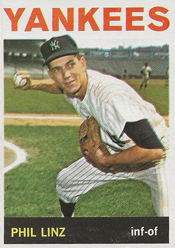
Linz was in the Yankees’ starting lineup against the 1964 Cardinals because shortstop Tony Kubek had a severely sprained wrist and couldn’t play.

A right-handed batter, Linz had seven hits, including two home runs, and scored five times in that Series. He also made two errors, including a Game 7 miscue that enabled the Cardinals to take the lead, and was involved in a costly misplay in Game 4.

Music man

Linz was 22 when he debuted with the Yankees in 1962. Because he played all four infield positions and the outfield, Linz became a valuable backup.

After the 1962 season, the Cardinals, seeking a shortstop, wanted Linz. According to the St. Louis Globe-Democrat, Linz was “a No. 1 target” of general manager Bing Devine, but a deal couldn’t be worked out. (The Cardinals got Dick Groat from the Pirates instead.)

In 1964, Linz made 50 starts at shortstop, 38 at third base and three at second base for an injury-plagued Yankees team trying to stay in contention with the White Sox and Orioles for the American League pennant.

After the Yankees were swept by the White Sox in a four-game series at Chicago in August, dropping them 4.5 games out of first place, they boarded a bus for the airport. In his book “The Mick,” Yankees slugger Mickey Mantle said, “I had sneaked a couple of beers on the bus. Probably a few other guys did the same.”

Linz, seated near the back, took out a new harmonica he was learning to play and began an amateurish rendition of “Mary Had a Little Lamb.”

From the front of the bus, manager Yogi Berra hollered out for Linz to stop playing. Unsure what Berra said, Linz asked Mantle what he heard. In his book, Mantle, a prankster, said he replied, “Play it fast.”

As Linz tooted the tune, Berra confronted him and they argued. In the heat of the moment, Linz flipped the harmonica to Berra, who slapped at the instrument, The Sporting News reported. The harmonica struck teammate Joe Pepitone on the knee, fell to the floor and broke apart.

Linz apologized to Berra the next day and was fined $200, according to The Sporting News. Later, a harmonica company gave Linz $10,000 to endorse its product, the New York Times reported. Not a bad return for Linz on his investment in the $2.50 harmonica.

Though some initially thought the incident was an indication the Yankees were cracking under pennant pressure, the opposite occurred.

The Yankees played the incident for laughs, relaxed and surged, winning 22 of 28 games in September and finishing a game ahead of the second-place White Sox.

Borrowed bat

Linz helped the Yankees beat Bob Gibson and the Cardinals in Game 2 of the 1964 World Series. Using a bat borrowed from Mantle, Linz had three hits, a walk, a RBI and scored two runs in the Yankees’ 8-3 victory at St. Louis.

“He could play regularly on a lot of ballclubs,” Cardinals third baseman Ken Boyer told the St. Louis Post-Dispatch.

With the Yankees ahead, 2-1, Linz led off the seventh inning with a single against Gibson and advanced from first to third on a wild pitch. Bobby Richardson followed with a single, scoring Linz.

In the ninth, Barney Schultz, who allowed one home run in 30 appearances during the season, relieved Gibson and gave up a homer to the first batter he faced, Linz.

Linz fouled off several pitches before connecting for the home run on a fastball from the knuckleball specialist. “I guess he wasn’t afraid of me,” Linz told the Post-Dispatch. Boxscore

Botched chance

The Yankees won two of the first three games of the Series and were leading, 3-0, in the sixth inning of Game 4 when the Cardinals put runners on first and second with one out.

Dick Groat hit a grounder that had the makings of an inning-ending double play. Second baseman Bobby Richardson went to his right, gloved the ball and intended to toss it to Linz, who was moving toward the bag at second, but the ball stuck in the webbing of Richardson’s glove.

After a moment of hesitation, Richardson managed to flip the ball with his glove hand to Linz, but their timing was off.

As the ball reached Linz, baserunner Curt Flood slid into him hard and the ball fell to the ground. “On any other Sunday, Flood would have been penalized 15 yards for clipping,” Linz said to the Post-Dispatch.

All runners were safe, loading the bases, and Richardson was charged with an error. The next batter, Ken Boyer, hit a grand slam against Al Downing, erasing the Yankees’ lead and propelling the Cardinals to victory. Boxscore

“It was entirely my fault,” Richardson told The Sporting News. “Phil couldn’t possibly have handled (the throw).”

Linz said to the Post-Dispatch, “It was just as much my fault. I was a little late getting to the bag. I was on the bag, but I had to reach back for the ball. That’s when Flood hit me.”

Flood told the New York Daily News, “I was sure they had me when I saw Richardson get the ball. All I wanted to do was break up the double play. So I slid into Linz’s right leg to knock him off balance.”

Turning point

In the winner-take-all Game 7, Linz was involved in the play that turned the momentum in the Cardinals’ favor.

The game was scoreless in the fourth inning when the Cardinals put runners on first and second with no outs. Tim McCarver hit a grounder sharply to first baseman Joe Pepitone. The Yankees were expecting to turn a double play.

Pepitone threw to Linz, covering second, for the forceout, but the return throw from Linz to pitcher Mel Stottlemyre, covering first, was wild. The ball sailed wide of first base and bounced to the bunting draping the stands. Ken Boyer scored from second, giving the Cardinals a 1-0 lead.

“A good throw and we got him,” Yogi Berra told the Post-Dispatch.

Instead of two outs, none in and a runner on third, the Cardinals had one out, one in and a runner on first because of the Linz error.

Berra called Linz’s wild throw “the key play” in the game. The Cardinals went on to score three runs, including a McCarver steal of home, in the inning.

The Cardinals took a 7-3 lead into the ninth. Gibson struck out Tom Tresh before Clete Boyer hit a home run, making the score 7-4. Johnny Blanchard struck out for the second out.

Up next was Linz. He hit a Gibson fastball deep to left. Lou Brock raced back to the wall and leaped, but the ball went into the stands, where it was caught by a fan, for a home run.

Linz’s homer made the score 7-5. Cardinals manager Johnny Keane, saying he was committed to Gibson’s heart, left him in the game to face Bobby Richardson, who hat 13 hits in the Series. If Richardson reached base, slugger Roger Maris was up next, representing the potential tying run, and Keane told The Sporting News, “I would have had to get Gibson out.”

Instead, Gibson got Richardson to pop out to second baseman Dal Maxvill, and the Cardinals won the championship. Boxscore


Read Full Post »

(Updated Nov. 25, 2024)

Denis Menke was a menace to Bob Gibson.

Menke was an infielder who played 13 seasons with the Braves (1962-67), Astros (1968-71, 1974) and Reds (1972-73). He also coached in the majors for 20 years.
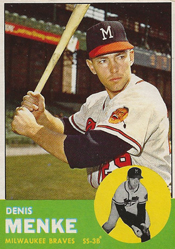
Though he batted .184 against Gibson in his career, Menke delivered multiple game-winning hits to beat the Cardinals’ ace. The highlights:

_ A three-run home run against Gibson in a 6-3 Braves win in 1963.

_ Two home runs against Gibson to drive in all the runs in a 4-0 Braves win in 1966.

_ A two-run single against Gibson in a 3-2 Astros win in 1968.

In the book “Stranger to the Game,” Gibson’s friend and teammate Joe Torre said, “Denis Menke was one who hit Bob a little better than he should have.”

Menke told Joe Schuster of Cardinals Yearbook in 2018, “Any success I had against him (Gibson) might have involved more than just a little luck.”

Power provider

Born in Bancroft, Iowa, Menke developed into an amateur baseball standout and was signed by the Braves for $125,000 in May 1958. He made his debut in the majors with them in 1962.

Menke played all four infield positions, though his primary spot was shortstop.

In 1963, Braves manager Bobby Bragan put him at third base and moved the future Hall of Famer, Eddie Mathews, from third to left field.

On Aug. 9, 1963, in a Friday night game against the Cardinals at Milwaukee, the Braves featured a lineup with Hank Aaron, Mathews, Torre and Menke in the third through sixth spots in the batting order against Gibson.

In the second inning, Menke doubled and scored. In the third, he hit a three-run home run, giving the Braves a 6-0 lead. Menke’s homer provided them the margin of victory in a 6-3 win. Boxscore

Adjustments at-bat

Three years later, in 1966, the Braves relocated from Milwaukee to Atlanta. Menke had two big performances against the Cardinals that season.

The first was on June 5, a Sunday in Atlanta. Batting in the leadoff spot, Menke produced five hits and five RBI in the Braves’ 14-4 victory. He had a pair of singles against starter Al Jackson, a RBI-single versus Don Dennis, a three-run home run against Art Mahaffey and another RBI-single versus Hal Woodeshick. Boxscore

Two months later, the Braves fired Bobby Bragan and replaced him with Billy Hitchcock, who returned Menke to shortstop.

On Sept. 21, 1966, a Wednesday night in Atlanta, Gibson was seeking his 21st win of the season when he started for the Cardinals against the Braves.

Before the game, Hitchcock asked Menke to come to the ballpark early and review film of himself at the plate. “He could hardly believe what he saw,” Hitchcock told the Atlanta Constitution.

A right-handed batter, Menke was “pulling his left foot on almost every pitch. Bailing out, as the players say,” The Sporting News reported.

Hitchcock said, “The only pitch he could handle was the one in on him. Anything from the middle to the outside part of the plate, he just couldn’t reach.”

During batting practice that evening, Menke “concentrated on keeping his left foot in place, then stepping toward, or into, the pitch,” The Sporting News noted.

Gibson held the Braves hitless until, with two outs in the fifth, Menke lined a pitch to left. According to the St. Louis Post-Dispatch, the ball was “fair by inches” as it cleared the fence for a home run, giving the Braves a 1-0 lead. Cardinals manager Red Schoendienst said Menke was fooled by the pitch “and was stepping out when he hit it.”

In the seventh, Menke batted with runners on first and second, one out, and drove a Gibson pitch over the fence in left-center for a three-run home run and a 4-0 Braves lead. “He just hit a good pitch,” Schoendienst said.

Gibson limited the Braves to four hits in the game, but Menke’s two home runs supported the shutout pitching of Dick Kelley and gave the Braves the win. Boxscore

“Gibson pitched one heck of a game,” said Schoendienst. “He didn’t make any mistakes, really. That kid (Menke) just hit the ball. That’s all.”

Special delivery

Menke was dealt to the Astros after the 1967 season and became the second baseman in 1968 when Joe Morgan was sidelined because of a knee injury.

The 1968 season is when Gibson posted a 1.12 ERA and was the recipient of the National League Most Valuable Player Award and Cy Young Award, but Menke cost him a win that season.

On May 12, 1968, a Sunday in St. Louis, the Cardinals led the Astros, 2-1, when Menke faced Gibson in the seventh inning with the bases loaded and two outs.

Gibson’s first pitch to Menke was called a ball by plate umpire Bob Engel. Gibson told the Post-Dispatch, “The guy behind the plate was calling balls on pitches that were waist high. That’s what happened on Menke. The first pitch was a ball and I know it was a strike.”

The second pitch clearly was outside the strike zone, but instead of the count being 1-and-1, it was 2-and-0.

With the bases loaded, “I’m just trying to get the ball over” on the third pitch, Gibson said.

Menke hit it for a two-run single, giving the Astros a 3-2 lead.

Starter Larry Dierker held the Cardinals scoreless over the last three innings to seal the win for the Astros. Boxscore

Moving on

Menke was the Astros’ shortstop in 1969 and 1970, and was named to the National League all-star team both years.

Learning from Astros manager Harry Walker, the former Cardinal, how to hit to all fields, Menke led the club in hits (149) and RBI (90) in 1969, and in hits (171) and RBI (92) in 1970.

Traded with Morgan and others to the Reds in November 1971, Menke was their third baseman when they won consecutive division titles in 1972 and 1973. In the 1972 World Series versus the Athletics, Menke batted a mere .083, but he hit a home run against Catfish Hunter and fielded 29 chances flawlessly at third.

For his career, Menke produced 1,270 hits.

After three seasons as a minor-league manager, Menke was a coach in the majors with the Blue Jays (1980-81), Astros (1983-88), Phillies (1989-96) and Reds (1997-2000).

Read Full Post »

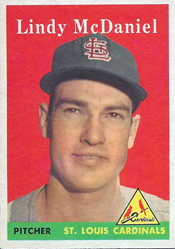
Though the Cardinals put Lindy McDaniel on their team because they had to, he showed he deserved to be there.

A right-hander who developed into a quality reliever and pitched 21 seasons in the major leagues, McDaniel was 19 when he got to the big leagues with the Cardinals as a teammate of Stan Musial in 1955. He was 39 when he pitched his final game with the Royals as a teammate of George Brett in 1975.
In addition to Cardinals (1955-62) and Royals (1974-75), McDaniel pitched for Cubs (1963-65), Giants (1966-68) and Yankees (1968-73). 

McDaniel led the National League in saves three times: twice with the Cardinals (1959 and 1960) and once with the Cubs (1963). He had a career record in the majors of 141-119 with 174 saves.

One of his most important wins was his first. It came when he was 20 years old and it helped convince the Cardinals his spot on the club was warranted.

Prime prospect

McDaniel was 19 when he signed with the Cardinals for $50,000 on Aug. 19, 1955. Because of the amount he received, the Cardinals were required by a baseball rule at the time to keep McDaniel on the big-league club for at least the next two years.

The Cardinals signed McDaniel on the recommendation of scout Fred Hawn, who called him “the best pitching prospect, maybe the best player, I’ve ever scouted for the Cardinals.,” the St. Louis Globe-Democrat reported. “His fastball and his curve are alive and he gets them over the plate.”

An amateur baseball standout in Oklahoma, McDaniel had been pursued by the Cardinals since he was 16 in 1952. He attended the University of Oklahoma for a year, but left to join the Cardinals, “fulfilling a childhood ambition to play with Dizzy Dean’s old club and alongside his idol, Musial,” the St. Louis Post-Dispatch reported.

The Phillies, Dodgers, Reds, Yankees, Indians and Red Sox also wanted to sign McDaniel, but “when I found out the Cardinals were interested, I told the others not to bother,” McDaniel said to The Sporting News. “They’re a team of the future with a young staff. I’ll get more chances to pitch with them than with other clubs.”

When Lindy and his father, Newell McDaniel, an alfalfa and cotton farmer, went to St. Louis for the contract signing, Lindy let his dad do most of the talking.

“He don’t talk much,” Newell said to the Post-Dispatch. “You won’t get much out of him. He concentrates on training. He’s one of those boys just born that way, not interested in girls or anything. Exercises every night before retiring. He’s a fanatic.”

According to The Sporting News, Lindy invested part of the signing bonus in purchasing a 160-acre farm near his home in Hollis, Okla., and turning it over to his father to tend.

Teen dream

McDaniel reported to the Cardinals on Sept. 1, 1955, and he made his debut in the majors the next day at Chicago. McDaniel, 19, entered in the seventh inning with the Cubs ahead, 11-1, and the second batter he faced, Walker Cooper, 40, hit a home run. McDaniel regrouped and didn’t allow another run over two innings. Boxscore

“That boy may never have to go down to the minors,” Cardinals manager Harry Walker told the Post-Dispatch.

On Sept. 19, 1955, McDaniel got his first start in the majors against the Cubs at St. Louis. He gave up a grand slam to Ernie Banks, making him the first player in the majors to hit five in one season. McDaniel gave up five runs, 10 hits and four walks in seven innings, but didn’t get a decision after the Cardinals rallied to win. Boxscore

McDaniel made four September appearances for the 1955 Cardinals and was 0-0 with a 4.74 ERA. According to The Sporting News, he “demonstrated he might be just more than ornamental in 1956.”

On his way

The Cardinals changed managers after the 1955 season, hiring Fred Hutchinson, a former pitcher, to replace Harry Walker.

McDaniel didn’t pitch much at spring training in Florida, but Hutchinson told The Sporting News, “I saw enough of him to know he had good stuff.”

As the Cardinals headed north from Florida to open the season, they were scheduled to play an exhibition game against the White Sox at Oklahoma City. McDaniel was supposed to pitch before a big crowd in his home state, but the game was canceled because of bad weather.

In the Cardinals’ final exhibition game at Kansas City two days before the season opener, McDaniel pitched two scoreless innings against the Athletics.

After losing two of their first three games of the regular season, the Cardinals were home to play the Braves on April 21, 1956, a Saturday afternoon.

With the Braves ahead, 5-3, McDaniel made his first appearance of the season, entering in the fifth inning in relief of starter Willard Schmidt.

Hutchinson “appeared to be taking a long gamble by bringing in a kid” whose “total professional experience consisted of 19 innings last September,” the Post-Dispatch reported, but Hutchinson “had been impressed with Lindy’s poise and potential.”

McDaniel rewarded his manager’s faith in him, retiring 12 of the 15 Braves batters he faced and pitching five scoreless innings. The Cardinals rallied for a 6-5 victory, giving McDaniel his first win in the majors.

A turning point came in the eighth inning. Eddie Mathews led off with a single and Hank Aaron walked, but catcher Bill Sarni made a snap throw to first baseman Wally Moon, picking off Aaron. McDaniel struck out Bobby Thomson and got Joe Adcock to ground out, ending the threat. He retired the side in order in the ninth.

“The kid did great,” Hutchinson said. Boxscore

Plate umpire Babe Pinelli told the Sporting News, “He showed one of the best curves I’ve ever seen and I’ve been in baseball 40 years. He doesn’t scare. He looks nerveless.”

Family affair

The win gave McDaniel a considerable boost. He was 4-0 with a 2.83 ERA entering June. Hutchinson tried him as a starter, but it didn’t work out. McDaniel finished the season at 7-6. He was 5-2 with a 2.58 ERA in 32 relief appearances and 2-4 with a 5.25 ERA in seven starts.

The next year, the Cardinals signed Lindy’s brother, Von McDaniel, 18, for $50,000 and he joined Lindy on the big-league club.

Von won his first four decisions with the 1957 Cardinals, finished 7-5 and flamed out.

Lindy was 66-54 with 66 saves in eight seasons with the Cardinals before he was traded with Larry Jackson and Jimmie Schaffer to the Cubs for George Altman, Don Cardwell and Moe Thacker on Oct. 17, 1962.

Read Full Post »

The Cardinals had the right idea, but the wrong position in mind, when they acquired strong-hitting Cecil Cooper from the Red Sox.

On Nov. 30, 1970, the Cardinals chose Cooper in the Rule 5 draft. Cooper, 20, was the Midwest League batting champion in 1970, but the Red Sox didn’t put him on their 40-man major-league winter roster, leaving him eligible to be drafted by another organization.
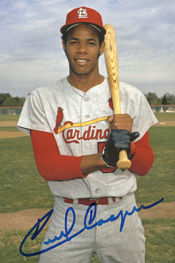
The Cardinals took advantage of the opportunity to obtain a left-handed hitter who was tailored for the AstroTurf and spacious dimensions of Busch Memorial Stadium in St. Louis.

Cooper ran well and consistently hit line drives to all fields, but his best position was first base. The Cardinals wanted him for the outfield.

Cards call

A standout high school player in Texas, Cooper was 18 when he was selected by the Red Sox in the sixth round of the June 1968 amateur draft. Assigned to a Class A farm club in Jamestown, N.Y., Cooper impressed, batting .452 with 38 hits in 26 games.

Though he continued to hit well, Cooper stayed in Class A the next two seasons. He hit .297 as the first baseman for Greenville, S.C., in 1969 and .336 for Danville, Ill., in 1970. Cooper primarily played first base for Danville but he also appeared in the outfield in 47 games.

The Cardinals were looking for backup outfielders for the 1971 season. When Cooper was left unprotected, the Cardinals paid the required $25,000 fee to draft him and put him on their 40-man major-league winter roster as an outfielder.

Either the Cardinals thought Cooper had a good chance to make the leap from Class A to the major leagues, or they figured the Red Sox wouldn’t want him back. Under the rules of baseball, if a player claimed in the Rule 5 draft is not kept on the major-league roster throughout the following regular season, he must be offered back to the team that lost him for $12,500.

Plenty of competition

The Cardinals went into 1971 spring training with a starting outfield of Lou Brock in left, Matty Alou in center and Jose Cardenal in right. Seven other players listed as outfielders on the big-league roster were competing for backup spots. In addition to Cooper, others in the mix were Jim Beauchamp, Bob Burda, Jose Cruz, Leron Lee, Luis Melendez and Jorge Roque.

Of the backup outfielder candidates, Burda, Cooper, Cruz and Lee batted from the left side. Another left-handed batter, Joe Hague, was the starting first baseman. Beauchamp, Burda and Cooper could back up Hague as well as play the outfield, but only Cooper lacked big-league experience.

“The Cardinals tried to make an outfielder out of me,” Cooper told The Sporting News.

When the Cardinals began playing intra-squad games, Cooper swung “a pretty stout bat,” according to the St. Louis Post-Dispatch.

In a game with eight position players in the field and batters taking their cuts against a pitching machine, Cooper hit a three-run triple. In an intra-squad game versus pitchers, he had a triple against Santiago Guzman and a double off George Lauzerique. He also substituted for Alou in center field.

“I’m very happy to get this shot with St. Louis and I hope to make the most of it,” Cooper told the Post-Dispatch. “I’ve got to work on my fielding and my throwing.”

Cooper didn’t fare so well in Grapefruit League exhibition games. He had one hit in 11 at-bats. He also walked and scored a run against the Reds. Meanwhile, his competition hit much better: Beauchamp, .408, and Burda, .438.

The Cardinals opened the 1971 season with Beauchamp, Burda, Lee and Melendez in reserve roles. Cruz and Roque were sent to the minors. Cooper was offered back to the Red Sox.

If the Red Sox had said no thanks, the Cardinals could have kept Cooper and assigned him to the minors, but the Red Sox paid the $12,500 to get him back.

Hot hitting

To his dismay, Cooper was assigned by the Red Sox to Winston-Salem, a Class A team, though he already had proven he could play at that level.

“That got me mad, depressed and frustrated,” Cooper said. “I told them, ‘I’m going home,’ and stayed away for five days. I wasn’t going to quit, but I wanted to get away and think. They told me I was lazy, that I didn’t want to play.”

Cooper took out his frustrations on opposing pitchers. He hit .379 in 42 games for Winston-Salem and got promoted to Class AA Pawtucket. In his first six games for Pawtucket, Cooper had 14 hits in 23 at-bats. He went on to hit .343 for Pawtucket, and in September, five months after the Cardinals rejected him, the Red Sox brought him to the major leagues.

“They aren’t likely to let him get away again,” The Sporting News declared. “Cooper is a hitter of promise.”

Cooper’s first hit in the big leagues was noteworthy, It came on Sept. 11, 1971, against Joe Coleman of the Tigers. Coleman held the Red Sox hitless until Cooper singled to lead off the eighth. Swinging at the first forkball he’d ever seen, Cooper tapped the ball toward third. Aurelio Rodrigeuz tried to make a backhand scoop, but the ball rolled under his glove and was ruled a hit. “I thought it would be an error the way I hit it,” Cooper told the Boston Globe. Boxscore

Cooper hit .310 for the Red Sox in 1971 and figured to be their first baseman in 1972, but they traded for Danny Cater and gave him the job. In 1973, Carl Yastrzemski moved from the outfield to first base and he remained the Red Sox’s first baseman through 1976, relegating Cooper to the role of backup and designated hitter.

“Boston never gave me a chance to show what I could do,” Cooper told The Sporting News. “I feel the Red Sox did me an injustice.”

Everyday excellence

In December 1976, the Red Sox traded Cooper to the Brewers for George Scott and Bernie Carbo. Given the chance to play every day, Cooper thrived as the first baseman. He was named to the American League all-star team five times and twice won a Gold Glove Award for fielding. In 1980, he led the league in total bases (335) and RBI (122). He was the RBI leader again in 1983 (126), and twice topped the league in doubles: 44 in 1979 and 35 in 1981.

The Brewers got to the World Series for the only time in 1982 and faced the Cardinals. Though the Cardinals won the championship in seven games, Cooper hit .286 with six RBI.

In Game 5, with the Brewers clinging to a 3-2 lead, the Cardinals had runners on first and second, two outs, in the seventh when Darrell Porter hit a ball sharply to the right side of the infield. Cooper dived, snared the ball and threw to pitcher Mike Caldwell covering first to retire Porter. The Brewers went on to a win, their third of the Series. Boxscore

“That play changed the whole game,” Cardinals second baseman Tommy Herr told the Post-Dispatch. “Cooper has played great first base the whole Series.”

Cooper batted .298 with 2,192 hits and 1,125 RBI in 17 seasons in the majors.

He became Astros manager late in the 2007 season, and managed them in 2008 (86-75) and 2009 (70-79).

Read Full Post »

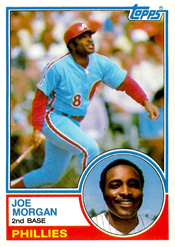
In his last hurrah as a National League player, Joe Morgan helped the Phillies dethrone the Cardinals.

A second baseman who began his big-league career with the Houston Colt .45s, Morgan spent his prime years as an integral member of championship Reds teams in the 1970s.

A two-time recipient of the National League Most Valuable Player Award as well as a member of the Baseball Hall of Fame, Morgan was 5 feet 7 but hit like a giant. He produced 2,517 hits and 1,133 RBI in 22 seasons in the majors. He also won five Gold Glove awards for fielding.

Morgan, a left-handed batter who flapped his left elbow as a distinctive timing mechanism before unleashing his swing, consistently clobbered the Cardinals.

A career .271 hitter, he batted .293 versus the Cardinals. His on-base percentage against them was .408. In 203 games versus the Cardinals, Morgan had 216 hits and 147 walks. He hit .313 against Bob Gibson and struck out a mere three times in 83 career at-bats versus the Cardinals’ ace.

In 1976, when Morgan was at his peak, he hit .452 versus the Cardinals, and his on-base percentage against them was an astounding .578. In 45 plate appearances against the 1976 Cardinals, Morgan had 14 hits and 12 walks.

Seven years later, with the 1983 Phillies, Morgan’s numbers against the Cardinals weren’t as great, but his performance remained devastating.

Power surge

In December 1982, after two seasons with the Giants, Morgan, 39, was traded to the Phillies, and was reunited with a prominent pair of former Big Red Machine teammates, Pete Rose and Tony Perez.

Playing in the same National League East Division as the Cardinals, who won the World Series championship in 1982, the 1983 Phillies were assembling a group of baseball royalty in the hope of overtaking the Cardinals. In addition to Morgan, Rose and Perez, the Phillies had Mike Schmidt and Steve Carlton.

Early on, the Phillies fizzled. They were 9-13 in May and lost their first four games in June.

On June 9, 1983, the Phillies went into their home game against the Cardinals with a record of 22-25. Morgan was batting .193.

Before the game, Morgan worked with coaches Deron Johnson and Bobby Wine to correct a flaw in his swing. Johnson noticed Morgan was committing too soon to pitches, and suggested Morgan rely more on his hands for timing. “As soon as I did, I felt good,” Morgan told the Philadelphia Inquirer.

In the bottom of the first inning, Morgan led off with a home run against Joaquin Andujar. The Cardinals came back and led, 5-1, heading to the bottom of the eighth, but Andujar unraveled. A double and two singles produced a run, making the score 5-2, and brought Morgan to the plate with two on and none out.

With the count 1-and-0, Andujar threw a fastball and Morgan walloped it over the wall in right for his second home run of the game, tying the score at 5-5.

“I wanted to go up and get a pitch I could pull and maybe hit out of the ballpark,” Morgan said. “I knew the situation, and I knew what I’m here for. I’m here to add some power. I could go up there and try to slap a ball to right, but they brought me here to do a job.”

It was the first time Morgan hit two home runs in a game since 1977. When Andujar gave up the second home run, he threw his hands up in disgust. “I feel like I want to kill myself,” Andujar told the St. Louis Post-Dispatch.

The Phillies got a run against Cardinals relievers in the 11th and won, 6-5. Boxscore

Repeat performance

Morgan said he thought the comeback victory would propel the Phillies into a winning streak, but it didn’t happen. Instead, the Phillies experienced a dismal July. Manager Pat Corrales was fired and replaced by Paul Owens. Morgan suffered a hamstring pull and batted .060 for July.

On Aug. 5, 1983, the Phillies were in St. Louis to play the Cardinals, and both Morgan and the club remained in a funk. The Phillies were 53-50 and trailed the first-place Pirates. Morgan was batting .192 for the season.

In the second inning, with the Phillies ahead, 2-0, Morgan faced John Stuper with two on and two outs. With the count 3-and-0, Morgan got a fat pitch and hit it over the wall in right for a three-run home run. In the seventh, Morgan hit a solo home run versus Dave Von Ohlen, giving him his second two-homer game of the season against the Cardinals. The Phillies won, 10-7. Boxscore

“I’m really glad for Joe,” Owens said. “It’s good to see him finally relax a little.”

Experience counts

Entering September, four teams were in contention for the National League East title. The Pirates (68-63) led, but the Phillies (67-64), Expos (66-64) and Cardinals (65-65) were close behind.

The Phillies took control, and Morgan played a prominent part. 

The Phillies were 22-7 in September, including 6-0 against the Cardinals, and finished atop the division at 90-72. The Cardinals were 12-18 in September and finished at 79-83.

Morgan hit .337 in September and had 18 RBI in 24 games. He had unusual numbers against the Cardinals for the season: a .181 batting average, but five doubles, four home runs and 13 RBI in 17 games.

The Phillies prevailed in the National League Championship Series versus the Dodgers and advanced to the World Series against the Orioles. Though the Orioles won four of five games, Morgan hit two home runs.

Released by the Phillies after the World Series, Morgan signed with the Athletics, who wanted him as their second baseman. After 21 seasons in the National League, Morgan, 40, completed his playing career in the American League with the 1984 Athletics.

Read Full Post »

« Newer Posts - Older Posts »