Feeds:
Posts
Comments

Archive for the ‘Opponents’ Category

A run-of-the-mill second game of a Saturday afternoon doubleheader at Wrigley Field turned into a showcase featuring a trio of future Hall of Fame pitchers.

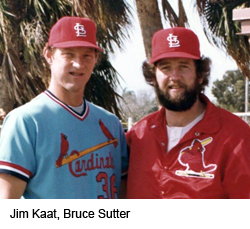
Jim Kaat and Lee Smith were the starters in the Cardinals versus Cubs game on June 26, 1982, at Chicago. Kaat got the win and Smith took the loss in a 2-1 St. Louis triumph. The save went to Bruce Sutter. All three pitchers would be elected to baseball’s shrine in Cooperstown, N.Y.
For Sutter, earning a save was standard _ a five-time National League saves leader with the Cubs (1979-80) and Cardinals (1981-82 and 1984) _ but starts were uncommon then for Kaat and always were rare for Smith.

A prominent starter during his prime with the Twins and White Sox, Kaat was converted to a relief role in 1979. The start against the Cubs was just his second in two years.

Smith pitched in 1,022 games in the majors but made only six starts.

The longshot odds of Kaat and Smith opposing one another as starters made their matchup extra-special.

Making adjustments

Kaat, 43, was the primary left-handed reliever in a 1982 Cardinals bullpen that had Sutter as the closer and Doug Bair as the right-handed setup man. After Kaat struggled early _ his ERA for the season was 6.75 on May 1 _ pitching coach Hub Kittle worked with him to use a sidearm motion. “When he drops down, his ball moves more,” Kittle told the St. Louis Post-Dispatch. “I think he throws harder down low, too.”

The altered delivery helped Kaat. He didn’t allow a run in 12 of 15 relief appearances from May 2 to June 20.

Meanwhile, Smith, 24, was part of a 1982 Cubs bullpen with veterans Willie Hernandez, Bill Campbell and Dick Tidrow. Hernandez and Campbell got most of the save opportunities early in the season, but Cubs pitching coach Bill Connors told the Chicago Tribune, “Smitty can be a bullpen star. If you need a strikeout, he’s the guy who’s going to get it for you. Some people say he’s not consistent with his fastball, that he tires easily and loses his stuff. They’re wrong.”

When Cubs starters Dickie Noles (knee) and Randy Martz (shoulder) went on the disabled list in June, manager Lee Elia moved Smith into the rotation. Before then, his only big-league start came in the 1981 season finale against the Phillies.

Smith started twice for the 1982 Cubs before facing the Cardinals.

Fine-tuned engine

With the Cubs’ top run producer (Bill Buckner) and best home run hitter (Leon Durham) batting left-handed, Cardinals manager Whitey Herzog chose a pair of left-handers, Dave LaPoint and Kaat, to start the June 26 doubleheader.

In Game 1, LaPoint (eight innings) and Sutter (one) confounded the Cubs, and St. Louis won, 4-1. Boxscore

As Kaat recalled to podcaster Jon Paul Morosi, “I’m sitting in the clubhouse and (broadcaster) Harry Caray’s on the air and he’s saying, ‘Well, the Cardinals got the best of us, but we’ve got a chance in Game 2, because we’ve got hard-throwing Lee Smith and the Cardinals got 43-year-old, soft-tossing Jim Kaat.’ ”

(Kaat had been around so long that his manager, Whitey Herzog, batted against him 20 years earlier when Herzog was with the 1962 Orioles. Kaat struck Herzog on the right elbow with a pitch and Herzog had to leave the game.)

The Cubs scored a run in the first, but Kaat found a groove and held them scoreless over the next five innings. Described by the Tribune as “a genuine geriatric marvel,” Kaat relied on “guile, breaking stuff and an occasional sneaky fast one,” the newspaper noted.

“In relief pitching, you have a tendency to come in and gun like you’re gunning the engine of a car,” Kaat said to the Post-Dispatch. “Starting pitching is entirely different. I don’t try to throw as hard. I try to stay within myself.”

Unlike Kaat, Smith was a hotrod. Displaying a 95 mph fastball, he gave up a run in the second on consecutive doubles by Ken Oberkfell and Gene Tenace. The winning run came in the third when, with two outs, Lonnie Smith singled, stole second and scored on a Keith Hernandez single.

Herzog said he planned to let Kaat pitch five innings, but he sent him out in the sixth because Buckner and Durham were due to bat. Kaat retired the side in order, then was lifted for a pinch-hitter in the seventh.

On being taken out after throwing 82 pitches, Kaat told the Post-Dispatch, “Emotion always tells you that you could have gone longer, but common sense tells you that you’ve got to bring pitchers in when you’ve got our bullpen.”

The Cubs loaded the bases in the seventh against Bair, and again in the eighth versus Bair and Sutter, but couldn’t score either time. (The Cubs stranded 11 runners in the game.) Sutter got his second save of the day with a scoreless ninth. The win for Kaat was his 280th in the majors.

Kaat, Sutter and Smith were three of eight future Hall of Famers in uniform during that game. The others: Cardinals shortstop Ozzie Smith, Cubs second baseman Ryne Sandberg, Cardinals manager Whitey Herzog, Cardinals coach Red Schoendienst and Cubs coach Billy Williams. Boxscore

What a relief

Smith was 0-4 with a 4.94 ERA as a starter for the 1982 Cubs. In July, they moved him back to the bullpen and he excelled as the closer (seven saves, 1.32 ERA in August; seven saves, 0.57 ERA in September.) He never started another game in the majors.

Kaat returned to the Cardinals bullpen. In July, he allowed just one run in 14 appearances. The Cardinals gave him one more start, his 625th and last in the big leagues, on Sept. 18 against the Mets. Boxscore

Sutter (nine wins, 36 saves, 70 games pitched) and Kaat (five wins, two saves, 62 appearances) helped the 1982 Cardinals become division champions. Then they won the National League pennant and World Series title.

Kaat pitched his final season, his 25th in the big leagues, with the 1983 Cardinals before being released in July.

After stints with the Cubs and Red Sox, Smith was acquired by the Cardinals in May 1990. In four seasons (1990-93) with St. Louis, Smith earned 160 saves. Only Jason Isringhausen has more saves (217) as a Cardinal. In 1991, Smith had 47 saves for St. Louis. The only Cardinals with a higher single-season total are Ryan Helsley (49 in 2024) and Trevor Rosenthal (48 in 2015).

Read Full Post »

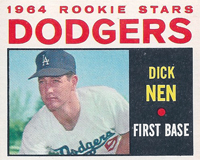
Dick Nen reached the pinnacle of his career in his first big-league game. He played in 366 more after that, but nothing topped what he did against the Cardinals in his debut.

On Sept. 18, 1963, in his second at-bat in the majors, Nen slammed a home run for the Dodgers, tying the score in the ninth inning and stunning the Cardinals. The Dodgers went on to win, completing a series sweep that put them on the verge of clinching a pennant.

Three decades later, reflecting on his storybook feat in St. Louis, Nen told the Palm Beach Post, “I should have walked away right then. That was my one day.”

Prized prospect

The California town of South Gate, seven miles south of downtown Los Angeles and dubbed the “Azalea City,” is the birthplace of Dick Nen as well as other sports figures such as NFL commissioner Pete Rozelle, Baseball Hall of Fame umpire Doug Harvey and Red Sox second baseman Doug Griffin.

After attending Los Angeles Harbor College, Nen went to Long Beach State and played baseball there. A left-handed batter, he hit with power and fielded gracefully at first base. Kenny Myers, the scout who brought Willie Davis to the Dodgers, signed Nen for them. Two weeks later, the Cubs offered $100,000 for Nen, but the Dodgers declined, the Los Angeles Times reported.

In 1961, Nen’s first pro season, with Reno, he produced 32 home runs, 144 RBI and batted .351. In a home game against Fresno, he blasted a ball out of the park and onto the roof of an indoor municipal swimming pool 100 feet beyond the outfield fence. With 177 hits and 102 walks, he had a .458 on-base percentage.

Promoted from Class C Reno to Class AAA Spokane in 1962, Nen was limited to 72 games. He joined the team after the season started because of a military commitment and then was sidelined when a thrown ball struck him below the right eye. Back with Spokane in 1963, Nen had 84 RBI and a .369 on-base percentage (167 hits and 75 walks).

Welcome aboard

On Tuesday night, Sept. 17, 1963, Spokane lost in the finale of the Pacific Coast League championship series at Oklahoma City. Nen was called up to the Dodgers after the game. On Wednesday, Sept. 18, he boarded a flight in Oklahoma City, arrived in St. Louis in the afternoon and went directly to the ballpark, where the Dodgers were to play the Cardinals that night in the finale of a three-game series. Issued uniform No. 5, Nen took batting practice, then settled in to watch the game from the dugout.

After losing the first two games and falling three behind the front-running Dodgers, the Cardinals desperately needed a win in Game 3. With Bob Gibson pitching for them, the Cardinals appeared on their way to achieving their goal, leading 5-1 through seven innings.

A pitcher, reliever Bob Miller, was due to be the first batter for the Dodgers in the eighth. Dodgers manager Walter Alston, seeking a left-handed pinch-hitter to send against Gibson, had two options: Derrell Griffith, called up from Class AA, or Nen, called up from Class AAA. Neither had been in a big-league game.

Alston chose Nen. “I was scared stiff,” Nen recalled to the Los Angeles Times. “I had no idea I’d be called upon.”

In making his big-league debut, Nen joined Truck Hannah (1918 Yankees), Johnny Reder (1932 Red Sox) and Eddie Kazak (1948 Cardinals) as players whose last names spell the same forward and backward. Since then, the list includes Toby Harrah (1969 Senators), Mark Salas (1984 Cardinals), Dave Otto (1987 Athletics), Robb Nen (1993 Rangers), Juan Salas (2006 Rays), Marino Salas (2008 Pirates), Fernando Salas (2010 Cardinals) and Glenn Otto (2021 Rangers).

Nen lined out sharply to center fielder Curt Flood, but the Dodgers went on to score three times in the inning, cutting the St. Louis lead to 5-4. Nen stayed in the game, taking over at first for Ron Fairly, who had been lifted for pinch-hitter Frank Howard during the eighth-inning rally.

In the ninth, with one out, none on, Nen batted for the second time. Right-hander Ron Taylor threw him a fastball, low and away. “I put the ball where I wanted it,” Taylor told the St. Louis Post-Dispatch.

Nen drove it onto the pavilion roof in right-center for a home run, tying the score. “I knew I hit it good,” Nen told the Los Angeles Times, “but I had no idea it was a home run until I saw the umpire give the home run sign.”

Watching on TV in California, Nen’s father and sister whooped with joy. Nen’s mother, attending a church function, got a call from her daughter, who exclaimed, “Richard hit a home run to tie the (score).”

The game moved into extra innings and became a duel between relievers Ron Perranoski (Dodgers) and Lew Burdette (Cardinals). With two on in the 11th, Nen nearly got a game-winning single, but second baseman Julian Javier ranged far to his left, made what the Post-Dispatch described as “an improbable glove-hand stop” of the grounder, wheeled and threw out Nen at first. In the 13th, with Dodgers runners on second and third, one out, Burdette issued an intentional walk to Nen. “A pretty high compliment for a rookie in his first big-league game,” columnist Jim Murray noted.

Maury Wills followed with a grounder, sending home the runner from third with the winning run. Boxscore

On the Dodgers’ flight home, most of the talk concerned Nen’s heroics. “I never saw anybody break in more spectacularly,” pitcher Johnny Podres told the Long Beach Independent. “That was the biggest homer of the year. It gave us the shot in the arm we needed.”

The Dodgers’ plane landed at 4:08 a.m. When Nen got home, his parents greeted him with a big spaghetti breakfast, featuring their homemade sauce.

A few days later, Sept. 24, the Dodgers clinched the pennant. Then they swept the Yankees in the World Series. Nen joined the club too late to be eligible, but he pitched batting practice before Game 4 and was given a $1,000 winner’s share.

Wanted in Washington

Nen’s home run against the Cardinals turned out to be his only hit as a Dodger.

Entering 1964 spring training as a candidate to earn a spot on the Dodgers’ Opening Day roster, Nen “developed the bad habit of lowering his back shoulder when he swings,” the Associated Press reported.

He was sent back to Spokane and spent the season there. In December 1964, the Dodgers dealt Nen, Frank Howard, Ken McMullen, Pete Richert and Phil Ortega to the Senators for Claude Osteen, John Kennedy and $100,000.

The Senators were managed by ex-Dodgers first baseman Gil Hodges. At spring training in 1961, Hodges had given pointers to Nen on how to play first base.

Nen, 25, began the 1965 season in the minors, but when Senators first baseman Bob Chance failed to hit as hoped, Nen was brought up in July to replace him. Nen started 63 games at first base for the 1965 Senators and hit .317 with runners in scoring position. He slugged two homers against Catfish Hunter, a walkoff homer to beat Luis Tiant and a grand slam versus Fred Talbot. Boxscore Boxscore Boxscore Boxscore

“This boy has all the qualifications to be a dandy player,” Senators general manager George Selkirk told the Washington Daily News. “… He’s our first baseman and I don’t see anyone taking it away from him.”

The good vibes didn’t last long. Nen had a terrible spring training in 1966. When the season opened, ex-Cardinal Joe Cunningham was the Senators’ first baseman and Nen was on the bench. In June, the Senators got Ken Harrelson from the Athletics and he took over at first base. Nen batted .213.

Nen “has the idea in his head that he is going to be lousy in the spring and so naturally he is,” Senators coach Joe Pignatano told Jerry Izenberg of the Newark Star-Ledger. “You can’t come in here thinking that way and expect to be anything but bad. When you do that, you concede the job. He could win it in a minute if he’d hit the way we think he can.”

Years later, Nen said to the Miami Herald, “I struggled most of my career, especially with the mental part. I always had to find ways to overcome the bad times and look forward to the good times. It seems like I went through more bad times than good. I should have done a lot better.”

In 1967, Nen was the Senators’ Opening Day first baseman, but in May they got Mike Epstein from the Orioles and he became the starter. Nen batted .218.

Seeking a pinch-hitter, the Cubs acquired Nen a week before the start of the 1968 season. On May 15, his two-run single in the ninth inning against Jack Billingham beat the Dodgers. It was Nen’s first National League hit since his 1963 home run versus the Cardinals. Boxscore

After batting .181 for the 1968 Cubs, Nen was returned to the Senators. He played his last game in the majors for them in June 1970.

All in the family

Nen’s son, Robb Nen, became a prominent big-league reliever. In 10 seasons with the Rangers (1993), Marlins (1993-97) and Giants (1998-2002), Robb had 314 saves, 45 wins and a 2.98 ERA. He pitched in two World Series (1997 Marlins and 2002 Giants) and was the National League saves leader (45) in 2001.

“Nen has the kind of arm that comes along once every 10 years,” Marlins general manager Dave Dombrowski told the Miami Herald in 1997.

Dick Nen said to the San Francisco Examiner, “We don’t know where the good arm came from. It didn’t come from me. He must have gotten it from my wife.”

Read Full Post »

When Walter Johnson emerged from the California oil fields to become the fireballing ace of the American League with the Washington Senators, he caught the attention of an Akron, Ohio, high schooler, George Sisler.

In the book “My Greatest Day in Baseball,” Sisler recalled to Lyall Smith, “Walter still is my idea of the real baseball player. He was graceful. He had rhythm and when he heaved that ball in to the plate, he threw with his whole body so easy-like that you’d think the ball was flowing off his arm and hand … I was so crazy about the man that I’d read every line and keep every picture of him I could get my hands on.”

Though first base became his featured position, Sisler took up pitching in high school, and at the University of Michigan, because of his admiration for Johnson.

In June 1915, after graduating from Michigan with a degree in mechanical engineering, Sisler signed with the St. Louis Browns, who were managed by his former Michigan baseball coach, Branch Rickey.

On his way to developing into one of the most prolific hitters in baseball, Sisler also pitched for the Browns in 1915 and again in 1916. Matched against his favorite player, Sisler outperformed Johnson _ twice.

Good investment

After Sisler’s sophomore season at Michigan, Rickey left to join the Browns. Batting and throwing left-handed, Sisler continued to excel as a first baseman, outfielder and pitcher as a junior and senior. In “My Greatest Day in Baseball,” Sisler recalled, “All this time I was up at school, I still had my sights set on Walter Johnson … I felt as though I had adopted him … He was really getting the headlines in those days and I was keeping all of them in my scrapbook.”

In Sisler’s final game for Michigan, on June 23, 1915, against Penn, he had three hits and five stolen bases, including a steal of home. With his collegiate career complete, Rickey gave Sisler $10,000 and brought him from campus to the Browns. “In getting Sisler, I staked a lot,” Rickey told the St. Louis Post-Dispatch. “I plunged for the first time in my life and I believe I made no mistake.”

Rickey planned to play Sisler at first base, all three outfield positions and as a pitcher. As the Associated Press noted, Sisler “combined incredible speed (on the field) with remarkable coordination, a great arm and unusual intelligence.”

“My, but he was fast,” Rickey told the wire service, referring to Sisler’s agility. “He was lightning fast and graceful, effortless. His reflexes were unbelievable. His movements were so fast you simply couldn’t keep up with what he was doing. You knew what happened only when you saw the ball streak through the air.”

On June 28, 1915, at Comiskey Park in Chicago, Sisler, 22, made his big-league debut. He pinch-hit in the sixth and singled, then stayed in the game and pitched three scoreless innings against the White Sox. Boxscore

“Next day, I was warming up when Rickey came over to me,” Sisler recalled to the Associated Press. “He was carrying a first baseman’s glove.”

“Here,” Rickey said to Sisler, “put this on and get over there to first base.”

Batting in the No. 3 spot, Sisler got a hit, scored a run and fielded flawlessly, making 12 putouts at first. Boxscore

“Rickey would pitch me one day, stick me in the outfield the next and then put me over on first the next three or four,” Sisler said to the Associated Press.

The rookie went on to make 33 starts at first, 26 starts in the outfield and pitched in 15 games, including eight as a starter. His pitching record was 4-4 with a 2.83 ERA and he hit .285, including .341 with runners in scoring position.

Sisler won his first start as a pitcher, a complete game against Cleveland, even though he walked nine, allowed seven hits and plunked a batter. (Cleveland stranded 14 runners.) At Fenway Park in Boston, he got a hit against Babe Ruth and had two RBI and two stolen bases in the game. Boxscore and Boxscore

The season highlight, though, was his duel with Walter Johnson.

Hero worship

On Aug. 28, 1915, after the Browns beat the Senators, 2-1, in 12 innings at St. Louis, Rickey told Sisler he’d be the starting pitcher against Walter Johnson the next day, Sunday, at Sportsman’s Park.

In “My Greatest Day in Baseball,” Sisler said, “I went back to my hotel that night but I couldn’t eat. I was really nervous. I went to bed but I couldn’t sleep. At 4 a.m. I was tossing and rolling around and finally got up and just sat there, waiting for daylight and the big game.”

Johnson entered the contest with a 20-12 record and 1.73 ERA. Sisler was 3-3 with a 2.40 ERA and a batting mark of .301.

“It was one of those typical August days in St. Louis,” Sisler recalled to Lyall Smith, “and when game time finally rolled around it was so hot that the sweat ran down your face even when you were standing in the shadow of the stands.

“All the time I was warming up I’d steal a look over at Johnson in the Washington bullpen. When he’d stretch way out and throw a fastball, I’d try to do the same. Even when I went to the dugout just before the game started, I was still watching him as he signed autographs and laughed with the photographers and writers.”

On the mound, Sisler managed to stay calm, even when the Senators scored a run in the first. Johnson gave up two tallies in the second and then both pitchers got into good grooves.

The first time Johnson batted against Sisler he blooped a single to right. In the fifth, Johnson plunked Sisler with a pitch. Three innings later, Sisler blooped a single against his idol.

In the seventh, Chick Gandil “bounced a single off Sisler’s shins,” according to the Post-Dispatch. “The ball went from the bat to the pitcher’s shin bone on a line. When the contact of ball and bone was heard, the fans gasped. They thought Sisler surely had a broken leg. Sisler didn’t even investigate. He just kept on pitching and retired the next three men in order.”

Tricks of the trade

With the Browns clinging to the 2-1 lead, the key play came in the eighth. Leading off for the Senators, Ray Morgan reached first on an error but injured a leg on his way to the bag. Horace Milan, making his big-league debut, ran for Morgan. Danny Moeller bunted and first baseman Ivon Howard fielded the ball, then flipped it to second baseman Del Pratt, covering first, for the out. Milan moved to second.

With the sleight of hand of a magician, Pratt pretended to throw the ball to Sisler, but instead tucked it under his right arm and returned to his second base position. Milan didn’t notice that Pratt still had the ball. Neither did Senators manager Clark Griffith, who was coaching at first.

When Eddie Foster stepped to the plate, Griffith called out to Milan to take a longer lead off second, so he’d be better able to score on a hit. When Milan drifted far off the bag, keeping his eye on Sisler, Pratt dashed over and tagged out the startled rookie. A big Senators threat was thwarted by the hidden ball trick.

More drama followed in the ninth. With Howie Shanks on first and one out, Walter Johnson batted against Sisler. The Senators put on a hit-and-run play. As Shanks broke from first, Johnson scorched a liner but it rocketed directly to shortstop Doc Lavan, who snared the ball, then threw to first, catching Shanks well off the bag and completing the double play.

In a showdown with his idol, Sisler won. Boxscore

As Sisler left the field, he looked toward the Senators dugout, hoping to make eye contact with Johnson, but he’d already headed to the locker room. Recalling the moment in “My Greatest Day in Baseball,” Sisler said, “I don’t know what I expected to do if I had seen him. For a minute I thought maybe I’d go over and shake his hand and tell him that I was sorry I beat him, but I guess that was just the silly idea of a young kid who had just come face to face with his idol.”

Encore, encore!

The next year, Fielder Jones, who replaced Branch Rickey as Browns manager, used Sisler mostly at first base but he did make three pitching starts, including a rematch with Walter Johnson.

On Sunday, Sept. 17, 1916, at St. Louis, Sisler tossed his lone big-league shutout, beating Johnson and the Senators, 1-0. Sisler escaped several jams and benefited from some fielding gems.

In the first inning, the Senators got two singles, but one runner was out trying to stretch the hit into a double and the other was caught trying to steal second. In the third, the Senators loaded the bases with none out but couldn’t score.

The Browns got their run in the fifth when catcher Grover Hartley’s first hit in two weeks produced a RBI.

The play of the game occurred in the eighth. Ray Morgan led off for the Senators and belted a drive toward the flag pole in the deepest part of the Sportsman’s Park outfield. It had the look of a triple, maybe even an inside-the-park home run, but the Browns’ Cuban center fielder, Armando Marsans, gave chase.

“Going at full speed, with his back toward the diamond, Marsans made a leaping stab with his bare hand, just as the ball was sailing over his shoulder,” the St. Louis Globe-Democrat reported.

The Washington Post proclaimed it as “one of the most wonderful feats ever seen in any ballyard.”

The Senators applied more pressure in the ninth, putting two on with one out, but Browns shortstop Doc Lavan, described by the Post-Dispatch as “the gamest little gazelle in the game,” made two nifty fielding plays, ranging far to his left to turn potential infield hits into outs and preserving the win for Sisler. Boxscore

According to the Baseball Hall of Fame, in explaining how his pitching helped his hitting, Sisler said, “I used to stand on the mound, study the batter and wonder how I could fool him. Now when I am at the plate, I can more easily place myself in the pitcher’s position and figure what is passing through his mind.”

Hit man

Years later, Bob Broeg of the Post-Dispatch wrote, “Sisler drew more satisfaction from the two games he pitched (versus Johnson) than from all his batting, baserunning and fielding achievements.”

That’s no small statement because Sisler achieved several stellar feats, including:

_ Twice hitting better than .400 in a season _ .407 in 1920 and .420 in 1922.

_ Wielding a 42-ounce bat, Sisler totaled 257 hits in 1920. Only Ichiro Suzuki (262 in 2004) produced more.

_ Batting .340 for his career and totaling 2,812 hits. Sisler likely would have achieved 3,000 if he didn’t sit out the 1923 season because of a sinus infection that caused double vision.

_ Batting .337, with 60 hits, against Walter Johnson.

_ Four times leading the American League in stolen bases.

Ty Cobb called Sisler “the nearest thing to a perfect ballplayer,” according to the Baseball Hall of Fame.

Sisler pitched in 24 games in the majors and was 5-6 with a 2.35 ERA. Cobb went 0-for-6 against him. In 111 innings, Sisler never allowed a home run.

Read Full Post »

When Davey Johnson was a second baseman for the Orioles in the early 1970s, long before the time when analytics became as much a part of the game as balls, bats and gloves, he voluntarily developed computer programs to construct optimized lineups and brought the data to manager Earl Weaver.

“I found that if I hit second, instead of seventh, we’d score 50 or 60 more runs and that would translate into a few more wins,” Johnson told the Baltimore Sun. “I gave it to him (Weaver), and it went right into the garbage can.”

Later, as a big-league manager, Johnson put his computer skills to good use, leading the Mets to a World Series title in 1986 and taking four other clubs (1988 Mets, 1995 Reds, 1996 Orioles and 1997 Orioles) to league playoff finals.

Johnson, however, wasn’t a push-button manager. He relied on instincts as well as calculations. “You’ve still got to allow for your gut feeling,” he told the New York Times.

“You gamble against the odds sometimes,” Johnson said. “If not, you’ll become a statistic in somebody else’s computer.”

A three-time American League Gold Glove Award winner, Johnson played in four World Series, including in 1966 when he became the last batter to get a hit against Sandy Koufax. According to the St. Louis Post-Dispatch, when reminded of that years later, Koufax quipped, “Yeah, that’s why I retired.” Boxscore

With the Braves in 1973, Johnson slugged 43 home runs, breaking the big-league record for a second baseman held by Rogers Hornsby, who hit 42 for the 1922 Cardinals. (Marcus Semien topped Johnson with 45 for the 2021 Blue Jays.) Johnson also played in the same lineup with two home run kings _ Hank Aaron of the Braves and Sadaharu Oh of the Yomiuri Giants.

As a player and as a manager, Johnson was a persistent foe of the Cardinals. He had a career .456 on-base percentage against them, and batted .424 with 11 RBI in 10 games versus St. Louis in 1973. When Johnson managed the Mets, he and Cardinals manager Whitey Herzog dominated the National League East Division in the mid-1980s. From 1985-88, Johnson’s Mets and Herzog’s Cardinals each won two division titles. Johnson was 82 when he died on Sept. 5, 2025.

Facts and figures

Davey Johnson was born while his father, Lt. Col. Frederick A. Johnson, was in the U.S. Army during World War II. Lt. Col. Johnson was serving in an advanced tank corps on the front line in North Africa when he was captured. He spent the rest of the war in prison camps. The officer tried three times to escape. Malnourished, Lt. Col. Johnson weighed 83 pounds when liberated, according to a newspaper report. He retired from the military in 1962, the year his son Davey signed with the Orioles after playing shortstop for Texas A&M and studying veterinary medicine.

While with the Orioles, Johnson earned a degree in mathematics from Trinity University in San Antonio and took graduate courses in computer science at Johns Hopkins University. “When he was a player … he was always asking why,” Orioles executive Frank Cashen told the New York Times. “I think the main influence on him was his mathematics.”

Earl Weaver said to the Baltimore Sun, “Davey was always the type of player that was inquisitive. He always wanted to know what I was trying to do and why I was trying it. That is the type of player who is going to be a successful manager.”

Naturally, his Orioles teammates nicknamed him Dum-Dum. “He was a guy who was always thinking about things,” pitcher Jim Palmer told the Sun. “Very cerebral, maybe even to the point of overanalyzing a situation.”

(According to the Sun, Palmer once said, “Johnson thinks he knows everything about everything.” Told of Palmer’s comment, Johnson laughed and said, “No, actually, I know a little about everything.”)

Frank Cashen recalled to the New York Times, “He was a different sort of cat. In salary negotiations, he was in a class by himself. He’d come in with a stack of computer printouts to prove he should bat someplace else in the lineup, or that he deserved more money. He had all these statistics.”

Or, as Cashen put it to the Sun, “Davey was always single-minded, willing to swim against the tide.”

During Johnson’s playing days with the Orioles (1965-72), personal computers were uncommon. So Johnson got permission to use the computer system at National Brewing, a company run by Orioles owner Jerry Hoffberger.

“When you apply statistics to something like baseball, you’ve got the problem of the number of limited chances,” Johnson said to the New York Times. “If you flipped a coin 10 times, you might get nine heads, but if you flipped it 1,000 times, you’d come close to 500 heads. The Standard Deviation Chart says a 5 percent deviation in 1,000 times is acceptable. One day, Jim Palmer was pitching and he was wild. So I trotted over and told him, ‘Jim, you’re in an unfavorable chance deviation situation. You might as well quit trying to hit the corners and just throw it over the plate.’ He told me to get back to second base and shut up.”

Big bopper

With first-round draft choice Bobby Grich ready to take over at second base, the Orioles traded Johnson to the Braves in November 1972. The Braves got him to replace Felix Millan, who was dealt to the Mets. They hoped Johnson would provide good glovework. They weren’t expecting him to hit with power. Johnson’s highest home run total with the Orioles was 18 in 1971.

However, with the 1973 Braves, Johnson turned into … Hank Aaron. Johnson clouted 43 homers and drove in 99 runs. With 151 hits and 81 walks, he produced an on-base percentage of .370 and had fewer than 100 strikeouts.

The top four home run hitters in the National League in 1973 were the Pirates’ Willie Stargell (44), Johnson (43) and his Braves teammates Darrell Evans (41) and Hank Aaron (40).

The Braves’ ballpark was a home run haven dubbed “The Launching Pad.” Johnson popped 26 homers at home in 1973 and 17 on the road. Aaron told Jesse Outlar of the Atlanta Constitution, “He doesn’t go for any bad pitches. He makes them pitch to him, waits for his pitch. He has a great swing.”

According to Thomas Boswell of the Washington Post, Johnson would “crowd the plate, dare the pitchers to bean him (and) feast on the inside pitch.”

Whether in Atlanta or St. Louis, Johnson was tough on Cardinals pitchers. On June 9, 1973 at Atlanta, he had three hits, including a home run, and a walk, scored three runs and knocked in two. Two months later in a game at St. Louis, Johnson again produced three hits, including a homer, and a walk. He drove in four runs, scored once and stole a base. Boxscore and Boxscore

In April 1975, Johnson and the Braves parted ways. He spent two unhappy seasons playing in Japan, where he clashed with popular manager Shigeo Nasashima and was booed. Returning to the U.S., Johnson finished his playing career with the Phillies (1977-78) and Cubs (1978).

Candid and formidable

After three seasons in the Mets’ system, two as a manager; one as an instructor, Johnson returned to the majors as Mets manager in 1984 and made them contenders. Frank Cashen, who had moved from the Orioles to the Mets, told the New York Times, “Davey makes moves in a game that are so good they are absolutely eerie. Other managers are thinking of the moves they’ll make this inning. Davey is thinking of the moves he’ll make three innings from now.”

As a sign of the respect he had for Johnson, Jim Leyland, a future Hall of Fame manager, called him “McGraw,” in reference to the manager with the most National League wins, John McGraw. Whitey Herzog said to the Post-Dispatch of Johnson, “I always thought he did a pretty good job of running the ballgame.”

Johnson’s managing methods usually worked, but his personality sometimes got him crossways with the front office. As Joseph Durso of the New York Times noted, Johnson “speaks so bluntly that people duck or cringe.”

It’s part of the reason he didn’t stay in one place for too long. He managed the Mets (1984-90), Reds (1993-95), Orioles (1996-97), Dodgers (1999-2000) and Nationals (2011-13).

“Davey Johnson isn’t the easiest guy to get along with,” Tony Kornheiser of the Washington Post wrote. “You wouldn’t want him living next door. He is abrasive and confrontational … Davey tends to manage from the position that he’s smarter than you and everybody else in the room. His history is that he wears out his welcome rather quickly.”

However, Kornheiser concluded, “There may be some discomfort about what Davey is as a manager, but here’s what Davey does as a manager: He wins.”

Mets pitcher Ron Darling, who majored in French and Southeast Asian history at Yale, told the New York Times, “I think of Davey the way I used to think of my father _ always pushing me to do better … He doesn’t walk through the locker room and chat with players about how they’re doing. That’s not his style … Davey expects you to do your job, period … I think there’s calculation in his being aloof. By not telling you what he’s going to do, he gains a little edge on you. If you carry it out far enough, though, it’s a sadistic edge.”

In 2012, 26 years after he managed the Mets to a World Series title, Johnson, nearly 70, still was successful. He led the Nationals to 98 wins, most in the majors. Their reward for that was a playoff matchup against the Cardinals, a team that finished fifth in the National League. In the decisive Game 5, the Cardinals rallied for four runs in the ninth on a pair of two-out, two-run singles from Daniel Descalso and Pete Kozma. Boxscore

Typically direct, Johnson said to the Associated Press, “Not fun to watch … We just need to let this be a lesson … learn from it, have more resolve, come back and carry it a lot farther.”


Read Full Post »

Sometimes in baseball a weak swing at a bad pitch can produce a good result. It happened that way for Randy Moffitt, a reliever for the Giants during the 1970s.

On July 8, 1974, at Jarry Park in Montreal, Moffitt pitched 3.1 scoreless innings against the Expos and was credited with a win.

His pitching, though, was only part of the reason the Giants prevailed. Moffitt’s bat was a factor, too. Actually, it wasn’t his bat. It belonged to teammate Bobby Bonds. Moffitt just happened to swing it. Well, actually, he didn’t swing. Moffitt simply moved the bat in the general direction of the pitch. Physics did the rest.

Here’s what happened:

With the score tied in the 10th inning, the Giants had a runner on first and none out. Moffitt was up next. Expecting the bunt sign, he reached for the heaviest bat he could find and grabbed one belonging to Bonds, the Giants’ home run leader that season.

“I could never swing that thing around deliberately,” Moffitt told the Montreal Gazette. “I had the fat bat because it was easier for me to bunt with that.”

Pitching was starter Steve Rogers, who hadn’t allowed a hit since the third inning.

The Expos, too, were expecting Moffitt to bunt. He had just two big-league hits and never had driven in a run. The corner infielders, first baseman Mike Jorgensen and third baseman Ron Hunt, moved way in, positioning themselves about 15 feet from the plate.

“Those two guys were sitting right in his lap,” Giants manager Wes Westrum told the San Francisco Examiner. “There was no way he could have sacrificed.”

Moffitt got the sign to swing away. Now he had to try to get that heavy bat around to meet the pitch.

Rogers delivered. “A fastball right down the middle,” Moffitt said to the Gazette.

No, said Rogers to the Montreal Star. “I didn’t throw him a fastball. It was a slider, high, and it was over the middle of the plate.”

A right-handed batter, Moffitt was hoping he could chop a grounder past Hunt. “I didn’t take a cut at the ball,” Moffitt told the Gazette, but somehow the bat connected solidly with the pitch.

Moffitt said to the Associated Press, “The ball hit the bat more than I hit the ball.”

It lifted into the air and carried _ way out to left-center. Playing in, left fielder Bob Bailey and center fielder Willie Davis turned and chased the ball but it landed past them and rolled toward the fence.

Mike Phillips scored from first with the go-ahead run and Moffitt hustled around the base paths. He thought he had a chance for an inside-the-park home run, but instead stopped at third with a stand-up triple because, “I decided I needed my strength for the finish,” he told the Associated Press.

Moffitt retired the Expos in the bottom half of the inning, sealing the 5-4 win. Boxscore

A sinkerball specialist, Moffitt was a better pitcher than hitter. In 12 seasons in the majors with the Giants (1972-81), Astros (1982) and Blue Jays (1983), he had 43 wins and 96 saves. Moffitt was 76 when he died on Aug. 28, 2025.

All in the family

Randy Moffitt was the younger brother of Billie Jean King, the tennis champion. Their parents, Billy and Betty Moffitt, raised Billie Jean and Randy in Long Beach, Calif. Billy was a fireman who later became a baseball scout for the Brewers.

“When Billie Jean was 10 years old, she was the star shortstop in the North Long Beach Girls’ Softball League,” Billy Moffitt said to Allen Abel of the Toronto Globe and Mail. “Her speed was her best asset. She could outrun all the other girls. She loved to play ball, but one day I told her, ‘There’s no future in this for a girl.’ I tried to get her into something that she could continue to do as she got older. I suggested swimming, but she said she didn’t like to swim. I sent her out to play golf, but she thought it was too slow. When she was 11, I gave her a racquet. She came back after the first day and said, ‘This is it. I’ll never give this up.’ ”

Randy Moffitt was five years younger than his sister. As Billy Moffitt recalled to the Globe and Mail, “He had to tag along to the tennis courts every day with his big sister. He won his share of tournaments, too, but his heart just wasn’t in it. Having to follow his sister everywhere made him sour on tennis. It wasn’t easy for him, being in the background all those years. He was always a quiet kid.”

At 14, Randy Moffitt quit playing competitive tennis. He said he turned to baseball because there weren’t enough boys his age to challenge him in tennis, according to the Globe and Mail.

Asked if he’d played tennis against his sister, Moffitt told Newsday, “When she’s serious, I couldn’t take a point off her, but she gets to laughing.”

Sink or swim

A pitcher and shortstop for Long Beach Polytechnic High School, Moffitt advanced to Long Beach State. The Giants picked him in the first round of the January 1970 amateur draft. Two years later, he was in the majors, joining a Giants bullpen with the likes of ex-Cardinal Jerry Johnson and 42-year-old Don McMahon.

Moffitt’s first save came against the Cardinals when he pitched two scoreless innings in relief of Sam McDowell. Boxscore

Moffitt led the Giants in saves in 1974 (15), 1975 (11) and 1976 (14).

In 1979, Moffitt began experiencing daily bouts with nausea. He passed blood, lost weight. “You can’t imagine how it feels to be nauseous every minute of every day,” Moffitt told the Houston Chronicle.

He eventually was diagnosed with having cryptosporidiosis, a disease caused by a parasite in the gastrointestinal tract.

It wasn’t until 1981 that doctors found a treatment to rid him of the illness. That year, during the players’ strike, the Giants released Moffitt. At 33, he was faced with having to rebuild his playing career.

The Astros signed him to a minor-league contract in 1982. Moffitt began the season at Tucson, but got brought up to the Astros in late April. He pitched in 30 games for them and posted a 3.02 ERA.

Granted free agency, Moffitt went to the Blue Jays in 1983. “He’s got a nasty sinker,” Blue Jays manager Bobby Cox told Peter Gammons of the Boston Globe. “He’s tough on right-handers. He’s unbelievably competitive.”

Moffitt had six wins and a team-leading 10 saves for the 1983 Blue Jays, but it turned out to be his last season in the majors. A free agent, Moffitt got a look from the Brewers, who agreed to send him to their Vancouver farm team. He signed in June 1984, was activated in July and released in August.

Read Full Post »

Whether trying to drive in a run against Bob Gibson or snare a Stan Musial line drive to stop a Cardinals rally, Ernie Banks often excelled on the baseball field. The rough-and-tumble arena of Chicago politics was quite a different matter.

In December 1962, a month before he turned 32, Banks said he would run as a Republican candidate in the election for 8th Ward alderman in Chicago. A two-time winner of the National League Most Valuable Player Award, the slugger said he planned to continue his playing career with the Cubs while serving as alderman.

Though popular in Chicago _ he was nicknamed Mr. Cub _ Banks soon learned that being liked didn’t necessarily translate into votes, even with fellow Republicans and certainly not against a Democrat-controlled organization run by machine boss Mayor Richard J. Daley.

Mean streets

Banks’ desire to run for local office may have stemmed from an incident that occurred at his Chicago home.

On July 1, 1962, a bullet was fired through a window of Banks’ house at 8159 Rhodes Avenue, the Chicago Tribune reported. Banks was on a road trip with the Cubs, but his pregnant wife, Eloyce, and 3-year-old twin sons were in the house, along with Eloyce’s aunt, Mary Jones. No one was injured.

Eloyce Banks said she heard two shots fired in a gangway and at the rear of her home about 1 a.m., shortly after she returned from attending a debutante cotillion for Jacqueline Barrow, daughter of boxer Joe Louis, at the iconic Palmer House hotel, the Associated Negro Press news service reported.

According to the Tribune, Eloyce and her aunt found the window of a breakfast nook had been pierced by a bullet. A .38 caliber slug was found on the floor.

Mrs. Banks told police six teens were gathered near the house, shouting abusive remarks, Associated Negro Press reported.

“Police said they believed the bullet fired into the Banks home was the outgrowth of general rowdiness rather than personal malice against the ballplayer or his family,” according to the Tribune.

Ernie Banks said to the newspaper, “This upsets me tremendously … There have been quite a few boys, and girls, too, hanging around the corners in our areas, making wisecracks, noise and so forth … It seems that in the summer they have parties and things, then gather on the street after the parties break up.”

Urban leader

Five months later, Banks announced his candidacy for the 8th Ward alderman seat. “There has been some trouble in our community,” Banks told the Chicago Defender. “It’s the kind that happens in any community, but I just think many people don’t pay attention to teenagers.”

Banks’ agent, Herman M. Peterson, said to the Tribune, “He wants to get into politics primarily so he can do everything in his power to help youth.”

An aide to U.S. Senator Everett Dirksen, an Illinois Republican, encouraged Banks to run, the Tribune reported. Banks told the Chicago Defender, “I said all right, providing it did not interfere with my baseball. It won’t.”

(Dirksen was Senate Minority Leader at the time Banks ran. Dirksen went on to have a crucial role in the passage of the Civil Rights Act of 1964, working to craft a bipartisan compromise that secured votes to overcome a Senate filibuster.)

In Chicago, an alderman is the equivalent of what might be more commonly known elsewhere as a city council member. The 8th Ward was located in Chicago’s South Side and encompassed areas such as Calumet Heights, Chatham and South Shore. Banks resided in Chatham. So, too, at the time did gospel singer Mahalia Jackson and future sports commentator Michael Wilbon.

The 8th Ward alderman seat was held by a Democrat, James Condon. He’d been a Chicago police sergeant while attending night classes at DePaul, where he earned a law degree. As assistant state’s attorney for Cook County, Condon helped establish the nation’s first narcotics court, declaring in 1951 that “dope is as plentiful for kids on the South Side as lollipops,” the Tribune reported.

Before Condon, aldermen who served the 8th Ward included:

_ William Meyering, a U.S. military officer who had his right arm amputated after he was wounded in combat at Verdun, France, during World War I. Meyering received the Distinguished Service Cross for gallantry.

_ David L. Sutton, who received a blackmail note that said his 5-year-old son would be harmed unless the alderman placed $5,000 in a tomato can and left it, as instructed, in a vacant lot. Sutton gave the note to police detectives and his son was not abducted.

Rough stuff

Before announcing his candidacy, Banks didn’t seek the endorsement of the local Republican leadership. His entry into the race brought an unenthusiastic reaction from Michael J. Connelly, 8th Ward Republican committeeman, who indicated Banks’ busy baseball schedule would keep him from fulfilling an alderman’s responsibilities. Several other people were under consideration to be the endorsed Republican candidate, Connelly told the Tribune.

“Banks plans to buck the power of Michael J. Connelly … by running for alderman,” the Chicago Defender noted. “It is expected that Connelly will offer opposition to Banks’ move.”

Asked about Banks’ candidacy, Benjamin Lewis, Democratic alderman from the 24th Ward, told the Tribune, “He’s a minor leaguer as far as politics is concerned.”

(Two months later, a couple of days after he overwhelmingly was re-elected alderman of the 24th Ward, Lewis was found shot to death in his office. He was handcuffed and shot three times in the head with a .32 caliber automatic pistol. No suspect was arrested and the case remains unsolved.)

Banks did have the support of Cubs owner Philip K. Wrigley and the editorial board of the Tribune.

“I talked to the boss, Mr. Wrigley, and he told me it isn’t often one would get an opportunity like the one I have been offered,” Banks said to the Chicago Defender.

In an editorial, the Tribune described Banks as “a promising candidate” and “an intelligent public-spirited citizen” whose candidacy “will be good for the development of a real two-party system in Chicago.”

“There are many like him in the new and rapidly growing Negro middle class who would like to run for office and are not yet committed to the Democratic Party,” the Tribune editorial concluded. “Many of the younger college-trained Negroes would turn to the Republican Party if they were given some encouragement and chances for advancement.”

Last hurrah

The Republican Party, however, didn’t endorse Banks as its candidate for 8th Ward alderman. Its choice was Gerald Gibbons, who worked for a printing company and had served as president of the 8th Ward Young Republicans Club.

It was reported that one reason the Republicans didn’t back Banks was because he didn’t vote in the November 1962 general election.

Banks said he would stay in the race as an independent Republican candidate.

“Politics is a strange business,” Banks said to the Tribune. “They try to strike you out before you get a turn at bat. I am in this, with or without the support of the Republican 8th Ward organization. I intend to win.”

Banks campaigned primarily on a promise to promote youth activities in the ward and fight juvenile delinquency. He was critical of incumbent James Condon’s “lack of interest” in the welfare of youths, the Tribune reported.

Condon told voters that during his four years as alderman the 8th Ward got more than $2 million in new street lighting, traffic control signals and street repairs.

On election day, Feb. 26, 1963, Condon retained his 8th Ward seat, finishing first in a field of four with 9,296 votes. The Republican-endorsed candidate, Gerald Gibbons, totaled 4,264. Banks was third with 2,028 votes and an independent with no party affiliation, Coleman Holt, got 1,335.

In recalling the election 50 years later, in 2013, Banks told Bruce Levine of ESPN.com, “Mayor Daley was running the city. Someone asked the mayor where that baseball player was going to finish in the race for the 8th Ward. He said somewhere out in left field. That is where I finished.”

A Tribune columnist noted that, though Banks lost the election, he remained the unofficial mayor of Wrigley Field.

Read Full Post »

« Newer Posts - Older Posts »