Feeds:
Posts
Comments

Archive for the ‘Opponents’ Category

One ball, two home runs.

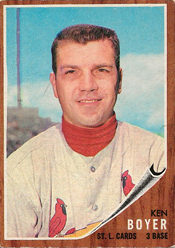
On April 23, 1960, Cardinals sluggers Ken Boyer and Daryl Spencer each hit a home run with the same baseball.

The unusual feat occurred in the second inning of a game against the Dodgers at St. Louis.

With the Dodgers ahead 4-0, Boyer led off the bottom of the second against Danny McDevitt and hit a home run into the pavilion in right-center. A spectator tried to catch the ball, but muffed it and the ball fell back onto the playing field, according to the Los Angeles Times.

Umpires examined the ball, “found it to be in good condition and put it back in play,” The Sporting News reported.

The next batter, Stan Musial, flied out to right fielder Sandy Amoros, who threw the ball back to the infield.

McDevitt, still using the same ball he threw to Boyer and Musial, delivered a pitch to Spencer, who connected for “one of the most robust home runs ever to dent the bleacher scoreboard” in left, the St. Louis Post-Dispatch reported. The ball “almost knocked the cap off” the electronic animated cardinal on the far left side of the scoreboard, according to the Post-Dispatch.

A spectator retrieved the ball and put it in his pocket, The Sporting News noted.

Boyer hit another home run, a two-run shot in the fifth, against Larry Sherry. He also had a run-scoring double and a sacrifice fly and finished with five RBI in a 9-5 Cardinals victory.

The game also was noteworthy for Cardinals right-hander Bob Duliba, who pitched five innings of relief for his first big-league win. Duliba also got his first hit in the majors, a single against Sherry. Boxscore


Read Full Post »

(Updated Nov. 25, 2024)

In a World Series filled with epic performances and major controversies, Al Kaline produced with his usual quiet consistency. His steady professionalism calmed the Tigers and inspired them to overtake the defending champion Cardinals.

The Hall of Fame right fielder played in the major leagues for 22 years, all with the Tigers, and appeared in one World Series, the 1968 classic.

After the Cardinals won three of the first four games, the Tigers rallied to win the last three, including Games 6 and 7 at St. Louis. The 1968 World Series was highlighted by:

_ The Cardinals’ Bob Gibson striking out 17 batters in Game 1.

_ The Tigers’ Mickey Lolich overshadowing teammate and 30-game winner Denny McLain by earning three wins, including Game 7.

_ Cardinals catalyst Lou Brock trying to score standing rather than sliding and being called out, turning the tide in the pivotal Game 5.

_ Gold Glove center fielder Curt Flood failing to catch a drive by Jim Northrup, allowing the Tigers to take control in Game 7.

Kaline, who got into the World Series lineup as the right fielder because of Tigers manager Mayo Smith’s bold decision to shift Mickey Stanley to shortstop, didn’t do anything epic or controversial, but his performance was integral.

Kaline batted .379 against the Cardinals and had an on-base percentage of .400. He had 11 hits, two home runs and eight RBI. He also fielded splendidly.

After the Tigers’ Game 7 triumph, Cardinals manager Red Schoendienst told the St. Louis Post-Dispatch, “You know what the turning point in the Series was? It was Kaline carrying them all along with him. That’s what beat us.”

Rising up

Kaline was born in Baltimore and grew up in a row house. His father worked in a broom factory and his mother scrubbed floors. His parents encouraged Kaline to play baseball.

“My dad was always there to play catch with me,” Kaline told Joe Falls of The Sporting News. “He’d be on his feet all day long at the factory and he’d come home dead tired, but we’d go down to the corner and start playing catch. He’d hit me some fly balls.”

In a 1965 profile, Sports Illustrated reported, “The Kaline family was poor, proud and hungry _ no Kaline had ever graduated from high school _ and before long the whole clan had decided little Al was going to be something different.”

Like his contemporary, Mickey Mantle, Kaline had osteomyelitis, a bone infection. “When he was 8 years old, doctors took two inches of bone out of his left foot, leaving jagged scars and permanent deformity,” Sports Illustrated reported. “They left him with a set of sharply swept-back toes on his left foot. Only two of those toes touch the ground when he walks, which has forced him to develop a running style on the heel and toes of his right foot and on the side of his left foot.”

Kaline overcame his physical limitations and developed into a top prospect. On June 19, 1953, Kaline, 18, signed with the Tigers for $30,000.

“He turned every penny of it over to his father and his mother,” Sports Illustrated reported. “The mortgage was paid off on the house and Mrs. Kaline’s failing eyesight was saved by an operation.”

On June 25, 1953, a week after his signing, Kaline made his debut in the majors against the Athletics at Philadelphia and never played a day in the minors.

Under pressure

In 1955, Kaline, 20, became the American League batting champion, hitting .340. He had 200 hits and struck out a mere 57 times.

Asked who Kaline reminded him of, Red Sox slugger Ted Williams replied, “Joe DiMaggio,” The Sporting News reported.

Kaline was called the Tigers’ best player since Hall of Famer Charlie Gehringer and comparisons also were made to Ty Cobb. For Kaline, it was too much too soon.

“The worst thing that happened to me in the big leagues was the start I had,” Kaline said. “This put the pressure on me. Everybody said this guy’s another Ty Cobb, another Joe DiMaggio. What they didn’t know is I’m not that good a hitter. I have to work as hard, if not harder, than anybody in the league.”

Described by Bob Broeg of the Post-Dispatch as “gracefully methodical,” Kaline remained the Tigers’ best player, even though he suffered setbacks such as a fractured cheekbone, fractured collarbone, rib injuries and a broken right hand.

According to Broeg, Chuck Dressen, who managed Kaline from 1963-66 after managing the Reds, Dodgers, Senators and Braves, said, “He’s the best player who ever played for me. Jackie Robinson was the most exciting runner I ever had and Hank Aaron the best hitter, but for all around ability _ hitting, fielding, running and throwing _ I’ll go with Al.”

On May 25, 1968, Kaline’s right forearm was broken when hit by a pitch from Lew Krausse of the Athletics. Mayo Smith moved Jim Northrup from center to right and put backup Mickey Stanley in center.

The outfield of Stanley, Northrup and Willie Horton in left excelled, and when Kaline returned to the lineup on July 1 he split time with Northrup in right and with Norm Cash at first base.

After the Tigers clinched the pennant, Smith moved Stanley to shortstop, a position he hadn’t played, for nine games in place of weak-hitting Ray Oyler. Satisfied Stanley could handle the switch, Smith kept Stanley at shortstop for the World Series and went with an outfield of Horton, Northrup and Kaline.

New heights

The Cardinals in 1968 were in the World Series for the third time in five years. The Tigers hadn’t been in a World Series since 1945. Kaline had waited 16 seasons for the chance. Entering Game 1 at St. Louis, “I’d never been so nervous in my life, ” Kaline told The Sporting News.

Kaline hit a double against Gibson but also struck out three times. Gibson tied Sandy Koufax’s World Series strikeout mark of 15 when he fanned Kaline for the first out in ninth before completing the game with strikeouts of Cash and Horton.

Said Kaline: “That was the greatest pitching I’ve seen in a long, long time.” Boxscore

(In 2018, Kaline told Joe Schuster of Cardinals Yearbook that Gibson “will always go down in my mind as the best pitcher I ever faced _ by far.”)

In Game 2, Kaline had two hits and scored two runs, but his defense was the story. In the first inning, the Cardinals had Julian Javier on second and Flood on first with one out when Orlando Cepeda lifted a ball to the corner in right. As the ball sliced into foul territory, Kaline, stationed in right-center, raced over, made a running one-handed catch and crashed through a gate.

“I guess I was only about a step, or a step and a half, away from the sideline fence out there,” Kaline told the Post-Dispatch. “I figured I’d make the catch, stop, pivot and throw, but when I hit the fence, I went through it. It’s well-padded out there, but there’s a gate, and I hit it. I was surprised when the fence opened.”

Kaline’s throw to the infield kept both runners from advancing.

The next batter, Mike Shannon, hit a looping fly to right-center and Kaline made another running one-handed grab. Boxscore

In Game 3 at Detroit, Kaline hit his first World Series home run, a two-run shot versus Ray Washburn. Boxscore In Game 4, Kaline had two of the Tigers’ five hits versus Gibson, but the Cardinals were a win away from clinching the championship. Boxscore

Title run

In the seventh inning of Game 5, the Cardinals led, 3-2, but the Tigers loaded the bases with one out. Kaline came up to face Joe Hoerner, a left-handed reliever. “The situation called for a right-handed replacement,” the Post-Dispatch declared, “but Schoendienst’s lack of regard for his right-handed relievers seemed even more pronounced than his confidence in Hoerner.”

Kaline took a mighty cut at a Hoerner pitch and missed. “He was trying for the home run with the bases loaded,” said Mayo Smith, “but then he realized he had to get the base hit.”

Kaline stroked Hoerner’s next pitch to right-center for a two-run single, giving the Tigers a 4-3 lead on the way to a 5-3 victory. Boxscore

“I wanted to hit it up the middle to get away from the double play,” said Kaline. “I enjoy batting with men on base. When there aren’t, there’s no incentive.”

The Series returned to St. Louis and the Tigers cruised to a 13-1 victory in Game 6. Kaline contributed three hits, four RBI and three runs. In the Tigers’ 10-run third inning, Kaline had two hits, a RBI-single against Washburn and a two-run single versus Ron Willis. In the fifth, he hit a solo home run off Steve Carlton. Boxscore

“I wanted it to go seven games,” Kaline said. “If we lose it, I want it to be to Gibson.”

Gibson and Lolich were locked in a scoreless duel in Game 7 until the Tigers broke through with three runs in the seventh and went on to a 4-1 victory. Boxscore

Cardinals general manager Bing Devine showed his respect by going into the Tigers’ clubhouse to congratulate Kaline and shake his hand.

For the Series, Kaline hit .571 with runners in scoring position. He was 4-for-5 versus Cardinals left-handers.

In the Post-Dispatch, Bob Broeg wrote, “It’s nice that this underrated athlete has made the most of the long-awaited Series opportunity, even if it has come at the expense of the Cards.”

Read Full Post »

Bob Lee, who threw hard pitches and hard punches, capped his career in the majors with wins in consecutive games against the Cardinals.

A 6-foot-3, 250-pound right-hander whom The Sporting News described as a “hurling Hercules,” Lee had the most intimidating fastball in the American League when he was a closer for the Angels in the 1960s.

In 1968, his final big-league season, Lee was with the Reds in the National League and no longer overpowered batters, but he was durable and figured out a way to beat the defending World Series champion Cardinals.

A late bloomer, Lee pitched eight years in the minors before getting his chance in the big leagues.

Escaping the mines

Lee was 18 when he signed with the Pirates in 1956. His career stalled in the minors and in 1963 it went backward. Lee, 25, began the year with Asheville, N.C., posted a 6.75 ERA and was demoted to Batavia, N.Y., the farm club in the lowest rung of the Pirates’ system. “Batavia is the salt mines of professional baseball,” the Los Angeles Times declared.

Lee decided to give baseball one last try. “I figured, I’m 25, in a lousy league with bad lights. If I can’t win here, I ought to quit,” he said.

The demotion “was supposed to teach Lee a lesson,” the Los Angeles Times observed. “It did. Taught him how to throw bullets.”

Using his fastball to overpower the overmatched prospects in the New York-Pennsylvania League, Lee became nearly unbeatable. He was 15-2 and won 14 decisions in a row for Batavia when the Pirates decided to start him in their exhibition game against the Indians in Cleveland on Aug. 1, 1963.

On the day of the game, Lee drove the 225 miles from Batavia to Cleveland, took the mound before a crowd of 34,487 and proceeded to show he could dominate big-league batters the way he did those in the minors. Lee struck out 16 and held the Indians to six hits in a 7-1 Pirates triumph. Only two of Lee’s 16 strikeouts were called, The Sporting News reported.

Except for catcher Jim Lawrence, the Indians played their starters: left fielder Tito Francona, shortstop Larry Brown, center fielder Willie Kirkland, first baseman Joe Adcock, third baseman Woodie Held, right fielder Al Luplow and second baseman Jerry Kindall. Francona’s home run accounted for the Indians’ run.

“I had a good fastball and depended on it a great deal,” Lee told The Sporting News.

Lee drove back to Batavia after the game. He finished the season with a 20-2 record and 1.70 ERA, striking out 240 in 185 innings.

Sheer speed

The Pirates traded Lee to the Angels in September 1963 for $25,000.

Lee made the Angels’ 1964 Opening Day roster and, after a couple of relief appearances, the 26-year-old rookie was put into the rotation.

“I knew this was my big opportunity,” Lee told The Sporting News. “If I was going to make it in the big leagues, it had to be now.”

In his first start, on April 25, 1964, Lee held the Indians to one run in 10 innings but didn’t get a decision. Boxscore

Four days later, Lee got his first win in the majors, yielding one hit in seven innings versus the Senators. Boxscore

On an Angels staff featuring Dean Chance and Bo Belinsky, nobody threw as hard as Lee, catcher Buck Rodgers told The Sporting News.

Chance told the Los Angeles Times, “On certain nights, I can throw as hard as anyone, including Sandy Koufax, but for sheer speed, Bob Lee gets my vote.”

Said Lee: “I was lucky. I just got off to a big start. Nobody knew me. I was just a big, sloppy buffalo out there.”

After three more starts, Angels manager Bill Rigney and pitching coach Marv Grissom noticed Lee lost command the longer he pitched in a game, so they moved him to the bullpen and Grissom told him to “fire the ball over the plate.”

Encouraged to throw to the strike zone as hard as he could rather than try to hit spots, Lee thrived, blowing his fastball past hitters.

“The bullpen is my cup of tea,” Lee said. “I really enjoy it. I can get myself up for it. I can go like hell for one or two innings. If I throw 25 to 30 pitches, I’m real good. If I have to throw 40 to 45 pitches, I start running out of gas.”

Lee soon got compared with Red Sox closer Dick Radatz, who was nicknamed “The Monster,” but Radatz told The Sporting News, “Lee is faster than I am.”

“Radatz appears to throw effortlessly. Lee looks like a roaring train every time he throws,” The Sporting News reported.

Naval attack

Heading into a September series at Boston, Lee was 6-5 with a 1.51 ERA in 64 games for the 1964 Angels and set an American League record for most appearances by a rookie pitcher. He was 1-1 with a 2.36 ERA in five starts and 5-4 with 19 saves and a 1.31 ERA in 59 relief stints.

His season ended on Sept. 11, 1964, when he broke his right hand in an altercation with a heckler at Fenway Park. Lee threw three punches and the last one hit a metal railing, fracturing two bones in his right hand.

Lee and other Angels, on the field early for warmups, “were the targets of jibes and insults” by three sailors attending the game, The Sporting News reported. When the hecklers directed their barbs at the Angels’ bat boy, Lee “suggested the sailors take a boat ride.”

When Lee moved out to the bullpen in right field, the sailors followed, “giving me hell all the time,” Lee told the Los Angeles Times.

“They were on me like a new suit,” Lee said. “One of them came down to the rail, just a few feet away, and began to get real abusive. Something snapped and I grabbed him. He swung. I grabbed him by the collar. I hit him once, twice, three times. The third time, they say, I hit the rail with my hand.”

Lee came back in 1965 as good as new, earned a spot on the American League all-star team and was 9-7 with 23 saves and a 1.92 ERA for the Angels.

Though effective in 1966 (5-4, 16 saves, 2.74 ERA), the Los Angeles Times noted, “There is at least some suspicion his fastball may be a zing of the past.”

Cardinals challenges

On Dec. 15, 1966, the Angels traded Lee to the Dodgers for pitcher Nick Willhite. Lee, who described himself as “a blazing 250” pounds, said he was delighted by the deal because “Dodger Stadium is a pitching paradise. The air is heavy and it’s a $3.80 cab drive to the center field fence.”

Lee pitched in four games for the Dodgers, who sold his contract to the Reds in May 1967.

Two months later, on July 3, 1967, Lee was ejected for his role in a brawl between the Reds and Cardinals at St. Louis involving future Hall of Famers Bob Gibson, Orlando Cepeda and Tony Perez.

In 1968, Lee, 30, was a Reds workhorse. He pitched in six consecutive games from April 11 to April 18. The final two games in that stretch were against the Cardinals and Lee won both, his last wins in the majors.

On April 17, 1968, at Cincinnati, the Cardinals had Lou Brock on third base, Curt Flood on first, with none out in the 12th inning, when Lee relieved Ted Davidson. Lee got Bobby Tolan to lift a pop fly into foul territory along the line in right. Reds right fielder Pete Rose “barely caught up with the ball after a long run,” the Dayton Daily News reported.

“I was expecting Brock to try and score on that one, even though there was only one out,” Lee said. “Pete had to go a long way and he was way off-balance, but he threw a strike to the plate.”

Brock held third and Lee’s adversary, Cepeda, stepped to the plate.

“I got two strikes on him and threw him a bad pitch, right up in his power,” Lee said.

Cepeda grounded sharply to shortstop Leo Cardenas, who turned a 6-4-3 double play. The Reds scored in the bottom half of the inning, earning the win for Lee. Boxscore

The next night, Lee pitched three scoreless innings and got another win versus the Cardinals. In the 10th, when he worked out of a bases-loaded jam by getting Julian Javier to hit into a forceout, “the Cardinals were ready to surrender again to Robert D. Lee,” wrote Neal Russo of the St. Louis Post-Dispatch. Boxscore

The 1968 season was Lee’s last in the majors. In five big-league seasons, he was 25-23 with 64 saves and a 2.71 ERA.

Read Full Post »

The Cardinals tried to acquire Don Zimmer to be their second baseman but were outmaneuvered by the Cubs.

On April 8, 1960, the Dodgers told Zimmer he would be traded later in the day to either the Cardinals or the Cubs. Zimmer said he preferred to go to the Cubs because they would play him at third base, his favorite position.

The Cardinals offered the Dodgers a pair of minor-league players and cash. The Cubs offered three minor-leaguers and cash.

After weighing both offers, the Dodgers chose the Cubs, dealing Zimmer for pitcher Ron Perranoski, infielder John Goryl and outfielder Lee Handley. Only Goryl had big-league experience, but Perranoski was the prize. The left-hander became a prominent reliever for the Dodgers.

The Cardinals’ failure to land Zimmer turned out to be fortuitous. A month later, they made a trade with the Pirates for Julian Javier, who developed into an all-star and was their second baseman on three National League championship clubs.

Hard knocks

In December 1959, the Cardinals traded second baseman Don Blasingame to the Giants for shortstop Daryl Spencer and outfielder Leon Wagner. With the acquisition of Spencer, the Cardinals planned to shift Alex Grammas from shortstop to second base.

Near the end of spring training in 1960, when the Dodgers started shopping Zimmer, the Cardinals saw an opportunity to upgrade at second base. Zimmer (29) was five years younger than Grammas (34). The Cardinals thought it would be better to have Grammas in a utility role.

Zimmer was available because Maury Wills had taken over the Dodgers’ shortstop job and Bob Lillis was a capable backup.

In 1953, Zimmer was beaned in a minor-league game, suffered a skull fracture and needed a plate inserted in his head. He made his debut in the majors with the Dodgers in 1954 and two years later suffered a broken cheekbone when beaned again by a pitch from Hal Jeffcoat of the Reds.

Zimmer “just doesn’t get out of the way,” pitcher Sal Maglie said to the Associated Press.

After being used primarily as a backup at second, third and short, Zimmer became the Dodgers’ starting shortstop in 1958 and hit .262 with 17 home runs.

“A colorful fielder, Zimmer looks like a chubby Nellie Fox, always yelling encouragement about the infield with a wad of chewing tobacco bulging in his jaw,” the Associated Press observed.

Zimmer returned as Dodgers shortstop in 1959, but struggled to hit for average. “Likable little Zimmer never has ceased stubbornly to swing for the fences,” Bob Broeg of the St. Louis Post-Dispatch noted.

In June 1959, the Dodgers called up Wills from the minors and the speedster supplanted Zimmer, who never got untracked and finished the season with a .165 batting mark for the National League champions.

Time to go

At spring training in 1960, Zimmer choked up on the bat and shortened his swing. “I’ve never seen Zimmer look better,” Dodgers manager Walter Alston told The Sporting News.

Alston may have been trying to prop up Zimmer’s trade value. He and Zimmer weren’t getting along.

“I wanted to get away, especially from Alston,” Zimmer told the Associated Press. “I know he doesn’t care for me. That’s because I’m always after him to play me or trade me.”

The Cardinals and Cubs were the most ardent suitors for Zimmer. The Cubs wanted him as the third baseman to replace Alvin Dark, who they traded to the Phillies in January 1960.

According to the Chicago Tribune, Zimmer “stated frankly he was not interested in going to the Cardinals when he learned they planned to play him at second base. He prefers third.”

The Dodgers “were understood to be seeking a suitable place for Zimmer in the major leagues,” the Tribune reported, “and his preference for the Cubs undoubtedly was taken into consideration.”

The Cardinals offered two minor-league players and cash to the Dodgers for Zimmer, the Post-Dispatch reported, adding the identities of the players were unknown. It’s possible pitcher Jim Donohue and outfielder Duke Carmel were the minor-leaguers offered because two months later the Cardinals dealt them to the Dodgers for outfielder John Glenn.

According to the Associated Press, Dodgers general manager Buzzie Bavasi told Zimmer, “You’re going to either the Cubs or the St. Louis Cardinals. I can’t tell you yet. I’ll be able to tell you later on.”

A few hours later, Zimmer learned he was a Cub.

“I would have liked to have had Zim because he can play three infield positions well and I like his fire,” Cardinals manager Solly Hemus told the Post-Dispatch.

Foiled in their attempt to acquire Zimmer, the Cardinals turned their attention to a Pirates prospect, Julian Javier, whose path to the majors was blocked by Bill Mazeroski, a future Hall of Famer. On May 28, 1960, the Cardinals dealt pitcher Vinegar Bend Mizell and infielder Dick Gray to the Pirates for reliever Ed Bauta and Javier, who became their mainstay at second base for more than a decade.

Crowd pleaser

Zimmer was the third baseman when the Cubs opened the season on April 12, 1960, against the Dodgers at Los Angeles. In his first at-bat as a Cub, Zimmer hit a home run against his former teammate, Don Drysdale.

“The crowd of 67,550 stood and cheered Don as he rounded the bases,” The Sporting News reported.

Zimmer told the Los Angeles Times, “I can’t think of anything that has happened to me in baseball that gave me a bigger thrill, and I hit it off one of my best buddies.” Boxscore

The next day, Zimmer was chatting with Drysdale at the ballpark when Dodgers outfielder Duke Snider approached and informed them his wife stood and applauded for Zimmer when he hit the home run.

Zimmer replied, “I can top that one. I saw Ginger Drysdale outside the dressing room after the game and she gave me a kiss and a hug.”

In June 1960, the Cubs called up prospect Ron Santo from the minors, put him at third base and moved Zimmer to second. Zimmer eventually played for the Mets, Reds, Dodgers again, and Senators before ending his playing career in 1965.

From 1971 through 2006, Zimmer was in the major leagues as either a coach or manager. He had a 906-873 record as manager of the Padres, Red Sox, Rangers, Cubs and Yankees.

Read Full Post »

The Cardinals had Willie Montanez in their organization, lost him, got him back, lost him again and made another attempt to reacquire him.

On April 8, 1970, the Cardinals sent Montanez to the Phillies as partial compensation for Curt Flood’s failure to report after being traded.

A first baseman and outfielder in the Cardinals’ farm system, Montanez became a prominent player for the Phillies.

He spent 14 seasons in the majors with nine teams, but not the Cardinals.

Big leap

Cardinals scout Chase Riddle, who signed Steve Carlton and who also opened the talent pipeline for the club in Latin America, discovered Montanez in Puerto Rico. Montanez signed with the Cardinals on March 1, 1965, a month before he turned 17. He spent the 1965 season with a Cardinals club managed by George Kissell in the Florida Rookie League.

Years later, Montanez admitted he too often flashed a temper in those development years. “I was really bad then,” Montanez said to the Philadelphia Daily News. He also told the St. Louis Post-Dispatch, “I wouldn’t take anything from anybody and I’m sure that’s what held me down in the minor leagues.”

Left off the Cardinals’ 40-man major-league roster, Montanez was selected by the Angels in the November 1965 Rule 5 draft. The move was a surprise because Montanez had little professional experience and, under the rules, would have to remain with the Angels throughout the 1966 major-league season or be offered back to the Cardinals.

Montanez, 18, was on the Angels’ Opening Day roster and made his debut in the majors on April 12, 1966, as a pinch-runner for Norm Siebern. Boxscore

He appeared in eight games for the Angels, had two at-bats and struck out both times. On May 5, 1966, the Angels returned Montanez to the Cardinals, who sent him to their farm club at Rock Hill, S.C. A month later, in June 1966, Rock Hill placed Montanez on a 10-day inactive list so he could return to Puerto Rico and graduate with his high school class, The Sporting News reported.

From 1966-69, Montanez made a steady rise through the Cardinals’ system. In 1969, he hit .375 in 14 games for Class AAA Tulsa before he fractured his right knee sliding into second base, ending his season.

Compromise solution

In October 1969, the Cardinals traded Flood, Tim McCarver, Joe Hoerner and Byron Browne to the Phillies for Dick Allen, Cookie Rojas and Jerry Johnson. Flood refused to report and filed an antitrust lawsuit, challenging the reserve clause.

At spring training in 1970, when it became obvious Flood wouldn’t reconsider, the Cardinals and Phillies opened talks regarding a player to replace him in the trade. The Phillies were interested in third baseman Mike Shannon, the Post-Dispatch reported, until medical tests revealed he had a kidney ailment.

With Shannon unavailable, the Cardinals submitted a list of players for consideration, but the Phillies rejected it because “we felt the players listed were no better than the players we already had,” Phillies general manager John Quinn told the Post-Dispatch. “In some cases, we felt they weren’t even quite as good as the players we had.”

The Phillies suggested to the Cardinals some alternative names, including Montanez. Phillies manager Frank Lucchesi had seen Montanez while managing winter baseball in Puerto Rico and urged the Phillies to take him, The Sporting News reported.

“Montanez was more or less a compromise name,” Cardinals general manager Bing Devine told the Post-Dispatch.

The Phillies got Montanez and the right to choose another Cardinals prospect. On Aug. 30, 1970, the Phillies took pitcher Jim Browning.

Fantastic Phillie

Montanez spent the 1970 season in the minors before being called up to the Phillies in September. He went to spring training in 1971 “with only an outside chance of winning a job as a utility man,” The Sporting News reported.

Instead, Montanez was the surprise of training camp and opened the 1971 season as the Phillies’ center fielder.

On April 25, 1971, when the Phillies were in St. Louis to play the Cardinals, Montanez made an over-the-shoulder catch of a Jose Cardenal liner and “collapsed to the warning track, the breath knocked out of him by the head-on collision with an unyielding wall,” the Philadelphia Daily News reported. Boxscore

Five months later, on Sept. 13, 1971, Montanez had five hits and a walk in six plate appearances against the Cardinals at St. Louis. Besides two singles and a double, Montanez hit two home runs. The first, against Reggie Cleveland, tied the score in the seventh and the second, against Don Shaw in the 10th, gave the Phillies a 6-5 victory. Boxscore

Montanez finished the 1971 season with 30 home runs and 99 RBI for the Phillies. The next year, he tied for the National League lead in doubles (39).

Near deal

In May 1975, the Phillies traded Montanez to the Giants for Garry Maddox.

Montanez didn’t like San Francisco’s weather or its stadium, Candlestick Park. He chose to play the 1976 season without a contract. The Giants, concerned Montanez intended to play out his option and become a free agent, decided to trade him. Montanez’s agent, Dennis O’Brien, told the Giants his client would play in St. Louis, Pittsbugh, Philadelphia or New York, the Post-Dispatch reported.

On June 12, 1976, the Cardinals and Giants made a deal “on the condition that Montanez would sign with the Cardinals,” the San Francisco Examiner reported, but the Cardinals backed out when Montanez indicated he would stay unsigned.

“Montanez’s agent called and said we appreciate the opportunity but we’ve decided to play out our option,” Devine told the Post-Dispatch.

Montanez said to the Examiner, “I never did say I’d sign with the Cardinals … I might have signed with St. Louis if the price had been right.”

According to the Examiner, the Cardinals intended to send Reggie Smith to the Giants for Montanez. The Post-Dispatch reported the Cardinals would have sent Reggie Smith or Keith Hernandez. Pitcher Lynn McGlothen told The Sporting News he was the player the Cardinals intended to swap for Montanez.

A year earlier, the Cardinals traded Ken Reitz, a San Francisco native, to the Giants. Hernandez, also a San Francisco native, told the Post-Dispatch he wouldn’t have been surprised if he had been dealt to the Giants for Montanez. “They’re looking for Bay Area products,” Hernandez said. “That’s why they got Reitzie. They’re looking for people who’ll bring fans into the park.”

The next day, June 13, 1976, the Giants traded Montanez to the Braves for Darrell Evans. Two days after that, the Cardinals swapped Smith to the Dodgers for Joe Ferguson and two minor-leaguers.

Extra mustard

Montanez batted .275 with 1,604 career hits for the Angels, Phillies, Giants, Braves, Mets, Rangers, Padres, Expos and Pirates. He developed a reputation for flamboyant catches and bat flips.

Bill Conlin of the Philadelphia Daily News concluded Montanez “has all the subtlety of a peacock.”

“He walks toward the plate twirling his bat, almost like a baton,” The Sporting News noted.

Padres second baseman Tito Fuentes said, “He’s headed for the hot dog hall of fame. Nobody else is close to him.”

Said Montanez: “Some players do those things, they call them colorful. I do them, they say I am a hot dog.”

Read Full Post »

In the ballpark on Grand Boulevard and Dodier Street and at the stadium downtown, Jim Wynn hit home runs to spots few others could reach in St. Louis.

Beginning with the Houston Colt .45s and continuing with their renamed version, the Astros, Wynn launched long balls wherever he played.

At Busch Stadium, formerly known as Sportsman’s Park, on the north side of St. Louis, Wynn twice hit home runs high off the left-field scoreboard, a structure situated behind and above the bleachers. A right-handed batter, Wynn also showed astonishing opposite-field power when he hit a home run onto the pavilion roof beyond the right-field wall.

A year after Busch Memorial Stadium opened in downtown St. Louis, Wynn hit a home run off the scoreboard in left-center. The rectangular scoreboard hung from underneath the upper deck and above the back end of the bleachers.

An outfielder who played 15 years (1963-77) in the big leagues, Wynn eight times hit 20 or more home runs in a season.

Uppercut punch

At 5 feet 9 and about 160 pounds, Wynn possessed the power of a giant.

“Wynn has developed one of the most lethal home run swings in baseball,” wrote Mark Mulvoy of Sports Illustrated. “He does not have the strong wrists of a Henry Aaron or a Frank Robinson (Wynn’s idol as he grew up in Cincinnati) or a Roberto Clemente, so he does not swing down on the ball. Instead, Wynn cocks his bat with a full extension of his left arm (much like the perfect golfer) and tries to uppercut the pitch. He works his muscular shoulders, arms and legs, all developed through extensive weight-lifting sessions, under and then up into the ball.”

Mark Whicker of Southern California News Group explained, “A home run hitter in Houston’s Astrodome, at least its old configuration, was like a fisherman in the Mojave. Wynn had a cannon-like arm, too, but his swing was the real fascination. He cocked and struck, unleashing all his musculature. He was a launch angle generator before anybody else claimed to be.”

Wynn was in his second season in the majors when he faced Cardinals left-hander Curt Simmons on April 26, 1964, at St. Louis. Batting in the first inning with two outs and a runner on first, Wynn got a fastball away and drove it onto the pavilion roof in right. Wynn’s ability to power a pitch the opposite way “shocked me,” Simmons told the St. Louis Post-Dispatch.

“It wasn’t that bad a pitch, about belt high,” Simmons said, “but he went with it, even though the wind was blowing in from right. He has a quick bat.” Boxscore

A year later, on June 6, 1965, at St. Louis, Wynn, though hobbling because of a chipped bone in his knee, hit a pitch from rookie right-hander Nelson Briles over the “U” on the Budweiser sign on the scoreboard in left for a solo home run.

“Think where he might have put it if he hadn’t been hurt,” Cardinals manager Red Schoendienst said to the Post-Dispatch. Boxscore

When Wynn and the Astros came back to St. Louis on Aug. 3, 1965, he hit another tape-measure home run. His three-run homer in the seventh against rookie right-hander Don Dennis struck the scoreboard above the word “American,” where the American League scores were posted, the Post-Dispatch reported.

Noting the scoreboard was topped by an image of an eagle in the Anheuser-Busch logo, Wynn chirped, “Now, I’m going for the bird.” Boxscore

Big boom

The Cardinals moved into Busch Memorial Stadium in May 1966 and, a year later, on June 6, 1967, Wynn hit a home run there for the first time. Leading off the fourth against right-hander Ray Washburn, Wynn got his bird, hitting a home run off the Anheuser-Busch eagle on the left side of the left-field scoreboard.

The Sporting News described it as “a tremendous shot” and added, “The size of the home run didn’t surprise anyone familiar with Wynn’s strength. Despite his compact 160-pound dimensions, Wynn generates tremendous power. When he hits a homer, it is as likely to be an awesome one as not.” Boxscore

Wynn’s home run in St. Louis was among multiple tape-measure shots he hit in 1967. Houston Chronicle sports reporter John Wilson began referring to Wynn as “Toy Cannon,” a nickname that stuck.

After leaving St. Louis, the Astros went to Cincinnati and Wynn hit a couple of mighty home runs. Both were against right-handers. The first was on June 10, 1967, against Mel Queen and the other the next day was off Sammy Ellis.

According to The Sporting News, Wynn hit the first home run “over the 40-foot scoreboard that sits directly in the power alley at Crosley Field. The next day, he hit one just to the left of the scoreboard _ and even farther than the one the day before. The ball crossed the edge of the parking lot, landed in the freeway feeder street, bounced up an embankment and came to rest some 600 feet from where it first changed direction in flight.”

The ball, The Sporting News added, was found “just short of a freeway 100 yards behind the stadium. It would have made the freeway except that it spent itself going up an embankment the last 40 or 50 feet.” Video

A month later, in July 1967 at Forbes Field in Pittsburgh, Wynn hit a home run against Pirates right-hander Pete Mikkelsen “that left the park almost directly over the 457-foot marker,” The Sporting News reported, “a corner of the stadium so far from home plate that the batting cage is rolled out there during games.”

According to a ballpark security guard, the ball landed “on a playground diamond 50 or 60 feet behind the fence,” The Sporting News reported. Video

Wynn had 291 home runs and 225 stolen bases in the majors with the Colt .45s (1963-64), Astros (1965-73), Dodgers (1974-75), Braves (1976), Yankees (1977) and Brewers (1977). He posted a career on-base percentage of .366.

His career numbers versus the Cardinals: 24 home runs, 20 stolen bases and a .360 on-base percentage.

Read Full Post »

« Newer Posts - Older Posts »