Feeds:
Posts
Comments

Archive for the ‘Opponents’ Category

While pitching to a Cardinals batter, Sandy Koufax was replaced by Ed Roebuck, who got the Dodgers out of a jam and went on to earn a win in an eight-inning relief effort.
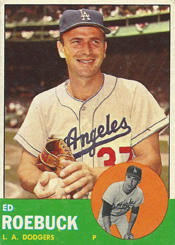
Roebuck’s performance was one of several successes he experienced against the Cardinals in his 11 major-league seasons. Roebuck had a 9-1 career record versus St. Louis.

The right-handed relief pitcher won nine consecutive decisions against the Cardinals before he lost to them.

Rescue work

Roebuck signed with the Dodgers as an amateur free agent in 1949 and made his major-league debut with them in 1955. Roebuck’s first win versus the Cardinals came in his first career appearance against them on May 5, 1955. Boxscore

A sinkerball specialist, Roebuck earned five wins and 12 saves for the 1955 Dodgers, who won Brooklyn’s only World Series championship that year.

In 1956, both Koufax, 20, and Roebuck, 25, were in their second major-league season with the Dodgers.

On Aug. 5, 1956, Koufax brought a 2-3 record and 4.56 ERA into his start against the Cardinals in the second game of a doubleheader at Ebbets Field. After Koufax held the Cardinals scoreless in the top of the first, Duke Snider hit a three-run home run in the bottom half of the inning.

In the second, the first three Cardinals batters reached base against Koufax on singles by Rip Repulski and Wally Moon and a walk to Walker Cooper. After Koufax threw two pitches outside the strike zone to the next batter, Bobby Del Greco, manager Walter Alston yanked the erratic left-hander and brought in Roebuck.

Cardinals manager Fred Hutchinson countered by replacing Del Greco, a right-handed batter, with Charlie Peete, who batted left-handed. With the bases loaded and none out, Roebuck got Peete to ground into a double play, with Repulski scoring from third, and struck out pitcher Larry Jackson, ending the threat.

Roebuck held the Cardinals scoreless for the next four innings, surrendered a two-run home run to Rocky Nelson in the seventh, and shut out the Cardinals the rest of the way in a 5-3 Dodgers victory. Boxscore

Pennant pressure

Roebuck had his best seasons with the Dodgers in 1957 (8-2, eight saves), 1960 (8-3, eight saves) and 1962 (10-2, nine saves). On July 30, 1963, Roebuck was traded by the Dodgers to the Senators for infielder Marv Breeding. Nine months later, on April 21, 1964, the Senators sold Roebuck’s contract to the Phillies.

Joining a bullpen featuring closer Jack Baldschun, Roebuck contributed to the Phillies’ rise to the top of the National League standings in 1964. The first-place Phillies were 6.5 games ahead of their nearest pursuers, the Cardinals and Reds, with 12 to play, but went into a tailspin, enabling St. Louis to clinch the pennant on the season’s final day.

Roebuck pitched well even while the Phillies faltered. He had a 1.04 ERA in 10 September appearances and earned a win versus the Reds in his lone October game. Roebuck finished 5-3 with 12 saves and a 2.21 ERA in 60 appearances for the 1964 Phillies and was 1-0 with a save and 2.03 ERA in nine games versus St. Louis.

Roebuck was 9-1 with 10 saves in 61 career games pitched against the Cardinals. He made more appearances versus St. Louis than he did against any other team.

Beat the streak

On May 19, 1965, with the Phillies ahead, 6-5, the Cardinals scored twice in the bottom of the ninth, beating Roebuck for the only time. A headline in the Philadelphia Inquirer declared, “Cards Manage To Beat Roebuck After 10 Years.”

With one out, Curt Flood singled and advanced to third on Lou Brock’s single off the glove of second baseman Tony Taylor. After Brock swiped second, Mike Shannon, batting .107, laid off Roebuck’s low pitches and drew a walk, loading the bases.

“That’s why we haven’t been able to beat Roebuck _ we’ve been swinging at his bad pitches,” Cardinals manager Red Schoendienst said to the St. Louis Post-Dispatch.

Cardinals pitching coach Joe Becker, who coached Roebuck with the Dodgers, said, “Roebuck would throw sinker, sinker, sinker and when he got ahead of the batter he’d put his pitches lower, lower and lower. He just wouldn’t give a guy a good ball to hit.”

Ken Boyer barely missed hitting a grand slam with a sacrifice fly to the center field wall, tying the score at 6-6, and Dick Groat’s groundball single to left drove in Brock from second with the winning run. Boxscore

“I look for the fastball all the time,” Groat told the Philadelphia Daily News. “That’s the only way I know how to hit.”

In a big-league career with the Dodgers (1955-58 and 1960-63), Senators (1963-64) and Phillies (1964-66), Roebuck was 52-31 with 62 saves.
Read Full Post »

(Updated July 21, 2019)

Trailing by eight runs with two outs and one runner on base, the Cardinals produced a 10-run inning and beat the Reds.

The Cardinals’ comeback happened on June 9, 1968, in the first game of a Sunday doubleheader at Crosley Field in Cincinnati. The Reds led, 8-0, scoring all of their runs against starter Steve Carlton, before the Cardinals rallied for 10 in the fifth inning.
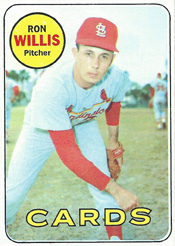
Ron Willis relieved Carlton and shut out the Reds on one hit for the final five innings, earning the win in a 10-8 Cardinals victory.

Game 2 of the doubleheader was the reverse of Game 1. The Cardinals led, 6-0, in the fourth inning, but the Reds rallied with a run in the fourth, four in the sixth and a run in the eighth, tying the score at 6-6. The Reds won, 7-6, with a run in the 12th against Carlton, who relieved in the 10th.

“The wackiest doubleheader in years,” wrote Bill Ford of the Cincinnati Enquirer.

On a roll

In the opener, the Reds reached Carlton for nine hits and three walks before he was relieved by Hal Gilson with two outs in the fourth. Eight of the hits against Carlton were singles and the other was a double.

Reds starter Gerry Arrigo shut out the Cardinals for four innings. In the fifth, Dal Maxvill led off with a shot that deflected off Arrigo’s glove for a single. Maxvill moved to second on a wild pitch, but Arrigo retired the next two batters.

After that, nine in a row reached base for the Cardinals and all scored.

Julian Javier started the hit parade with a double, scoring Maxvill. Curt Flood followed with an infield single, moving Javier to third. Orlando Cepeda singled, driving in Javier, advancing Flood to second and making the score 8-2.

Arrigo walked Mike Shannon, loading the bases, and Tim McCarver singled, driving in Flood and Cepeda, moving Shannon to third and cutting the Reds’ lead to 8-4.

Bob Lee relieved Arrigo and faced Roger Maris, who was batting for right fielder Dick Simpson, the No. 7 batter in the order. Maris walked, reloading the bases. Maxvill followed with his second single of the inning, scoring Shannon and McCarver, advancing Maris to second and getting the Cardinals within two at 8-6.

Johnny Edwards, batting for Gilson, singled, scoring Maris and slicing the Reds’ lead to 8-7, with Maxvill going to third.

Bill Kelso relieved Lee and the first pitch he threw to Lou Brock was hit nearly to the top of the right-field bleachers for a three-run home run, putting the Cardinals ahead, 10-8. Javier lined out to left, ending the inning.

“If I had known we were going to score 10 runs, I’d have done something different,” Carlton told the St. Louis Post-Dispatch.

Fly chasers

The 10-run inning and the comeback from an eight-run deficit weren’t Cardinals records. The 1926 Cardinals had a 12-run third inning in a 23-3 victory over the Phillies Boxscore and the 2012 Cardinals had a 12-run seventh inning in a 12-0 victory over the Cubs. Boxscore In 1952, the Cardinals overcame an 11-0 Giants lead after three innings and won, 14-12. Boxscore

Strong outfield play by Flood and Maris prevented the Reds from denting Willis.

In the bottom of the fifth, Tommy Helms hit a sinking liner to right that Maris caught on the run.

In the sixth, Alex Johnson’s drive to left-center was tracked down by Flood, who raced up the outfield incline to reach the ball. “My knees were up in my chest,” said Flood.

Two innings later, Flood leaped above the fence in right-center to catch a ball and deprive Vada Pinson of a home run. Boxscore

Long day

In the second game, the Cardinals used five pitchers and the Reds used six. Reds starter Billy McCool faced five batters, all reached base and he was lifted before recording an out. The Game 1 starters, Arrigo and Carlton, both relieved in Game 2. Willis pitched again, too, and held the Reds scoreless for 1.2 innings.

After scoring five runs in the first and another run in the fourth, the Cardinals went scoreless over the next eight innings. In the bottom of the 12th, Leo Cardenas doubled with two outs against Carlton, driving in Tony Perez from first with the winning run. Carlton, who had won his last five decisions, took the loss. Boxscore

The Cardinals went to the airport after the game for a flight to Atlanta. They were aboard when an electrical problem on the plane delayed takeoff. The team waited in darkness without air-conditioning inside the plane while repairs were made.

“Nothing like a sauna after a hot doubleheader,” said Flood.

History repeats

Fifty-one years later, the Cardinals repeated the comeback feat of the 1968 team.

On July 19, 2019, the Cardinals came back from a 7-0 deficit with a 10-run sixth inning and beat the Reds, 12-11, at Cincinnati. Boxscore

Read Full Post »

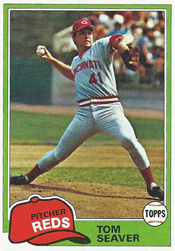
Keith Hernandez provided the biggest challenge to Tom Seaver in his bid to pitch a no-hitter against the Cardinals.

On June 16, 1978, Seaver got the lone no-hitter of his 20-year major-league career in a 4-0 Reds victory over the Cardinals at Cincinnati.
Hernandez twice came close to getting singles, but skillful plays by second baseman Joe Morgan and shortstop Dave Concepcion turned the sharp shots into outs.

Hernandez also almost ruined Seaver’s shutout, drawing a walk and advancing to third with one out before being left stranded.

Early jam

In 1978, Seaver, 33, was in his second season with the Reds. He’d pitched five one-hitters in 11 seasons with the Mets before they traded him to Cincinnati in June 1977.

Facing the Cardinals for the second time in 1978, Seaver retired the first four batters before Hernandez walked with one out in the second. When Hernandez stole second and advanced to third on a throwing error by catcher Don Werner, the Cardinals were positioned to score, but Jerry Morales struck out and, after Ken Reitz walked, Mike Phillips grounded out, ending the threat.

In the fourth, Hernandez hit a one-hop smash between first and second. Morgan moved to his left, snared the ball and threw out Hernandez.

“It wasn’t a tough play if I get to it,” Morgan said to the Cincinnati Enquirer. “The only question was if I’d get to it on the AstroTurf.”

Said Seaver: “Joe has a lot of smarts. He knows how to play the hitters. That was a case of intelligence getting you an out rather than raw ability.”

The Reds scored three runs in the fifth against John Denny on a two-run double by Pete Rose and a RBI-double by Morgan. A home run by Dan Driessen leading off the sixth gave the Reds a 4-0 lead.

Bearing down

In the seventh, Hernandez hit a low rocket that caromed off Seaver’s glove and deflected to Concepcion, who fielded the ball and threw out Hernandez.

“Even if Seaver doesn’t touch the ball, I think I make the play at first,” Concepcion said to The Sporting News.

Seaver survived another scare in the eighth when Morales hit a high chopper off the plate. Third baseman Ray Knight, who’d entered the game as a defensive replacement for Rose, fielded the ball and fired a throw to first to nip Morales.

Seaver retired 19 in a row before walking Jerry Mumphrey to open the ninth. “After that walk, I told myself, ‘Wait a minute, pal, you can lose this game,’ ” Seaver said.

Up next for the Cardinals were Lou Brock, Garry Templeton and George Hendrick. Ted Simmons and Hernandez awaited after that. “If I had to get down to Simmons and Hernandez, I knew the game would be in jeopardy,” Seaver said to the St. Louis Post-Dispatch.

Savvy Seaver

Brock worked the count to 2-and-1, fouled off four pitches and flied out to left. Templeton followed with a ground ball to Concepcion, who tossed to Morgan at second for the forceout of Mumphrey.

Seaver got ahead of the count, 1-and-2, on Hendrick before getting him to ground out to Driessen at first, securing the no-hitter and giving the Reds a 4-0 victory. Video of last out

“I did have a good sinker most of the way and my fastball came along later,” said Seaver. “I had my best stuff at the end.”

The no-hitter “was more a matter of skill over power,” wrote Bob Hertzel of the Enquirer.

Werner, catching in place of Johnny Bench, who had an ailing back, said Seaver called all the pitches. “Tom runs the show out there,” Werner said. “I was more of a spectator.” Boxscore

The no-hitter was the first by a Reds pitcher at Riverfront Stadium. It also was the first by a Reds pitcher since Jim Maloney versus the Astros in April 1969.

Seaver’s no-hitter was the first pitched against the Cardinals since Gaylord Perry of the Giants did it in September 1968.

“If it has to happen,” said Cardinals manager Ken Boyer, “at least it happened to a real pro.”

In 51 career starts against the Cardinals, Seaver was 25-13 with a 2.69 ERA, 21 complete games and four shutouts.

Here is a link to a game video of Seaver’s no-hitter.

Read Full Post »

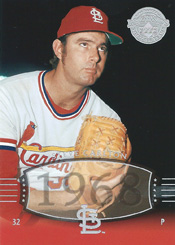
In the Year of the Pitcher, Steve Carlton showed he could hit as well as pitch for the Cardinals.

On June 13, 1968, Carlton hit his first home run in the major leagues, and allowed one run in eight innings, leading the Cardinals to a 3-1 victory over the Braves at Atlanta.
Carlton’s home run was the first by a Cardinals pitcher since Bob Gibson hit one against Jim Lonborg of the Red Sox in Game 7 of the 1967 World Series and the first by a St. Louis pitcher in the regular season since Larry Jaster accomplished the feat on Sept. 23, 1966, against Larry Jackson of the Phillies.

Mistake pitch

The 1968 season became known as the Year of the Pitcher because a mere six major-league players batted .300 or better and the sport was dominated by the likes of Gibson (1.12 ERA, 13 shutouts, 268 strikeouts), the Giants’ Juan Marichal (26 wins, 30 complete games), the Tigers’ Denny McLain (31 wins, 28 complete games) and the Indians’ Luis Tiant (1.60 ERA, nine shutouts).

Carlton, 23, was developing into a premier pitcher. The left-hander would finish the 1968 season with a 13-11 record, 2.99 ERA and five shutouts.

He also was showing an ability to handle the bat.

Carlton, a left-handed batter, had three hits in his last three at-bats entering his start against the Braves and his batting average was .233.

In the third inning, in his first at-bat of the game, Carlton hit an 0-and-2 fastball from Braves starter Ken Johnson over the wall in right-center.

“The pitch was right down the middle with nothing on it,” Johnson said to the St. Louis Post-Dispatch. “I tried to go inside with that pitch and I figured on coming back with a knuckleball. Carlton hit a pitch that my two sons, both pitchers, wouldn’t make in Little League.”

Carlton said he never hit a home run in the minor leagues, but hit some in winter league games.

Knuckle under

Carlton’s home run gave the Cardinals a 1-0 lead. The Braves tied the score in the sixth on Joe Torre’s RBI-single with two outs.

Carlton pitched eight innings, allowing four singles and a walk and striking out seven, and departed with the score tied at 1-1.

In the 12th inning, shortstop Dick Schofield led off for the Cardinals with a home run against Phil Niekro. “A lousy, lousy knuckler,” Niekro told the Atlanta Constitution.

Said Schofield: “It wasn’t one of Niekro’s better knucklers because nobody hits those.”

The home run was Schofield’s 17th in 16 major-league seasons and his only one in 1968.

Phil Gagliano, who batted after Schofield, walked and scored on Lou Brock’s double, extending the Cardinals’ lead to 3-1.

In the Braves’ half of the 12th, Wayne Granger struck out Torre, walked Deron Johnson and yielded a single to Tommie Aaron. Hal Gilson relieved and retired Clete Boyer and Marty Martinez on groundouts, stranding the runners and sealing the win. Boxscore

Power pitchers

Carlton hit two more home runs for the Cardinals _ on July 27, 1968, against the Pirates’ Bob Moose and on Sept. 1, 1969, against the Astros’ Don Wilson _ before he was traded to the Phillies after the 1971 season.

Carlton hit 13 regular-season home runs in his major-league career and one in the postseason. In Game 3 of the 1978 National League Championship Series, Carlton hit a three-run home run against the Dodgers’ Don Sutton.

Bob Gibson holds the Cardinals record for regular-season career home runs by a pitcher, with 24. Gibson also holds the club single-season mark for regular-season home runs by a pitcher, with five.

The all-time major-league leader for regular-season career home runs by a pitcher is Wes Ferrell. He hit 38 in a big-league career from 1927-41 with the Indians, Red Sox, Senators, Yankees, Dodgers and Braves.

After Ferrell, the next best in regular-season career home runs by a pitcher are Bob Lemon (37) and Warren Spahn (35).

Read Full Post »

(Updated April 19, 2019)

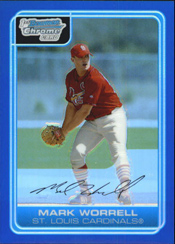
In his brief stint with the Cardinals, Mark Worrell provided a lasting impression with his hitting instead of his pitching.

On June 5, 2008, in the second game of a doubleheader between the Cardinals and Nationals in Washington, Worrell hit a three-run home run in his first major-league plate appearance.
Worrell, no relation to Cardinals reliever Todd Worrell, was regarded as a premier pitching prospect, but didn’t last long with St. Louis.

After four relief appearances for the 2008 Cardinals, Worrell was returned to the minors, got traded after the season and hurt his arm.

His place in franchise lore, though, was secured as one of 10 Cardinals to hit a home run in his first plate appearance in the major leagues.

The list:

_ Eddie Morgan, pinch-hitter, April 14, 1936, vs. Cubs.

_ Wally Moon, center fielder, April 13, 1954, vs. Cubs.

_ Keith McDonald, pinch-hitter, July 4, 2000, vs. Reds.

_ Chris Richard, left fielder, July 17, 2000, vs. Twins.

_ Gene Stechschulte, pinch-hitter, April 17, 2001, vs. Diamondbacks.

_ Hector Luna, second baseman, April 8, 2004, vs. Brewers.

_ Adam Wainwright, pitcher, May 24, 2006, vs. Giants.

_ Mark Worrell, pitcher, June 5, 2008, vs. Nationals.

_ Paul DeJong, pinch-hitter, May 28, 2017, vs. Rockies.

_ Lane Thomas, pinch-hitter, April 19, 2019, vs. Mets.

Climbing the ladder

Worrell, a starting pitcher at Florida International University, was selected by the Cardinals in the 12th round of the 2004 amateur baseball draft and established himself as a quality reliever. In 2005, Worrell played for Class A Palm Beach, led all minor leagues in saves with 35 and was named Cardinals minor-league pitcher of the year.

Worrell led the Texas League in saves, with 27 for Class AA Springfield in 2006, and he struck 66 batters in 67 innings for Class AAA Memphis in 2007.

In 21 games for Memphis in 2008, Worrell had a 1.88 ERA and 38 strikeouts in 24 innings before he was called up to the Cardinals.

Worrell had an unorthodox pitching motion. “As he begins his delivery, Worrell bends over and then springs up to throw sidearm while stepping almost toward first base,” the St. Louis Post-Dispatch reported.

“In the end, his success is the ball on the edge and not the middle of the plate,” said Cardinals manager Tony La Russa.

Power pitcher

Worrell made his major-league debut on June 3, 2008, in the Cardinals’ first visit to Nationals Park and pitched a scoreless ninth inning in a 6-1 St. Louis victory. Boxscore

Two nights. later, Worrell made his second appearance when he relieved rookie starter Mike Parisi in the fifth. Parisi allowed eight runs in four innings and also got his first major-league hit, a two-run double against Nationals starter Tim Redding.

After Worrell pitched a scoreless fifth, the Cardinals batted in the sixth against Redding, looking to chip away at an 8-3 deficit. With runners on first and third, two outs, Worrell made his first major-league plate appearance and hit a 3-and-2 fastball from Redding into the left field stands for a three-run home run.

“Look at these pitchers! That’s a home run,” Nationals television broadcaster Bob Carpenter exclaimed as the ball carried over the fence. Video

“I let two different pitchers drive in five runs and a guy that had never swung a bat in the big leagues hit a three-run homer off me,” Redding said to the Washington Times. “Other than those two outcomes, I felt good.”

Worrell pitched a scoreless sixth and exited with the Nationals ahead, 8-6. The Cardinals rallied with two runs in the ninth to tie the score at 8-8 and went ahead, 9-8, with a run in the 10th, but the Nationals got a two-run home run from Elijah Dukes against Ryan Franklin in the bottom half of the inning and won, 10-9. Boxscore

Arm ailment

Worrell made his third appearance for the Cardinals on June 12 against the Reds and was the losing pitcher, yielding two runs in two-thirds of an inning. Boxscore

After one more appearance, in which he gave up three runs to the Phillies, Worrell was sent back to Memphis. His record in four games with the Cardinals was 0-1 with a 7.94 ERA, but his slugging percentage was 2.000.

On Dec. 4, 2008, the Cardinals traded Worrell and a player to be named to the Padres for shortstop Khalil Greene. Three months later, the Cardinals sent the Padres pitcher Luke Gregerson to complete the deal.

At spring training with the Padres in 2009, Worrell injured his right elbow and needed reconstructive surgery, sidelining him for the season.

Two years later, Worrell returned to the major leagues with the 2011 Orioles and yielded eight earned runs in two innings over four appearances for a 36.00 ERA.

In his last big-league appearance, on July 24, 2011, Worrell gave up a three-run home run to Mike Trout, the first in the big leagues for the Angels rookie. Trout, 19, became the first teen to hit a home run in the major leagues since 2007, according to the Los Angeles Times. Boxscore

Read Full Post »

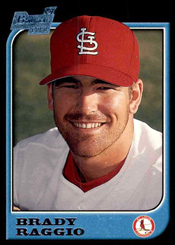
In answering a call for help from the Cardinals, Brady Raggio got into a jam and required rescue.

On May 15, 1998, Raggio started for the Cardinals against the Marlins and allowed 11 consecutive batters to reach base before he was lifted in the first inning.

Though he was sent to the minor leagues the next day, Raggio returned to the Cardinals a month later and earned redemption.

Bad results

Needing someone to fill in for Donovan Osborne, who developed a shoulder ailment, the Cardinals called on Raggio, who was with their Class AAA Memphis club, and gave him the start in the Friday night opener of a series against the Marlins at St. Louis. Raggio, who’d made 15 appearances as a rookie with the 1997 Cardinals, was 4-2 with a 2.48 ERA at Memphis.

Though the Marlins were defending World Series champions, three of their best players _ third baseman Bobby Bonilla, catcher Charles Johnson and outfielder Gary Sheffield _ were held out of the lineup against the Cardinals while the club negotiated a deal to trade them to the Dodgers.

Raggio got the first batter, John Cangelosi, to ground out. The next eight _ Edgar Renteria, Cliff Floyd, Derrek Lee, Mark Kotsay, Gregg Zaun, Craig Counsell, Dave Berg and pitcher Brian Meadows _ each singled.

The hits by Floyd, Kotsay, Zaun, Berg and Meadows produced five runs. It could have been more except Kotsay made the second out of the inning when he drifted too far off second base after Zaun singled.

The Marlins, though, weren’t done. Batting for the second time in the inning, Cangelosi walked, loading the bases. Renteria singled again, driving in a run and making the score 6-0.

After Raggio walked Floyd, forcing in a seventh run, manager Tony La Russa replaced him with Curtis King, who got Lee to ground out, ending the Marlins’ half of the first.

Raggio departed with an ERA of 94.50, yielding seven runs in two-thirds of an inning.

“They found the holes,” Raggio said to the Miami Herald. “I thought I was making pretty good pitches, but they had, like, six groundball hits.”

La Russa agreed, telling the St. Louis Post-Dispatch, “We expected him to get a bunch of ground balls. We didn’t get anything hit at anyone. I think the results were a little misleading.”

Raggio told the Memphis Commercial-Appeal he received “some encouraging words” from La Russa after the outing. “I make the same pitches that I made in that inning in 100 more innings and I get out with no runs,” Raggio said.

Keep on trying

Down 7-0, the Cardinals chipped away, scoring a run in the first, a run in the third and four in the fifth. Meadows gave up two home runs to Ray Lankford and one to Brian Hunter. The Marlins added a run in the fourth against Kent Bottenfield and led, 8-6, after five innings.

The Cardinals made Marlins reliever Jay Powell squirm in the ninth. With two outs, John Mabry doubled, scoring Gary Gaetti from first and getting the Cardinals within a run at 8-7. When La Russa sent Willie McGee to bat for pitcher Juan Acevedo, the Marlins opted to walked him intentionally, even though he represented the potential winning run. Tom Pagnozzi ended the drama by lining out to Renteria at short. Boxscore

Raggio was returned to Memphis after the game and pitched well, boosting his record to 6-3 with a 2.50 ERA. On June 15, the Cardinals recalled him. “Brady deserves it,” said Memphis manager Gaylen Pitts. “That’s what happens when you come down and work. He could have gone the other way, but he worked hard and did what he had to do to get back.”

In his first appearance for the Cardinals since his recall, Raggio pitched 2.1 scoreless innings of relief, earning the win against the Diamondbacks. Boxscore

After two more relief stints, Raggio went back to Memphis. Released after the season, Raggio was in the Rangers’ system in 1999 and spent three years (2000-2002) in Japan. In 2003, he returned to the big leagues with the Diamondbacks.

Read Full Post »

« Newer Posts - Older Posts »