(Updated April 22, 2020)
Displaying mutual respect, Ty Cobb and Stan Musial met on the field before the first regular-season game between the Giants and Cardinals in San Francisco.
 On April 22, 1958, the Cardinals played at Seals Stadium for the first time since the Giants moved from New York.
Cobb, 71, a resident of Atherton, Calif., went to the game to see Musial, 37, who was in the lineup for his first West Coast regular-season game.
Cobb played for 24 years (1905-28) in the American League and retired as baseball’s career hits leader. Cobb and Musial rank first and second all-time in career hits among left-handed batters. The top four in career hits among all batters are switch-hitter Pete Rose (4,256), Cobb (4,189), right-handed Hank Aaron (3,771) and Musial (3,630).
Cobb, dressed in coat and hat and described by the St. Louis Post-Dispatch as “tall and sharp-eyed,” went onto the field during pre-game warmups and chatted with Musial. Their conversation continued in the dugout before Cobb took a seat in the stands to watch the game.
Musial, batting third and playing first base, produced a double and two singles in five at-bats, scored twice and drove in a run. Cobb admired how Musial scored from second on Gene Green’s line-drive single to left.
In comments published by The Sporting News, Cobb said of Musial, “He showed me that his legs are still good. That’s the life of a ballplayer _ his legs. I’ve always contended Joe DiMaggio could have lasted five years longer had he used his legs more in the winter.
“Musial’s speed impressed me,” Cobb said. “Too many long ball hitters today think they’re paid only to hit homers. Musial always hits his share of them, but he also fields and runs the bases. Stan is of the stripe who played in my time. There are too few of them today.”
Drawing a crowd
Musial and his road roommate, Del Ennis, sparked St. Louis to a 7-5 victory in the first Cardinals regular-season game at San Francisco. Ennis, a left fielder who batted cleanup, hit a two-run home run against Giants starter Johnny Antonelli in the first inning and a RBI-single off Al Worthington in the seventh.
The game drew a near sellout crowd of 22,786 to Seals Stadium (capacity 22,900) on a Tuesday night, and many were there to see Musial. “San Franciscans began to line up as early as noon for the 4,000 unreserved seats,” the Post-Dispatch reported. “Approximately 1,000 reportedly were turned away when the general admission and bleacher tickets were exhausted.”
Retired Cardinals who visited the clubhouse included Taylor Douthit and Tommy Glaviano. Musial and ex-teammate Hank Sauer of the Giants posed together for photographers before the game. Both wore uniforms with the No. 6. “Musial got by far the largest hand of the night when he batted,” the Post-Dispatch reported.
According to the San Francisco Examiner, the fans cheered for Musial “just as lustily as they applauded their own Willie Mays. The crowd enjoyed Musial and gave him repeated ovations, even during batting practice.”
Said Musial: “I never thought I’d play long enough to be in the majors when the big leagues went to the Coast, but it’s quite a thrill. Personally, I’ll miss New York _ wish we could go there, too.”
Opposite field swing
With the wind blowing in from right field to home plate, Musial decided not to try pulling pitches. His singles were hit to center and his double, which produced a run against Mike McCormick, was slashed along the left-field line.
In his book “Stan Musial: The Man’s Own Story,” Musial said of Seals Stadium, “I found that the trade winds made it tough (to bat) for a left-hander … and served as an anchor on drives smashed to right.”
Willie Mays and Orlando Cepeda each had three hits for San Francisco, but the Giants stranded 13 base runners. Boxscore
After winning the series opener, the Cardinals lost the next two games when the Giants came from behind in the ninth innings of both.
In two seasons at Seals Stadium before the Giants moved to Candlestick Park in 1960, Musial batted .294, with 20 hits and 11 walks in 20 games.
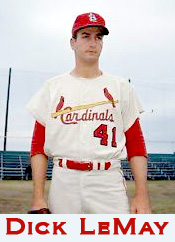 Unlike Hubbell, Gibson and Spahn, who were Hall of Fame pitchers, LeMay was a journeyman. Though he pitched in the big leagues for the Giants and Cubs, LeMay spent a significant portion of his playing career in the Cardinals’ system.
 Staub had more plate appearances (162) and more at-bats (143) versus Gibson than he did against any other pitcher in his major-league career.
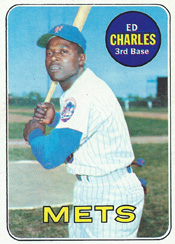 Charles, nicknamed “The Glider,” was a third baseman who played eight seasons in the big leagues with the Athletics (1962-67) and Mets (1967-69).
 Hamilton is most remembered as the pitcher who in 1967 beaned Red Sox slugger Tony Conigliaro, fracturing his cheekbone, dislocating his jaw and severely damaging his left eye.
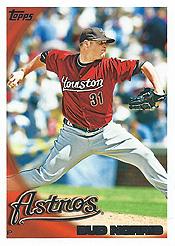 On Aug. 2, 2009, Norris, appearing in his second big-league game, started for the Astros at St. Louis, held the Cardinals to two hits in seven innings and earned the win.
 RetroSimba