Feeds:
Posts
Comments

Archive for the ‘Opponents’ Category

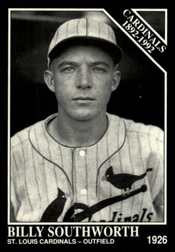
Three months after he was traded by the Giants to the Cardinals, Billy Southworth hit a home run against his former team, providing the winning run in the victory that clinched the first National League pennant for St. Louis.

billy_southworth4It was sweet revenge for Southworth, whose deteriorating relationship with Giants manager John McGraw led to the trade.

On Sept. 24, 1926, Southworth broke a 3-3 tie with a two-run home run in the second inning, carrying the Cardinals to a 6-4 victory over the Giants at the Polo Grounds in New York. The victory gave the Cardinals a three-game lead over the second-place Reds with two remaining.

In a biography of Southworth by author John C. Skipper, Southworth said, “I couldn’t have asked for a better setting, in the Polo Grounds against the Giants who had traded me. That was the timeliest home run I ever hit and to have hit it against the Giants, with McGraw snarling his defiance from the bench, made it doubly thrilling and satisfying.”

Quite a comeback

Southworth, a right fielder, was traded by the Giants to the Cardinals on June 14, 1926. “I was unable to subordinate myself to McGraw’s rigid system,” Southworth explained. “So when he decided, in 1926, that I was, from his viewpoint, hopeless, he traded me with no personal feeling one way or the other.”

Contributing to their pennant push, Southworth hit .317 in 99 games for the 1926 Cardinals.

To pitch the potential pennant clincher against the Giants, Cardinals manager Rogers Hornsby chose 20-game winner Flint Rhem as his starter.

After the Cardinals failed to score in the top of the first against Hugh McQuillan, Bill Terry slugged a three-run home run off Rhem in the bottom half of the inning.

Said Southworth: “Hornsby poured acid on us when we came back to the bench. He told us we hadn’t been taking our full cuts at the ball for several games and to get out there and swing.”

Hornsby’s words woke up the Cardinals.

In the second, Les Bell doubled and, with one out, advanced to third on a wild pitch. Bell scored on Bob O’Farrell’s infield single. The No. 8 batter in the order, Tommy Thevenow, doubled, moving O’Farrell to third.

Rhem was due up next, but Hornsby lifted him for a pinch-hitter, Specs Toporcer.

Toporcer, who hit .391 as a pinch-hitter for the 1926 Cardinals, drilled a two-run double, tying the score at 3-3.

After Taylor Douthit flied out, Southworth batted and hit his home run into the upper deck in right field, giving the Cardinals a 5-3 lead.

Bill Sherdel, who relieved Rhem, held the Giants to one run in eight innings and got the win. Boxscore

Dancing downtown

In downtown St. Louis that Friday afternoon, the game was broadcast over loudspeakers set up for the public.

When Sherdel nailed down the final out, sealing the Cardinals’ victory, it “loosed bedlam in the downtown district,” according to the St. Louis Post-Dispatch.

“Scenes comparable only with the ending of the Great War were enacted in the business section and repeated upon a smaller scale in other centers of the city’s life,” the newspaper reported. “Blizzards of paper enveloped every office building in the downtown area between Twelfth Boulevard and Fourth.”

Wrote the Associated Press: “Traffic at the principal corners was in a hopeless jam. Policemen, trying vainly to keep some semblance of order, were unable to keep the automobiles and street cars moving. Parades formed on Olive Street, Washington Avenue and other principal thoroughfares.”

At the Polo Grounds, the victorious Cardinals “merely smiled as they hurried to the clubhouse, shaking hands and slapping one another on the back” wrote the Associated Press.

That night, reported J. Roy Stockton in the Post-Dispatch, “as the young men sat around the lobby of the Alamac Hotel, accepting congratulations and reading telegrams from friends back home, they appeared suddenly to have knocked 10 years off their age.”

Confident Cards

Contacted by the Associated Press, Cardinals owner Sam Breadon said, “Nothing could possibly have made me happier than the winning of the pennant. When I took charge of the club seven years ago, I did it with the sole hope of winning a championship for St. Louis.”

Asked about the Cardinals being matched against the American League champion Yankees in the 1926 World Series, Hornsby boasted to The Sporting News, “Of course we are going to win the world’s championship. We have the punch and that means we do not fear the Yankees’ pitchers. We have better pitchers of our own, for that matter. Also, a faster fielding team.”

The Cardinals went on to win four of seven games against the Yankees, earning the World Series title.

Previously: How Cardinals got Grover Cleveland Alexander
Read Full Post »

(Updated March 27, 2023)

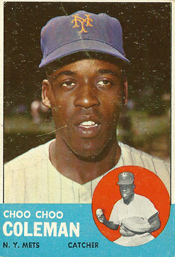
In his first game as a starting catcher for the 1962 Mets, Choo Choo Coleman dared to lead off an inning with a bunt against Bob Gibson.

choochoo_colemanBy challenging the Cardinals’ ace, Coleman played a key role in ending Gibson’s four-game winning streak and snapping the Mets’ 11-game skid.

On July 27, 1962, in the first game of a doubleheader against the Cardinals, Coleman opened the third inning with a bunt single and scored the lone run in the Mets’ 1-0 victory at St. Louis. Coleman’s batterymate, Al Jackson, who hadn’t earned a win in more than a month, pitched the shutout.

It was the only 1-0 win for the 1962 Mets and one of four shutout victories for them. Jackson pitched all four.

Runaway train

Clarence Coleman told an interviewer he got the nickname “Choo Choo” as a boy in his hometown of Orlando because he ran fast like a train.

Small for a catcher at 5 feet 9 and 165 pounds, Coleman entered the big leagues with the 1961 Phillies and batted .128 for them in 34 games.

The Mets selected Coleman in the National League expansion draft, but assigned him to Class AAA Syracuse before the start of the 1962 season. According to The Sporting News, “He didn’t take well to the demotion.”

Coleman batted .195 for Syracuse, but when Mets catcher Sammy Taylor fractured the ring finger on his right hand in July 1962, Coleman was promoted to the big club.

Getting a boost

The Mets had lost 16 of their previous 17 games entering the July 27 doubleheader versus the Cardinals.

Mets manager Casey Stengel, looking to show confidence in Coleman, put him in the starting lineup for the first time. He couldn’t have picked a much tougher opponent than Gibson.

Stengel “is currently embarked upon a psychological campaign designed to instill the big-league attitude into the shy and uncommunicative Choo Choo Coleman,” The Sporting News reported.

In the book “We Played the Game,” Mets outfielder Gene Woodling said Coleman “had the misfortune of coming out of a poor area of Florida and not getting much education … The sorriest thing I ever saw was Casey trying to teach Choo Choo how to count on his fingers. He had to paint them.”

Gibson had limited the Mets to a two-out Felix Mantilla single through the first two innings before Coleman led off the third.

Batting left-handed, Coleman bunted toward third baseman Ken Boyer and raced down the line for a single. Jackson followed with a sacrifice bunt, moving Coleman to second.

Gibson struck out Richie Ashburn for the second out.

The next batter, Rod Kanehl, hit a routine grounder. Shortstop Julio Gotay reached for the ball, but couldn’t come up with it.

Coleman, living up to his nickname, steamed around third base and dashed for home. While Gotay still struggled to field the ball, Coleman streaked across the plate with the unearned run. Boxscore

Off track

Stengel also started Coleman in the second game of the doubleheader. Facing Larry Jackson, Coleman produced the first of his two career triples, but the Cardinals won, 6-5.

Coleman played in 55 games for the 1962 Mets and batted .250. Grasping for a positive, The Sporting News said of the diminutive catcher, “Pitchers say he is one of the most adroit receivers of the low delivery.”

In his final two seasons with the Mets, Coleman hit .178 in 1963 and, after two years of exile in the minors, .188 in 1966. His career batting mark in four seasons in the majors: .197.

After his playing career, Coleman worked as a cook in a Chinese restaurant in Virginia, according to his obituary in the New York Times.

Previously: Cardinals have strong link to original Mets

Previously: Interview with former Cardinals pitcher Al Jackson

Read Full Post »

With the first grand slam of his major-league career, Mike Shannon slowed the Cubs’ momentum and helped the Cardinals split a four-game series at Wrigley Field.

mike_shannon5On Aug. 15, 1968, Shannon hit a grand slam against reliever Bill Stoneman in the second inning, carrying the Cardinals to an 8-0 victory in the finale of the series and putting a dent in the Cubs’ pennant hopes. Boxscore

Second City showdown

The Cardinals, defending World Series champions, entered the series in first place, 14 games ahead of the second-place Cubs in the National League. After the Cubs won the first two, cutting the Cardinals’ lead to 12, fans in Chicago were fired up, sensing their club was poised to get back into the pennant race.

Cardinals ace Bob Gibson dampened those hopes in Game 3, pitching a complete game in a 3-1 victory.

That set up a scenario in which the Cubs needed to win Game 4 in order to gain any ground on the Cardinals.

Get up, baby

A crowd of 23,116 turned out for the Thursday afternoon series finale and the bleachers were packed with rowdies.

Gibson, in a playful mood, pinned a button with the words “We’re No. 1” to the bill of his cap and bantered with fans in the right-field bleachers before the game. “I led the boos for Roger Maris,” Gibson said to the St. Louis Post-Dispatch, referring to his outfield teammate.

In the first inning, the Cardinals scored four runs against starter Ken Holtzman and knocked him out of the game. Shannon contributed a RBI-single.

In the second, the Cardinals loaded the bases with two outs against former teammate Jack Lamabe. With Shannon up, Lamabe was replaced by Stoneman.

Shannon hit Stoneman’s second pitch into the left-field seats. The grand slam _ the only one of his Cardinals career _ was his 500th hit in the big leagues.

“In Wrigley Field, if you get the ball in the air, you have a heck of a chance,” Shannon said.

Last laugh

The Bleacher Bums took out their frustrations on Cardinals outfielders Lou Brock, Curt Flood and Ron Davis.

“They were hitting us with everything,” said Flood. “Ice cubes, burned-out flashbulbs, fruit, tennis balls, paper cups and old sandwiches.”

Said Davis: “If you turned around, then you’d really get it. That’s when they’d start throwing things at you.”

Plotting his revenge, Flood printed a banner that stated, “We’re still No. 1.”

In the bottom of the ninth, with the Cardinals ahead 8-0, Flood took the banner with him to his position in center and spread it on the outfield grass, with the words facing the bleachers.

Knowing what was to come, Brock stuffed his ears with cotton to block out the taunts.

Day shift

Shannon finished the game 3-for-5 with five RBI and two runs scored. The performance gave him a .415 batting average (27-for-45) in day games that season.

“I just can see that ball better in the daytime,” Shannon told the Associated Press.

Nelson Briles pitched the shutout for the Cardinals. It was his fifth consecutive win and boosted his season record to 16-7.

The Cardinals went on to win the 1968 pennant, finishing nine games ahead of the Giants and 13 in front of the third-place Cubs.

Shannon finished his Cardinals career with 68 home runs. He had 16 against the Cubs, including 12 at Wrigley Field.

Previously: Mike Shannon ignited Cards with World Series blast

Read Full Post »

(Updated May 5, 2018)

Two of the best hitters of their era, Ichiro Suzuki and Albert Pujols, were in their sophomore years in the big leagues when they played against one another for the first time in the regular season. Suzuki had the better overall series; Pujols produced the biggest hit.

albert_ichiroIn June 2002, Suzuki went 6-for-12 in helping the Mariners win two of three games versus the Cardinals at Safeco Field in Seattle. Pujols was 2-for-11, but one of those hits was a grand slam that carried the Cardinals to their lone win in the interleague set.

Fourteen years later, in August 2016, Suzuki, playing for the Marlins, capped his U.S. big-league career by getting his 3,000th hit. On May 4, 2018, Pujols, playing for the Angels, got his 3,000th career hit.

Suzuki has a career .333 batting average (27-for-81) against the Cardinals.

Bat man

In 2001, Suzuki won the American League Rookie of the Year Award and Pujols won the National League Rookie of the Year Award.

They brought star power to the Cardinals-Mariners series the following season.

On June 10, 2002, Suzuki was 3-for-5 with three runs scored and two RBI in the Mariners’ 10-0 victory over the Cardinals. Suzuki singled off starter Bud Smith and had a double and triple against Luther Hackman. Boxscore

Before the game, reporter Larry LaRue of the Tacoma News Tribune visited Suzuki in the clubhouse while Suzuki examined new bats. “Each bat shipped to him from Japan comes shrink-wrapped (in cellophane) and once he unwraps a bat it’s kept in a specially-made case beside his locker,” wrote LaRue.

Mariners infielder Bret Boone called the case Suzuki’s humidifier.

Suzuki said, “No matter how well you take care of your bat, eventually moisture gets into the wood. Even clubhouse air-conditioning can effect the wood.”

Before placing a bat in the case, Suzuki tapped the barrel with his palm, then held it to his ear, listening for a tone, LaRue reported. Suzuki said, “High pitch, better wood. Low pitch, it probably gets used for batting practice.”

Pujols pop

In Game 2 of the series, on June 11, 2002, Suzuki had another strong game. He was 2-for-3 _ a double off starter Woody Williams and a single against Steve Kline _ with two walks and a stolen base, but it was Pujols who created the sweetest sound with his swing.

In the sixth inning, with the Mariners ahead 1-0, the Cardinals had runners on second and third with one out. Mariners manager Lou Piniella instructed starter James Baldwin to issue an intentional walk to J.D. Drew and face Pujols with the bases loaded.

“I’m trying to get out of the inning with a double play ball,” Piniella said to the St. Louis Post-Dispatch.

Said Pujols: “I was surprised.”

Pujols watched two curves sail out of the strike zone. Behind in the count 2-and-0, Baldwin threw a fastball. Pujols pounded it over the center-field fence for the second grand slam of his Cardinals career.

“That young guy has some real pop,” Piniella said to the Seattle Post-Intelligencer.

Pujols added a single and finished 2-for-4 with four RBI and two runs scored in a 7-4 Cardinals triumph. Boxscore

Part of 3,000

In the series finale, June 13, 2002, Suzuki doubled off starter Darryl Kile and finished 1-for-4 in a 5-0 Mariners victory. Pujols was 0-for-3. Boxscore

For the series:

Suzuki’s totals: 6-for-12, three doubles, two singles, one triple, two walks, three runs and two RBI.

Pujols’ totals: 2-for-11, one home run, one single, four RBI, two runs.

Here is how Suzuki fared in his subsequent season series versus the Cardinals:

_ 2004: 3-for-11.

_ 2010: 5-for-13.

_ 2014: 0-for-7.

_ 2015: 3-for-15.

_ 2016: 5-for-14.

_ 2017: 5-for-9.


Read Full Post »

(Updated April 17, 2022)

Three years after the Blue Jays removed Chris Carpenter from their big-league roster and told him he’d have to go to the minors if he wanted to remain with the organization, the pitcher returned to Toronto as a member of the Cardinals and showed why giving up on him was a mistake.

chris_carpenter11On June 14, 2005, Carpenter faced the Blue Jays for the first time since leaving them and pitched a one-hit shutout for a 7-0 Cardinals victory that was as much personal as it was professional.

The masterpiece at Toronto helped establish Carpenter as a pitcher who got big wins in the big games for St. Louis. Carpenter posted a 95-44 regular-season record and 10-4 postseason mark (including 3-0 in the World Series) as a Cardinals starter from 2004-2012.

Oh, Canada

Carpenter began his professional career with the Blue Jays. He was selected by them with the 15th pick in the first round of the 1993 amateur draft, just ahead of pitcher Alan Benes, who was chosen by the Cardinals with the 16th selection.

Four years later, Carpenter made his big-league debut. One of the teammates who influenced him was pitcher Pat Hentgen, who, like Carpenter, would pitch for the Cardinals after leaving the Blue Jays.

“He taught me the importance of what every fifth day was,” Carpenter told Cardinals Magazine. “You get one time every five days to go and make an impact, and you need to make that important. I learned from him that you have to find a way to grind through it, no matter if you feel good or not.”

Carpenter had a 49-50 record for Toronto from 1997-2002.

In October 2002, the Blue Jays removed Carpenter, who had undergone shoulder surgery, from their big-league roster and offered him a spot at Class AAA Syracuse. Instead, Carpenter chose to become a free agent and signed with the Cardinals.

He spent 2003 working his shoulder into shape and didn’t pitch in the major leagues that season. He returned to the big leagues with the Cardinals in 2004.

Good stuff

After posting a 15-5 record in 28 starts for the 2004 Cardinals, Carpenter established himself as the staff ace in 2005. He took an 8-4 record into the start at Toronto.

Carpenter’s return to Toronto drew a Tuesday night crowd of 37,536, including actor Bruce Willis. One fan held up a sign that read: “Thanks for four years of frustrating mediocrity, Carpenter.”

Carpenter responded to the wise guy with a tip of his cap.

Mostly, he let his pitching do the talking.

Effectively mixing a four-seam fastball, curve and changeup, Carpenter baffled the Blue Jays. “My stuff was good and I thought I kept them off balance pretty good,” Carpenter said to the St. Louis Post-Dispatch.

Said Cardinals manager Tony La Russa: “He had movement all over, mostly down.”

Gregg Zaun, drawing a leadoff walk in the third, was the first Blue Jays batter to reach base. The next batter, Orlando Hudson, grounded into a double play.

The Blue Jays were hitless until, with two outs in the sixth, rookie Russ Adams pulled a ball that landed barely inside the right-field foul line for a double.

Carpenter retired the last 10 batters in a row. Video

“In a game of inches, he came within a couple of inches of throwing a no-hitter,” Cardinals designated hitter Larry Walker said.

Toronto tormentor

The one-hitter was the first of Carpenter’s big-league career. It also was the 19th one-hitter by a Cardinals pitcher and the first since Vicente Palacios achieved the feat for St. Louis against the Astros in 1994.

“He wanted to come back (to Toronto) and make an impression,” La Russa said of Carpenter. “He did.”

Blue Jays manager John Gibbons told the Associated Press, “He throws downhill at you. He throws 94 mph with that big old hook that he can control. It’s tough to hit that.”

Carpenter was supported by four home runs: Walker hit a pair of two-run home runs, Reggie Sanders hit a solo shot and Albert Pujols also had a two-run home run. Boxscore

Carpenter pitched one more one-hitter. It occurred on Sept. 7, 2009, in a 3-0 Cardinals victory over the Brewers at Milwaukee. The lone hit off Carpenter was a fifth-inning double by Jody Gerut.

On June 23, 2010, at Toronto, Carpenter faced the Blue Jays for the second and last time in his career. He pitched eight scoreless innings and got the win in a 1-0 Cardinals victory.

Matt Holliday broke a scoreless tie with a two-out, RBI-single in the top of the ninth off Kevin Gregg, who had relieved starter Ricky Romero.

Ryan Franklin earned the save, yielding a single and a walk _ but no run _ in the bottom of the ninth.

Previously: Mike Matheny helped Chris Carpenter join Cards

Read Full Post »

The Cardinals were a significant part of the baseball career of Jim Hickman. He signed his first professional contract with the Cardinals, played in their farm system for six seasons and ended his big-league playing days with them. Also, Hickman’s two best games in the major leagues came against the Cardinals.

jim_hickmanHickman was an outfielder and first baseman for 13 years in the majors. Best known as a member of the original 1962 Mets and for an all-star season with the 1970 Cubs, Hickman grew up a Cardinals fan and was 18 when he signed with St. Louis in 1956.

“As a kid, I didn’t know there was any other club except the Cardinals,” Hickman told The Sporting News.

Helped by expansion

Displaying power but failing to hit for average, Hickman played in the Cardinals’ system from 1956-61 without getting a call to the big-league club. His best seasons in the Cardinals organization were 1957 when he produced 26 home runs and 113 RBI for Class D Albany (Ga.) and 1959 when he had 22 home runs and 81 RBI for Class AA Tulsa.

“The closest he ever got to the big club was a couple of early spring training camps,” The Sporting News reported. “They gave Jim big uniform numbers reserved for no names … and he didn’t get much of a look.”

After Hickman hit 11 home runs with 57 RBI for Class AAA Portland (Ore.) in 1961, the Cardinals made him available in the National League expansion draft. According to The Sporting News, the Cardinals lost interest in Hickman when they received a scouting report that said he lacked aggressiveness.

Said Hickman: “I know people say I’m not aggressive … I give it all I got.”

Hickman was drafted by the expansion Mets and made his big-league debut with them in 1962. He became one of their everyday outfielders, batting .245 with 13 home runs in 140 games.

Cycle in sequence

In July 1963, Mets manager Casey Stengel experimented with converting Hickman into a third baseman. Hickman was batting .223 entering the Aug. 7, 1963, game between the Cardinals and Mets at the Polo Grounds.

Batting leadoff and playing third base, Hickman became the first Mets player to hit for the cycle. He was 4-for-5 with two RBI and two runs scored in the Mets’ 7-3 victory.

Hickman, a right-handed batter, got his first three hits off starter Ernie Broglio: a single in the first, a double in the second and a RBI-triple in the fourth. In the sixth, Hickman hit a solo home run off Barney Schultz to complete the cycle.

“If this fellow can learn to cut down on his strikeouts, he could be one of the top hitters around,” Stengel said. “He has all the power he needs, but by now he should know that you can’t hit a ball with the bat on your shoulder. You have to swing.” Boxscore

Trio of homers

Two years later, on Sept. 3, 1965, Hickman became the first Mets batter to hit three home runs in a game. He did it against Cardinals starter Ray Sadecki, leading the Mets to a 6-3 triumph at St. Louis.

Batting sixth and playing first base, Hickman, who entered the game with a .212 batting average, was 4-for-4 with four RBI and three runs scored.

A look at his three home runs off Sadecki:

_ Home run #1: Swinging at the first pitch, a high, outside fastball, Hickman hit it 403 feet the opposite way, clipping the pavilion roof in right-center.

_ Home run #2: The count was 3-and-0 when Hickman looked toward third-base coach Don Heffner and was surprised to see he was being given the freedom to swing away.

According to The Sporting News, “Hickman, knowing the Mets have an automatic $10 fine for a missed sign, stepped out of the batter’s box and looked again.”

Heffner shouted to him, “Go ahead. It won’t cost you 10 bucks.”

Sadecki threw a fastball and Hickman pulled it over the left-field wall.

_ Home run #3: On a 1-and-2 count, Hickman swung at a slider down in the zone and golfed it into the left-field bleachers.

When Hickman batted for a fourth time in the game, Nelson Briles was pitching in relief. Asked later whether he was trying for a fourth home run, Hickman replied, “You bet.”

Instead, he produced a single on a groundball that took a bad hop and eluded third baseman Ken Boyer. Boxscore

Nostalgia tour

In 1970, Hickman was named an all-star for the only time. Playing for the Cubs, he produced 32 home runs and 115 RBI and was named NL Comeback Player of the Year by The Sporting News.

On March 23, 1974, the Cubs traded Hickman to the Cardinals for pitcher Scipio Spinks. Eighteen years after he had signed with St. Louis, Hickman finally was getting his chance to play for the Cardinals.

“I’m 36, but I know I still can hit a baseball,” Hickman said. “And I still can half-catch a baseball.”

Used primarily as a pinch-hitter and backup to Joe Torre at first base, Hickman hit .267 with the 1974 Cardinals. He hit two pinch-hit home runs _ off George Stone of the Mets and Danny Frisella of the Braves _ but his batting average as a pinch hitter was .182.

On July 16, 1974, four months after they acquired him, the Cardinals released Hickman, who made it clear he would retire rather than seek a chance with another club.

“This is it,” Hickman said. “So what if I hooked up with another club for the last two months? It would be the same thing after the season ended.”

In a big-league career from 1962-74 with the Mets, Dodgers, Cubs and Cardinals, Hickman batted .252. He had a .242 career mark with 20 home runs in 153 games versus the Cardinals.

Previously: Bob Gibson nearly was unbeatable against Mets

Read Full Post »

« Newer Posts - Older Posts »