Feeds:
Posts
Comments

Archive for the ‘Opponents’ Category

In a bid to contend with the Cardinals and others for the 1964 National League pennant, the Giants added the majors’ first Japanese import to their bullpen.
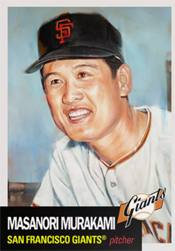
On Sept. 1, 1964, Masanori Murakami, 20, became the first Japanese native to play in the big leagues when he pitched in relief for the Giants against the Mets.

Possessing impressive command of his pitches, Murakami, a left-hander, made an impact. Though the Giants didn’t win a pennant in either of his two seasons with them, Murakami “was right at the top among relief pitchers in the National League,” Giants general manager Chub Feeney told the San Francisco Examiner in 1965. “Possibly only Ron Perranoski of the Dodgers was better.”

In two years with the Giants, Murakami was 5-1 with nine saves and struck out 100 batters in 89.1 innings.

He faced the Cardinals four times, all in 1965, and was 1-0 with a save.

Baseball rebirth

Murakami was born during World War II in Otsuki, Japan, a silk production center, on May 6, 1944.

After the war, Tsuneo “Cappy” Harada, a Japanese-American who served the Allies in military intelligence, was assigned by General Douglas MacArthur to encourage the resumption of baseball in Japan, according to the Hartford Courant.

Helping Harada in his efforts was Lefty O’Doul, two-time National League batting champion. O’Doul made multiple trips to Japan to promote baseball before the war and became a national institution, according to Red Smith of the New York Herald Tribune. In return visits there after the war, O’Doul was an influence on young Masanori Murakami, according to the Examiner.

Murakami was 19 when he joined the Nankai Hawks of the Japan Pacific League in September 1963. Cappy Harada was scouting for the San Francisco Giants then. Harada arranged with Nankai to let three of their teen prospects _ Murakami, infielder Tatsuhiko Tanaka and catcher Hiroshi Takahashi _ join the Giants’ organization in 1964. “They sent me over … to study the baseball system,” Murakami said years later to the New York Times.

New world

After getting a look at the Japanese teens in 1964 spring training, the Giants determined Murakami could pitch for the Class A Fresno farm club. The other two players were sent there with Murakami to observe before they’d join a rookie level farm team at Twins Falls, Idaho, in June.

The agricultural Fresno area then was home to 15,000 Japanese-Americans. Murakami and his two countrymen resided in the home of Keek Saiki and his wife Fumiko. “They drink milk by the gallon,” Fumiko said to the Examiner, “and go for fried chicken and westerns on TV. They are very quiet, write letters a yard long and ask where they can swim.”

Murakami’s manager at Fresno was Bill Werle. A former left-handed reliever for the Cardinals, he saw Murakami had the makeup to be a closer. “His control is incredible,” Werle told the Examiner. “That’s why I put him in tight spots in late innings … His low curve makes the batsmen tap grounders for double plays.”

Murakami was 11-7 with 11 saves and a 1.78 ERA for Fresno. He struck out 159 batters in 106 innings. Murakami made one start _ on Japanese-American Night in Fresno _ and pitched a complete game in a 3-2 win over Reno.

“He was too good for the league,” Werle told the Los Angeles Times.

The 1964 Giants entered September in third place in the National League and were a half game ahead of the Cardinals when they called up Murakami. Attempting the leap from Class A to the majors was formidable. The cultural significance of being the first Japanese-born big leaguer added to the challenge.

Big Apple

The rookie joined the Giants in New York for their series against the Mets. At Shea Stadium, he was greeted by general manager Chub Feeney and several Japanese reporters and photographers.

Murakami carried with him a Stan Musial model glove. When asked by the Examiner whether Musial was one of his favorites, Murakami shrugged. His English was limited.

Feeney “trailed him around the field, pen in hand, before the game,” trying to get Murakami to sign a major-league contract, the Times reported. Murakami didn’t want to sign until he understood what the contract meant. Feeney scrambled to find an interpreter and eventually got Murakami’s signature.

With the Mets ahead, 4-0, Giants manager Al Dark brought in Murakami to pitch the eighth. According to Newsday, “Many of the (39,379) fans stood and cheered when the pitcher came into the game.”

Mets starter Al Jackson told the newspaper, “We thought he might be a little nervous, but he wasn’t.”

Actually, Murakami told the San Francisco Chronicle, “I was afraid.” To calm his nerves, he said he hummed the tune “Sukiyaki” as he walked to the mound.

Murakami struck out the first batter, Charlie Smith. Chris Cannizzaro singled, then Ed Kranepool struck out and Roy McMillan grounded out. “As Murakami, with a spring in his gait and a wad of chewing gum in his mouth, strode toward the Giants’ dugout, Mets fans stood and cheered,” the Associated Press reported.

Stadium organist Jane Jarvis saluted Murakami’s successful debut with “The Japanese Sandman.” Boxscore

The next day, from Lefty O’Doul’s saloon near San Francisco’s Union Square, Examiner columnist Prescott Sullivan wrote that Murakami’s debut made the proprietor the happiest man in town. “Such was his joy, that for a period of six seconds, shortly before 11 a.m. when a slow bartender was on duty, all drinks served at his Geary Street tavern were on the house,” Sullivan noted.

Back in New York, Murakami was a guest on Ralph Kiner’s TV show, but, even with an interpreter, something got lost in translation, according to the Examiner.

Kiner: “What is your best pitch?”

Murakami: “Koufax.”

Kiner: “Who is your favorite pitcher?”

Murakami: “Curveball and a little bit changeup.”

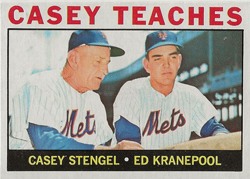
Murakami asked to meet 74-year-old Mets manager Casey Stengel, who spoke his own unique style of English, Stengelese. Stengel posed with Murakami for a photo. Asked what he thought of him, Murakami said to the Examiner, “Nice old man. Very friendly.”

Sudden impact

In his first nine appearances for the 1964 Giants, covering 11 innings, Murakami didn’t allow a run. His first big-league win came against Houston at San Francisco’s Candlestick Park. Murakami pitched three scoreless innings and the game ended when Matty Alou of the Dominican Republic slugged a home run (his first in two years) against French-Canadian Claude Raymond in the 11th. Boxscore

In his next appearance, against the Cubs, Murakami faced three future Hall of Famers, Billy Williams, Ron Santo, Ernie Banks, and retired them in order. Boxscore

Described by the Examiner as “the slingin’ samurai,” he finished with a 1-0 record, one save and a 1.80 ERA for the 1964 Giants, striking out 15 and walking one in 15 innings. Batters hit .163 against him.

The Giants and Nankai Hawks both wanted Murakami to pitch for them in 1965, causing a dispute between the clubs. The matter got settled in late April 1965 when the Hawks agreed to let Murakami play for the Giants on the condition he’d be allowed to return to Japan in 1966 if he desired.

Murakami made his first appearance for the 1965 Giants on May 9, three days after he turned 21. (Murakami and teammate Willie Mays shared a birthday.)

When the Giants were at home, Murakami resided at the Benjamin Franklin Hotel in San Mateo. On the road, his roommate was fellow left-handed reliever Bill Henry, 37, a Texan, who began playing professional baseball in 1948 with the Clarksdale Planters of Mississippi.

Popular with teammates, Murakami “has an innate dignity, a quiet confidence and a sly sense of humor,” the Examiner’s George Murphy observed.

Giants manager Herman Franks was trying to find the players who were helping Murakami learn English. When Franks went to the mound to talk to Murakami during a game, the pitcher smiled and said to him, “Take a hike.” (Or words a good deal stronger than that.) Franks told the Examiner, “I don’t think he knows what he’s saying.”

Reliable reliever

Murakami beat the Cardinals the first time he faced them. With the score tied at 2-2 and Cardinals runners on first and second, one out, Murakami relieved Frank Linzy. He got Tim McCarver to pop out to second and fanned Carl Warwick. After Tom Haller’s two-run homer against Bob Gibson in the top of the 13th, Murakami retired the Cardinals in order for the win. Boxscore

A month later, with the Giants clinging to a 3-2 lead, the Cardinals had Julian Javier on second, two outs, in the ninth when Murakami relieved Linzy and struck out Bill White for the save. Boxscore

Murakami was especially effective against the Dodgers. In eight appearances covering 11 innings versus the 1965 Dodgers, he allowed one run (for an 0.82 ERA) and struck out 11. He also got his first big-league hit, a bunt single, against the Dodgers’ Sandy Koufax. Boxscore

Because of his delayed start to the season, Murakami wasn’t available when the Giants’ bullpen lost games to the Dodgers on April 30 and May 7.

“We lost the pennant to the Dodgers by only two games, and I missed one month,” Murakami said to Jim Murray of the Los Angeles Times. “If I pitched more, we would have won the pennant.”

Murakami was 4-1 with eight saves for the 1965 Giants. He struck out 85 in 74.1 innings and held batters to a .206 average.

Times have changed

Afterward, Murakami opted to play for the Nankai Hawks. “Murakami explained he wanted to stay with the Giants in 1966, but pressure from his parents, among others, forced him to return to Japan,” the Examiner reported.

Years later, asked by Jim Murray whether he wished he had stayed a Giant, Murakami replied, “Oh, yes.”

Murakami pitched in Japan for 18 years. His best season was 1968 when he was 18-4 with a 2.38 ERA for the Nankai Hawks. His teammates that season included second baseman Don Blasingame, a former Cardinal, and first baseman Marty Keough, who would become a Cardinals scout.

In 1983, when he was 38, Murakami attempted a comeback with the Giants but was released in spring training. “Fastball not so fast,” he told the Examiner.

Thirty years passed between the time Murakami last pitched for the 1965 Giants and the next Japanese player, Hideo Nomo of the 1995 Dodgers, reached the majors. A Japanese network arranged to televise Nomo’s games and hired Murakami as a broadcaster. On Aug. 5, 1995, at Candlestick Park, Murakami was honored by the Giants and threw the ceremonial first pitch. Then Nomo took the mound and hurled a one-hit shutout. Boxscore

Nomo received the 1995 National League Rookie of the Year Award. More Japanese players followed. The Cardinals signed their first, outfielder So Taguchi, in January 2002. In 2024, the most celebrated player in the game was the Dodgers’ Shohei Ohtani of Japan.
Read Full Post »

Call it boldly creative or plain folly, 72-year-old Mets manager Casey Stengel defied convention when he chose an 18-year-old rookie first baseman to be his Opening Day right fielder against the 1963 Cardinals.

Ed Kranepool was the teen Stengel started that day, putting him in the No. 3 spot in the order ahead of cleanup hitter and future Hall of Famer Duke Snider.

Twelve years earlier, when he managed the Yankees, Stengel made a similar move, selecting a 19-year-old rookie shortstop to be his Opening Day right fielder against the 1951 Red Sox. Mickey Mantle batted third that day ahead of cleanup hitter and future Hall of Famer Joe DiMaggio. Boxscore

Mantle went on to become an acclaimed slugger and a Hall of Famer. Not so with Kranepool. Though he spent 18 seasons with the Mets and set their franchise record for most games played (1,853), Kranepool was a career .261 hitter who did some of his best work late in his playing days as a pinch-hitter.

Preps to pros

Kranepool’s father, a U.S. Army sergeant, was killed in action serving in France during World War II in the summer of 1944. Kranepool was born a few months later, in November, and was raised in the Bronx by his mother, Ethel.

At James Madison High School, Kranepool, a left-handed batter, broke the school home run record of Hank Greenberg, who became a Hall of Fame first baseman with the Tigers.

In June 1962, scout Bubber Jonnard, a former Cardinals catcher, and scouting supervisor Johnny Murphy went to the Kranepool house with an offer from the Mets. “I can still remember when they signed me on the dining room table,” Kranepool said to the New York Times years later. “I got $85,000 _ that included the bonus and salary.”

(Kranepool bought his mother a house in White Plains, N.Y., with some of the bonus money, according to Newsday. He bought himself a white Thunderbird.)

Kranepool went to the minors, hit .301 in 41 games and was called to the Mets in September 1962. He was 17 when he got into three games that month against the Cubs. After his first hit, a double sliced to left against Don Elston, “I was so happy, I danced around second base,” Kranepool told the Times.

Casey’s boy

At spring training with the 1963 Mets, Kranepool became a favorite of Stengel and Mets owner Joan Payson. Kranepool described Payson to the Times as “like a grandmother to me.” 

Over the objections of his boss, club president George Weiss, who wanted Kranepool to play in the minors all season, Stengel insisted on him being on the Mets’ 1963 Opening Day roster. “He’s a ballplayer,” Stengel said to Newsday. “He stands up there with that bat in his hands and he’s not afraid of anybody.”

Kranepool told the newspaper, “I appreciate what Casey is doing for me. Very few managers would ever look at an 18-year-old.”

(Stengel was 22 when he debuted with the 1912 Dodgers and went 4-for-4 with a walk against the Pirates.)

Duke Snider, acquired from the Dodgers a week earlier, made his Mets debut in the season opener against the visiting Cardinals. Snider, 36, was twice the age of Kranepool, 18. It was a striking contrast to see the teen prospect in right field, and the graying former Brooklyn favorite positioned beside him in center.

(Snider, though, was a comparative pup to the Cardinals’ left fielder, 42-year-old Stan Musial.)

After the Cardinals cruised to a 7-0 victory on Ernie Broglio’s two-hitter, Stengel said to Newsday, “I thought we had two good players today _ one of them (Kranepool) is maybe too young and the other (Snider) is maybe too old.”

Regarding Kranepool, Stengel told the New York Daily News, “The kid in right didn’t look a bit nervous and he was the one everybody seemed worried about.” Boxscore

The next day, the Mets were shut out again (on Ray Washburn’s four-hitter), but Kranepool had two of the hits. Boxscore

Ups, downs

Kranepool’s first month with the 1963 Mets was fun. He hit a home run in their first win and batted .300 for April. “He excited the imagination with his good early start,” Newsday noted.

The good times faded quickly, however. Overmatched, especially against veteran left-handers, Kranepool slumped. When the Cardinals’ Curt Simmons struck him out four times in a game, Dick Young of the Daily News wrote, “Kranepool was made to look sick by Simmons.” Boxscore

Hearing the cheers turn to jeers, Kranepool batted .175 in May, .169 in June and got ornery. (Asked a decade later how he would describe himself during his early days with the Mets, Kranepool told Times columnist Dave Anderson, “Young, temperamental, a spoiled brat.”

Kranepool’s road roommate, pitcher Larry Bearnarth, said to Newsday, “He started getting very defensive when things got bad. Instead of trying to overlook things, everything bothered him. He heard people yell at him, or took to heart the little needling that all young fellows get.”

Hitless in July, Kranepool was taking his cuts in the batting cage when Snider suggested he quit trying to pull the ball so much. According to the Daily News, Kranepool snapped at Snider, “You’re not going so hot yourself.” (Snider hit .243 for the 1963 Mets.)

Though Snider laughed off Kranepool’s remark, the incident displeased Stengel, who believed young players shouldn’t disregard the advice of respected veterans.

Kranepool was shuffled off to Buffalo, a Mets farm club.

Snider said to Newsday, “He’ll be better off down there … I was sent down twice before I stuck and those two seasons in the minors helped.”

Change of tune

If the demotion was meant to serve as a wakeup call, it worked. Kranepool went 4-for-5 in his first game with Buffalo, and kept on hitting. His attitude was better, too. When Buffalo teammate Marv Throneberry, who played for Stengel with the Yankees and Mets, offered advice, Kranepool listened. “Marv has helped me tremendously,” Kranepool told the Buffalo Courier Express.

In 53 games with Buffalo, Kranepool hit .310. The Mets rewarded him with a September promotion. In his first game back, Kranepool played left field for the first time in his life and, batting in the leadoff spot, smacked four singles against the Cardinals. Boxscore

(Overall, Kranepool hit .209 for the 1963 Mets, but .265 against the Cardinals.)

Lost luster

When Kranepool pulled a thigh muscle the first week of 1964 spring training, Stengel seemed to sour on him. “You don’t pull muscles when you’re 19 if you’re in shape,” Stengel said to Newsday.

According to the newspaper, “Casey thinks Kranepool could run faster, throw harder, hustle more often.”

When Kranepool hit .167 in April and .184 in May, a couple of fans at Shea Stadium unfurled a banner: “Is Kranepool Over the Hill?”

He was 19.

The player who had bristled at Duke Snider’s suggestion now sought the advice of retired masters. Kranepool “has discussed hitting at every opportunity with Stan Musial, Paul Waner and any other acknowledged expert he has been able to find,” Times columnist Arthur Daley wrote.

Kranepool did better the second half of the 1964 season. He nearly sank the Cardinals’ pennant hopes. On the penultimate day of the season, Kranepool drove a curveball from former teammate Roger Craig deep to left-center for a three-run homer, the game-breaking blow in a Mets victory at St. Louis. The loss dropped the Cardinals into a tie for first with the Reds. Boxscore

(St. Louis won the pennant the next day, winning the season finale against the Mets while the Reds lost to the Phillies.)

Gap hitter

On July 16, 1967, reliever Jack Lamabe woke up in his St. Louis hotel room as a member of the Mets. When he got to Busch Memorial Stadium for that day’s doubleheader, he learned he’d been traded to the Cardinals.

The 1967 Cardinals were on their way to becoming World Series champions, but Kranepool knocked them backwards that Sunday afternoon. His two-run homer versus Ray Washburn carried the Mets to a 2-1 victory in Game 1. In the second game, Kranepool slugged another two-run homer, against Lamabe, giving the Mets the lead and sparking them to a sweep. Boxscore and Boxscore

Two years later, Kranepool hit a home run in Game 3 of the 1969 World Series versus Orioles reliever Dave Leonhard. Video

Kranepool, though, never hit more than 16 homers in a season. He said to columnist Arthur Daley, “I’m primarily a line drive hitter, don’t strike out much, and can wait for the final split second before committing myself.”

That approach helped Kranepool become a deluxe pinch-hitter late in his career. As a pinch-hitter, he batted .486 in 1974, .400 in 1975, .400 again in 1976 and .448 in 1977.

Turn back the clock

Kranepool batted .313 (36 hits, including two home runs) versus Bob Gibson and had some big years against the Cardinals (.323 in 1967, .429 in 1971, .348 in 1972 and .440 in 1974).

Nonetheless, he didn’t become the standout some hoped he’d be when he got the big bonus and reached the majors rapidly. As Newsday’s Tony Kornheiser noted, “There is a certain sadness to his career. It speaks of broken promises and wasted youth … He has never really been a symbol of the Mets. When the team was bad, he wasn’t bad enough. When the team was good, he wasn’t good enough.”

Looking back, Kranepool told Newsday’s Steve Jacobson it would have been better for him to spend three seasons in the minors before coming to the Mets.

“I might have been good at 20 instead of mediocre at 17 and staying there,” Kranepool said. “I might have grown and matured in three years in the minors.”

Read Full Post »

(Updated Dec. 14, 2024)

Cubs rookie catcher Steve Swisher took the blame for a passed ball that cost the Cardinals a chance to reach the playoffs, but it might not have been his fault. Swisher may have been crossed up by his pitcher.

On Oct. 2, 1974, the Pirates’ Bob Robertson swung and missed at strike three, a strikeout that should have ended the game. A Cubs win would have kept alive the Cardinals’ division title hopes.

Instead, the ball got away from Swisher, who retrieved it but couldn’t throw out Robertson at first as the tying run streaked home from third. The Pirates went on to win in extra innings, clinching the division crown.

Swisher’s misplay made him a villain to some, but he may have been the fall guy. A gifted receiver, it’s suspected the ball eluded him because he wasn’t expecting his pitcher, Rick Reuschel, to throw a spitter.

Change in plans

Shortstop was the position Swisher played best in high school at Parkersburg, W.Va., but when he got to Ohio University, the team had a shortstop, junior Mike Schmidt (the future Hall of Fame third baseman). Swisher shifted to catcher, a position he hadn’t played, and he learned it well.

Impressed by his catching and what The Sporting News described as “a howitzer arm,” the White Sox selected Swisher in the first round of the June 1973 amateur draft and sent him to the minors.

(Nearly 30 years later, Swisher’s son, Nick, an outfielder, was a first-round choice of the Athletics in the 2002 draft. The Swishers joined Tom and Ben Grieve, and Jeff and Sean Burroughs, as father and son first-rounders at that time.)

Six months after they drafted Swisher, the White Sox reluctantly dealt him to the crosstown Cubs. Ron Santo, the Cubs’ iconic third baseman, triggered the trade.

Second City swap

On Dec. 5, 1973, Cubs general manager John Holland asked Santo if he’d consent to a trade to the Angels, The Sporting News reported. Santo said no and told the Cubs he wanted to stay in Chicago. Two days later, the White Sox got involved.

Swisher wasn’t part of the White Sox’s initial offer, but the Cubs refused to make a deal unless he was included. The White Sox relented, swapping Swisher, pitchers Steve Stone and Ken Frailing and a player to be named (pitcher Jim Kremmel) for Santo. “Swisher apparently was the key,” The Sporting News reported.

At 1974 spring training, the Cubs assigned Swisher to their Wichita farm club, managed by ex-catcher and future Cardinals pitching coach Mike Roarke, “with the intention of keeping him there all season,” according to The Sporting News.

The timetable got moved up in June 1974 when Cubs catcher George Mitterwald injured a knee and his backup, Tom Lundstedt, also had chronic knee pain.

Batting a mere .196 at Wichita, Swisher, 22, got called to the Cubs and was put in the starting lineup. Cubs coach Pete Reiser said to The Sporting News, “He’s going to be another Johnny Bench.”

Umpire John McSherry told the publication, “He’s a beautiful catcher defensively.”

Though Swisher struggled to hit (.214) in the National League, the rookie turned into Gabby Hartnett against the 1974 Cardinals (.343, including a grand slam against Barry Lersch. Boxscore)

Tuning in 

On Oct. 1, 1974, Mike Jorgensen stunned the Cardinals, belting a two-run home run with two outs in the eighth inning against Bob Gibson to erase a 2-1 deficit and carry the Expos to a 3-2 victory. Boxscore

The loss put the Cardinals (86-75) a game behind the Pirates (87-74) entering the final day of the regular season.

At Montreal on Oct. 2, the Cardinals’ game with the Expos was rained out. The Pirates played that night at home against the Cubs. If the Pirates lost, the Cardinals would play the Expos on Oct. 3 with a chance for a win that would put them in a tie with the Pirates atop the standings. If that happened, the Cardinals and Pirates would face off in a one-game playoff at Pittsburgh on Oct. 4 to decide the division champion.

In the lobby of the Queen Elizabeth Hotel in Montreal, the Cardinals gathered around TV broadcaster Jay Randolph as he listened by telephone to an account of the Cubs-Pirates game relayed to him by colleague Ron Jacober from the station in St. Louis. Tension soared with each pitch.

The Cubs took a 4-2 lead into the bottom of the ninth. After scoring a run to make it 4-3, the Pirates had a runner, Manny Sanguillen, on third with two outs and pinch-hitter Bob Robertson, batting on his 28th birthday, at the plate against starter Rick Reuschel.

Reuschel’s first three pitches to Robertson were out of the strike zone. Then Robertson took two called strikes before fouling off a pitch.

Swisher said he then signaled for a curve.

All wet

Whatever Reuschel threw on the 3-and-2 pitch, no one was quite sure.

The Pittsburgh Press called it a sharp slider.

Robertson said to the Pittsburgh Post-Gazette, “It was the best sinking fastball I’ve seen all this year.”

Swisher told the St. Louis Post-Dispatch, “His curve had been breaking away from right-handed hitters all night, but, for some reason, this one broke down.”

Robertson said to the Chicago Tribune, “It sure came in strange.”

Angels scout Grover Resinger said to reporter Neal Russo, “I’m convinced that the pitch by Reuschel was a spitball, and Reuschel failed to let the kid catcher know it was coming.”

Resinger said he scouted Reuschel a week earlier and saw him throw five spitters. “They fell right off the table,” Resinger said to the Post-Dispatch.

Dave Nightengale of the Chicago Daily News wrote that the pitch Reuschel threw to Robertson was a spitter. According to The Sporting News, a spitball dips down and in to a right-handed batter.

Miracle workers

Robertson swung at the mystery pitch and missed for strike three. (“I’m not sure it was a strike, but I couldn’t afford to take it,” Robertson told the Post-Gazette.)

Swisher said to the Post-Dispatch, “It hit the bottom of my glove and it just bounced away. I missed it. It was my fault. I have no excuses.”

As Swisher chased after the ball, Manny Sanguillen steamed toward the plate from third with the tying run, and Robertson, facing knee surgery after the season, hobbled toward first.

According to the Post-Gazette, “Swisher had trouble picking up the ball about 20 feet behind the plate. When he did throw toward first, he had a good chance to nab Robertson.”

The Pirates’ Al Oliver said to The Pittsburgh Press, “There’s no doubt he would have been out with a good throw.”

Swisher’s throw was strong but it tailed toward Robertson, hitting him in the left shoulder and bounding into right field.

Swisher was charged with a passed ball and an error.

According to the Post-Dispatch, when word of Swisher’s blunder that enabled the Pirates to tie the score reached the Cardinals in Montreal, rookie first baseman Keith Hernandez said, “How could they make a bonehead play like that?”

In the Pirates’ 10th, Al Oliver tripled versus Ken Frailing and Sanguillen then topped a slow roller toward third. Bill Madlock charged in but couldn’t make a barehand grab, and Oliver scored the winning run on the weak single. Boxscore

The Pirates’ victory meant the Cardinals couldn’t catch them, making it unnecessary to play the rained out finale with the Expos. The Cardinals immediately took a flight home.

In his memoir, Keith Hernandez recalled, “On the plane back to St. Louis, Anheuser-Busch products were aplenty as well as hard liquor. Most of the guys opted for the latter … and most everyone was getting a bit boxed _ especially Reitzie (Ken Reitz), who was ranting that Swisher had let the ball get by him on purpose. He kept getting madder and madder, saying he was going to go after Swisher the first time the Cardinals and Cubs met next April.”

Back in Pittsburgh, Robertson told the Post-Dispatch, “I didn’t want that playoff game with the Cardinals. They’re a tremendous team.”

Switching sides

Swisher rebounded from the Pittsburgh mess. He was the Cubs’ Opening Day catcher from 1975 to 1977. National League manager Sparky Anderson put him on the all-star team as a backup to Johnny Bench in 1976.

In St. Louis during that time, Swisher’s appearances with the Cubs “were greeted with boos,” the Post-Dispatch reported.

So it was a quirk of fate when on Dec. 8, 1977, Swisher was traded with Jerry Morales to the Cardinals for Hector Cruz and Dave Rader. Asked whether he was concerned about lingering hard feelings, Swisher said to the Post-Dispatch, “I think that’s water over the dam.”

Swisher understood he was acquired to back up Ted Simmons. He said to the Decatur (Ill.) Daily Review, “I consider playing behind Ted Simmons a compliment. He’s unbelievable. He doesn’t receive enough credit.”

Though he didn’t play often in his three seasons (1978-80) with St. Louis, Swisher was respected. After Pete Vuckovich got a win versus the Expos, he said to the Post-Dispatch, “Swisher carried me. He called a hell of a game … His input is registering in my mind at various times of the game.”

In December 1980, Swisher was sent to the Padres as part of the trade that brought Rollie Fingers, Gene Tenace and Bob Shirley to the Cardinals.

After his playing career, Swisher was a manager in the farm systems of the Indians, Mets, Astros and Phillies. As manager at Tidewater in 1991, his catcher was Todd Hundley, son of former Cubs catcher Randy Hundley. Swisher also was a Mets coach from 1994 to 1996.

Read Full Post »

(Updated Nov. 25, 2024)

Ron Hunt, best known for getting hit by pitches, made his biggest contribution to the Cardinals just by standing still at the plate and watching a ball zip into the catcher’s mitt.

On Sept. 5, 1974, the Cardinals acquired Hunt, a second baseman, after the Expos placed him on waivers. Born and raised in St. Louis, Hunt got to close out his playing career in his hometown with the 1974 Cardinals.

Adept at reaching base, Hunt was obtained to be a pinch-hitter who might ignite a spark for the Cardinals, contending for a division title.

Hunt did the job _ in eight plate appearances as a Cardinals pinch-hitter, he got on base five times (a .625 percentage), with two hits, two walks and one hit by pitch. Better yet, his patience at the plate enabled Lou Brock to break Maury Wills’ single-season stolen base record before the hometown fans.

Meet the Mets

Growing up in northeast St. Louis, Hunt considered himself a city kid before he moved with his mother and grandparents to nearby Overland. “My parents broke up when I was little,” Hunt said to Newsday. “My grandparents took care of me most of the time … They loved me so much they’d do anything for me.”

At Ritenour High School, Hunt was a third baseman and pitcher. He signed with the reigning National League champion Milwaukee Braves after graduating in June 1959. (Hunt’s favorite player, second baseman Red Schoendienst, helped the Braves win consecutive pennants in 1957-58.)

Assigned to play third base for the Class D team in McCook, Nebraska, Hunt, 18, was a teammate of pitchers Phil Niekro, 20, and Pat Jordan, 18. (Niekro went on to a Hall of Fame career and Jordan became a writer.)

Switched to second base in 1960, Hunt played three consecutive seasons in the minors for former Cardinals second baseman Jimmy Brown as his manager.

Late in the 1962 season, the Mets, on their way to losing 120 games, dispatched their coach, former Cardinals infielder and manager Solly Hemus, to scout prospects. After watching Hunt (.381 on-base percentage) play for Class AA Austin in the Texas League, Hemus recommended him to the Mets.

“I talked to Jimmy Brown about him,” Hemus told the New York Daily News. “He said he thought the kid could make the major leagues.”

In October 1962, the Mets purchased Hunt’s contract on a conditional basis. They had until May 9, one month after the start of the 1963 season, to decide whether to keep him or send him back to the Braves.

Gesundheit

Hunt appeared a longshot to make the leap from Class AA to the majors, but at 1963 spring training his rough and tumble style of play impressed manager Casey Stengel. “There’s a soft spot in the old man’s heart for his second baseman,” Newsday’s Joe Donnelly noted. “When he was a player, there must have been a bit of Ron Hunt in him.”

The 1963 Mets lost their first eight games before beating the Braves on Hunt’s two-run double in the ninth. Boxscore

Club owner Joan Payson showed her gratitude by sending a bouquet of roses to Hunt’s wife, Jackie, a gesture that prompted Hunt to run for a box of Kleenex.

“Ron is allergic to flowers,” Jackie told the St. Louis Post-Dispatch.

When he was a teen, “I went to an allergist,” Hunt said to the Los Angeles Times. “I found out I was allergic to just about everything.”

Hunt had asthma and, in addition to flowers, was allergic to two of the constant companions of an infielder _ grass and dust.

As St. Louis journalist Bob Broeg noted, Hunt “spends more time in the dirt than a grubworm.” Mets broadcaster Lindsey Nelson told Broeg, “My favorite recollection is of Ron sliding into second in a cloud of dust, coming up sneezing and borrowing umpire Augie Donatelli’s handkerchief to blow his nose.”

Hunt’s asthma and allergies required special attention. Mets trainer Gus Mauch kept under refrigeration a vial of medicine supplied by Hunt’s physician and administered the shots, the New York Daily News reported.

Neither his health issues nor the challenges of the big leagues deterred him. Hunt played with the same hustle, toughness and aggressiveness of another 1963 National League rookie second baseman, Pete Rose.

Bob Broeg described Hunt as “a back alley ballplayer.” Newsday’s George Vecsey observed that Hunt “slid hard with his spikes high and applied liberal dosages of knees to any runner who tried the same thing with him.”

“If anybody wants to get tough, I can get tougher than anybody else,” Hunt said to the Montreal Gazette.

On Aug. 6, 1963, the Cardinals’ Tim McCarver slid high and hard into Hunt at second base. McCarver’s spikes dug deep into Hunt’s thigh, causing two wounds. Hunt, hobbling, stayed in the game. Boxscore

Hunt led the 1963 Mets in total bases (211), hits (145), runs (64), doubles (28), batting average (.272) and most times hit by a pitch (13). He finished second to Rose in balloting for the National League Rookie of the Year Award.

Hit and run

In 1964, Hunt became the first Met to make the starting lineup for an All-Star Game. In voting by players, managers and coaches, Hunt was named the National League second baseman. He singled against Dean Chance in the game at New York’s Shea Stadium. Boxscore

(Hunt played in one other All-Star Game, in 1966 at St. Louis. His sacrifice bunt in the 10th inning moved Tim McCarver into position to score the winning run. Boxscore)

Hunt was sidelined for a chunk of the 1965 season because of a play involving the Cardinals’ Phil Gagliano. On May 11, with the bases loaded and one out, Lou Brock hit a slow grounder. Just as Hunt crouched for the ball, Gagliano, trying to advance from first to second, barreled into him. As Dick Young wrote in the lede to his story in the New York Daily News, “Ron Hunt was run over by an Italian sports car named Phil Gagliano.”

The impact separated Hunt’s left shoulder. He underwent an operation in which two metal pins were placed in the shoulder and was sidelined until August. Boxscore

In November 1966, Mets executive Bing Devine traded Hunt and Jim Hickman to the Dodgers for two-time National League batting champion Tommy Davis and Derrell Griffith. Hunt spent one season with the Dodgers, then went to the Giants (1968-70) and Expos (1971-74).

Black and blue

It was when he got to the Giants that Hunt began getting hit by pitches at an accelerated rate. He was the National League leader in most times getting plunked for seven consecutive seasons (1968-74).

Los Angeles Times columnist Jim Murray wrote, “Most batters dream of a pitcher they can hit. Hunt dreams of a pitcher who can hit him.”

Choking the bat up to the label, Hunt “couldn’t reach the ball unless two-thirds of his body was in the strike zone,” Jim Murray noted. Hunt told him, “I don’t stand close to the plate. I sit right on it.”

Hunt’s most remarkable seasons were with the Expos in 1971 (.402 on-base percentage, 145 hits, 58 walks, 50 hit by pitches) and 1973 (.418 on-base percentage, 124 hits, 52 walks, 24 hit by pitches).

On Sept. 29, 1971, when Hunt was plunked for the 50th time that season, the pitcher was the Cubs’ Milt Pappas, who told the Montreal Gazette, “He not only didn’t try to get out of the way, he actually leaned into the ball.” Pappas’ teammate, Ken Holtzman, said to the newspaper, “The pitch was a strike.” Boxscore

Hughie Jennings of the 1896 Baltimore Orioles holds the single-season record for most times hit by a pitch, with 51. Jim Murray wrote, “Hunt himself seems to go back to 1896. Crewcut, leather-faced, tobacco-chewing, his slight scarecrow appearance makes him look like something sitting with a squirrel gun and pointed black hat in front of an Ozark cabin.”

The pitcher who hit Hunt the most times with pitches was Bob Gibson (six). Tom Seaver and Nolan Ryan each plunked Hunt five times. In 1969, a Seaver fastball conked Hunt on the back of the batting helmet, knocking him out. The ball bounced high off his helmet and Seaver caught it near first base, according to the San Francisco Examiner. Taken off in a stretcher, Hunt was back in the lineup three days later. Boxscore

(As for Gibson, in a 2018 interview with Joe Schuster of Cardinals Yearbook, Hunt recalled, “When I was traded to the Cardinals, one day I was pitching batting practice to the pitchers and I must have thrown at Gibson 10 times, but as much as I tried, I couldn’t hit him once since he was jumping all over the place.”)

Helping hand

After the Cardinals acquired Hunt, their manager, Red Schoendienst, said to the Post-Dispatch, “He can help you win.”

Soon after, the Cardinals’ second baseman, Ted Sizemore, got injured when his spikes caught in a seam of the artificial turf while chasing a grounder. Hunt replaced him in the starting lineup.

Sizemore batted in the No. 2 spot, behind Lou Brock, and his patience in taking pitches enabled Brock to get a lot of stolen base attempts.

On Sept. 10, 1974, against the Phillies at St. Louis, Hunt, batting second, was at the plate when Brock stole two bases. The first was his 104th of the season, tying Maury Wills’ major-league mark. The second broke the record. Boxscore

Hunt, 34, went to spring training with the 1975 Cardinals, looking to earn a utility job. In the batting cage against the Iron Mike pitching machine, he got struck by pitches six times. Hunt “actually practiced getting hit by pitches,” Ira Berkow of the New York Times reported.

He didn’t do enough to get base hits, though, batting .194 in 12 spring training games, and was cut from the roster before the season began.

In 12 big-league seasons, Hunt had 1,429 hits, got plunked 243 times (Hughie Jennings is the leader with 287) and produced a .368 on-base percentage.

From his ranch in Wentzville, Mo., Hunt started a baseball program for youths ages 15 through 18. More than 100 of his players received college scholarships.

Read Full Post »

Duane Thomas was a valuable running back and non-conformist in a league that valued conformity more than it did talent.

Thomas had two seasons with the Dallas Cowboys and was their leading rusher in both. In his rookie season, they reached the Super Bowl for the first time. In his second season, they won it.

The Cowboys traded Thomas after both title games because he wanted a pay raise. They preferred to get rid of him rather than renegotiate his contract.

Thomas led the NFL in average yards per carry (5.3) as a rookie in 1970 and in total touchdowns (13) and rushing touchdowns (11) in 1971. Against the St. Louis Cardinals, he scored four touchdowns in the 1971 regular-season finale.

On the run

Born and raised in South Dallas, Thomas was a teen when his parents, John and Loretta, died less than a year apart. He moved in with relatives.

Regarding those teen years, Thomas said to Gary Cartwright of Texas Monthly magazine in 1971, “Both of my parents were dead and I traveled a lot. This aunt in Los Angeles … This aunt in Dallas … You travel, you see things. One night, I slept next to a dead man on a railroad track, only I didn’t know he was dead. You see things and you start to relate … I met the Great Cosmos out there.”

(According to Cartwright, “The Great Cosmos was Duane’s attempt to express the inexpressible, and he used the term like a new toy. It was an interchangeable expression of faith and fear, of love and loneliness, of infinite acceptance and eternal rejection, a gussied-up extraterrestrial slang that still hovered painfully near his South Dallas streets.”)

“When I was young, hobos used to come and sleep on our porch,” Thomas told the Boston Globe. “We might not have anything but beans and cornbread but we always shared what we had.”

Thomas played football at Lincoln High School in South Dallas. He reminded observers of Abner Haynes, who played for Lincoln a decade earlier and went on to lead the American Football League (AFL) in rushing touchdowns for three consecutive seasons (1960-62).

Lincoln head coach Floyd Iglehart told Gary Cartwright, “I guess you could call Duane a loner. The only thing that boy liked to do was run. All the time … Running, by himself. Running from home to school, running back home, running over to his girlfriend’s house at night.”

Thomas and his girlfriend married while in high school after she got pregnant. They had a daughter and later a son, according to Texas Monthly.

Happy days

Thomas went to college at West Texas A&M in the panhandle town of Canyon, 375 miles from Dallas. He averaged six yards per carry in four seasons.

The Cowboys chose Thomas in the first round of the 1970 NFL draft. (The Cardinals took the first running back, Texas A&M’s Larry Stegent, who then tore up his knees.)

Cowboys head coach Tom Landry was ecstatic about Thomas being available when Dallas’ turn came with the 23rd pick. “We have unlimited feeling for Thomas,” Landry told the Fort Worth Star-Telegram. “He’s the type running back that doesn’t come along every year … If we’d gone into the draft with only one (player) to come out with, he’s the one we wanted … This guy doesn’t lack anything.”

Asked his reaction to being drafted by Dallas, Thomas said to the newspaper, “There’s nothing like home sweet home. I’m so excited I can hardly think.”

Thomas signed a three-year contract. According to Los Angeles Times columnist Jim Murray, Thomas got base salaries of $18,000 in 1970, $20,000 in 1971 and $22,000 in 1972. Thomas also got a $25,000 signing bonus, plus a bonus for making the team as a rookie.

Robust rookie

Calvin Hill and Walt Garrison opened the 1970 season as the Cowboys’ starting running backs, with Thomas primarily returning kickoffs. (He averaged 22 yards on 19 returns.) In October, Thomas moved into the starting backfield. The rookie led the 1970 Cowboys in rushing (803 yards) and rushing touchdowns (five).

“Thomas is the best we’ve ever had as far as hitting all types of plays and being able to go all the way on them,” Landry told The Sporting News.

Football writer Bob Oates observed, “When daylight appears in a football line, even a crack of light, his acceleration is breathtaking.” Jim Murray wrote, “He didn’t really run; he just sort of flowed, like syrup over a waffle.”

In describing what it was like to carry a football as a NFL running back, Thomas told Gary Cartwright, “It’s like moving in a shadow … in a dream … where everything is real slow and yet so fast you don’t think about it … Then you see some light and you go for it.”

The 1970 Cowboys qualified for the playoffs and Thomas carried them to wins over the Detroit Lions (135 yards rushing) and San Francisco 49ers (143 yards rushing and two touchdowns _ one rushing and the other receiving).

“Thomas is great at cutting back on power sweeps,” columnist Dick Young noted in The Sporting News. “Here’s a guy who picks up the most casual six, eight yards a try I ever saw.”

In the third quarter of the Super Bowl against the Baltimore Colts, the Cowboys were ahead, 13-6, and on the verge of delivering a knockout punch. On first down from the Baltimore 2-yard line, Thomas took a handoff, got inside the 1, twisted and tried to get across the goal line, but linebacker Mike Curtis stripped the ball out of his hands and cornerback Jim Duncan recovered. The Colts rallied and won, 16-13.

Hard feelings

Based on the overall success of his first season, Thomas wanted to be paid more than the $20,000 his contract called for him to receive in 1971. He asked the Cowboys to renegotiate and they refused.

Upset with the response, Thomas held a news conference in July 1971 and criticized Cowboys management. He said Landry was “so plastic, just not a man at all.” He called team president Tex Schramm “sick, demented and completely dishonest” and said player personnel director Gil Brandt was “a liar.”

“I had all the freedom of a Negro slave,” Thomas said to the Boston Globe.

The Cowboys shipped Thomas, lineman Halvor Hagen and defensive back Honor Jackson to the New England Patriots for running back Carl Garrett and a No. 1 draft pick.

At his first training camp practice with the 1971 Patriots, Thomas clashed with head coach John Mazur when asked to set up in a three-point stance. Thomas went into a two-point stance instead. According to The Sporting News, Thomas told Mazur, “This is the way I was taught at Dallas. They said you could see the linebackers better from a two-point stance.”

Mazur insisted a three-point stance was better. Thomas replied, “That may be but I’m doing it my way.”

(Years later, Thomas recalled to the Boston Globe, “I was in a two-point stance because it gives a better view of a handoff. I was behind [fullback] Jim Nance, and I couldn’t see. His ass was the size of a volleyball court.”)

Mazur ordered Thomas to leave the field, then went to general manager Upton Bell and said he wanted Thomas off the team.

When Bell called the Cowboys about rescinding the trade, Tex Schramm said no, but NFL commissioner Pete Rozelle intervened and brokered a compromise, the Boston Globe reported. The Cowboys returned Garrett and the No. 1 draft pick to the Patriots, who sent Thomas and two high draft picks to Dallas. The Patriots kept Hagen and Jackson.

With the Cowboys still unwilling to renegotiate his contract, Thomas refused to report. The Cowboys placed him on their reserve list without pay.

In late September 1971, Thomas agreed to return to the team.

Championship run

The player the Cowboys traded in July and reluctantly relented to take back led them in rushing (793 yards) and total touchdowns scored (13) in 1971, even though he played in just 11 of their 14 games.

One of those games was a 44-21 Cowboys victory against the Patriots. Thomas ignited the rout with a 56-yard touchdown run for the first score of the game. Landry described Thomas as “tremendous,” The Sporting News reported.

Another highlight came Dec. 18, 1971, in the Cowboys’ 31-12 triumph against the Cardinals at Dallas. Thomas scored three touchdowns rushing and another receiving. One of the touchdown runs was of 53 yards. The touchdown catch, on a screen play, went 34 yards. “Thomas zigzagged behind blockers, cut back to the middle and scored easily,” the St. Louis Post-Dispatch reported. Game stats and Video

Throughout the season, Thomas refused to talk with the media because he thought it had taken management’s side in his contract squabble. Years later, he told the Boston Globe, “The NFL controlled the media. That’s how they kept players in line _ through fear, which is an old slave tactic. Pit one against the another … Tom (Landry) would tell you one thing and the media something else.”

Thomas helped the Cowboys repeat as NFC champions, scoring touchdowns in playoff victories versus the Minnesota Vikings and San Francisco 49ers.

In the Super Bowl against the Miami Dolphins, Thomas rushed for 95 yards and a touchdown in Dallas’ 24-3 victory, earning a winner’s share of $15,000.

Moving around

At training camp in July 1972, Thomas again threatened to sit out unless his base pay was raised. Again, the Cowboys traded him _ to the San Diego Chargers for wide receiver Billy Parks and running back Mike Montgomery.

“I’m not going to try and change Duane Thomas,” Chargers head coach Harland Svare said to The Sporting News. “He won’t be expected to stand and salute.”

Thomas never played a regular-season game for the Chargers. He eventually was put on the reserve list in 1972 and traded to the Washington Redskins for two high draft picks in 1973.

Thomas played two seasons (1973-74) with Washington. One of his best performances came on Sept. 22, 1974, when he rushed for 96 yards against the Cardinals, who won, 17-10. Game stats

After playing a few games for Hawaii of the World Football League in 1975, Thomas worked a variety of jobs, including as an avocado farmer in California, before settling in the Village of Oak Creek near Sedona, Arizona.

“I was living in my own little world,” Thomas told Jim Murray. “I was making the world up as I went along.”

Read Full Post »

There are many frustrating ways to lose a baseball game but perhaps none more so than this:

On Aug. 20, 1954, the Cardinals turned six double plays, tying a National League record, and still were beaten, 3-2, at home against the Reds.

Though they totaled 12 hits and eight walks, putting a runner on base in every inning, the Reds didn’t do much damage. They had two triples and a double, but none produced a run. The Reds scored one run on a double play and another on a wild pitch.

Meanwhile, the Cardinals ran into outs. They had four runners thrown out on the base paths, including two at home plate. The game ended when a Cardinals runner was nailed trying to score from second on a single.

Twists and turns

The Friday night game featured starting pitchers Joe Nuxhall, on his way to his first winning season with the Reds, against winless Cardinals rookie Ralph Beard, a Cincinnati native.

The first inning set the tone. For the Reds, Ted Kluszewski’s single scored Roy McMillan from second but Jim Greengrass ended the threat by grounding into a double play. For the Cardinals, Wally Moon was thrown out at second attempting to steal.

In the second, the Cardinals nearly turned a triple play. After Johnny Temple and Wally Post opened with singles, Hobie Landrith lined to second baseman Red Schoendienst. He tossed to shortstop Alex Grammas, who made the out on Temple at second, but Post beat Grammas’ peg to first “by a whisker,” the Dayton Daily News reported.

(Schoendienst started four of the double plays; Grammas started the other two.)

The Cardinals made another out on the base paths in the bottom half of the inning. With Rip Repulski on third and one out, Nuxhall snared Joe Cunningham’s grounder and then trapped Repulski, who had broken for home, in a rundown before tagging him out.

More buffoonery in the third: With two outs, Beard uncorked a wild pitch, enabling Bobby Adams to score and extending the Reds’ lead to 2-0.

The Reds scored the decisive run in the fourth. With runners on the corners, none out, Nuxhall rolled into a 4-6-3 double play, but Post came home from third, making the score 3-0.

St. Louis turned its fourth double play in the fifth on Gus Bell’s grounder.

Hits, runs, errors

The Cardinals scored twice in the sixth. With two outs, Stan Musial was on second and Ray Jablonski on first, when Bill Sarni singled to center. Musial scored, and when center fielder Gus Bell let the ball roll between his legs for an error, Jablonski streaked home from first with the second run. Sarni kept running, too, trying to take third, but left fielder Jim Greengrass, who retrieved the ball, fired to third baseman Bobby Adams in time to tag the runner, ending the inning.

The Reds got leadoff triples from Temple in the sixth and Post in the eighth, but failed to score. Kluszewski grounded into double plays in the seventh and ninth.

With two outs and none on in the St. Louis eighth, Reds manager Birdie Tebbetts used a four-man outfield, removing the shortstop, against Musial for the second time that season. Tebbetts wanted to prevent Musial from getting an extra-base hit that would put him in scoring position.

When Musial saw the defensive alignment, he called time and met with Cardinals manager Eddie Stanky. “I told Stan to get on base any way he could,” Stanky said to the St. Louis Post-Dispatch.

Attempting to hit the ball into the vacated shortstop spot for a single, Musial instead grounded out to third, ending the inning.

Hit and run

Clinging to the 3-2 lead, Nuxhall walked the leadoff batter, Ray Jablonski, in the ninth. Dick Schofield, 19, ran for Jablonski and advanced to second on Rip Repulski’s sacrifice bunt. Frank Smith, who threw sidearm, relieved Nuxhall.

Bill Sarni bounced out to Smith, with Schofield holding second. Then Joe Cunningham drilled a low line single to right. Wally Post charged the ball, gloved it and threw a strike to catcher Andy Seminick, nailing Schofield easily for the final out. Boxscore

(Note: The box score, which shows Schofield was on third when Cunningham singled, is wrong. Multiple newspaper accounts of the game report that Schofield was on second when Cunningham got his hit. None report him being on third.)

Asked about third-base coach Johnny Riddle’s decision to wave Schofield to the plate, Stanky said to the Post-Dispatch, “If he hadn’t sent the kid with two outs, I’d have shot him.”

The dramatic finish almost overshadowed the six double plays. It was the seventh time a National League team turned that many double plays in a game, and the third time the team achieving that fielding feat lost, The Cincinnati Post reported.

The Yankees of the American League established the big-league record by turning seven double plays in a win versus the Athletics on Aug. 14, 1942. Boxscore

Since then, the Astros equaled the Yankees’ mark, turning seven double plays in a 3-1 victory against the Giants at the Astrodome on May 4, 1969. Boxscore

Read Full Post »

« Newer Posts - Older Posts »