Feeds:
Posts
Comments

Archive for the ‘Opponents’ Category

May was indeed a merry month for Denny Lemaster when he pitched against the Cardinals. A left-hander, Lemaster hurled four shutouts versus the Cardinals, and all occurred in May during the 1960s.

In 11 seasons in the majors with the Braves (1962-67), Astros (1968-71) and Expos (1972), Lemaster was on the cusp of becoming an ace until injuries set him back. His record was 90-105, including 15-13 versus the Cardinals.

Lemaster experienced multiple family tragedies during his life: his sister drowned in a cesspool; his father died in a car crash; his wife also was killed in an auto accident.

Cesspool cave-in

Lemaster resided with his parents and younger sister in Camarillo, Calif., 50 miles north of Los Angeles. Denny’s father, Cyrus, milked cows for Adohr Farms and the family was housed in a residence court leased by the dairy for its workers.

On June 24, 1951, Denny’s sister, Lana, 8, and a playmate, Peggy Ziese, were skipping across the yard of the residence court when “the earth opened up beneath them,” the Los Angeles Times reported.

Rotten timbers covering a cesspool had given way and Lana fell in, the Associated Press reported. “Lana fell from sight through a hole about three feet in diameter,” the Times reported.

According to the Los Angeles Daily News, her friend Peggy “lost her footing but scrambled to safety” and screamed for help.

Two neighbors, Fred Luddenburg and Charles Simmons, were the first on the scene. According to the Camarillo Star, Lana’s father, Cyrus, soon joined them. The men lowered a garden hose to Lana.

“She grasped it and was nearly free of water when rotted timber gave way and struck her, causing her to lose her grip,” the Daily News reported. “Lana disappeared under an avalanche of dirt,” according to the Associated Press.

Her brother Denny, 12, had run to a fire station three blocks away for help, but rescuers arrived too late. “The rescue squad laid planks across the opening and lowered a ladder into the pit,” the Times reported. “Russell Griffin climbed down the ladder and carried Lana’s body to the surface.” Attempts to resuscitate failed.

Twenty minutes after she first fell, Lana was dead, drowned in the cesspool.

“Because of the tragic death of little Lana Lemaster, many local residents are advocating the immediate installation of a central sewage system,” the Camarillo Star reported.

(The Lemasters never considered a lawsuit. “We were poor, uneducated people,” Denny told the Times in 2021. “If that happened today, we’d have owned Adohr Farms.”)

Fatal accident

Three years later, on Dec. 3, 1954, Denny’s father, Cyrus, 44, died after his pickup truck skidded on a rain-slick road in Camarillo and slammed into a power pole, deputy coroner Virgil Payton said to the Oxnard Press-Courier.

A passing motorist stopped and found Cyrus in the pickup truck, bleeding badly. An ambulance was called to the scene, but Cyrus “had to be transferred to another ambulance when the first broke down (on its way) to the hospital,” the Ventura County Star reported. Cyrus was dead on arrival.

Pitching in

Without a father to support he and his mother, Denny worked 40 hours a week at a gas station while attending Oxnard High School, the Oxnard Press-Courier reported. He earned extra income from a second job with a lumber company.

When he wasn’t working or attending classes, Lemaster played high school baseball. He was a first baseman as a freshman and sophomore, then turned to pitching his junior and senior years.

As a senior in 1958, Lemaster had a stretch of 53 consecutive scoreless innings. He struck out 251 in 123 innings. Johnny Moore, West Coast scout for the reigning World Series champion Milwaukee Braves, signed Lemaster for $60,000 in June 1958. Moore previously signed Eddie Mathews and Del Crandall for the Braves.

(One of Lemaster’s prep teammates, Ken McMullen, signed with the Dodgers in 1960 and went on to play 16 seasons in the majors as a third baseman.)

Reaching the top

In 1962, his fifth season in the minors, Lemaster was 10-4 for Louisville when he got called to the Braves in July. Their ace left-hander, Warren Spahn, helped him adapt to the big leagues, showing him an effective pickoff move to first and how to add off-speed pitches to his mix.

“At Louisville, I could rear back and just throw it by some hitters,” Lemaster told the Ventura County Star, “but you can’t get away with that in the big leagues.”

In 1963, his first full season in the majors, Lemaster was 11-14, but the Braves were shut out in seven of those defeats and he lost another by a 2-1 score.

The next year, Lemaster had his best record _ 17-11 for the 1964 Braves. On May 24, he shut out the Cardinals for the first time, a three-hitter at Milwaukee. Boxscore

When he got to spring training in 1965, Lemaster’s shoulder ached. “Figuring he could work the stiffness out, he continued to pitch,” Newspaper Enterprise Association reported. “The pain increased. By July, the pain in his shoulder was as bad as his pitching record.” He finished the season with a 7-13 mark.

“I had torn tendons and there was nothing to do but rest,” Lemaster told reporter Sandy Padwe. “I was taking ultrasound and cobalt treatments and they were shooting my shoulder with cortisone. Finally, the shoulder began to respond and I could throw normally again.”

Pitching instead of throwing

In May 1966, the Cardinals moved into Busch Memorial Stadium in downtown St. Louis and defeated the Braves twice in their first two games there. The first pitcher to beat the Cardinals in their new home was Lemaster. He did it with a four-hit shutout and also drove in a run against Bob Gibson.

“Tonight I had to be a pitcher,” Lemaster told the Atlanta Journal. “I had to make a guy pop the ball up on a 3-1 pitch. I got another one to pop up on a 3-2 pitch and I got one to ground out on a 3-1 pitch. There’s a fine point between a good game like that and a bad game sometimes. If you make a little mistake in those situations, 3-1, 3-2, you can be in real trouble.

“So that’s why I get more satisfaction out of a game like (this) one. I made the pitches I had to when I had to make them.” Boxscore

With an 11-8 season record, Lemaster was warming up for an August 1966 start at San Francisco “when I felt something snap in my arm below the elbow,” he told Newspaper Enterprise Association. He pitched four innings, couldn’t straighten his arm and was shut down for the season.

Right stuff

The Cardinals were on their way to becoming World Series champions in 1967, but Lemaster was not intimidated. On May 24 in Atlanta, he pitched a one-hitter against them and won, 2-0.

“Just as soon as I started warming up, my fastball was going boom, boom, boom, right over the plate and I knew that I had it,” Lemaster told the Associated Press.

Catcher Joe Torre said to the Atlanta Constitution, “His fastball was as good as I ever saw it.”

The Cardinals’ lone hit was Lou Brock’s one-out single in the third, a low liner to center. “It almost tore my head off,” Lemaster said to the St. Louis Post-Dispatch.

Bob Gibson pitched a three-hitter for the Cardinals. One of those hits was Felipe Alou’s two-run home run in the fifth. More upsetting to Gibson, though, was what preceded the home run. With two outs and none on, Gibson issued a walk to Woody Woodward, who entered the game with a .197 batting average and had a career mark of .100 (3-for-30) versus Gibson.

“I should have thrown the ball right down the middle to Woodward,” Gibson said to the Post-Dispatch. Boxscore

More tragedy

After the 1967 season, Lemaster and infielder Denis Menke were dealt to the Astros for infielder Sonny Jackson and first baseman Chuck Harrison.

Lemaster shut out the Cardinals for the final time on May 2, 1968, a three-hitter at Houston. Lemaster had a 2.81 ERA for the 1968 Astros but a 10-15 record. Boxscore

He was moved fulltime to the bullpen by Astros manager Harry Walker in 1971 and finished his pitching career as a reliever with the 1972 Expos.

Lemaster became a custom home builder in Georgia, where he resided with his wife, Earlene, and their four children.

In October 1978, Earlene, 40, was killed and a daughter, Kim, 14, was injured in a traffic accident in Decatur, Ga. Earlene was driving her daughter home from school when she apparently ran a stop sign, a DeKalb County police official told the Atlanta Constitution. A truck slammed into the Cadillac and Earlene and her daughter were pinned in the wreckage for at least 30 minutes before rescuers could free them. The 20-year-old driver of the truck was not seriously injured and was not charged, police said.

Lemaster remarried in 1983. He was a master woodcarver, whose specialty was duck decoys.

Read Full Post »

John Lackey was a big guy (6-foot-6) with a big presence on the mound who often came up big in the biggest games.

On July 31, 2014, the Cardinals acquired Lackey from the Red Sox for outfielder Allen Craig and pitcher Joe Kelly. The Red Sox also sent the Cardinals a minor-league pitcher, Corey Littrell, and $1.75 million cash.
Just nine months earlier with the Red Sox, Lackey beat the Cardinals in the decisive Game 6 of the 2013 World Series, making him the first pitcher to start and win the clinching game of a World Series for two franchises. As an Angels rookie, he started and won Game 7 of the 2002 World Series against the Giants.

David Eckstein, shortstop for two World Series champions (2002 Angels, 2006 Cardinals), said to the St. Louis Post-Dispatch about Lackey, “The bigger the stage, the better the performance. The bigger the game, the better he is.”

Lackey’s success in big games was an obvious quality that appealed to the Cardinals. Another was his demeanor. On the mound, Lackey was intense, edgy. Or, as Cubs catcher David Ross described it to the Chicago Tribune, full of “competitive fire.” The Cardinals would benefit from that kind of approach.

Pitching provides path

Lackey, naturally, came from a big state _ Texas. He was born and raised in Abilene. In high school, Lackey played almost exclusively at first base and hit .541 as a senior.

He went to the University of Texas-Arlington as a first baseman, but also was given the chance to pitch his freshman season. Then he enrolled at Grayson College in Denison, Texas, where he planned to play one season before transferring to Texas Tech.

At Grayson, Lackey, a right-hander, developed his pitching skills. “I like it a lot,” he told the Abilene News-Reporter in May 1999. “It gives me a chance to be in control of the game. It’s been fun so far. I still like to hit, though.”

Grayson won the national junior college baseball championship in 1999 and Lackey canceled his plans of transferring to Texas Tech when the Angels selected him in the second round of the 1999 amateur draft.

Three years later, in June 2002, he made his Angels debut, replacing Scott Schoeneweis in the starting rotation.

Rookie won’t rattle

Lackey, 23, made 18 regular-season starts for the 2002 Angels and was 9-4. He lost just once in his final seven starts of the season and won the game that clinched the Angels’ first playoff berth in 16 years.

“A lot of John’s success is due to his makeup, which started long before he pitched in the major leagues,” Angels manager Mike Scioscia told the San Gabriel Valley Tribune. “His passion for the game and his makeup and his willingness to work … You mix that with his talent, it’s an incredible combination.”

In the American League Championship Series against the Twins, Lackey started Game 4 and pitched seven scoreless innings for the win. Boxscore The Angels clinched the pennant the next day, reaching the World Series for the first time.

When Scioscia chose Lackey to start World Series Game 7 versus the Giants, Angels closer Troy Percival told the Los Angeles Times, “You couldn’t ask for a better man to be out there than Lackey. He’s not scared of anything.”

Lackey did the job, allowing one run in five innings and becoming the first rookie since the Pirates’ Babe Adams in 1909 to win a World Series Game 7. Boxscore

Noting how Lackey established the inside fastball early in the game, Angels pitching coach Bud Black told the New York Times, “You can’t discount experience, but a lot of times youthful aggressiveness pays off.”

Lackey said to the Los Angeles Times, “If you don’t want to go out there with a little pressure and pitching in big games, you shouldn’t be around.”

Lackey pitched eight seasons (2002-09) with the Angels, posting a 102-71 record, then became a free agent and took a five-year contract from the Red Sox for $82.5 million.

Getting it done

When the Red Sox missed qualifying for the playoffs in 2010 and 2011, “Lackey became one of the symbols of what had gone wrong,” the Boston Globe noted. “Fans booed him and Lackey’s angry exchanges with reporters caused team officials to wince.”

Lackey tore a ligament in his right elbow during the 2011 season, managed to make 28 starts but had a 6.41 ERA. He underwent surgery and sat out the 2012 season, when the Red Sox (69-93) finished in last place.

John Farrell, a former pitcher, replaced Bobby Valentine as Red Sox manager in 2013 and Lackey returned to the rotation. The 2013 Red Sox had the best record in the American League (97-65). In the playoffs, Lackey beat the Rays in Game 2 of the Division Series and won Game 3 of the League Championship Series against the Tigers. Then he beat the Cardinals in the decisive Game 6 of the World Series. Boxscore, Boxscore, Boxscore

“You can foresee him being successful for years to come because of the style of pitcher he is,” Farrell told the Globe. “He can put the ball on the ground. Because he throws the ball on a downhill angle, he doesn’t rely on velocity as much.”

When the Red Sox floundered in 2014 and sunk to last place in July, they shopped Lackey and fellow starter Jon Lester.

Finding a bargain

The 2014 Cardinals needed a boost. After losing, 12-1, to the Padres on July 30, the Cardinals (56-50) were in third place in a five-team division. That day, they acquired pitcher Justin Masterson (4-6, 5.51 ERA) from Cleveland for a prospect, outfielder James Ramsey.

Seeking another starter, the Cardinals had their eyes on Lackey, Lester and the Rays’ David Price, according to the Post-Dispatch.

Lackey, who would turn 36 in October, became their focus. In addition to his 11-7 record for the 2014 Red Sox, Lackey had an enticing contract structure. Though owed $5.08 million for the remainder of 2014, a clause in his contract gave his team the option to bring him back in 2015 for a salary of $500,000.

When the Cardinals agreed to include Joe Kelly (2-2, 4.37 ERA), along with Allen Craig (.237, 44 RBI), the trade was made.

Get to work

Craig and Kelly were “cherished teammates” among the Cardinals and the trade “left the clubhouse stunned,” the Post-Dispatch reported.

Cardinals general manager John Mozeliak was “a little stunned,” too, “by the immediate take of disappointment” among the players, he told the Post-Dispatch.

One of the players who applauded the deal was a newcomer, catcher A.J. Pierzynski, 37. Released by the Red Sox on July 16, he signed with St. Louis five days before Lackey was acquired.

“He brings a presence,” Pierzynski told the Post-Dispatch. “He brings competitiveness, He wants the ball. He’s won big games wherever he’s been.”

As the Post-Dispatch noted, Lackey “proved reliable, if not dominant,” for the 2014 Cardinals. In 10 starts, he was 3-3. Additionally, he “brought an edge to us,” Cardinals manager Mike Matheny told the Post-Dispatch.

From 2.5 games out of first place on the day Lackey was acquired, the Cardinals finished atop their division, two games ahead of the runner-up Pirates. The Cardinals were 34-22 after Lackey joined them and finished at 90-72.

Trading Craig and Kelly sent a message that served as a wakeup call to Cardinals players. “I think we came out of it as a stronger, tougher, more energized team,” Mozeliak said to the Post-Dispatch.

Wins matter

In the 2014 National League Division Series, Lackey pitched a gem in Game 3 (seven innings, one run) and beat the Dodgers. Boxscore

He started Game 3 of the National League Championship Series versus the Giants and was lifted for a pinch-hitter in the seventh inning with the score tied. The Giants won, 5-4, and eventually prevailed in the series. Boxscore

Back with the Cardinals in 2015, Lackey, 36, was 13-10 with a 2.77 ERA and led the team in starts (33) and innings pitched (218). No Cardinal has pitched that many innings in a season since. Video

The 2015 Cardinals (100-62) had the best record in the National League and were pitted in the playoffs against the third-place finisher from their division, the Cubs, a team they’d defeated 11 times in 19 tries.

In Game 1, matched against Jon Lester, Lackey was superb (no runs, two hits, 7.1 innings) and St. Louis won. Boxscore

It was a different story in Game 4. Lackey allowed four runs in three innings. The Cardinals came back and tied the score, but the Cubs prevailed and advanced to the next round. Boxscore

Granted free agency, Lackey joined the Cubs, whose manager, Joe Maddon, coached the Angels when Lackey was with them. Reflecting on how Lackey didn’t want to be bothered on days he pitched, Maddon said to the Chicago Tribune, “Honestly, you can’t talk to him that day in the dugout.”

Lackey was 11-8 (including 1-1 with a 2.03 ERA versus the Cardinals) in 29 starts for the 2016 Cubs. Though he didn’t win a game in the 2016 World Series against Cleveland, the Cubs prevailed for the first time since 1908.

After a final season with the Cubs in 2017, Lackey finished with a career record of 188-147 and three World Series championship rings.

Read Full Post »

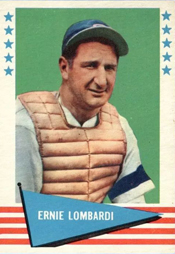
In a game in which both catchers were perfect at bat, Ernie Lombardi won it for the Reds with his mitt.

On July 6, 1934, the Reds edged the Cardinals, 16-15, at St. Louis. Lombardi, the Reds catcher and future Hall of Famer who was nicknamed “Schnozz” because of his big nose, produced five hits in five trips to the plate. Cardinals catcher Spud Davis, a career .308 hitter, was 4-for-4 with two walks.

The game ended when Lombardi tagged out Leo Durocher at the plate.

Theatre of the absurd

Played on a Friday afternoon, a paid gathering of 1,100 came to Sportsman’s Park to see the last-place Reds (22-46) and second-place Cardinals (41-28).

The home team gave what the St. Louis Star-Times described as a “burlesque performance,” committing three errors, stranding 12 runners and allowing the Reds to score in six of the first seven innings.

Of the seven pitchers used by the Cardinals, three were future Hall of Famers (Jesse Haines, Dizzy Dean and Dazzy Vance), but the only one who didn’t give up a run was Tex Carleton, who worked the ninth.

The Reds led 8-0 in the second and 15-8 in the sixth, but their pitchers were as ineffective as those on the Cardinals.

More to come

Ahead by five, the Reds scored the decisive run in the seventh when Lombardi drove in ex-Cardinal Chick Hafey from second with a two-out single, extending the lead to 16-10.

However, an error by Lombardi in the bottom half of the inning gave the Cardinals a chance to create some drama.

The first batter, Jack Rothrock, hit a pop fly near the plate in fair territory. Lombardi called for it, but dropped the ball, and Rothrock was safe at first. Frankie Frisch flied out and Joe Medwick, on what should have been the third out, fanned.

Rip Collins then drove a pitch onto the pavilion roof in right for a two-run home run, getting the Cardinals within four, at 16-12.

The Cardinals scored again in the eighth, making it 16-13.

In the ninth, Tex Carleton “showed his pals how real baseball should be pitched,” the Star-Times noted, and retired the Reds in order.

Fantastic finish

In the home half of the ninth, the Cardinals had runners on first and second, two outs, when their eighth-place batter, Leo Durocher, came to the plate against Si Johnson, who was on his way to a 22-loss season with the Reds.

Durocher hit a pop-up in foul ground, but “got a break when a boy in a grandstand box prevented Lombardi from reaching over for a catch,” the St. Louis Post-Dispatch reported.

Given a second chance, Durocher drilled a double to right, driving in both runners and making the score 16-15.

Next up was the pitcher, Carleton.

Cardinals player-manager Frankie Frisch had used 20 of his 22 players, including five as pinch-hitters. Only pitchers Paul Dean and Bill Hallahan hadn’t appeared in the game. Deeming neither a better option than Carleton, Frisch let Tex bat.

(Carleton produced 100 hits in the majors, including 17 in 1934.)

Carleton hit a sharp grounder to the right of shortstop Mark Koenig, who fielded the ball, but his low throw to first wasn’t in time to nail the runner.

When Durocher, who rounded third, saw first baseman Jimmy Shevlin fumble the ball, he dashed for the plate, hoping to score the tying run.

According to the Star-Times, “Shevlin quickly recovered the ball but his throw home was bad. Lombardi reached out, pulled in the ball and wheeled around just as Durocher tried to slide under him. Umpire Bill Klem whipped off his mask and cap and shouted, ‘You’re out!’ “

Believing he was safe, an angry Durocher “wanted to throw a fistful of dirt” at Klem, “but resisted the impulse,” the Post-Dispatch reported. Boxscore


Read Full Post »

Gee Walker took a nap in St. Louis. Problem is, he did it on the base paths.

On June 30, 1934, Walker was picked off base twice in the same inning while sleep-walking for the Tigers against the Browns at Sportsman’s Park.

His blunders ruined a potential Tigers scoring threat, opening the door for the Browns to win in extra innings, and enraged Tigers player-manager Mickey Cochrane, who fined and suspended Walker.

Born to run

Gerald “Gee” Walker was an exciting ballplayer with multiple skills. He could run, hit for average and drive balls into the gaps for extra bases.

An outfielder and right-handed batter, Walker hit .300 or better in six of his 15 seasons in the majors with the Tigers (1931-37), White Sox (1938-39), Senators (1940), Indians (1941) and Reds (1942-45). He twice ranked among the top 10 in the American League in doubles, triples, RBI and total bases. He had 20 or more steals in a season five times.

At the University of Mississippi, Walker played football as well as baseball. He was a member of the “The Flying Five” backfield which also included Tadpole Smith, Rube Wilcox, Doodle Rushing and Cowboy Woodruff.

Walker brought a football-type aggressiveness to the diamond that could thrill but sometimes backfired. The Detroit News described him as a “base-running screwball” and the Detroit Free Press called it “dizzy base running.”

“He frequently was in hot water with his manager because of reckless running and his penchant for being picked off base,” The Sporting News noted.

Costly gaffes

The Tigers, who had not won a pennant since 1909, were challenging the Yankees for control of the American League in 1934. Entering a series-opening Saturday afternoon game with the Browns at St. Louis, the Tigers (40-25) were a mere half game behind the first-place Yankees (40-24). The Browns (28-34) were a team the Tigers were expected to beat, so Mickey Cochrane, Detroit’s manager and catcher, was looking for a strong start to the series.

With the score tied at 3-3, Hank Greenberg led off the Tigers’ eighth with a single. Walker followed with a grounder to third baseman Harlond Clift, who threw low trying to force out Greenberg at second.

Clift’s error gave the Tigers a scoring chance, with Greenberg at second, Walker at first, no outs and Marv Owen (who drove in 98 runs that season) at the plate.

Greenberg’s presence on second meant Walker had nowhere to go and thus didn’t need to take anything more than a normal lead, but after Jack Knott made a pitch to Owen, catcher Rollie Hemsley noticed Walker had drifted into a no-man’s land off first. Hemsley fired the ball to first baseman Jack Burns and Walker was trapped between first and second.

When Greenberg saw the predicament Walker was in, he tried to help by galloping toward third but got caught in a rundown. Before Greenberg was tagged out, Walker advanced to second. Owen then lined to left for the second out.

Though picked off once that inning, Walker wandered six feet from second base. Before making a pitch to the next batter, Knott whirled and threw to shortstop Alan Strange, covering second. Walker was caught flat-footed and tagged out, ending the inning. As the Detroit Free Press noted, Walker “broke up a rally with some of his characteristic crackpottery.”

The Browns won, 4-3, in 10 innings. Boxscore

Out of sight

“Cochrane was furious with Walker,” the Free Press reported. “Before he left the Tigers’ dugout at the end of the game, he almost blew four fuses.”

Citing Walker’s bungling on the base paths, Cochrane suspended him indefinitely and issued a fine.

“I’m through with that fellow,” Cochrane said to the Free Press. “I’ve done everything I could to help him. Then he goes and kicks away a ballgame through reckless, stupid base running. It would not be fair to the other players to keep a fellow of Walker’s type around.”

Walker told the Detroit newspaper, “I don’t blame Mickey for doing what he has done. I had it coming to me.”

(The contrite comments were in contrast to what Walker said years later. Walker said to Chicago reporter Edgar Munzel, “I thought it was a rotten deal because I had violated no baseball rule on the club. A base runner has to be given a lot of latitude. Cochrane never forgot that day … He never liked me after that.”)

The next day, Sunday, July 1, the Tigers and Browns split a doubleheader and Walker, not in uniform, watched from a box seat. Afterward, the Tigers departed by train for a series in Cleveland and Walker took a separate train back to Detroit.

“All I want to do is get that fellow out of my sight in a hurry,” Cochrane told the Free Press.

While the Tigers were splitting a doubleheader at Cleveland on Monday, July 2, Walker met with Tigers owner Frank Navin. Though it was a pleasant session, Navin told Walker he backed Cochrane’s right to fine and suspend the player.

Cochrane wanted to send Walker to the minors, but he needed to clear waivers first. When the Browns made a waiver claim for Walker, the Tigers scrapped the idea of a demotion, the Free Press reported.

After the Tigers beat the Indians at Cleveland on Tuesday, July 3, both teams headed to Detroit for a July 4 doubleheader.

Gee whiz

Walker met with Cochrane before the holiday games at Detroit and offered to make an apology to the team if given another chance. He also asked if he could work out with the club, but the request was denied. Walker watched from the stands as the Tigers and Indians split the doubleheader.

After the games, Cochrane asked his players to vote on whether Walker should be reinstated. Walker’s teammates supported his return. Cochrane then declared the suspension would end after 10 days. Because the punishment began July 1, Walker was eligible to play again July 11.

“When he returns, I’ll be for him again, provided he plays the right kind of ball,” Cochrane told the Free Press.

Three days later, on Saturday, July 7, Cochrane was the catcher when the Tigers faced the Browns at Detroit. In the first inning, Cochrane doubled, driving in a run. Then, lo and behold, Browns catcher Rollie Hemsley picked off Cochrane. He took off for third but was tagged out.

In the seventh, after Cochrane walked, Hemsley tried to pick off Cochrane again but he scrambled back to the bag in time.

The Tigers won, 4-0. Cochrane fined himself $10 for getting picked off second, the Free Press reported. Boxscore

He’s back

Although back in uniform on July 11, Walker didn’t get into a game until making a pinch-hit appearance against the Yankees’ Red Ruffing on July 13. He popped out to second.

The next day, July 14, Cochrane started Walker in center and he contributed a double, two singles and three RBI in the Tigers’ 12-11 victory at home versus the Yankees. Walker got an ovation from the crowd when he singled against Lefty Gomez in the first.

The game also was noteworthy because Lou Gehrig was listed in the starting lineup as the shortstop, batting leadoff. Gehrig was “weak from an attack of lumbago,” according to the Free Press, and was in the lineup “only long enough to extend to 1,427 the string of consecutive games in which he has played.”

After Gehrig led off the game with a single, Red Rolfe ran for him and stayed in to play shortstop. Boxscore

Walker went on to hit .300 with 20 stolen bases for the 1934 Tigers, who won the pennant, but Cochrane didn’t start him in any of the World Series games against the Cardinals. Walker was 1-for-3 in that Series as a pinch-hitter. In Game 2, his RBI-single against Bill Hallahan tied the score at 2-2. Bill Walker relieved _ and picked Walker off first. Boxscore

Most popular

Walker had outstanding seasons for the Tigers in 1936 (.353 batting average, 55 doubles, 105 runs scored) and 1937 (.335 batting average, 213 hits, 113 RBI, 105 runs scored). On Opening Day in 1937, he hit for the cycle against Cleveland. Boxscore

Walker “won the hearts of all Detroit baseball fans with his daring, hard play,” International News Service reported.

The Free Press referred to Walker as the “people’s choice” and rated him as “probably the most popular player on the Tigers.”

Thus, there was an outcry when on Dec. 2, 1937, in a trade engineered by Cochrane, the Tigers sent Walker, Marv Owen and Mike Tresh to the White Sox for Vern Kennedy, Tony Piet and Dixie Walker.

“Fans by the thousands were protesting” the trading of Gee Walker, the Associated Press reported. The angry phone calls and letters produced “the biggest fan protest in the club’s history,” according to The Sporting News.

John Lardner of the North American Newspaper Alliance noted that “Mickey Cochrane, hitherto a public monument, is being wildly reviled for trading” Walker.

Cochrane said he made the deal to get Kennedy, a pitcher who was 14-13 with a 5.09 ERA for the White Sox in 1937 after earning 21 wins the year before. “We had to have pitching, and the only way we could get it was by giving up Walker,” Cochrane told the Associated Press. “The Sox wanted him and they had the only pitcher I thought could help us.”

Asked his reaction to the trade, Walker, referring to Cochrane, said, “I am out of the doghouse for the first time in six years.”

Kennedy was 12-12 with a 5.20 ERA for the Tigers before they dealt him to the Browns in May 1939. Walker did well with the White Sox (.305 batting average in 1938; 111 RBI in 1939) before joining the Senators (96 RBI in 1940).

Walker finished his big-league career with 1,991 hits and a .294 batting average.

Read Full Post »

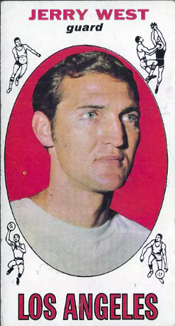
Fans of St. Louis basketball found out in a hurry how gifted Jerry West was as an all-round playmaker.

Whether facing the St. Louis University Billikens as a college senior or the St. Louis Hawks as a NBA rookie, West performed with excellence, totaling consistently impressive numbers of points, rebounds and assists.

A 6-foot-3 guard who played three varsity seasons at West Virginia University and 14 seasons with the Los Angeles Lakers, West averaged 24.8 points per game in college and 27 in the pros. (The NBA career leader is Michael Jordan at 30.1). West became the inspiration for the NBA logo.

College classic

As a junior at West Virginia, West averaged 26.6 points and 12.3 rebounds per game. West Virginia reached the championship final of the 1959 NCAA Tournament, but lost to California, 71-70. West had 28 points and 11 rebounds in that game. Boxscore

With West back for his senior season, West Virginia roared to a 6-0 start before facing St. Louis University in the first round of the Kentucky Invitation Tournament at Lexington in December 1959.

St. Louis assistant coach Fred Kovar, who scouted West that month when he scored 28 against Richmond, described him to the St. Louis Post-Dispatch as “a great all-round player with a lot of finesse and a fine jump shot. He’s a dynamic rebounder and defensively tough.”

The Billikens tried having one of their top players, 6-foot-5 Pete McCaffrey, guard West, but it didn’t work out. West scored 25 points in the first half and his team led, 51-36, at halftime.

St. Louis head coach John Benington made a defensive adjustment for the second half, having his team go to a zone-and-chaser defense. The chaser was George Latinovich, a 5-foot-11 sophomore. Described by the Post-Dispatch as “agile and aggressive,” Latinovich chased and hounded West.

As the newspaper noted, “The idea was to make West think he could take the short defender into the middle. West did, and that’s where the taller, zone-playing other Billikens ganged him and cut down his scoring.”

With West slowed, the Billikens clawed back from a 20-point deficit in the second half. As the West Virginia lead evaporated, Benington had his Billikens switch to a zone press. West fouled out with 22 seconds remaining.

St. Louis trailed by two, 87-85, when Billikens senior Jim Dailey was fouled with one second left. Dailey made the first free throw, but the second “hit the right side of the rim, looped, and rolled off the left side,” the Post-Dispatch reported.

West Virginia escaped with an 87-86 win. West had 37 points (12 in the second half) and 22 rebounds. “He’s the best I ever played against,” McCaffrey, who finished with 22 points, told the Post-Dispatch. “West can jump higher and he is quicker than Oscar (Robertson). Oscar is a better team player, though.”

The next night, St. Louis beat North Carolina, 68-52, in the consolation game, and West scored 33 to lead West Virginia to a 79-70 triumph over Kentucky for the tournament title.

Tough rookie

Three outstanding guards _ all destined for induction to the Naismith Memorial Basketball Hall of Fame _ were taken among the first six picks in the opening round of the 1960 NBA draft. Oscar Robertson, chosen first, went to the Cincinnati Royals. The next pick, West, went to the Minneapolis Lakers. With the sixth selection, the St. Louis Hawks took Lenny Wilkens.

West’s first season with the Lakers was their first in Los Angeles. They relocated from Minneapolis before the 1960-61 season and hired Fred Schaus, West’s college coach, to be their head coach.

Among the highlights of West’s rookie season were a pair of regular-season games against the Hawks.

On Feb. 2, 1961, as part of a NBA doubleheader at Philadelphia’s Convention Hall, the Lakers beat the Hawks, 116-115. West’s drive to the hoop resulted in a basket that tied the score at 115-115 with 38 seconds left. The Lakers won on Frank Selvy’s free throw in the final five seconds.

With forward Elgin Baylor sidelined because of an ankle injury, West snared 21 rebounds to go along with his 29 points. Boxscore

Ten days later, the Lakers faced the Hawks at St. Louis’ Kiel Auditorium. Though Baylor was in the lineup, West was a force on the boards again. He grabbed a career-high 24 rebounds and scored 17 points in a 105-95 Lakers victory. Boxscore

As the Post-Dispatch noted, West “caused no little embarrassment among the Hawks” and was “a major factor in the Lakers’ wide edge in rebounding. West charged the boards while his teammates blocked out the taller St. Louis players.”

Hawks head coach Paul Seymour told the newspaper, “To let their small men go in for rebounds as they did had to insult our guards.”

The loss was a rare one at home for the Hawks that season. It dropped their home record to 24-3. The other two losses were to the Boston Celtics.

In his 1970 book, “Mr. Clutch,” West said, “The fans in St. Louis were the toughest in the league. At Kiel Auditorium, they were closer to the court than in most arenas, and it was hard not to hear them. I have no complaints with most fans. They pay their way in and have a right to express themselves within reason. The sort of support they give teams in St. Louis, Boston and Philadelphia really helped those teams.”

West also was impressed with the Hawks’ standout player, Bob Pettit. “He was the most agile 6-foot-9 forward I ever faced and one of the greatest competitors,” West said in his 1970 book.

The Hawks (51-28) were regular-season conference champions in 1960-61, but the NBA then (like all professional sports now) had a playoff system that allowed also-rans in as wild cards. The Lakers (36-43) were one of the teams “rewarded” with a wild card spot.

Though undeserving of a playoff berth based on their record in the regular season, the Lakers took advantage of the gift and nearly knocked out the Hawks in the conference finals. The Lakers won three of the first five games before the Hawks eked out a 114-113 win in overtime in Game 6 and a 105-103 triumph in Game 7. West, the rookie, averaged 24.7 points and 8.7 rebounds per game in that series.

In his autobiography, West criticized the NBA for awarding playoff berths to clubs with mediocre or losing records. “If the games in October and November aren’t going to count, why charge for them?” West said. “It isn’t a big-league operation if the fourth-place team can win the championship.”

Class act

West had several other noteworthy performances against St. Louis. In 1962, he scored 46 points in a game at Los Angeles and 45 at St. Louis. Boxscore and Boxscore

He also dished out 16 assists to go with 23 points in a 1966 game versus St. Louis. Boxscore

Facing St. Louis in the 1966 conference finals, West averaged 34.6 points, 6.1 rebounds and 6.1 assists per game. West was the Lakers’ high scorer in six of the seven games in that series.

Guarded by St. Louis player-coach Richie Guerin, West scored 42 in Game 4. As the Post-Dispatch noted, “West was able to score because of his phenomenal skill firing in baskets despite hands in his face and constant harassment.” Boxscore

In the Game 7 finale, a 130-121 win for the Lakers, West had 35 points and six assists, even though he was called for his fifth foul late in the third quarter. West played the rest of the game without committing a disqualifying sixth foul.

“We did our best to take him under the basket, where he might get his sixth foul, but when we did that, we sacrificed some of our movement on offense,” Guerin told the Post-Dispatch. Boxscore

West was a guest instructor at the summer basketball camp run by former St. Louis University and NBA standout Ed Macauley at Hillsboro, Mo., in 1962.

One of the tips West gave the campers was: “If you’re trying to steal the ball, slap up, not down, and you’re less likely to be caught off balance.”

West also told the newspaper, “Quickness is more important than speed. The Hawks’ Bob Pettit has it, and so does Lenny Wilkens. The first move is the key one. It gets you past your man, or at least in the clear long enough to shoot.”

West was 36 when he opted to end his playing career in October 1974. Though he had a guaranteed $300,000 contract and had just scored 19 points in an exhibition game against the Portland Trail Blazers, West told the New York Times, “The major reason for my retirement is because I have set high standards for myself that I’m not willing to compromise. I have seen other players play longer than I thought they should have. I did not want to do that.”

Read Full Post »

(Updated June 28, 2024)

During his core years with the Pirates, Bob Skinner did a convincing impersonation of Stan Musial whenever he played against the Cardinals in St. Louis.

An outfielder who batted from the left side, Skinner had a level swing admired by teammates and foes alike.

In a six-season stretch from 1957-62, these were the numbers Skinner produced for the Pirates in games at St. Louis:

_ 1957: .412 batting average (14-for-34); .459 on-base percentage.

_ 1958: .364 batting average (8-for-22); .462 on-base percentage.

_ 1959: .410 batting average (16-for-39); .465 on-base percentage.

_ 1960: .345 batting average (10-for-29); .367 on-base percentage.

_ 1961: .500 batting average (14-for-28); .517 on-base percentage.

_ 1962: .308 batting average (8-for-26); .500 on-base percentage.

No wonder the Cardinals acquired him in their bid to get back into the 1964 pennant race.

Late bloomer

At La Jolla High School near San Diego, where his father taught Spanish and French, Skinner batted .200 as a junior. According to the Pittsburgh Post-Gazette, his high school coach said, “Of all the players I coached, I figured Bob Skinner was the least likely to succeed in baseball.”

Described by writer Myron Cope as sloped-shoulder, gangly and with “the features of a friendly hound dog,” Skinner moved deliberately around a ballfield. “It’s not that I’m lazy,” he told the Post-Gazette. “I just don’t waste any steps.”

Nonetheless, Pirates scout Tom Downey became fascinated with Skinner’s textbook swing, placed him in an amateur Sunday league and monitored his progress, the Post-Gazette reported. When Skinner, 19, learned to use that classic batting stroke to rap base hits consistently, Downey signed him to a Pirates contract in 1951.

He played in the minors that summer, then served two years stateside in the Marines and played baseball for service teams.

Skinner, 22, made the leap to the big leagues with the 1954 Pirates, becoming their first baseman and hitting .249 for a team that finished 53-101. Sent back to the minors in 1955, he returned to the Pirates the next year and settled in as their left fielder in 1957.

In the groove

Skinner’s sweet swing produced results _ .305 batting average and .370 on-base percentage in 1957, and .321 batting mark and .387 on-base percentage in 1958.

The Cubs’ Ernie Banks rated Musial, Hank Aaron and Skinner as the best hitters in the National League in 1958, The Pittsburgh Press reported. In the book “We Played the Game,” Tom Cheney, who pitched for the Cardinals and Pirates, said Skinner “was one of the best left-handed hitters I ever saw.”

In April 1959, New York Times columnist Arthur Daley wrote, “The successor to Stan Musial as the best left-handed hitter in the National League is Bob Skinner.”

Pittsburgh Press baseball writer Les Biederman noted, “The Pirates who see Skinner every day put him in Musial’s class as a hitter.”

Skinner told the newspaper, “I’ve become a better hitter now because I’m a better judge of the strike zone. I won’t swing at a bad pitch.” He credited Pirates instructor George Sisler, the former Browns first baseman, with helping him learn the strike zone.

“Mr. Sisler would show up any time you wanted to work with him and he’d stay as long as you wanted him to,” Skinner told the St. Louis Post-Dispatch. “He’d work mainly on the mental approach to hitting, on concentration, being ready and hitting only strikes.”

Two-time American League batting champion Mickey Vernon, who became a Pirates coach, said to the Post-Gazette, “Skinner has a beautiful, level swing. That’s the mark of a good hitter _ a level swing. Skinner has it. No reason why he shouldn’t hit well over .300 each year.”

Yet, after the 1958 season, Skinner didn’t hit better than .280 for three years in a row. “He is the first to tell you that his pretty swing has produced, over the years, some mighty ugly results,” the Post-Gazette noted.

Hit and miss

In 1959, Skinner hurt his back when he crashed into a fence chasing a Hank Aaron drive in Milwaukee. “I was out for nine days after foolishly trying to knock that fence down,” Skinner said to the Post-Gazette. “It pained like the devil. I realized later I tried to get back in the lineup too soon. My timing was off for a long time.”

He still managed to be a pain to Cardinals pitchers. On Aug. 6, 1959, Skinner had four hits, a walk and scored twice during an 18-2 rout of the Cardinals at St. Louis. Boxscore

In 1960, Skinner had a team-leading 33 doubles and a career-high 86 RBI, helping the Pirates win the pennant. In Game 1 of the World Series against the Yankees, he injured a thumb making a headfirst slide and didn’t play again until Game 7, scoring a run in the Pirates’ 10-9 triumph. Boxscore

Though he had a subpar 1961 season (.268), Skinner did have three doubles, three RBI and four runs scored in a 19-0 romp over the Cardinals at St. Louis. Boxscore

In 1962, Skinner hit .302 and led the Pirates in on-base percentage (.395), slugging percentage (.504), home runs (20), walks (76) and total bases (257).

(Though more a contact hitter than a slugger, Skinner had power. In May 1966, the Post-Dispatch reported that only nine fair balls ever had been hit to or over the right field roof at Pittsburgh’s Forbes Field and the only two batters to do it twice were Skinner and the Braves’ Eddie Mathews.)

Looking to make room for a young, slugging left fielder, Willie Stargell, the Pirates sent Skinner to the Reds in May 1963 for Jerry Lynch. Unable to crack an outfield of Frank Robinson, Vada Pinson and Tommy Harper, Skinner was a reserve.

Helping hand

The departures of three left-handed batters (Musial and Carl Sawatski retired, and George Altman was traded) after the 1963 season left the Cardinals with a gap in 1964. They hoped a couple of promising outfielders who batted from the left side, Doug Clemens and Johnny Lewis, could do the job, but both struggled, prompting general manager Bing Devine to go shopping.

On June 13, 1964, the Cardinals (in sixth place at 28-28) got Skinner from the Reds for cash and minor-league catcher Jim Saul. “Skinner fills the Cardinals’ need for an experienced outfielder who bats left-handed,” the Post-Dispatch reported.

Two days later, the Cardinals got another left-handed batter, Lou Brock, from the Cubs to take a starting spot in the outfield.

Brock’s acquisition was crucial to the Cardinals becoming National League and World Series champions in 1964. Skinner helped, too.

Playing almost exclusively against right-handed pitching, Skinner, 32, hit .333 with runners in scoring position for the 1964 Cardinals. He also hit .389 (7-for-18) against the front-running Phillies.

On July 14 at St. Louis, the Dodgers led, 7-4, entering the bottom of the ninth, but the Cardinals scored four times for an 8-7 triumph. With two outs, Skinner, batting for Julian Javier, drove in the tying and winning runs with a two-run single versus ex-Cardinal Bob Miller. Boxscore

A month later, Skinner again batted for Javier, and cracked a three-run home run against the Dodgers’ Howie Reed, carrying the Cardinals to a 4-1 victory at St. Louis. Boxscore

As he had as a Pirate, Skinner hit well in St. Louis for the Cardinals. His home batting average for them in 1964 was .290.

Skinner also provided leadership. The Post-Dispatch described him as “commander in chief of the St. Louis reserves.”

In the 1964 World Series against the Yankees, Skinner made four pinch-hit appearances and produced two hits and a walk.

All in the family

Skinner was an asset to the Cardinals again in 1965. He hit .309 overall and .319 as a pinch-hitter. According to the Post-Dispatch, Skinner in 1965 had the most pinch-hits (15) and the most pinch-hit RBI (15) in the National League. In games at St. Louis in 1965, he batted .339 overall.

Released by the Cardinals after an unproductive 1966 season, Skinner went on to manage the Phillies (1968-69) and coached for 19 years in the big leagues with the Padres, Pirates, Angels and Braves. He coached for manager Chuck Tanner’s 1979 World Series champion Pirates.

A son, Joel Skinner, was an American League catcher for nine seasons. Joel also coached in the majors for 10 years and was Cleveland manager for part of the 2002 season.

Besides Bob Skinner and Joel Skinner, other fathers and sons who have managed teams in the majors are Felipe Alou and Luis Rojas; Buddy Bell and David Bell; Bob Boone and Aaron Boone; and George Sisler and Dick Sisler.

Read Full Post »

« Newer Posts - Older Posts »