Feeds:
Posts
Comments

Archive for the ‘Opponents’ Category

Tom Lasorda, in his big-league debut, helped Stan Musial achieve a personal best.

tom_lasorda2On Aug. 5, 1954, Musial had seven RBI in a game for the first time in his Cardinals career.

Facing the Dodgers at Ebbets Field in Brooklyn, Musial hit a pair of three-run home runs _ one each off Preacher Roe and Erv Palica _ in consecutive innings. His seventh RBI came on a sacrifice fly against Lasorda.

Musial, 33, was in the prime of a Hall of Fame playing career. Lasorda, 27, was a big-league rookie who had spent eight seasons in the minor leagues. The left-hander would appear in just 26 games in the majors _ eight with the Dodgers and 18 with the Athletics _ but would be elected to the Hall of Fame as a Dodgers manager.

Dodgers nemesis

After grounding out in the first inning, Musial hit the first of his three-run homers in the third against Roe, a left-hander who had debuted with the 1938 Cardinals.

It was Roe who, when asked his approach to pitching to Musial, replied, “I throw him four wide ones, then try to pick him off first base.”

Musial hit .377 with 12 homers and 28 RBI against Roe in his career.

In his autobiography, Musial said of Roe, “At Brooklyn, he became an outstanding pitcher, changing speeds and mixing up a well-controlled curve, screwball and, as the man admitted himself later, a spitter. Because I didn’t want him to load up one of those quick-dipping spitters on me, I always tried to keep him from getting two strikes on me.”

An inning after his home run off Roe, Musial crushed the second of his three-run homers, this time against Palica. Musial hit .429 in his career versus Palica.

Rookie reliever

Lasorda relieved Palica in the fifth. The first big-league batter to face him was Red Schoendienst, who singled. The next batter, Bill Sarni, also singled. Lasorda then struck out Joe Cunningham and got Alex Grammas to ground into a double play.

In the sixth, Lasorda walked the leadoff batter, pitcher Brooks Lawrence. After Rip Repulski flied out, Wally Moon doubled, putting runners on second and third.

Musial then hit a fly ball to left. Sandy Amoros caught it, Lawrence tagged and scored, giving Musial his seventh RBI, and the Cardinals led, 10-2.

With those RBI, Musial became the first player in the majors to reach 100 in 1954. It was his seventh season of 100 RBI. His two home runs were Musial’s 29th and 30th of the season.

Paul Waner, the Hall of Fame outfielder, told The Sporting News, “No telling how many homers Stan could make if he weren’t unselfish.”

The Cardinals won, 13-4. Before then, the Dodgers had won 18 of the last 19 against the Cardinals at Ebbets Field. Boxscore

Lasorda pitched three innings in his debut and yielded three runs. Musial would face Lasorda a total of three times in his career. After the sacrifice fly, his other two plate appearances versus Lasorda resulted in a walk and a strikeout.

In his 22 seasons with the Cardinals, Musial had just one other seven-RBI game. That occurred on June 23, 1961, in a 10-5 Cardinals victory over the Giants at St. Louis. In that game, Musial had a three-run home run off starter Billy O’Dell and a grand slam off Bobby Bolin. Boxscore


Read Full Post »

Dennis Eckersley and Jason Isringhausen, the closers who contributed the most to helping Tony La Russa earn election to the National Baseball Hall of Fame, also played prominent roles in his first win as Cardinals manager.

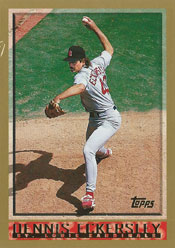
dennis_eckersley2The Cardinals beat the Mets, 5-3, in New York on April 3, 1996, in La Russa’s second game as Cardinals manager. Eckersley earned a tension-filled four-out save. Isringhausen was the opposing starter, facing the Cardinals for the first time in his career.

The win was the first of a franchise-record 1,408 for La Russa in 16 years as Cardinals manager.

After successful stints managing the White Sox and Athletics, La Russa secured his Hall of Fame status with his Cardinals career. He joined another Hall of Famer, Billy Southworth, as the only managers to win two World Series titles with the Cardinals. On July 27, 2014, La Russa and another former Cardinals manager, Joe Torre, were inducted into the Hall of Fame at Cooperstown, N.Y.

Converted starters

At Oakland, La Russa and pitching coach Dave Duncan converted a reluctant Eckersley from a starter into a closer. The move transformed Eckersley into a Hall of Fame pitcher. He earned 386 of his 390 saves with La Russa as manager _ 320 in nine years with the Athletics and 66 in two years with the Cardinals.

Isringhausen, who also successfully converted from starter to closer, joined the Cardinals in 2002. Pitching for La Russa and Duncan, Isringhausen compiled a franchise-record 217 saves in seven seasons with the Cardinals and finished his big-league career with 300 saves.

After La Russa left the Athletics to become manager of the 1996 Cardinals, Eckersley was acquired in a trade for pitcher Steve Montgomery and, at 41, became the St. Louis closer.

On April 1, 1996, in La Russa’s debut as Cardinals manager, the Mets overcame a four-run deficit and won, 7-6. Eckersley didn’t appear in that game. Boxscore

Seeking a win

Isringhausen, 23, got the start for the Mets in the season’s second game. He was 9-2 as a Mets rookie in 1995. A native of Brighton, Ill., near St. Louis, Isringhausen acknowledged that facing the Cardinals was special. “I had more butterflies (than usual),” Isringhausen said to the St. Louis Post-Dispatch.

Isringhausen pitched six innings, yielding three runs to the Cardinals. He was lifted for a pinch-hitter, with the Cardinals leading, 3-0. Bernard Gilkey, a former Cardinal, clubbed a three-run home run off starter Todd Stottlemyre in the bottom of the sixth, tying the score at 3-3.

The Cardinals scored a run in the seventh off Robert Person and another run in the eighth against Jerry DiPoto, taking a 5-3 lead. In the bottom of the eighth, the Mets had runners on first and second with two outs when La Russa replaced Stottlemyre with Eckersley.

“No matter how much experience you have, you’re a little uptight when you come into the game,” Eckersley said to the Post-Dispatch. “I felt very uncomfortable, like I’d never been in a game before.”

Solid swing

The first batter Eckersley faced in his Cardinals debut was Butch Huskey, the Mets’ cleanup batter.

With the count 1-and-2, Eckersley threw a fastball. Huskey swung and launched a drive toward center field. He knew he had made solid contact. “I thought it had a chance to go (over the wall),” Huskey said to the New York Daily News.

Center fielder Ray Lankford raced toward the wall while tracking the path of the ball. “I thought I could tell by the look on (Lankford’s) face that he was going to catch it,” Eckersley said.

The ball carried farther than Eckersley thought. As Lankford neared the 396-foot sign, he leaped, extended his glove and caught the ball, ending the inning and preserving the lead.

“Most definitely, I was robbed,” Huskey told the Post-Dispatch. “The ball jumped off my bat. I thought it was going out.”

In the bottom of the ninth, with the Cardinals still ahead by two, Eckersley retired the first two batters before Jose Vizcaino and Kevin Roberson each singled. Edgardo Alfonzo was up next, representing the potential winning run. Eckersley struck him out, earning his first National League save and preserving La Russa’s first National League win.

“In this league, it’s hard to get a hit or a save or a win,” La Russa said. “I don’t think there are any ugly ones.” Boxscore


Read Full Post »

(Updated July 17, 2019)

Insisting the crime didn’t fit the punishment, Cardinals pitcher Joaquin Andujar threatened to return home to the Dominican Republic rather than pay a fine for an altercation with Giants counterpart Mike Krukow.

joaquin_andujar6Though Andujar didn’t leave the Cardinals _ he completed a season in which he led the National League in wins (20) and innings pitched (261.1) _ the incident and his reaction to it contributed to the legend of the talented, emotional starter.

On July 17, 1984, in a game between the Giants and Cardinals at St. Louis, Manny Trillo was hit by a pitch from Andujar in the first inning. Andujar led the National League in most batters hit by pitches in both 1984 and 1985.

Two innings later, when Andujar batted for the first time in the game, Krukow brushed him back with two pitches. On the second brushback pitch, Andujar “had to jump rope or the ball would have hit him” in the leg, the St. Louis Post-Dispatch reported.

Plate umpire Billy Williams went to the mound to warn Krukow to stop throwing at Andujar. “I thought the first time the ball got away from him,” Williams said. “The second one didn’t.”

As Giants manager Frank Robinson joined the conversation on the mound, Krukow began yelling at Andujar.

“I said, ‘Don’t throw at my hitters,’ ” Krukow told the San Francisco Examiner. “He said something back. He wasn’t speaking Spanish.”

Krukow tossed down his glove and charged at Andujar.

Andujar tossed down his helmet and threw a punch at Krukow, the Post-Dispatch reported. Krukow and Andujar grappled on the ground for a while.

Both benches emptied but there was no serious fighting and neither pitcher was ejected because Williams said he didn’t see either throw a punch. When the at-bat continued, Krukow struck out Andujar.

Krukow said his teammates expected him to answer Andujar’s plunking of Trillo. “I have to dress next to these guys,” Krukow said. “I couldn’t look them in the eye if I didn’t protect them.”

Trillo said Andujar probably didn’t intend to hit him with the pitch, but added, “I think Krukow was right to do what he did.”

When Andujar went back to the mound to pitch the fourth, he was an emotional wreck. The Giants broke a scoreless tie, reaching Andujar for four runs on three singles, a double and a walk. They swiped two bases in the inning and Andujar uncorked a wild pitch. The Giants went on to a 7-2 victory. “He always comes unglued when that happens,” Cardinals manager Whitey Herzog said. Boxscore

A week later, the National League fined Andujar $200 for his role in the incident.

Incredulous, Andujar said, “I’m not going to pay that. They’re going to suspend me if I don’t pay. I should go to the Dominican Republic right now. I have enough money. I could live on that. This is lousy.”

“I’m a black Dominican and that’s why they fine me,” Andujar said to reporter Rick Hummel. “What else am I supposed to think?”

In explaining his on-field actions to The Sporting News, Andujar said, “He charged me. What am I supposed to do, run?”

A month later, amid speculation he would ask to be traded when his contract expired after the 1984 season, Andujar attempted to squelch such talk. “I like Whitey Herzog,” Andujar said. “I want to be here. I don’t want to get traded. I want to die here. I want St. Louis fans to know that. Maybe they will feel better if they know you want to die here.”

Andujar accepted a three-year, $4.5 million deal from the Cardinals after the season. In his book “White Rat: A Life in Baseball,” Herzog said, “If it hadn’t been for Andujar and (Bruce) Sutter, we might have finished in last place (in 1984).”

The next year, Andujar posted 21 wins for the 1985 Cardinals, but he imploded during Game 7 of the World Series, confronting umpire Don Denkinger, and was traded to the Athletics two months later.

Previously: How Joaquin Andujar made like Babe Ruth for Cardinals

Previously: Joaquin Andujar skipped All-Star Game to barbecue quail


Read Full Post »

In his major-league debut, Cardinals reliever John Costello escaped an inherited bases-loaded jam, struck out the side in the next inning and earned the win.

john_costelloTwenty-six years later, on June 16, 2014, Nick Greenwood became the first Cardinals reliever to earn a win in his major-league debut since Costello did so on June 2, 1988, at Philadelphia.

Costello and Greenwood achieved their feats under very different circumstances.

Greenwood, 26, a left-hander, relieved starter Carlos Martinez to begin the fifth inning with the Cardinals leading the Mets, 2-1, at St. Louis. Greenwood held the Mets to a run in 3.1 innings and the Cardinals won, 6-2. Greenwood got the win because Martinez didn’t pitch the necessary five innings for a starter to qualify for a win. Boxscore

Costello, 27, a right-hander, was brought in by manager Whitey Herzog to replace reliever Steve Peters with the score tied at 2-2 in the 13th inning at Philadelphia. The Phillies had the bases loaded and one out.

“I didn’t have much alternative,” Herzog told the St. Louis Post-Dispatch.

Tough spot

The Cardinals had used six pitchers in the game after also using six the night before in a 13-inning victory against the Astros at Houston.

Said Herzog: “That was a hell of a place to put him in.”

After Herzog handed the ball to Costello and left the mound, catcher Tony Pena began a conversation with the newcomer. According to the Post-Dispatch, the talk went like this:

Pena: “What you got?”

Costello: “I’ve got three pitches _ fastball, slider, changeup.”

Then Costello told Pena to forget about the latter two and just call for the fastball.

“When he started laughing,” Costello told United Press International, “that broke the nervousness.”

Costello had another reason to focus on fastballs. He was experiencing stiffness in his right shoulder. “But the adrenaline took over and took the pain away,” Costello told the Post-Dispatch.

The first batter he faced, Chris James, hit a short fly out to right and the runners held. The next batter, Mike Young, flied out to left, ending the threat.

Pressure no problem

In the 14th, Cardinals cleanup hitter Tom Brunansky walked, stole second and scored on a two-out infield single by Pena.

Costello, throwing fastballs only, struck out all three Phillies he faced in the bottom half of the inning (Bill Almon, Danny Clay, Juan Samuel), earning the win in the Cardinals’ 3-2 triumph. Boxscore

“If I can handle that pressure right there, I guess I can handle some more along the line,” Costello said to the Post-Dispatch.

Said Herzog: “He was sneaky (fast), the way they were swinging. We’ll put him back out there.”

Costello, chosen by St. Louis in the 24th round of the 1983 amateur draft, went on to have a spectacular rookie season for the 1988 Cardinals. He was 5-2 with a save and a 1.81 earned run average in 36 games.

In 1989, Costello followed up with a 5-4 record, 3 saves and a 3.32 ERA in 48 games.

On April 23, 1990, the Cardinals traded Costello to the Expos for utility player Rex Hudler. Costello finished his big-league career with the 1991 Padres. In four major-league seasons, Costello was 11-6 with 4 saves and a 2.97 ERA in 119 games.

Previously: How Jose Oquendo became a Cardinals catcher

Read Full Post »

His name, perfect for a young, hard thrower, seemed the kind a novelist or screenwriter would conjure, but Billy McCool was real, a left-hander who broke into the majors with the Reds as a teenager and for two years was among the top relievers in the National League.

bill_mccoolThe Cardinals found McCool nearly untouchable in 1966, when he was a National League all-star.

McCool battled the Cardinals for six seasons, 1964-69. He pitched more innings and had more strikeouts versus the Cardinals than he did against any other big-league opponent.

In 1970, the Cardinals acquired McCool, 26, from the Padres, but his career had peaked. In 18 appearances for the 1970 Cardinals, he was 0-3 with a 6.23 ERA and a save.

Reds rookie

A standout athlete at Lawrenceburg, Ind., McCool was signed by the Reds as an amateur free agent in 1963. McCool, 19, made his big-league debut with the 1964 Reds and was a prominent pitcher for a club in the thick of a pennant race with the Cardinals and Phillies through the final day of the season.

McCool posted six wins and seven saves with a 2.42 ERA for the 1964 Reds. The Sporting News named him its National League Rookie Pitcher of the Year.

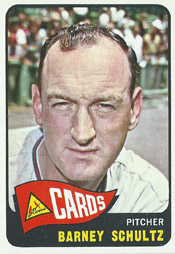
Against the Cardinals that season, McCool was 0-2 with a save in six appearances. On Sept. 19, the Reds beat Bob Gibson and the Cardinals in the first game of a doubleheader at Cincinnati. McCool got his first big-league start in the second game. Matched against Ray Sadecki, McCool was good, yielding two runs, striking out seven and issuing no walks in eight innings. Sadecki was better. He pitched eight scoreless innings and combined with Barney Schultz for the shutout in a 2-0 triumph for the Cardinals. Boxscore

After the season, McCool and his brother-in-law, a pharmacist, bought a drugstore in Lawrenceburg. Wrote The Sporting News: “Billy McCool not only throws aspirin tablets, he sells them.”

Billy the Kid

McCool sought a pay raise from the Reds for 1965. According to The Sporting News, contract talks between McCool and assistant general manager Phil Seghi included this exchange:

Seghi: “Billy, you’re just a kid yet. You’re asking for too much money.”

McCool: “If I’m only a kid, why do they give me a man’s job to do?”

Appearing in 62 games, including two starts, in 1965, McCool compiled nine wins and 21 saves for the Reds. He ranked second in the league in saves, behind the Cubs’ Ted Abernathy. McCool was 1-1 with four saves versus the Cardinals that season.

Used exclusively in relief in 1966, McCool had eight wins, 18 saves and a 2.48 ERA. He again ranked second in the league in saves, behind the Dodgers’ Phil Regan. In seven games against the 1966 Cardinals, McCool was 2-1 with three saves and a 1.04 ERA. He struck out 23 Cardinals in 17.1 innings and yielded two earned runs.

In the July 2, 1966, edition of The Sporting News, Mets second baseman Chuck Hiller said of McCool’s fastball, “It looks about the size of a Ping-Pong ball when it comes up to the plate.”

Said Mets third baseman and former Cardinals standout Ken Boyer: “That slider he’s throwing now is the best I’ve ever seen a left-hander have.”

McCool made 11 starts in 31 appearances in 1967 and four starts in 30 appearances in 1968.

Battles with Brock

He had two significant games against the 1968 Cardinals.

On April 23, 1968, the Reds led the Cardinals, 2-0, through eight innings at St. Louis. In the ninth, the Cardinals scored twice off starter George Culver, tying the score. In the 10th, Lou Brock hit a two-run walkoff home run against McCool, giving the Cardinals a 4-2 victory. Boxscore

Two months later, on June 14, McCool got a start at St. Louis. He held the Cardinals scoreless in six innings and limited them to two hits _ singles by Julian Javier and Tim McCarver _ and got the win in a 7-0 Reds triumph. Boxscore It was McCool’s last major-league win as a starter.

Brock hit .147, 5-for-34, with 12 strikeouts against McCool in his career. Another Cardinals hitter who struggled versus McCool was Mike Shannon. He hit .100, 2-for-20, with seven strikeouts. The Cardinals who hit McCool best: Javier at .400, 8-for-20, and Curt Flood at .292, 7-for-24.

The Reds made McCool, 24, available in the expansion draft after the 1968 season and he was selected by the Padres. In four appearances for the Padres against the 1969 Cardinals, McCool was 2-1 with a 4.15 ERA.

On Aug. 6, 1969, at San Diego, McCool relieved Clay Kirby in the ninth with the score tied at 2-2 and retired the Cardinals in order. When ex-Cardinal Ed Spiezio opened the Padres’ ninth with a home run off Steve Carlton, lifting San Diego to a 3-2 victory, McCool got the win, his last in the big leagues. Boxscore

Save for St. Louis

In April 1970, the Cardinals acquired McCool from the Padres for infielder Steve Huntz. After a stint at Class AAA Tulsa, McCool was promoted to the Cardinals in May.

In his third appearance, May 15, 1970, McCool earned a save with two scoreless innings in relief of Mike Torrez in a 1-0 victory over the Cubs at St. Louis. McCool retired Don Kessinger, Glenn Beckert and Billy Williams on ground balls in the eighth. In the ninth, after getting groundouts from Jim Hickman and Johnny Callison, McCool walked Ron Santo before retiring Cleo James on a fly ball. Boxscore

That was McCool’s highlight as a Cardinal. In July, he was demoted to Tulsa. After the season, the Cardinals traded him to the Red Sox for pitcher Bill Landis. McCool never returned to the major leagues.

In seven big-league seasons, he posted a 32-42 record with 58 saves and a 3.59 ERA. In 33 games against the Cardinals, McCool was 6-6 with eight saves, a 3.26 ERA and 68 strikeouts in 66.1 innings.

Previously: Cardinals vs. Reds: rich tradition of July 4 showdowns

Read Full Post »

After losing the first two games of the 1985 National League Championship Series, the Cardinals could have been fazed by the prospect of facing Dodgers pitcher Bob Welch in Game 3. Welch had produced two complete-game wins against St. Louis in the regular season. A loss to him in the third game of the postseason series would push the Cardinals to the brink of elimination.

bob_welchInstead, it was Welch who was shaky.

Speedsters Vince Coleman and Willie McGee distracted a jumpy Welch and the Cardinals beat him, sparking a streak of four consecutive wins that propelled them into the World Series.

Welch was a premier pitcher for 17 years in the big leagues with the Dodgers and Athletics. He posted a career record of 211-146. In 1990, he was 27-6 with a 2.95 ERA and earned the American League Cy Young Award while pitching for the pennant-winning Athletics team of manager Tony La Russa and coach Dave Duncan.

In 1985, Welch was 14-4 with a 2.31 ERA in 23 starts for the Dodgers. He averaged less than two walks per nine innings.

The Cardinals, though, jolted Welch out of his comfort zone in the National League Championship Series.

Give the ump a mitt

In the first inning, Coleman lined a single over the head of third baseman Bill Madlock. With the count 1-and-0 on the next batter, McGee, the Dodgers pitched out, but Coleman swiped second anyway. Distracted by Coleman dancing off second, Welch walked McGee.

Tommy Herr came up next and worked the count full. Welch then whirled and attempted a pickoff of Coleman. The throw came closer to hitting umpire Paul Runge than it did to reaching the glove of shortstop Dave Anderson, covering second, and the ball sailed into center field. Coleman scored and McGee raced to third.

“I’m supposed to be able to make this play,” Welch said to the Daily Breeze of Torrance, Calif. “But for some reason I threw the ball to Runge. Too bad he didn’t have a mitt. He could have made the tag.”

Said Coleman to the Springfield (Ill.) State Journal-Register: “I was surprised he threw. The count was 3-and-2 and I wasn’t going to run until he threw to the plate.”

After walks to Herr and Andy Van Slyke, McGee scored on Terry Pendleton’s grounder to second, giving the Cardinals a 2-0 lead.

Sitting on the fastball

In the second inning, the Cardinals continued to apply pressure on Welch. With one out, Coleman singled. Catcher Mike Scioscia tried to pick off Coleman, but the throw eluded first baseman Greg Brock. Coleman advanced to third and scored on McGee’s single. After McGee was nailed attempting to swipe second, Herr smacked a Welch fastball over the right-field wall for a home run, putting the Cardinals ahead, 4-0.

“Welch kept throwing me fastballs,” Herr said to the Daily Breeze. “I fouled three of them off and I was sitting on the fastball when he threw the home run pitch.”

Said Welch: “I never got in a situation where I could use my curve ball. I never got in a situation where I was pitching, period. I just threw it up there.”

(Including the postseason, Herr batted .300 against Welch in his career, with 12 hits in 40 at-bats. Eleven of those hits were singles.)

Herr told the San Diego Union that the reason Welch beat the Cardinals twice during the 1985 regular season was because “he kept Coleman and McGee off base and was able to throw his breaking ball a lot. Today, he had to throw more fastballs with Vince and Willie on base.”

Welch was lifted after 2.2 innings. His line: 6 walks, 5 hits, 4 runs, 2 earned. Harried by the Cardinals, he’d made 20 pickoff throws.

“We weren’t trying to screw Welch up, even though that’s what happened,” said McGee.

Given the 4-0 lead, Cardinals starter Danny Cox and relievers Ricky Horton, Todd Worrell and Ken Dayley held the Dodgers to two runs. St. Louis won, 4-2. Boxscore

The Dodgers never recovered, losing the next three games, including Game 5 on the Ozzie Smith “Go crazy, folks” walkoff home run and Game 6 on Jack Clark’s ninth-inning three-run homer.

Welch finished his career with a 7-8 record and 3.99 ERA against the Cardinals in 18 regular-season appearances, including 15 starts.

Previously: How Bing Devine tried coaxing Kirk Gibson to Cardinals

Read Full Post »

« Newer Posts - Older Posts »