Feeds:
Posts
Comments

Archive for the ‘Opponents’ Category

Lou Brock was expected to have a breakout year in 1964 _ with the Cubs, not the Cardinals.

lou_brock8From October 1963 until the start of the 1964 season, Brock was heralded as an emerging superstar who, along with Billy Williams and Ron Santo, gave the Cubs legitimate hope of building a contender.

Instead, the Cubs deviated from their plan to construct a team with Brock as a cornerstone. Desperate for experienced pitching, the Cubs traded Brock and pitchers Jack Spring and Paul Toth to the Cardinals on June 15, 1964, in a deal that brought them pitchers Ernie Broglio and Bobby Shantz along with outfielder Doug Clemens.

Brock propelled the Cardinals to the 1964 National League pennant with his hitting (.348 batting average in 103 games) and speed (33 steals) after being acquired from the Cubs.

Many had predicted he would produce those kinds of numbers for Chicago.

After hitting .258 with 24 steals for the Cubs in 1963, his second full season in the major leagues, Brock, 24, finished runner-up to Cardinals catcher Tim McCarver in balloting by the Associated Press for the honor of National League sophomore of the year.

“Brock is going to be one of the great players in the game within a few years,” Cubs executive Bob Whitlow told The Sporting News in October 1963.

A month later, The Sporting News reported, “In order to acquire (an) extra starting hurler, the Cubs will not break up their infield nor will they deal either Billy Williams or Lou Brock of the outfield.”

Said Santo: “As for Brock, he’s just going to keep getting better.”

Brock led the Cubs in hitting at .380 during the 1964 spring training season.

In a poll of National League writers conducted by The Sporting News before the start of the 1964 regular season, Brock was selected the Cubs player “likeliest to improve.”

Brock started the season well, hitting .306 in April, but batted .221 in May. He entered June in a 4-for-29 slump. On the day he was traded to the Cardinals, his batting average was .251.

Cubs beat writer Edgar Munzel sensed the Cubs were erring in dumping Brock. Calling Brock “a great young prospect,” Munzel wrote, “Even though he was hitting only .251, the youngster combines power with tremendous speed. He was a constant base-running threat.”

Brock, acquired by the Cardinals three days before his 25th birthday, went on to enjoy a spectacular 19-year big-league career, with 3,023 hits, 938 stolen bases and election to the National Baseball Hall of Fame in 1985.

Previously: Bill White: We thought Brock deal was nuts

Read Full Post »

(Updated April 5, 2018)

The lineup of luminaries who participated in the first event held at San Francisco’s Candlestick Park included Stan Musial, Willie Mays and Richard Nixon. The story of the day, though, wasn’t created by ballplayers or politicians. Instead, the wind, sweeping across San Francisco Bay and swirling throughout the $15 million stadium, produced the most attention.

bill_white2Candlestick Park was dedicated on April 12, 1960, when the Cardinals played the Giants in the National League season opener for both clubs. Video

After two years at Seals Stadium in San Francisco’s Mission District, the Giants played at Candlestick Park from 1960 through 1999 before moving into a ballpark in the China Basin section of San Francisco in 2000.

Tricky winds and Tricky Dick

Vice President Nixon took part in the Candlestick Park dedication ceremonies before the start of the Cardinals-Giants game and called the facility “the finest baseball park in America,” the Associated Press reported. “It is truly a magnificent stadium,” Nixon said.

The sun shined brightly that Tuesday afternoon, but those among the 42,269 seated in the shade, especially in the lower level underneath the overhang of the upper deck, were chilled blue by the wind which relentlessly rolled in from left field.

Ray Haywood of the Oakland Tribune wrote, “Although Candlestick Park undoubtedly is the Taj Mahal of baseball _ a beautiful, commodious creation in steel and concrete _ it might not be a fit place either for shirtsleeves or right-handed hitters aiming for the left field fence. A spring wind, eager and brisk from the north, put the air brakes on everything hit toward left and boosted balls hit to right.”

Wrote Art Rosenbaum in The Sporting News: “It was like a Sierra winter day, warm in the sunshine but freezing under the trees. The coffee sales at Candlestick more than doubled the pre-game estimate of concessions experts.”

Musial, playing first base for the Cardinals, told the Oakland Tribune, “This wind will force teams to change their style of play. Right-handed power will be neutralized and clubs will have to go more for running and stealing bases.”

Future and former Cardinals

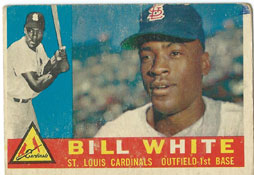
Bill White, the Cardinals’ center fielder, got the first hit in Candlestick Park, a two-out single in the first inning off Sam Jones. A year earlier, White and Jones were traded for one another.

Orlando Cepeda of the Giants hit a two-run triple in the bottom of the first off Larry Jackson, giving San Francisco a 2-0 lead. Cepeda’s sinking line drive darted wickedly in the wind and eluded White about 15 feet from the center field fence. “I should have had it, wind or not,” White said.

In the third, Cepeda increased the San Francisco lead to 3-0 with a single, scoring Mays from third.

Leon Wagner, traded by the Giants to the Cardinals four months earlier, hit the first Candlestick Park home run on a curve from Jones in the fifth. In the book “The Original San Francisco Giants,” Wagner recalled, “He threw me one of his long, hooking curveballs, the ones that broke about eight feet, and I just waited on it and hit it into the bay … I had the breeze blowing with me at Candlestick. I just had to get it up in the wind.”

Jones threw 121 pitches and finished with a three-hitter (the Wagner homer and two singles by White) in the Giants’ 3-1 victory. Boxscore

It was Jones’ fifth consecutive win against St. Louis since his trade to the Giants.

“I was more impressed with Jones than the wind,” Cardinals manager Solly Hemus said. “Sam was as good out there today as I’ve ever seen him.”

Musial went hitless in three at-bats. Mays and Willie McCovey each was 1-for-3 (each hit a double) with a walk apiece.

White works wonders in wind

One more wind story from that game:

In the eighth, with McCovey on first and no outs, Cepeda crushed a pitch into center field. White, still burning from failing to catch the Cepeda rocket in the first, raced after the ball as the wind pushed it away from him. White tracked it, grabbed it, crashed into the fence, 420 feet from home plate, and rolled on the ground without dropping the ball.

“That ball was my best shot,” Cepeda said. “I just can’t hit it any better.”

Said Wagner, who watched from left field: “If it hadn’t been for the wind, it would have gone 700 feet.”


Read Full Post »

Mark Ellis nearly lost a leg when injured playing against the Cardinals.

Less than two years later, a healthy Ellis has joined the Cardinals as a reserve infielder and mentor to second baseman Kolten Wong.

mark_ellisEllis, 36, a free-agent second baseman, signed a one-year contract with the Cardinals on Dec. 16, 2013. In 11 big-league seasons with the Athletics, Rockies and Dodgers, Ellis has a .265 batting average and 1,311 hits. He ranks third in fielding percentage among active major-league second basemen at .9907, behind Placido Polanco (.9927) and Dustin Pedroia (.9909).

On May 18, 2012, Ellis was playing second base for the Dodgers against the Cardinals at Los Angeles. In the seventh inning, with the score tied at 4-4, Tyler Greene was the baserunner at first for the Cardinals when Shane Robinson grounded to shortstop.

Dee Gordon fielded the ball and tossed it to Ellis, covering second. Greene slid into Ellis, who landed hard on his lower left leg.

Ellis remained in the game and lined out leading off the bottom of the seventh. When the pain and swelling in his leg increased, Ellis was replaced before the start of the eighth. The Dodgers won, 6-5. Boxscore

Dodgers manager Don Mattingly called the play “clean” and “a good, hard slide,” reported Joe Strauss of the St. Louis Post-Dispatch.

Greene said he wasn’t trying to hurt Ellis. “There’s nothing going on there,” Greene said. “You’re trying to break up the double play. I don’t think he anticipated me being there as soon as I was. The way he came off the bag into the baseline he almost went right in front of it. I think he mistimed it.”

The next day, before the Cardinals played the Dodgers, Ellis told trainer Sue Falsone the leg still was causing pain. After an examination, Falsone and the Dodgers medical staff got Ellis to a hospital.

Doctors determined Ellis needed an emergency fasciotomy. Surgeons cut a six-inch incision into Ellis’ left calf to drain blood and fluid, the Los Angeles Times reported.

Mattingly said he was told by the team’s physician, Dr. Neal ElAttrache, that Ellis might have required amputation of the leg had he not undergone the urgent fasciotomy, MLB.com reported.

“Doc said that if that thing goes another six or seven hours (Ellis) has a chance to lose a leg,” Mattingly said.

Ellis spent five days in the hospital. When the swelling went down, Ellis was diagnosed with a sprained medial collateral ligament, according to the Orange County Register.

On July 4, 2012, Ellis returned to the Dodgers’ lineup and resumed being the everyday second baseman. He played 110 games in 2012 and produced 107 hits. In 910.1 innings at second base that season, Ellis committed only three errors.

Previously: How Cardinals pursued trade for Don Mattingly

Read Full Post »

(Updated Jan. 8, 2014)

Frank Thomas spent his 19-year big-league career in the American League, which is fortunate for the Cardinals, because they were limited to facing him in interleague competition.

frank_thomasIn 12 games against the Cardinals from 1997-2000, the White Sox slugger punished St. Louis pitching. His .372 career batting mark versus the Cardinals (16-for-43) is his highest against any opponent whom he has 50 at-bats against.

Thomas, a first baseman and designated hitter for the White Sox, Athletics and Blue Jays from 1990-2008, was elected to the National Baseball Hall of Fame by the Baseball Writers Association of America on Jan. 8, 2014.

A two-time winner of the American League Most Valuable Player Award, Thomas hit .301 with 521 home runs and 1,704 RBI in his big-league career. He won an American League batting title (with .347 in 1997) and four times topped the league in on-base percentage.

Thomas’ last game against the Cardinals was one of the best of his career. He tied a career-high with six RBI in a 15-7 White Sox victory on July 15, 2000. Boxscore

It was one of only two times Thomas achieved six RBI in a game. He first did it on May 15, 1996, against the Brewers. Boxscore

Thomas got his six RBI against the Cardinals on two swings: a three-run home run in the first inning off Darryl Kile and a three-run double in the seventh off Mike Matthews.

The performance showed how Thomas had emerged as a White Sox leader.

In 1999, Thomas had feuded with White Sox manager Jerry Manuel. The two also got into a shouting match during spring training in 2000, according to the St. Louis Post-Dispatch.

“Manuel essentially challenged Thomas to take an active role in the club, to be a teammate to the young players,” the Post-Dispatch reported.

Thomas rose to that challenge in what was a contentious Cardinals-White Sox series in July 2000. Three Cardinals batters (Fernando Tatis twice and Fernando Vina once) were hit by pitches in the July 14 game against the White Sox. Boxscore

The next day, Tatis and teammate Eduardo Perez were hit by pitches and so, too, were Magglio Ordonez and Jose Valentin of the White Sox. It was after Valentin was plunked that Thomas hit his bases-clearing double, capping his six-RBI performance, and sending a message to his teammates.

“Being the leader has definitely been my role,” Thomas said. “I had to embrace that. It’s been a challenging year for me … Maybe I was down for a while and wasn’t motivated. I said to myself I was going to give my best, day in and day out, and be the best possible teammate I can be.”

Previously: As player, Robin Ventura was tough on Cardinals

Read Full Post »

(Updated June 16, 2023)

Tom Glavine was at the center of some of the biggest postseason highs and lows for the Cardinals during Tony La Russa’s era as manager.

tom_glavineGlavine was elected to the National Baseball Hall of Fame by the Baseball Writers Association of America on Jan. 8, 2014.

In a big-league career for the Braves and Mets from 1987-2008, the left-handed pitcher had a 305-203 record, won two Cy Young awards, led the National League in wins five times and posted double-digit wins 14 years in a row (1989-2002).

Glavine dominated the Cardinals. His 20-6 career record against St. Louis in the regular season represented a .769 winning percentage, Glavine’s highest versus any National League foe.

From September 2000 to September 2008, Glavine allowed one regular-season home run to a Cardinal. It was hit on May 18, 2004, by Mike Matheny. Boxscore

In the postseason, Glavine was 2-3 against the Cardinals. His most memorable playoff performances versus St. Louis occurred in the National League Championship Series of 1996 and 2006.

Big hit in big game

Glavine was the starting and losing pitcher for the Braves in Game 3 of the 1996 NL Championship Series. Donovan Osborne started for St. Louis and was the winner in a 3-2 Cardinals victory. Boxscore

Game 7 was a rematch of Osborne vs. Glavine _ and Glavine delivered with his arm and his bat.

In the first inning, the Braves were ahead, 3-0, and had the bases loaded with two outs and Glavine at bat. Andy Benes was warming up in the bullpen and ready to relieve, but La Russa stuck with Osborne.

Said La Russa to the St. Louis Post-Dispatch: “I second-guess myself as much as anybody, but there’s no way I’d get Osborne out with the bottom of the lineup up.”

Glavine lined an Osborne pitch to left field. Ron Gant attempted a diving catch but missed. The ball got past Gant and into the corner. Glavine raced to third with a three-run triple, giving the Braves a 6-0 lead and deflating the Cardinals.

“That base hit was a big base hit in the ballgame,” Glavine said. “If St. Louis gets out of it trailing only 3-0, they’re still in the ballgame.”

Said Gant: “It was one of those plays that was do or die. If you let it drop, they’re going to score a couple runs anyway. Just go all out. See if you can get to it. An inch away, I think.”

Glavine shut out the Cardinals on three hits for seven innings before he was relieved and the Braves coasted to a 15-0 victory, winning the pennant and advancing to the World Series against the Yankees.

“I don’t think we expected to be as dominant as we were,” Glavine said. Boxscore

Old Man River

Ten years later, Glavine, 40, was pitching for the Mets against the Cardinals in the 2006 NL Championship Series. He was superb in Game 1, keeping the Cardinals off balance with a mix of changeups and fastballs on the outside corner. Glavine pitched seven scoreless innings, limiting St. Louis to four hits, and got the win in a 2-0 Mets victory. Boxscore

In his book, “Baseball for Brain Surgeons and Other Fans,” broadcaster and former Cardinals catcher Tim McCarver said, “Glavine is so consistent that he can throw two inches off the plate and get strike calls. When hitters move toward the plate to be able to reach those pitches that are being called strikes, he comes inside enough to keep them honest.

“In the absence of velocity, Glavine relies on a controlled fastball and, for deception, a circle change. He’s like a golfer who never gets much distance on his drives but is always in the fairway.”

With the best-of-seven series squared at 2-2, Glavine was paired against his Game 1 counterpart, Jeff Weaver, in the pivotal Game 5. It would be Glavine’s 35th postseason start, a major league record.

Glavine cruised through the first three innings. The Mets led, 2-0, as the Cardinals came to bat in the bottom of the fourth.

With one out, Albert Pujols crushed a home run off Glavine and snapped the Cardinals out of their funk.

Wrote Post-Dispatch columnist Bernie Miklasz: “The Cardinals began taking pitches. They started to stroke the ball to the opposite field.”

The Cardinals tied the score in the fourth and went ahead, 3-2, in the fifth, knocking Glavine out of the game. The Cardinals went on to a 4-2 victory. Boxscore

Under the headline “Cardinals Put Mets’ Aging Artist on Canvas,” Miklasz observed, “The more intelligent the Cardinals’ approach, the more Glavine gave way. By the end of his start, the classy future Hall of Famer was like one of those old barges on the Mississippi River, stalled on a sandbar.”

It was only the second time Glavine had lost a postseason game in which he was given a lead of two runs.

Inspired, the Cardinals dispatched the Mets in seven games and went on to defeat the Tigers in five to earn their first World Series championship in 24 years.

Read Full Post »

(Updated Jan. 8, 2014)

Greg Maddux lost to the Cardinals more than he did against any other club.

greg_madduxThat doesn’t diminish the career accomplishments of Maddux, who was elected to the National Baseball Hall of Fame by the Baseball Writers Association of America on Jan. 8, 2014.

Rather it’s a tribute to the Cardinals for often solving a pitcher who dominated the sport throughout the 1990s.

The Cardinals beat Maddux 22 times _ 20 in the regular season and twice in the postseason. The Phillies came closest to matching St. Louis, beating Maddux 20 times in the regular season and once in the postseason.

Maddux, who pitched for the Cubs, Braves, Dodgers and Padres from 1986-2008, was 26-20 with a 2.84 ERA versus the Cardinals in the regular season and 1-2 in the postseason.

The right-hander had the most regular-season wins in his career against the Mets (35) and Giants (31).

In his 23 seasons in the big leagues, Maddux was 355-227 in the regular season. He won four consecutive Cy Young awards (1992-95), 18 Gold Glove awards and led the National League in ERA four times. He posted at least 15 wins in 17 consecutive seasons (1988-2006).

Several players who spent at least parts of their careers with the Cardinals hit well against Maddux. Among the best: Pedro Guerrero, .405 (17-for-42); Albert Pujols, .341 (14-for-41); Vince Coleman, .328 (20-for-61); Jose Oquendo, .317 (13-for-41); Edgar Renteria, .314 (16-for-51) and Scott Rolen, .314 (22-for-70).

Power vs. pitching

Ray Lankford hit four career home runs against Maddux (three as a Cardinal; one as a Padre) and Pujols hit three homers (all as a Cardinal) versus Maddux.

One of those home runs by Pujols came in a game when the Cardinals hit three off Maddux.

On July 9, 2004, Renteria, Pujols and Jim Edmonds each hit a solo homer against Maddux in a 6-1 Cardinals victory over the Cubs at St. Louis. Maddux yielded four runs and eight hits in six innings.

“I tip my hat to Renteria and Edmonds,” Maddux said to the Chicago Sun-Times. “I didn’t think they were bad pitches. Pujols, I left that up. It’s not surprising he hit it out.”

Bernie Miklasz, columnist for the St. Louis Post-Dispatch, credited Cardinals manager Tony La Russa for the rare rout of Maddux that night.

Wrote Miklasz: “La Russa protested after home plate umpire Derryl Cousins gave Cubs starter Greg Maddux a strike zone so large you could have driven the team bus through it. La Russa got ejected, which, according to the Chicago Sun-Times, prompted laughter from Cubs manager Dusty Baker. It might have been a coincidence, but the strike zone narrowed and the Cardinals teed off on Maddux.” Boxscore

Fast and effective

The best game Maddux pitched against the Cardinals was a two-hit shutout on Aug. 20, 1995, in a 1-0 Braves victory at St. Louis.

“That’s probably the best I’ve ever thrown,” Maddux told the Post-Dispatch. “That’s as good as I can throw the ball.”

Brian Jordan singled in the fifth and Danny Sheaffer doubled in the sixth for the lone St. Louis hits. It was the quickest big-league game of the 1995 season, finishing in 1:50.

“That happened so fast I don’t even think my wife made it in time,” Jordan said. “She usually doesn’t get here until the later innings.” Boxscore

Previously: Near no-hitter by Alan Benes became crushing loss

Read Full Post »

« Newer Posts - Older Posts »