Feeds:
Posts
Comments

Archive for the ‘Opponents’ Category

(Updated Nov. 25, 2024)

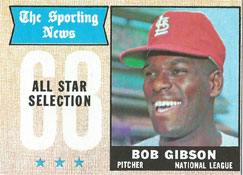
Using a combination of fastballs and sliders with control and confidence, Bob Gibson capped the most successful stretch of starts ever experienced by a Cardinals pitcher.

bob_gibson15On Aug. 19, 1968, Gibson got his 15th consecutive win, pitching a two-hitter in the Cardinals’ 2-0 victory over the Phillies at Philadelphia.

During the 15-game winning streak, from June 2 through Aug. 19, Gibson made 16 starts, with one no-decision. Ten of the 15 wins were shutouts. His ERA in that 16-start stretch was 0.68 in 146 innings, with 124 strikeouts. He pitched nine innings or more 16 games in a row.

“I haven’t seen anybody that good during the time I’ve been in the majors,” Cardinals outfielder Roger Maris said to The Sporting News.

Looking back on Gibson’s 1968 season, Cardinals catcher Tim McCarver told Cardinals Yearbook in 2018, “It got to a point where I could sense the helplessness when hitters came to bat … There were many times when I could feel a hitter’s legs buckle as one of Bob’s vicious sliders whizzed across the plate.”

Slip sliding away

Using only fastballs and sliders against the Phillies for his 15th win in a row, Gibson struck out 11, including Dick Allen four times and Bill White three times.

“He had great control of his slider,” McCarver said to the Associated Press. “The last strike on Rich Allen in the ninth broke a foot.”

Gibson credited the development of his slider with making him a dominant pitcher.

“My slider was nasty,” Gibson said in a conversation for the book “Sixty Feet, Six Inches.” “They could look for it and couldn’t hit it.

“Actually, I had two sliders … My main slider was my hardest one, and it would just break abruptly and mostly downward. And I had one where I’d twist my wrist a little more and give it a bigger break. That one didn’t have the speed or suddenness of the first one … but if I got it where I was supposed to get it, a right-handed batter wasn’t going to do anything with it.”

In his bid for the 15th consecutive win, Gibson held the Phillies hitless for five innings. In the sixth, with one out, pitcher John Boozer singled to center.

The Phillies’ only other hit came in the eighth when Johnny Callison, batting for Boozer, singled to right with two outs. Boxscore

Confidence equals control

The 15th consecutive win gave Gibson a season record of 18-5 with a 0.99 ERA in 234.2 innings. The shutout, his 10th, tied the Cardinals’ single-season record established by Mort Cooper in 1944.

“Of all the reasons behind his brilliance, I start with his command,” McCarver told Cardinals Yearbook. “Gibson threw hard and featured the best slider I’ve ever caught by a right-hander. His pitches exploded with movement a few feet from the plate. What made them even more effective was his ability to throw them where he wanted. He could consistently hit a target no wider than two baseballs.”

In discussing his slider with Cardinals Yearbook writer Stan McNeal, Gibson said, “I had pinpoint control in 1968 … If I wanted to throw it outside, I’d start it in the middle of the plate and I knew it was going to be outside … That was an unbelievable feeling. It really was. Hitters were at a disadvantage because I knew where the ball was going and I could throw it there in any count. Most pitchers would get to a 3-and-2 count and throw a fastball because they could control it, but I’d throw a slider because I could control it as well as the fastball. Sometimes it would break out of the strike zone, but they’d swing anyway.”

Gibson’s consecutive win streak ended in his next start, Aug. 24, at home against the Pirates. The Cardinals led, 4-0, after six. Willie Stargell hit a three-run home run off Gibson in the seventh. The Pirates scored a run in the eighth and two more in the ninth to win, 6-4, overcoming a 15-strikeout performance by Gibson. Three of the Pirates’ six runs were unearned. Boxscore

Gibson finished the 1968 season with a 22-9 record, and 1.12 ERA, pitching 13 shutouts and 28 complete games. In Game 1 of the 1968 World Series, he struck out 17 Tigers batters.

In a 2018 interview with Joe Schuster of Cardinals Yearbook, Willie Horton recalled how he became the 17th strikeout victim: “On the last pitch, he had me set up for a slider, so I was looking for a ball off the edge of the plate, maybe even six inches outside. I set up for a pitch out there, so if it broke I would have hit it, but it just stayed in on me and I couldn’t do anything with it. I learned later he had a backdoor slider. I can’t think of another right-handed pitcher who would try to throw a backdoor slider, because you can make so many mistakes with it. He had one _ and that shows how great he was.”

On Oct. 28, 1968, Gibson was named unanimous winner of the National League Cy Young Award. Two weeks later, on Nov. 13, he was named recipient of the NL Most Valuable Player Award.

In the book “Late Innings,” Gibson told author Roger Angell, “I was never that good again … I’d like to think I’d really perfected my pitching to that point.”

Read Full Post »

Playing in lineups with the likes of Hank Aaron, Eddie Mathews, Roberto Clemente and Willie Stargell, shortstop Johnny Logan was a batter the Cardinals learned to respect.

johnny_loganIn 1957, when Logan was the starting shortstop for the World Series champion Braves, he reached base in seven consecutive plate appearances against the Cardinals over two games at St. Louis.

During a 13-year major-league career (1951-63), Logan batted .282 against the Cardinals and had 209 hits in 209 games versus them. He hit especially well at St. Louis, posting a .309 batting average there in 102 games while playing for the Braves and Pirates.

On May 10, 1957, Logan, batting sixth, went 4-for-4 with a walk and five RBI in the Braves’ 10-5 victory over the Cardinals. In his first two at-bats, Logan produced a two-run double and a RBI-single against starter Sam Jones.

In the fifth, Logan drew a walk from Lloyd Merritt. Logan followed that with a solo home run off Hoyt Wilhelm in the seventh and finished with a RBI-single off Jim Davis in the ninth. Boxscore

The next day, May 11, Logan, in his first two at-bats, had a RBI-double and a single off starter Lindy McDaniel. Logan had reached base in each of his first seven plate appearances of the series.

In the sixth, Willard Schmidt got Logan on a fly out. Logan doubled off Schmidt in the eighth _ his eighth time on base in nine plate appearances since the series began. Boxscore

A month later, the Braves acquired second baseman Red Schoendienst from the Giants. The former Cardinal paired with Logan to form an effective keystone combination.

“The first thing I did when we got Red was give (general manager) John Quinn a big kiss,” Logan told The Milwaukee Journal. “We had the best pitching in the league and a lot of power, but we (had) needed a second baseman.”

Logan remained the Braves’ starting shortstop through 1960 until he was replaced by Roy McMillan. In June 1961, the Braves traded Logan to the Pirates for outfielder Gino Cimoli.

Logan primarily was a utility player and pinch-hitter for Pittsburgh. One of his last big hits came against the Cardinals.

On July 16, 1962, Logan started at third base for the Pirates at Pittsburgh. In the sixth inning, with the Cardinals ahead, 2-1, the Pirates loaded the bases with two outs against starter Ray Sadecki.

Logan, homerless as a Pirate, stepped to the plate and delivered a grand slam, the last home run of his big-league career, leading Pittsburgh to a 5-2 victory. It also was Logan’s first extra-base hit of the season. Boxscore

“I’ve been saving this for a long time to show how much I appreciate the Pirates staying with me,” Logan said to The Sporting News. “I’m 35, all right, but I’m not over the hill yet.”

Previously: Hank Aaron and the home run that wasn’t vs. Cardinals

Read Full Post »

Cardinals manager Tony La Russa took a gamble that triggered one of the rarest plays in baseball.

rafael_furcal3On Aug. 10, 2003, the Braves faced the Cardinals in a Sunday night game at St. Louis before a national television audience on ESPN. In the fifth inning, with runners on first and second, no outs and pitcher Woody Williams batting, La Russa called for the hit-and-run. Williams lined the ball to shortstop Rafael Furcal, who turned an unassisted triple play.

Only 15 unassisted triple plays have been achieved in the major leagues. The Cardinals never have converted one. They twice have been the victims.

The Cardinals first hit into an unassisted triple play at Pittsburgh on May 7, 1925. The Cardinals had Jimmy Cooney on second base and Rogers Hornsby on first, with no outs in the ninth, when cleanup batter Jim Bottomley hit a liner to shortstop Glenn Wright, who caught the ball, “leaped on second base after the catch” to double up Cooney and tagged out Hornsby, who was racing toward second and couldn’t stop in time to elude Wright, The Sporting News reported. Boxscore

Furcal turned a similar play against the Cardinals.

With the score 1-1, Mike Matheny was on second and Orlando Palmeiro was on first, with no outs, when Williams came to bat against starter Horacio Ramirez.

Squaring to bunt, Williams saw two pitches, one a strike and the other a ball. Confident of Williams’ ability to handle the bat, La Russa removed the bunt sign and called for the hit-and-run. “More guts than brains,” La Russa told MLB.com. “I’ve been accused of that many times.”

As Ramirez unleashed his pitch, Matheny and Palmeiro took off running. Williams lined the ball on a path toward left-center field. “I thought it got through,” Ramirez told the Atlanta Journal-Constitution.

One-man show

Furcal leaped and snared the ball. With Matheny almost at third, Furcal could have flipped the ball to second baseman Marcus Giles, who was positioned to receive the toss at second base.

“When Giles asked me, ‘Give me the ball, give me the ball,’ I said, ‘No. I got a chance to make it myself.’ ” Furcal said to the St. Louis Post-Dispatch.

Said Giles: ” I could tell by the look in his eyes that he wasn’t giving it up. It was pretty cool.”

Furcal stepped on second to double up Matheny for the second out.

Palmeiro, steaming toward second, had crossed the bag, applied the brakes, turned and began to retreat. Furcal caught him easily and applied the tag, completing the 12th unassisted big-league triple play. Video

“And so, the worst thing that could have happened for the Cardinals, did happen,” ESPN broadcaster Jon Miller said in summarizing the play.

Good instincts

Miller’s broadcast partner, Hall of Fame second baseman Joe Morgan, praised an “excellent job by Furcal not to take off for second base” when Furcal saw Palmeiro break from first on the pitch. Furcal held his ground until Ramirez delivered his pitch and was positioned to field the line drive, Morgan told viewers.

“You could see it developing, just like that,” Braves manager Bobby Cox said to the Associated Press.

Said Furcal: “I thought the play had a real flow.” Boxscore

(Eight years later, the Cardinals acquired Furcal from the Dodgers and he was their starting shortstop when they won the 2011 World Series title. Three days after winning the title, La Russa retired. Matheny replaced him and opened the 2012 season with Furcal as his shortstop.)

It was the second unassisted triple play turned by the Braves. The other was achieved by shortstop Ernie Padgett on Oct. 6, 1923, in the season finale against the Phillies at Boston.

Since Furcal’s feat, there have been three unassisted triple plays in the major leagues. Those were turned by Rockies shortstop Troy Tulowitzki on April 29, 2007; Indians second baseman Asdrubal Cabrera on May 12, 2008; and Phillies second baseman Eric Bruntlett on Aug. 23, 2009. Complete list

Previously: Rafael Furcal cost Rick Ankiel Rookie of the Year Award

Read Full Post »

With the most important pitch of his big-league career, Frank Castillo tried to slip a fastball by Bernard Gilkey.

Wrong choice.

frank_castilloOne strike away from a no-hitter, Castillo’s high fastball was lined by Gilkey into right-center field. Sammy Sosa attemped a diving catch, but the ball landed about eight feet away from him and rolled to the wall for a triple.

In 13 major-league seasons, Castillo was 82-104 with a 4.56 ERA. His best game was the one-hitter against the Cardinals, a 7-0 Cubs victory on Sept. 25, 1995, at Chicago’s Wrigley Field. Castillo, a right-hander, struck out a career-high 13.

Throwing strikes

Facing a Cardinals club that ranked 27th in the major leagues in batting average at .248, Castillo was in command from the start.

“I knew right from the first pitch … that I could throw any pitch I wanted for a strike,” Castillo said to the Chicago Sun-Times.

Benefitting from a wide strike zone by home plate umpire Jerry Layne, Castillo walked two: Ray Lankford in the first and Tripp Cromer in the seventh.

With two outs in the ninth inning, Castillo appeared poised to complete the Cubs’ first no-hitter since Milt Pappas in 1972.

All that stood in Castillo’s way was Gilkey, the Cardinals’ left fielder and leadoff batter.

Cat and mouse

“Nobody was on my side,” Gilkey told the St. Louis Post-Dispatch. “I was up there all alone. It was a very intense situation, everybody in the stands yelling all kinds of stuff.”

After Gilkey fell behind in the count 0-and-2, Castillo threw a slider outside, followed by a low changeup, evening the count.

“I thought I threw a good pitch on the 1-and-2 changeup,” Castillo said. “I was hoping he would bite.”

Said Gilkey: “When he threw me the slider and then a changeup down, I felt like he was trying to lull me to sleep.”

Cubs catcher Scott Servais said he figured Gilkey would be looking for another slow pitch. “So, I thought, ‘OK, let’s try a fastball up and away,’ ” Servais said. “Frankie got it up fine, but it caught too much of the plate.”

Said Castillo to the Chicago Tribune: “It was one of those pitches that, as soon as I threw it, I wanted it back.”

Command and focus

Sosa had no real chance to catch the sinking liner.

“When I walked up to the plate, I had to lock in,” Gilkey said. “I had to use every ounce of energy, mentally and physically, to get that hit.”

Castillo retired the next batter, Cromer, on a fly out, preserving the shutout and earning his second complete game of the season. The Cardinals were shut out for the 19th time, most in the big leagues in 1995. Boxscore

“This definitely was the best command I’ve had all year and probably in my career,” Castillo said.

Said Cubs first baseman Mark Grace: “I’d have to say that’s the best (pitched) game I’ve played behind.”

Read Full Post »

George Scott tried to psyche out Bob Gibson before Game 7 of the 1967 World Series. Naturally, it didn’t work. Instead, Gibson struck out Scott for the final out to seal the championship for the Cardinals.

george_scottIn 1967, Scott, a first baseman, won the first of eight Gold Glove awards and batted .303 with 19 home runs and 82 RBI for the Red Sox.

In Game 1 of the World Series, Scott had a double, single and walk against Gibson. The Cardinals ace ran the count to three balls on only one batter, Scott in the ninth inning, before walking him on a 3-and-2 pitch. In Game 4, Scott singled off Gibson. The Cardinals won both games.

On Oct. 12, 1967, the morning of the decisive Game 7 at Boston, a headline in the Boston Herald Traveler newspaper blared, “We’ll KO Gibson in Five _ Scott.”

The article by George Sullivan led with this sentence: “George Scott poetically predicts Bob Gibson ‘won’t survive five’ in Thursday’s World Series Game 7.”

Brash words for a second-year big-leaguer.

Gibson and the Cardinals were neither impressed nor intimidated. Instead, they were angered, motivated.

In his book “Stranger to the Game,” Gibson said Scott gave “a poor imitation of Cassius Clay (as Muhammad Ali was known at the time).”

Said Cardinals reliever Joe Hoerner of Gibson’s reaction to Scott’s comments: “He responded … by taking it personally.”

Fifth-inning fireworks

Scott was wrong in his prediction that Gibson wouldn’t survive five, but the fifth inning did turn out to be memorable for both players.

Leading 2-0, the Cardinals scored twice in the fifth. Gibson slugged a solo home run off starter Jim Lonborg and Roger Maris produced a sacrifice fly.

Scott opened the bottom of the fifth with a triple off Gibson and scored Boston’s first run when second baseman Julian Javier, taking the relay from center fielder Curt Flood, made an errant throw trying to nail Scott at third.

That was one of the few Red Sox highlights. As he had in Games 1 and 4, Gibson dominated Game 7.

Sweet revenge

In the ninth, Scott came to bat with two outs. Gibson fanned him for his 10th strikeout of the game, securing a 7-2 Cardinals victory and their second championship in four years. Video

Gibson’s pitching line for Game 7: 9 innings, 3 hits, 2 runs, 3 walks, 10 strikeouts. Boxscore

In three wins in the 1967 World Series, Gibson struck out 26 in 27 innings.

Scott hit .231 (6-for-26) during the World Series. Against Gibson, he was 4-for-11 (.364) with a double, triple and two singles.

“There are pitchers in our league with his stuff, guys like (Dean) Chance and (Joel) Horlen and (Gary) Peters,” Scott said to The Sporting News about Gibson after Game 7. “But the thing that makes Gibson is that he’ll never give in. He’ll always challenge you. He’ll throw the ball across the plate with something on it and say, ‘There it is. See if you can hit it.’

“Other good pitchers will give you the ball when they get in trouble. But not him. He won’t give you anything. That’s what makes him a winner.”

Previously: Dick Williams couldn’t intimidate 1967 Cardinals

Read Full Post »

Ozzie Smith thought the Cardinals were being bullied and he needed to show them how to stand up for themselves. Will Clark thought Smith was behaving like a bully by attacking him from behind.

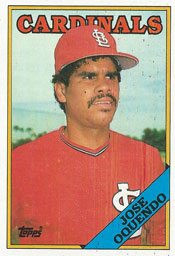
will_clark2Clark, Smith and Jose Oquendo were the principal figures in a memorable brawl during a Giants-Cardinals game at St. Louis.

On July 24, 1988, nine months after the Cardinals defeated the Giants in a seven-game National League Championship Series, the teams played a Sunday afternoon game at Busch Stadium.

In the eighth inning, Clark was on first base when Candy Maldonado hit a grounder to Smith at shortstop. Smith tossed the ball to Oquendo at second base in time to get the forceout on Clark. Attempting to prevent Oquendo from completing a double play, Clark slid over the bag and toward Oquendo.

Clark called it an aggressive, clean slide. Oquendo thought Clark could have avoided contact.

“In the old days, they played hard and aggressive and that’s the way I was brought up,” Clark said to the Associated Press.

Said Oquendo to the St. Louis Post-Dispatch: “I was just trying to get out of the way and I didn’t think that was a right slide. He slid late. I was ticked off.”

With Clark on the ground, Smith and Oquendo stood over the baserunner.  Oquendo either kicked or kneed Clark.

“When I slid, I hit the bag and bounced off to the side and I was laying against Oquendo’s leg,” Clark said. “He kneed me and said, ‘What are you doing, man?’ or something like that. There’s really no answer to that. I was trying to break up two.”

As Clark began to rise, Oquendo slapped him in the head. “I couldn’t understand what that was all about,” Clark said. “Then I just went off.”

Enraged, Clark got up and grabbed Oquendo.

Approaching from behind, Smith punched Clark in the head. “It was a cheap shot,” Clark said.

Said Cardinals manager Whitey Herzog: “Any shortstop and second baseman would do the same thing.”

Smith took several more punches, connecting with at least a couple, as Clark and Oquendo grappled.

Smith to Cards: Toughen up

”It’s become embarrassing,” Smith said to Mike Shannon of radio station KMOX. “You have a guy like Will Clark … He’s taking liberties. He’s coming down to second base at will, thinking nobody’s going to do anything, doing whatever he wants to do out there … As a competitor, it’s embarrassing for me.

”Sometimes you’ve got to stand up and be a man. That’s been part of our problem around here, guys not taking the initiative to tell people that, ‘Hey, I’m not going to be bullied.’

”I’ve never run from anybody,” Smith continued. “I’ve never been intimidated by anyone and I’m not going to start now. As a team, we have to learn that if that’s the way people want to play, that’s the way we have to play.”

Clark told reporters covering the Giants, ”I thought Ozzie Smith had a little more (class) than to sucker-punch somebody from behind. If you’re going to whup somebody, you might as well whup them face to face.”

A video of the incident showed players from both teams quickly rushed toward the combatants and piled onto one another. Maldonado took a swing at Smith. “That’s the fastest I’ve seen Maldonado run from first to second,” Giants manager Roger Craig said.

Clark and Oquendo were ejected. Asked why Smith wasn’t ejected, umpire Dutch Rennert said he hadn’t seen Smith land any punches.

“I saw Clark swing first at (Oquendo) and both were ejected for fighting,” Rennert said. “… I just saw one punch by Clark. I didn’t know Ozzie hit him. If I had seen Ozzie sucker-punch him, I would have thrown him out.”

Terry gets the message

After order was restored, Mike Aldrete came to bat against Scott Terry. The first pitch from Terry was high and wide. The second was high and inside, near Aldrete’s head. Home plate umpire Randy Marsh ejected Terry for the brushback pitch. Both benches emptied. Smith and Giants catcher Bob Brenly argued near third base, but no punches were thrown.

“By no means was I trying to hit Aldrete,” Terry said. “It was a purpose pitch. He knew it and I knew it.

“The only way the club can protect itself is on the mound. We felt like the Giants were doing things they shouldn’t be doing. We felt they had overstepped their bounds and we were not going to accept that.”

Rennert said Clark’s slide was within the rules. “(Clark) didn’t slide out of the baseline,” Rennert said. “He slid over the base. Straight and direct. A hard slide. Baseball can be a hard game.”

Said Clark: ” If I have the opportunity to do it again, I’m going to go in there the same way.” Boxscore

Previously: 1980s macho match: Whitey Herzog vs. Roger Craig

Read Full Post »

« Newer Posts - Older Posts »