Feeds:
Posts
Comments

Archive for the ‘Pitchers’ Category

(Updated April 17, 2022)

Four Cardinals pitchers have won a Gold Glove Award for fielding. Bobby Shantz, the first pitcher to earn a Gold Glove in each league, won two while with the Cardinals. Shantz was the first Cardinals pitcher to earn the award.
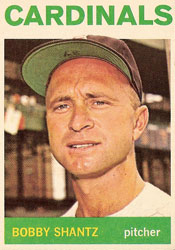
Shantz, who stood 5 feet 6 and weighed less than 140 pounds, was Jim Kaat’s favorite boyhood player. After Kaat reached the majors, he won the Gold Glove Award 16 times while with the Twins, White Sox and Phillies.

In his book “Still Pitching,” Kaat said as a boy he imitated the pitching motion of Shantz.

“If there was a game on the radio and Shantz was pitching, I would listen intently as the announcers described his delivery _ finishing square to the plate on the balls of his feet and taking a small hop toward home after delivering so as to be in perfect position to field a ball hit back to the mound,” Kaat recalled. “The next day, I would be outside … trying to finish in the same position as Bobby Shantz. Shantz was probably the greatest fielding pitcher of all time, quick as a cat and always on balance when he finished his delivery.”

The Gold Glove Award first was given in 1957. One Gold Glove was awarded at each of the nine positions in the major leagues that year. Shantz, then with the Yankees, won his first of eight in a row in 1957. The next year, a Gold Glove was given at each position in each league. Shantz earned four in the American League (with the Yankees) and one with the National League Pirates.

The Cardinals coveted Shantz for a long time and nearly traded Bob Gibson to the Senators for him in December 1960.

In 1962, Shantz, 36, began the season with the National League expansion Houston Colt .45s. On May 6, Houston traded him to the Cardinals for outfielder Carl Warwick and pitcher John Anderson.

Shantz bolstered the Cardinals’ bullpen and lived up to his reputation as a fielder. Reporting on a May 21, 1962, game in which Shantz earned his first St. Louis save, The Sporting News wrote, “After Bobby Shantz made a brilliant stab of a hot liner and flipped perfectly to third for a rally-stopping double play, manager Johnny Keane called the little guy the best-fielding pitcher in the league.”

“With Bob Gibson, I feel we have the two best-fielding pitchers in the league,” Keane said.

Shantz and Cardinals first baseman Bill White each won a Gold Glove in 1962. In those years, big-league players voted for the Gold Glove winners. Players could vote for anyone in their league except teammates. Shantz received 89 votes. Harvey Haddix of the Pirates was second at 70 and Gibson was third with 23. Shantz made one error in 22 chances for St. Louis that year and, including his errorless stint with Houston, had an overall .972 fielding percentage in 1962. Shantz also had a 5-3 record, four saves and a 2.18 ERA for St. Louis.

In 1963, Shantz was one of four Cardinals who earned Gold Glove honors. Joining White, third baseman Ken Boyer and outfielder Curt Flood, Shantz received votes from 113 players. Gibson placed second with 23 again. Shantz commited one error in 32 chances for the 1963 Cardinals. His record was 6-4 with 11 saves and a 2.61 ERA in 55 games.

Shantz became a largely forgotten part of one of the most famous trades in baseball history in 1964. Fielding flawlessly and sporting a 1-3 record with a 3.12 ERA in 16 games, Shantz was packaged with starter Ernie Broglio and outfielder Doug Clemens in the deal that brought outfielder Lou Brock and pitchers Jack Spring and Paul Toth to the Cardinals from the Cubs on June 15, 1964.

Two months later, the Cubs sent Shantz to the Phillies, who were in first place. With a significant boost from Brock, the Cardinals overtook the Phillies in September, won the pennant and beat the Yankees in the World Series.

Shantz won the last of his Gold Glove awards in 1964. He got 111 votes from the players. Gibson again was second, with 30. Shantz had one error in 35 fielding chances with the Cardinals, Cubs and Phillies that year.

The next year, Gibson won the first of his nine consecutive Gold Glove awards (1964-73) with the Cardinals. Since then, Cardinals pitchers to earn a Gold Glove are Joaquin Andujar (1984) and Adam Wainwright (2009 and 2013).
Read Full Post »

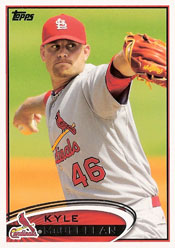
Kyle McClellan should be remembered as one of the key contributors in the Cardinals’ remarkable run to the World Series title in 2011.

Though he lacked the star power and big-game swagger of colleagues such as Chris Carpenter and Jason Motte, McClellan gave the 2011 Cardinals a significant early-season boost to their starting rotation and also contributed wins in relief down the stretch as St. Louis successfully made a frantic push to overtake the Braves for the National League wild-card spot.

The wear McClellan put on his right arm that year as he converted from reliever to starter in the spring and back to reliever in late July may have shortened his Cardinals career. Plagued by a damaged right shoulder, McClellan, 28, was sidelined for most of the 2012 season and was released by the Cardinals Nov. 13, 2012.

When starter Adam Wainwright suffered a season-ending arm injury at the start of spring training in 2011, McClellan moved into the rotation to replace him, even though McClellan had been used exclusively as a reliever since his rookie season of 2008.

Joining a rotation of Chris Carpenter, Jaime Garcia, Kyle Lohse and Jake Westbrook, McClellan’s selfless teamwork paid big early-season dividends for the Cardinals.

On April 11, 2011, McClellan earned his first win as a starter, limiting the Diamondbacks to a run in six innings and collecting his first two RBI in an 8-2 Cardinals triumph. “He did it all,” Cardinals manager Tony La Russa said to the St. Louis Post-Dispatch. Boxscore

McClellan won his first five decisions of 2011. On May 8, after he held the Brewers to a run and four hits in eight innings in a 3-1 Cardinals victory on Mother’s Day, McClellan had a 5-0 record and 3.30 ERA and St. Louis was in first place in the National League Central. McClellan’s mother and his wife, who was pregnant, attended the game. Afterward, Wainwright told St. Louis reporter Derrick Goold that McClellan’s record “is not surprising any of us.” Boxscore

Soon thereafter, McClellan fell into a funk. After earning a win on May 19, McClellan went more than two months before recording another. On July 25, in the last of his 17 starts for the 2011 Cardinals, McClellan held the Astros to a run in seven innings and got the win in the Cardinals’ 10-5 victory. “There’s been games where I’ve let the big inning kill me,” McClellan said to the Post-Dispatch. “Today, I felt like I was able to keep control of the game.” Boxscore

Two days later, the Cardinals acquired starting pitcher Edwin Jackson from the Blue Jays. McClellan quickly agreed to move to the bullpen to open a spot for Jackson in the rotation. La Russa told St. Louis reporter Rick Hummel that McClellan “showed a lot of character” in accepting the move. “He could have been bitter,” La Russa said.

Explained McClellan: “I felt like the time I was in the rotation, I did a good job. I don’t feel that I pitched my way out of a job.”

On Sept. 16, McClellan earned a big win in relief, pitching a scoreless 10th inning in the Cardinals’ 4-2 victory in 11 over the Phillies. McClellan retired Jimmy Rollins, Shane Victorino and Chase Utley in order, helping the Cardinals get within 3.5 games of the Braves in the wild-card chase. Boxscore

Joe Strauss of the Post-Dispatch wrote that the victory transformed the Cardinals’ postseason chances “from improbable to, dare it be said, believable.”

St. Louis did catch the Braves, swept through the National League postseason series and won the World Series championship in seven games.

The Cardinals couldn’t have qualified for the postseason without the contributions of McClellan. The right-hander was 12-7 overall _ 6-6 as a starter and 6-1 in relief _ in 43 apperances.

Previously: 2011: a year of titles, turnarounds, turmoil for Cardinals

Read Full Post »

Pascual Perez played a significant role in the 1982 Cardinals’ bid to win the National League pennant and reach the World Series.

Perez was the losing pitcher for the Braves against the Cardinals in Game 1 of the 1982 NL Championship Series and he pitched in long relief during Game 3 when St. Louis completed a sweep of the best-of-five playoff.
At the time, Perez, 25, was regarded as one of the most promising talents in the major leagues.

Perez was supposed to start Game 2 of the 1982 NL Championship Series. Braves knuckleball specialist Phil Niekro was matched against Joaquin Andujar in Game 1.

Niekro was protecting a 1-0 lead entering the bottom of the fifth inning during a light rain at St. Louis. After Niekro retired the leadoff batter and closed within two outs of completing the five innings needed to declare an official game, plate umpire Billy Williams halted play. More than two hours later, the game was postponed. Though most agreed the fifth inning likely could have been completed before the rain worsened, Braves manager Joe Torre supported the umpires’ decision, telling The Sporting News, “I don’t think a team should play 162 games and then lose a playoff game in five innings … We don’t want to come in here and steal a game.”

Niekro offered to pitch again in the rescheduled Game 1 on Oct. 7, but Torre instead chose Perez.

Traded by the Pirates to the Braves on June 30, 1982, Perez posted a 4-4 record in helping Atlanta win the NL West Division championship. He made unwanted headlines when he got lost on I-285 while driving to the Atlanta ballpark and missed a start.

Asked by the St. Louis Post-Dispatch how he could make certain Perez found his way to Busch Memorial Stadium for his postseason start against the Cardinals, Torre said, “We gave him a room at the hotel that faces the ballpark.”

For five innings in rescheduled Game 1, it appeared Torre had made the correct choice. Perez pitched effectively, but his counterpart, Bob Forsch, was better. The Cardinals led 1-0 entering the bottom of the sixth. Lonnie Smith started the inning by hitting a grounder to first baseman Chris Chambliss. Perez hustled off the mound to take the toss from Chambliss, but he fumbled the ball and Smith streaked across the bag, credited with an infield single.

“The ball was tailing away from me,” Perez said to the Atlanta Constitution. “I tried to catch it and tag Smith with the ball in the glove. He is a fast man.”

Singles by Keith Hernandez (on a good sinker) and George Hendrick (on a hanging slider) followed, the latter scoring Smith and knocking Perez from the game. The Cardinals scored five times in the inning and went on to a 7-0 victory behind Forsch’s three-hitter. During the regular season, Forsch had yielded 19 hits and 10 runs in 10.2 innings pitched against the Braves. Video

“We misplayed Smith’s groundball and they got a broken-bat hit (by Hendrick) and I think that just kind of set them off,” Braves catcher Bruce Benedict said to the Associated Press. Boxscore

The Cardinals rallied to win Game 2 in St. Louis (Niekro started, but closer Gene Garber took the loss) and headed to Atlanta for Game 3. The Cardinals struck for four runs off starter Rick Camp. Perez relieved in the second, pitched 3.2 innings (yielding a run and three hits) but couldn’t stop St. Louis from sweeping into the World Series with a 6-2 victory. Boxscore

In an 11-year big-league career, including stints with the Pirates, Braves and Expos, Perez posted a 7-6 record and 2.33 ERA in 16 regular-season starts versus St. Louis.

Previously: September hot streak carried 1982 Cardinals to title

Read Full Post »

Mort Cooper, usually outstanding for the 1942 Cardinals, uncharacteristically experienced double disappointments in two of his most high-profile starts that year.

Cooper earned 22 wins and pitched 10 shutouts for the Cardinals in 1942, but he also started and lost both the All-Star Game and Game 1 of the World Series.
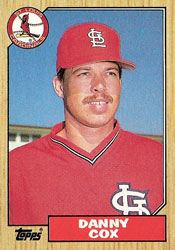
Cooper, 29, a right-hander, was 22-7 with a 1.78 ERA and 22 complete games for the 1942 Cardinals. During one stretch, he won nine consecutive decisions, including five by shutouts. Dodgers manager Leo Durocher chose Cooper to start the All-Star Game for the National League on July 6, 1942, at the Polo Grounds in New York.

Cooper and his brother, Cardinals catcher Walker Cooper, formed the first brother battery to start an All-Star Game.

The game was scheduled to start at 6:30 p.m. but was delayed more than 30 minutes because of storms. Mort Cooper, who had completed his warmups, told the United Press wire service the delay hurt him and he didn’t find his command until the third inning.

Lou Boudreau, the Indians shortstop and American League leadoff batter, drove Cooper’s second pitch of the game 260 feet into the upper deck in left for a home run. Boudreau said the home run provided “one of the biggest thrills I ever had in baseball.”

The next batter, Yankees right fielder Tommy Henrich, lined a 3-and-2 pitch. The ball landed in a pool of water in the outfield, enabling Henrich to stretch a single into a double.

After Cooper retired the American League’s two marquee players, left fielder Ted Williams of the Red Sox and center fielder Joe DiMaggio of the Yankees, Tigers first baseman Rudy York delivered a key blow. A right-handed batter, York swung late at a high fastball and “the result,” The Sporting News reported, “was something like a slice in golf.”

The ball carried toward the short right-field stands and stayed in fair territory as it landed over the fence for a two-run home run and a 3-0 American League lead. “On most any other big-league field,” The Sporting News reported, “the homer would have sliced foul.”

York swung so late at the 1-and-1 pitch “I thought I already had that one in my glove,” Walker Cooper said.

“I walloped it,” York said. “I thought at first it was going foul, but what a kick I got out of it when I saw the ball plump into the lower-right stands, well inside the foul line.”

Cooper pitched three innings, yielding four hits and three runs. The American League won, 3-1. Boxscore

Behind the pitching of Cooper and rookie Johnny Beazley (a 21-game winner), the 1942 Cardinals won 106 games and finished two ahead of the second-place Dodgers. Cooper was selected by manager Billy Southworth to start Game 1 of the World Series against the Yankees on Sept. 30 at St. Louis.

Cooper gave up five runs, 10 hits and three walks in 7.2 innings and took the loss in a 7-4 Yankees victory.

Batting fourth, DiMaggio singled and scored in the fourth, drove in a run in the fifth and singled and scored in the eighth, igniting a three-run inning versus Cooper. Boxscore

“I hadn’t pitched in a week and my control was off,” Cooper said to the Associated Press. “Pitched too high. They didn’t hit my fastball at all. It was my curve.”

Cooper started Game 4 at Yankee Stadium and surrendered five runs in 5.1 innings. Max Lanier got the win in relief in a 9-6 Cardinals triumph. Boxscore

Sporting News columnist Dan Daniel called Cooper an “emphatic flop,” who was “too tired to show at his best.”

It ended well, though, for Cooper and the Cardinals. St. Louis won the championship in five games. Cooper won the 1942 National League Most Valuable Player Award winner and he again topped 20 wins in both 1943 and 1944, helping the Cardinals to two more pennants.

Previously: How Mort Cooper pitched two straight 1-hitters for Cardinals

Read Full Post »

Mike Aldrete threatened to derail the Cardinals’ pennant push with a knockout smash off the foot of Danny Cox.

Cox was a starting pitcher for the 1987 Cardinals and Aldrete was a lethal hitter for the 1987 Giants.
Aldrete hit .438 (14-for-32) against the Cardinals during the 1987 regular season. His most damaging swing, however, produced a groundout that broke a bone in Cox’s right foot and sidelined him for a month.

Cox got even in the 1987 National League Championship Series. In a Game 7 pennant-clinching triumph, Cox held Aldrete hitless and shut out the Giants.

Riding a seven-game winning streak, the first-place Cardinals opened a series against the Giants at St. Louis on July 9, 1987.

In the seventh inning, Aldrete smacked a low liner and it struck Cox in the right foot. The ball caromed back to catcher Tony Pena, who threw out Aldrete at first base.

Cox remained in the game and completed eight innings before being relieved by Todd Worrell with the score tied 3-3. The Cardinals won, 7-6, scoring four in the 10th after the Giants had scored three in the top of the inning. Boxscore

The next day, it was discovered during an examination by team physician Dr. Stan London that Aldrete’s shot broke a bone in Cox’s foot. Cox, who had an 8-3 record, went on the disabled list and his foot was placed in a cast.

“I was throwing the ball real well and the team was playing real well,” Cox said to the Associated Press. “If anything good came out of it, at least we got (Aldrete) out.”

Aldrete, a Carmel, Calif., native and former standout for Stanford University, was enjoying a productive year for the Giants. He replaced injured right fielder Candy Maldonado in late June and put together an 11-game hitting streak before the all-star break. In his first 21 outfield starts after replacing Maldonado, Aldrete hit .341 with 15 RBI.

“I’ve tried to be a patient, disciplined hitter,” Aldrete said to The Sporting News. “You swing at strikes and let the balls go _ that’s the key to hitting.”

Nick Peters, a Bay Area baseball reporter, wrote of Aldrete, “He has a classic swing and the ability to foul off pitches until he finds something he likes. When he does, it usually becomes a rope.”

Cox returned to the Cardinals’ rotation Aug. 8, 1987. He finished the regular season with 31 starts, 199.1 innings pitched, an 11-9 record and a 3.88 ERA.

Aldrete posted a .325 batting average and a .396 on-base percentage in 126 regular-season games. He hit .419 with runners in scoring position.

As division champions, the Cardinals and Giants advanced to the National League Championship Series. They split six games, setting up a deciding Game 7 at St. Louis.

For the winner-take-all finale, Cox was named the Cardinals’ starting pitcher by manager Whitey Herzog. Aldrete was placed first in the Giants’ batting order by manager Roger Craig.

Cox set the tone early, retiring Aldrete on a groundout to second to begin the game.

In the third, with the Cardinals ahead 4-0, the first two Giants batters of the inning singled, bringing Aldrete to the plate. Cox got him to ground into a double play.

From there, Cox and the Cardinals were in control. Aldrete flied out to left, leading off the sixth, and he ended the eighth with a groundout to third. Cox pitched a shutout and the Cardinals won, 6-0. Boxscore

“He’s a good pitcher, no matter what the score is,” Aldrete said of Cox. “When he gets a lead, it makes him that much tougher.”

Previously: On 25th anniversary, top 10 facts about 1987 Cardinals

Read Full Post »

(Updated Sept.30, 2017)

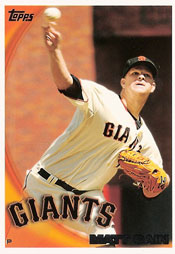
As a 20-year-old rookie, Matt Cain was put in the care of a 35-year-old veteran catcher, Mike Matheny.

With Matheny catching six of the right-hander’s seven starts for the 2005 Giants, Cain enjoyed a successful beginning to his major-league career.

Promoted to the Giants after posting a 10-5 record for Class AAA Fresno, Cain made his big-league debut on Aug. 29, 2005, against the Rockies at San Francisco.

With Matheny behind the plate, Cain, the youngest pitcher to start a game for the Giants since 20-year-old Mark Grant in 1984, limited the Rockies to two runs in five innings, but took the loss in a 2-1 Colorado victory. Matt Holliday, the Rockies’ cleanup batter, got two of the three Colorado hits against Cain _ a solo home run and a single. Boxscore

After the game, reporters approached Matheny for his assessment of the rookie.

“He has electric stuff, the kind of stuff you don’t see very often as far as velocity and late life,” Matheny said to the San Jose Mercury News. “His fluid motion makes him very deceptive.”

Matheny told the San Francisco Chronicle: “It’s just a shame we have such trouble scoring runs for these guys, especially after a first start like that, and he has to walk away with a loss. It’s a shame we couldn’t pull out a win for him.”

Working well with Matheny, Cain quickly achieved two milestones. He earned his first big-league win in his second start and recorded his first big-league complete game in his third start.

Cain held the Diamondbacks to a run on three hits through seven innings and got the win in the Giants’ 3-2 victory at Phoenix on Sept. 4. Boxscore

Five days later, Cain went the distance in earning the win in the Giants’ 2-1 victory over the Cubs at San Francisco. He gave up two hits and struck out eight. Boxscore

Cain earned 104 regular-season wins in 13 years (2005-17) with the Giants.

Against the Cardinals in his career, Cain was 2-7 with a 6.42 ERA in the regular season and 1-1 with a 2.19 ERA in the postseason. Both postseason appearances against the Cardinals occurred in 2012 when Matheny was in his first year as St. Louis manager.

Cain made his final big-league appearance on Sept. 30, 2017.

Previously: Pitcher for 1964 Cardinals was mentor to Mike Matheny

Read Full Post »

« Newer Posts - Older Posts »